Sovereignty in International Relations is the principle that gives states legal authority over their territory, population, political institutions, and domestic affairs while recognizing their formal independence from other states. It is one of the foundations of the modern international system, but sovereignty does not mean that a state can act without legal or political constraints.
The contemporary meaning of sovereignty has developed through centuries of state formation, decolonization, international treaties, customary international law, and the growth of institutions such as the United Nations. Today, states remain formally sovereign while simultaneously accepting obligations under international law, treaties, regional organizations, trade agreements, human-rights regimes, and security arrangements.
This creates an important tension: how can states remain sovereign while operating in an increasingly interconnected international system? The answer requires distinguishing territorial authority, political independence, legal equality, non-intervention, self-determination, and the obligations states voluntarily undertake. This article examines the meaning, history, legal foundations, practical dimensions, contemporary challenges, and future of sovereignty in International Relations.


What Is Sovereignty in International Relations?
In International Relations, sovereignty refers to the supreme legal and political authority of a state within its territory and its independence from external authority.
It has two closely connected dimensions:
- Internal sovereignty: the state’s authority to govern its territory and population.
- External sovereignty: the state’s independence and legal equality in its relations with other states.
The modern international legal order is built around the idea of sovereign equality. Article 2(1) of the UN Charter states that the United Nations is based on the principle of the sovereign equality of its members. The same article establishes other principles closely connected with sovereignty, including peaceful dispute settlement and restrictions on the threat or use of force. (United Nations Legal Affairs)
Sovereignty therefore does not simply mean “doing whatever a government wants.” A sovereign state possesses rights, but it also accepts international obligations.
Internal Sovereignty
Internal sovereignty concerns authority within a state’s jurisdiction.
It includes the ability of a government to:
- make and enforce domestic laws;
- administer territory;
- maintain public institutions;
- regulate economic activity;
- control borders;
- provide security;
- establish political institutions; and
- exercise jurisdiction over people and property, subject to applicable international obligations.
This concept is particularly important because external actors generally cannot simply dictate a state’s domestic political, economic, or social system.
External Sovereignty
External sovereignty concerns independence in the international system.
A sovereign state is not legally subordinate to another state merely because that other state is wealthier, militarily stronger, or more influential. The principle of sovereign equality therefore creates a formal legal equality between states even though their material capabilities differ enormously.
The distinction between legal equality and actual power is fundamental to geopolitics. A small state may possess the same formal sovereign status as a major power while having considerably less military, economic, technological, or diplomatic influence.
How Did the Concept of Sovereignty Develop?
Sovereignty did not appear fully formed at a single historical moment. It developed gradually as political authority became increasingly associated with territorial states.
The concept is frequently linked in political theory to the European state system and the Peace of Westphalia of 1648. However, describing Westphalia as the single moment when modern sovereignty was “invented” is an oversimplification. The modern international legal understanding of sovereignty emerged through a much longer process involving state practice, diplomacy, treaties, colonialism, decolonization, and international institutions.
The United Nations itself describes sovereign equality as combining two older pillars of international law: sovereignty and equality. (Digital Library)
From Dynastic Rule to Territorial States
European political development gradually shifted from overlapping forms of authority toward more clearly defined territorial states.
This transformation strengthened ideas concerning:
- territorial jurisdiction;
- permanent populations;
- centralized political authority;
- diplomatic recognition;
- territorial boundaries; and
- independence from external rulers.
These developments eventually influenced the structure of modern international law.
Decolonization and the Expansion of Sovereignty
The twentieth century transformed the meaning of sovereignty further.
Following the Second World War, decolonization produced a large expansion in the number of independent states. Sovereignty became closely connected with self-determination, national independence, and opposition to colonial rule.
The UN General Assembly’s 1970 Friendly Relations Declaration reaffirmed sovereign equality, non-intervention, territorial integrity, political independence, and the principle of equal rights and self-determination of peoples. (United Nations Treaty Collection)
This means contemporary sovereignty cannot be understood only as government authority. It also exists within a legal framework recognizing peoples’ rights and the political independence of states.
What Are the Main Principles of State Sovereignty?
Several principles work together to define sovereignty in International Relations.
Sovereign Equality
All states are formally equal under international law regardless of:
- population;
- geographic size;
- GDP;
- military strength;
- technological capability; or
- diplomatic influence.
This does not mean all states have equal power. It means that international law does not ordinarily establish a hierarchy in which powerful states possess inherently greater sovereign status.
Territorial Integrity
Territorial integrity protects the territorial domain of states from unlawful external force.
Article 2(4) of the UN Charter requires states to refrain from the threat or use of force against the territorial integrity or political independence of another state, as well as from force inconsistent with the purposes of the UN. (United Nations)
Territorial integrity is therefore closely connected with sovereignty, borders, and national security.
Political Independence
Political independence means that a state has the right to determine its political system and governmental arrangements without coercive external interference, subject to international law.
The International Court of Justice addressed this principle in the Nicaragua v. United States case. The Court found violations involving non-intervention, use of force, and respect for Nicaragua’s sovereignty under the circumstances before it. (International Court of Justice)
Non-Intervention
Non-intervention protects matters that international law leaves within a state’s sovereign decision-making authority.
The ICJ explained in Nicaragua that prohibited intervention involves coercion concerning matters in which a state is permitted to decide freely, including political, economic, social, and cultural choices and foreign policy. (International Court of Justice)
Non-intervention, however, does not mean that states have no international obligations concerning their conduct. Nor does it prevent all forms of diplomatic engagement, criticism, negotiation, sanctions, or international cooperation. The legal character of a particular action depends on its circumstances and the applicable rules.
Sovereignty and International Law
One of the most important misconceptions about sovereignty is that it places states completely outside international law.
In reality, sovereignty and international law operate together.
The UN Charter requires members to fulfill their Charter obligations in good faith, settle disputes peacefully, and respect restrictions on the use of force. (United Nations Legal Affairs)
The result is a basic principle of the contemporary international system:
States are sovereign, but sovereign states operate within an international legal order.
Treaties provide an especially clear example. When a state voluntarily becomes party to an international agreement, it assumes legal obligations. Sovereignty therefore includes the capacity to make international commitments.
Sovereignty and the Use of Force
The relationship between sovereignty and force is particularly important.
International law generally prohibits the threat or use of force against another state’s territorial integrity or political independence, subject to the Charter’s recognized framework, including Security Council enforcement powers and the law governing self-defence. (United Nations)
This is why military intervention cannot be assessed solely by asking whether a state claims a political justification. The legality of force depends on the applicable rules of international law and the factual circumstances.
Sovereignty, Self-Determination and Territorial Integrity
Sovereignty becomes particularly complicated when a population seeks independence or when territorial boundaries are disputed.
There are two important principles that can come into tension:
- territorial integrity of states, and
- self-determination of peoples.
International law does not provide a simple formula that automatically resolves every political dispute involving these concepts.
The ICJ’s 2019 Chagos Archipelago Advisory Opinion illustrates the importance of self-determination in the specific context of decolonization. The Court concluded that the decolonization of Mauritius had not been lawfully completed in accordance with the right of peoples to self-determination. (International Court of Justice)
The Kosovo Advisory Opinion likewise demonstrates why territorial integrity and declarations of independence require careful legal analysis rather than broad assumptions. The ICJ examined the specific question presented to it and emphasized the particular legal context surrounding territorial integrity and declarations of independence. (International Court of Justice)
The broader lesson is that sovereignty, territorial integrity, and self-determination are related but not interchangeable concepts.
Sovereignty in Maritime Affairs
Sovereignty is not limited to land territory.
The UN Convention on the Law of the Sea provides a detailed legal framework for maritime jurisdiction. Under Article 2 of UNCLOS, coastal-state sovereignty extends to the territorial sea, its airspace, seabed, and subsoil, subject to the Convention and other international-law rules. A state’s territorial sea may extend up to 12 nautical miles from its baselines. (United Nations)
This illustrates an important feature of contemporary sovereignty: jurisdiction can exist together with internationally defined limitations and rights of other states.
Maritime sovereignty therefore interacts with:
- freedom of navigation;
- innocent passage;
- exclusive economic zones;
- continental shelves;
- marine resources;
- maritime boundaries; and
- environmental obligations.
For geopolitical analysis, this is why apparently small maritime spaces can have major strategic and economic significance.
Sovereignty and International Organizations
International organizations do not simply eliminate state sovereignty. Their relationship with sovereignty is more complicated.
States create international organizations through treaties and other legal instruments. Membership can involve accepting institutional procedures and obligations.
The United Nations provides the clearest global example. States retain sovereignty while participating in a system designed to regulate international peace, security, cooperation, and law.
The European Union and Shared Sovereignty
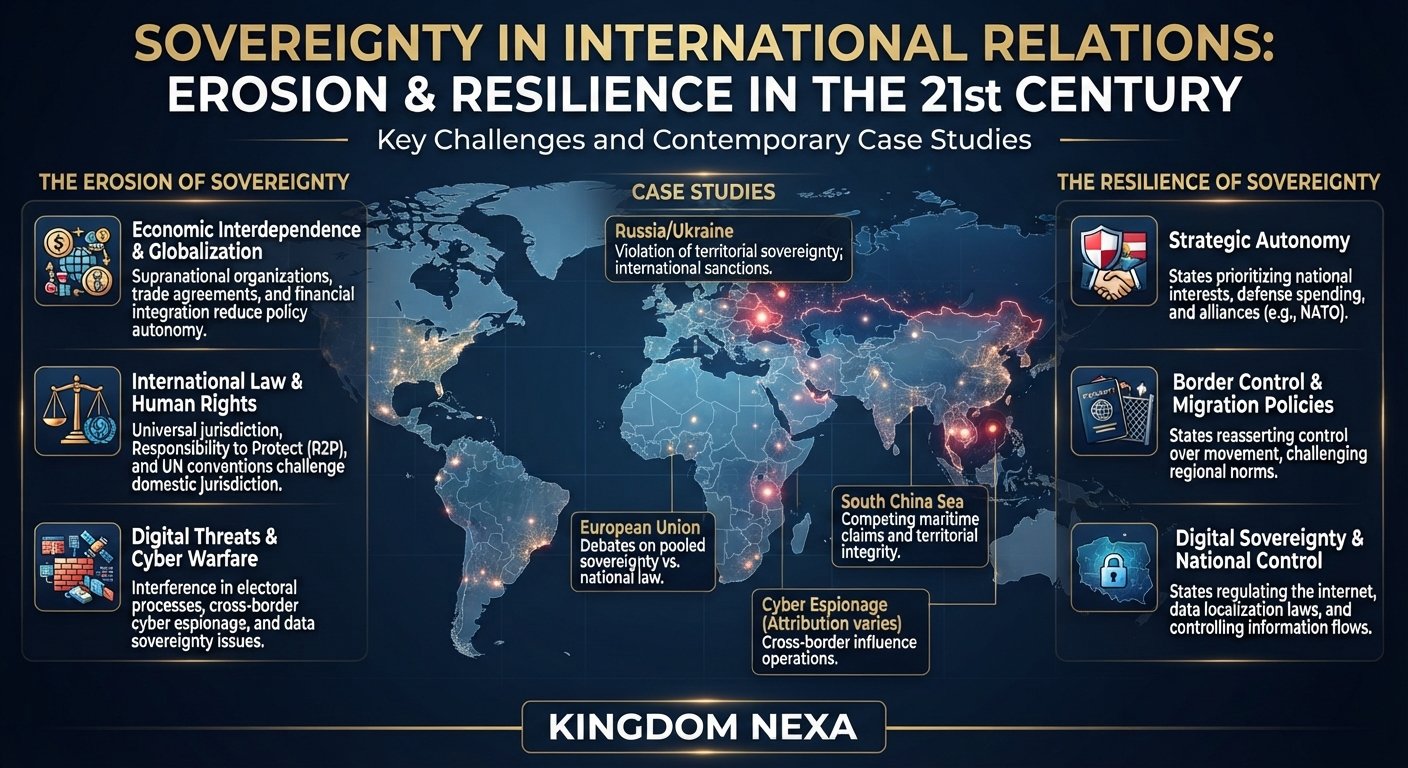
The European Union provides an especially important example of how states can pool elements of decision-making authority.
EU member states remain independent sovereign states, while EU treaties confer specific areas of authority on European institutions. The European Commission explains that the EU can act only in areas where member states have authorized it to do so through the treaties. (European Commission)
EU institutional materials describe this arrangement as the pooling of some sovereignty through shared institutions. (Publications Office of the EU)
This is sometimes described as pooled sovereignty or shared sovereignty, although the precise legal terminology depends on the context.
The EU demonstrates that sovereignty does not necessarily disappear when states cooperate deeply. Instead, states can voluntarily organize the exercise of particular powers through common institutions.
Sovereignty and Globalization
Globalization has changed how sovereignty works without eliminating it.
Modern states are deeply connected through:
- international trade;
- financial markets;
- supply chains;
- migration;
- energy networks;
- telecommunications;
- digital platforms;
- climate systems;
- international investment; and
- multinational corporations.
A government may possess full legal authority over its territory while having limited practical ability to control developments originating outside its borders.
This distinction between legal sovereignty and effective capacity is increasingly important.
A state can be legally sovereign but economically dependent. It can be politically independent but technologically reliant on foreign suppliers. It can control its borders while remaining exposed to international financial pressures.
Consequently, geopolitical analysis increasingly asks not only whether a state possesses sovereignty, but how effectively it can exercise it.
Economic Sovereignty and Geopolitical Power
Economic sovereignty concerns a state’s ability to maintain meaningful control over economic policy and critical resources.
Issues include:
- dependence on imported energy;
- foreign currency exposure;
- external debt;
- food security;
- critical minerals;
- semiconductor supply chains;
- strategic infrastructure;
- foreign investment;
- sanctions vulnerability; and
- control over essential technologies.
Economic interdependence creates both benefits and vulnerabilities.
For example, a state may gain access to international markets while becoming dependent on external suppliers for strategically important goods. Similarly, international financial institutions and trade agreements can increase economic cooperation while also imposing rules that constrain certain domestic policy choices.
The key distinction is between formal sovereign authority and practical policy autonomy.
Sovereignty in the Digital Age
Technology has created new questions about sovereignty.
Cyber operations can cross borders almost instantaneously. Data may be stored in one country, processed in another, and accessed by users around the world. Artificial intelligence, cloud computing, satellite systems, and global digital platforms further complicate territorial jurisdiction.
Cyber sovereignty therefore raises questions such as:
- Which state’s law governs cross-border data?
- When does a cyber operation violate another state’s sovereignty?
- How should states respond to malicious cyber activity?
- Who controls critical digital infrastructure?
- How can governments protect national security without fragmenting the global internet?
The UN has developed an ongoing framework for discussing responsible state behaviour in cyberspace, including international security and applicable international-law principles. (Digital Library)
Digital technology consequently does not make territorial sovereignty irrelevant. Instead, it creates new arenas in which sovereignty must be interpreted and exercised.
Sovereignty and Human Rights
Another major debate concerns the relationship between state sovereignty and human rights.
Traditional sovereignty emphasizes domestic jurisdiction and non-intervention. Contemporary international law, however, also contains extensive obligations concerning human rights and humanitarian law.
The UN’s Responsibility to Protect (R2P) framework emerged from this debate. At the 2005 World Summit, states affirmed that each state has responsibility to protect its population from genocide, war crimes, ethnic cleansing, and crimes against humanity. They also recognized an international responsibility to use appropriate diplomatic, humanitarian, and other peaceful means, consistent with the UN Charter. (United Nations)
This does not establish an unrestricted international right to intervene militarily whenever serious human-rights violations occur. The UN framework specifically situates coercive action within the Charter system, including Security Council authority under Chapter VII. (United Nations)
Thus, contemporary sovereignty increasingly involves both rights and responsibilities.
Why Sovereignty Matters in Geopolitics
Sovereignty remains central to geopolitical competition because control over territory and political decision-making continues to determine access to strategic resources, infrastructure, population centers, trade routes, and military positions.
It matters in several ways.
Security
States seek to protect territorial borders, airspace, maritime zones, and critical infrastructure from external threats.
Diplomacy
Diplomatic recognition, treaties, alliances, and negotiations all operate around the legal existence and independence of states.
Economics
Governments use sovereign authority to regulate markets, taxation, natural resources, investment, trade, and strategic industries.
Military Strategy
Military power is closely connected to protecting territorial integrity and deterring violations of sovereignty.
National Identity
Sovereignty is also connected with national identity and political legitimacy. Governments frequently present the defense of sovereignty as a core national objective, although the meaning of sovereignty can be contested within societies.
Major Challenges to Sovereignty Today
Sovereignty remains a foundational principle, but its practical exercise faces several pressures.
Transnational Threats
Climate change, pandemics, terrorism, cybercrime, organized crime, and financial instability can cross borders rapidly.
No individual state can completely manage many of these problems alone.
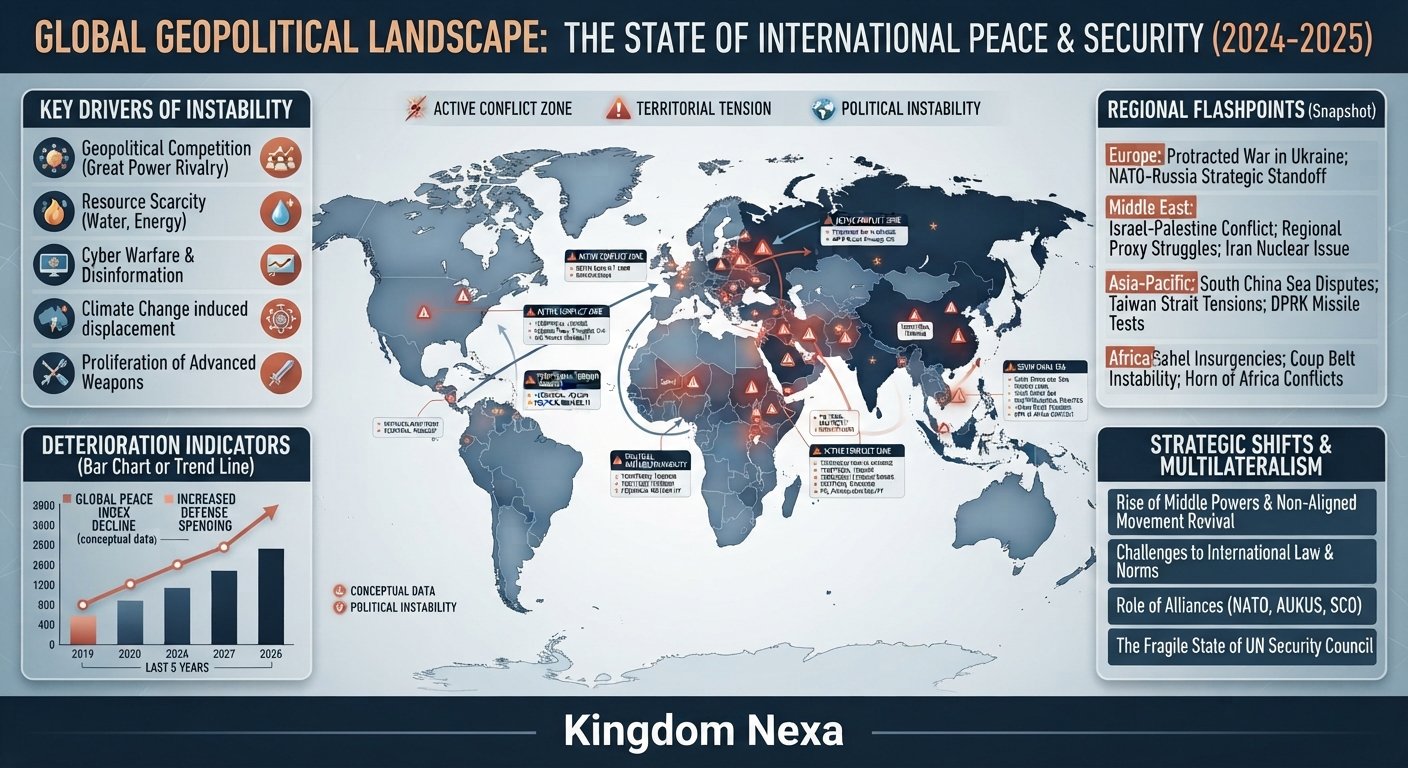
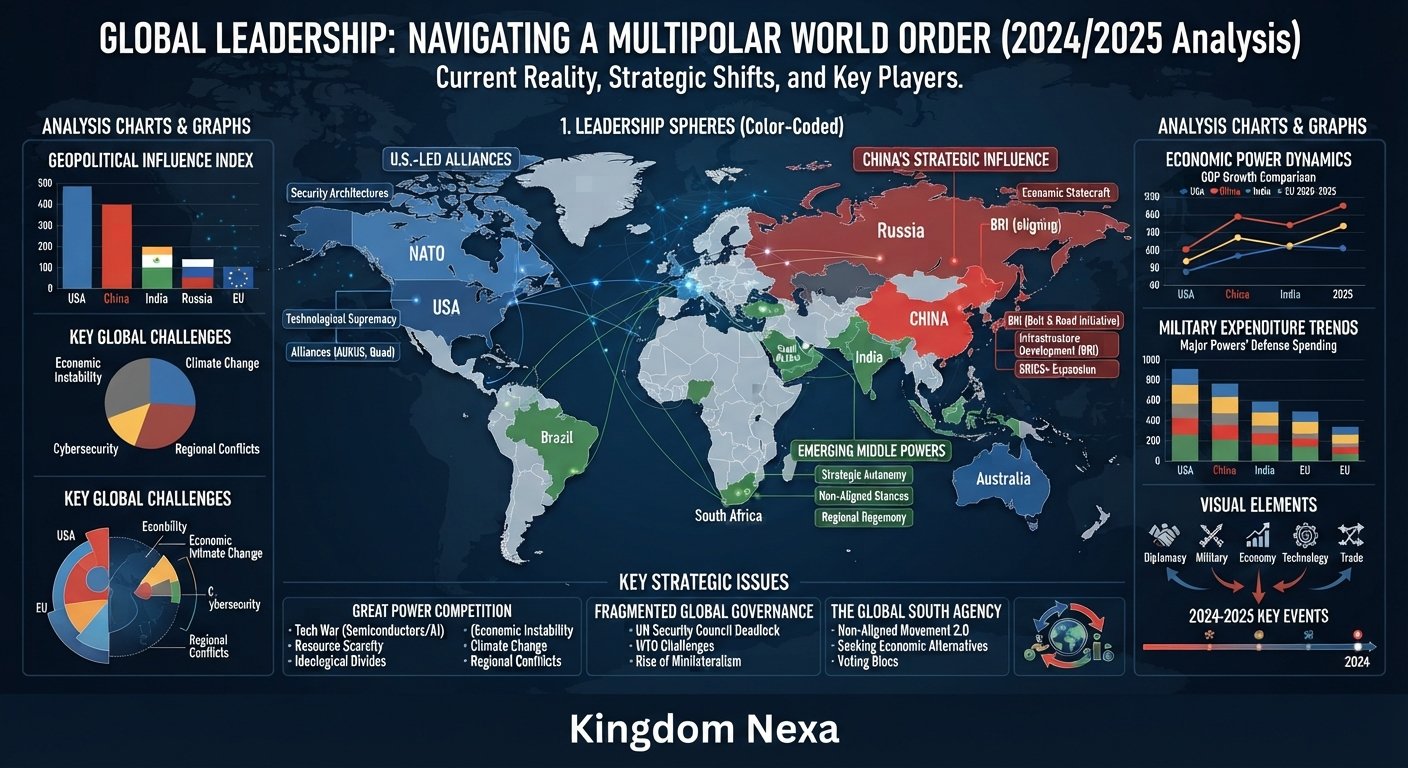
Great-Power Competition
Powerful states can exert influence through military alliances, economic relationships, sanctions, technology, investment, diplomacy, and information networks.
This can create a gap between formal sovereign equality and actual geopolitical influence.
Economic Interdependence
Deep global supply chains can restrict policy autonomy when states depend heavily on foreign energy, technology, capital, or markets.
Technological Dependence
Control over semiconductors, artificial intelligence, satellites, telecommunications infrastructure, and digital systems increasingly has strategic significance.
Territorial Disputes
Unresolved borders and competing claims continue to create difficult questions involving sovereignty, self-determination, security, and international law.
What Is the Future of Sovereignty?
The future of sovereignty is unlikely to involve either its complete disappearance or a simple return to an isolated state system.
A more plausible interpretation is that sovereignty will remain the basic legal organizing principle of international relations while its practical exercise becomes increasingly networked and interdependent.
Three developments are particularly important.
More Shared Decision-Making
States may continue transferring or coordinating specific powers through regional and international institutions when collective action provides advantages.
Greater Focus on Strategic Autonomy
At the same time, governments may seek greater control over critical technologies, energy, food, finance, defense production, and supply chains.
Expansion into New Domains
Sovereignty debates will increasingly involve cyberspace, outer space, artificial intelligence, digital infrastructure, data, biotechnology, and emerging technologies.
The precise balance will vary by country and region. International law will remain important, but geopolitical power, domestic politics, technological capacity, and economic resilience will also shape how sovereignty works in practice.
Frequently Asked Questions About Sovereignty in International Relations
1. What is sovereignty in International Relations?
Sovereignty is the authority and independence of a state to govern its territory and population while participating as a legally independent actor in the international system.
2. What are the two main types of sovereignty?
The two broad dimensions are internal sovereignty, concerning authority within the state, and external sovereignty, concerning independence from external authority.
3. Why is sovereignty important in International Relations?
Sovereignty establishes the legal foundation for state independence, territorial integrity, diplomatic relations, domestic jurisdiction, and sovereign equality.
4. Does sovereignty mean a state can do whatever it wants?
No. Sovereign states remain subject to international law and obligations arising from treaties, customary international law, and the UN Charter.
5. What is sovereign equality?
Sovereign equality means that states possess equal formal legal status even though their populations, economies, territories, military capabilities, and political influence may differ greatly.
6. How does sovereignty relate to territorial integrity?
Territorial integrity protects a state’s territory from unlawful external force and is closely connected to the UN Charter’s prohibition on the threat or use of force against another state’s territorial integrity or political independence. (United Nations)
7. What is the principle of non-intervention?
Non-intervention generally protects matters that international law leaves within a state’s sovereign decision-making authority. The ICJ has recognized non-intervention as a principle of customary international law. (International Court of Justice)
8. Can states share or pool sovereignty?
Yes. States can voluntarily coordinate or transfer specific decision-making powers through international and regional institutions. The European Union provides a prominent example of this model. (Publications Office of the EU)
9. What is the relationship between sovereignty and self-determination?
They are related but distinct principles. Sovereignty concerns state authority and independence, while self-determination concerns the right of peoples to determine their political status. Their interaction can become particularly complex in decolonization and territorial disputes. (International Court of Justice)
10. Is sovereignty still important in a globalized world?
Yes. Globalization has made states more interdependent, but sovereignty remains the central legal principle organizing the international state system. The main change is that states increasingly exercise sovereignty within dense networks of international obligations and economic, technological, and institutional interdependence.
Conclusion
Sovereignty in International Relations remains one of the fundamental concepts for understanding how the international system operates. It provides states with authority over their territory and domestic affairs while establishing their formal independence and legal equality in relations with other states.
Yet sovereignty in the twenty-first century is not absolute isolation. The UN Charter, international treaties, customary international law, maritime law, human-rights obligations, regional institutions, economic interdependence, and emerging technological challenges all shape how sovereign power can be exercised.
The central geopolitical reality is therefore a balance between independence and interdependence. States remain the principal sovereign actors, but they increasingly need international cooperation to manage challenges that cross borders. At the same time, governments continue to protect strategic autonomy in areas such as defense, technology, energy, finance, and critical infrastructure.
Understanding this interaction between legal authority, political power, international obligations, and practical capacity is essential for analyzing diplomacy, territorial disputes, global governance, great-power competition, and the evolving international order.