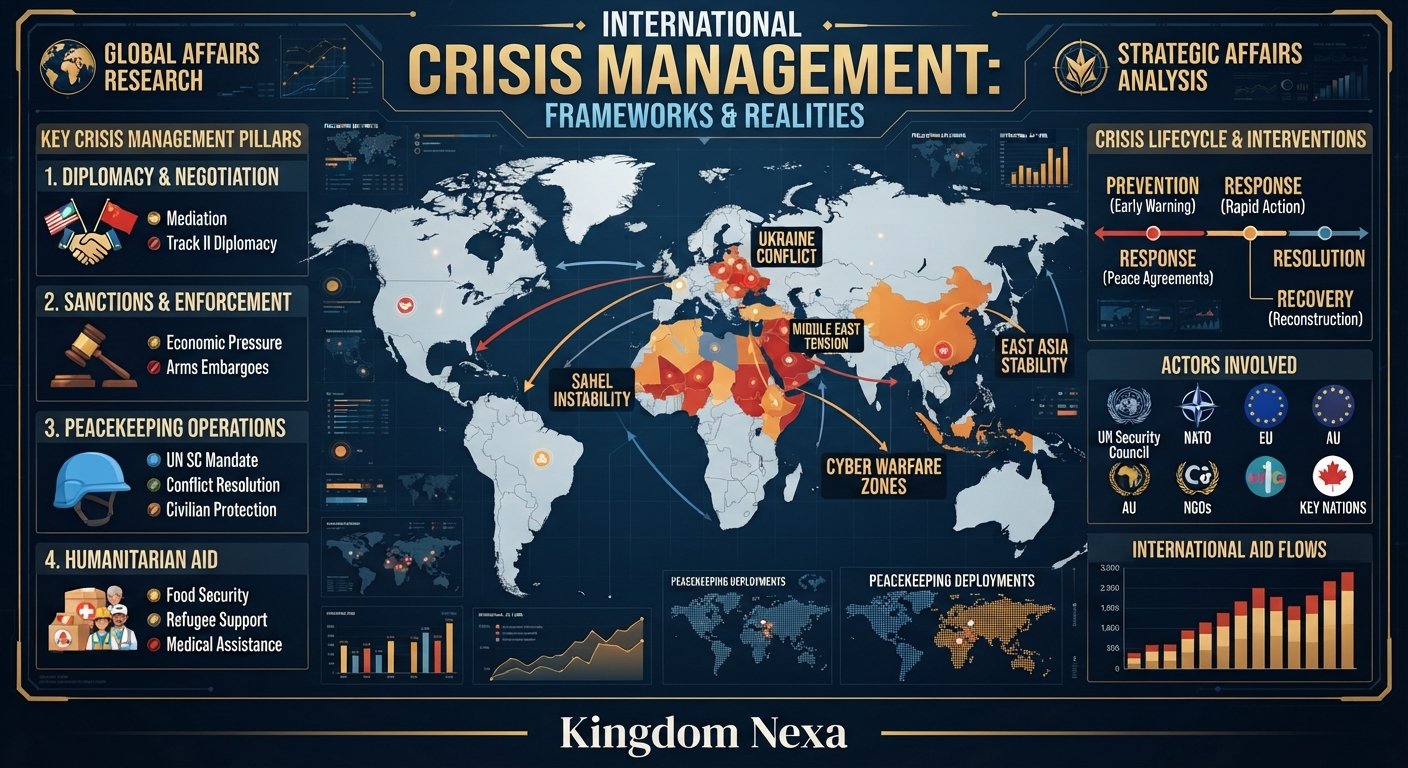
International crises rarely remain confined to the countries where they begin. An armed conflict can disrupt global trade, a regional disease outbreak can threaten international health security, and a cyberattack against critical infrastructure can create diplomatic tensions between governments. In an interconnected world, the speed and effectiveness of the international response can determine whether a crisis remains manageable or develops into a broader political, economic, or humanitarian emergency.
International Crisis Management is the coordinated process through which countries, international organizations, regional institutions, and other stakeholders prevent, contain, and respond to serious cross-border threats. It combines diplomacy, intelligence sharing, political negotiation, humanitarian assistance, economic measures, security cooperation, and strategic communication.
Its importance has grown as geopolitical competition, armed conflicts, technological vulnerabilities, climate-related disasters, and public health emergencies increasingly interact. Yet international cooperation is rarely straightforward. Governments may disagree over responsibility, legal authority, strategic interests, or the appropriate response, even when they face a shared threat.
This article examines the meaning, historical development, principal actors, diplomatic mechanisms, legal foundations, economic consequences, and emerging challenges of international crisis management. It also explores real-world examples, evaluates possible future scenarios, and explains how effective crisis response can reduce escalation while protecting human security and international stability.
What Is International Crisis Management?
International crisis management is the organized effort to prevent, contain, resolve, and recover from crises that threaten international peace, public safety, economic stability, or cooperation between states. It involves identifying emerging threats, assessing their consequences, coordinating decisions, mobilizing resources, and reducing the likelihood that an emergency will escalate.
Unlike domestic emergency management, which generally operates within one country’s legal and administrative system, international crisis management must coordinate actors with different political systems, national interests, capabilities, and legal obligations.
The Difference Between a Crisis, Conflict, and Emergency
These concepts overlap, but they are not identical.
- International crisis: A situation involving an urgent threat to important interests that requires immediate political or operational decisions. Examples include a military confrontation, a diplomatic breakdown, or a major cyber incident.
- International conflict: A sustained dispute or confrontation between states or other organized actors. It may involve armed violence, territorial claims, economic competition, or ideological differences.
- International emergency: An event requiring urgent action because it threatens lives, essential services, public health, or critical infrastructure across borders.
A crisis can emerge without armed conflict. For example, a sudden interruption of energy supplies may produce diplomatic pressure, economic disruption, and national security concerns even if no military confrontation occurs.
The Main Objectives of Crisis Management
Effective international crisis management seeks to achieve several connected objectives:
- Prevent escalation: Stop a local incident from developing into a wider confrontation.
- Protect human life: Reduce civilian casualties, displacement, disease transmission, and other humanitarian consequences.
- Maintain communication: Preserve diplomatic channels and establish reliable information-sharing arrangements.
- Coordinate international action: Align national governments, international institutions, and humanitarian organizations around practical priorities.
- Preserve stability: Limit economic disruption, regional insecurity, and damage to international institutions.
- Support recovery: Restore essential services, rebuild trust, and address the conditions that contributed to the crisis.
Success does not always mean eliminating the underlying dispute. Sometimes it means preventing violence, reducing immediate harm, and creating enough political space for a longer-term settlement.
Historical Development of International Crisis Management
The practice of managing international crises predates modern international organizations. However, the development of diplomatic institutions, international law, crisis communication systems, and multilateral cooperation has gradually expanded the available tools.
From Traditional Diplomacy to Collective Security
For centuries, rulers and governments managed international crises through diplomacy, military mobilization, alliances, bargaining, and negotiated settlements. These methods sometimes prevented wars, but the absence of reliable international institutions made outcomes highly dependent on the decisions of powerful states.
The two world wars exposed the consequences of failed diplomacy, escalating alliances, and inadequate mechanisms for collective security. The League of Nations represented an early effort to institutionalize international cooperation, although it could not prevent the Second World War.
The United Nations, established in 1945, created a broader framework for maintaining international peace and security. Its Charter calls on states to settle disputes peacefully and prohibits the threat or use of force against another state’s territorial integrity or political independence, subject to the Charter’s applicable exceptions.
The Cuban Missile Crisis: A Defining Case
October 1962
The Cuban Missile Crisis demonstrated how miscalculation, military readiness, secrecy, and uncertain intentions could bring nuclear-armed powers close to catastrophic conflict.
After the United States discovered Soviet nuclear missile installations in Cuba, President John F. Kennedy announced a naval quarantine on October 22, 1962. Washington and Moscow exchanged messages while military forces remained on high alert. On October 28, Soviet leader Nikita Khrushchev publicly agreed to dismantle and remove the missiles.
The resolution involved direct and indirect communication, private bargaining, strategic restraint, and concessions that were not all publicly acknowledged at the time. The crisis subsequently helped motivate the establishment of a direct Washington–Moscow communications link.
The lesson is not that every crisis can be resolved through private negotiation. Rather, reliable communication and room for compromise can help prevent leaders from interpreting every opposing move as preparation for war.
How International Crisis Management Has Evolved
| Period | Major development | Significance |
|---|---|---|
| 1919–1939 | League of Nations and collective security efforts | Early attempts to institutionalize peace |
| 1945 onward | United Nations system | Multilateral diplomacy and collective security mechanisms |
| Cold War | Nuclear deterrence and crisis communication | Greater emphasis on escalation control |
| 1990s onward | Expanded peacekeeping and humanitarian coordination | More attention to civilian protection and complex emergencies |
| 2000s onward | Global health, cyber, and counterterrorism cooperation | Broader understanding of cross-border threats |
| 2020s | Pandemic lessons, digital risks, and geopolitical fragmentation | Renewed focus on resilience, preparedness, and coordination |
This evolution reflects a fundamental change: international crises are no longer understood exclusively as military or diplomatic confrontations. They can also originate in public health systems, financial markets, digital networks, environmental disasters, and interconnected supply chains.
Who Are the Main Actors in International Crisis Management?
No single institution controls every international crisis. Responsibilities depend on the nature of the threat, the countries affected, the legal framework, and the political willingness of participating governments.
National Governments and Diplomatic Services
States remain the central actors because they control most national security institutions, armed forces, border agencies, public resources, and diplomatic services.
Foreign ministries negotiate settlements, communicate demands, coordinate with allies, and maintain contact with opposing governments. National security councils and intelligence agencies assess threats, while civilian emergency services and technical agencies implement operational responses.
Governments must also balance international responsibilities against domestic pressures. Leaders may face public demands for decisive action even when escalation could worsen the situation.
The United Nations and Its Security Council
The United Nations provides a forum for diplomatic engagement and international coordination. The Security Council has primary responsibility under the UN Charter for international peace and security and can address threats to peace through diplomatic initiatives, sanctions, and, where legally authorized, other measures.
The Secretary-General and UN envoys may support mediation, facilitate communication, or use diplomatic good offices. UN humanitarian agencies and coordination mechanisms also help organize assistance in complex emergencies.
However, the UN’s ability to respond is constrained by member-state cooperation, funding, operational access, and political disagreements among Security Council members. In particular, divisions among permanent members can prevent agreement on proposed action.
Regional Organizations and Alliances
Regional institutions can offer geographic knowledge, political legitimacy, and relationships that global organizations may lack.
- The European Union combines diplomatic engagement with economic instruments, sanctions, financial assistance, and civil protection cooperation.
- The African Union supports regional peace and security initiatives, mediation, and responses to constitutional or political crises.
- The Association of Southeast Asian Nations (ASEAN) provides regional diplomatic channels and mechanisms for dialogue.
- The North Atlantic Treaty Organization (NATO) focuses on collective defence, deterrence, consultation, and crisis response among its members.
Their effectiveness depends on institutional mandates, resources, political unity, and the willingness of members to act collectively.
Humanitarian Organizations, Businesses, and Civil Society
Organizations such as the International Committee of the Red Cross, humanitarian NGOs, and UN relief agencies can provide medical care, emergency supplies, protection, and assistance to displaced people.
Private companies also play important roles. Telecommunications firms maintain networks, shipping companies transport essential goods, energy operators protect infrastructure, and technology companies may help identify cyber threats or limit the spread of harmful information.
These actors can contribute expertise and resources, but they face different obligations and incentives. Effective coordination must respect humanitarian principles, protect sensitive information, and clarify who is responsible for decisions.
How Does International Crisis Management Work?
A successful response generally follows a sequence of connected stages. In practice, these stages overlap: diplomatic negotiations may continue while humanitarian operations begin, and new information can require earlier decisions to be reconsidered.
Early Warning and Risk Assessment
Crisis management begins before a situation reaches its most dangerous stage. Governments and international organizations monitor political tensions, military movements, economic indicators, disease outbreaks, cyber incidents, displacement, and environmental hazards.
Early warning systems are valuable only when information leads to action. Analysts must distinguish credible signals from rumours, political messaging, deliberate deception, and ordinary fluctuations.
Risk assessment should consider the probability of an event, the severity of its consequences, the speed at which it may develop, and the vulnerability of affected populations.
Strategic Decision-Making and Coordination
Once a threat is identified, decision-makers determine the objectives, acceptable risks, available resources, and appropriate response.
Clear leadership matters, but a single command structure is not always possible in international settings. Governments may retain sovereign authority over their own personnel and policies, while international organizations coordinate specific functions.
Practical coordination requires agreed responsibilities, secure communications, common operating information, and realistic expectations about what each participant can deliver.
Diplomatic De-escalation and Operational Response
Diplomacy can reduce tensions through direct negotiations, third-party mediation, confidence-building measures, temporary agreements, or arrangements to prevent accidental confrontation.
At the same time, authorities may need to deploy emergency medical teams, establish humanitarian corridors where feasible and lawful, protect critical infrastructure, evacuate civilians, or provide emergency financial assistance.
The appropriate combination depends on the crisis. A public health emergency requires scientific surveillance and medical coordination; an interstate military confrontation may demand immediate diplomatic engagement, military-to-military communication, and escalation controls.
Recovery, Accountability, and Lessons Learned
The end of the immediate emergency does not necessarily mean the crisis has been resolved.
Recovery may require rebuilding infrastructure, restoring trade, supporting displaced communities, investigating failures, addressing grievances, and negotiating longer-term political arrangements.
After-action reviews can identify what worked, where coordination failed, and which procedures need improvement. Without this learning process, institutions risk repeating the same mistakes during the next emergency.
Major Examples of International Crisis Management
Historical and contemporary cases show that crisis management depends on more than diplomatic statements. Institutional capacity, timely information, political trust, and practical cooperation all influence outcomes.
The COVID-19 Pandemic and Global Health Security
The COVID-19 pandemic demonstrated how quickly a health emergency can disrupt international travel, trade, employment, education, and public services. It also exposed differences in countries’ preparedness, access to medical supplies, public communication, and capacity to coordinate across borders.
The World Health Organization (WHO) played a central role in international health coordination, guidance, and information sharing. The International Health Regulations (2005), a legally binding framework for participating states, establish obligations concerning surveillance, notification, preparedness, and responses to public health risks with international implications. WHO also coordinates international response efforts within its mandate.
The experience highlighted several weaknesses: delayed information sharing, competition for medical supplies, unequal access to vaccines, inconsistent public messaging, and the difficulty of balancing public health restrictions with economic and civil liberties.
Key lesson: International health security requires strong domestic health systems, transparent reporting, scientific cooperation, and mechanisms that support equitable access to essential resources.
Armed Conflicts and Humanitarian Emergencies
Armed conflicts present particularly difficult crisis-management challenges because the parties may disagree over the causes of the conflict, territorial control, political legitimacy, or the terms of a settlement.
The international response can include ceasefire negotiations, mediation, sanctions, peacekeeping where authorized, humanitarian assistance, prisoner exchanges, monitoring arrangements, and support for displaced populations. Different instruments may operate simultaneously, but they do not necessarily share the same goals.
A ceasefire, for example, can reduce immediate violence without resolving the underlying dispute. Humanitarian assistance can save lives without changing the military balance. Sanctions may signal opposition to certain conduct, but their effectiveness depends on implementation, international participation, enforcement, and the behaviour of the targeted actors.
Key lesson: Humanitarian relief, conflict de-escalation, civilian protection, and political settlement are related but distinct objectives. Treating them as interchangeable can undermine both immediate relief and long-term peace.
Natural Disasters and Cross-Border Emergencies
Earthquakes, floods, wildfires, and extreme weather events can overwhelm national response capacity and create regional consequences. Disasters may disrupt electricity grids, transport networks, food supplies, water systems, and cross-border trade.
International cooperation can provide search-and-rescue teams, medical assistance, emergency logistics, satellite imagery, technical expertise, and financial support. Its effectiveness depends on whether aid reaches affected populations quickly and whether assistance is coordinated with local authorities.
The UN-backed Sendai Framework for Disaster Risk Reduction 2015–2030 emphasizes understanding disaster risk, strengthening governance, investing in resilience, and improving preparedness for effective response and recovery. Its approach underlines that disaster management begins before a disaster occurs.
Key lesson: Preparedness, resilient infrastructure, and clearly defined procedures can reduce the need for improvised international responses when a major disaster strikes.
The Geopolitical Interests Behind Crisis Management
International crisis management is not politically neutral in its operating environment. Even when countries recognize a shared danger, they may disagree over the causes, responsibilities, priorities, and appropriate response.
National Security and Strategic Competition
Governments evaluate crises through their own security interests, alliance commitments, regional influence, and assessments of adversaries. A military incident that one state considers defensive may be interpreted by another as preparation for aggression.
This creates a security dilemma: actions intended to increase one country’s security can make another feel less secure, encouraging countermeasures and increasing the risk of escalation.
Crisis managers can reduce this risk through military hotlines, prior notification of certain activities, incident-prevention arrangements, transparent communication, and verification mechanisms where parties accept them.
These measures do not eliminate strategic competition. They can, however, reduce the likelihood that uncertainty or misinterpretation turns competition into an uncontrolled confrontation.
Domestic Politics and Public Opinion
Foreign policy decisions are shaped by political institutions, public sentiment, national identity, economic conditions, and electoral incentives. Leaders may have limited room to compromise if concessions are portrayed domestically as weakness or betrayal.
Public communication therefore becomes part of crisis management. Governments must explain decisions accurately without releasing information that could compromise security or negotiations.
Excessively confident public claims can create problems if events later contradict them. Likewise, inflammatory rhetoric can raise political costs for leaders who might otherwise consider a negotiated settlement.
Economic Interdependence and Strategic Leverage
Trade, energy, finance, transport, and technology connect countries across political boundaries. These relationships can encourage cooperation because escalation carries economic costs for multiple parties.
Yet interdependence can also become a source of vulnerability. Governments may restrict exports, impose sanctions, freeze assets, or limit access to critical technologies in an attempt to influence another state’s behaviour.
The challenge is to assess whether economic measures advance a clearly defined objective, whether they are enforceable, and how their effects on civilians and third countries can be managed.
The Role of International Law and Institutions
International crisis management operates within a framework of international law, although the precise rules depend on the type of crisis.
The UN Charter and Peaceful Settlement
Article 2(3) of the UN Charter requires members to settle international disputes by peaceful means. Article 33 identifies negotiation, enquiry, mediation, conciliation, arbitration, judicial settlement, and regional arrangements among the available methods for resolving disputes that could endanger international peace and security.
The Charter also prohibits the threat or use of force against the territorial integrity or political independence of states, subject to relevant Charter provisions, including the right of self-defence under Article 51 and Security Council measures under Chapter VII.
These principles provide a legal foundation for managing interstate crises. They do not automatically settle every disagreement, and disputes can arise over how particular rules apply to specific circumstances.
International Humanitarian Law and Civilian Protection
When an international or non-international armed conflict exists, international humanitarian law governs important aspects of how hostilities are conducted and how protected persons must be treated.
The rules include protections for civilians, wounded and sick persons, detainees, and humanitarian personnel, alongside restrictions on methods and means of warfare. Parties must distinguish between civilians and combatants and between civilian objects and military objectives, and they must comply with applicable rules governing proportionality and precautions in attack.
Humanitarian access and the protection of medical services can become urgent crisis-management priorities. Political or military objectives do not remove applicable legal obligations.
International Health Regulations and Disaster Frameworks
Different types of crises require specialized legal and institutional arrangements. The International Health Regulations provide a framework for cross-border public health threats, while disaster risk reduction frameworks help governments improve preparedness and resilience.
These arrangements are most effective when national authorities maintain the necessary institutions, resources, and reporting systems. International rules cannot substitute for functioning local capacity, political cooperation, or implementation.
Economic and Technological Dimensions of Modern Crises
Today’s international emergencies can move rapidly through digital networks, financial systems, transport routes, and global supply chains. Effective crisis management therefore requires expertise beyond traditional diplomacy and defence.
Trade, Energy, and Financial Stability
A conflict or political confrontation can interrupt shipping, raise transport and insurance costs, reduce access to essential goods, and increase uncertainty in financial markets.
Energy-importing states may face higher prices or shortages when supplies are disrupted. Businesses can experience production delays if they depend on a limited number of suppliers or strategically important transport routes. Governments may respond with emergency financing, alternative sourcing, strategic reserves, or temporary trade measures.
Crisis planners should map critical dependencies before an emergency occurs. Diversified suppliers, contingency contracts, reserve capacity, and coordinated trade arrangements can improve resilience without requiring countries to eliminate international economic relationships.
Cybersecurity, Artificial Intelligence, and Information Integrity
Cyber incidents can affect hospitals, ports, financial institutions, power systems, government networks, and communications infrastructure. Attribution may be difficult because technical evidence does not always establish who ordered an operation or why it occurred.
Artificial intelligence can support threat detection, translation, logistics planning, and the analysis of large volumes of information. However, automated systems may produce inaccurate assessments, reproduce biased assumptions, or accelerate decisions before evidence has been adequately checked.
Disinformation creates a separate challenge. False reports during a military incident, disaster, or public health emergency can trigger panic, undermine trust, and complicate negotiations.
Effective responses require secure information-sharing systems, independent verification, human oversight, incident-reporting procedures, and clear public communication. Governments should distinguish confirmed evidence from preliminary assessments and openly acknowledge uncertainty when necessary.
Major Challenges in International Crisis Management
Even well-designed systems can fail when political incentives and operational realities work against cooperation.
Conflicting National Interests
Countries may agree that a crisis is dangerous but disagree about who is responsible, which party should make concessions, or whether intervention is justified. Rival powers may also use international institutions to advance their own strategic priorities.
Consensus becomes especially difficult when influential states perceive a proposed response as threatening their security or regional position.
Delayed Information and Coordination Failures
Poor intelligence, fragmented reporting, incompatible systems, and bureaucratic delays can prevent decision-makers from seeing the full picture. Conflicting statements from different agencies can undermine credibility and create confusion among partners.
A strong response requires established communication channels, agreed terminology, clear decision-making authority, and procedures for updating assessments as evidence changes.
Resource Inequality and Humanitarian Access
Not all countries possess comparable financial resources, emergency infrastructure, medical capacity, or logistical networks. Vulnerable states may face severe consequences even when the original crisis begins elsewhere.
Aid can also be restricted by insecurity, administrative barriers, sanctions-related complications, or political interference. Humanitarian organizations must navigate these constraints while prioritizing need and maintaining their independence.
Escalation, Miscalculation, and Loss of Trust
Threats, military deployments, cyber operations, sanctions, and retaliatory measures can create a cycle in which each side interprets the other’s response as justification for further escalation.
Trust may be limited, but crisis management does not require complete confidence between adversaries. It requires sufficiently reliable communication, credible commitments, and mechanisms to reduce the risks of misunderstanding.
The Future of International Crisis Management
The future of crisis management will depend on whether international institutions can adapt to interconnected threats while managing competition among major powers. Three broad scenarios illustrate possible directions. These are analytical possibilities, not predictions.
Scenario 1: Stronger International Cooperation
In this scenario, governments strengthen early-warning systems, expand diplomatic communication, share technical information, and invest in joint preparedness.
Regional organizations improve coordination, humanitarian financing becomes more predictable, and countries develop clearer procedures for responding to cyber incidents, public health threats, and natural disasters.
Such progress would not eliminate geopolitical rivalry. It would make cooperation more practical in areas where the cost of inaction is high.
Scenario 2: Fragmented Crisis Response
In a more fragmented system, rival powers increasingly rely on separate alliances, competing institutions, and selective information-sharing arrangements.
Responses may become faster within individual blocs but less coordinated internationally. Humanitarian assistance, sanctions, technological standards, and emergency financing could become more politicized.
This scenario would increase the risk of duplicated efforts, inconsistent messaging, and delayed responses to crises that cross geopolitical boundaries.
Scenario 3: Technology-Driven Crisis Management
A third scenario involves wider use of AI-supported forecasting, satellite monitoring, automated alerts, cyber defence, and real-time logistics.
These tools could improve situational awareness and accelerate the distribution of resources. However, unreliable data, opaque algorithms, cyber vulnerabilities, and automated misinterpretation could introduce new risks.
The most resilient approach would combine technological capability with human judgment, transparent procedures, independent verification, and accountable decision-making.
Best Practices for Effective International Crisis Management
Although every crisis has unique characteristics, several principles can improve the quality of international responses.
- Invest in prevention. Monitor emerging risks and address vulnerabilities before they develop into emergencies.
- Maintain diplomatic channels. Keep communication open even when political relations deteriorate.
- Establish clear responsibilities. Define who makes decisions, coordinates operations, provides resources, and communicates with the public.
- Share verified information. Distinguish confirmed facts from preliminary reports and unverified allegations.
- Coordinate across institutions. Align diplomatic, security, humanitarian, economic, and technical responses where their objectives overlap.
- Protect civilians and vulnerable populations. Make humanitarian needs and applicable legal obligations central to operational planning.
- Prepare for economic disruption. Identify critical dependencies and develop credible contingency arrangements.
- Evaluate performance. Review decisions, measure outcomes, and update procedures after each major incident.
For policymakers and diplomats, the central priority is to maintain options for de-escalation without weakening essential security arrangements. Researchers and journalists, it is to assess evidence carefully and distinguish official claims from independently verified information. For businesses, it is to identify geopolitical exposure, protect critical systems, and develop continuity plans.
Frequently Asked Questions (FAQs)
1. What is international crisis management?
International crisis management is the process of preventing, containing, responding to, and recovering from crises that threaten international peace, security, public health, economic stability, or humanitarian welfare. It involves coordination among governments, international organizations, regional institutions, and other relevant actors.
2. Why is international crisis management important?
It helps prevent local emergencies from escalating into wider conflicts, reduces harm to civilians, protects essential economic systems, and supports cooperation between countries. It is particularly important when threats cross borders faster than individual governments can respond independently.
3. What are the main stages of international crisis management?
The main stages are prevention and preparedness, early warning, risk assessment, coordinated decision-making, emergency response, de-escalation or stabilization, recovery, and post-crisis evaluation. These stages frequently overlap rather than following a strictly linear sequence.
4. What role does the United Nations play in international crisis management?
The United Nations supports diplomatic negotiations, mediation, international peace and security initiatives, humanitarian coordination, and cooperation on global challenges. Its Security Council can adopt measures within its Charter authority, but political disagreements among member states can constrain collective action.
5. What is the difference between crisis management and conflict resolution?
Crisis management focuses on controlling immediate risks, limiting escalation, and reducing harm. Conflict resolution seeks to address the underlying causes of a dispute and establish a more durable settlement. Crisis management can create the conditions needed for conflict resolution, but it does not guarantee it.
6. How does diplomacy help manage international crises?
Diplomacy creates channels for communication, clarifies demands, identifies possible compromises, and reduces the risk of miscalculation. Negotiations, mediation, confidence-building measures, and direct communication between opposing governments can help contain a crisis even when the underlying disagreement remains unresolved.
7. How do international organizations coordinate emergency responses?
International organizations operate through their mandates, established procedures, technical expertise, and partnerships with national authorities. Depending on the emergency, they may coordinate humanitarian relief, public health surveillance, peacekeeping, disaster assistance, or economic support. Their effectiveness depends on access, resources, and cooperation from relevant governments.
8. What are the biggest challenges in international crisis management?
Major challenges include conflicting national interests, delayed information, limited resources, weak institutional coordination, misinformation, political mistrust, and the risk of military escalation. Unequal national capabilities can also leave vulnerable populations without adequate assistance.
9. How is technology changing international crisis management?
AI-assisted analysis, satellite monitoring, secure communications, cybersecurity systems, and digital early-warning tools can improve detection, coordination, and resource allocation. However, these technologies also create risks involving misinformation, cyberattacks, biased assessments, and decisions based on unreliable data.
10. What is the future of international crisis management?
The future will likely combine more advanced monitoring and response technologies with continued reliance on diplomacy, international law, and political cooperation. Whether the system becomes more effective will depend on institutional adaptability, reliable information-sharing, adequate resources, and the willingness of governments to cooperate despite strategic differences.
Conclusion
International crisis management is a fundamental component of global security and international cooperation. From nuclear confrontations and armed conflicts to pandemics, cyber incidents, and natural disasters, crises test the ability of governments and international institutions to act quickly without making an already dangerous situation worse.
The historical record demonstrates that timely communication, diplomatic flexibility, credible information, effective coordination, and respect for applicable international law can help contain threats. Yet no institution can guarantee success when governments pursue incompatible objectives, withhold essential information, or reject opportunities for de-escalation.
The most effective approach combines prevention, preparedness, coordinated emergency action, humanitarian protection, and sustained recovery. It also recognizes that managing an immediate emergency is different from resolving the political, economic, or social conditions that caused it.
Ultimately, international crisis management is not simply about responding to emergencies; it is about building the capacity to prevent avoidable disasters, limit escalation, and preserve opportunities for peaceful cooperation. In an increasingly interconnected and geopolitically competitive world, that capacity remains essential to international stability and human security.