
Global Affairs encompasses the political, economic, diplomatic, security, technological, environmental, and social forces that influence relationships among countries and shape the international system. It is far more than diplomacy between governments. Today, global affairs also involves international trade, military alliances, energy security, artificial intelligence, climate change, cyber conflict, migration, sanctions, global institutions, and the competition for technological and economic influence.
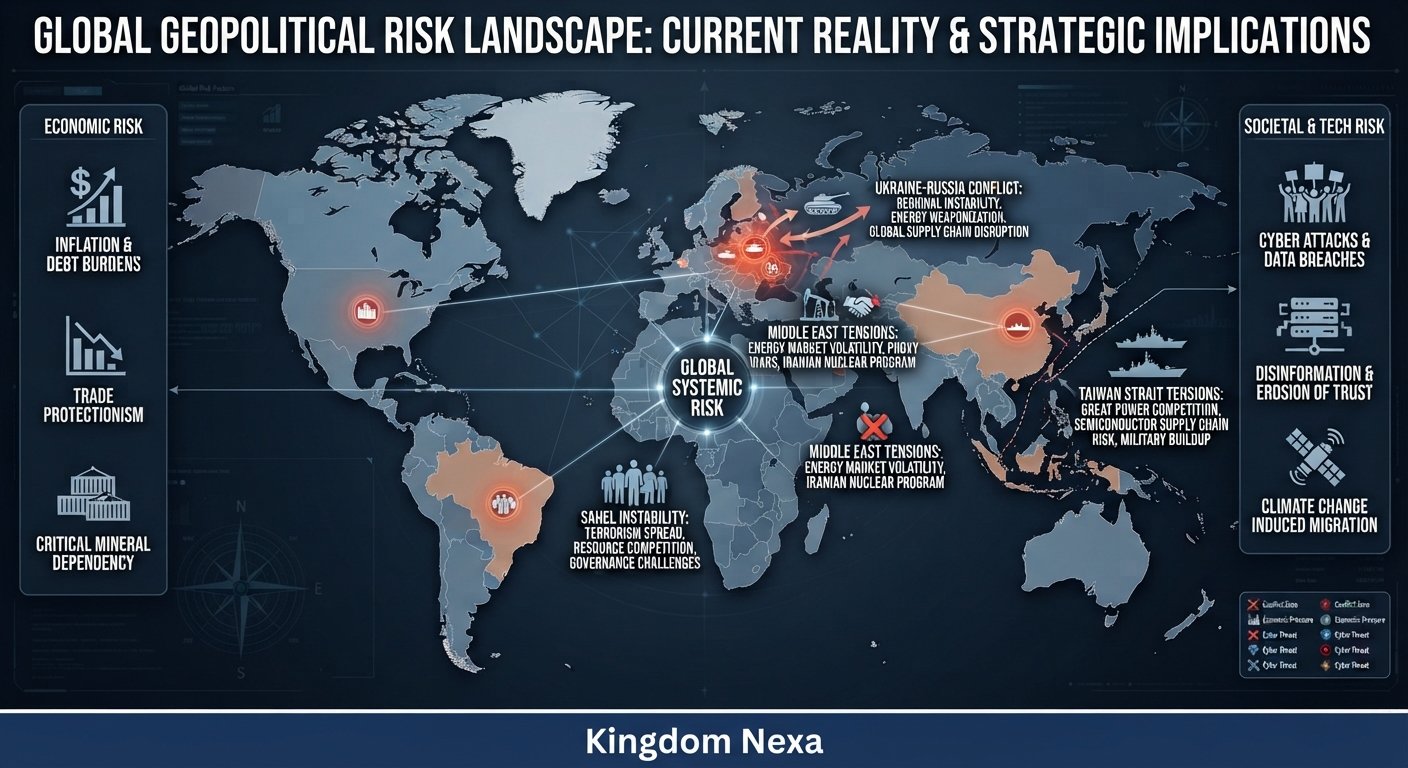
The international environment in 2026 is particularly complex. Geopolitical competition is increasingly intertwined with economic policy, technology, energy markets, and national security. The World Economic Forum’s Global Risks Report 2026 identifies geoeconomic confrontation as the leading risk for 2026, followed by state-based armed conflict. The report also found that 68% of respondents expect a multipolar or fragmented global order over the next decade. (World Economic Forum)
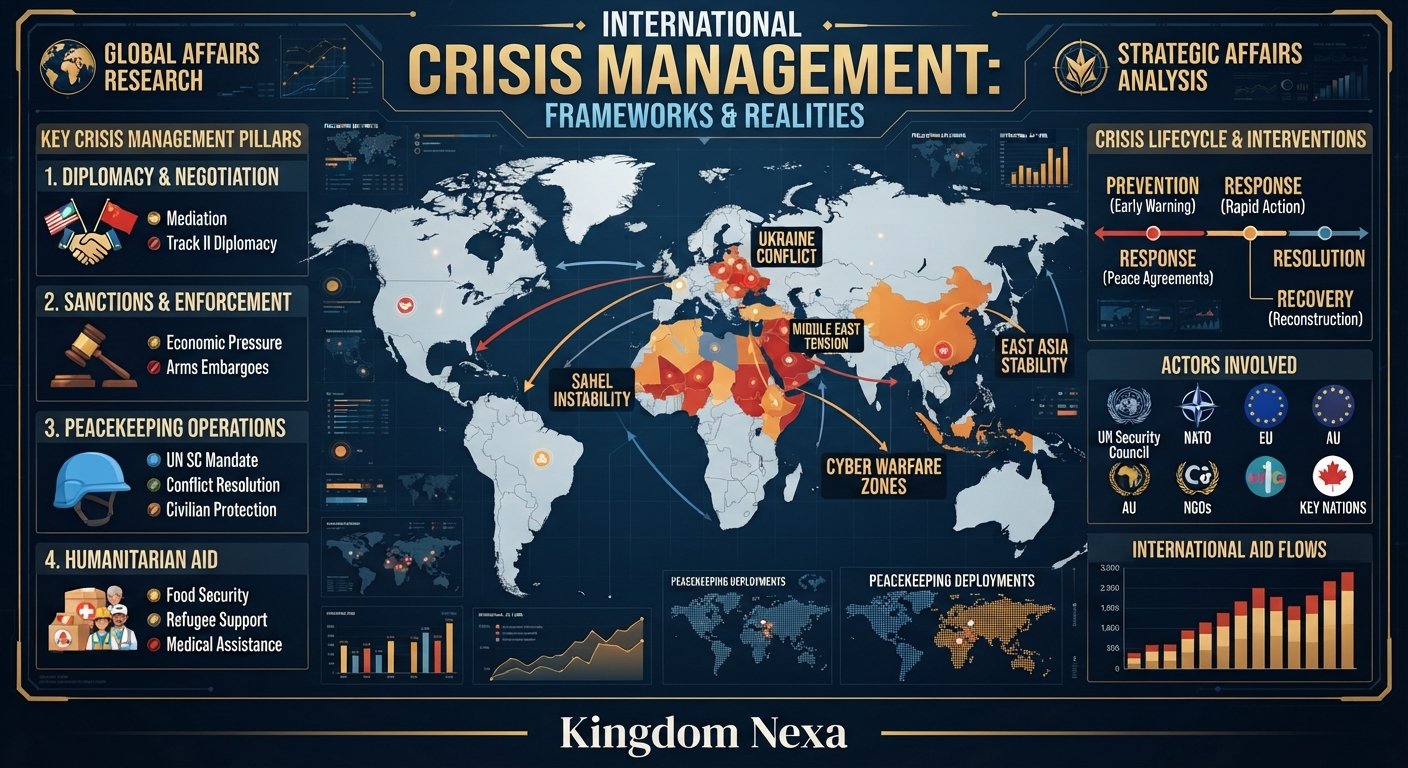
At the same time, international institutions remain essential for managing problems that no country can solve independently. The United Nations continues to emphasize multilateral cooperation, while major alliances such as NATO are adapting to a security environment shaped by strategic competition, hybrid threats, cyber capabilities, and military modernization. (United Nations)
Understanding global affairs therefore requires looking beyond individual headlines. It requires examining why countries make particular decisions, how power is distributed, how economic interests influence foreign policy, and how regional events can produce worldwide consequences.
What Is Global Affairs?
Global affairs refers to the study and analysis of interactions between countries, international organizations, multinational companies, non-state actors, and societies.
It includes several interconnected fields:
- International relations
- Geopolitics
- Foreign policy
- Diplomacy
- International security
- Global economics
- International trade
- Energy politics
- Climate diplomacy
- Human rights
- Migration
- International law
- Technology and artificial intelligence
- Cybersecurity
- Global development
- International organizations
The key characteristic of global affairs is interdependence.
A conflict in one region can affect energy prices elsewhere. A trade dispute between major economies can disrupt supply chains across several continents. A technological breakthrough can change military capabilities, economic competitiveness, and diplomatic influence simultaneously.
This interconnectedness makes modern global affairs both more complicated and more consequential.
Why Global Affairs Matters
Global affairs directly or indirectly affects almost every country and population.
1. It Shapes International Security
Military alliances, nuclear deterrence, territorial disputes, terrorism, civil wars, cyber operations, and hybrid warfare are central elements of international security.
The war in Ukraine, tensions in the Middle East, strategic competition in the Indo-Pacific, and concerns surrounding nuclear proliferation demonstrate how regional security issues can have international consequences.
NATO’s 2026 Ankara Summit, for example, reaffirmed collective defense under Article 5 while emphasizing strategic competition, hybrid threats, industrial resilience, and broader security challenges. (NATO)
2. It Influences the Global Economy
Political decisions increasingly affect trade, investment, energy prices, financial markets, and supply chains.
Tariffs, export controls, sanctions, investment restrictions, and technology controls can now function as instruments of geopolitical influence.
The International Monetary Fund’s July 2026 outlook projects global economic growth of 3.0% in 2026 and 3.4% in 2027, while warning that geopolitical escalation and renewed economic disruption remain important downside risks. (IMF)
3. It Affects Energy Security
Energy has always been connected to geopolitics.
Oil and gas-producing states can gain significant strategic influence because major economies depend on reliable energy supplies. Meanwhile, shipping routes and maritime chokepoints can become strategically important during periods of conflict.
The Middle East demonstrates this relationship particularly clearly. The IMF reported in 2026 that disruption around the Strait of Hormuz created significant uncertainty for commodity prices, inflation, and economies dependent on imported energy. (IMF)
4. It Shapes Technology Competition
Technology has become a major dimension of global power.
Artificial intelligence, semiconductors, quantum computing, telecommunications, satellites, cyber capabilities, and advanced manufacturing increasingly influence national security and economic competitiveness.
Countries therefore compete not only over territory and military capabilities but also over:
- AI infrastructure
- Semiconductor production
- Data
- Digital standards
- Critical minerals
- Telecommunications networks
- Cybersecurity capabilities
- Advanced research
Technology is consequently becoming part of both economic statecraft and strategic competition.
A Brief History of Global Affairs
Modern global affairs has been shaped by several major historical periods.
The Westphalian State System
The Peace of Westphalia of 1648 is commonly associated with the development of the modern concept of state sovereignty, although historians debate how accurately it represents the origins of the contemporary international system.
The basic idea became increasingly important: states possess authority over their territories and interact with other sovereign entities.
The Rise of European Powers
From the 17th through the 19th centuries, European powers expanded their political, military, commercial, and colonial influence across large parts of the world.
Imperial competition shaped international trade, borders, political institutions, and economic relationships.
The World Wars
The First and Second World Wars dramatically transformed global politics.
The devastation of the Second World War contributed to the creation of institutions intended to prevent another global conflict.
The United Nations Charter was signed in 1945, establishing a framework centered on international cooperation, sovereignty, peaceful dispute settlement, and collective security. (United Nations)
The Cold War
After 1945, global politics became heavily influenced by competition between the United States and Soviet Union.
The Cold War involved:
- Military alliances
- Nuclear deterrence
- Ideological competition
- Proxy conflicts
- Intelligence operations
- Space competition
- Economic rivalry
Although the United States and Soviet Union generally avoided direct large-scale war with each other, their rivalry shaped politics across Europe, Asia, Africa, Latin America, and the Middle East.
The Post-Cold War Era
The collapse of the Soviet Union in 1991 created a period often described as a unipolar moment, with the United States possessing unmatched global military and economic influence.
However, the international system gradually became more complicated as China expanded economically and strategically, Russia sought to restore influence, India increased its global role, and regional powers became more assertive.
Major Forces Shaping Global Affairs Today


1. The Shift Toward a Multipolar World
One of the most important developments in global affairs is the movement away from a simple single-center model of international power.
The United States remains a major military, economic, technological, and diplomatic power. China has become a central economic and strategic actor. Russia retains significant military and nuclear capabilities. India is expanding its economic and diplomatic influence, while the European Union, Gulf states, Japan, Türkiye, Brazil, Indonesia, and other regional powers increasingly pursue independent strategic interests.
The result is not necessarily a clean division into opposing blocs.
Instead, many countries practice multi-alignment—cooperating with different powers on different issues.
This creates a more flexible but also more unpredictable international environment.
2. Strategic Competition Between Major Powers
Competition among major powers increasingly extends across multiple domains.
These include:
- Military capabilities
- Trade
- Technology
- Infrastructure
- Energy
- Maritime access
- Space
- Artificial intelligence
- Diplomatic influence
- Financial systems
The United States-China relationship is particularly important because it combines economic interdependence with strategic competition.
The central question is no longer simply who possesses the largest military. Increasingly, countries compete over who can control critical technologies, supply chains, investment networks, standards, and strategic infrastructure.
3. Geoeconomic Competition
Geoeconomics describes the use of economic tools to achieve strategic and geopolitical objectives.
Governments can use:
- Tariffs
- Sanctions
- Export controls
- Investment restrictions
- Development finance
- Trade agreements
- Subsidies
- Energy policy
- Currency and financial mechanisms
The World Economic Forum’s 2026 assessment places geoeconomic confrontation at the top of its short-term global risk ranking, illustrating how economic competition has become closely connected to national security. (World Economic Forum)
This means that economic policy can no longer be separated easily from foreign policy.
4. Military Alliances and Strategic Partnerships
Military alliances remain fundamental to international security.
NATO is the most prominent example, but countries also increasingly rely on bilateral and regional security partnerships.
Modern alliances address more than conventional warfare. They increasingly consider:
- Cyberattacks
- Space security
- Disinformation
- Critical infrastructure
- Supply-chain resilience
- Drone warfare
- Missile defense
- Artificial intelligence
At its July 2026 Ankara Summit, NATO emphasized collective defense while strengthening defense investment and industrial capacity. (NATO)
5. The Indo-Pacific
The Indo-Pacific has become one of the most strategically important regions in global affairs.
Its importance comes from several factors:
- China’s economic and military rise
- U.S. strategic presence
- India’s growing influence
- Japan’s security role
- Australia’s strategic position
- Taiwan Strait tensions
- South China Sea disputes
- Major global shipping routes
Events in the region can affect global trade, semiconductor supplies, maritime security, and international markets.
6. The Middle East and Energy Security
The Middle East remains central to international security because of its strategic geography, energy resources, maritime routes, political conflicts, and relationships with major global powers.
The region also demonstrates how security, economics, diplomacy, and energy policy overlap.
The Strait of Hormuz is particularly important because disruption there can affect global energy markets.
The IMF’s 2026 analysis illustrates the broader consequences of regional conflict, including pressure on commodity prices, inflation, financial conditions, and vulnerable economies. (IMF)
7. Climate Change as a Geopolitical Issue
Climate change is no longer solely an environmental issue.
It increasingly intersects with:
- Food security
- Water availability
- Migration
- Infrastructure
- Energy policy
- Agricultural productivity
- Disaster response
- Political stability
Climate-related pressures can intensify existing economic and political vulnerabilities.
The World Economic Forum continues to identify environmental risks as particularly important over longer time horizons, even while immediate geopolitical and economic concerns dominate the short-term outlook. (World Economic Forum)
8. Artificial Intelligence and Global Power
Artificial intelligence is emerging as a strategic technology with implications extending far beyond the technology sector.
AI can influence:
- Military planning
- Intelligence analysis
- Cybersecurity
- Economic productivity
- Scientific research
- Information warfare
- Public administration
- Industrial competitiveness
This creates a new question for global affairs: Who controls the technologies that increasingly influence economic and military power?
The answer may affect the distribution of international power during the coming decades.
Key Actors in Global Affairs
Global affairs is not controlled exclusively by governments.
Nation-States
Countries remain the principal actors in international relations.
Major powers such as the United States, China, Russia, India, Japan, and European states possess substantial influence, but middle powers can also shape regional and global outcomes.
International Organizations
Organizations such as the United Nations, World Bank, IMF, World Trade Organization, and regional institutions provide platforms for cooperation and negotiation.
The UN describes multilateralism as a mechanism through which countries collectively address challenges that exceed the capacity of individual states. (United Nations)
Regional Organizations
Regional institutions can provide security, economic, and political coordination.
Examples include:
- European Union
- African Union
- ASEAN
- NATO
- Gulf Cooperation Council
- Organization of American States
Multinational Corporations
Large corporations influence global affairs through investment, technology, employment, supply chains, and infrastructure.
Technology companies have become particularly significant because digital platforms and AI systems can influence information flows and economic activity across borders.
Non-State Actors
Other influential actors include:
- NGOs
- Humanitarian organizations
- Armed groups
- Universities
- Think tanks
- Financial institutions
- Media organizations
- Civil society networks
The growing importance of these actors makes international politics more complex than traditional state-to-state diplomacy.
Global Affairs and International Trade
Trade is one of the strongest connections between geopolitics and everyday economic life.
Modern supply chains cross multiple borders. A product may be designed in one country, manufactured using components from several others, assembled somewhere else, and sold worldwide.
This creates efficiency but also vulnerability.
Geopolitical disputes can disrupt:
- Shipping
- Semiconductor supplies
- Energy markets
- Food imports
- Critical minerals
- Manufacturing
- Investment
The result is growing interest in economic resilience and supply-chain diversification.
Governments increasingly ask not only, “Where can we buy this most cheaply?” but also, “Can we reliably obtain it during a geopolitical crisis?”
Global Security Beyond Traditional Warfare
Modern security is no longer limited to tanks, aircraft, and naval vessels.
Cybersecurity
Cyberattacks can target government systems, banks, energy networks, hospitals, telecommunications, and transportation infrastructure.
Information Warfare
States and other organizations can use digital platforms to influence public opinion, spread narratives, or create political divisions.
Economic Security
Dependence on foreign technology, energy, minerals, or manufacturing capacity can become a strategic vulnerability.
Space Security
Satellites support communications, navigation, weather forecasting, intelligence, and military operations.
Consequently, competition in space has become increasingly relevant to international security.
The Role of the United Nations in Global Affairs
The United Nations remains one of the central institutions of the international system.
Its responsibilities include:
- Peace and security
- Humanitarian assistance
- Development
- Human rights
- International cooperation
- Global governance
However, the organization faces significant challenges.
These include geopolitical rivalry among powerful states, disagreements within the Security Council, financing pressures, conflicts, and debates about institutional reform.
The UN’s Our Common Agenda initiative calls for more inclusive, networked, and effective multilateralism, while the 2024 Pact for the Future sought to strengthen international cooperation and global governance. (United Nations)
The central challenge is therefore not whether international cooperation is necessary. It is whether existing institutions can adapt quickly enough to changing global realities.
Economic Consequences of Geopolitical Conflict
Geopolitical instability can affect economies through several channels.
Energy Prices
Conflict near major energy-producing regions can create supply uncertainty.
Inflation
Higher energy, food, transportation, and commodity costs can increase inflation.
Trade
Tariffs and sanctions can reduce trade flows and increase business costs.
Investment
Political uncertainty can discourage foreign investment.
Government Spending
Security crises can push governments to increase defense spending.
The IMF notes that large defense-spending increases can support economic activity in the short term but may also create inflationary, fiscal, and debt pressures over time. (IMF)
This demonstrates an important principle of global affairs: security decisions can produce substantial economic consequences.
Regional Impact of Global Affairs
Europe
Europe continues to face major security questions surrounding Russia, NATO, defense spending, energy security, and strategic autonomy.
Asia
Asia is increasingly central to global economic and strategic competition because of China, India, Japan, Southeast Asia, Taiwan, and major maritime trade routes.
Middle East
The Middle East remains important because of conflict, energy, maritime routes, diplomacy, and competition among regional and external powers.
Africa
African countries are increasingly important in discussions about critical minerals, demographic growth, food security, energy, infrastructure, and global development.
Latin America
Latin America possesses major agricultural, energy, mineral, and strategic resources and is increasingly important in debates involving supply-chain diversification and critical minerals.
Global Affairs and the Rise of the Global South
The influence of developing and emerging economies is expanding.
Countries across Asia, Africa, Latin America, and the Middle East increasingly seek greater representation in international institutions and more flexibility in foreign policy.
The debate is not simply about replacing one dominant power with another.
It is increasingly about creating an international system in which more countries possess meaningful influence.
The UN has highlighted the growing importance of South-South cooperation and the demand from developing countries for greater participation in global decision-making. (United Nations)
This could become one of the defining characteristics of 21st-century global affairs.
Challenges Facing Global Affairs
Several major challenges will influence international relations in the coming years.
Geopolitical Fragmentation
Countries may increasingly divide into competing economic, technological, and security networks.
Declining Trust
International cooperation becomes harder when governments have limited trust in one another.
Misinformation
False or misleading information can influence public opinion and complicate diplomacy.
Economic Inequality
Unequal development can create domestic instability and international tensions.
Climate Pressure
Climate-related disruptions can intensify economic and humanitarian problems.
Technology Governance
Governments are still developing rules for AI, digital platforms, autonomous systems, and emerging technologies.
The World Economic Forum’s 2026 report describes the current environment as an “age of competition” in which geopolitical, economic, technological, and societal risks increasingly interact. (World Economic Forum)
What Could the Future of Global Affairs Look Like?
Predicting international politics with certainty is impossible. However, several scenarios are plausible.
Scenario 1: Greater Multipolarity
More countries could develop independent strategic relationships rather than joining rigid blocs.
Scenario 2: Deeper Fragmentation
Trade, technology, finance, and security could become increasingly divided between competing geopolitical networks.
Scenario 3: Renewed Multilateral Cooperation
Major powers could recognize that challenges such as climate change, pandemics, AI governance, nuclear risks, and financial instability require cooperation.
Scenario 4: Competitive Interdependence
Perhaps the most realistic scenario is a mixture of competition and cooperation.
Countries may compete intensely in security and technology while continuing to trade, negotiate, and cooperate on selected global problems.
This would produce a world that is neither completely divided nor fully integrated.
How to Understand Global Affairs More Effectively
Readers, students, and researchers can improve their understanding by asking five questions about any international event:
- Who are the key actors?
- What does each actor want?
- What economic, security, or political interests are involved?
- What historical factors explain the current situation?
- What could happen next, and what evidence supports each scenario?
This approach helps separate facts from assumptions.
It is especially important to distinguish between verified information, expert analysis, political claims, and predictions.
Global affairs is rarely black and white. Different governments can interpret the same event in completely different ways because their interests, historical experiences, and security concerns differ.
FAQs About Global Affairs
1. What does global affairs mean?
Global affairs refers to international political, economic, diplomatic, security, technological, environmental, and social developments that affect relationships between countries and other global actors.
2. Why is global affairs important?
Global affairs matters because international decisions can influence national security, trade, energy prices, economic growth, migration, technology, investment, and everyday life.
3. What is the difference between global affairs and geopolitics?
Geopolitics focuses primarily on how geography, power, resources, and strategic interests influence international relations. Global affairs is broader and includes economics, diplomacy, security, technology, climate, development, and international institutions.
4. Who are the major actors in global affairs?
Major actors include nation-states, international organizations, regional organizations, multinational corporations, NGOs, financial institutions, technology companies, and other non-state actors.
5. What is a multipolar world?
A multipolar world is an international system in which power and influence are distributed among several major states or centers rather than concentrated primarily in one dominant power.
6. How does geopolitics affect the global economy?
Geopolitics can influence tariffs, sanctions, energy prices, trade routes, investment, supply chains, financial markets, and access to strategic resources.
7. How does technology influence global affairs?
Technologies such as artificial intelligence, semiconductors, cyber systems, satellites, and telecommunications increasingly influence military capabilities, economic competitiveness, intelligence, diplomacy, and national security.
8. What role does the United Nations play in global affairs?
The United Nations provides a major platform for diplomacy, international cooperation, peace and security, humanitarian action, development, and human rights. Its effectiveness depends significantly on member-state cooperation. (United Nations)
9. What are the biggest global affairs challenges today?
Major challenges include geopolitical conflict, economic fragmentation, climate change, cybersecurity, misinformation, technological competition, energy security, inequality, and weaknesses in international cooperation.
10. What is the future of global affairs?
The future is likely to involve a combination of multipolarity, strategic competition, economic interdependence, technological rivalry, and selective international cooperation rather than a completely unified or completely divided world.
Conclusion
Global Affairs provides a framework for understanding how political decisions, economic forces, security threats, technology, diplomacy, and social changes interact across borders.
The international system is entering a period characterized by strategic competition, economic uncertainty, technological transformation, and growing geopolitical fragmentation. The World Economic Forum’s 2026 assessment shows the prominence of geoeconomic confrontation and state-based conflict, while the IMF’s latest outlook demonstrates how geopolitical shocks can influence global growth, inflation, energy markets, and financial stability. (World Economic Forum)
Yet competition does not eliminate the need for cooperation.
The major challenges of the coming decades—from climate change and artificial intelligence to pandemics, nuclear risks, economic instability, and cross-border conflict—cannot be managed effectively by individual countries acting alone.
The future of global affairs will therefore depend on how governments balance national interests with international cooperation. The world may become more multipolar, but multipolarity alone does not guarantee stability. Effective diplomacy, credible institutions, economic resilience, strategic restraint, and meaningful international cooperation will remain essential to creating a more predictable global order.