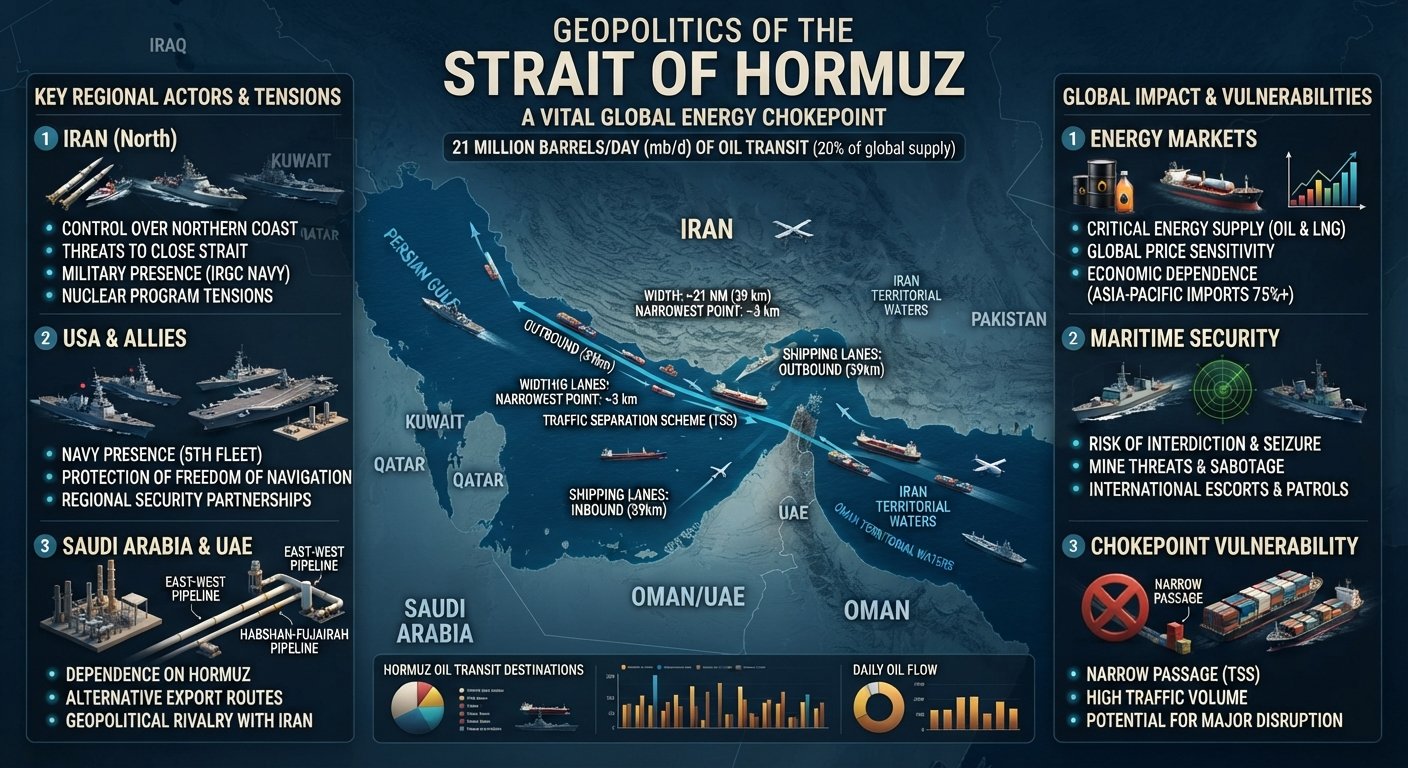
The geopolitics of the Strait of Hormuz extends far beyond a narrow waterway between Iran and Oman. It is one of the most strategically important maritime chokepoints in the world because it connects the Persian Gulf with the Gulf of Oman and the wider Indian Ocean while carrying enormous volumes of oil, petroleum products and liquefied natural gas.
In 2024, an average of about 20 million barrels per day of oil moved through Hormuz, equivalent to roughly one-fifth of global petroleum liquids consumption. About one-fifth of global LNG trade also transited the strait in 2024, with Qatar accounting for most of the LNG flows. (U.S. Energy Information Administration)
Its importance, however, is not simply economic. Iran’s geographical position gives it potential leverage over one of the world’s most important energy corridors, while Oman occupies the other side of the waterway. Saudi Arabia, the United Arab Emirates, Qatar, Kuwait, Iraq and Bahrain all have major economic interests connected to the Gulf’s maritime security. The United States and other external powers also regard freedom of navigation through the region as a major strategic concern.
As of September 2026, the strategic importance of Hormuz has become even more apparent. The region is experiencing a prolonged conflict and serious disruption to commercial shipping. The International Maritime Organization reported in August that thousands of seafarers remained affected and that at least 70 attacks on international shipping had been verified since the conflict began on February 28, 2026. (International Maritime Organization)
This article examines why the Strait of Hormuz matters, its history, geography, competing interests, energy significance, international-law framework, military dimensions, economic consequences and possible future scenarios.
What Is the Strait of Hormuz and Where Is It Located?

The Strait of Hormuz is a strategically vital maritime passage linking the Persian Gulf with the Gulf of Oman and Arabian Sea.
Iran lies to the north, while Oman controls territory along the southern side of the waterway through the Musandam Peninsula. The geography gives the strait unusual strategic significance: ships entering or leaving the Persian Gulf must pass through a relatively constrained maritime corridor.
Why Does Geography Matter?
Geography is the foundation of Hormuz’s geopolitical importance.
The Gulf contains some of the world’s largest concentrations of oil and natural-gas production and export infrastructure. Yet these resources are not located directly beside the world’s major consuming markets. Tankers therefore need maritime routes connecting Gulf terminals with Asia, Europe and other destinations.
The result is a classic geopolitical chokepoint: a geographically constrained passage through which a disproportionately large amount of strategically important commerce must travel.
Image/Infographic: A high-resolution geopolitical map showing Iran, Oman, the Strait of Hormuz, Persian Gulf states, Gulf oil terminals and the main maritime route toward the Arabian Sea.
Placement: Immediately after this H2 section.
Purpose: Help readers understand the physical geography and why alternative routes are limited.
Suggested SEO Alt Text: “Map showing the Strait of Hormuz between Iran and Oman and major Gulf energy routes”
Why Is the Strait of Hormuz So Important to Global Energy Security?
Hormuz is central to the global energy system because of the sheer volume of hydrocarbons transported through it.
The U.S. Energy Information Administration estimated that oil flows through the strait averaged about 20 million barrels per day in 2024. Its later global chokepoint analysis put the 2024 average at approximately 20.7 million barrels per day, including crude, condensate and petroleum products. (U.S. Energy Information Administration)
The importance is even broader when natural gas is considered.
Oil and Petroleum Products
The Gulf’s major energy exporters—including Saudi Arabia, Iraq, Kuwait, the UAE, Qatar and Iran—depend to varying degrees on maritime routes through or around Hormuz.
Oil transported through the strait supplies refineries and consumers across Asia and other markets. China, India, Japan and South Korea are particularly important because Asian economies account for a large share of Gulf energy demand.
The strategic problem is not simply how much oil passes through Hormuz. It is how difficult it would be to replace the route quickly if sustained disruption occurred.
LNG and Natural Gas
Hormuz is also critical for liquefied natural gas.
EIA estimates indicate that around 20% of global LNG trade transited the strait in 2024. Qatar was the dominant exporter, while the UAE accounted for much of the remaining Gulf LNG traffic. Around 83% of LNG moving through Hormuz in 2024 went from Persian Gulf producers toward Asian markets. (U.S. Energy Information Administration)
This creates a particularly important vulnerability for Asian energy security.
A prolonged disruption would therefore affect not only gasoline and diesel markets but also electricity generation, industrial production, fertilizer manufacturing and household energy costs.
The Historical Evolution of Hormuz Geopolitics

The strategic significance of Hormuz predates the modern oil industry.
For centuries, the waterway formed part of commercial networks connecting the Persian Gulf with the Indian Ocean. Its importance increased dramatically during the twentieth century as Gulf petroleum became central to the global economy.
From Maritime Trade to Energy Chokepoint
The discovery and development of major Gulf oil reserves transformed Hormuz from an important regional maritime route into a global strategic asset.
As Western economies became increasingly dependent on imported petroleum, protecting Gulf energy supplies became a major foreign-policy objective.
During the Cold War, the United States and its partners viewed the Persian Gulf as strategically important because disruption could affect the economic and military capabilities of major industrial powers.
The Iran-Iraq War and the Tanker War
The strategic risks became especially visible during the Iran-Iraq War, particularly during the 1980s Tanker War.
Commercial shipping became exposed to missile attacks, mines and military confrontation. The conflict demonstrated that a regional war could rapidly become a threat to international commerce.
The United States and other powers subsequently increased maritime-security involvement in the Gulf.
Hormuz in the Twenty-First Century
In the twenty-first century, tensions surrounding Iran’s nuclear program, U.S. sanctions, regional rivalries and the presence of foreign naval forces have repeatedly raised concerns about Hormuz.
The strait has therefore become both an economic artery and a potential instrument of strategic coercion.
Which Countries Are Most Important in the Geopolitics of the Strait of Hormuz?
The geopolitics of Hormuz involves several overlapping groups of actors.
Iran
Iran is the most geographically significant coastal power on the northern side of the strait.
Tehran’s strategic position provides potential leverage because Iran can threaten, monitor or influence maritime activity near one of the world’s most important energy corridors.
Iran also has an important contradiction: it benefits economically from regional energy commerce but can use the threat of disruption as a bargaining instrument against adversaries.
Iran’s ability to exploit Hormuz therefore depends not only on military capability but also on international political conditions, economic pressure and the willingness of other states to tolerate disruption.
Oman
Oman occupies the southern side of the waterway through its Musandam Peninsula.
Unlike Iran, Oman has traditionally emphasized mediation and diplomatic engagement. Its geography gives it considerable strategic importance even though its foreign-policy approach has often been more cautious than that of the region’s larger powers.
Oman’s position also makes it an important potential intermediary during regional crises.
Saudi Arabia
Saudi Arabia is one of the world’s largest oil producers and has enormous economic interests in keeping Gulf shipping routes open.
Riyadh has invested in alternative infrastructure that can move some petroleum exports toward the Red Sea, thereby reducing dependence on Hormuz for a portion of its exports.
Nevertheless, alternative routes cannot simply eliminate the strategic importance of the strait.
United Arab Emirates
The UAE has developed infrastructure and export options designed partly to reduce its exposure to maritime chokepoint risks.
Its strategic position also makes it an important actor in Gulf security, trade and regional diplomacy.
Qatar
Qatar is particularly exposed to Hormuz because of its enormous LNG-export industry.
A significant disruption would therefore affect one of the world’s most important natural-gas exporters and its customers, particularly in Asia.
Iraq, Kuwait and Bahrain
Iraq and Kuwait depend heavily on Gulf maritime infrastructure for energy exports, while Bahrain’s location and close security relationship with Saudi Arabia and the United States make it strategically important.
United States
The United States has historically maintained a major military presence in the Gulf because of energy security, regional stability and freedom of navigation.
Its naval capabilities provide a major deterrent but also make the United States a central participant in any confrontation involving Hormuz.
How Does Iran Use the Strait of Hormuz as Geopolitical Leverage?
Iran’s leverage comes primarily from geography combined with asymmetric military capabilities.
Tehran does not necessarily need to maintain permanent control over the entire waterway to create economic pressure. Even the perception that commercial vessels may be attacked, detained, inspected or delayed can affect shipping decisions.
Asymmetric Maritime Strategy
Iran can potentially employ:
- Coastal missile systems
- Drones
- Fast attack craft
- Naval mines
- Surveillance systems
- Electronic warfare
- Maritime special forces
- Long-range missiles
- Other asymmetric capabilities
These capabilities create a strategic problem for conventional naval forces.
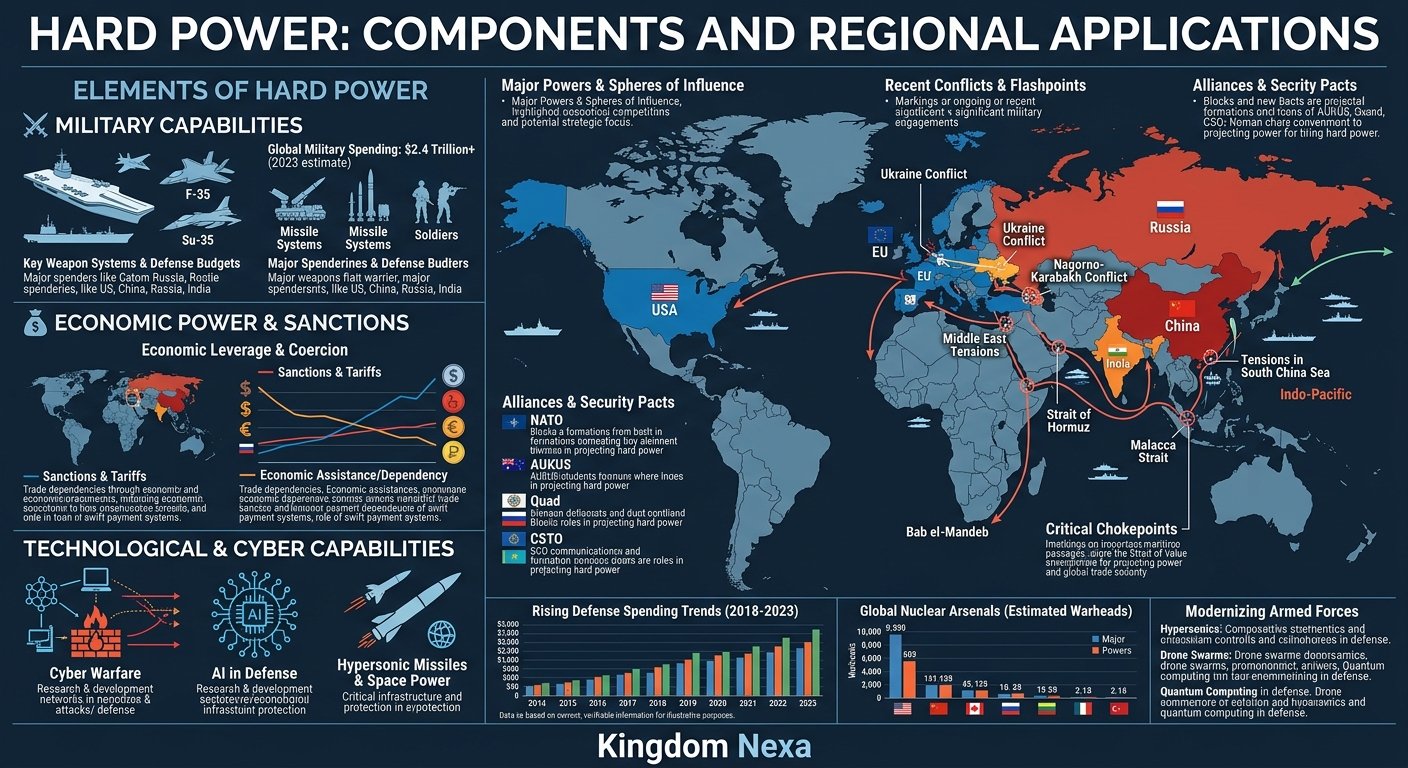
A large warship or tanker may be technologically sophisticated, but a relatively inexpensive asymmetric weapon can still impose significant costs through insurance premiums, escorts, delays and rerouting.
The Power of Uncertainty
The most important strategic effect may therefore be uncertainty.
A shipowner does not need to believe that every vessel will be attacked. The possibility of attack can be enough to increase insurance costs and alter routing decisions.
This transforms Hormuz from a physical chokepoint into a risk chokepoint.
What Is the Role of the United States and Other External Powers?
The geopolitics of Hormuz cannot be understood without considering external military powers.
The United States has long treated freedom of navigation in the Gulf as a major strategic interest. European and Asian countries also have strong economic reasons to support maritime stability.
Naval Presence and Deterrence
A military presence can discourage attacks against commercial shipping and reassure regional partners.
However, military deployments also carry escalation risks. A confrontation between Iran and U.S.-aligned forces could quickly expand beyond a maritime incident.
Asian Powers
Asia is particularly exposed because major economies—including China, India, Japan and South Korea—depend heavily on Gulf energy.
China is especially significant because it is a major purchaser of Middle Eastern oil and LNG.
This creates an important geopolitical paradox: Asian countries have strong economic interests in Gulf stability even when they are not directly involved in the region’s military rivalries.
What Does International Law Say About the Strait of Hormuz?
The legal status of Hormuz is a central part of its geopolitical significance.
The United Nations Convention on the Law of the Sea (UNCLOS) establishes a legal framework for straits used for international navigation.
Under Article 37, the transit-passage regime applies to qualifying international straits connecting one part of the high seas or exclusive economic zone with another. Article 38 establishes the right of transit passage for ships and aircraft, subject to the Convention’s requirements. (United Nations)
Transit Passage
Transit passage is broader than ordinary innocent passage in important respects.
It is designed to facilitate continuous and expeditious international navigation through qualifying straits.
Article 44 also states that states bordering such straits shall not hamper transit passage and that there shall be no suspension of transit passage under that provision. (United Nations)
Why Is the Legal Question Politically Important?
International maritime law does not remove geopolitical competition.
A coastal state can have sovereignty or jurisdiction over maritime areas while remaining subject to international obligations concerning navigation.
This creates a recurring tension between:
Coastal-state security claims
and
International navigation rights.
The distinction matters because political statements about “closing” Hormuz do not automatically settle the underlying legal questions.
In July 2026, the International Maritime Organization’s Council reaffirmed the importance of preserving navigational rights and freedoms under international law and specifically condemned attacks on civilian commercial ships around the Strait of Hormuz. (International Maritime Organization)
How Does Hormuz Affect Global Trade and the World Economy?
The economic consequences of Hormuz disruption extend far beyond crude oil.
A major disruption can affect:
- Crude oil prices
- Refined petroleum prices
- LNG prices
- Electricity costs
- Shipping insurance
- Freight rates
- Inflation
- Industrial production
- Fertilizer prices
- Food costs
- Currency markets
- Consumer confidence
Oil Price Shock
When traders believe that a significant volume of supply could disappear, prices can rise even before an actual long-term shortage develops.
This is partly because energy markets price future risk.
The current 2026 crisis demonstrates this mechanism. On September 10, 2026, Reuters reported Brent crude above $107 per barrel amid intensified attacks and concerns about further disruption to Middle Eastern shipping. (Reuters)
Shipping and Insurance
The risk premium can become almost as important as the physical loss of cargo.
If insurers consider the Gulf excessively dangerous, premiums increase. Shipowners may then require higher freight rates or avoid the route entirely.
The result can be a feedback loop:
Conflict → higher risk → higher insurance → higher freight costs → fewer ships → tighter supply → higher prices.
How Has the 2026 Crisis Changed the Geopolitics of Hormuz?
The 2026 conflict has demonstrated that Hormuz can become a global economic crisis even without a perfectly defined or permanently closed waterway.
As of September 2026, commercial traffic remains severely disrupted.
Reuters reported on September 10 that only seven commodity vessels transited the strait on the previous day, significantly below the recent average. No LNG tankers were recorded in that day’s preliminary tracking data. (Reuters)
The International Maritime Organization said in August that up to 400 ships carrying approximately 6,000 seafarers had been unable to leave the Persian Gulf safely since the conflict began. (International Maritime Organization)
The Importance of Partial Disruption
One of the most important lessons is that Hormuz does not have to be completely closed to create economic consequences.
Even partial disruption can:
- Increase shipping costs
- Reduce available supply
- Delay deliveries
- Increase insurance premiums
- Encourage alternative routing
- Increase oil-price volatility
- Force governments to release strategic stocks
Reuters reported that some oil continues to move through the Omani corridor, while alternative export routes such as Saudi Arabia’s Red Sea infrastructure are helping compensate for part of the lost capacity. (Reuters)
Can Oil Avoid the Strait of Hormuz?
Yes, but only partially.
Several Gulf states possess alternative pipelines or export infrastructure that can bypass the strait.
Saudi Arabia can move oil toward Red Sea terminals, while the UAE has infrastructure connecting inland production areas with export facilities outside the most constrained portion of Hormuz.
Why Alternatives Are Not a Complete Solution
Alternative routes have limitations:
- Lower capacity
- Different grades of crude
- Infrastructure constraints
- Geographic limitations
- Additional transportation costs
- Vulnerability to other chokepoints
- Limited ability to handle all Gulf exports
Therefore, alternative infrastructure acts more like a shock absorber than a complete replacement.
The same principle applies to LNG. Qatar’s massive LNG exports are particularly dependent on maritime access through Hormuz.
What Are the Main Security Risks Around Hormuz?

The security risks include both conventional and asymmetric threats.
Missile and Drone Attacks
Drones and missiles can threaten tankers, ports, naval vessels and offshore infrastructure.
The 2026 conflict has demonstrated how attacks on commercial vessels can rapidly influence global energy markets.
Naval Mines
Mines represent another potential threat because they can make maritime passage dangerous even when a state does not maintain continuous physical control over the entire strait.
Mine clearance can be slow, expensive and dangerous.
Vessel Seizures and Inspections
The detention or seizure of commercial vessels can create legal and diplomatic crises while increasing uncertainty among shipping companies.
Escalation
Perhaps the most dangerous risk is escalation.
A limited maritime incident could trigger retaliation, which could produce additional attacks on energy infrastructure and commercial shipping.
That could transform a localized confrontation into a wider regional war.
What Are the Major Geopolitical Risks for Gulf States?
Gulf countries face a strategic dilemma.
They need stable relations with Iran because geography makes confrontation costly. At the same time, many maintain close security relationships with the United States and other Western powers.
This produces a balancing strategy involving:
- Security partnerships
- Economic diversification
- Diplomatic engagement
- Alternative export routes
- Strategic reserves
- Maritime-security cooperation
The long-term trend among Gulf states has increasingly involved reducing dependence on any single external security arrangement while maintaining multiple diplomatic channels.
What Does the Strait of Hormuz Mean for China and Asia?
Hormuz is increasingly an Asian energy-security issue.
China, India, Japan and South Korea are major destinations for Gulf energy.
EIA data indicate that Asian markets accounted for the overwhelming majority of LNG moving through Hormuz in 2024, with China, India and South Korea among the leading destinations. (U.S. Energy Information Administration)
This means Asian governments have a strong incentive to support stability even when they pursue different diplomatic relationships with Iran, Saudi Arabia, the UAE and the United States.
For China in particular, Hormuz connects Middle Eastern energy security with broader questions surrounding maritime power, strategic autonomy and the security of overseas supply chains.
Future Scenarios for the Geopolitics of the Strait of Hormuz
The future of Hormuz depends on regional military developments, diplomacy, international pressure, energy-market adaptation and the behavior of the major powers.
Scenario 1: Gradual Stabilization
A diplomatic settlement could restore commercial confidence.
Shipping would gradually return, insurance costs could decline and energy markets would normalize.
This would probably be the least economically damaging outcome.
Scenario 2: Prolonged Partial Disruption
This may be more realistic than either complete closure or immediate normalization.
Some vessels would continue transiting while others avoid the route. Energy would still reach international markets, but at higher costs and with greater uncertainty.
Such a situation could become a new geopolitical “normal.”
Scenario 3: Wider Regional Escalation
A larger military confrontation could affect not only Hormuz but also Gulf ports, energy infrastructure, pipelines and other regional maritime chokepoints.
This would have consequences far beyond the Middle East.
Scenario 4: Greater Diversification Away From Hormuz
Repeated crises could accelerate investment in:
- Alternative pipelines
- Strategic petroleum reserves
- Renewable energy
- Nuclear power
- LNG diversification
- Alternative shipping routes
- Domestic energy production
- Energy-efficiency technologies
Such changes would not eliminate Hormuz’s importance, but they could gradually reduce its leverage.
Why the Strait of Hormuz Will Remain Geopolitically Important
The fundamental geopolitical equation is unlikely to disappear.
Hormuz combines four forms of strategic power:
Geographic power: It is a narrow gateway connecting the Gulf with the open ocean.
Energy power: It carries enormous volumes of oil and LNG.
Military power: Its surrounding geography permits states to deploy naval, missile, drone and surveillance capabilities.
Economic power: Even uncertainty around the waterway can affect global prices, shipping and inflation.
That combination makes Hormuz far more than a maritime passage.
Frequently Asked Questions About the Geopolitics of the Strait of Hormuz
Why is the Strait of Hormuz geopolitically important?
The Strait of Hormuz is geopolitically important because it connects the Persian Gulf with the Gulf of Oman and carries a major share of global oil and LNG trade. Its disruption could affect energy prices, shipping and global economic stability.
Which countries control the Strait of Hormuz?
Iran and Oman are the principal coastal states bordering the strait. Iran occupies the northern side, while Oman controls territory around the southern approach, particularly through the Musandam Peninsula.
How much oil passes through the Strait of Hormuz?
About 20 million barrels per day of oil flowed through the strait in 2024, according to EIA estimates. That represented roughly one-fifth of global petroleum liquids consumption. (U.S. Energy Information Administration)
Why is Hormuz important to China?
China is a major importer of Middle Eastern energy. Disruption to Hormuz can therefore increase China’s energy costs and create risks for industrial production, transportation and economic stability.
Can the Strait of Hormuz be bypassed?
Some Gulf oil can bypass Hormuz through pipelines and alternative export infrastructure, particularly toward the Red Sea. However, alternative capacity is insufficient to replace all normal flows through the strait.
Is the Strait of Hormuz governed by international law?
Yes. International maritime law, including the UNCLOS framework concerning straits used for international navigation, is highly relevant. Article 38 establishes a right of transit passage in qualifying international straits. (United Nations)
Could closing Hormuz cause an oil crisis?
A sustained severe disruption could cause a major energy-market shock because of the large volume of petroleum and LNG normally transported through the waterway. The actual impact would depend on the duration of the disruption, alternative supplies, strategic reserves and demand responses.
Why is Oman important to Hormuz security?
Oman’s geography gives it a strategic position at the southern side of the waterway. Its traditionally pragmatic diplomatic posture has also made it an important channel for regional mediation.
What is the biggest geopolitical risk around Hormuz?
The biggest risk is uncontrolled escalation. A maritime incident involving Iran, the United States or another regional actor could trigger retaliation and expand into a broader conflict affecting energy infrastructure and commercial shipping.
Will the Strait of Hormuz remain important in the future?
Yes. Even if alternative pipelines, renewable energy and diversified supply chains reduce dependence over time, the concentration of Gulf energy resources and the geography of the waterway will keep Hormuz strategically important for decades.
Conclusion
The geopolitics of the Strait of Hormuz is ultimately a story about the intersection of geography, energy, military power, international law and global economic interdependence.
Its significance does not come simply from its physical size. It comes from what passes through it and from the difficulty of replacing its capacity quickly. Oil and LNG exports from the Persian Gulf connect Hormuz directly to the economic security of Asia and the wider international economy.
For Iran, the waterway provides geographic leverage. Gulf exporters, it is an essential commercial artery. For Oman, it is a strategic neighborhood and diplomatic asset. United States and other maritime powers, freedom of navigation remains a major security concern. For China, India, Japan, South Korea and other Asian economies, Hormuz is fundamentally an energy-security issue.
The events of 2026 have reinforced another lesson: a chokepoint does not have to be completely closed to become geopolitically powerful. Reduced traffic, attacks, uncertainty, higher insurance costs and fear of future disruption can themselves reshape markets.
Ultimately, the future stability of Hormuz will depend not only on military deterrence but also on diplomacy, maritime law, regional confidence-building, energy diversification and the ability of major powers to prevent local confrontations from becoming global economic crises.