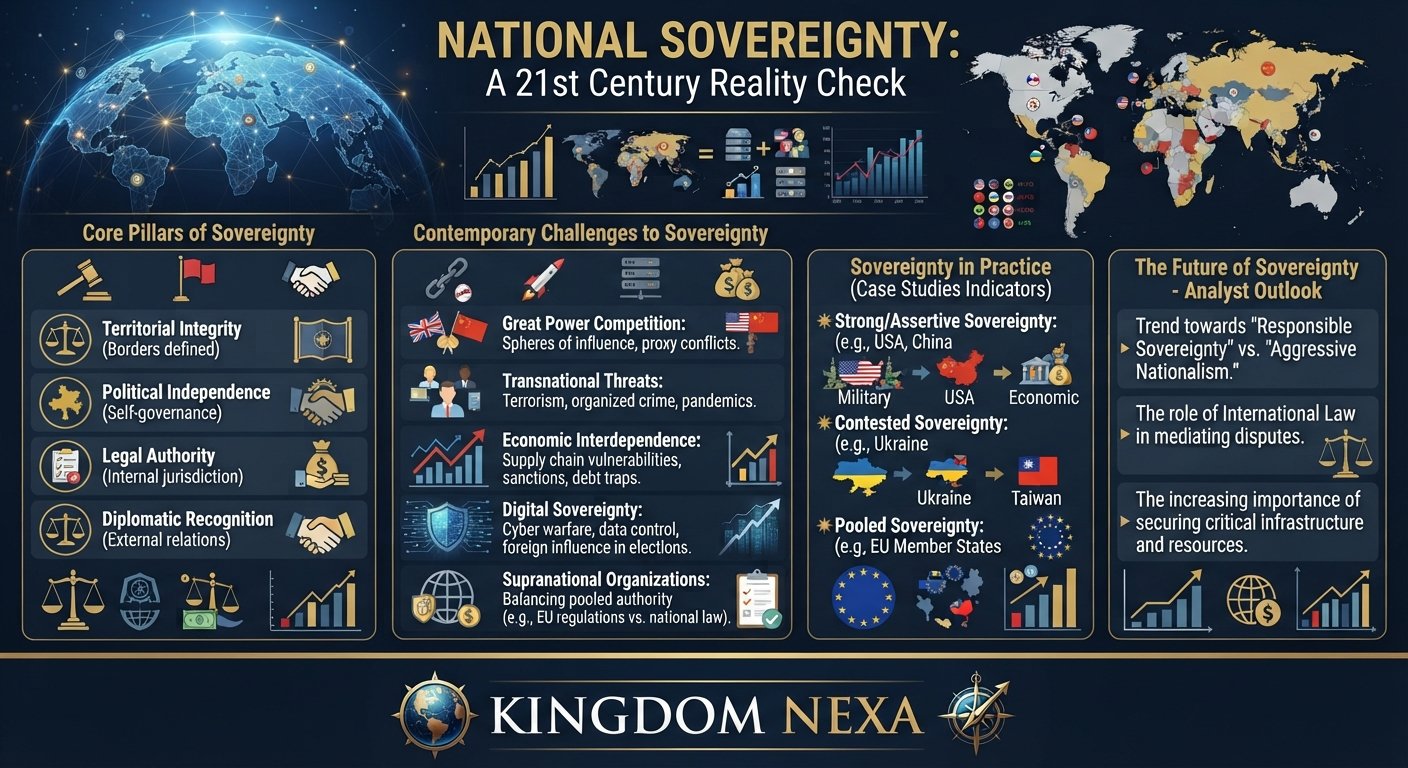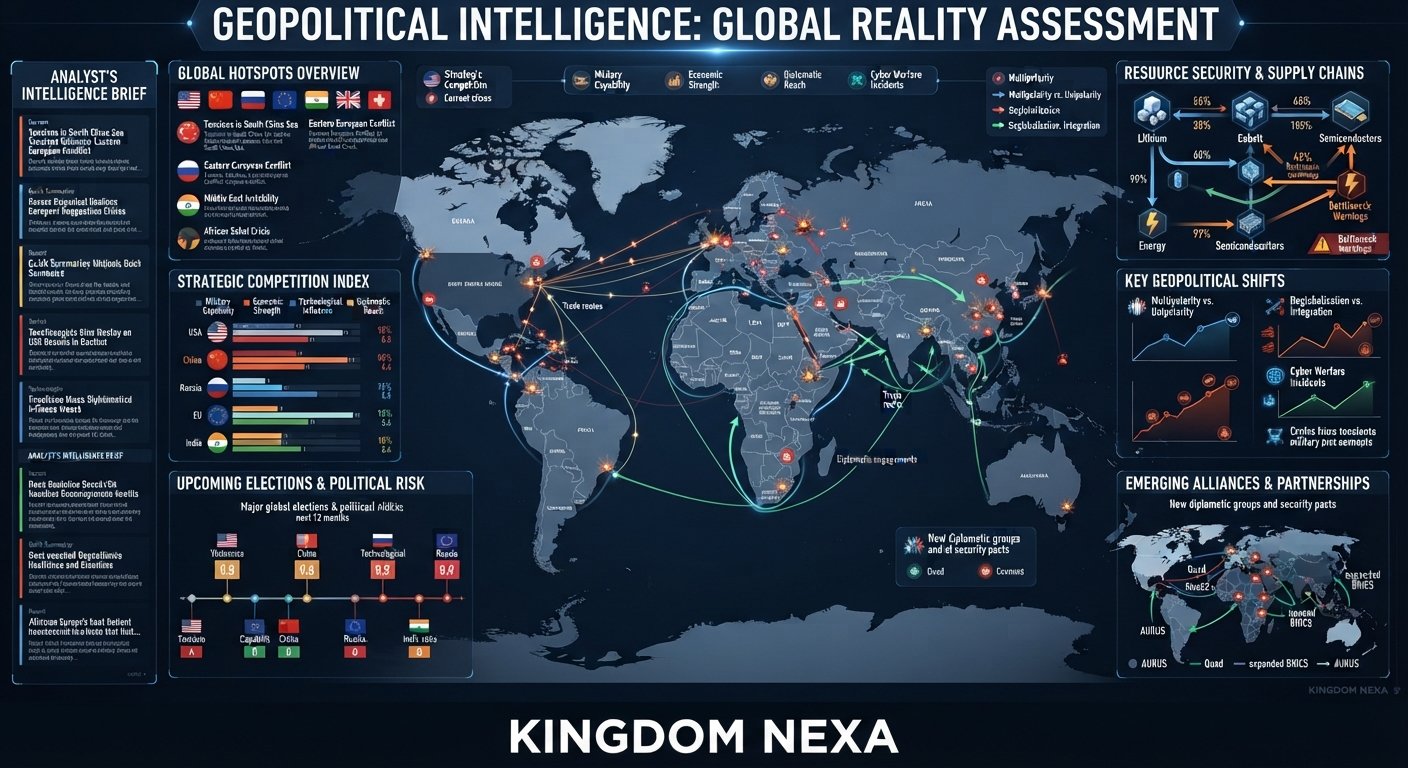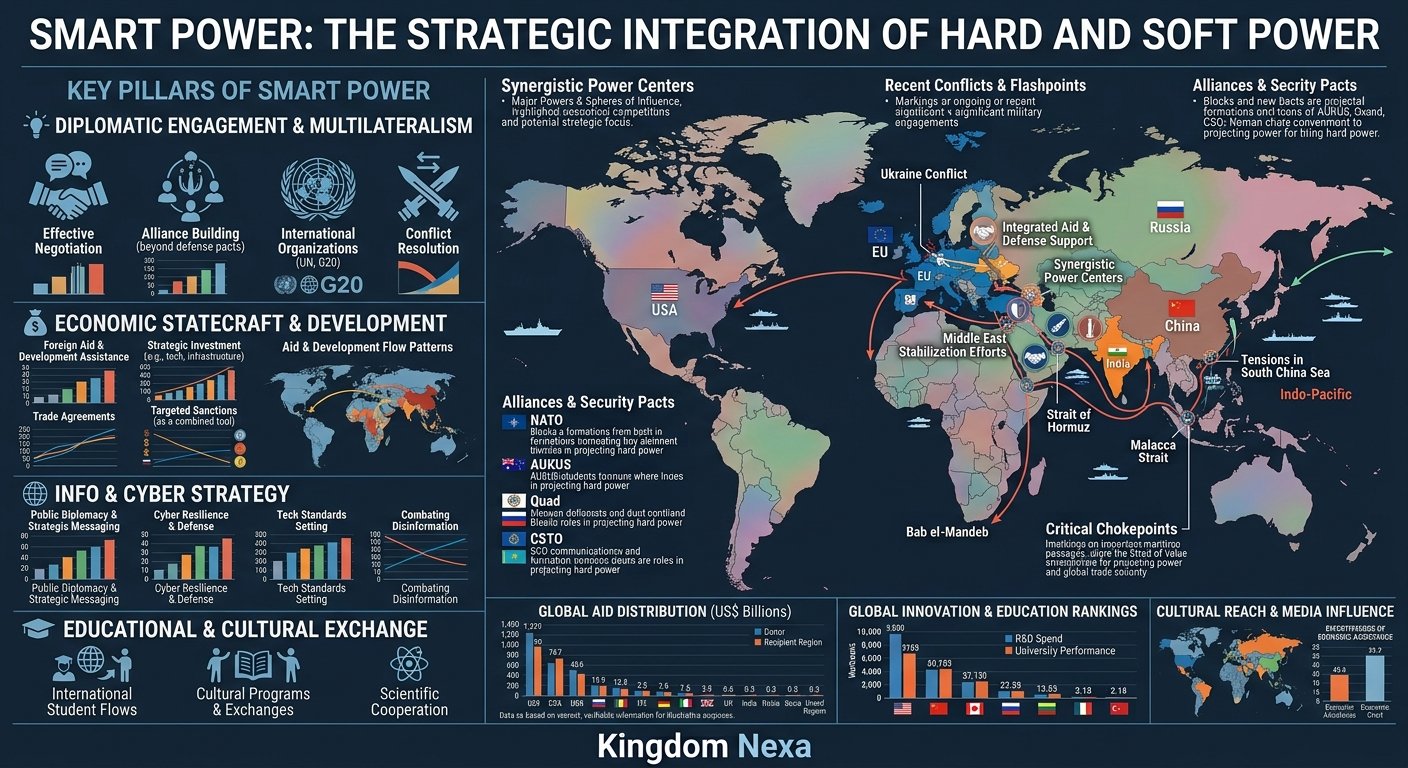
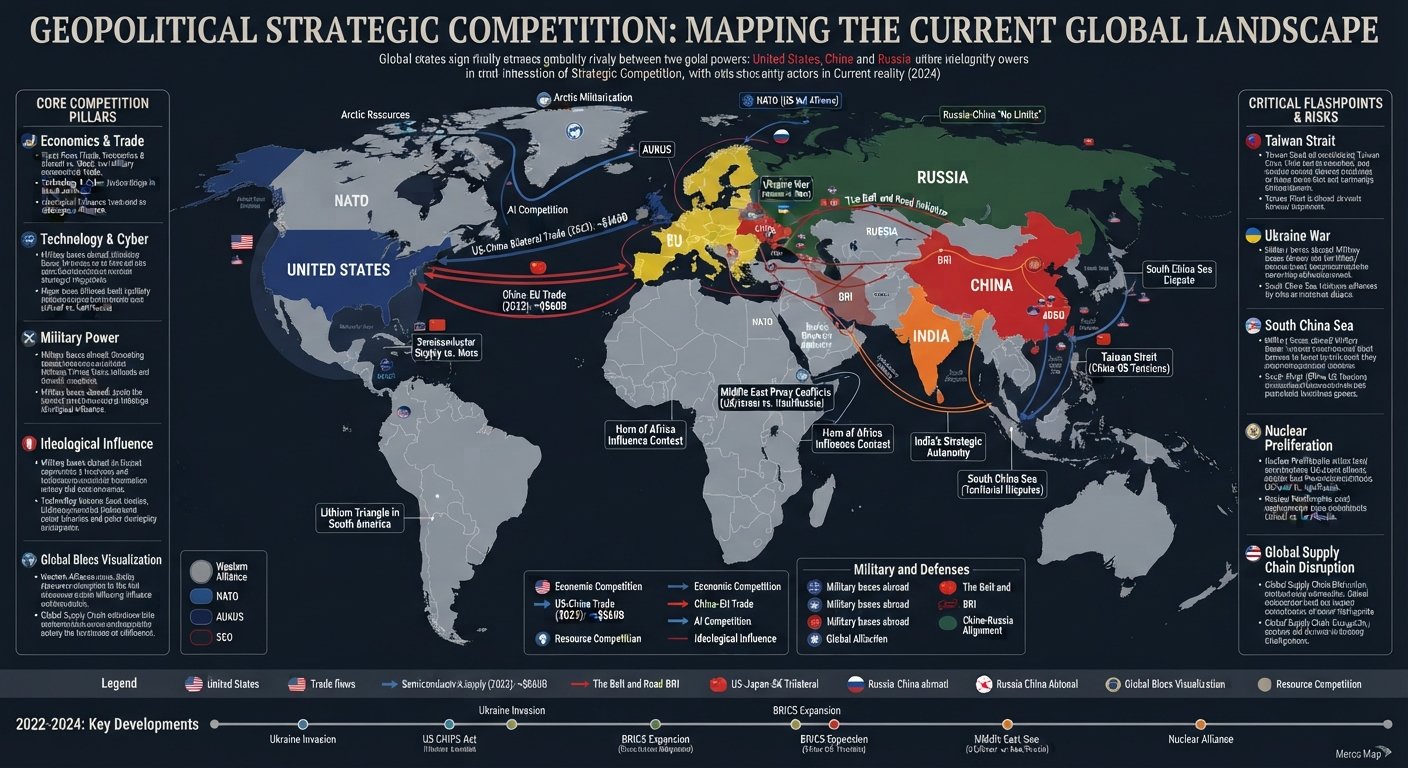
The international system is entering a period in which Strategic Competition Between Nations extends far beyond traditional military rivalry. States now compete over technology, trade routes, critical minerals, financial systems, energy security, artificial intelligence, supply chains, diplomatic influence, and access to strategic infrastructure. At the same time, they continue to cooperate where interests overlap.
This makes modern geopolitical competition fundamentally different from the simple bloc confrontation associated with the Cold War. The United States and China remain central to global strategic rivalry, while Russia, India, the European Union, Japan, Türkiye, Gulf states, and other regional powers pursue their own interests and partnerships. Countries that do not want to choose a single camp increasingly seek flexibility through diversified relationships.
As of September 2026, global military expenditure, economic-security policies, technological controls, and investment patterns all show that strategic competition is becoming deeply embedded in international affairs. Yet competition does not automatically mean war. Understanding where rivalry ends, where cooperation remains possible, and how states use different instruments of power is essential for understanding the emerging world order.
What Is Strategic Competition Between Nations?
Strategic competition between nations is a sustained contest among states to protect or expand their security, economic interests, political influence, technological advantages, and position within the international system.
Unlike an isolated diplomatic dispute, strategic competition operates across several interconnected domains. A government may compete militarily in one region while simultaneously maintaining trade with its rival, negotiating climate agreements, or cooperating on nuclear-risk reduction.
Modern competition commonly involves:
- Military capabilities and deterrence
- Economic strength and industrial capacity
- Trade and investment
- Critical minerals and energy
- Artificial intelligence and advanced computing
- Semiconductors and telecommunications
- Cybersecurity and space systems
- Diplomatic influence
- Alliances and strategic partnerships
- Infrastructure and connectivity
- Information and public diplomacy
- International institutions and rule-making
The concept therefore describes a spectrum ranging from cooperation and managed rivalry to coercion and confrontation.
This distinction matters. Strategic competition should not automatically be described as a new Cold War. Contemporary powers remain economically interconnected, and many states maintain relationships with competing powers simultaneously.
Why Has Strategic Competition Increased?
Several long-term developments have contributed to the return of intense geopolitical competition.
The End of the Unipolar Moment
After the Soviet Union collapsed in 1991, the United States possessed an unusually dominant combination of military, economic, technological, and institutional power.
That period did not eliminate geopolitical rivalry. Regional powers continued pursuing their interests, while China experienced rapid economic growth and Russia sought to preserve influence in its surrounding regions.
Over time, the distribution of power became more dispersed.
China emerged as a major economic, technological, and military power. India expanded its economic and diplomatic weight. The European Union remained a major regulatory and economic center. Russia retained substantial military capabilities, particularly nuclear forces, despite its smaller economic base relative to the United States, China, and the EU.
The result is a more complicated system in which no single measurement fully captures international power.
Russia’s War Against Ukraine
Russia’s full-scale invasion of Ukraine in February 2022 transformed European security and intensified strategic competition between Russia and Western states.
NATO describes Russia as the most significant threat to Allied security in its current Strategic Concept, while also identifying China, cyber threats, emerging technologies, and instability in other regions as important challenges. (NATO)
The war also affected energy policy, defense spending, sanctions, supply chains, food security, and European strategic planning.
U.S.-China Strategic Rivalry
The relationship between the United States and China has become one of the most consequential strategic relationships in the international system.
Competition encompasses:
- Semiconductors
- Artificial intelligence
- Military capabilities
- Space
- Cybersecurity
- Trade
- Industrial policy
- Critical minerals
- Maritime security
- Infrastructure
- Standards and technology governance
The U.S. Department of Defense’s 2025 China Military Power Report examines China’s military modernization, cyber and space capabilities, nuclear developments, Taiwan Strait security, South China Sea activities, and broader strategic objectives. (Defense Media)
Yet competition coexists with substantial economic interaction and areas where cooperation may remain necessary.
The Main Dimensions of Strategic Competition
Strategic competition is best understood as a multidimensional process rather than a contest determined solely by military power.
Military and Security Competition
Military power remains a fundamental component of national strategy.
States seek to improve deterrence, defend territory, protect sea lanes, strengthen alliances, and prevent adversaries from gaining decisive advantages.
Modern military competition increasingly covers:
- Nuclear forces
- Long-range missiles
- Air and missile defense
- Unmanned systems
- Drones
- Cyber operations
- Space capabilities
- Intelligence, surveillance and reconnaissance
- Electronic warfare
- Naval power
- Autonomous systems
- Defense-industrial capacity
Global military spending illustrates the scale of this transformation. SIPRI estimates that worldwide military expenditure reached $2.887 trillion in 2025, rising 2.9% in real terms and marking the eleventh consecutive annual increase. The United States, China, and Russia together accounted for approximately 51% of global military expenditure. (SIPRI)
These figures demonstrate increasing security expenditure, but military spending alone does not determine strategic outcomes. Training, logistics, industrial capacity, geography, alliances, technology, leadership decisions, and combat experience also matter.
Economic Competition
Economic power has become inseparable from national security.
Governments increasingly view excessive dependence on foreign suppliers as a potential strategic vulnerability. Consequently, economic policies once treated primarily as commercial instruments are increasingly connected to national security.
Examples include:
- Export controls
- Investment screening
- Industrial subsidies
- Tariffs
- Sanctions
- Supply-chain diversification
- Strategic stockpiles
- Local manufacturing incentives
- Restrictions on sensitive technologies
The World Trade Organization has warned that deeper geopolitical fragmentation could impose substantial costs on global output and trade. Its 2026 World Trade Report estimates that a geopolitically fragmented trading system could reduce global GDP by 5.1% and global exports by 18.6% under its modeled scenario. These are scenario estimates, not forecasts of what will necessarily happen. (World Trade Organization)
Technology Competition
Technology has become a strategic asset.
The most important areas include:
- Artificial intelligence
- Advanced semiconductors
- Quantum computing
- Biotechnology
- Cybersecurity
- Satellites
- Autonomous weapons
- Telecommunications
- Cloud computing
- Advanced manufacturing
The strategic importance of technology comes from its ability to affect both civilian economies and military capabilities.
For example, advanced semiconductor production supports artificial intelligence, telecommunications, data centers, weapons systems, and industrial automation. Control over technological supply chains can therefore provide economic advantages while also creating national-security leverage.
The competition is not simply about inventing technology. It also involves controlling standards, talent, manufacturing capacity, intellectual property, data, infrastructure, and access to essential components.
Economic Security and the New Role of Supply Chains
One of the clearest changes in international relations is the transformation of supply chains from commercial concerns into strategic assets.
The European Union’s economic-security policies increasingly focus on risks involving supply-chain resilience, critical infrastructure, technology leakage, and the potential weaponization of economic dependencies. (European Commission)
In December 2025, the European Commission announced additional measures concerning critical raw materials, supply-chain diversification, and economic-security resilience, including initiatives affecting batteries, rare earths, defense materials, AI chips, and data centers. (European Commission)
This reflects a broader trend toward de-risking rather than necessarily ending international economic relationships.
Businesses may therefore face pressure to answer questions that previously belonged mostly to governments:
- Where are critical components manufactured?
- Which country controls key raw materials?
- Could sanctions interrupt supplies?
- Are alternative suppliers available?
- What happens if a strategic shipping route is disrupted?
- Could foreign ownership create national-security concerns?
Strategic Competition and Global Investment
Investment patterns are also changing.
UN Trade and Development reported that global foreign direct investment rose by 6% to approximately $1.6 trillion in 2025, but the recovery was uneven. More than 80% of global FDI went to the top 20 host economies, while strategic sectors represented 44% of global greenfield project values, compared with 16% in 2020. UNCTAD also identified geopolitical tensions, trade-policy uncertainty, and economic fragmentation as risks for 2026. (Investment Policy Hub)
This suggests that capital is not simply following traditional market incentives.
Investors increasingly consider:
Market opportunity + political stability + supply-chain security + regulatory environment + geopolitical risk.
This is particularly important for infrastructure, energy, semiconductors, telecommunications, ports, artificial intelligence, and critical minerals.
The Role of Geography
Geography remains central even in an increasingly digital international system.
Strategic competition concentrates around locations with:
- Major ports
- Maritime chokepoints
- Energy reserves
- Critical mineral deposits
- Border corridors
- Industrial centers
- Semiconductor production
- Undersea cables
- Space-launch infrastructure
- Major trade routes
The Indo-Pacific is particularly important because it contains major economic centers, strategic waterways, and several areas of unresolved security competition.
Europe remains central because of the Russia-Ukraine war, NATO’s eastern flank, energy infrastructure, and its economic relationship with both the United States and China.
The Middle East remains strategically important because of energy resources, maritime routes, regional conflicts, and its position between Europe, Asia, and Africa.
Strategic geography therefore connects local disputes with global consequences.
Alliances, Partnerships and Strategic Autonomy
Traditional alliances remain important, but the modern system also includes flexible partnerships.
NATO remains a central security institution in Europe and North America. Its 2022 Strategic Concept identifies collective defense, crisis management, and cooperative security as its core tasks. (NATO)
At the same time, countries such as India, Indonesia, Saudi Arabia, Türkiye, Brazil, South Africa, and others frequently seek relationships with multiple major powers rather than permanently aligning with one.
This behavior is sometimes described as strategic autonomy, multi-alignment, hedging, or the behavior of swing states.
The distinction is important. A country can cooperate with the United States on defense, China on trade, Russia on energy or military equipment, and European states on investment without considering those relationships mutually exclusive.
This creates a more fluid geopolitical environment than a simple two-bloc model.
Regional Dimensions of Strategic Competition
Europe
Europe’s strategic environment has been heavily influenced by Russia’s war against Ukraine.
European governments have increased defense spending, reconsidered energy dependencies, strengthened military capabilities, and debated the future balance between national, European, and transatlantic security.
SIPRI estimates European military expenditure increased by 14% in 2025 to $864 billion, reflecting the continuing security response to the continent’s strategic environment. (SIPRI)
Indo-Pacific
The Indo-Pacific is a major center of strategic competition involving the United States, China, India, Japan, Australia, South Korea, ASEAN members, and other regional actors.
Key issues include:
- Taiwan Strait stability
- South China Sea disputes
- East China Sea security
- Maritime trade
- Semiconductor supply chains
- Naval power
- Critical minerals
- Regional infrastructure
- Technology standards
China’s military modernization has become an important factor in regional strategic planning, while the United States continues to rely heavily on alliances and partnerships across the region. The 2025 U.S. Defense Department assessment documents China’s continuing military modernization and activities around Taiwan and the South China Sea. (Defense Media)
Middle East
The Middle East demonstrates why strategic competition cannot be reduced to U.S.-China rivalry.
The region combines energy resources, maritime chokepoints, armed conflicts, competing regional powers, external military involvement, and major infrastructure projects.
States in the region have increasingly sought diversified diplomatic and economic relationships, allowing them to maintain connections with several major powers simultaneously.
Africa
African states are also affected by strategic competition through infrastructure finance, energy investment, critical minerals, security partnerships, agricultural markets, and diplomatic relationships.
Competition over access to resources does not mean African governments are passive participants. Many seek to maximize bargaining power by engaging multiple external partners.
This broader pattern is increasingly important because strategic competition is not simply something major powers conduct against smaller countries. Smaller and middle powers can exercise agency by choosing when, where, and how to cooperate.
International Organizations and the Rules-Based System
Strategic competition creates pressure on international institutions, but those institutions remain important.
The United Nations provides diplomatic forums and legal mechanisms. The WTO establishes rules for international trade. The IMF and World Bank remain important for financial stability and development. Regional institutions provide additional platforms for cooperation.
The central challenge is that geopolitical rivalry can make consensus harder.
Trade disputes, sanctions, technology controls, competing infrastructure initiatives, and disagreements over international law can all weaken institutional cooperation.
Yet fragmentation is not inevitable.
The WTO’s research emphasizes that multilateral trade rules can reduce uncertainty and constrain escalation between states. (World Trade Organization)
The continued existence of these institutions means today’s international system is not simply being replaced by power politics. Instead, power competition and institutional cooperation operate simultaneously.
International Law and Strategic Competition
International law remains relevant even when states disagree sharply.
Important legal areas include:
- Sovereignty and territorial integrity
- The UN Charter
- Use of force
- International humanitarian law
- Maritime law
- Sanctions and countermeasures
- Treaties
- Arms-control agreements
- Diplomatic law
Disputes often arise because states interpret legal principles differently or disagree about whether particular actions comply with international law.
A neutral analysis should therefore distinguish between:
What a government claims, what another government disputes, and what an international court, tribunal, or recognized legal authority has actually determined.
This distinction prevents political narratives from being mistaken for established legal findings.
Domestic Politics and Strategic Competition
Foreign policy does not occur independently of domestic politics.
Governments must consider:
- Public opinion
- Elections
- Economic growth
- Employment
- Energy prices
- Defense-industry interests
- National identity
- Legislative institutions
- Budgetary constraints
- Industrial competitiveness
For example, a government may want stronger economic relations with another country but face domestic pressure to protect strategic industries.
Similarly, a government may want greater military spending but face competing demands for healthcare, infrastructure, education, or social programs.
Strategic competition is therefore partly a contest between states and partly a question of how governments manage domestic constraints.
The Growing Importance of Non-State Actors
States remain the primary actors in international security, but they no longer control every strategic variable.
Multinational corporations influence:
- Semiconductor production
- Cloud computing
- Artificial intelligence
- Energy
- Telecommunications
- Shipping
- Finance
Technology companies can possess capabilities with direct national-security implications. International financial institutions can influence economic stability. NGOs affect humanitarian responses and global advocacy. Armed non-state groups can disrupt regional security.
This creates a more complex environment in which national governments must cooperate with, regulate, or compete against powerful non-state actors.
What Are the Main Risks?
Strategic competition creates several interconnected risks.
Miscalculation
When military forces operate near one another, an accident or misunderstanding can escalate quickly.
Economic Fragmentation
Excessive trade restrictions can increase costs, reduce efficiency, and disrupt developing economies.
Technology Decoupling
Separated technology ecosystems may reduce innovation diffusion and raise costs for businesses and consumers.
Arms-Race Dynamics
Increasing military spending can create security dilemmas in which one country’s defensive preparations are interpreted by another as preparation for aggression.
Supply-Chain Vulnerability
Strategic competition can encourage diversification but may also produce new dependencies if production simply moves from one concentrated supplier to another.
Diplomatic Polarization
International institutions can become less effective if major powers treat every issue as a zero-sum confrontation.
What Could Happen Next?
The future of strategic competition between nations is uncertain. Several broad pathways are plausible.
Managed Strategic Competition
Major powers could continue competing intensely while maintaining diplomatic channels, economic relationships, crisis communication, and limited cooperation on issues such as climate, health, financial stability, and AI safety.
Deeper Geoeconomic Fragmentation
Governments could increasingly divide technology, investment, supply chains, and trade according to geopolitical alignment.
This would not necessarily produce two completely separate economic systems. More likely, the world could develop partially overlapping regional networks.
Greater Multipolarity
The United States and China could remain the most consequential major-power relationship while other states acquire greater strategic autonomy.
India, the EU, Japan, Gulf countries, Türkiye, Brazil, Indonesia, and other significant economies could gain additional influence by maintaining multiple partnerships.
Intensified Security Competition
Military modernization could continue if governments perceive their strategic environments as deteriorating.
SIPRI’s data already show sustained growth in global military expenditure, while European and Asian spending increased substantially in 2025. (SIPRI)
These scenarios are not mutually exclusive. Elements of all four could occur simultaneously in different regions.
Why Strategic Competition Between Nations Matters
The significance of strategic competition extends beyond diplomats and defense ministries.
For businesses, it affects supply chains, investment decisions, sanctions compliance, technology access, insurance, shipping, and market entry.
Governments, it affects defense planning, energy security, industrial policy, diplomacy, and infrastructure.
For researchers and students, it changes how international relations must be analyzed. Military power remains important, but it must be studied alongside economics, technology, geography, institutions, demographics, and political legitimacy.
For ordinary citizens, strategic competition can influence energy prices, employment, consumer technology, food security, migration, public spending, and national security.
The most important lesson is that modern geopolitical power is multidimensional.
A country may possess military superiority but depend on foreign supply chains. Another may have enormous manufacturing capacity but face demographic pressures. A third may lack global military reach but control strategically important minerals or geographic chokepoints.
Power therefore comes from the interaction of capabilities, geography, institutions, alliances, resilience, and political choices.
Frequently Asked Questions
What is strategic competition between nations?
Strategic competition between nations is a sustained contest among states over security, economic interests, technology, political influence, resources, alliances, and international rules. It can include both cooperation and confrontation.
Is strategic competition the same as war?
No. Strategic competition can occur without direct armed conflict. States may compete through diplomacy, trade, technology, investment, military deterrence, sanctions, and alliances while maintaining diplomatic relations.
Which countries are central to current strategic competition?
The United States and China are central to contemporary great-power competition, while Russia, India, the European Union, Japan, and numerous regional powers significantly influence particular security, economic, and technological issues.
Why is technology important in geopolitical competition?
Technology affects military capabilities, economic productivity, intelligence, communications, cybersecurity, and industrial competitiveness. Technologies such as AI, semiconductors, quantum computing, and advanced telecommunications therefore have strategic importance.
How does strategic competition affect global trade?
It can encourage tariffs, export controls, investment screening, sanctions, supply-chain diversification, and industrial policies. These measures can increase resilience in some areas while also increasing trade costs and fragmentation risks. (World Trade Organization)
What is geoeconomic competition?
Geoeconomic competition is the use of economic capabilities and instruments to pursue geopolitical objectives. It can include sanctions, trade policy, investment, financial measures, industrial policy, energy policy, and control of strategic resources.
Why are middle powers important?
Middle powers can influence international outcomes because major powers often need their markets, resources, diplomatic support, geographic access, or security cooperation. Many also maintain relationships with multiple competing powers.
Is the world becoming multipolar?
There is substantial evidence of a more dispersed distribution of influence, but the exact structure of the emerging system remains debated. Contemporary international politics includes major powers, regional powers, alliances, institutions, and states pursuing strategic autonomy rather than fitting neatly into two permanent blocs.
Can countries compete and cooperate at the same time?
Yes. States can compete in military or technological fields while cooperating on trade, climate, public health, financial stability, nuclear risk reduction, or other issues where their interests overlap.
Conclusion
Strategic Competition Between Nations is reshaping the international system across military, economic, technological, diplomatic, and geopolitical domains. The current environment cannot be understood through military power alone. Supply chains, critical minerals, AI, semiconductors, energy, investment, alliances, geography, and international institutions increasingly influence national power.
The United States-China relationship remains a central axis of global competition, while Russia’s war against Ukraine continues to shape European security. At the same time, India, the European Union, Japan, Gulf states, Türkiye, Brazil, Indonesia, and other actors are exercising greater strategic agency.
The emerging system is therefore neither a straightforward return to the Cold War nor a completely borderless global economy. It is a more fluid environment in which competition, cooperation, interdependence, deterrence, and strategic autonomy coexist.
For policymakers, businesses, researchers, and students, the key is to examine not only who possesses power, but how power is converted into influence, where dependencies exist, and how competing interests can be managed without allowing rivalry to become uncontrolled confrontation.