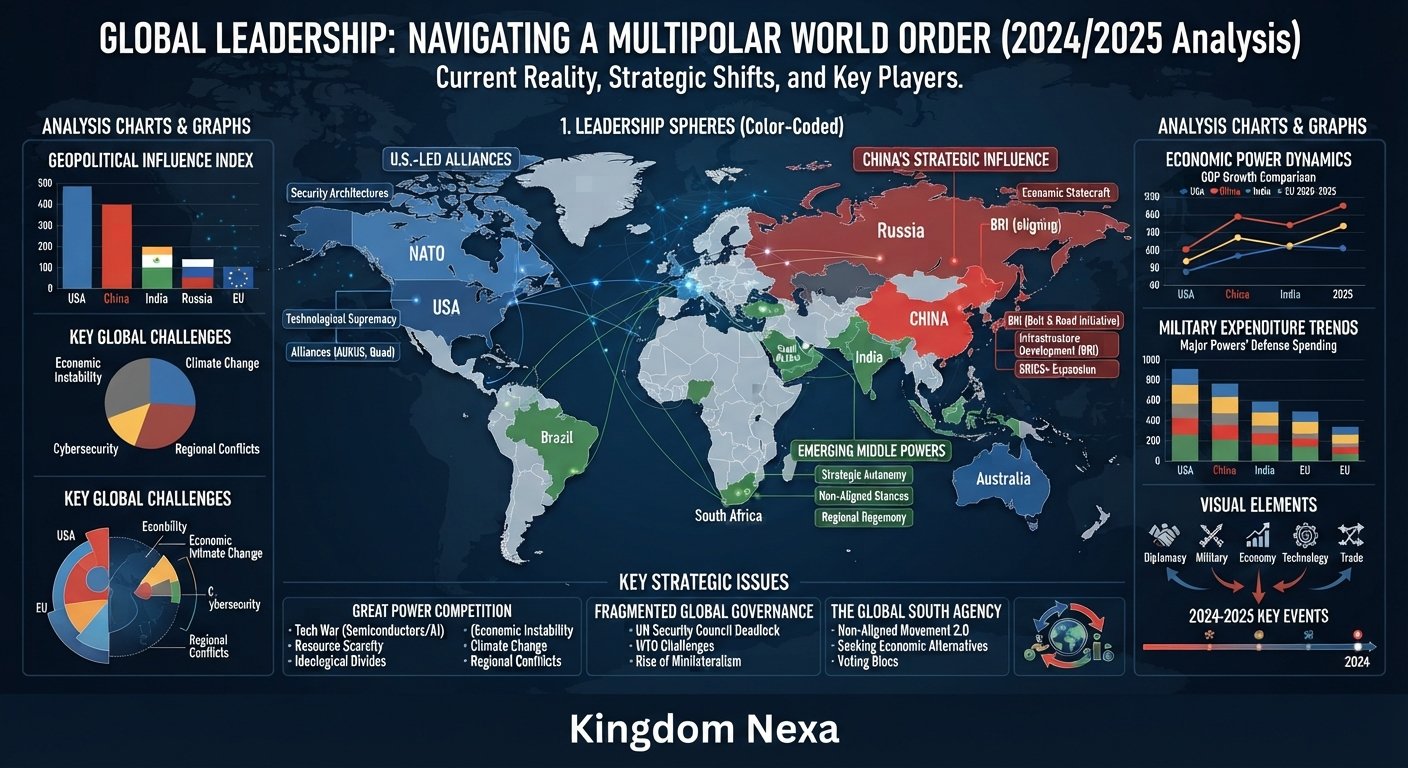
Global leadership shapes how the world responds to conflict, economic uncertainty, climate change, technological disruption, and threats to international peace. Yet leadership in international affairs is no longer simply a question of which country possesses the strongest military or the largest economy. It increasingly depends on the ability to build alliances, influence international institutions, establish credible rules, mobilize resources, and persuade other countries to cooperate.
Global leadership refers to the capacity of countries, international institutions, coalitions, and influential non-state actors to shape international priorities and coordinate responses to challenges that cross national borders. It can emerge through diplomacy, economic influence, military capabilities, technological innovation, humanitarian assistance, or the provision of international public goods.
In the contemporary geopolitical environment, the United States remains a major source of global influence, while China, the European Union, India, Russia, and regional powers pursue different strategic priorities. At the same time, international institutions face pressure to become more representative and effective.
Understanding global leadership therefore requires examining not only who holds power, but also how that power is exercised, whose interests it serves, and whether it produces lasting international cooperation. This article explores its meaning, historical development, major actors, strategic dimensions, current challenges, and possible future trajectories, using developments documented through October 9, 2026.

What Is Global Leadership?
Global leadership is the ability to influence international decisions, shape shared priorities, and mobilize cooperation beyond national borders. It involves more than commanding resources: effective leaders must also build trust, negotiate competing interests, and demonstrate that their actions produce credible results.
A country can possess substantial military and economic power without consistently providing effective international leadership. Conversely, a smaller state may exercise considerable influence by mediating disputes, building coalitions, contributing specialist expertise, or advancing internationally accepted rules.
The difference between global power and global leadership
Global power describes the resources and capabilities an actor can use to influence others. Global leadership concerns how those capabilities are applied to achieve objectives, establish direction, or coordinate collective action.
The distinction matters because influence does not automatically generate legitimacy. A powerful country may secure short-term compliance through pressure but struggle to sustain cooperation if its partners perceive its policies as unpredictable or unfair.
Effective global leadership generally combines five elements:
- Capability: Economic resources, technology, diplomatic networks, military capacity, and institutional expertise.
- Vision: A coherent understanding of international priorities and long-term objectives.
- Legitimacy: Acceptance of an actor’s authority, conduct, or proposed rules by relevant stakeholders.
- Coalition-building: The ability to coordinate countries and institutions with different interests.
- Delivery: Demonstrable results in security, development, crisis management, or international cooperation.
These elements reinforce one another, but they are not interchangeable. Strong capabilities without legitimacy can generate resistance, while a widely respected initiative may fail if its sponsors cannot finance or implement it.
Who can exercise global leadership?
Global leadership is not restricted to heads of state or major powers. It can emerge at several levels.
National governments influence international security, trade, finance, and diplomacy. Multilateral institutions coordinate negotiations and establish common frameworks. Regional organizations help manage local conflicts and economic integration. Businesses influence technology, investment, energy systems, and supply chains, while scientific networks and civil society contribute expertise and public pressure.
Leadership can therefore be distributed across multiple actors, even when their resources and authority differ substantially.
How Has Global Leadership Evolved Historically?
The structure of global leadership has changed repeatedly as wars, economic transformations, technological advances, and political movements have redistributed power.
From European dominance to a global system
During the nineteenth century, European empires exercised extensive influence over international trade, territory, finance, and security. Industrialization strengthened their military and economic advantages, while colonial rule imposed unequal political and economic relationships across much of the world.
This system was never uncontested. Anti-colonial movements, local resistance, and competition among imperial powers challenged its stability. The First World War further weakened the European balance of power.
After the Second World War, the United States and the Soviet Union emerged as the principal superpowers. The United Nations was established in 1945, while the Bretton Woods institutions helped organize postwar economic cooperation.
The Cold War and the emergence of a US-led order
From the late 1940s until 1991, international politics was heavily shaped by rivalry between Washington and Moscow. Their competition involved military alliances, nuclear deterrence, ideological influence, economic assistance, intelligence operations, and proxy conflicts.
The United States helped establish institutions and alliances that supported a US-centered international economic and security system. The Soviet Union built its own military and political bloc.
However, neither superpower controlled every international outcome. The Non-Aligned Movement, decolonization, regional conflicts, and the independent policies of other states demonstrated the limits of superpower authority.
The post-Cold War period
The Soviet Union dissolved in 1991, leaving the United States with an unusually dominant position in military, financial, technological, and diplomatic affairs.
Global trade expanded, digital communications accelerated, and international institutions gained prominence in several policy areas. Nevertheless, conflicts in the Balkans, the Middle East, and elsewhere exposed the limits of military intervention and international consensus.
China’s economic rise, India’s expanding international role, Russia’s efforts to restore strategic influence, and the growing importance of regional powers gradually complicated the post-Cold War distribution of power.
Key turning points
| Period | Significance for global leadership |
|---|---|
| 1945 | The UN system and postwar institutions were established. |
| 1947–1991 | US–Soviet rivalry shaped a largely bipolar strategic environment. |
| 1991 | The Soviet Union dissolved, leaving the United States in a dominant position. |
| 2001–2008 | The September 11 attacks and global financial crisis reshaped security and economic priorities. |
| 2010s | China’s growing influence, renewed great-power competition, and digital transformation intensified debates about global order. |
| 2020–2024 | The COVID-19 pandemic, wars, supply-chain disruptions, and accelerating technological competition tested international cooperation. |
| 2024–2026 | Global governance reform, digital cooperation, strategic competition, and institutional effectiveness remained central international concerns. |
The central historical lesson is that global leadership changes when existing institutions and power arrangements struggle to address new realities. However, changes in influence do not necessarily produce a clean transition from one dominant power to another.
Who Are the Major Actors in Global Leadership Today?
The international system is characterized by unequal capabilities, overlapping partnerships, and competing ideas about how global affairs should be managed.
The United States: A major source of global influence
The United States retains substantial advantages in military reach, advanced technology, capital markets, research institutions, and international alliances. Its relationships with NATO members, Japan, South Korea, Australia, and other partners provide strategic reach that cannot be measured by national resources alone.
The dollar’s international role and the depth of US financial markets also contribute to American influence over global finance.
Nevertheless, leadership involves trade-offs. Domestic political polarization, debates over international commitments, disagreements with allies, and the perceived consistency of US foreign policy can affect confidence in American leadership. Partners may seek greater strategic autonomy even while maintaining close security relationships with Washington.
China: An influential economic and strategic competitor
China’s position is supported by its manufacturing base, extensive trade relationships, infrastructure capabilities, technological development, and permanent membership of the UN Security Council.
Through bilateral partnerships, trade, infrastructure financing, and initiatives such as the Belt and Road Initiative, Beijing has expanded its international engagement.
China also advocates reforms to international institutions that it considers insufficiently representative of contemporary economic and political realities. Other governments, however, scrutinize issues including strategic dependencies, transparency, market access, and the security implications of Chinese investment.
Its global leadership ambitions must therefore be understood alongside both its growing capabilities and the concerns its policies generate among other countries.
The European Union: Leadership through institutions and regulation
The European Union exercises influence through its single market, regulatory standards, trade relationships, development assistance, and climate policies. Its rules can affect businesses and governments beyond Europe because access to the European market creates incentives to comply with EU standards.
The EU also supports multilateral diplomacy and international development. However, differences among member states, uneven military capabilities, and disagreements over migration, energy, defense, and foreign policy can constrain collective action.
Its ability to translate economic influence into coordinated geopolitical strategy remains an important measure of its international leadership.
India: A growing strategic and diplomatic actor
India’s large population, expanding economy, technology sector, military capabilities, and diplomatic relationships support its growing international role.
New Delhi maintains partnerships with Western countries while preserving relationships with Russia and participating in forums such as BRICS and the G20. This approach reflects strategic autonomy: the effort to preserve independent decision-making rather than rely exclusively on one geopolitical bloc.
India’s leadership potential also depends on domestic development, infrastructure, employment, institutional capacity, and its ability to build durable partnerships across different regions.
Russia and other influential powers
Russia remains an important military and nuclear power, a permanent member of the UN Security Council, and a major actor in Eurasian security and energy politics. Its war against Ukraine has also generated extensive international debate over sovereignty, territorial integrity, sanctions, and European security.
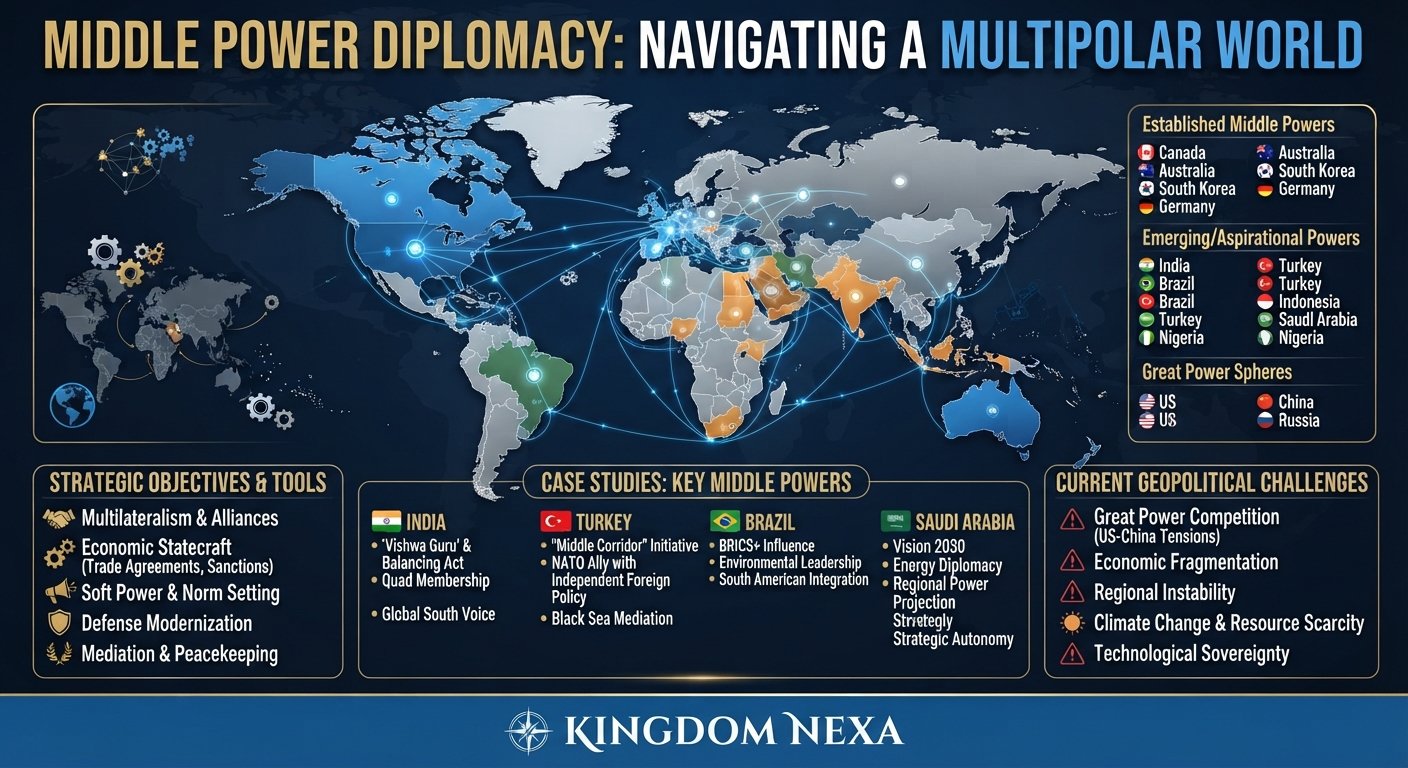
Other actors—including Brazil, Türkiye, Saudi Arabia, Indonesia, South Africa, Japan, South Korea, and the Gulf states—exercise influence in particular regions and policy areas. Their roles differ according to economic resources, geography, diplomacy, energy markets, technology, and security relationships.
No single ranking captures all these forms of leadership. The more useful question is which actors possess the resources, partnerships, and credibility to influence a particular international problem.
What Drives Global Leadership in the Contemporary World?
International leadership is shaped by a combination of material resources, geographic advantages, institutional influence, domestic political conditions, and the ability to respond to shared challenges.
Economic strength and financial influence
Economic power gives governments the capacity to finance defense, invest in research, provide development assistance, and influence international markets. Major economies can shape trade rules, control important supply-chain nodes, attract investment, and offer access to large consumer markets.
Financial influence is particularly significant. International lending, currency markets, payment networks, and sanctions can affect the decisions available to other governments. Yet economic interdependence also creates vulnerabilities: restrictions that pressure a rival can impose costs on domestic businesses, consumers, and allied economies.
For emerging economies, leadership often means expanding access to finance, negotiating fairer trade arrangements, strengthening domestic industries, and reducing excessive dependence on a limited number of external suppliers.
Military capabilities and strategic credibility
Military strength remains an important source of geopolitical influence. Nuclear deterrence, conventional forces, intelligence capabilities, logistics, and security partnerships shape how states assess threats and make strategic decisions.
However, military superiority cannot guarantee political success. Operations can produce unintended consequences, increase opposition, or generate long-term financial and diplomatic costs.
Effective security leadership combines deterrence with crisis communication, arms control, conflict prevention, and credible diplomatic alternatives. It also requires recognizing the difference between defeating an opponent militarily and establishing a sustainable political settlement.
Soft power, reputation, and diplomacy
Soft power is the ability to influence others through attraction rather than primarily through coercion or payment. Educational opportunities, scientific achievements, cultural influence, credible institutions, humanitarian assistance, and consistent diplomatic conduct can strengthen a country’s international appeal.
Soft power does not eliminate conflict of interest. Countries may admire another state’s universities or culture while opposing its foreign policy. Nevertheless, international credibility can make coalition-building easier and reduce the political costs of cooperation.
Diplomacy is the mechanism through which many forms of influence become practical outcomes. Negotiations, mediation, strategic dialogue, and confidence-building measures help governments manage disagreements without allowing every dispute to become a wider confrontation.
Geography, resources, and infrastructure
Geography affects leadership by shaping access to markets, energy supplies, maritime routes, strategic chokepoints, and neighboring regions.
States located near major shipping corridors or possessing important energy resources can acquire influence beyond what their population or economic size alone might suggest. Countries that invest in ports, railways, pipelines, telecommunications, and cross-border electricity networks can also shape regional connectivity.
Yet geographic advantages can create exposure to conflict, external pressure, environmental risks, and economic volatility. Sustainable leadership requires managing these vulnerabilities rather than simply exploiting strategic location.
How Do International Institutions Shape Global Leadership?
International institutions provide mechanisms for negotiation, coordination, rule-making, and collective responses to problems that no country can resolve independently.
The United Nations and collective security
The United Nations is central to global diplomacy because it brings almost every internationally recognized sovereign state into a common institutional framework. Its activities include peacekeeping, humanitarian coordination, development support, human rights work, and the promotion of international law.
The Security Council has primary responsibility under the UN Charter for maintaining international peace and security. Its five permanent members—the United States, China, Russia, France, and the United Kingdom—hold veto power over substantive resolutions.
This structure gives major powers a central role in the security system but also creates a persistent problem: disagreements among permanent members can prevent collective action even during serious crises.
The UN therefore illustrates both the importance and the limitations of global leadership. The organization can provide legitimacy, coordination, and diplomatic channels, but its member states ultimately shape much of its political room for action.
The G20, IMF, World Bank, and WTO
Different institutions address different dimensions of international leadership.
- G20: Provides a forum for major advanced and emerging economies to discuss global economic coordination.
- International Monetary Fund: Supports international monetary cooperation and provides financial assistance to countries facing qualifying balance-of-payments problems.
- World Bank: Finances development projects and supports poverty reduction and institutional capacity.
- World Trade Organization: Provides a framework for trade rules and dispute settlement, although its dispute-settlement system has faced significant difficulties.
- Regional organizations: The African Union, European Union, ASEAN, and other bodies address regional security, economic integration, and political cooperation in different ways.
These institutions do not operate independently of geopolitical competition. Voting arrangements, financing, leadership appointments, and disagreements over policy conditions can reflect the unequal distribution of power among member states.
Global governance reform and the Pact for the Future
A significant recent initiative is the UN’s Pact for the Future, adopted by world leaders on September 22, 2024, alongside the Global Digital Compact and the Declaration on Future Generations. The agreement covers international peace and security, sustainable development, digital cooperation, human rights, and institutional reform.
The initiative reflects recognition that international institutions must adapt to new technological, economic, demographic, and geopolitical realities.
However, adopting an agreement is not the same as implementing it. Progress depends on national policies, funding, institutional capacity, and sustained political commitment. Reforming the international system also requires governments to negotiate difficult questions about representation, sovereignty, accountability, and the distribution of decision-making power.
How Does Global Leadership Affect International Security?
Security leadership involves preventing conflict, managing escalation, reducing uncertainty, and creating conditions for lasting peace.
Alliances and deterrence
Alliances allow states to coordinate defense planning, share intelligence, develop interoperable military capabilities, and signal that aggression against one member may trigger a broader response.
NATO is a prominent example of a collective-defense alliance. Its deterrent role depends not only on military capabilities but also on members’ confidence that commitments will be honored.
Deterrence, however, carries risks. Military deployments, exercises, weapons transfers, and alliance expansion can be interpreted differently by rival states. A policy intended to reassure one government may be perceived as threatening by another.
Responsible leadership therefore requires combining defense preparedness with crisis-management channels, diplomatic engagement, and efforts to reduce the risk of miscalculation.
Conflict resolution and international law
Global leaders can support negotiations, ceasefire monitoring, humanitarian access, peacekeeping, and post-conflict reconstruction. Their influence may be especially important when conflicting parties distrust one another or lack incentives to compromise.
The legal framework matters. The UN Charter generally prohibits the threat or use of force against the territorial integrity or political independence of states, subject to recognized exceptions, including lawful self-defense and Security Council-authorized enforcement action.
International humanitarian law governs conduct during armed conflict, including the protection of civilians and other persons entitled to protection. Compliance with these rules is a fundamental measure of responsible state conduct, not simply a diplomatic preference.
Selective enforcement, inconsistent condemnation, and competing interpretations of legal obligations can undermine trust. Leadership becomes more credible when governments apply principles consistently, including when doing so conflicts with their immediate political interests.
What Is the Economic Impact of Global Leadership?
International leadership shapes the environment in which businesses invest, governments develop infrastructure, and households experience changes in prices, employment, and access to essential goods.
Trade, sanctions, and supply chains
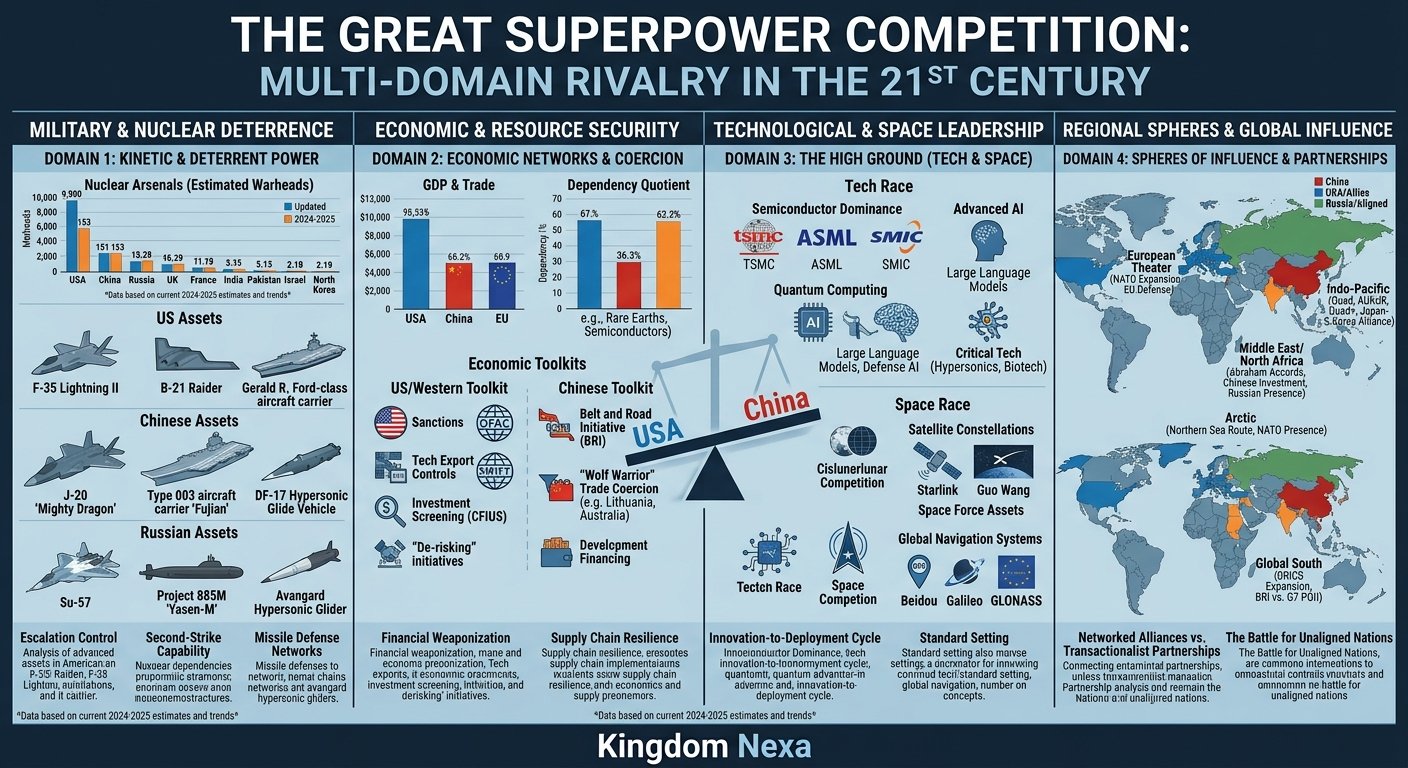
Major powers influence global commerce through trade agreements, export controls, tariffs, investment screening, and financial restrictions. These measures can support national security objectives, but they can also fragment markets and raise costs.
Strategic competition over semiconductors, critical minerals, batteries, energy technology, and advanced manufacturing illustrates the growing overlap between economic policy and national security.
Governments increasingly seek to diversify supply chains and reduce dependence on potential rivals. Such efforts can improve resilience, but complete economic separation is often expensive and impractical.
The challenge for global leadership is to balance legitimate security concerns with the benefits of predictable trade, competition, and international investment.
Energy security and climate cooperation
Energy markets connect geopolitics, national development, industrial competitiveness, and environmental policy. Oil and gas producers can influence supply conditions, while importing countries must manage price volatility and strategic dependence.
Renewable energy, electricity networks, battery storage, and critical-mineral processing are becoming more important to national economic and security strategies. These changes create opportunities for technological cooperation, but also competition over industrial capacity and access to resources.
Climate change requires a different form of leadership because emissions and environmental consequences cross borders. Effective action depends on international financing, technology transfer, adaptation planning, emissions reductions, and support for countries with limited resources.
Leadership in this area is judged not only by ambitious announcements but also by implementation, financing, and measurable progress.
How Are Technology and Artificial Intelligence Changing Global Leadership?
Technological capabilities increasingly determine which countries can shape international standards, secure critical infrastructure, and compete in advanced industries.
Artificial intelligence and digital governance
Artificial intelligence can improve scientific research, public services, productivity, and national security. It can also intensify surveillance risks, disinformation, cyber threats, and concerns about accountability.
Countries and companies with strong computing infrastructure, advanced semiconductor access, research talent, and substantial investment can influence the direction of AI development.
However, no single government or company can independently address every cross-border issue. International cooperation is important for safety research, technical standards, cybersecurity, privacy, and the management of risks associated with increasingly capable systems.
The Global Digital Compact, adopted as an annex to the Pact for the Future in 2024, provides a UN framework for digital cooperation, including discussion of AI governance and digital inclusion.
The central leadership question is whether technological innovation can advance without deepening inequality or concentrating excessive power.
Cybersecurity, satellites, and strategic infrastructure
Digital networks, satellites, undersea cables, cloud services, and navigation systems support modern economies and military operations. Disruption to these systems can affect financial transactions, communications, transport, and emergency response.
States therefore increasingly treat cybersecurity and technological resilience as national-security priorities. Private companies are also important because much of the infrastructure on which governments depend is commercially operated.
Global leadership requires better information-sharing, protection of critical systems, responsible state behavior, and channels for responding to cyber incidents before they escalate into wider political confrontations.
Technological leadership is consequently not measured by innovation alone. Reliability, safety, access, institutional competence, and the ability to establish trusted standards matter as well.
What Are the Main Challenges Facing Global Leadership?
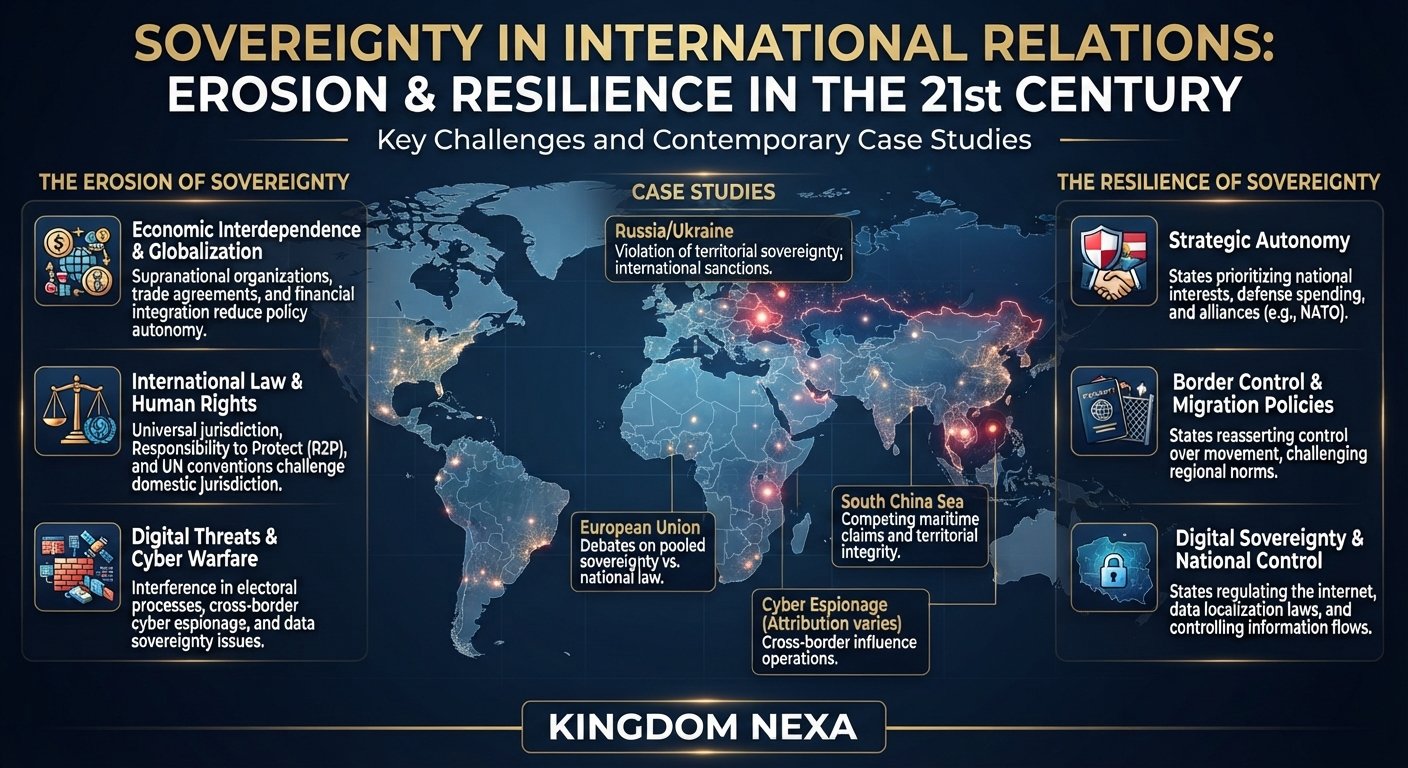
The greatest challenge is not simply that power is distributed among more actors. It is that governments increasingly disagree about the rules, priorities, and institutions through which international problems should be addressed.
Great-power competition and declining trust
Strategic competition between the United States and China affects technology, trade, maritime security, international institutions, and relationships across the Indo-Pacific and beyond. Russia’s confrontation with Western governments over Ukraine and European security adds another major source of tension.
These rivalries can encourage innovation and strengthen some alliances, but they can also obstruct cooperation on climate change, arms control, global health, and economic stability.
Trust is particularly difficult to rebuild once governments begin treating ordinary economic relationships as potential security vulnerabilities. Communication channels and carefully negotiated agreements remain important for preventing competition from becoming uncontrolled confrontation.
Unequal representation and legitimacy
Many developing countries argue that global institutions do not adequately reflect today’s distribution of population, economic activity, and regional interests.
Debates over reforming the UN Security Council, improving developing countries’ representation in international financial institutions, and expanding access to development finance reflect this concern.
Reform is politically difficult because governments that benefit from existing arrangements may resist changes that reduce their influence. Nevertheless, institutions that are perceived as unrepresentative risk losing cooperation from countries whose participation is necessary for effective international action.
Domestic politics and inconsistent commitments
Global leadership depends on decisions made within national political systems. Elections, public opinion, legislative constraints, budget disputes, and changes of government can alter international commitments.
Allies may hesitate to make long-term investments if they are uncertain whether security guarantees or economic agreements will survive a political transition. Rival governments may exploit these divisions, while domestic dissatisfaction can limit support for overseas commitments.
Strong institutions, transparent decision-making, realistic commitments, and broad political support can make foreign policy more predictable across electoral cycles.
Humanitarian crises and competing priorities
Armed conflict, forced displacement, food insecurity, poverty, and natural disasters place competing demands on international resources. Governments must decide how to balance immediate humanitarian needs with security interests, domestic spending, and long-term development.
Leadership can lose credibility when humanitarian principles are applied inconsistently or assistance is used primarily to secure political influence.
Effective responses require coordination among governments, humanitarian agencies, local organizations, and donors, alongside safeguards that protect civilians and preserve the independence of humanitarian operations.
Climate change and global inequality
The consequences of climate change are not evenly distributed. Countries differ in their historical emissions, financial resources, exposure to extreme weather, and capacity to adapt.
Disagreements over climate finance, development pathways, energy security, and responsibility for emissions complicate international negotiations. Similar tensions arise over access to medicines, digital infrastructure, education, and affordable financing.
Global leadership must therefore address both collective objectives and differences in national circumstances. Agreements are more likely to endure when their costs, benefits, and responsibilities are considered credible by participating countries.
What Does Global Leadership Mean for Developing Countries?
Developing countries are not merely recipients of decisions made by major powers. They can shape international outcomes through regional cooperation, diplomatic coalitions, strategic geography, economic partnerships, and participation in multilateral institutions.
Strategic autonomy and diversified partnerships
Countries such as India, Indonesia, Brazil, and South Africa demonstrate different approaches to maintaining relationships with competing powers while preserving room for independent decisions.
For smaller and developing states, strategic autonomy often means diversifying trade, investment, defense partnerships, technology providers, and sources of development finance.
Diversification can reduce dependence on any single partner. However, maintaining multiple partnerships requires administrative capacity, skilled diplomacy, sound economic planning, and careful management of conflicting commitments.
Regional leadership and collective bargaining
Regional organizations allow countries to pool resources, coordinate policies, and strengthen their negotiating positions.
The African Union, ASEAN, and other regional bodies provide platforms for discussing security, trade, infrastructure, and diplomatic cooperation. Their effectiveness varies, depending on member-state interests, institutional resources, political cohesion, and enforcement mechanisms.
Collective bargaining can help developing countries seek greater representation in global economic governance and negotiate more favorable arrangements on trade, debt, climate finance, and technology access.
Pakistan’s position in the changing international system
Pakistan illustrates the strategic choices facing a country located at the intersection of South Asia, Central Asia, and the wider Middle East.
Its geographic position, relationship with China, ties with Gulf countries, security relationship with the United States, and connections to regional trade routes create opportunities for diplomatic and economic engagement.
However, geography alone does not guarantee influence. Domestic economic stability, export competitiveness, institutional effectiveness, energy security, and predictable foreign relations all affect the country’s ability to translate strategic importance into sustainable gains.
For Pakistan, constructive global leadership can involve supporting regional dialogue, improving trade connectivity, participating in climate cooperation, strengthening economic partnerships, and promoting diplomatic approaches to regional disputes.
A balanced foreign policy does not require equal distance from every major power. It requires making decisions that serve national interests while avoiding unnecessary dependence and preserving opportunities for cooperation.
What Is the Future of Global Leadership?
The future is uncertain. Rather than assuming that a single country will inevitably dominate, it is more useful to consider several plausible pathways.

Scenario 1: Renewed multilateral cooperation
Governments strengthen international institutions, negotiate practical agreements, and cooperate on shared challenges despite strategic rivalry. This scenario becomes more plausible if major powers see clear benefits in reducing economic instability, preventing conflict, and managing global risks.
Key indicator: Agreements translate into sustained funding, implementation, and measurable outcomes.

Add to Favorites
Scenario 2: Intensified strategic fragmentation
Rival powers deepen competing technology ecosystems, trade restrictions, defense partnerships, and financial arrangements. International institutions continue to function but struggle to resolve the most politically sensitive disputes.
Key indicator: More restrictive trade policies, competing technical standards, and persistent diplomatic deadlock.

Add to Favorites
Scenario 3: A more distributed leadership system
Major powers retain considerable influence, but middle powers, regional organizations, cities, scientific institutions, and private companies take larger roles in selected policy areas. Leadership varies by issue rather than following a single hierarchy.
Key indicator: More issue-specific coalitions and regional initiatives that operate alongside established global institutions.
These scenarios are not mutually exclusive. Different patterns may emerge in security, trade, climate policy, technology, and humanitarian affairs at the same time.
The most plausible assessment is that global leadership will remain contested and uneven. Some problems may encourage cooperation, while others deepen geopolitical divisions. The balance will depend on political choices, institutional adaptability, economic conditions, and the capacity to manage crises without escalating them.
Frequently Asked Questions About Global Leadership
1. What is global leadership in simple terms?
Global leadership is the ability to influence international decisions and coordinate action on issues that affect multiple countries. It can involve diplomacy, economic cooperation, security, technology, climate policy, and international institutions.
2. Why is global leadership important?
It helps countries manage shared risks, prevent conflicts, establish common rules, coordinate responses to crises, and address challenges that cannot be solved effectively by one government acting alone.
3. Which country is the global leader today?
There is no universally accepted single leader across all policy areas. The United States retains major military, financial, technological, and alliance advantages, while China, the European Union, India, and other actors exercise substantial influence in different areas.
4. What are the main characteristics of an effective global leader?
Effective leadership combines capability, strategic vision, diplomatic credibility, coalition-building, respect for applicable international law, and the ability to deliver measurable results.
5. What is the difference between global leadership and global governance?
Global leadership concerns the ability to influence direction and mobilize cooperation. Global governance refers to the institutions, rules, processes, and arrangements through which international affairs are managed.
6. How does the United Nations contribute to global leadership?
The UN provides a forum for diplomacy, supports peacekeeping and humanitarian coordination, promotes international law, and helps establish common goals. Its effectiveness depends substantially on member-state cooperation and the political constraints built into its institutions.
7. How does China influence global leadership?
China influences international affairs through trade, manufacturing, infrastructure investment, technological development, diplomacy, and its permanent seat on the UN Security Council. Its international role is also shaped by strategic competition and concerns other governments raise about its policies.
8. Can developing countries exercise global leadership?
Yes. Developing countries can influence international decisions through regional cooperation, diplomatic coalitions, specialized expertise, strategic partnerships, and participation in global institutions. Their influence depends on the issue and their capacity to coordinate action.
9. How does technology affect global leadership?
Technology influences economic competitiveness, military capabilities, cyber resilience, information flows, and international standards. Leadership increasingly depends on technological capacity as well as cooperation on safety, access, security, and governance.
10. What is the future of global leadership?
Global leadership may become more distributed across major powers, middle powers, regional institutions, and private actors. The outcome will depend on geopolitical competition, institutional reform, domestic politics, and whether countries can sustain cooperation on shared challenges.
Conclusion:
Global leadership is not simply the exercise of dominance by the world’s most powerful countries. It is the ability to turn resources, influence, diplomacy, and strategic vision into outcomes that shape international stability and human development.
The United States, China, the European Union, India, Russia, and other influential actors will continue to compete and cooperate according to their interests. Meanwhile, international institutions must respond to changing power relationships, technological disruption, economic inequality, climate risks, and persistent security challenges.
The central challenge is to reconcile national interests with international responsibilities. Military strength and economic influence remain important, but neither guarantees trust, legitimacy, or lasting political success. Credible commitments, effective institutions, diplomatic engagement, and the capacity to deliver practical results are equally important.
For developing countries, the changing international system creates opportunities to strengthen strategic autonomy, diversify partnerships, and exercise greater influence through regional cooperation.
Ultimately, global leadership will be judged not only by who possesses the greatest power, but by who can use influence responsibly, manage competing interests, and achieve meaningful international cooperation. The future of the global order will depend on whether countries can adapt their institutions and strategies to a more interconnected, competitive, and uncertain world.