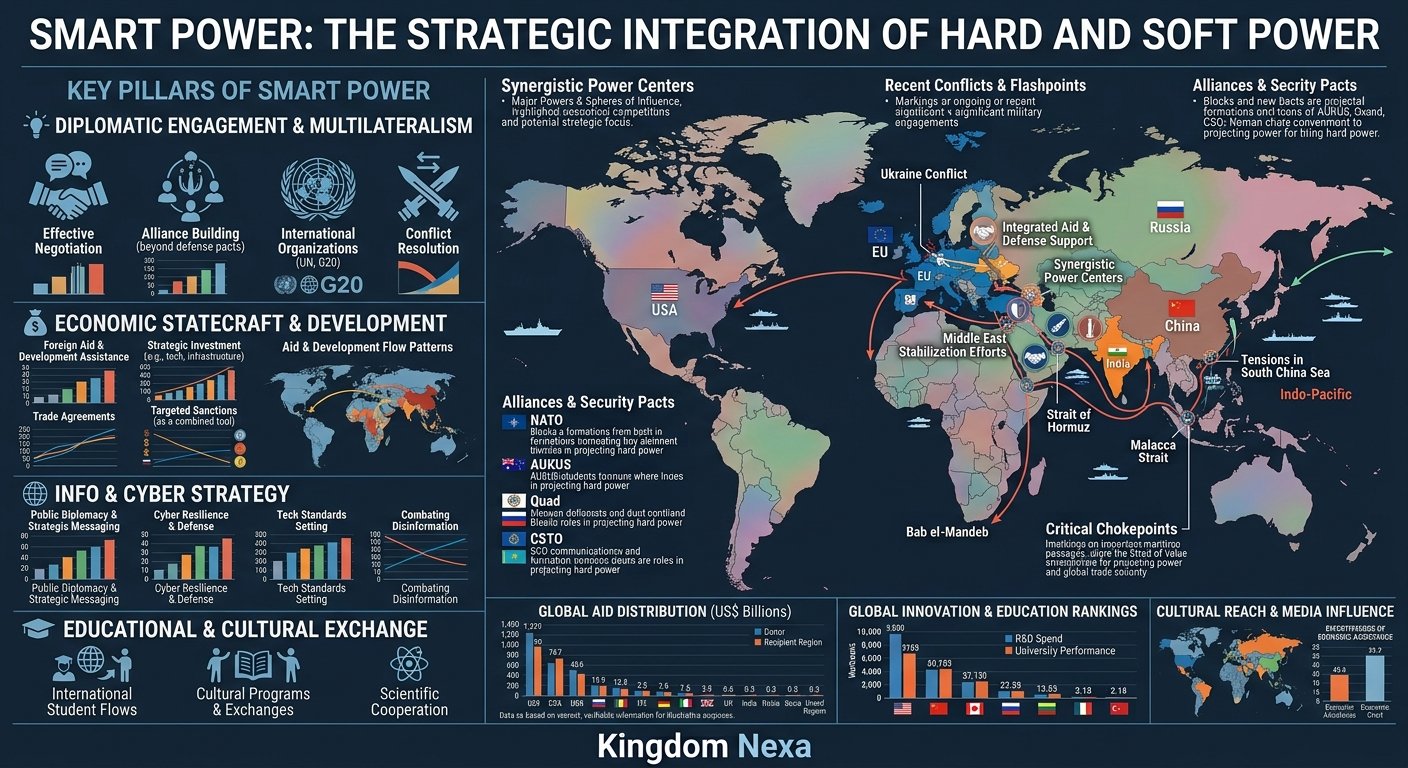
In international politics, military strength alone rarely determines whether a country can achieve its long-term objectives. Economic influence, diplomacy, alliances, technological capabilities, development assistance, culture, institutions, and the credibility of a state’s policies can be equally important. This is the strategic logic behind Smart Power: combining hard power and soft power in ways that fit the circumstances and advance clearly defined objectives.
The concept is closely associated with political scientist Joseph S. Nye Jr., who defined smart power as the ability to combine hard- and soft-power resources into effective strategies. Hard power relies primarily on coercion and inducements, while soft power works through attraction and persuasion.
The idea has become particularly relevant in an international environment shaped by strategic competition, economic interdependence, cyber threats, technological rivalry, information warfare, sanctions, alliance politics, and growing geopolitical fragmentation. This article explains what Smart Power means, how it differs from hard and soft power, how it developed, how states use it today, its advantages and limitations, and what its future may look like.
What Is Smart Power?
Smart Power is the strategic integration of hard-power and soft-power resources to achieve foreign-policy objectives effectively and efficiently.
The central idea is not that military force and diplomacy should always be used together. Rather, policymakers should select the combination of instruments that best fits a particular problem.
Hard power can include:
- Military capabilities and deterrence
- Economic sanctions
- Trade restrictions
- Financial leverage
- Security assistance
- Coercive diplomacy
Soft power can include:
- Diplomacy
- Culture
- Education
- Political values
- International partnerships
- Development cooperation
- Public diplomacy
- Persuasion and attraction
The U.S. National Museum of American Diplomacy describes smart power as the flexible combination of hard power—such as military force or economic sanctions—with soft power, including diplomatic and cultural influence, to address foreign-policy challenges.
The crucial word is strategic. Possessing many instruments does not automatically make a state powerful in a smart way. A country may have enormous military and economic capabilities yet use them inefficiently.
Smart power therefore asks a more demanding question:
Which instruments should be used, in what combination, at what time, against which objective, and with what likely consequences?
That makes smart power an approach to strategy rather than simply another category of national capability.
Smart Power vs. Hard Power and Soft Power
Understanding smart power requires distinguishing it from the two concepts on which it is built.
What Is Hard Power?
Hard power is the ability to influence behavior through coercion or inducement.
Military force is the most obvious example. A state can use military capabilities to deter an adversary, defend its territory, compel a change in behavior, or impose costs.
Economic tools can also constitute hard power. Sanctions, export controls, investment restrictions, financial pressure, and trade measures can alter another actor’s incentives.
Hard power is therefore broader than warfare.
Its major strengths are speed, coercive credibility and the ability to impose material costs. Its weaknesses include escalation risks, financial costs, resistance from the target, diplomatic backlash and potential damage to legitimacy.
What Is Soft Power?
Joseph Nye defined soft power as the ability to obtain desired outcomes through attraction and persuasion rather than coercion or payment. Its sources can include culture, political values and foreign policies when others regard them as legitimate or attractive.
Soft power can operate through:
- Universities and scholarships
- Cultural exports
- International broadcasting
- Diplomacy
- Humanitarian assistance
- Development partnerships
- International institutions
- Scientific cooperation
- Political credibility
Soft power is particularly useful when governments need cooperation rather than simple compliance.
What Makes Smart Power Different?
Smart power integrates these resources into a broader strategy.
A state might use military deterrence to prevent aggression while simultaneously using diplomacy to create an off-ramp, economic incentives to encourage cooperation, development assistance to address underlying instability, and public diplomacy to maintain international legitimacy.
The objective is not maximum pressure.
The objective is maximum strategic effectiveness from an appropriate combination of instruments.
How Did the Concept of Smart Power Develop?
The intellectual roots of smart power lie in debates about the changing nature of power in international relations.
Traditional realist thinking placed considerable emphasis on military capabilities, material resources and the distribution of power among states. Nye argued that this was incomplete because influence could also result from attraction, persuasion and the ability to shape preferences.
Joseph Nye and the Development of the Concept
Nye became closely associated with the concept of soft power and later developed the idea of smart power as a combination of hard and soft power.
His work argued that effective leadership in the twenty-first century required more than military superiority. Globalization, transnational organizations, economic interdependence and information networks created circumstances in which governments often needed cooperation from actors they could not simply command.
Nye’s formulation subsequently influenced foreign-policy debates, particularly in the United States.
Smart Power and U.S. Foreign Policy
The concept gained significant policy visibility during the Obama administration. Secretary of State Hillary Clinton described smart power as using the full range of diplomatic, economic, military, political, legal and cultural tools, selecting the appropriate instrument or combination for each situation.
U.S. policy documents of that period emphasized the integration of diplomacy, development and defense, sometimes described as the “three Ds.”
The approach emerged partly from recognition that military superiority could solve some immediate problems while failing to produce durable political outcomes.
Why Does Smart Power Matter in International Relations?
The international system has become too interconnected for many strategic problems to be solved through military force alone.
A state dealing with terrorism, maritime insecurity, climate-related instability, cyber threats or geopolitical competition may need several instruments simultaneously.
Complex Problems Require Multiple Instruments
Consider a fragile state facing armed violence.
Military assistance may improve immediate security. But without functioning institutions, economic opportunities, legitimate governance and diplomacy, military gains may not survive.
A smart-power strategy could therefore combine:
- Security assistance
- Diplomatic engagement
- Economic support
- Institution-building
- Intelligence cooperation
- Regional diplomacy
- Public communication
The exact mix depends on the circumstances.
This is why smart power is especially relevant to problems where security, economics and politics overlap.
Power Is Increasingly Networked
Modern influence is also increasingly dependent on networks.
Alliances, technology partnerships, financial institutions, supply chains, universities, corporations, international organizations and civil society can all contribute to national influence.
Nye has emphasized that transnational problems often require “power with” other actors rather than simply “power over” them.
That distinction is central to contemporary geopolitics.
What Are the Main Tools of Smart Power?
Smart power can be understood as an integrated portfolio rather than a single instrument.
Diplomacy
Diplomacy is often the first mechanism for translating capabilities into political outcomes.
Negotiations, mediation, coalition-building, confidence-building measures and diplomatic signaling can reduce the need for coercion.
Diplomacy is also essential for understanding an adversary’s objectives and identifying compromises that military pressure alone cannot produce.
Military Power
Military strength remains fundamental.
Smart power does not mean abandoning hard power. A credible defense capability can deter aggression and give diplomacy greater leverage.
NATO’s contemporary strategy illustrates this principle. At its 2026 Ankara Summit, NATO reaffirmed collective defense while emphasizing a mix of nuclear, conventional, missile-defense, space and cyber capabilities, alongside partnerships, industrial capacity and emerging technologies.
The lesson is important: smart power does not mean soft power replacing hard power.
Economic Statecraft
Economic instruments have become increasingly important in geopolitics.
States can use:
- Sanctions
- Export controls
- Investment
- Development finance
- Trade agreements
- Infrastructure projects
- Market access
- Energy partnerships
- Supply-chain policies
Economic power can be coercive, persuasive or both.
However, economic measures can also produce unintended consequences. Sanctions may impose costs on the target while encouraging alternative financial networks or supply chains.
This is why economic statecraft requires strategic assessment rather than automatic reliance on pressure.
Development and Foreign Assistance
Development cooperation can address conditions that contribute to instability.
Infrastructure, education, health, food security, energy access and institutional development can strengthen relationships with partner states.
When development cooperation is genuinely aligned with local priorities, it can produce both material benefits and political goodwill.
The EU’s Global Gateway is a contemporary example of this broader approach. Launched in 2021, it focuses on digital, climate and energy, transport, health, and education and research, linking investment with European external interests and standards. In March 2026, the European Commission described the strategy as seeking to mobilize up to €300 billion through 2027.
Technology
Technology increasingly affects every dimension of power.
Artificial intelligence can strengthen military capabilities, intelligence analysis and economic productivity. Satellites support communications, navigation and observation. Cyber capabilities can create new vulnerabilities and strategic options.
Technology also has a soft-power dimension. A country that leads in scientific research, digital infrastructure or advanced education can attract talent, investment and international partnerships.
Recent scholarship increasingly treats AI as a factor reshaping the relationship between hard, soft, sharp and smart power.
Strategic Communication
Information can influence perceptions of legitimacy and credibility.
Public diplomacy, international broadcasting, social media and government communication can shape how policies are understood abroad.
But strategic communication has a major limitation: credibility matters.
A government cannot easily manufacture durable soft power through messaging if its actions consistently contradict its stated values.
How Is Smart Power Used in Great-Power Competition?
Smart power is particularly relevant to competition among major powers because direct military confrontation can be extremely costly.
United States
The United States possesses an unusually broad portfolio of power: military capabilities, economic influence, technological leadership, alliances, global diplomatic networks, universities, financial institutions and cultural reach.
Its challenge is integrating these resources coherently.
Contemporary U.S. strategic competition increasingly involves alliances, technology controls, defense cooperation, supply-chain policy, diplomacy and military deterrence. Recent academic analysis of U.S.-China competition has specifically examined alliance-centered diplomacy, technology restrictions and integrated deterrence through a smart-power framework.
China
China’s international influence combines military modernization with trade, investment, infrastructure, diplomatic engagement, technological development and economic relationships.
Its Belt and Road-related activities demonstrate how infrastructure and economic connectivity can become instruments of international influence.
China’s growing technological capabilities also create opportunities to combine economic, diplomatic and strategic influence.
European Union
The EU demonstrates another form of smart power.
Unlike a conventional military superpower, the EU derives substantial influence from its economic scale, regulatory capacity, trade relationships, development finance, diplomatic institutions and market access.
Global Gateway illustrates how infrastructure investment can serve both development objectives and geopolitical interests. The EU’s own institutions describe the strategy as promoting connectivity while advancing standards, strategic interests and global partnerships.
Smart Power in Alliance and Coalition Building
One of the strongest applications of smart power is coalition-building.
A state can have considerable capabilities but still struggle to achieve its objectives if other governments refuse to cooperate.
NATO as a Contemporary Example
NATO’s evolution illustrates how military deterrence can be combined with partnerships, resilience, industrial cooperation, technology and political coordination.
At the 2025 Hague Summit, NATO allies agreed to increase defense and security-related investment substantially, including spending on critical infrastructure, networks, resilience, innovation and defense industrial capacity.
This is significant from a smart-power perspective because security is no longer treated purely as a question of troop numbers.
Infrastructure, supply chains, cyber resilience, technology and industrial production can all influence strategic endurance.
NATO’s 2024 Washington Summit declaration likewise emphasized partnerships, resilience, public-private cooperation and cooperation with the EU across areas including cyber, space and emerging technologies.
Smart Power and Small States
Smart power is not limited to great powers.
Small and middle powers can compensate for limited military capabilities by combining diplomacy, economic specialization, mediation, strategic partnerships, culture, investment and geography.
Why Small States Can Be Influential
A smaller state may become strategically important if it possesses:
- A valuable geographic position
- Financial resources
- Energy assets
- Diplomatic credibility
- Mediation capacity
- Specialized technology
- Major transport infrastructure
- Strong international networks
Qatar, for example, has attracted recent academic attention as a small-state case of smart power involving diplomacy, mediation, alliances and deterrence.
The broader lesson is that national influence cannot always be measured by territory or military size.
A country can create strategic relevance by becoming useful to multiple actors simultaneously.
What Are the Limitations of Smart Power?
Smart power is influential as a framework, but it is not a guaranteed formula for successful foreign policy.
Choosing the Wrong Combination
The central challenge is judgment.
A government may correctly identify several available instruments but combine them badly.
Too much coercion can undermine diplomacy. Too much accommodation can weaken deterrence. Excessive economic pressure can accelerate de-risking or alternative partnerships.
Smart power therefore depends on contextual intelligence.
Legitimacy Matters
Power can achieve short-term compliance without producing sustainable political outcomes.
A smart strategy must consider how policies affect legitimacy, trust and future cooperation.
This is particularly important because soft power depends partly on how others perceive a country’s actions.
Coordination Is Difficult
Smart power requires government agencies and institutions to work together.
Defense ministries, foreign ministries, development agencies, intelligence organizations, economic institutions and technology regulators may have different objectives, budgets and organizational cultures.
Poor coordination can turn an integrated strategy into contradictory policies.
Smart Power Can Become a Label Without Substance
There is also a conceptual danger.
Governments may describe almost any combination of policies as smart power after the fact.
That makes the concept difficult to evaluate unless policymakers specify:
- The strategic objective
- Available instruments
- Expected behavior change
- Costs
- Risks
- Time horizon
- Measures of success
Recent scholarship has also questioned whether the traditional smart-power framework is sufficiently adaptive for today’s gray-zone competition, where timing, legitimacy, resilience and rapid adjustment can be decisive.
How Should Smart Power Be Applied Strategically?
A useful smart-power framework can be built around eight questions.
1. Define the Objective
What exactly does the government want to achieve?
“Contain an adversary” is different from “deter an attack,” “change a policy,” or “build a long-term partnership.”
2. Understand the Target
What motivates the other actor?
Economic interests, domestic politics, security fears, ideology and international reputation may all matter.
3. Map Available Instruments
Policymakers should identify diplomatic, military, economic, technological, legal and informational options.
4. Select the Minimum Effective Combination
More pressure is not automatically better.
A successful strategy often seeks the least costly combination capable of producing the desired behavior.
5. Build Coalitions
Partners can provide legitimacy, resources, intelligence, market access and diplomatic leverage.
6. Anticipate Second-Order Effects
Every action creates reactions.
Sanctions may encourage alternative suppliers. Military deployments may strengthen deterrence but also increase escalation risks. Public messaging may mobilize domestic support while reducing diplomatic flexibility.
7. Preserve an Exit Strategy
A coercive strategy should ideally provide a pathway for the opposing side to change behavior without unacceptable political humiliation.
This can make diplomacy more effective.
8. Measure Results
The final test is whether policy achieves its strategic objective at an acceptable cost.
Smart power should therefore be judged by outcomes, not by how sophisticated a policy sounds.
What Is the Role of Smart Power in the Current Geopolitical Environment?
As of October 2026, the international environment makes integrated statecraft particularly important.
Strategic competition increasingly occurs across multiple domains at once: military security, economic networks, technology, information, infrastructure, energy, diplomacy and institutional influence.
NATO’s 2026 Ankara declaration reflects this multidomain environment, highlighting conventional and nuclear deterrence alongside cyber, space, AI, uncrewed systems, industrial capacity and resilience.
At the same time, economic fragmentation creates pressure for states to diversify trade and strengthen resilience. IMF research has highlighted the consequences of geopolitical and geoeconomic fragmentation for trade and economic performance, particularly in regions such as the Middle East, North Africa, Central Asia and the Caucasus.
This environment favors governments capable of switching between cooperation and competition without treating every international problem as a military contest.
What Could Smart Power Look Like in the Future?
The future of smart power is likely to become more technological, networked and data-driven.
AI and Decision-Making
Artificial intelligence can improve intelligence analysis, scenario modeling, diplomatic preparation and strategic communications.
But AI also creates risks involving misinformation, autonomous weapons, cyber operations and accelerated decision cycles.
Human judgment will therefore remain critical.
Economic and Technological Security
Semiconductors, critical minerals, energy systems, cloud infrastructure and telecommunications are increasingly strategic assets.
Future smart-power strategies will likely combine industrial policy, alliances, investment, export controls, research partnerships and diplomacy.
More Importance for Middle Powers
A more fragmented international system may give middle powers greater opportunities to act as mediators, coalition-builders and specialized economic partners.
Their influence will depend less on dominating others and more on being strategically useful to multiple networks.
From Power Over to Power With
The most sustainable form of smart power may increasingly involve cooperation.
States facing climate change, pandemics, cyber threats, financial instability and transnational crime cannot solve every problem through unilateral action.
Smart power therefore increasingly means knowing when to coerce, when to persuade, when to incentivize, and when to cooperate.
Frequently Asked Questions About Smart Power
What is Smart Power in international relations?
Smart Power is the strategic combination of hard power and soft power to achieve foreign-policy objectives. It involves selecting and coordinating instruments according to the circumstances rather than relying exclusively on military force or attraction.
Who developed the concept of Smart Power?
The concept is strongly associated with Joseph S. Nye Jr., who developed the idea of combining hard- and soft-power resources into effective strategies. Suzanne Nossel introduced the term in a 2004 Foreign Affairs article, while Nye subsequently helped establish its broader theoretical and policy significance.
What is the difference between Smart Power and Soft Power?
Soft power relies primarily on attraction and persuasion. Smart power combines soft-power tools with hard-power resources such as military and economic capabilities when appropriate.
Is military power part of Smart Power?
Yes. Smart power does not reject military strength. Instead, it treats military capabilities as one component of a wider strategic toolkit that may also include diplomacy, economics, development, technology and communication.
Why is Smart Power important today?
Modern geopolitical challenges frequently cross military, economic, technological and diplomatic boundaries. States therefore need combinations of instruments rather than a single form of power.
Can small countries use Smart Power?
Yes. Small states can use diplomacy, mediation, economic specialization, alliances, geography, investment and soft power to gain influence beyond what their military size alone would suggest. Qatar is one contemporary case examined through this framework.
Is Smart Power always successful?
No. Smart power depends on accurate assessments, effective coordination, realistic objectives and appropriate timing. Poorly designed combinations can produce escalation, economic costs, reputational damage or strategic failure.
How does technology affect Smart Power?
Technology expands both hard and soft power. AI, cyber capabilities, satellites, communications, semiconductors and digital infrastructure can strengthen military, economic, diplomatic and informational influence simultaneously.
What is the future of Smart Power?
Smart power is likely to become increasingly multidomain. Future strategies will combine defense, diplomacy, economic statecraft, technology, resilience, development, alliances and information capabilities while placing greater emphasis on adaptation and coalition-building.
Conclusion
Smart Power is best understood not as a middle ground between hard power and soft power, but as a strategy for using different forms of power intelligently.
Its central lesson is straightforward: military strength matters, but military strength alone rarely determines durable political outcomes. Diplomacy can open doors that force cannot. Economic incentives can alter calculations. Development can strengthen long-term stability. Alliances can multiply capabilities. Technology can expand both coercive and persuasive influence. Credibility can make all of these instruments more effective.
The concept remains particularly relevant in 2026 because geopolitical competition increasingly occurs across several domains simultaneously. NATO’s emphasis on deterrence, resilience, technology, industrial capacity and partnerships, alongside the EU’s use of investment and connectivity as instruments of external engagement, illustrates the broader movement toward multidimensional statecraft.
Ultimately, the defining feature of Smart Power is strategic judgment. The strongest state is not necessarily the one that uses the most pressure. It is often the one that understands when to apply pressure, when to negotiate, when to provide incentives, when to build partnerships, and when cooperation offers a better route to national and international objectives.