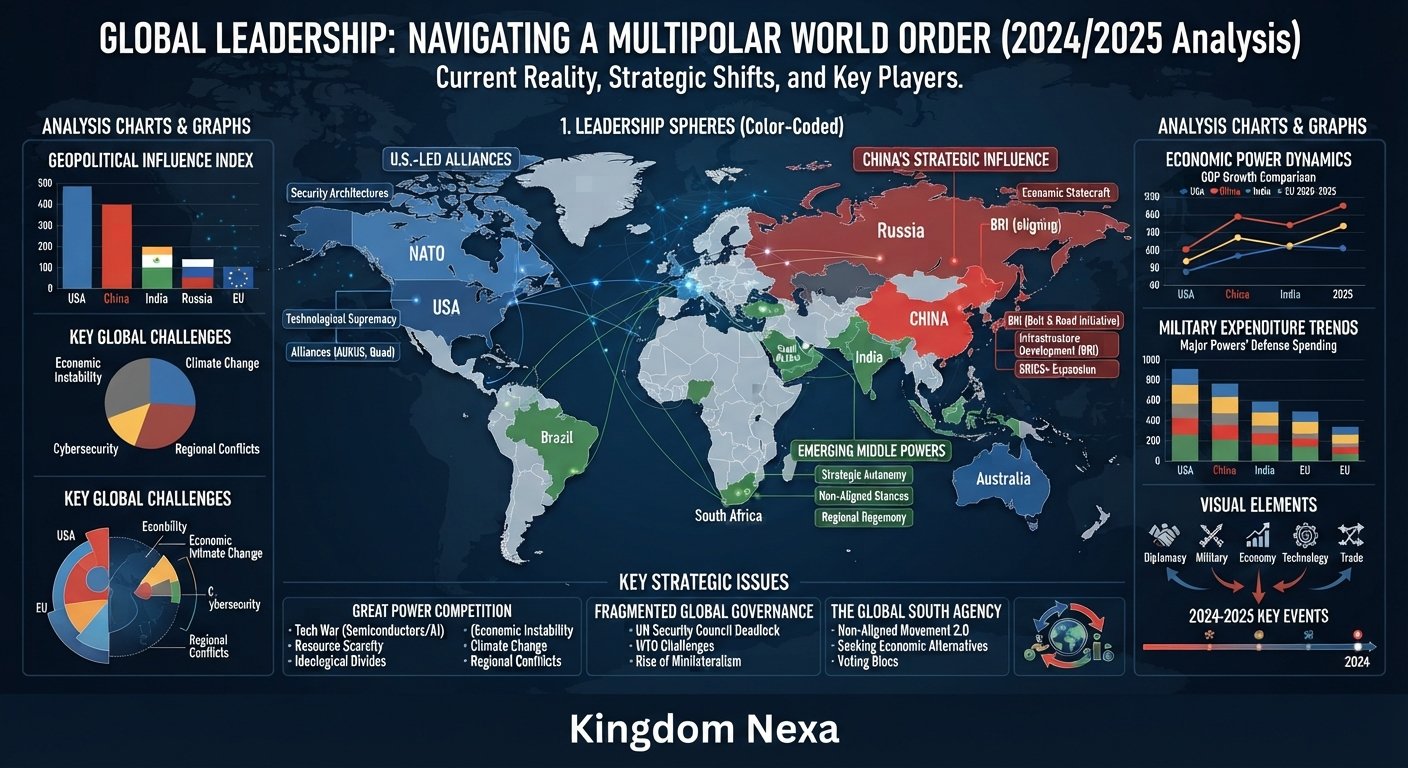
Strategic alliances shape how countries protect their interests, respond to security threats, compete for economic influence, and manage an increasingly interconnected world. From NATO’s collective-defence commitments to security cooperation in the Indo-Pacific, these partnerships influence military planning, diplomatic negotiations, international trade, and the balance of power between major states. Their importance extends beyond warfare: alliances also facilitate intelligence sharing, technological development, infrastructure investment, and coordination on global challenges.
Strategic alliances are formal or informal partnerships through which countries coordinate policies, pool resources, or support one another to achieve shared objectives. Although military defence remains a major motivation, modern alliances increasingly encompass cybersecurity, advanced technology, energy security, industrial capacity, and economic resilience.
However, cooperation does not automatically produce unity. Allies may disagree over spending, regional priorities, diplomatic negotiations, and the risks they are willing to accept. Some partnerships contain binding defence commitments, while others depend on political understanding or cooperation in specific areas.
Understanding strategic alliances therefore requires more than identifying which countries cooperate. It means examining why partnerships emerge, how they operate, what constraints they face, and how they affect regional and global stability. This article explores their historical development, principal forms, leading examples, economic and security implications, international-law foundations, and possible future trajectories, using developments available as of October 2026.
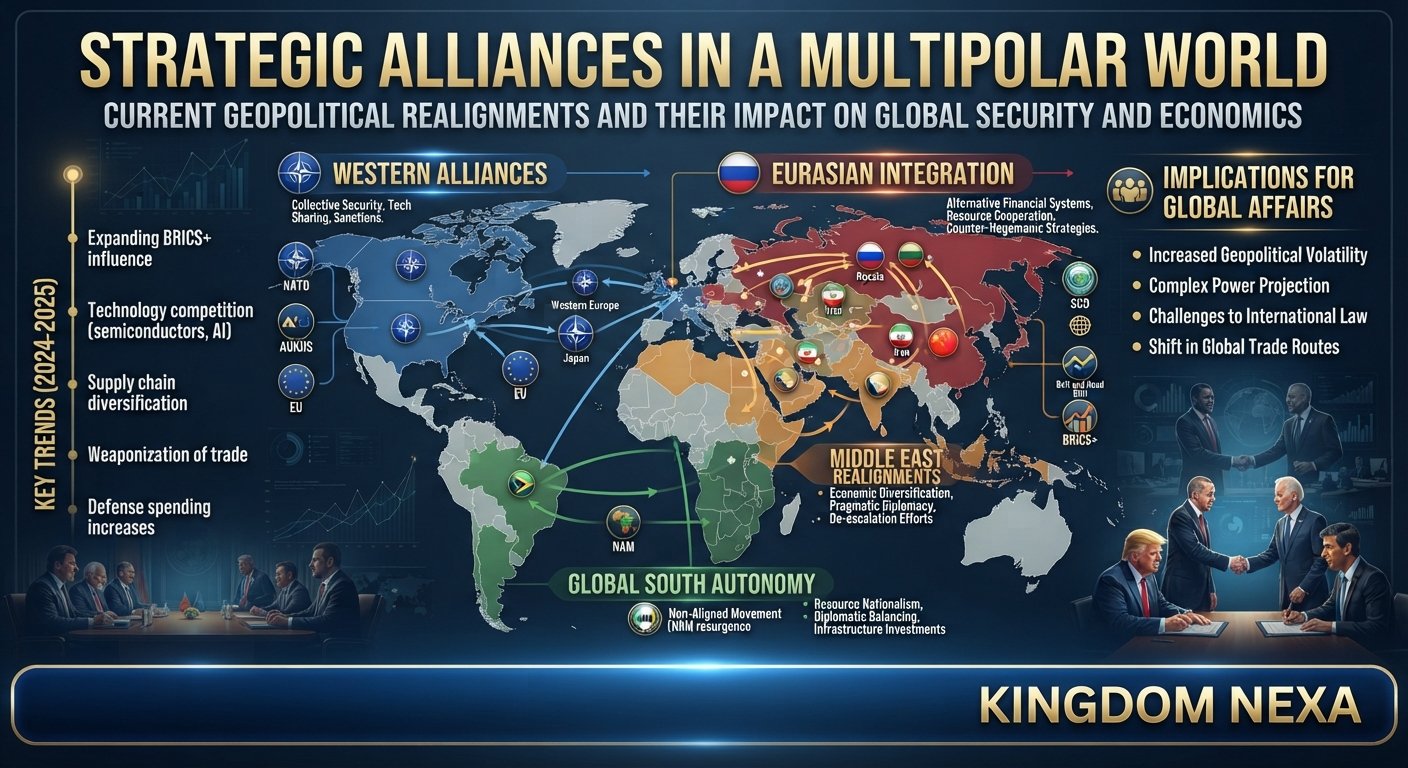
Suggested infographic placement: Insert a world map illustrating major alliance networks across Europe, North America, and the Indo-Pacific immediately below this introduction. Distinguish formal defence treaties from flexible security partnerships to avoid implying that every cooperating country has the same legal obligations.
What Are Strategic Alliances?
Strategic alliances are partnerships between states or other major actors established to advance important long-term interests through coordinated action. They may involve mutual defence, military access, intelligence exchange, economic cooperation, technology sharing, diplomatic support, or joint responses to shared challenges.
The defining feature is deliberate cooperation in pursuit of strategic objectives. Partners coordinate decisions because they believe working together offers advantages that would be difficult, expensive, or risky to achieve independently.
For example, countries facing a common security concern may conduct joint military exercises, share surveillance information, and develop compatible weapons systems. Others may coordinate energy infrastructure, secure semiconductor supply chains, or establish mechanisms for responding to cyberattacks.
How Are Strategic Alliances Different from Partnerships and Coalitions?
These terms overlap, but their distinctions matter.
- Strategic alliance: A sustained relationship organized around significant shared interests, sometimes formalized through a treaty.
- Security partnership: A broader or more flexible arrangement that may involve military training, technology, intelligence, or consultations without a mutual-defence guarantee.
- Military coalition: A group of countries cooperating for a particular operation or limited objective, often without a permanent alliance structure.
- Economic partnership: An arrangement focused primarily on trade, investment, infrastructure, finance, or industrial cooperation.
- Collective-security system: A framework in which participating states seek to respond collectively to threats to peace, rather than relying exclusively on predetermined groups of allies.
These categories can overlap. NATO is a treaty-based political and military alliance, while AUKUS is an advanced security partnership between Australia, the United Kingdom, and the United States. A temporary coalition may also include countries that are not formal allies.
The practical distinction is between cooperation that is institutionally established, cooperation that is politically discretionary, and cooperation designed for a specific mission.
Why Do Countries Form Strategic Alliances?
Governments generally pursue alliances when cooperation improves their security, influence, or economic position.
The most common motivations include:
- Deterrence: Making potential adversaries less likely to attack by increasing the anticipated costs of aggression.
- Collective defence: Establishing commitments to assist partners if they face an armed attack.
- Burden sharing: Distributing the financial, military, technological, and logistical costs of security.
- Strategic access: Obtaining access to facilities, transport routes, intelligence, and geographically important locations.
- Economic resilience: Reducing vulnerabilities in critical supply chains and strengthening industrial capacity.
- Diplomatic influence: Increasing bargaining power in international negotiations and multilateral institutions.
- Technological cooperation: Sharing expertise and developing capabilities that would be difficult to produce independently.
Alliance formation is rarely explained by a single factor. A government may seek protection from a stronger partner while simultaneously trying to preserve freedom of action and avoid excessive dependence.
The Historical Evolution of Strategic Alliances
Strategic alliances are not a modern invention. Their purposes, however, have changed alongside military technology, economic interdependence, and the structure of international politics.
From Traditional Diplomacy to Modern Alliance Systems
Before the twentieth century, European powers frequently formed alliances to prevent a single state from dominating the continent. Governments shifted partners when their interests changed, making diplomatic flexibility an important feature of the balance-of-power system.
The First World War demonstrated how interconnected commitments and competing strategic calculations could contribute to the expansion of a regional crisis. Alliances did not independently cause the war, but mobilization decisions, threat perceptions, and diplomatic failures interacted in ways that widened the conflict.
The Second World War further transformed international cooperation. The Allied powers coordinated military campaigns and industrial production against the Axis powers despite substantial ideological and political differences.
The Cold War and the Institutionalization of Collective Defence
After 1945, the emerging rivalry between the United States and the Soviet Union reorganized international security around competing strategic blocs.
NATO was established in 1949, linking North American and European members through a collective-defence treaty. The Soviet Union and several Eastern European states subsequently formed the Warsaw Pact in 1955.
These arrangements reflected competing security interests, ideological divisions, and fears of military encirclement. Nuclear deterrence made alliance credibility particularly important because the consequences of a major-power conflict could be catastrophic.
The Cold War also produced extensive bilateral security arrangements in Asia, including the US alliances with Japan and South Korea. These relationships became important elements of the regional security order.
Strategic Alliances After the Cold War
The Soviet Union dissolved in 1991, ending the bipolar structure that had dominated international politics. Alliances did not disappear. Instead, their missions diversified.
NATO expanded its membership, developed crisis-management activities, and later renewed its emphasis on territorial defence in response to a deteriorating European security environment. Regional organizations and bilateral partnerships also became more prominent.
Since the 2000s, counterterrorism, cyber threats, maritime security, and technological competition have increasingly shaped cooperation. The rise of China, Russia’s annexation of Crimea in 2014, and its full-scale invasion of Ukraine in February 2022 have reinforced debates about deterrence, military readiness, and the reliability of external security guarantees.
The result is not a simple return to Cold War blocs. Today’s international system contains overlapping alliances, flexible partnerships, economic dependencies, and states that cooperate with different powers on different issues.
Major Types of Strategic Alliances
Military and Defence Alliances
Military alliances coordinate defence planning, training, intelligence, force posture, and sometimes mutual assistance in the event of an attack.
NATO is the leading example of a multilateral defence alliance. Article 5 of the North Atlantic Treaty establishes the principle that an armed attack against one member is considered an attack against all. Each member must assist the attacked ally, although the treaty leaves each country to take the action it considers necessary, including potentially the use of armed force.
Bilateral defence treaties, such as the US–Japan security arrangement, operate within different regional and political contexts. They can provide security assurances while enabling countries to maintain distinct national defence policies.
The effectiveness of these arrangements depends on military readiness, political credibility, interoperability, and the ability to coordinate decisions during a crisis.
Economic and Industrial Alliances
Economic cooperation can strengthen strategic relationships by connecting trade, investment, infrastructure, and industrial development.
Countries may coordinate critical-mineral supplies, establish trusted technology networks, finance transport corridors, or reduce exposure to politically vulnerable suppliers. Defence-industrial cooperation is particularly significant because advanced weapons production often depends on specialized components and multinational supply chains.
Nevertheless, economic cooperation does not automatically create a military alliance. States can maintain strong commercial relationships while disagreeing over security policy.
Intelligence and Technology Partnerships
Intelligence-sharing arrangements enable participating governments to exchange information about terrorism, military movements, cyber threats, and other security risks.
Technology partnerships increasingly address artificial intelligence, satellite systems, quantum technologies, secure communications, autonomous platforms, and cybersecurity. These areas matter because modern military and economic power depends partly on access to data, computing capacity, advanced manufacturing, and resilient digital infrastructure.
Such cooperation requires safeguards. Partners must balance information sharing against concerns about espionage, intellectual property, export controls, and the protection of sensitive technologies.
Flexible and Issue-Based Partnerships
Some governments prefer partnerships that avoid comprehensive treaty commitments. These arrangements may focus on maritime exercises, disaster relief, counterterrorism, infrastructure, or regional diplomacy.
Flexible cooperation allows countries with different political systems and strategic priorities to work together where their interests overlap. However, it may provide less certainty during a major crisis than a longstanding treaty-based alliance.
Major Strategic Alliances and Partnerships in the Current World
The international system contains several important alliance networks. Their objectives differ, and their membership or cooperation arrangements should not be treated as equivalent.
NATO and Transatlantic Security
NATO remains a central institution for the collective defence of North America and Europe. Its members coordinate defence planning, exercises, capability development, and political consultations.
Russia’s war against Ukraine has reinforced the alliance’s focus on deterrence, readiness, reinforcement, and support for Ukraine. Ukraine is not a NATO member, and support for it should not be confused with the treaty’s collective-defence guarantee.
At the June 2025 Hague Summit, NATO members committed to investing 5% of GDP annually in core defence requirements and broader defence- and security-related spending by 2035. The commitment comprises at least 3.5% for core defence requirements and up to 1.5% for wider security-related priorities, with the trajectory due for review in 2029. Implementation depends on national budgets, political decisions, and agreed definitions of qualifying expenditure. NATO’s Hague Summit Declaration.
This commitment illustrates a broader issue: alliances require not only common threat perceptions but also sustained contributions from members.
US Alliances in the Indo-Pacific
The United States maintains longstanding security alliances with Japan, South Korea, Australia, the Philippines, and Thailand. These relationships differ in their treaty language, operational arrangements, and regional priorities.
Their strategic importance reflects the Indo-Pacific’s maritime geography, major trade routes, advanced manufacturing networks, and the growing military capabilities of regional powers.
Japan and South Korea are particularly important to US regional force posture, while Australia provides a close defence partner with extensive cooperation in intelligence, exercises, and advanced capabilities. The Philippines occupies a strategically significant position near major maritime routes and areas of tension in the South China Sea.
These alliances are not identical, nor do they remove the need for diplomacy with China and other regional states. Their durability depends on domestic political support, credible commitments, and management of disagreements between partners.
AUKUS: Advanced Defence and Technology Cooperation
AUKUS is a security partnership between Australia, the United Kingdom, and the United States, announced in September 2021.
Its two principal lines of effort are the development of a pathway for Australia to acquire conventionally armed, nuclear-powered submarines and cooperation on advanced capabilities. The latter includes areas such as cyber capabilities, artificial intelligence, autonomy, electronic warfare, quantum technologies, and undersea systems.
AUKUS demonstrates how strategic cooperation increasingly combines traditional military capabilities with industrial capacity, technological development, workforce training, and long-term investment. Its implementation also faces significant challenges, including costs, shipbuilding capacity, workforce requirements, and the need to manage nuclear non-proliferation obligations. Australian Government overview of AUKUS.
The partnership is intended to strengthen the participating countries’ capabilities, but its long-term results depend on whether they can deliver complex programs on schedule and sustain political and financial support.
The Quad and Flexible Indo-Pacific Cooperation
The Quadrilateral Security Dialogue, commonly known as the Quad, brings together Australia, India, Japan, and the United States.
It is not a mutual-defence treaty comparable to NATO. Its cooperation has covered maritime awareness, infrastructure, critical and emerging technologies, public health, and other regional priorities.
The Quad illustrates how governments can coordinate strategic activities without establishing a formal collective-defence obligation. India, in particular, maintains a foreign policy that preserves strategic autonomy while expanding cooperation with several partners.
China, Russia, and Other Regional Cooperation Frameworks
China and Russia have developed extensive diplomatic, economic, and security cooperation, including joint military activities and coordination in international forums. Their relationship is important to global power competition, but it should not automatically be described as a NATO-style mutual-defence alliance.
The Shanghai Cooperation Organisation (SCO) provides another example of multilateral regional cooperation. Its members include China, Russia, India, Pakistan, Iran, Belarus, and several Central Asian states. The organization addresses security, political, and economic cooperation, although its members retain differing interests and relationships with other major powers.
These arrangements show why the international system is better understood as a network of overlapping relationships than as two perfectly unified blocs.
How Strategic Alliances Shape Geopolitical Power
Deterrence, Defence, and the Balance of Power
Alliances can deter aggression by making an adversary consider the possibility of confronting several states rather than one. Shared intelligence, coordinated military exercises, compatible equipment, and access to strategically located facilities can strengthen this effect.
Yet deterrence depends on credibility. If an adversary believes that members will not act together during a crisis, the alliance may provide less reassurance than its formal commitments suggest.
Alliance expansion can also produce competing threat perceptions. A state may regard its partnerships as defensive, while a rival interprets them as evidence of encirclement or containment. Such interpretations do not justify aggression, but they can influence military planning and diplomatic behaviour.
Effective alliance management therefore combines credible defence with communication, crisis-management channels, and efforts to reduce misunderstandings.
Geography, Maritime Routes, and Strategic Access
Geography shapes alliance value. Ports, airfields, logistics hubs, undersea cables, satellite infrastructure, and major maritime chokepoints can affect a country’s ability to project power and protect trade.
Partners may offer access to locations that improve surveillance, reinforcement, or logistical reach. These arrangements can also create political sensitivities in host countries, especially when local communities perceive foreign deployments as a threat to sovereignty or security.
For smaller states, cooperation with stronger powers can improve deterrence. At the same time, dependence on a powerful ally can constrain diplomatic choices and expose them to pressure from competing powers.
Diplomatic Influence and Crisis Management
Alliances give governments opportunities to coordinate positions before international negotiations. A group of states acting together may gain greater influence over sanctions, arms-control discussions, trade rules, or responses to aggression.
However, collective decision-making can be slow. Members may disagree over escalation risks, diplomatic concessions, military contributions, or the costs of economic measures.
A strong alliance is therefore not one in which disagreements never occur. It is one with institutions and political practices that help members resolve disputes without undermining core commitments.
The Economic and Technological Dimensions of Alliances
Trade, Energy, and Supply-Chain Resilience
Strategic alliances increasingly address vulnerabilities in energy systems, critical minerals, food supplies, transport infrastructure, and advanced manufacturing.
Governments may diversify suppliers, coordinate export controls, invest in alternative transport routes, or encourage domestic production of strategically important goods. Such measures can reduce exposure to coercion or disruption.
However, reshaping supply chains can increase costs. Restricting trade may also affect businesses and consumers in countries that were not directly involved in the original dispute. Economic security policies must therefore balance resilience against efficiency and openness.
Defence Spending and Industrial Cooperation
Alliances require resources. Members may need to invest in equipment, logistics, ammunition stocks, infrastructure, maintenance, and personnel.
According to the Stockholm International Peace Research Institute, global military expenditure reached approximately $2.887 trillion in 2025, a 2.9% increase in real terms from 2024. SIPRI reported that spending rose in Europe and Asia and Oceania, while it declined in the Americas. These figures measure global military expenditure, not alliance effectiveness, but they indicate the scale of the resources governments are devoting to security. SIPRI, Trends in World Military Expenditure, 2025.
Joint procurement and shared research can lower some costs and improve interoperability. Conversely, competing procurement requirements, export restrictions, and industrial bottlenecks can make multinational programs difficult to manage.
Cybersecurity, Artificial Intelligence, and Emerging Technologies
Digital infrastructure has become a strategic asset. Cyberattacks can disrupt government services, financial systems, energy networks, communications, and military operations without a conventional invasion.
Allies increasingly cooperate on threat intelligence, secure communications, cyber defence, and technology standards. Artificial intelligence can support data analysis and surveillance, but it also raises questions about reliability, escalation, accountability, and human control over military decisions.
Technology sharing creates a dilemma: deeper integration may improve collective capabilities, yet it can expose sensitive systems to espionage or create dependencies on a partner’s software, components, and maintenance infrastructure.
Long-term alliance resilience therefore requires both cooperation and safeguards for national capabilities.
International Law and the Limits of Alliance Commitments
Strategic alliances operate within an international legal framework, but the existence of an alliance does not automatically make every action by its members lawful.
Article 51 of the United Nations Charter recognizes the inherent right of individual and collective self-defence if an armed attack occurs against a UN member, subject to the Charter’s conditions. Measures taken in self-defence must be reported to the Security Council, and the Council retains its responsibilities for international peace and security. United Nations Charter, Chapter VII.
Defence treaties establish obligations between their parties, but their precise wording matters. Some require assistance following an attack without prescribing identical military responses from every member. Others provide for consultation or cooperation without guaranteeing direct military intervention.
Alliance members remain bound by applicable international law, including the UN Charter and international humanitarian law during armed conflict. Collective action does not remove individual responsibility for unlawful conduct.
Governments must consequently assess treaty obligations, the circumstances of an attack, applicable legal rules, and the actions required under their domestic constitutional systems.
The Risks and Challenges of Strategic Alliances
Despite their advantages, alliances can create serious strategic and political difficulties.
Unequal burden sharing: Members may disagree over defence spending, troop deployments, or who should pay for shared capabilities. Smaller states may depend heavily on a stronger partner, while larger states may demand greater contributions.
Entrapment and abandonment: A country may fear being drawn into a partner’s conflict or, conversely, being left without assistance when a crisis occurs. This tension is particularly important when allies have different threat perceptions.
Escalation and arms competition: Rival powers may respond to new military partnerships by strengthening their own capabilities or building countervailing coalitions. The result can be a security dilemma in which measures intended to increase safety contribute to wider insecurity.
Conflicting national interests: Allies may disagree over sanctions, trade, relations with rival powers, or the use of military force. Shared strategic goals do not eliminate differences in domestic politics and economic priorities.
Overdependence: Reliance on a single partner for intelligence, weapons, energy, or critical technology can weaken national autonomy. Diversification and domestic capacity can reduce this vulnerability.
Domestic political uncertainty: Elections, leadership changes, public opinion, and fiscal pressures may alter a government’s willingness to sustain commitments. Formal treaties can provide continuity, but they cannot entirely eliminate political uncertainty.
Limited institutional flexibility: Established alliance procedures may be slow to adapt to rapidly changing cyber threats, autonomous systems, or emerging crises. Flexible cooperation can respond more quickly but may offer weaker assurances.
These risks do not make alliances inherently destabilizing. Their effects depend on how commitments are designed, communicated, implemented, and balanced with diplomacy.
The Future of Strategic Alliances: Three Plausible Scenarios
The following scenarios are analytical possibilities, not predictions of inevitable outcomes.
Scenario One: Stronger and More Integrated Alliances
If governments continue to perceive significant external threats, they may deepen defence planning, increase military readiness, coordinate industrial production, and expand technology sharing.
This scenario could strengthen deterrence and improve responses to cyberattacks or military crises. It could also increase fiscal pressure and sharpen competition with states outside the relevant networks.
Scenario Two: Flexible Partnerships and Strategic Autonomy
Some governments may deepen cooperation in selected areas while resisting comprehensive commitments. Countries could collaborate on maritime security or technology while maintaining independent positions on trade, energy, or diplomacy.
This approach offers flexibility and may reduce the risks of automatic alignment. However, it can make collective responses less predictable when a serious crisis requires rapid decisions.
Scenario Three: Fragmentation and Weaker Alliance Credibility
Domestic political shifts, disputes over costs, competing economic interests, or inconsistent security commitments could weaken trust between allies.
States might seek alternative partners, increase independent defence capabilities, or reduce their reliance on existing institutions. Such developments could make crisis management more difficult and encourage adversaries to test perceived divisions.
The eventual direction of global alliances will likely vary by region and issue. Strong defence cooperation may coexist with economic disagreements, while states may work together on climate, public health, or trade despite strategic rivalry.
Frequently Asked Questions About Strategic Alliances
1. What is the main purpose of a strategic alliance?
The main purpose is to advance important shared interests through coordinated action. Depending on the agreement, these interests may include collective defence, deterrence, intelligence sharing, economic resilience, technological development, or diplomatic influence.
2. What are the main types of strategic alliances?
The main types include military and defence alliances, economic and industrial partnerships, intelligence-sharing arrangements, technology partnerships, and flexible issue-based coalitions. Some are legally binding treaties, while others rely on political commitments.
3. What is an example of a strategic alliance?
NATO is a prominent example of a formal multilateral military alliance. AUKUS, involving Australia, the United Kingdom, and the United States, illustrates a different model focused on advanced defence capabilities and technology cooperation.
4. How do strategic alliances affect global politics?
They influence deterrence, military planning, diplomatic bargaining, economic policy, and the balance of power. Alliances can discourage aggression, but competing partnerships may also intensify rivalry or complicate crisis management.
5. Are strategic alliances legally binding?
Some are. Their legal force depends on the treaty or agreement, its wording, and the applicable international and domestic legal frameworks. Informal partnerships may create political expectations without establishing a binding mutual-defence obligation.
6. What is the difference between NATO and the Quad?
NATO is a treaty-based alliance with a collective-defence commitment under Article 5. The Quad is a cooperative forum involving Australia, India, Japan, and the United States, without an equivalent mutual-defence treaty.
7. Can strategic alliances prevent war?
They can help deter aggression by increasing the expected costs of an attack and improving preparedness. However, they cannot guarantee peace and may intensify rivalries if governments perceive them as threatening or use them in ways that increase escalation risks.
8. What is burden sharing in an alliance?
Burden sharing means distributing the financial, military, technological, and logistical responsibilities of cooperation. Disputes arise when members disagree over the appropriate level of contribution or believe that others benefit disproportionately.
9. How do strategic alliances affect smaller countries?
They can provide security assurances, access to technology, intelligence, investment, and greater diplomatic influence. They may also create dependence on stronger partners and limit freedom of action during disputes between major powers.
10. Are strategic alliances becoming more important?
They remain important as governments respond to military competition, cyber threats, economic vulnerabilities, and technological change. Their future significance will depend on the credibility of commitments, domestic political support, and the ability to cooperate without unnecessarily increasing international tensions.
Conclusion
Strategic alliances are fundamental instruments through which states manage insecurity, pursue shared interests, and influence the international balance of power. Their importance extends from collective defence and military deterrence to technology, trade, industrial development, intelligence, and diplomatic coordination.
NATO demonstrates the value and complexity of institutionalized collective defence. US partnerships in the Indo-Pacific and AUKUS illustrate how regional security cooperation is adapting to changing strategic conditions. The Quad and other flexible arrangements show that states can coordinate without accepting identical treaty obligations or surrendering strategic autonomy.
Yet alliances are not automatically effective or stabilizing. Their success depends on credible commitments, fair burden sharing, interoperable capabilities, public support, and the management of disagreements. Excessive dependence, escalation risks, and conflicting national interests can undermine the benefits of cooperation.
In an increasingly interconnected and competitive world, strategic alliances will continue to shape how governments respond to threats and opportunities. The central challenge is to build partnerships strong enough to protect legitimate interests while maintaining diplomatic channels, respecting international law, and avoiding unnecessary confrontation.