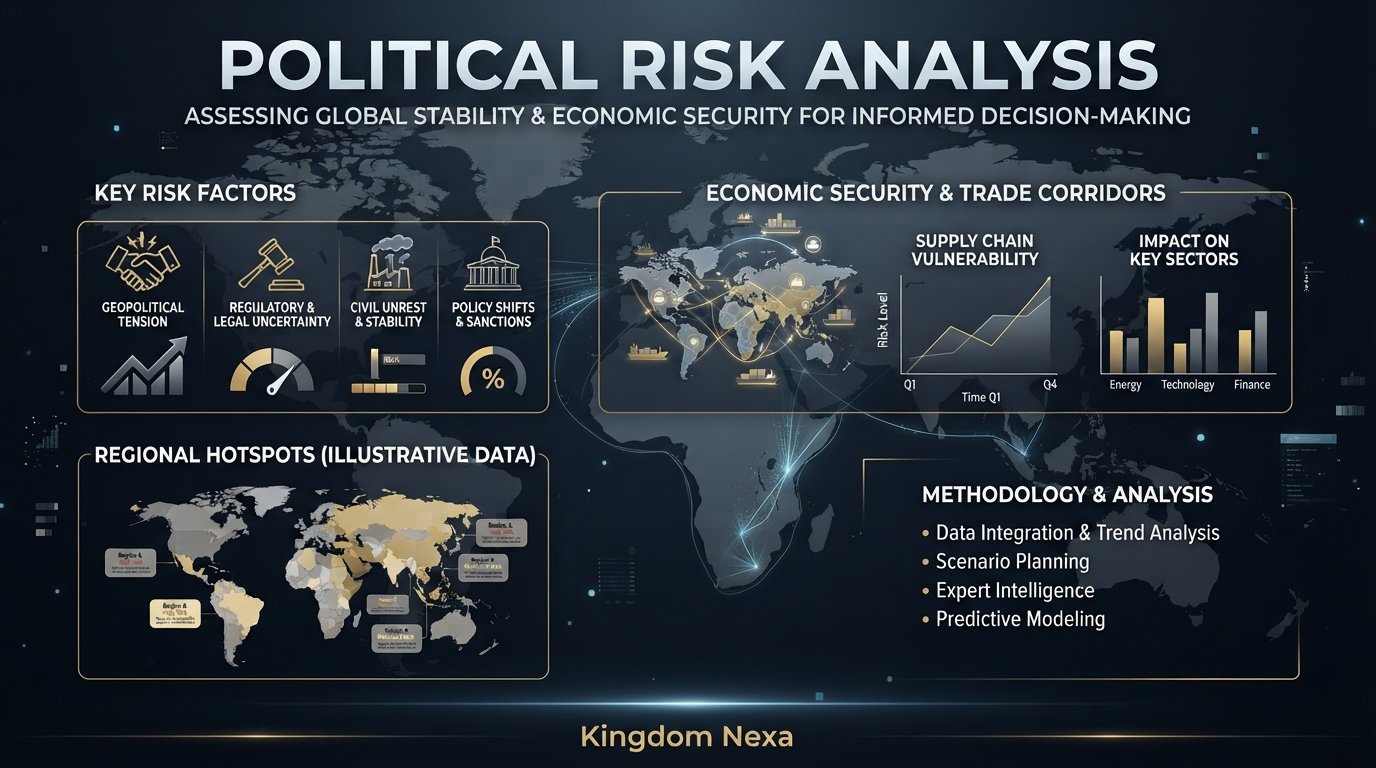
Political Risk Analysis has become increasingly important as governments, businesses, investors, diplomats, and international organizations operate in a world where political decisions can rapidly affect markets, trade, investment, security, and supply chains. A change in regulation, election outcome, sanctions regime, government policy, civil unrest, diplomatic relationship, or security environment can alter the commercial or strategic outlook of an entire country or region.
The challenge is that political risk is rarely confined to politics alone. Domestic institutions interact with geopolitics, economic pressures, technology, social divisions, international law, and security competition. In 2026, this interconnectedness is particularly significant: the World Economic Forum’s Global Risks Report 2026 identifies geoeconomic confrontation and state-based armed conflict among the leading immediate global risks, while UN Trade and Development reports that geopolitical tensions and policy uncertainty continue to influence international investment. (World Economic Forum)
This guide explains what Political Risk Analysis means, how professionals conduct it, which indicators matter, how geopolitical events are transmitted into economic consequences, and how analysts can build useful scenarios without confusing evidence with prediction.


What Is Political Risk Analysis?
Political Risk Analysis is the systematic assessment of how political events, institutions, government actions, social conditions, geopolitical developments, and regulatory changes could affect a country, organization, investment, project, market, or strategic objective.
In simple terms, it asks:
What political developments could change the operating environment, how likely are different developments, and what would their consequences be?
The analysis can be conducted at several levels:
- Country level: political stability, institutions, elections, regulation, public finances, social tensions.
- Sector level: energy, mining, technology, finance, infrastructure, defense, telecommunications, or agriculture.
- Project level: exposure of a specific investment or infrastructure project to government action or political disruption.
- Regional level: conflicts, alliances, border disputes, migration, trade corridors, and regional organizations.
- Global level: great-power competition, sanctions, supply-chain fragmentation, strategic technologies, and changes in the international economic system.
Political risk therefore differs from simply asking whether a country is “stable.” A country can have relatively stable political institutions while presenting significant regulatory, geopolitical, currency-transfer, or sector-specific risks.
The OECD’s country-risk methodology illustrates this broader approach. Its assessment combines quantitative analysis of payment, financial, economic, and institutional conditions with qualitative expert assessment capable of incorporating events such as crises and wars. (OECD)
Why Political Risk Analysis Matters
Political decisions can change economic conditions surprisingly quickly.
A government may introduce new investment-screening rules. A dispute between states may lead to sanctions. A conflict can disrupt transportation routes. An election may produce uncertainty over taxation or industrial policy. A regulatory decision may affect the profitability of an entire sector.
For companies and investors, political risk analysis can therefore support:
- Market-entry decisions
- Foreign direct investment
- Infrastructure planning
- Supply-chain diversification
- Project finance
- Insurance decisions
- Contract negotiations
- Crisis preparedness
- Strategic planning
- Government relations
- Corporate security
- Business continuity
Its importance is particularly visible in current international investment patterns. UN Trade and Development’s World Investment Report 2026 says global FDI increased 6% in 2025 to about $1.6 trillion, but the recovery was highly concentrated: the world’s 20 largest host economies received more than 80% of global FDI, while geopolitical tensions, trade-policy uncertainty, conflict, high financing costs, and economic fragmentation continued to cloud the outlook. (Investment Policy Hub)
This means political risk analysis is not simply about identifying unstable countries. It is increasingly about understanding how political decisions reshape otherwise interconnected economic systems.
Political Risk vs Country Risk vs Geopolitical Risk
These terms overlap, but they are not identical.
Political Risk
Political risk generally concerns the possibility that political actions or events will adversely affect an organization, investment, project, or economic activity.
Examples include:
- Expropriation
- Contract repudiation
- Sudden regulatory changes
- Political violence
- Civil disturbance
- Government instability
- Restrictions on capital transfers
- Nationalization
- Changes in taxation
MIGA, the World Bank Group’s Multilateral Investment Guarantee Agency, explicitly provides political-risk guarantees covering areas including expropriation, currency inconvertibility and transfer restrictions, breach of contract, war and civil disturbance, and certain government or state-owned-enterprise payment risks. (MIGA)
Country Risk
Country risk is broader. It can include political, economic, financial, institutional, social, and external-sector conditions affecting a country.
For example, a country’s sovereign debt problems may create commercial risks even without a major political crisis.
Geopolitical Risk
Geopolitical risk concerns relationships among states and the strategic consequences of geography, military power, alliances, resources, borders, trade routes, and international competition.
A company operating in one country can therefore face geopolitical risk generated somewhere else.
For example, a distant conflict may affect:
Conflict → sanctions → shipping disruption → higher transport costs → higher input prices → lower margins
This transmission mechanism is one reason modern political risk analysis increasingly overlaps with geopolitical risk analysis.
The Main Components of Political Risk Analysis
A robust assessment normally combines several dimensions rather than relying on one political indicator.
Political Institutions
Analysts examine the structure and resilience of political institutions.
Important questions include:
- How is political power obtained and transferred?
- Are institutions predictable?
- How strong are checks and balances?
- Can governments implement policy effectively?
- Are courts independent and capable of enforcing contracts?
- Are regulatory agencies predictable?
- Are political disputes resolved institutionally?
The World Bank’s Worldwide Governance Indicators provide six broad governance dimensions: Voice and Accountability, Political Stability, Government Effectiveness, Regulatory Quality, Rule of Law, and Control of Corruption. The current WGI dataset provides comparable governance information for more than 200 economies through 2024, drawing on 35 cross-country sources. (World Bank)
These indicators are useful inputs, but they should not be treated as complete forecasts of political events.
Elections and Leadership Transitions
Elections can create uncertainty when competing political groups propose substantially different economic or foreign policies.
Analysts examine:
- Election timing
- Incumbent popularity
- Opposition strength
- Coalition possibilities
- Constitutional rules
- Electoral institutions
- Policy differences between major parties
- Potential disputes over results
- Political constraints after the election
A key analytical principle is to separate what political actors have officially stated from what an analyst thinks they may eventually do.
Government Policy and Regulation
Political risk can arise without an election or crisis.
Changes to:
- Taxation
- Labor law
- Environmental regulation
- Foreign ownership
- Data protection
- Local-content requirements
- Energy policy
- Import controls
- Export restrictions
- Investment screening
can materially change the operating environment.
UNCTAD reported in 2026 that economies with investment-screening regimes increased from 21 in 2016 to 52 in 2025. It also reported a growing policy focus on strategic sectors such as digital infrastructure, advanced manufacturing, energy-transition technologies, and critical minerals. (UNCTAD)
For companies, this demonstrates why political risk cannot be separated completely from industrial policy and national-security policy.
How to Conduct Political Risk Analysis
Political risk analysis works best as a structured process.
Define the Decision
The first step is to establish what decision the analysis is intended to support.
A useful assessment might concern:
- Whether to enter a market
- Whether to expand an existing operation
- Whether to finance a project
- Whether to locate a factory
- Whether to diversify suppliers
- Whether to renew a government contract
- Whether to insure an investment
Without a defined decision, analysts can produce large amounts of political information without identifying what actually matters.
Identify Exposure
Next, identify how the organization is exposed to political developments.
Consider:
- Assets
- Employees
- Suppliers
- Customers
- Government contracts
- Licenses
- Imports
- Exports
- Financing
- Currency conversion
- Transportation routes
- Critical infrastructure
- Digital systems
Two companies operating in the same country may therefore face very different political risks.
Identify Political Drivers
The next stage is to identify the underlying drivers.
These may include:
- Institutional weakness
- Leadership transitions
- Political polarization
- Economic inequality
- Inflation
- Unemployment
- Resource competition
- Ethnic or communal tensions
- Territorial disputes
- Foreign intervention
- Sanctions
- Social unrest
- Constitutional disputes
The analyst should distinguish structural drivers from short-term triggers.
Assess Probability and Impact Separately
A common analytical mistake is to combine probability and impact too early.
Instead, ask two separate questions:
Probability: How plausible is the event given current evidence?
Impact: If it occurs, how seriously could it affect the organization?
A low-probability event can still deserve significant attention if its potential consequences are severe.
Identify Early-Warning Indicators
A strong political risk assessment should specify what evidence would indicate that conditions are changing.
Possible indicators include:
- Cabinet resignations
- Parliamentary defections
- New legislation
- Emergency decrees
- Military deployments
- Diplomatic expulsions
- Capital controls
- Currency restrictions
- New sanctions
- Protest activity
- Changes in polling
- Judicial decisions
- Changes in central-bank policy
- Border incidents
- Changes in trade restrictions
This converts political analysis from a static country report into a monitoring system.
A Practical Political Risk Framework
A useful framework can be organized around eight questions.
Who?
Identify governments, political parties, militaries, regulators, courts, businesses, civil-society organizations, international institutions, and other relevant actors.
What?
Define the event, policy, dispute, or structural change.
Why?
Identify political, economic, historical, social, security, and strategic drivers.
Where?
Examine geography.
A country’s position near a strategic waterway, border, resource basin, alliance frontier, or major trade route can materially affect its political risk exposure.
When?
Separate immediate developments from medium- and long-term structural trends.
How?
Assess the instruments available to actors.
These may include:
- Diplomacy
- Legislation
- Sanctions
- Tariffs
- Investment restrictions
- Military force
- Cyber operations
- Information campaigns
- Subsidies
- Trade agreements
So What?
Translate political developments into concrete consequences.
For a business, this might mean:
Policy change → license uncertainty → delayed investment → higher financing cost
For a government:
Regional conflict → refugee flows → fiscal pressure → domestic political tension
What Next?
Develop several plausible pathways rather than presenting one future as certain.
Historical Development of Political Risk Analysis
Political risk analysis emerged partly from the need to understand why investments could be damaged by political developments that conventional financial analysis did not capture.
During the twentieth century, nationalization, revolution, decolonization, military coups, ideological competition, and Cold War rivalry demonstrated that foreign assets could be affected by state decisions as much as by conventional market forces.
The globalization of production later expanded the problem.
Multinational companies increasingly depended on:
- Cross-border investment
- Global supply chains
- International finance
- Overseas infrastructure
- Energy imports
- Digital networks
Political risk consequently became more interconnected.
The twenty-first century added new dimensions, including terrorism, cyber threats, economic sanctions, technology controls, supply-chain resilience, critical minerals, data sovereignty, and strategic competition over advanced technologies.
Political Risk in the Current Global Environment
The 2026 environment illustrates why traditional country-by-country analysis is no longer sufficient.
The World Economic Forum’s Global Risks Report 2026, based on responses from more than 1,300 experts, identifies geoeconomic confrontation as the leading risk most likely to trigger a material global crisis in 2026, selected by 18% of respondents. State-based armed conflict followed at 14%. The report also identifies misinformation, societal polarization, cybersecurity, economic pressures, and technological risks as interconnected concerns. (World Economic Forum)
This does not mean that a particular crisis will occur. The survey measures expert perceptions of risk rather than providing a deterministic forecast.
For political risk analysts, however, the development is significant because economic instruments increasingly form part of geopolitical competition.
Trade and Economic Security
Tariffs, export controls, sanctions, investment screening, subsidies, and industrial policy can influence political and commercial relationships simultaneously.
The WEF’s 2026 analysis describes a widening use of economic tools for national-security objectives, including sanctions, regulations, capital restrictions, and supply-chain policies. (World Economic Forum)
Investment Fragmentation
International investment is increasingly affected by strategic considerations.
UNCTAD’s 2026 assessment reports that strategic sectors accounted for 44% of global greenfield project values in 2025, compared with 16% in 2020. (Investment Policy Hub)
For political risk analysis, this means sectors such as semiconductors, artificial intelligence infrastructure, critical minerals, energy, telecommunications, and advanced manufacturing may face political considerations that differ substantially from ordinary commercial sectors.
Conflict and Security
Military conflict can create political risk far beyond the battlefield.
Potential transmission channels include:
- Shipping disruption
- Commodity-price volatility
- Refugee movements
- Insurance costs
- Infrastructure damage
- Sanctions
- Cybersecurity threats
- Fiscal pressure
- Food insecurity
The IMF’s April 2026 World Economic Outlook illustrates this interconnectedness, warning that a longer or broader Middle East conflict, greater geopolitical fragmentation, renewed trade tensions, or weaker-than-expected AI productivity could significantly weaken global growth and destabilize financial markets. (IMF)
Political Risk and International Law
International law provides an important framework for understanding political risk.
Relevant areas can include:
- Bilateral investment treaties
- Multilateral investment agreements
- International trade law
- State responsibility
- Contract law
- Arbitration
- Maritime law
- Rules governing the use of force
- International humanitarian law
Legal protection does not necessarily eliminate political risk.
A company may have contractual or treaty rights, yet enforcement can still become difficult during political crises.
UNCTAD’s 2025 investment-policy analysis reported 1,401 known investor–State arbitration cases, with around 75% arising during the previous 15 years. It also noted that extractive activities and energy supply accounted for more than half of investor-initiated arbitrations in 2024. (UNCTAD)
Political Risk Insurance and Risk Mitigation
Political risk analysis is not only about identifying threats. It should also identify ways to reduce exposure.
Possible measures include:
- Political risk insurance
- Contractual protections
- Arbitration clauses
- Diversification
- Local partnerships
- Supplier diversification
- Geographic diversification
- Cash-flow restructuring
- Scenario planning
- Contingency financing
- Security planning
- Government engagement
- Business continuity plans
MIGA’s guarantee programs illustrate the practical relationship between political risk assessment and investment protection. In fiscal 2025, MIGA issued $9.5 billion in new guarantees across 44 projects, while the wider World Bank Group Guarantee Platform issued $12.3 billion in guarantees across 77 projects in 40 countries and one regional development bank. (MIGA)
Risk mitigation, however, should not be confused with risk elimination. Insurance may transfer particular financial risks without removing the underlying political conditions.
Common Mistakes in Political Risk Analysis
Relying on One Country Rating
A single score can conceal important differences between sectors, regions, assets, and political exposures.
Treating Political Stability as Permanence
A stable political system today does not guarantee stability tomorrow.
Confusing Correlation With Causation
Two political developments occurring together do not automatically establish that one caused the other.
Overrelying on Official Statements
Government announcements are important evidence of stated policy, but analysts should distinguish them from independently verified outcomes.
Ignoring Local Politics
International headlines can obscure provincial governments, local authorities, courts, regulators, communities, and interest groups that may determine how policy is actually implemented.
Treating Forecasts as Facts
Political scenarios should communicate uncertainty. An analyst should explain assumptions, indicators, and alternative pathways rather than present an uncertain future as predetermined.
How Technology Is Changing Political Risk Analysis
Technology is expanding both the information available to analysts and the risks they must monitor.
Artificial intelligence can help process:
- Legislative documents
- Government announcements
- Financial disclosures
- News reports
- Social-media data
- Trade statistics
- Satellite imagery
- Corporate filings
However, automated systems can also amplify false information, misinterpret political language, or produce false confidence.
The WEF’s 2026 report places misinformation and disinformation and cyber insecurity among significant short-term global risks, while also highlighting longer-term concerns surrounding AI and other frontier technologies. (World Economic Forum)
Consequently, technology should support—not replace—source verification, contextual judgment, and human analytical review.
Future Scenarios for Political Risk Analysis
Scenario analysis is particularly useful because political developments rarely follow a straight line.
Scenario 1: Managed Competition
States continue competing over trade, technology, security, and investment while maintaining enough diplomatic communication to prevent systemic breakdown.
Implication: Political risk remains elevated but becomes more manageable through diversification and contingency planning.
Scenario 2: Deeper Geoeconomic Fragmentation
Strategic competition produces wider restrictions on trade, technology, investment, capital, and supply chains.
Implication: Businesses may face higher costs, duplicated supply chains, regulatory divergence, and increased pressure to choose between competing economic ecosystems.
Scenario 3: Regional Conflict Spillover
A regional conflict expands geographically or generates significant economic effects through energy, shipping, financial, or migration channels.
Implication: Political risk can rapidly become macroeconomic and operational risk.
Scenario 4: Institutional Stabilization
Governments strengthen domestic institutions while states rebuild mechanisms for diplomatic and economic cooperation.
Implication: Greater predictability could reduce some forms of political risk even if geopolitical competition remains.
These are scenarios, not predictions. Their usefulness comes from identifying indicators that would make each pathway more or less plausible.
Political Risk Analysis Checklist
Before completing an assessment, analysts should ask:
- What decision is this analysis supporting?
- Who are the principal political actors?
- What are their stated interests?
- What incentives constrain them?
- Which political developments could change the operating environment?
- Which risks are domestic and which are externally generated?
- What legal protections exist?
- How exposed is the organization to government action?
- Which sectors or supply chains are strategically sensitive?
- What early-warning indicators should be monitored?
- What would be the economic consequences?
- What would be the security consequences?
- What evidence supports each conclusion?
- What remains uncertain?
- What alternative scenarios are plausible?
- What mitigation measures are available?
This checklist helps keep analysis connected to decisions rather than turning it into a general description of a country.
Frequently Asked Questions About Political Risk Analysis
What is Political Risk Analysis?
Political Risk Analysis is the systematic assessment of how political events, government actions, institutions, geopolitical developments, social conditions, and regulatory changes could affect an investment, organization, project, market, or strategic objective.
Why is Political Risk Analysis important?
It helps decision-makers identify political developments that could affect investment, regulation, trade, security, supply chains, financing, contracts, and market access.
What are examples of political risk?
Examples include expropriation, nationalization, political violence, civil unrest, sanctions, regulatory changes, capital controls, contract repudiation, government instability, and restrictions on foreign investment.
What is the difference between political risk and geopolitical risk?
Political risk generally focuses on how political developments affect an organization or economic activity. Geopolitical risk focuses more specifically on interactions among states, strategic competition, conflicts, alliances, geography, and international power relationships.
How is political risk measured?
Analysts may combine governance indicators, economic data, political-event monitoring, institutional analysis, expert judgment, scenario analysis, and sector-specific exposure assessments. No single indicator captures every dimension of political risk.
Can political risk be predicted?
Political risk cannot be predicted with certainty. Professional analysis instead identifies plausible scenarios, assesses evidence and uncertainty, and monitors indicators that could signal changes in the risk environment.
How does political risk affect foreign investment?
Political risk can influence expected returns, financing costs, insurance requirements, market access, regulatory certainty, supply chains, asset security, and the willingness of investors to commit capital.
What organizations assess political risk?
Political risk is assessed by governments, multinational corporations, banks, insurers, investment firms, development institutions, political-risk consultancies, academic researchers, and international organizations. Different organizations use different methodologies and risk definitions.
Can political risk be insured?
Some forms can be insured or guaranteed. MIGA, for example, provides political-risk guarantees covering specified risks such as expropriation, transfer restrictions, breach of contract, and war and civil disturbance for eligible investments. (MIGA)
Why is political risk especially important in 2026?
The international environment increasingly combines geopolitical competition with trade restrictions, investment screening, sanctions, technology competition, armed conflicts, and supply-chain vulnerabilities. Current assessments from the WEF, IMF, and UN Trade and Development all point to significant uncertainty surrounding geopolitical and economic conditions in 2026. (World Economic Forum)
Conclusion
Political Risk Analysis is ultimately an exercise in connecting political developments to real-world consequences. It goes beyond asking whether a country is stable or unstable. A rigorous assessment examines institutions, leadership, regulation, elections, social pressures, geopolitical relationships, security conditions, international law, economic dependencies, technology, and the specific exposure of the organization being analyzed.
The current global environment makes this approach particularly important. Geoeconomic competition, investment screening, strategic technology controls, armed conflicts, supply-chain vulnerabilities, and changing trade policies increasingly overlap. The result is a risk landscape in which a political decision in one jurisdiction can create economic or operational consequences far beyond its borders. (World Economic Forum)
Effective Political Risk Analysis therefore combines evidence with structured judgment. It identifies what is known, distinguishes it from interpretation, makes uncertainty explicit, develops plausible scenarios, and establishes early-warning indicators. For businesses, governments, investors, researchers, and policymakers, that discipline provides a more practical way to understand an increasingly interconnected international system.