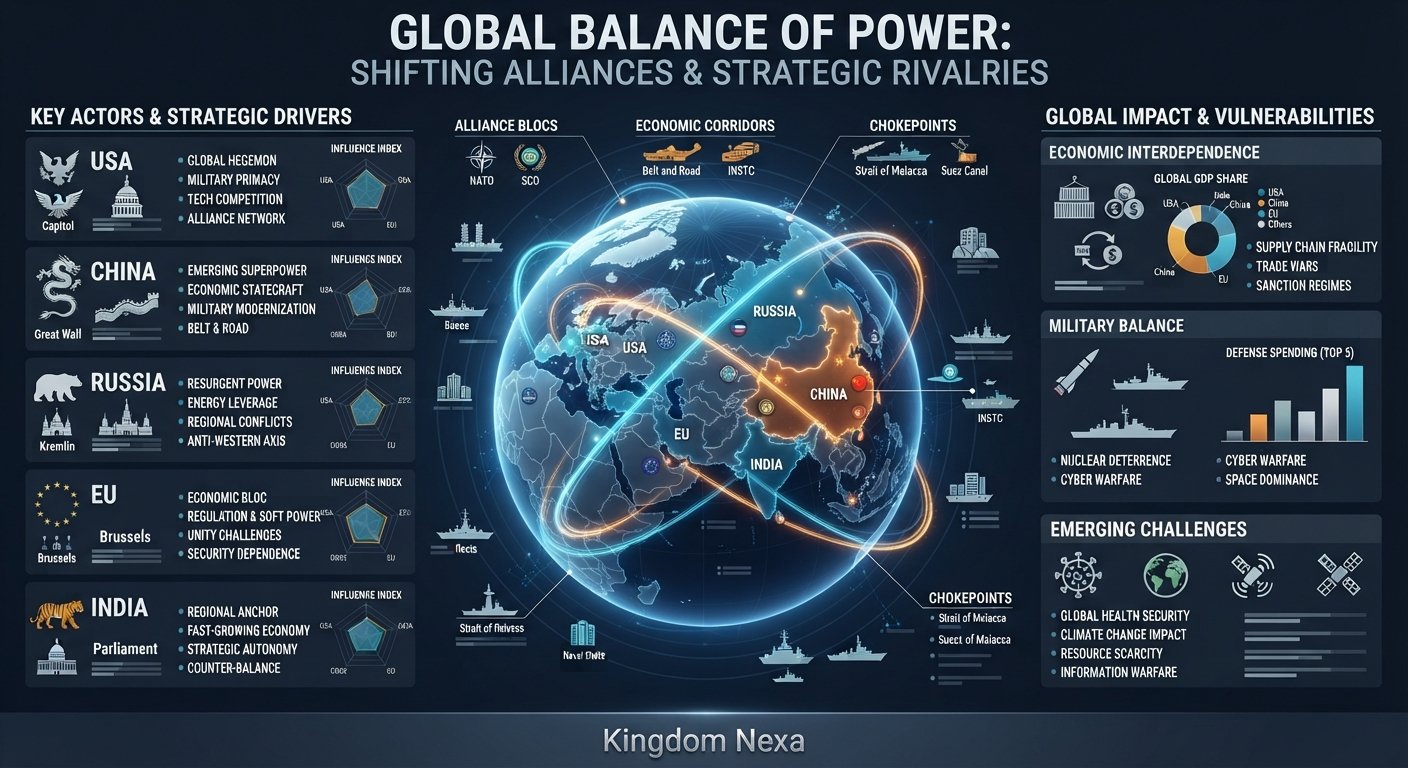

International politics is rarely driven by a single motive. States seek security, economic prosperity, political influence, territorial integrity, access to resources, diplomatic freedom, and a favorable international environment. These objectives are commonly brought together under the concept of National Interest in International Relations.
National interest is one of the most important concepts for understanding why states make particular foreign-policy decisions. It helps explain why governments form alliances, negotiate treaties, impose sanctions, protect trade routes, develop military capabilities, compete for technological advantages, or cooperate through international institutions. At the same time, the concept is contested because governments, political parties, social groups, and scholars may disagree about what truly serves the nation.
The idea is central to both the study and practice of foreign policy. Academic literature emphasizes that governments use national interest both to explain state behavior and to define the objectives they seek abroad. (DOI)
What Is National Interest in International Relations?
National interest in international relations refers to the fundamental goals, priorities, and objectives that a state seeks to protect and advance in its relations with other states and actors.
These interests can include:
- National security and territorial integrity
- Protection of sovereignty
- Economic prosperity
- Political stability
- Access to energy and strategic resources
- Trade and investment
- Protection of citizens abroad
- Strategic influence
- Diplomatic autonomy
- Regional stability
- Technological and industrial capabilities
- Protection of important national values
The concept is broader than military security. Although security has historically occupied a central position, modern national interests can also involve economic resilience, technological competitiveness, energy security, environmental stability, supply chains, and international reputation.
The International Encyclopedia of Political Science describes national interest as central to understanding state action and foreign policy, while emphasizing that its content changes across time and political contexts. (DOI)
A useful way to understand the concept is to ask:
What does a state consider sufficiently important to protect, promote, or obtain through its external relations?
The answer differs from one country to another and can change as circumstances change.


Why Is National Interest Important in International Relations?
National interest provides a framework for understanding state behavior.
Without identifying interests, it becomes difficult to explain why a government chooses one foreign-policy option over another. Two countries may face the same international event but respond differently because their strategic priorities, geographic positions, economic structures, and security concerns differ.
For example, a country dependent on imported energy may regard stable energy supplies as a major national interest. A maritime trading state may place greater emphasis on freedom of navigation and secure sea lanes. A country facing a serious military threat may prioritize territorial defense and alliances.
National interest therefore connects foreign-policy objectives with national priorities.
It also helps policymakers decide where limited resources should be allocated. A government cannot normally pursue every international objective with equal intensity. It must establish priorities and determine which interests justify significant diplomatic, economic, or military commitments.
Donald Nuechterlein’s influential work on the subject highlights the ambiguity of the concept and argues for greater precision when using national interest as a framework for analyzing foreign policy. (Cambridge University Press)
How Did the Concept of National Interest Develop?
The intellectual roots of national interest are closely connected with the older idea of raison d’état, or “reason of state.”
European political thought increasingly developed the idea that governments sometimes had to make decisions based on the survival and security of the state rather than purely religious or moral considerations. The consolidation of sovereign states and the development of modern diplomacy strengthened this way of thinking.
The concept became particularly influential in the twentieth century as scholars attempted to explain international conflict and foreign-policy behavior.
Hans Morgenthau and Classical Realism
Hans J. Morgenthau played a particularly important role in establishing national interest as a central concept in classical realist thought.
For Morgenthau, international politics could not be understood without considering power and interest. He argued that foreign-policy objectives should be understood in relation to national interest and the political circumstances of a particular historical period.
The important point is that Morgenthau did not treat interest as completely detached from context. The meaning of national interest depends partly on the political and cultural environment in which foreign policy is formulated. (Encyclopedia.com)
This became one of the foundations of realist international relations theory.
What Are the Main Types of National Interest?
There is no universally accepted classification of national interests. Different scholars and governments organize them differently. However, several broad categories are useful for analysis.
1. Vital or Core Interests
Vital interests concern issues that a state considers fundamental to its survival or basic security.
They may include:
- Territorial integrity
- National sovereignty
- Survival of the state
- Protection against major external threats
- Protection of the constitutional or political order
- Survival of the population
A government may be willing to accept substantial economic or diplomatic costs to protect a vital interest.
2. Secondary Interests
Secondary interests matter to a state but generally do not justify unlimited costs.
Examples may include:
- Expanding commercial relationships
- Supporting diplomatic partners
- Protecting overseas investments
- Increasing international influence
- Promoting cultural relations
- Securing favorable trade arrangements
Governments may negotiate or compromise on secondary interests when doing so protects more important objectives.
3. Economic Interests
Economic interests have become increasingly important in contemporary international relations.
They can include:
- Export markets
- Foreign investment
- Energy supplies
- Critical minerals
- Technology
- Supply-chain resilience
- Access to international finance
- Maritime trade
- Economic sanctions
- Industrial competitiveness
Economic security and national security are increasingly interconnected. A disruption in energy, semiconductors, food supplies, shipping, or financial systems can have strategic consequences.
4. Security Interests
Security interests involve protecting the state and its population from external threats.
They may involve:
- Military defense
- Intelligence
- Counterterrorism
- Cybersecurity
- Nuclear deterrence
- Border security
- Alliance commitments
- Maritime security
- Space security
Security remains particularly important to realist theories of international relations.
5. Political and Diplomatic Interests
States also seek political objectives abroad.
These may include:
- Maintaining diplomatic influence
- Building alliances
- Preventing isolation
- Supporting favorable international rules
- Strengthening regional partnerships
- Increasing influence in international organizations
Diplomatic influence can sometimes achieve objectives that military power cannot accomplish efficiently.
6. Ideological and Value-Based Interests
Governments may also define certain political values as part of national interest.
These can include:
- Democracy
- Human rights
- Religious or cultural values
- National identity
- Political ideology
- International norms
However, analysts should distinguish between a government’s stated values and its strategic interests. A state may simultaneously pursue moral, ideological, economic, and security objectives.
What Is the Relationship Between National Interest and Foreign Policy?
National interest and foreign policy are closely connected, but they are not identical.
National interest describes what a state considers important. Foreign policy describes how the state attempts to pursue those objectives internationally.
A simplified relationship can be expressed as:
National Interests → Strategic Objectives → Foreign Policy → Diplomatic and Other Instruments → Outcomes
For example, suppose a country identifies energy security as an important national interest.
Its strategic objective might be to diversify energy suppliers.
Its foreign policy could then involve:
- Negotiating energy agreements
- Building regional partnerships
- Investing in alternative infrastructure
- Developing renewable energy
- Protecting maritime routes
- Establishing strategic reserves
The same national interest can therefore produce several foreign-policy instruments.
How Does National Interest Shape Foreign Policy Decisions?
Governments generally have multiple policy options. National interest helps policymakers compare the expected benefits, risks, costs, and strategic consequences of those options.
A government may ask:
- What national interest is at stake?
- How important is that interest?
- What threats could undermine it?
- What resources are available?
- What are the likely costs of action?
- What are the consequences of inaction?
- How will other states respond?
- Can diplomacy achieve the objective?
- Is military power necessary?
- What international-law constraints apply?
This makes national interest a decision-making framework rather than merely a slogan.
National Interest and International Relations Theories
Different theories of international relations interpret national interest differently.
Realism
Realism places national interest, power, security, and survival near the center of international politics.
From a realist perspective, states operate in an international system without a single world government capable of reliably protecting every state. Governments therefore have strong incentives to preserve their security and relative position.
Realists commonly emphasize:
- Survival
- Power
- Security
- Strategic competition
- Balance of power
- Military capability
- State sovereignty
This does not mean every realist explanation reduces foreign policy to military power. Economic and diplomatic capabilities can also contribute to national power.
Liberalism
Liberal approaches provide a broader interpretation.
States may pursue national interests through:
- International institutions
- Trade
- Cooperation
- International law
- Economic interdependence
- Multilateral diplomacy
From this perspective, cooperation does not necessarily contradict national interest. Governments may cooperate because institutions and agreements can produce benefits that individual states cannot easily achieve alone.
Constructivism
Constructivists challenge the assumption that national interests are fixed.
They emphasize the importance of:
- Identity
- Norms
- Ideas
- Historical experiences
- Social interaction
- Political narratives
From a constructivist perspective, what a state considers an “interest” can itself be shaped by its identity and interaction with other states.
Critical Approaches
Critical and other approaches examine who defines national interest and whose interests are represented by state policy.
This raises an important question:
Does a policy described as being in the national interest actually benefit society broadly, or does it disproportionately benefit particular political or economic groups?
Oxford scholarship on South Asian foreign policy, for example, emphasizes that domestic interest groups, political negotiation, and state-building can influence how national interest is defined. (OUP Academic)
Is National Interest the Same as Public Interest?
No.
National interest generally concerns a state’s objectives in its external environment, while public interest can refer more broadly to what benefits society within the country.
The two can overlap, but they are not automatically identical.
A government might argue that an overseas investment agreement serves the national interest because it improves strategic influence. Critics might argue that the agreement benefits particular corporations without producing sufficient public benefit.
This distinction is important because the phrase “national interest” can carry considerable political authority. Invoking it may make a policy appear to represent the entire nation even when significant domestic disagreement exists.
Scholars have therefore warned that national interest can function both as an analytical concept and as a political instrument used to justify particular policies. (Encyclopedia.com)
Who Defines the National Interest?
There is rarely a single person or institution that defines national interest permanently.
Depending on the political system, influential actors may include:
- Heads of government
- Foreign ministries
- Defense ministries
- Legislatures
- National-security institutions
- Military leadership
- Intelligence agencies
- Economic ministries
- Political parties
- Business organizations
- Civil society
- Public opinion
- Media
- Strategic communities
Domestic institutions can therefore shape foreign policy.
A democratic government may need to consider public opinion and parliamentary constraints. An authoritarian system may give greater influence to a narrow political leadership. Coalition governments may face competing domestic priorities.
Consequently, national interest should not automatically be treated as a single objective preference shared equally by every citizen.
What Factors Determine National Interest?
National interest is shaped by both domestic and international factors.
Geography
Geography can strongly influence strategic priorities.
Countries with coastlines may prioritize maritime security. Landlocked states may focus on access to neighboring transport networks. States located between competing powers may emphasize strategic balancing.
Geography can also determine the importance of rivers, mountain passes, ports, borders, islands, and strategic chokepoints.
Economic Structure
A country’s economy influences its external priorities.
An export-oriented economy may emphasize open markets and trade agreements. An energy-importing country may prioritize stable energy supplies. A major financial center may emphasize financial stability and predictable international rules.
Military Capabilities
Military power affects what governments can realistically pursue.
A powerful state may have more options for deterrence, alliance commitments, overseas operations, and crisis response. Smaller states may rely more heavily on diplomacy, alliances, international institutions, or strategic partnerships.
Domestic Politics
Political institutions and domestic groups can significantly affect foreign policy.
Elections, public opinion, nationalism, economic interests, ideology, and leadership preferences may influence how governments interpret national interest.
This is why foreign policy cannot always be explained exclusively through international-system pressures.
Technology
Technology has become a major component of strategic competition.
National interests increasingly involve:
- Artificial intelligence
- Semiconductors
- Cybersecurity
- Satellite systems
- Telecommunications
- Drones
- Quantum technologies
- Digital infrastructure
Control over strategically important technologies can affect both economic competitiveness and national security.
National Interest and International Organizations
National interest does not necessarily conflict with international cooperation.
States frequently use international institutions to advance interests that would be difficult to achieve independently.
The United Nations, NATO, European Union, World Trade Organization, IMF, World Bank, and regional organizations can provide mechanisms for:
- Collective security
- Trade
- Diplomacy
- Economic coordination
- Conflict management
- Development
- Rule-making
The important question is not simply whether states cooperate, but why they cooperate and what interests they expect cooperation to serve.
The UK’s 2025 National Security Strategy, for example, explicitly links international cooperation and alliances with national security interests, illustrating how governments can regard collective action as part of national interest rather than its opposite. (GOV.UK)
National Interest and International Law
National interest operates within a system of international law, although tensions can arise between national objectives and international legal obligations.
States must consider issues such as:
- Sovereignty
- Treaty obligations
- Use of force
- Diplomatic law
- International humanitarian law
- Maritime law
- Human rights obligations
- Sanctions regimes
- International dispute settlement
A government may believe a particular action serves its national interest, but that does not automatically make the action lawful.
This distinction is essential for objective geopolitical analysis:
Strategic interest, political justification, and legal validity are separate questions.
National Interest in a Changing Global System
The meaning of national interest is evolving as global politics becomes more interconnected.
Traditional concerns such as military security and territorial defense remain important, but states increasingly consider transnational issues.
These include:
- Climate change
- Pandemics
- Cyber threats
- Global supply chains
- Energy transitions
- Food security
- Artificial intelligence
- Migration
- Critical minerals
- Financial instability
The result is a broader understanding of security.
A disruption thousands of kilometers away can affect domestic economic stability through energy prices, shipping costs, supply shortages, or financial markets.
Former UN Secretary-General Kofi Annan argued that countries increasingly needed to recognize the connection between national and global interests, particularly when confronting challenges that cross borders. (United Nations)
Examples of National Interest in International Relations
Energy Security
A state dependent on imported oil or gas may develop relationships with multiple suppliers to reduce vulnerability.
This can influence diplomacy, infrastructure investment, maritime security, and regional alliances.
Alliance Building
States may join or strengthen alliances because collective defense improves their security.
The alliance itself can become part of the national-interest calculation because it changes the strategic balance and reduces isolation.
Trade Policy
Governments may negotiate trade agreements to expand exports, attract investment, protect strategic industries, or strengthen supply-chain resilience.
Trade policy can therefore serve both economic and geopolitical objectives.
Strategic Chokepoints
Maritime chokepoints can have enormous geopolitical importance because disruption can affect international commerce and energy supplies.
Consequently, freedom of navigation and maritime security may become national interests for countries heavily dependent on international trade.
Technology Competition
Governments increasingly regard advanced technology as strategically important.
Semiconductors, artificial intelligence, telecommunications, cybersecurity, and satellite capabilities can affect both economic competitiveness and military power.
What Are the Limitations of the National Interest Concept?
Despite its importance, national interest has significant limitations.
It Can Be Ambiguous
There is no universally accepted formula for determining exactly what constitutes national interest.
Nuechterlein specifically highlighted the ambiguity surrounding the concept and argued for more precise analytical frameworks. (Cambridge University Press)
It Can Be Politicized
Political leaders may describe controversial policies as being in the “national interest” to strengthen public support.
The phrase can therefore become a rhetorical tool.
It Can Hide Domestic Conflicts
A country may contain multiple groups with different interests.
Business interests, workers, political parties, security institutions, regional communities, and civil society may disagree about foreign-policy priorities.
It Can Encourage Short-Term Thinking
A policy may generate immediate strategic benefits while producing long-term costs.
For example, a government might gain short-term economic advantages while increasing long-term strategic dependence.
Interests Can Conflict
National interests are not always mutually compatible.
Economic openness may increase prosperity while creating strategic dependencies. Military expansion may improve deterrence while increasing financial pressure. Supporting an ally may strengthen regional security while creating the risk of entrapment in conflict.
Effective foreign policy therefore requires prioritization and trade-offs.
How Should Analysts Evaluate National Interest?
A useful analytical framework is to examine national interest through eight questions:
1. What is the stated interest?
What does the government officially claim it wants?
2. What is the underlying strategic objective?
What outcome is the state actually trying to achieve?
3. Who benefits?
Does the policy benefit the broader national community or particular groups?
4. What capabilities support the objective?
Does the state possess the economic, military, diplomatic, and technological resources required?
5. What constraints exist?
Consider geography, international law, domestic politics, economic limitations, alliances, and public opinion.
6. How will other states respond?
National interest must be evaluated within an interactive international system.
7. What are the costs and risks?
Every strategic choice involves trade-offs.
8. What happens if the policy succeeds or fails?
This helps distinguish immediate gains from long-term consequences.
This approach prevents analysts from simply accepting official statements at face value.
National Interest vs Foreign Policy vs National Security
These concepts are related but different.
| Concept | Meaning |
|---|---|
| National Interest | What a state seeks to protect or advance |
| Foreign Policy | The strategies and policies used to pursue external objectives |
| National Security | Protection of the state and population from significant threats |
| Diplomacy | Negotiation and communication used to manage international relations |
| National Power | The capabilities available to pursue national objectives |
National security can be one of the most important national interests, but national interest is broader.
Similarly, diplomacy is an instrument of foreign policy, while foreign policy is an instrument through which national interests are pursued.
Why National Interest Still Matters in the 21st Century
The international system has changed considerably, but national interest remains central to geopolitical analysis.
States continue to compete over:
- Security
- Territory
- Resources
- Technology
- Markets
- Influence
- Strategic partnerships
- International rules
At the same time, interdependence means that states increasingly pursue national objectives through cooperation.
The modern challenge is therefore not simply choosing between national interest and international cooperation. It is understanding when cooperation itself advances national interests and when international commitments impose costs or constraints.
This makes national interest particularly useful for analyzing strategic competition among major powers, regional rivalries, economic diplomacy, alliance politics, energy security, and emerging technological competition.
Future of National Interest in International Relations
The future concept of national interest is likely to become broader rather than narrower.
Military power will remain important, but governments will increasingly evaluate national power through a combination of:
- Economic resilience
- Technological capacity
- Cybersecurity
- Energy security
- Supply-chain reliability
- Diplomatic influence
- Social resilience
- Military capability
- Strategic partnerships
- Access to critical resources
The distinction between domestic and international security is also becoming less clear.
Cyberattacks, pandemics, climate-related disruptions, financial crises, artificial intelligence, and supply-chain shocks can originate beyond national borders but produce domestic consequences.
This means future foreign-policy analysis will increasingly require an integrated understanding of economics, technology, security, diplomacy, and domestic politics.
Frequently Asked Questions
What is national interest in international relations?
National interest is the collection of goals and priorities that a state seeks to protect and advance through its domestic and international actions, particularly in areas such as security, sovereignty, economic prosperity, and strategic influence.
Why is national interest important in international relations?
It helps explain why states make particular foreign-policy decisions, form alliances, negotiate agreements, pursue economic relationships, develop military capabilities, and respond to international threats.
What are the main types of national interest?
Common categories include vital or core interests, secondary interests, security interests, economic interests, political interests, diplomatic interests, and ideological or value-based interests.
Who defines national interest?
National interest is shaped by political leaders, governments, legislatures, security institutions, economic actors, public opinion, political parties, and broader domestic and international conditions.
Is national interest the same as foreign policy?
No. National interest describes what a state wants to protect or achieve, while foreign policy refers to the strategies and actions used to pursue those objectives internationally.
How does realism view national interest?
Realism generally places survival, security, power, and strategic competition at the center of national interest because states operate in an international system without a central authority that can reliably guarantee their security.
Can national interest change?
Yes. National interests can change as governments, economic conditions, technology, threats, alliances, public preferences, geography, and the international system change.
Does national interest conflict with international cooperation?
Not necessarily. States can cooperate through alliances and international institutions when cooperation helps advance their security, economic, diplomatic, or strategic objectives.
Why is national interest controversial?
The concept is controversial because different political groups and scholars may disagree about what benefits the nation, who should define national priorities, and whether a particular policy genuinely serves society as a whole.
Conclusion
National Interest in International Relations provides one of the most useful frameworks for understanding how states behave in the international system. It connects national priorities with foreign policy, diplomacy, security strategy, economic policy, alliances, and geopolitical competition.
At its core, national interest concerns what a state considers important enough to protect or promote. Security and sovereignty remain fundamental, but contemporary national interests increasingly include economic resilience, technological capabilities, energy security, trade, supply chains, diplomatic influence, and international stability.
The concept should nevertheless be used carefully. National interest is not always objective, unified, or permanent. Political leaders, institutions, interest groups, historical experiences, and changing international conditions can influence how it is defined. As a result, analysts should distinguish between a government’s stated national interest and the broader evidence concerning its objectives, capabilities, costs, and consequences.
Understanding these distinctions makes national interest far more than a textbook definition. It becomes a practical analytical tool for explaining why states act, what they seek, what constraints they face, and how their decisions shape international geopolitics.