
Great Power Politics is one of the most important concepts for understanding how the international system works. Wars, alliances, economic rivalries, diplomatic crises, technological competition and struggles over international institutions are often shaped by the behavior of states with unusually large concentrations of power.
Yet great power politics is not simply a contest between the strongest militaries. Modern power includes economic scale, technological capability, diplomatic reach, alliances, financial influence, nuclear deterrence, demographic resources, geographic position and the ability to shape international rules. A country may therefore be powerful in one dimension while constrained in another.
The concept has become particularly important as the post-Cold War international system has become more contested. The United States remains the world’s most powerful state across many measures, China has emerged as a comprehensive challenger with enormous economic and technological weight, Russia retains major military and nuclear capabilities, while India and other influential states are gaining greater strategic importance. Europe, Japan and middle powers also shape the balance through alliances, markets, technology and diplomacy.
Understanding Great Power Politics therefore requires more than asking who is strongest. It requires examining how power is distributed, how major states pursue their interests, how smaller states respond, and whether competition produces rivalry, balancing, cooperation or conflict.
What Is Great Power Politics?
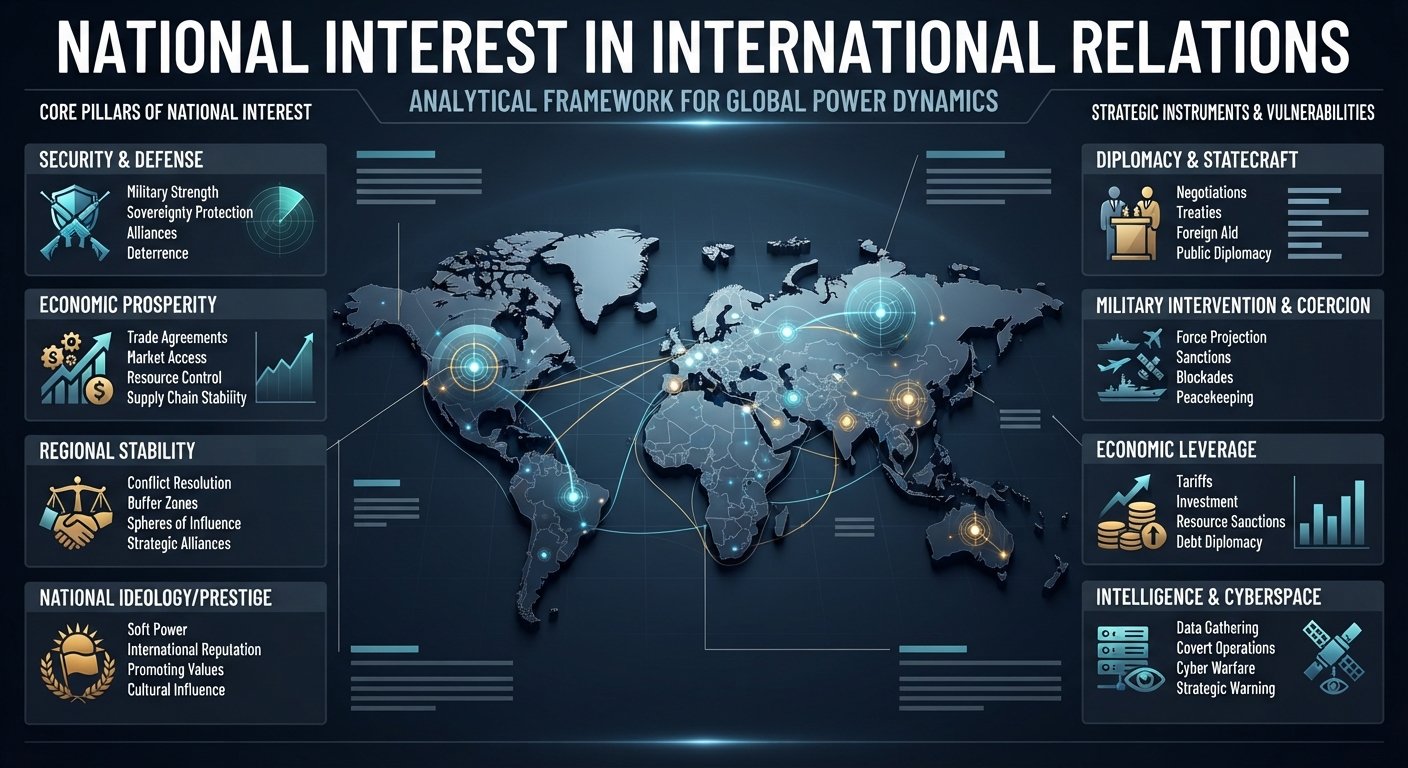
Great Power Politics refers to the competition, cooperation and strategic interaction among states possessing exceptional capabilities and substantial influence over the international system.
There is no universally accepted mathematical threshold that makes a country a “great power.” Scholars commonly consider a combination of military capabilities, economic resources, technological strength, diplomatic reach, strategic geography and the ability to project influence beyond a state’s immediate neighborhood. Recognition by other states can also matter. (Cambridge University Press)
A useful distinction is between power and great-power status. A country may have a large economy but limited military reach. Another may possess formidable military forces but a smaller economic base. Great-power status usually reflects a broader combination of capabilities and the capacity to use them internationally.
Great Power Politics vs. Superpower Politics
The terms are related but not identical.
A great power possesses exceptional capabilities and can significantly influence international affairs. A superpower generally implies an even higher level of global reach and systemic influence.
During the Cold War, the United States and Soviet Union were commonly described as superpowers because their military, nuclear, political and ideological capabilities extended across the globe.
The contemporary system is more complicated. The United States retains an unusually broad global power position, while China has developed capabilities that allow it to challenge American influence across several domains. Russia remains exceptionally important in nuclear and military affairs despite having a considerably smaller economy.
The result is better understood as a contested international system rather than a simple repetition of the Cold War.


Image/Infographic: A world map showing major power centers, strategic regions, alliance networks and major economic or military corridors.
Placement: Immediately after the H2 section “What Is Great Power Politics?”
Purpose: Help readers visualize why great-power competition is global rather than confined to one geographic region.
Historical Evolution of Great Power Politics
Great power politics predates the modern nation-state. European diplomacy gradually developed the idea that certain states possessed disproportionate influence over the continental and international balance.
From European Concert to World Wars
The Congress of Vienna in 1814–1815 helped institutionalize a system in which major European powers attempted to manage the balance of power after the Napoleonic Wars. Britain, Austria, Prussia, Russia and France became central actors in what evolved into the Concert of Europe.
The objective was not permanent peace through equality. Instead, the major powers attempted to prevent any single state from becoming overwhelmingly dominant.
This logic illustrates a central feature of great-power politics: states frequently cooperate against threats to the overall balance even when they remain strategic competitors.
By the late nineteenth and early twentieth centuries, industrialization, imperial expansion, nationalism and military competition transformed the balance. Germany’s rise altered European calculations, while competition among European empires extended into Africa, Asia and the Middle East.
The First World War demonstrated how alliance commitments and balance-of-power competition could turn a regional crisis into a systemic conflict.
The Second World War further transformed the system. European great powers were weakened, while the United States and Soviet Union emerged as the dominant military and ideological competitors.
The Cold War and Bipolarity
The Cold War produced an unusually clear form of great-power politics: bipolarity.
The United States and Soviet Union competed through:
- Nuclear deterrence
- Military alliances
- Proxy conflicts
- Economic systems
- Ideological influence
- Intelligence operations
- Space and technological competition
- Diplomatic influence
NATO and the Warsaw Pact institutionalized opposing security structures.
Yet the Cold War also demonstrates that great-power competition does not inevitably result in direct war. Nuclear deterrence created enormous risks associated with direct confrontation, encouraging both superpowers to manage escalation.
The Post-Cold War Period
The Soviet Union’s dissolution in 1991 left the United States in a uniquely dominant position.
For much of the 1990s and early 2000s, the international system was often described as unipolar, although the concept remains debated.
China’s economic rise subsequently altered the distribution of global power. Russia also sought to restore strategic influence, while India expanded its economic, diplomatic and military importance.
The result has been a more complicated international environment in which American power remains substantial but is increasingly contested across specific regions and domains.
What Makes a Country a Great Power?
Great-power status cannot be measured by one statistic.
Economic Power
Economic scale provides the resources necessary to sustain military capabilities, technology, diplomacy and international influence.
The World Bank’s 2025 data place U.S. nominal GDP at approximately $30.8 trillion and China’s at approximately $19.5 trillion. India, the European Union, Japan and other major economies also have substantial influence over global markets. (World Bank Open Data)
Economic power matters because states can translate wealth into:
- Defense spending
- Infrastructure investment
- Research and development
- Development finance
- Foreign aid
- Industrial capacity
- Trade leverage
- Financial sanctions
Military and Nuclear Power
Military capability remains a core component of great-power status.
According to SIPRI, global military expenditure reached approximately $2.887 trillion in 2025, the highest level recorded in its database. The United States remained the largest military spender at about $954 billion, followed by China at an estimated $336 billion and Russia at approximately $190 billion. (SIPRI)
Nuclear weapons add another dimension. Nuclear-armed states can impose enormous costs on potential adversaries, making deterrence a central component of great-power strategy.
But military spending alone does not determine strategic power. Readiness, logistics, intelligence, industrial capacity, geography, alliances, command systems and technological sophistication also matter.
Technological Power
Technology has become increasingly central to great-power competition.
Competition now extends into:
- Artificial intelligence
- Semiconductors
- Quantum technologies
- Cybersecurity
- Satellites
- Space systems
- Autonomous weapons
- Advanced telecommunications
- Biotechnology
- Critical minerals
This creates an important change from traditional power politics. A state can gain strategic leverage without deploying conventional military forces.
Control over advanced technologies can influence military effectiveness, economic productivity and supply-chain resilience simultaneously.
Diplomatic and Institutional Power
Great powers also influence international institutions.
The five permanent members of the UN Security Council—China, France, Russia, the United Kingdom and the United States—possess veto power over substantive Security Council decisions. (United Nations)
This does not mean that every permanent member automatically dominates international affairs. Rather, it gives these states an institutional position that smaller states do not possess.
Diplomatic networks, development assistance, international organizations, cultural influence and the ability to build coalitions can substantially increase a country’s effective power.
Who Are the Major Great Powers Today?
There is no universally agreed list. Contemporary scholarship often treats the United States, China and Russia as the clearest examples of global great powers, while debates increasingly involve India, France, the United Kingdom, Japan and the European Union in different ways. (NDU Press)
United States
The United States retains an unusually broad combination of military, economic, technological, financial and diplomatic capabilities.
Its global network of alliances is particularly important. NATO currently has 32 members, following Sweden’s accession in March 2024. (NATO)
American influence also derives from the dollar-centered international financial system, technological companies, universities, military logistics and a worldwide diplomatic presence.
Its principal strategic challenge is increasingly centered on managing China’s rise while maintaining commitments to European and Indo-Pacific partners.
China
China represents the most significant long-term challenge to the existing distribution of power.
Its strengths include:
- Large economic scale
- Manufacturing capacity
- Major technological industries
- Growing military capabilities
- Nuclear forces
- Permanent UN Security Council membership
- Extensive trade relationships
- Growing diplomatic engagement with the Global South
China’s rise has transformed great-power politics because it combines economic, technological and military resources on a scale that can affect multiple regions simultaneously.
Russia
Russia occupies a distinctive position.
Its economy is considerably smaller than those of the United States or China, but its military capabilities, nuclear arsenal, energy resources, geography and permanent Security Council status give it significant strategic influence.
The war in Ukraine has also demonstrated both the continuing importance and the limitations of military power. Russia has demonstrated its ability to sustain large-scale military operations, while the conflict has generated substantial economic, military and political costs.
India and Other Rising Powers
India’s growing economy, population, military capabilities, nuclear status, geographic position and diplomatic relationships make it increasingly important to global power calculations.
India also maintains relationships across different geopolitical groupings rather than aligning completely with one great-power bloc.
Other states—including Japan, France, the United Kingdom, Germany, Türkiye, Brazil, Saudi Arabia and Indonesia—can exert substantial regional or issue-specific influence.
This illustrates an important point: the world is not divided neatly into great powers and powerless states.
How Great Powers Compete
Great-power competition occurs across multiple domains simultaneously.
Alliances and Balance of Power
States rarely rely entirely on their own capabilities.
They build alliances and partnerships to increase deterrence and reduce strategic vulnerability.
NATO illustrates institutionalized balancing in Europe and the North Atlantic. In the Indo-Pacific, security relationships involving the United States, Japan, Australia, South Korea, the Philippines and others form a more flexible network.
Alliances can deter conflict, but they can also create risks if commitments become unclear or if rival states interpret alliance expansion as threatening.
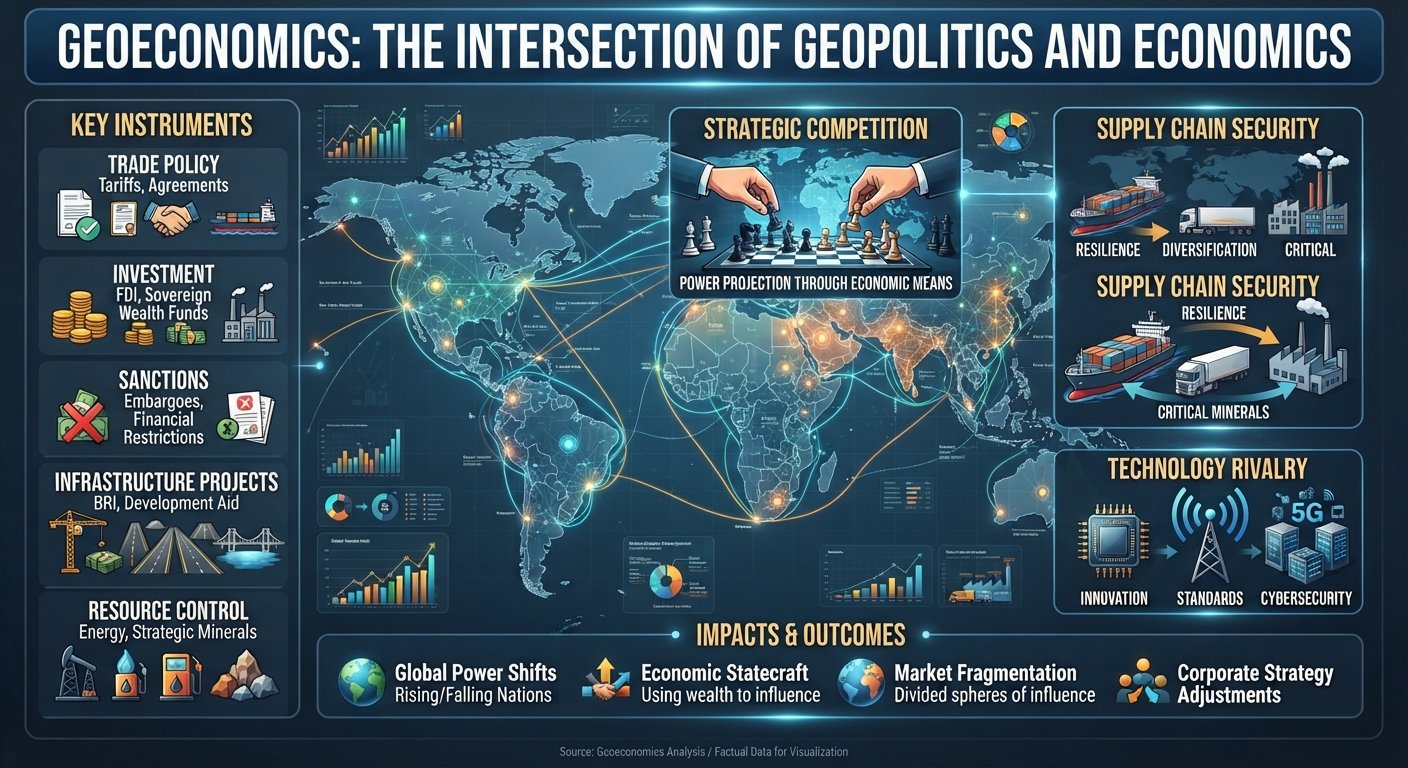
Economic Statecraft
Economic power is increasingly used as a strategic instrument.
Governments can employ:
- Tariffs
- Export controls
- Investment restrictions
- Sanctions
- Financial restrictions
- Industrial subsidies
- Development finance
- Supply-chain policies
Trade remains enormous despite geopolitical tensions. UN Trade and Development reported that global trade reached a record $35 trillion in 2025, while also identifying growing fragmentation, diversification and geopolitical restructuring of supply chains. (UNCTAD)
This creates a paradox: great powers are competing economically while remaining deeply economically interdependent.
Technology Competition
Technology increasingly sits at the intersection of economics and national security.
Semiconductor manufacturing is a particularly important example. Advanced chips support artificial intelligence, telecommunications, data centers and modern weapons systems.
Consequently, competition over technology is no longer simply commercial. Governments increasingly treat critical technologies as components of national security.
Information and Diplomatic Influence
Great powers also compete through narratives, diplomatic messaging, cultural influence and international institutions.
Digital platforms have increased the speed at which governments and non-state actors can influence international audiences.
However, information influence is difficult to measure. A country’s ability to communicate a message does not necessarily mean foreign audiences accept it.
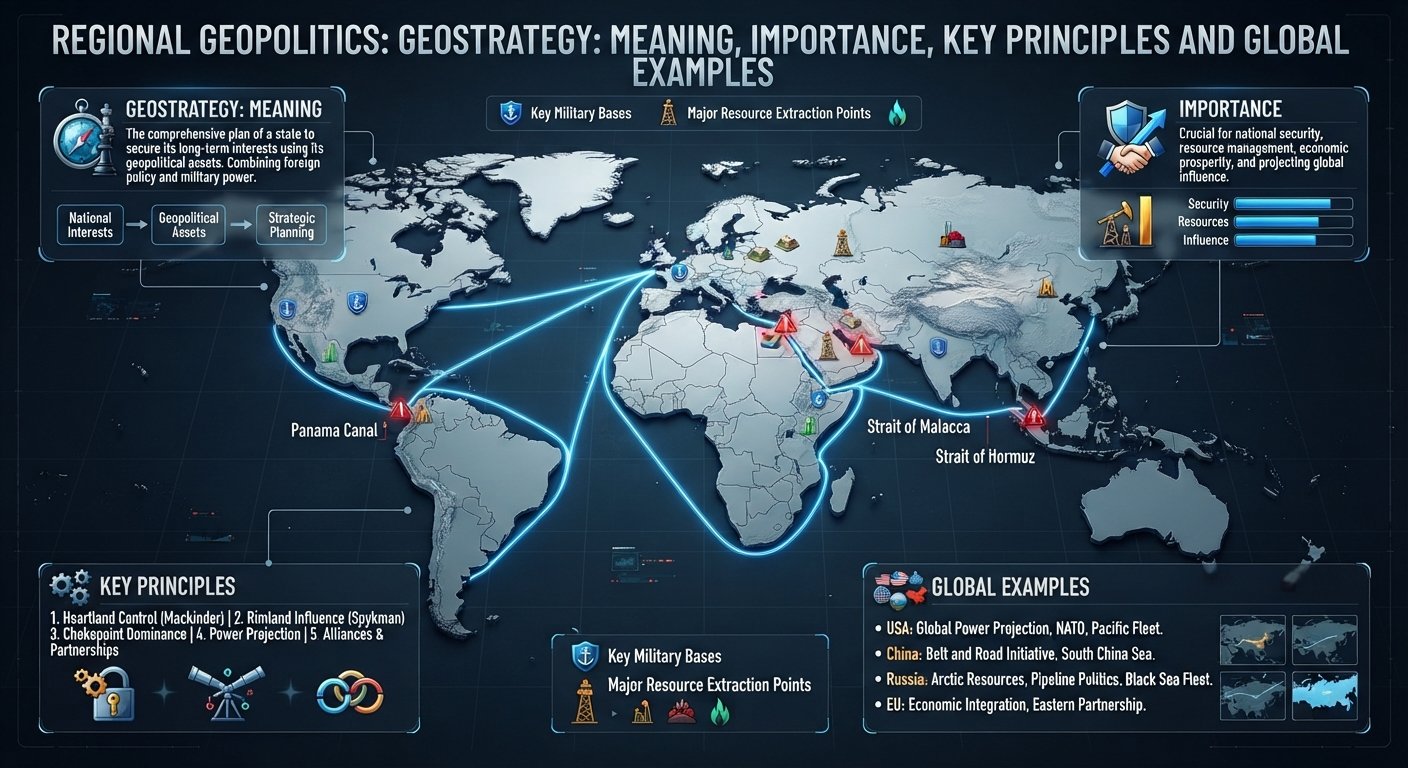
Why Geography Still Matters
Technology has not eliminated geography.
Strategic locations continue to influence great-power calculations.
Important areas include:
- The Indo-Pacific
- Taiwan Strait
- South China Sea
- Eastern Europe
- Arctic routes
- Persian Gulf
- Red Sea
- Indian Ocean
- Black Sea
- Major maritime chokepoints
Geography determines access to markets, resources, military bases, shipping lanes and strategic depth.
This is why great-power politics frequently becomes concentrated around seemingly small territories or waterways whose strategic significance exceeds their physical size.
The Role of International Organizations
Great-power politics takes place both inside and outside international institutions.
United Nations
The UN attempts to establish rules for international relations while giving the five permanent Security Council members exceptional institutional power.
This produces an inherent tension.
The UN Charter establishes the sovereign equality of states and requires members to refrain from the threat or use of force against the territorial integrity or political independence of states. (United Nations Office of Legal Affairs)
At the same time, the Security Council’s structure reflects the geopolitical realities of 1945.
This creates continuing debates over Security Council reform and whether today’s institutional arrangements adequately reflect the distribution of global power.
NATO and Other Alliances
NATO demonstrates how great-power politics can be institutionalized through collective defense.
The alliance has expanded substantially since its founding in 1949 and now includes 32 members. (NATO)
Other regional organizations—including the European Union, ASEAN, African Union and Gulf institutions—also affect how states respond to major-power competition.
BRICS and the Global South
BRICS illustrates another aspect of contemporary great-power politics: efforts to increase the influence of non-Western and Global South states.
As of 2025, BRICS had 11 full members, including Brazil, Russia, India, China, South Africa, Egypt, Ethiopia, Iran, the United Arab Emirates, Saudi Arabia and Indonesia. (Brics)
BRICS should not automatically be interpreted as a military alliance equivalent to NATO. It is better understood as a political and diplomatic coordination forum whose members have diverse interests.
Its expansion nevertheless demonstrates dissatisfaction in some countries with existing global governance arrangements.
Great Power Politics and International Law
Power politics does not exist outside international law.
The UN Charter prohibits the threat or use of force against the territorial integrity or political independence of states, subject to the Charter’s recognized exceptions. (United Nations Office of Legal Affairs)
The challenge is enforcement.
International law provides rules, institutions and mechanisms for dispute settlement, but enforcement depends heavily on political cooperation. The Security Council can authorize sanctions or force in accordance with the Charter, yet disagreement among permanent members can limit collective action. (United Nations)
This is one reason great-power rivalry can become a structural challenge to international governance.
When major powers agree, international institutions can become powerful mechanisms for cooperation. When they disagree, institutional paralysis becomes more likely.
Economic and Global Consequences
Great-power rivalry affects countries that are not themselves great powers.
Businesses may face:
- Supply-chain disruptions
- Export controls
- Higher compliance costs
- Sanctions exposure
- Investment uncertainty
- Technology restrictions
- Commodity-price volatility
Developing countries may face difficult choices when major powers compete for political and economic influence.
However, competition can also create opportunities. Governments may attract investment by positioning themselves as alternative manufacturing centers, logistics hubs or strategic partners.
The result is not simply “decoupling.” Global commerce remains highly interconnected. UNCTAD’s 2026 trade assessment found that global trade continued expanding despite increasing geopolitical fragmentation, demonstrating that rivalry and globalization can coexist. (UNCTAD)
Great Power Politics and the Security Dilemma
One of the most important concepts for understanding great-power rivalry is the security dilemma.
A state may strengthen its military because it feels threatened. Its rival may interpret those defensive measures as preparations for aggression and respond by increasing its own military capabilities.
The cycle can continue even when neither side initially wants war.
For example:
- State A increases military capabilities.
- State B interprets the increase as threatening.
- State B responds with additional capabilities.
- State A perceives the response as confirmation of its fears.
- Both sides become more heavily armed.
This does not mean every arms buildup causes war. Communication, deterrence, diplomacy and arms-control arrangements can interrupt the cycle.
Great Power Politics in the Indo-Pacific
The Indo-Pacific has become one of the central theaters of contemporary great-power competition.
China’s economic and military rise intersects with longstanding U.S. alliances and partnerships.
The Taiwan Strait is particularly sensitive because Taiwan’s security intersects with Chinese sovereignty claims, U.S. policy, regional military planning and global semiconductor supply chains.
The South China Sea also combines territorial disputes, maritime security, trade routes and military positioning.
At the same time, countries across Southeast Asia generally seek strategic flexibility rather than choosing permanently between Washington and Beijing.
This makes the Indo-Pacific fundamentally different from the rigid bloc structure of the Cold War.
Is the World Becoming Multipolar?
The answer depends on how polarity is defined.
A strictly military definition might emphasize the United States, China and Russia. A broader economic and diplomatic definition produces a more dispersed system involving India, the European Union, Japan, regional powers and influential middle powers.
The growth of BRICS, the expanding role of India, stronger European defense debates and greater strategic autonomy among middle powers all point toward greater dispersion of influence. (Brics)
But multipolarity does not necessarily mean equality.
The international system can contain several important powers while still having major differences in military reach, economic scale, technological capacity and alliance networks.
The emerging system may therefore be better described as asymmetrical multipolarity: multiple influential centers exist, but their capabilities differ considerably.
Future of Great Power Politics
Several scenarios are plausible.
Managed Competition
The United States and China could continue competing intensely while establishing mechanisms to prevent rivalry from escalating into direct military conflict.
This would resemble strategic competition combined with selective cooperation on issues such as climate, financial stability or global health.
Intensified Rivalry
Trade restrictions, military deployments, technology controls and alliance competition could increase.
This scenario would raise the risk of regional crises and economic fragmentation.
Multipolar Balancing
India, the European Union, Japan, Türkiye, Brazil, Saudi Arabia, Indonesia and other influential states could increasingly pursue flexible partnerships rather than joining rigid blocs.
This would make international diplomacy more complicated but could also prevent the emergence of a completely bipolar system.
Major-Power Crisis
The most dangerous scenario would involve direct confrontation between nuclear-armed major powers.
Potential flashpoints include Taiwan, Eastern Europe, maritime disputes or unforeseen military incidents.
This scenario is not inevitable, but the destructive consequences explain why deterrence, crisis communication and diplomacy remain essential.
What Does Great Power Politics Mean for Smaller and Middle Powers?
Great-power competition does not eliminate the agency of smaller states.
Middle and smaller powers can:
- Diversify partnerships
- Avoid excessive dependence
- Develop strategic industries
- Strengthen regional organizations
- Negotiate favorable investment
- Use international law
- Build diplomatic coalitions
- Maintain strategic ambiguity where appropriate
Many states increasingly practice hedging: cooperating with multiple major powers while avoiding complete alignment with any single one.
This strategy is especially visible in regions where economic relationships with China coexist with security relationships involving the United States or other partners.
For business leaders, the lesson is equally important. Geopolitical risk is no longer simply a government concern. Corporate investment, shipping, technology procurement, energy security and supply-chain planning are increasingly affected by strategic rivalry.
Why Great Power Politics Matters
The central significance of Great Power Politics is that the decisions of a relatively small number of highly capable states can generate consequences far beyond their borders.
A change in military doctrine can alter regional security calculations. A semiconductor export restriction can affect global technology markets. A war can reshape energy prices and food security. A diplomatic agreement can transform alliance structures.
The system is therefore interconnected.
Great-power behavior also creates a tension between competition and cooperation. States compete because they have different interests, security concerns and visions of international order. Yet they must also cooperate because global problems such as climate change, pandemics, financial instability, nuclear proliferation and international trade cannot be managed effectively by one country alone.
This contradiction is likely to remain a defining feature of international politics.
Frequently Asked Questions About Great Power Politics
What is Great Power Politics?
Great Power Politics is the competition and cooperation among states with exceptional military, economic, technological, diplomatic and strategic capabilities. It focuses on how these states influence the international balance of power and global rules.
What are the main examples of Great Power Politics today?
The most important examples include U.S.–China strategic competition, Russia–Western confrontation, competition over technology and supply chains, Indo-Pacific security disputes, nuclear deterrence and debates over reform of international institutions.
Which countries are considered great powers?
There is no universally accepted list. The United States, China and Russia are commonly treated as major contemporary great powers. India is increasingly discussed as a rising great power, while France and the United Kingdom retain significant global influence, including permanent UN Security Council membership and nuclear capabilities.
What is the difference between a great power and a superpower?
A great power possesses exceptional capabilities and global or major regional influence. A superpower generally possesses an unusually comprehensive ability to project military, economic, diplomatic and technological power across the world.
Is the world becoming multipolar?
There is strong evidence that global power is becoming more distributed, particularly economically and diplomatically. However, power remains highly unequal, so contemporary multipolarity is better understood as an uneven or asymmetrical distribution of influence.
Why is China important to Great Power Politics?
China combines enormous economic scale with manufacturing capacity, technological development, military modernization, nuclear weapons, diplomatic influence and permanent membership of the UN Security Council. This makes its rise consequential across several dimensions of international power.
Why is Russia still considered a great power?
Russia’s economic capabilities are smaller than those of the United States or China, but it retains major nuclear forces, substantial military capabilities, geographic reach, energy resources and permanent Security Council status. Great-power status therefore cannot be reduced to GDP.
How does Great Power Politics affect developing countries?
Developing countries can experience higher trade and investment opportunities but also face sanctions, supply-chain disruptions, geopolitical pressure and competing demands from major powers. Many respond by diversifying partnerships and practicing strategic hedging.
Can Great Power Politics cause war?
Yes. Competition can generate arms races, alliance tensions, miscalculation and crises. However, great powers also have strong incentives to avoid direct war, particularly when nuclear deterrence makes escalation potentially catastrophic.
Will Great Power Politics disappear?
Unlikely. Competition among major states is deeply connected to differences in interests, capabilities, geography and visions of international order. Its form can change—from military rivalry to economic, technological and diplomatic competition—but great-power politics is likely to remain central to international relations.
Conclusion:
Great Power Politics is ultimately about much more than powerful countries competing for influence. It is about how the distribution of power shapes international order, how states respond to changes in relative strength, and how competition interacts with institutions, economics, technology and international law.
The contemporary system is neither a simple return to Cold War bipolarity nor a completely equal multipolar world. The United States remains exceptionally powerful; China has become a comprehensive strategic competitor; Russia retains major military and nuclear capabilities; India and other rising powers are gaining greater influence; and institutions such as NATO, the UN and BRICS reflect different dimensions of the changing order.
Military spending also illustrates the intensity of this transformation. Global military expenditure reached a record $2.887 trillion in 2025, according to SIPRI, while global trade simultaneously reached roughly $35 trillion. (SIPRI)
That combination captures the central paradox of the modern system: states are becoming more strategically competitive while remaining deeply interconnected.
The future of international politics will therefore depend not only on who possesses the greatest capabilities, but on whether major powers can manage rivalry without allowing competition to destroy the institutions, economic networks and diplomatic mechanisms on which global stability depends.