Introduction
National security is no longer limited to protecting a country’s borders from military attack. In the 21st century, a state can face serious security pressures through cyberattacks, economic coercion, supply-chain disruptions, disinformation, energy dependence, terrorism, technological competition, climate-related shocks, and attacks on critical infrastructure. Military power remains essential, but it is now only one part of a much broader security system.
This changing environment makes National Security an important subject for governments, businesses, researchers, diplomats, and citizens alike. The security of a country increasingly depends on the resilience of its economy, institutions, infrastructure, information systems, energy networks, technology base, and society.
The international environment in 2026 illustrates this transformation. Global military expenditure reached an estimated $2.887 trillion in 2025, according to SIPRI, while the World Economic Forum’s 2026 Global Risks Report identifies geoeconomic confrontation, state-based conflict, misinformation and disinformation, and technological risks among major concerns.
This article explains what national security means, how it evolved, its major dimensions, contemporary threats, international-law foundations, geopolitical implications, and the strategic challenges governments face in building security without undermining economic development or social stability.
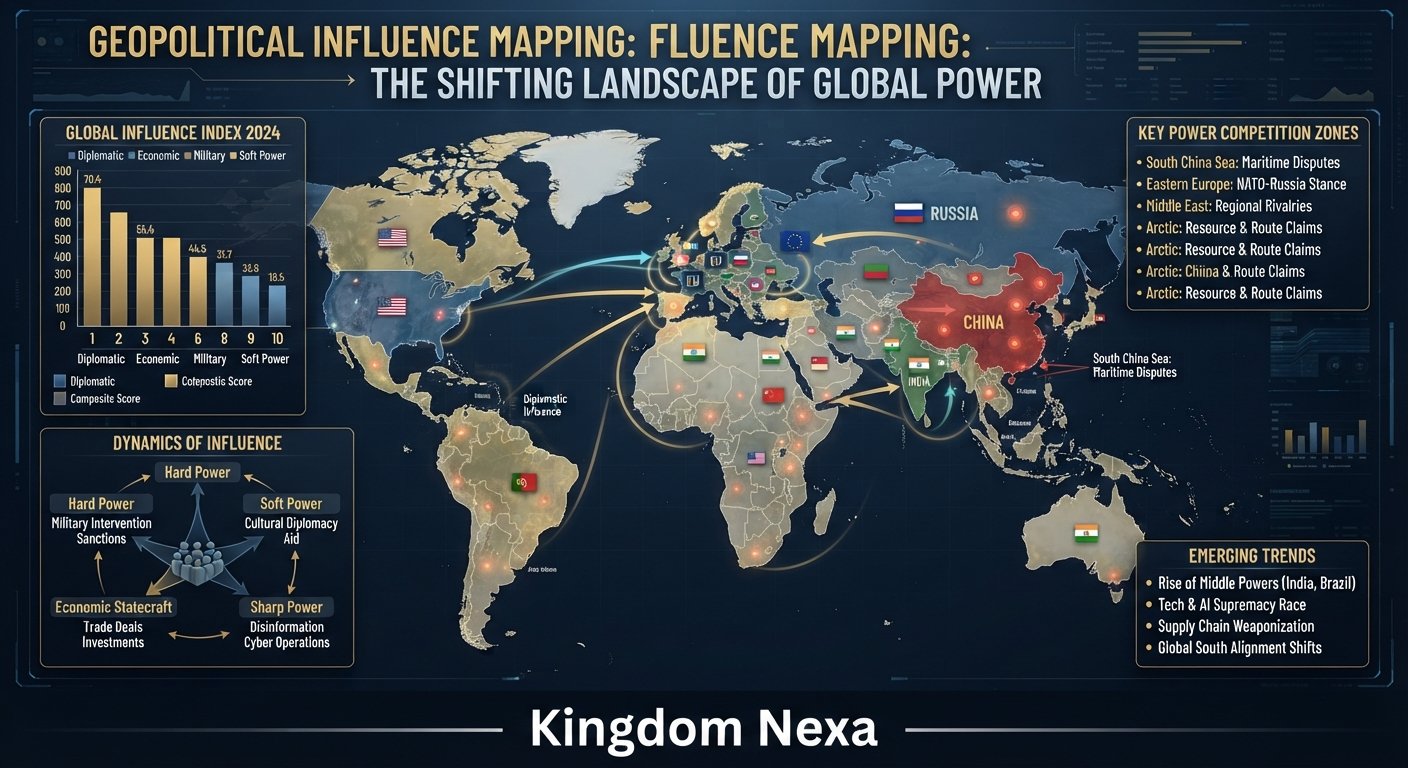
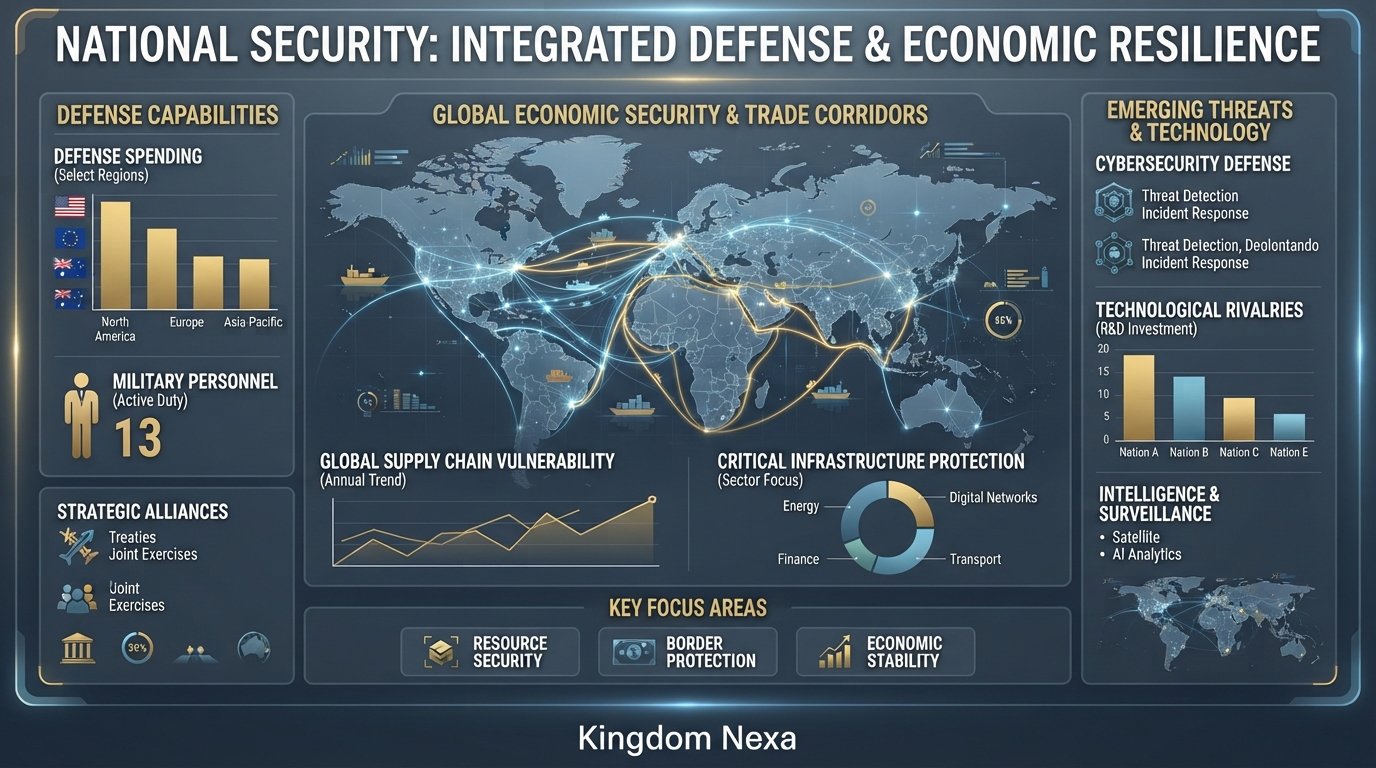
[Image/Infographic: Modern National Security Threat Landscape]
What Is National Security?
National security refers to the ability of a state to protect its sovereignty, territorial integrity, population, institutions, vital interests, and national capacity against threats and coercion.
Traditionally, national security was closely associated with armed forces, territorial defence, intelligence, and deterrence. Today, governments increasingly treat security as a multidimensional concept involving military, economic, technological, cyber, social, environmental, and institutional resilience.
A useful way to understand national security is to distinguish between security objectives and security instruments.
Security objectives may include:
- Protecting territorial sovereignty
- Preventing or deterring external aggression
- Protecting citizens and critical infrastructure
- Maintaining political and institutional stability
- Preserving economic resilience
- Protecting sensitive technologies and information
- Securing energy, food, water, and strategic resources
- Maintaining freedom of diplomatic and strategic decision-making
Security instruments include diplomacy, military capabilities, intelligence, economic policy, law enforcement, alliances, technology policy, cyber defence, development policy, and international cooperation.
There is no single universal model of national security. Different countries define their priorities according to geography, history, economic structure, military capabilities, alliances, political institutions, and perceived threats.
How Has National Security Evolved?
National Security During the Classical State Era
Early concepts of state security focused heavily on territorial control, military strength, alliances, and the survival of ruling governments.
The development of the modern state system made sovereignty central to security thinking. States sought to prevent foreign domination while building military capabilities capable of defending territory.
Geography was particularly important. Mountains, rivers, deserts, coastlines, strategic ports, and borderlands shaped defence planning and diplomatic relationships.
National Security During the Cold War
The Cold War transformed national security into a global strategic competition.
The United States and Soviet Union built enormous military capabilities while competing through alliances, intelligence networks, economic systems, technological development, and political influence.
Nuclear weapons introduced the concept of mutually assured destruction and made deterrence a central component of strategic thinking.
National security consequently expanded beyond conventional warfare to include nuclear strategy, intelligence, aerospace technology, ideological competition, and strategic communications.
National Security After the Cold War
The end of the Cold War temporarily reduced the likelihood of direct great-power confrontation, but it did not eliminate security threats.
Terrorism, civil wars, organized crime, cyberattacks, proliferation of weapons of mass destruction, fragile states, and humanitarian crises became more prominent.
The terrorist attacks of September 11, 2001, further changed security policy, particularly through the expansion of counterterrorism, intelligence cooperation, border security, and homeland protection.
National Security in the 2020s
The current security environment is increasingly characterized by overlapping risks.
Military conflict continues to matter, but states also compete through trade restrictions, investment screening, sanctions, technology controls, supply-chain policies, cyber operations, information campaigns, and control of strategic resources.
The World Economic Forum’s 2026 assessment describes geoeconomic confrontation as its top global risk for 2026 based on its expert survey, followed by state-based armed conflict. It also identifies misinformation and disinformation, cyber insecurity, and technological risks as significant concerns.
This does not mean traditional military security has become less important. Instead, military and non-military dimensions increasingly interact.
What Are the Main Dimensions of National Security?
Military and Defence Security
Military security remains a fundamental component of national security.
It includes:
- Armed forces
- Air and missile defence
- Naval capabilities
- Intelligence, surveillance and reconnaissance
- Military logistics
- Defence industrial capacity
- Mobilization systems
- Strategic deterrence
- Military alliances and partnerships
Military power can deter aggression, protect territory, support crisis response, and provide governments with strategic options.
However, military expenditure alone does not guarantee security. Defence effectiveness also depends on training, readiness, logistics, command structures, industrial capacity, intelligence, technology, political institutions, and economic sustainability.
Global military expenditure reached approximately $2.887 trillion in 2025, an increase of 2.9% in real terms from 2024, according to SIPRI. Spending increased for the 11th consecutive year, illustrating the continuing importance governments place on military capabilities.
Economic Security
Economic security has become increasingly connected with national security.
A state that cannot maintain access to energy, food, finance, strategic technologies, transportation networks, or essential industrial inputs may become vulnerable to external pressure.
Economic security therefore includes:
- Supply-chain resilience
- Energy security
- Food security
- Financial stability
- Strategic industries
- Trade resilience
- Access to critical minerals
- Foreign investment screening
- Protection of economic infrastructure
The OECD’s 2025 work on economic security emphasizes the interconnected nature of supply-chain resilience, energy security, and cybersecurity.
The concept of geoeconomics has consequently become increasingly important. Governments can use tariffs, sanctions, export controls, investment restrictions, financial measures, and technology policies to pursue strategic objectives.
Cybersecurity
Modern states depend heavily on digital infrastructure.
Government databases, banks, electricity grids, hospitals, telecommunications networks, ports, airports, defence systems, and industrial facilities can all depend on interconnected digital systems.
Cybersecurity therefore forms an essential part of national security.
Threats include:
- Cyber espionage
- Ransomware
- Disruption of critical infrastructure
- Theft of sensitive information
- Supply-chain attacks
- State-sponsored cyber operations
- Attacks on government systems
- Digital sabotage
NATO identifies cyberspace as an operational domain and treats cyber defence as part of its collective-defence framework. Its 2026 Alliance Digital Strategy also emphasizes Zero Trust principles, digital resilience, mission-critical services, and preparation for post-quantum cryptography.
Technological Security
Technology increasingly determines national power.
Artificial intelligence, semiconductors, satellites, drones, quantum computing, advanced telecommunications, biotechnology, and autonomous systems can influence both economic competitiveness and military capabilities.
This creates a difficult policy problem: governments want access to global technology markets while also preventing strategically sensitive technologies from becoming vulnerabilities.
The 2026 Global Risks Report notes that technological developments can create opportunities while also generating risks involving information integrity, labour markets, autonomous weapons systems, and national security.
Energy Security
Energy availability can influence economic stability, military readiness, industrial production, and diplomatic freedom.
Countries dependent on a limited number of external energy suppliers may face strategic vulnerabilities if supplies are interrupted or prices rise sharply.
Energy security therefore involves:
- Diversifying suppliers
- Maintaining strategic reserves
- Protecting pipelines and electricity grids
- Expanding resilient generation capacity
- Securing maritime energy routes
- Developing domestic energy resources
- Protecting energy infrastructure from cyber and physical attacks
The energy transition adds another layer because technologies such as batteries, electric vehicles, solar systems, and advanced power networks depend on industrial supply chains and access to critical minerals.
Food and Water Security
Food and water are also strategic concerns.
Drought, conflict, disrupted trade routes, agricultural shocks, extreme weather, and rising demand can affect national stability.
Food insecurity can also contribute to migration, social unrest, humanitarian emergencies, and political instability.
Water security is especially important in regions where rivers cross national borders or where groundwater resources are under pressure.
Social and Human Security
A state can possess sophisticated weapons while remaining vulnerable if its institutions and society lack resilience.
Social security dimensions include:
- Public health capacity
- Social cohesion
- Emergency preparedness
- Protection of vulnerable populations
- Institutional trust
- Disaster response
- Critical public services
This broader perspective does not eliminate the distinction between national security and human security. Rather, it recognizes that serious threats to societies can eventually affect state stability and strategic resilience.
What Are the Major National Security Threats in 2026?
Interstate Conflict and Great-Power Competition
Military conflict remains one of the most consequential national-security risks.
The Russia-Ukraine war, instability in the Middle East, tensions involving major powers, and other regional conflicts demonstrate how local crises can generate wider diplomatic, economic, military, and humanitarian consequences.
The International Institute for Strategic Studies reported in its 2025 Armed Conflict Survey that global violence and geopolitical fragmentation had intensified, with major conflicts continuing across several regions.
For governments, the challenge is not only preparing for war but also preventing escalation and maintaining communication during crises.
Hybrid Warfare
Hybrid threats combine different instruments of pressure.
These can include:
- Cyber operations
- Disinformation
- Economic coercion
- Political interference
- Proxy activity
- Sabotage
- Intelligence operations
- Irregular warfare
NATO has specifically identified hybrid activities targeting political institutions, critical infrastructure, economies, societies, and democratic systems as a major security challenge.
The significance of hybrid activity lies partly in ambiguity. A state may attempt to weaken another country without crossing an obvious threshold into conventional war.
Disinformation and Information Manipulation
Information has become a strategic domain.
Governments, political organizations, private actors, and non-state groups can use digital platforms to distribute misleading narratives, manipulate public debate, impersonate institutions, or exploit social divisions.
Not every false statement constitutes an organized national-security threat. The distinction between ordinary misinformation, deliberate disinformation, propaganda, legitimate political disagreement, and foreign interference requires careful evidence.
NATO’s 2024 approach to information threats describes coordinated harmful information activities and foreign interference as potential national-security challenges.
Critical Infrastructure Vulnerability
Modern societies depend on interconnected infrastructure.
Power systems, telecommunications, financial networks, ports, railways, water systems, hospitals, satellites, and data centres can create cascading vulnerabilities.
A disruption in one system may affect several others.
The World Economic Forum’s 2026 analysis highlights the interaction between ageing infrastructure, extreme weather, digitalization, electrification, and geopolitical confrontation.
Supply-Chain Dependence
Strategic dependence on foreign suppliers can become a national-security concern when essential goods have few substitutes.
Semiconductors, rare earth elements, pharmaceuticals, energy equipment, advanced machinery, telecommunications components, and defence technologies can have strategic significance.
Governments therefore increasingly seek to diversify suppliers, build domestic capacity, establish strategic reserves, and strengthen relationships with trusted partners.
Climate and Environmental Risks
Climate change is not automatically a military threat, but its effects can interact with existing political and security vulnerabilities.
Extreme weather can damage infrastructure, disrupt food production, intensify water stress, increase displacement, and impose fiscal pressures on governments.
These effects may become particularly significant where institutions are already weak or resources are contested.
NATO’s current strategic framework recognizes climate change as a security issue alongside resilience and human security.
How Do Geography and Geopolitics Shape National Security?
Geography remains one of the most enduring influences on national security.
A country’s location determines its exposure to neighbours, maritime routes, mountain passes, strategic waterways, trade corridors, resource regions, and military competition.
A landlocked country may prioritize secure transportation corridors and relations with transit states. A maritime power may focus heavily on ports, sea lanes, naval capabilities, and overseas supply chains.
Geography also affects alliance structures.
Countries located near major powers may face stronger incentives to develop deterrence capabilities, alliances, diplomatic balancing strategies, or economic diversification.
The concept of the security dilemma helps explain why defensive actions by one state can appear threatening to another. When one government increases military readiness because it feels vulnerable, neighbouring governments may respond with their own military preparations. The resulting cycle can increase insecurity even when neither side initially seeks war.
What Role Do Alliances Play in National Security?
Alliances can strengthen national security by pooling military capabilities, intelligence, logistics, technology, diplomatic influence, and economic resources.
NATO provides one prominent example. Its 2022 Strategic Concept identifies three core tasks: deterrence and defence, crisis prevention and management, and cooperative security. It also emphasizes resilience, technological innovation, climate change, and human security.
Other regional organizations also contribute to security through political dialogue, peacekeeping, economic cooperation, intelligence sharing, and crisis-management mechanisms.
However, alliances can also create obligations and strategic risks. Members may disagree over priorities, threat perceptions, burden sharing, or the appropriate response to a crisis.
National Security and International Law
National security operates within an international legal framework.
The UN Charter establishes important principles concerning sovereignty, territorial integrity, peaceful dispute settlement, and the prohibition on the threat or use of force. At the same time, international law recognizes specific circumstances, including the inherent right of individual or collective self-defence in response to an armed attack.
International humanitarian law becomes relevant during armed conflict, governing the conduct of hostilities and the protection of civilians and other protected persons.
National-security policies must therefore balance legitimate security requirements with obligations under international law.
This is particularly important in areas such as counterterrorism, cyber operations, surveillance, sanctions, military intervention, maritime security, and the use of emerging technologies.
Who Are the Key Actors in National Security?
National security is not managed by the military alone.
Governments
Executive authorities establish national-security priorities and coordinate defence, diplomacy, intelligence, economic, technological, and emergency policies.
Armed Forces
Military institutions provide deterrence, defence, operational capabilities, and support during certain national emergencies.
Intelligence Agencies
Intelligence organizations collect and analyze information concerning threats, capabilities, intentions, and strategic developments.
Diplomatic Institutions
Foreign ministries help prevent conflict, negotiate agreements, build partnerships, manage crises, and communicate national positions.
Businesses
Private companies increasingly operate critical infrastructure, technology platforms, financial systems, telecommunications networks, logistics systems, and energy facilities.
Their resilience can therefore have direct national-security implications.
International Organizations
The United Nations, NATO, European Union, regional organizations, financial institutions, and other international bodies can influence security through diplomacy, collective action, economic coordination, peacekeeping, sanctions, standards, and crisis response.
What Are the Strategic Challenges for Governments?
Balancing Security and Economic Openness
Globalization creates efficiency through international trade and investment, but excessive dependence on foreign suppliers can create vulnerabilities.
Governments therefore face a continuing trade-off between economic openness and strategic resilience.
Protecting Security Without Undermining Rights
National-security measures such as surveillance, emergency powers, data collection, and counterterrorism legislation can raise questions concerning privacy, civil liberties, accountability, and proportionality.
Effective security policy requires legal safeguards and institutional oversight.
Managing Technological Change
Governments often struggle to develop policy quickly enough to keep pace with technological innovation.
Artificial intelligence, quantum computing, autonomous systems, biotechnology, and advanced cyber capabilities may evolve faster than regulatory frameworks.
Maintaining Fiscal Sustainability
Defence and resilience require investment, but governments face competing priorities including healthcare, education, infrastructure, debt management, and economic development.
Sustainable security therefore involves prioritizing critical vulnerabilities rather than treating every possible threat as equally urgent.
What Could National Security Look Like in the Future?
Several broad scenarios are possible, although none should be treated as a prediction.
Greater Strategic Competition
States may increasingly compete through military modernization, technology controls, industrial policy, sanctions, investment screening, and strategic partnerships.
More Integrated Security Planning
The distinction between defence, economic, technological, cyber, and infrastructure policy may continue to weaken as governments adopt more integrated national-security strategies.
Greater Importance of Resilience
Instead of attempting to prevent every disruption, states may focus more heavily on absorbing shocks, maintaining essential services, rapidly recovering from attacks, and reducing single points of failure.
Technology-Driven Strategic Change
AI, autonomous systems, quantum computing, space systems, advanced sensors, and cyber capabilities could reshape intelligence, deterrence, military operations, economic competition, and critical infrastructure protection.
More Pressure on Multilateral Cooperation
The World Economic Forum’s 2026 assessment describes a global environment in which geoeconomic confrontation and geopolitical competition are putting pressure on multilateral cooperation. It also notes that respondents increasingly perceive a multipolar or fragmented international order. These are survey-based assessments rather than predictions, but they illustrate the uncertainty surrounding the current international system.
Frequently Asked Questions About National Security
What is national security in simple words?
National security is the ability of a country to protect its territory, people, institutions, sovereignty, economy, infrastructure, and vital interests from serious internal and external threats.
Why is national security important?
National security helps protect a state’s independence, population, institutions, economic stability, critical infrastructure, and ability to make sovereign decisions without coercion.
Is national security only about the military?
No. Military defence is important, but modern national security also includes cybersecurity, economic resilience, energy, critical infrastructure, technology, intelligence, diplomacy, social resilience, and emergency preparedness.
What are the biggest national-security threats today?
Major contemporary threats include interstate conflict, terrorism, cyberattacks, hybrid operations, disinformation, economic coercion, supply-chain disruptions, critical-infrastructure vulnerabilities, technological competition, and certain climate-related risks.
What is economic security?
Economic security concerns a country’s ability to maintain stable access to essential goods, energy, finance, technology, markets, and supply chains while reducing dangerous strategic dependencies.
How does cybersecurity affect national security?
Cyberattacks can disrupt government systems, financial institutions, telecommunications, energy networks, military systems, and critical infrastructure. Cybersecurity therefore forms an increasingly important component of national defence and resilience.
What is hybrid warfare?
Hybrid warfare generally refers to the coordinated or overlapping use of military and non-military instruments such as cyber operations, information manipulation, economic pressure, proxy activity, sabotage, and political interference.
How does technology affect national security?
Technologies such as AI, semiconductors, drones, satellites, quantum computing, biotechnology, and advanced communications can improve economic and military capabilities while creating new vulnerabilities and strategic dependencies.
What is the difference between national security and human security?
National security traditionally emphasizes the protection of the state and its vital interests. Human security places greater emphasis on protecting individuals and communities from threats such as violence, poverty, disease, food insecurity, and environmental disruption. The two approaches can overlap but are not identical.
Why is national security becoming more complex?
National security is becoming more complex because threats increasingly cross traditional boundaries. A geopolitical dispute can simultaneously involve military forces, trade restrictions, cyber operations, energy markets, technology controls, information campaigns, and supply chains.
Conclusion
National security has evolved from a primarily military concept into a multidimensional framework for protecting the state, society, economy, infrastructure, institutions, and strategic autonomy.
Military strength remains essential, particularly in an era of renewed interstate conflict and rising defence expenditure. Yet contemporary security cannot be understood through military power alone. Economic resilience, cybersecurity, technological capability, energy security, supply-chain diversification, infrastructure protection, diplomacy, intelligence, and social resilience increasingly determine how effectively states withstand pressure.
The current international environment reinforces this broader understanding. SIPRI’s latest data show global military expenditure reaching a record estimated $2.887 trillion in 2025, while international risk assessments point to the growing interaction between geopolitical competition, economic coercion, technology, information threats, and infrastructure vulnerabilities.
The central challenge for policymakers is therefore not simply to build more power, but to build resilient national-security systems capable of managing uncertainty while remaining economically sustainable, legally grounded, technologically adaptable, and institutionally accountable.
In an increasingly interconnected world, National Security is ultimately about more than defending borders. It is about preserving a country’s capacity to make sovereign decisions, protect its population, withstand disruption, and pursue its interests in a changing international system.