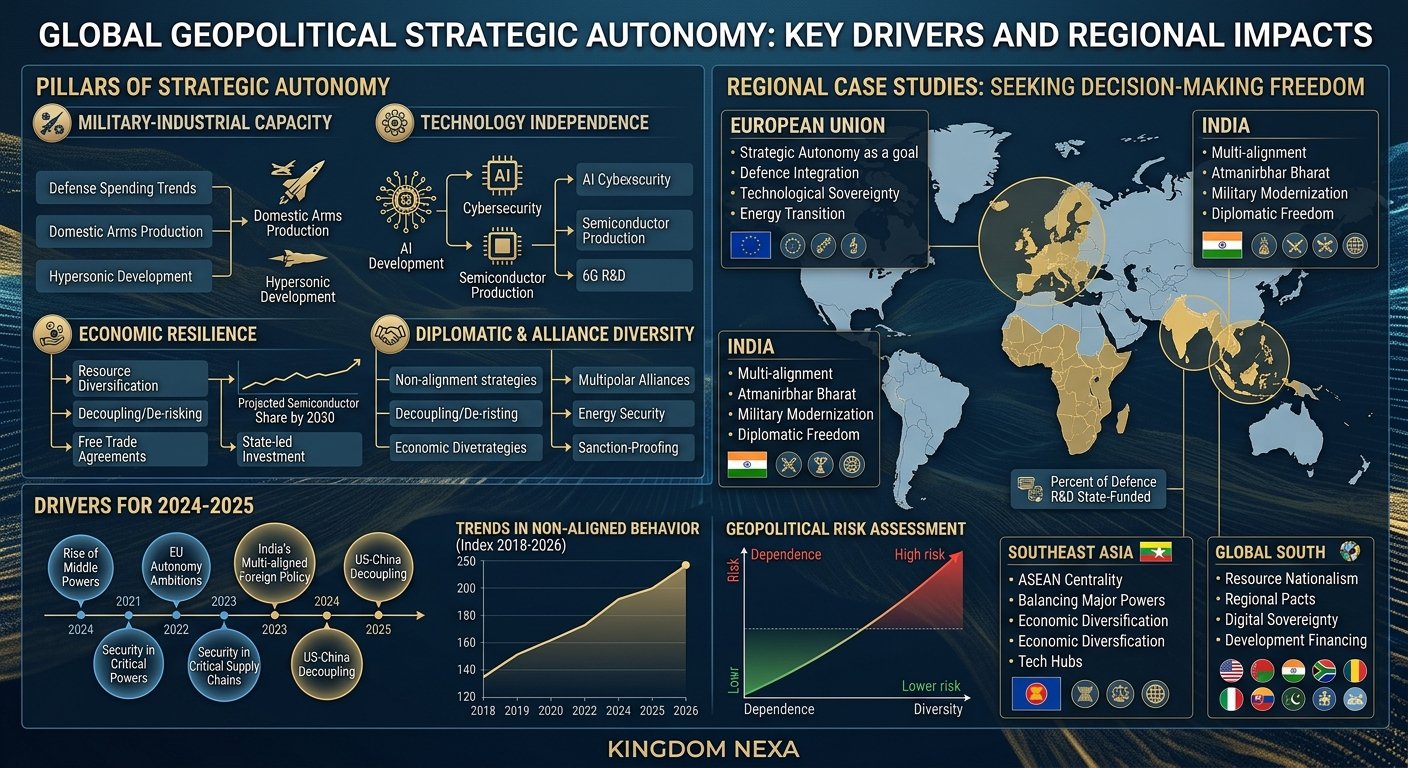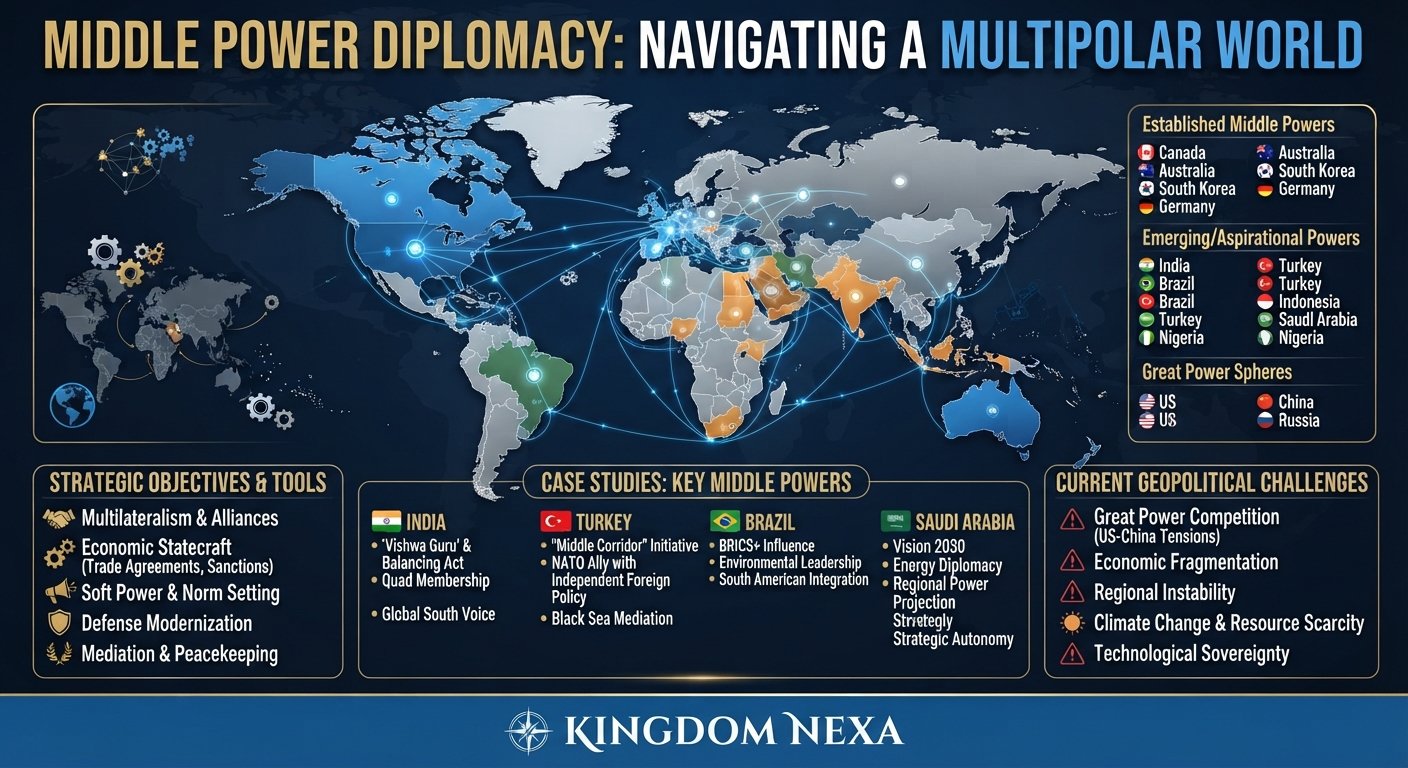
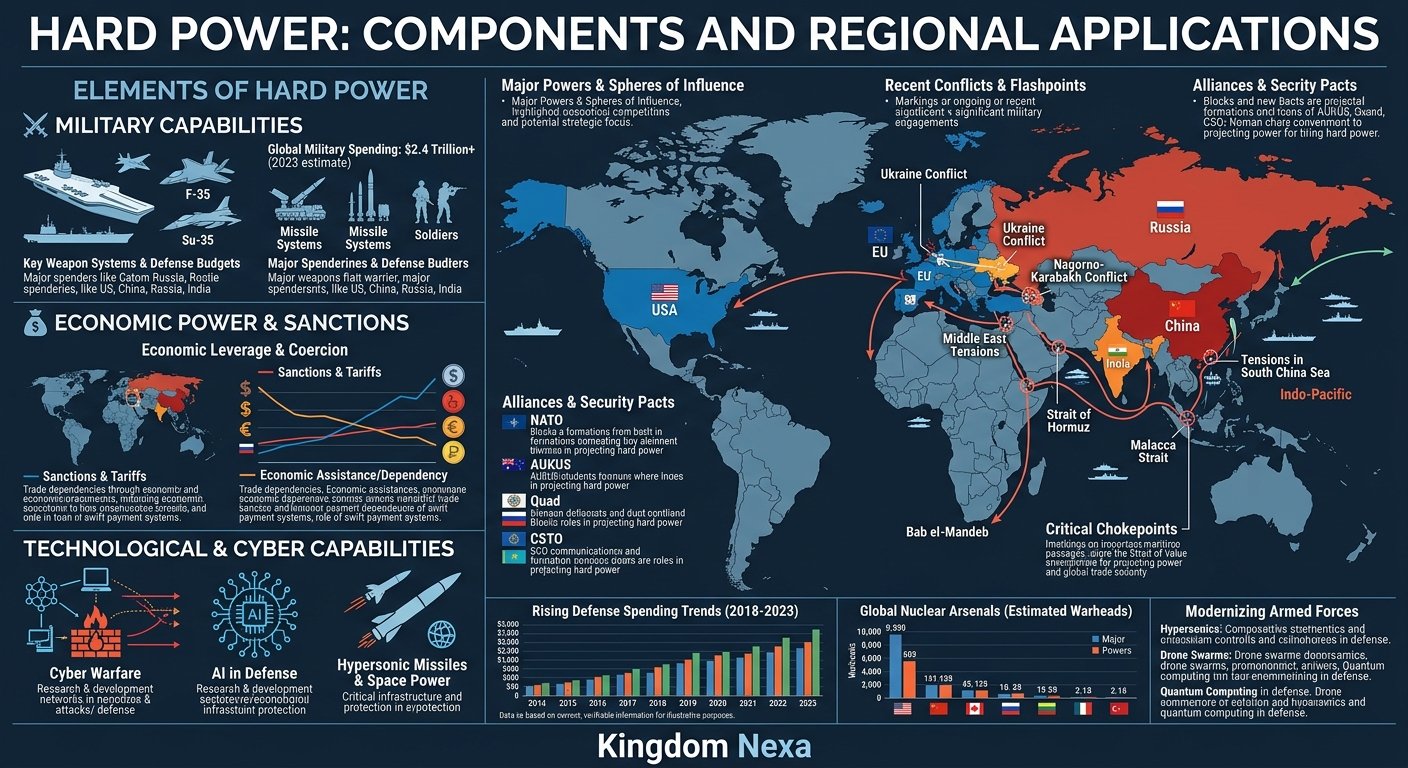
Hard power remains one of the most important concepts for understanding how states compete, deter adversaries, protect national interests, and shape international outcomes. In simple terms, Hard Power is the ability to influence another actor through material capabilities, particularly military force, economic pressure, or the credible threat or promise of either. Unlike soft power, which relies primarily on attraction and persuasion, hard power changes the strategic calculations of others by altering the costs and benefits they face.
The concept has become especially relevant as geopolitical competition intensifies. Global military expenditure reached an estimated $2.887 trillion in 2025, according to SIPRI, the highest level in its series. The United States, China, and Russia together accounted for about 51% of global military spending. (SIPRI) At the same time, sanctions, export controls, technology restrictions, energy leverage, supply-chain dependencies, and economic statecraft have become increasingly important instruments of strategic competition.
Understanding hard power therefore requires looking beyond armies and weapons. It involves economics, technology, geography, alliances, industrial capacity, deterrence, and the political ability to convert resources into credible influence.

What Is Hard Power?
Hard power is the ability of a state or other political actor to influence behavior through coercion, material pressure, or inducements, particularly by using military and economic capabilities.
The concept is closely associated with American political scientist Joseph S. Nye, whose work on soft power established a distinction between influence based on attraction and influence based on tangible capabilities. Military force and economic sanctions are commonly understood as hard-power instruments, while attraction and persuasion are generally associated with soft power. (USAWC Press)
Hard power can therefore involve both sticks and carrots.
A “stick” could be a military threat, economic sanction, blockade, tariff, or export restriction. A “carrot” could involve economic rewards, market access, security guarantees, arms transfers, or other material incentives.
The central mechanism is not necessarily actual violence. Credibility matters. A state may exercise hard power simply because another actor believes that the state possesses the capability and political will to impose meaningful costs.
Hard Power vs. Soft Power
| Hard Power | Soft Power |
|---|---|
| Coercion and material pressure | Attraction and persuasion |
| Military force and deterrence | Culture and values |
| Sanctions and economic restrictions | Diplomacy and international reputation |
| Arms transfers and security guarantees | Education and cultural exchange |
| Trade and financial leverage | Legitimacy and political appeal |
| Threats and material inducements | Voluntary alignment |
In practice, the distinction is not absolute. Modern states frequently combine both approaches.
How Does Hard Power Work?
Hard power works by changing another actor’s calculation of what is possible, affordable, or dangerous.
Suppose a state considers taking a particular action. If another state can credibly threaten military retaliation, impose economic costs, restrict access to critical technology, or provide powerful incentives for an alternative course, the original decision may change.
This produces several important mechanisms.
Coercion
Coercion attempts to make another actor change behavior by threatening or imposing costs.
Military threats, sanctions, blockades, tariffs, and export restrictions can all function as coercive instruments.
Deterrence
Deterrence seeks to prevent an action before it occurs.
A state may maintain conventional forces, nuclear weapons, missile defenses, alliances, or forward-deployed military assets partly to convince potential adversaries that aggression would carry unacceptable costs.
Deterrence is therefore a form of hard power that succeeds through non-use of force.
Compellence
Compellence is different from deterrence. Deterrence attempts to stop an action; compellence attempts to make an actor do something or stop something already underway.
This distinction is important in geopolitical crises because possessing overwhelming military capabilities does not automatically mean a state can compel another government to surrender its objectives.
Material Inducements
Hard power is not exclusively punitive.
Security guarantees, military assistance, preferential market access, infrastructure financing, arms sales, and other material benefits can be used to encourage alignment.
The effectiveness of these tools depends on the recipient’s alternatives and the credibility of the offer.
What Are the Main Instruments of Hard Power?
Hard power is broader than military strength alone. Its effectiveness often depends on the interaction between several forms of national capability.
Military Power
Military capability is the most visible component.
It includes:
- Armed forces and trained personnel
- Air, land, and naval capabilities
- Missiles and long-range strike systems
- Nuclear weapons and deterrent forces
- Intelligence, surveillance, and reconnaissance
- Cyber capabilities
- Space-based military systems
- Logistics and military infrastructure
- Defence-industrial capacity
However, military inventories alone are poor measures of actual power. Readiness, training, command structures, logistics, intelligence, industrial replenishment, geography, political cohesion, and alliances can substantially alter military effectiveness.
The IISS Military Balance 2026 assesses military forces, equipment, defence budgets, and defence economics across more than 170 countries, illustrating how modern military power increasingly depends on complex combinations of capabilities rather than simple troop numbers. (IISS)
Economic Power
Economic strength provides resources that can be converted into military and geopolitical capabilities.
A large and productive economy can support:
- Defence spending
- Research and development
- Industrial production
- Infrastructure
- Military procurement
- Foreign assistance
- Strategic investment
- Financial influence
Economic power can also become a coercive instrument through sanctions, trade restrictions, investment controls, tariffs, and restrictions on access to critical technologies.
This is why economic resilience is increasingly treated as part of national security.
Technological Power
Technology has become a central multiplier of hard power.
Artificial intelligence, semiconductors, satellites, cyber capabilities, autonomous systems, precision weapons, advanced sensors, communications networks, and electronic warfare can influence the balance between states.
Technology can also reduce the significance of traditional measures. A country with a smaller population may compensate partly through advanced weapons, intelligence systems, industrial automation, or sophisticated command-and-control networks.
Industrial and Logistical Capacity
Wars and prolonged strategic competition consume enormous quantities of equipment and resources.
The ability to produce ammunition, missiles, drones, vehicles, aircraft components, energy, and other strategic goods can determine whether military power is sustainable.
The Russia-Ukraine war has reinforced the importance of defence-industrial capacity and ammunition production, while European states have increasingly focused on expanding defence production and procurement.
Why Is Hard Power Important in Geopolitics?
Hard power matters because international politics lacks a central government capable of reliably enforcing every rule against every state.
The United Nations Charter prohibits the threat or use of force against the territorial integrity or political independence of states, while Article 51 recognizes the inherent right of individual and collective self-defence following an armed attack. (United Nations)
Within that legal framework, states still maintain military capabilities because they cannot assume that international institutions will always prevent aggression.
Hard power consequently serves several purposes:
- Deterrence — discouraging aggression.
- Defence — protecting territory and populations.
- Compellence — attempting to change an adversary’s behavior.
- Bargaining leverage — strengthening a state’s position in negotiations.
- Alliance credibility — demonstrating the capacity to support partners.
- Strategic autonomy — reducing dependence on another state’s capabilities.
- Economic security — protecting critical trade routes, infrastructure, and resources.
The key issue is that power is useful only when capabilities can be translated into political outcomes.
Hard Power in the Current Global System
The contemporary international environment demonstrates that hard power remains highly relevant, but its form is changing.
SIPRI estimates that global military expenditure increased for the 11th consecutive year in 2025, reaching $2.887 trillion. The United States remained the largest spender at approximately $954 billion, followed by China at an estimated $336 billion and Russia at approximately $190 billion. (SIPRI)
Europe has also been rapidly strengthening its military capabilities. European military expenditure increased by 14% in 2025, according to SIPRI. (SIPRI)
NATO’s 2025 Hague Summit reflected this changing security environment. Allies committed to spending 5% of GDP annually on defence and security-related requirements by 2035, including at least 3.5% for core defence requirements and up to 1.5% for broader defence and security-related investments such as resilience, infrastructure, innovation, and defence-industrial capacity. (NATO)
This illustrates an important evolution: contemporary hard power is increasingly understood as an ecosystem involving military readiness, industrial capacity, infrastructure, technology, resilience, and economic resources.
Major Examples of Hard Power
United States
The United States remains the world’s largest military spender and possesses extensive global force-projection capabilities.
Its hard-power advantages include a large defence budget, nuclear forces, advanced air and naval capabilities, overseas bases, logistics networks, technological capabilities, and a wide network of military partnerships.
Its economic and financial position also gives Washington significant leverage through sanctions, export controls, and access to the US financial system.
The effectiveness of US hard power, however, depends on political decisions, alliance support, domestic resources, and the willingness to sustain commitments.
China
China has substantially expanded its military and technological capabilities alongside the growth of its economy.
SIPRI estimates China’s military spending at approximately $336 billion in 2025, making it the world’s second-largest military spender. (SIPRI)
China’s hard-power development extends across naval capabilities, missiles, space systems, cyber capabilities, industrial production, and defence technology.
Its economic scale is particularly important because industrial and technological capacity can support sustained military modernization.
Russia
Russia demonstrates another form of hard power.
Its economic size is considerably smaller than that of the United States or China, but it possesses nuclear weapons, substantial military forces, missile capabilities, energy resources, and a large defence-industrial base.
SIPRI estimated Russian military spending at about $190 billion in 2025, equivalent to approximately 7.5% of GDP. (SIPRI)
Russia’s experience also demonstrates a critical limitation of hard power: possessing significant military capabilities does not guarantee rapid or inexpensive political success.
European Powers and NATO
European states collectively possess substantial economic and technological resources, while NATO provides a framework for combining the capabilities of multiple countries.
The alliance’s 2025 spending decision illustrates how collective hard power can compensate for weaknesses that individual states might face independently. (NATO)
How Economic Sanctions Become Hard Power
Economic sanctions are an increasingly important form of hard power because they can impose costs without immediately resorting to military force.
Sanctions may restrict:
- Financial transactions
- Energy exports
- Technology transfers
- Banking access
- Foreign investment
- Dual-use goods
- Strategic commodities
- International market access
Their effectiveness depends heavily on the target country’s economic structure and the participation of other states.
A sanctioning coalition with broad international participation can create much greater pressure than unilateral measures. Conversely, sanctions can become less effective when targeted states develop alternative suppliers, payment systems, domestic production, or substitute markets.
This makes economic hard power closely connected to global interdependence.
The Role of Alliances in Hard Power
A country’s military strength cannot always be evaluated independently.
Alliances can multiply hard power by combining:
- Military forces
- Intelligence
- Logistics
- Technology
- Industrial production
- Financial resources
- Strategic geography
NATO is an important example. Its collective-defence framework means that the military calculation facing a potential aggressor involves the combined capabilities of multiple states rather than the forces of one country alone. The 2025 Hague Declaration reaffirmed the alliance’s commitment to collective defence under Article 5. (NATO)
Alliances can therefore transform individual national capabilities into broader strategic deterrence.
The Limitations of Hard Power
Hard power is powerful, but it is not unlimited.
Military Superiority Does Not Guarantee Political Success
Winning battles and achieving political objectives are different things.
An intervention may destroy military targets but fail to produce a stable political settlement. Occupation, insurgency, domestic opposition, international resistance, economic costs, and unclear objectives can undermine military advantages.
Economic Pressure Can Produce Unintended Effects
Sanctions may impose substantial costs, but they can also encourage alternative supply chains, domestic substitution, sanctions evasion, or closer relationships among targeted states.
Geography Matters
A distant military power may possess superior weapons but face enormous logistical difficulties.
Local actors may have advantages involving terrain, population, proximity, and political familiarity.
Domestic Politics Constrain Power
Governments must consider public opinion, economic conditions, budgetary constraints, elections, institutional divisions, and the willingness of citizens to sustain prolonged costs.
Hard Power Can Damage Legitimacy
Excessive reliance on coercion can generate opposition and encourage other states to balance against the stronger actor.
This is one reason hard power cannot be evaluated separately from diplomacy, legitimacy, alliances, and soft power.
Hard Power vs. Smart Power
The modern strategic environment rarely presents states with a simple choice between military force and diplomacy.
Smart power refers broadly to combining hard and soft power in ways that reinforce strategic objectives.
For example, a state might use:
- Military deterrence to prevent aggression
- Diplomacy to manage escalation
- Economic incentives to encourage cooperation
- Sanctions to impose costs
- Development assistance to build partnerships
- Technology cooperation to deepen relationships
The objective is not to maximize coercion. It is to use the appropriate instrument for the political objective.
A military threat may be effective against one type of problem but counterproductive against another.
What Does Hard Power Mean for the Future?
The future of hard power is likely to be increasingly multidimensional.
Traditional military capabilities will remain important, especially nuclear deterrence, air and naval power, missiles, ground forces, and strategic logistics. But technological and economic capabilities will increasingly determine whether military strength can be generated and sustained.
Three trends are particularly important.
First, technology is compressing the distance between economic and military power. Advanced civilian technologies can increasingly contribute to military capabilities.
Second, economic security is becoming inseparable from national security. Semiconductor supply chains, energy infrastructure, critical minerals, financial systems, ports, undersea cables, and industrial capacity can all have strategic significance.
Third, alliances will remain critical. The growing emphasis on collective defence and defence-industrial cooperation shows that states increasingly view power through networks rather than purely national capabilities. NATO’s 2025 decisions are one prominent example. (NATO)
These developments suggest that the most consequential states will not necessarily be those possessing the largest armies alone. They will be those capable of converting economic strength, technology, military capacity, industrial production, alliances, geography, and political will into credible strategic outcomes.
Frequently Asked Questions About Hard Power
What is hard power in international relations?
Hard power is the ability to influence other actors through material capabilities, particularly military force, economic pressure, threats, or material inducements. It is commonly contrasted with soft power, which relies more heavily on attraction and persuasion. (USAWC Press)
Is hard power only military power?
No. Military capability is a major component, but hard power can also include economic sanctions, trade restrictions, financial pressure, strategic investment, arms transfers, and other material instruments.
What is an example of hard power?
Military deterrence, economic sanctions, arms transfers, coercive threats, and trade restrictions can all constitute hard power when they are used to influence another actor’s behavior.
What is the difference between hard power and soft power?
Hard power seeks influence through coercion or material incentives, while soft power seeks influence through attraction, persuasion, legitimacy, culture, values, and diplomacy.
Why is hard power important for national security?
Hard power can deter aggression, defend territory, protect strategic interests, strengthen alliances, and give governments leverage during international negotiations and crises.
Can economic power be considered hard power?
Yes. Economic resources can become hard power when they are used to impose costs or provide material incentives. Sanctions, export controls, tariffs, financial restrictions, and strategic market access are examples.
Which countries have the strongest hard power?
There is no universally accepted single ranking of hard power because military capability, economic resources, technology, industrial capacity, nuclear forces, alliances, geography, and readiness are measured differently. The United States, China, and Russia are among the most consequential military powers, while other major states possess significant regional capabilities. SIPRI’s 2025 spending data places the United States, China, and Russia as the three largest military spenders. (SIPRI)
Does hard power always work?
No. Hard power can impose costs or deter an opponent without necessarily achieving the political objective. Its effectiveness depends on credible capabilities, strategy, geography, domestic politics, alliances, escalation risks, and the adversary’s willingness to absorb costs.
What is smart power?
Smart power is the strategic combination of hard and soft power. It seeks to use military and economic capabilities alongside diplomacy, attraction, partnerships, and other forms of influence.
Conclusion
Hard Power remains a fundamental instrument of international politics, but modern geopolitical power is far more complex than military strength alone. Armed forces, nuclear deterrence, economic resources, sanctions, technology, industrial capacity, logistics, and alliances all contribute to a state’s ability to influence strategic outcomes.
Current trends reinforce that conclusion. Global military expenditure reached a record estimated $2.887 trillion in 2025, while governments across Europe and Asia continued increasing defence investments. (SIPRI) NATO’s commitment to substantially higher defence and security investment by 2035 further illustrates the renewed importance of material capabilities in the international system. (NATO)
Yet hard power has clear limits. Military superiority does not automatically produce political success, and economic coercion can generate adaptation or counter-coalitions. The most effective strategy is therefore rarely coercion alone. States that can combine credible hard power with diplomacy, economic resilience, alliances, technology, legitimacy, and soft power are generally better positioned to pursue long-term geopolitical objectives.