Introduction
Understanding International Relations Basics is essential for anyone who wants to understand how countries interact, why conflicts emerge, how alliances are formed, and how international decisions affect economies and societies around the world. International relations is not limited to diplomacy between governments. It also encompasses international organizations, trade, military alliances, international law, economic competition, technology, security, human rights, and the growing influence of non-state actors.
From the United Nations and NATO to international trade agreements and diplomatic negotiations, countries operate within a complex international system where cooperation and competition exist simultaneously. A government may cooperate with another country on trade while disagreeing with it over security, territorial disputes, technology, or foreign policy.
The modern international system was heavily shaped by the aftermath of the Second World War, the Cold War, decolonization, globalization, and the emergence of new economic and strategic powers. Today, international relations is also being transformed by cyber capabilities, artificial intelligence, economic sanctions, climate change, supply-chain competition, and changing patterns of global power.
This guide explains the fundamental concepts of international relations, its historical development, major theories, key actors, diplomacy, international organizations, security, economics, international law, and the major forces shaping the field today.
What Are International Relations?
International relations (IR) is the study of relationships and interactions among states and other actors across international borders.
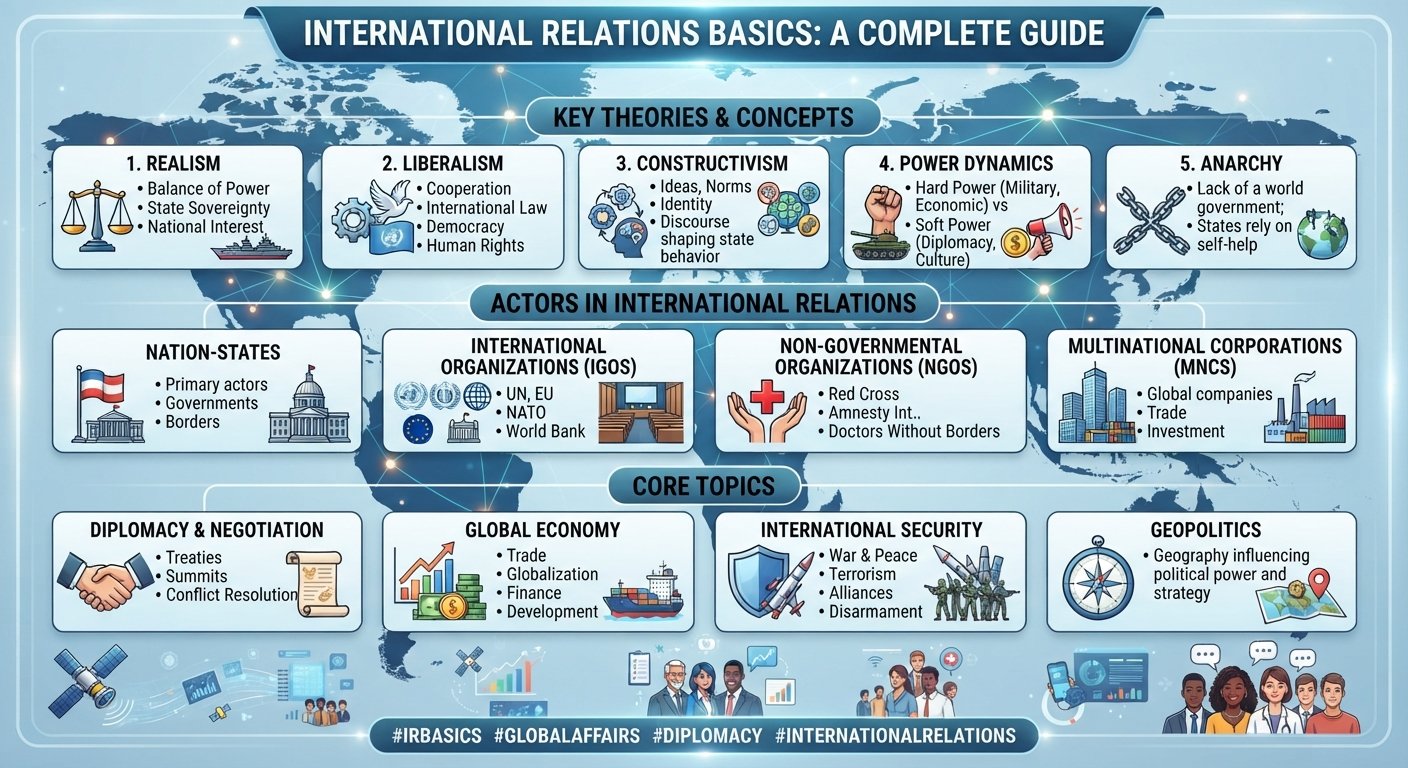
Traditionally, the field focused primarily on relations between sovereign states. Modern international relations is broader and examines the activities of:
- Nation-states
- International organizations
- Regional organizations
- Multinational corporations
- Non-governmental organizations
- Transnational movements
- Armed non-state groups
- Financial institutions
- Technology companies
International relations examines questions such as:
- Why do countries cooperate?
- Why do wars occur?
- How are alliances created?
- How does diplomacy prevent conflict?
- Why do states impose sanctions?
- How does international trade affect political relationships?
- What determines the distribution of global power?
- How do international institutions influence state behavior?
At its simplest, international relations is about how political actors interact within an international system where no single world government has supreme authority over all states.
Why Are International Relations Important?
International relations affects much more than foreign ministries and diplomatic meetings.
International political decisions can influence:
- International trade
- Energy prices
- Food security
- Migration
- National defense
- Investment
- Technology
- Currency and financial systems
- Global supply chains
- Humanitarian assistance
- International development
- Environmental cooperation
A conflict in one region can disrupt shipping routes and increase commodity prices elsewhere. A change in trade policy can affect manufacturers thousands of kilometers away. A military alliance can influence the security calculations of countries that are not even members.
This interconnectedness makes international relations important for students, businesses, governments, journalists, researchers, investors, and ordinary citizens.
Historical Development of International Relations
International relations has existed for centuries, although the academic discipline developed much more recently.
Ancient Diplomacy and Early International Systems
Ancient civilizations developed diplomatic practices involving treaties, envoys, trade agreements, alliances, and warfare.
Examples can be found in ancient Mesopotamia, Egypt, China, India, Greece, and Rome.
The Treaty of Kadesh, concluded between the Egyptian pharaoh Ramesses II and the Hittite king Hattusili III in the 13th century BCE, is commonly regarded as one of the earliest surviving international peace treaties.
These early examples demonstrate that political communities have long needed mechanisms for managing competition and cooperation.
The Rise of the Modern State System
The Peace of Westphalia of 1648 is frequently associated with the development of the modern state system, although historians debate how accurately the “Westphalian sovereignty” narrative describes the period.
The broader historical development nevertheless contributed to the idea that territorial states possess political authority within defined jurisdictions.
This concept of sovereignty became fundamental to modern international relations.
The Concert of Europe
Following the Napoleonic Wars, European powers attempted to maintain stability through consultation and balance-of-power diplomacy.
The Concert of Europe demonstrated how major powers could cooperate to manage competition without creating a single centralized world government.
The League of Nations
After the First World War, the League of Nations was created to promote collective security and international cooperation.
The League ultimately failed to prevent another world war, but its experience contributed to later efforts to create stronger international institutions.
The United Nations Era
The Second World War produced a renewed effort to establish international institutions.
The United Nations Charter was signed in 1945 and established a framework for international cooperation, peace and security, and sovereign equality.
The Charter also established principles concerning the peaceful settlement of disputes and restrictions on the use of force. (United Nations)
The Cold War
From the late 1940s through the early 1990s, international relations was heavily influenced by rivalry between the United States and Soviet Union.
The period featured:
- Nuclear deterrence
- Military alliances
- Proxy conflicts
- Ideological competition
- Arms races
- Intelligence operations
- Diplomatic crises
The Cold War ended with the dissolution of the Soviet Union in 1991.
Globalization and the Post-Cold War Period
The decades following the Cold War saw increased economic globalization, international trade, regional integration, technological development, and expansion of international institutions.
At the same time, conflicts in the Middle East, Africa, Europe, and Asia demonstrated that interstate rivalry had not disappeared.
The contemporary international system combines globalization with strategic competition.
Major Concepts in International Relations


Sovereignty
Sovereignty refers broadly to a state’s authority over its territory and domestic affairs.
It is one of the foundational concepts of international relations.
However, sovereignty exists alongside international obligations. States voluntarily enter treaties and international organizations that create commitments affecting their behavior.
National Interest
The national interest describes the objectives a government considers important for its country’s security, prosperity, political stability, or international position.
National interests may include:
- Territorial security
- Economic growth
- Energy access
- Trade
- Political influence
- Military security
- Access to strategic resources
- Protection of citizens abroad
Different governments may define their national interests differently.
Power
Power is central to international relations.
It can include:
Military power: Armed forces, nuclear capabilities, weapons systems, and defense infrastructure.
Economic power: GDP, trade, financial institutions, natural resources, and market size.
Technological power: Advanced technologies, artificial intelligence, semiconductors, satellites, and cyber capabilities.
Diplomatic power: The ability to negotiate, build coalitions, and influence international institutions.
Soft power: The ability to attract or persuade others through culture, values, institutions, education, and international reputation.
Balance of Power
The balance of power describes situations in which states seek to prevent any single state from becoming overwhelmingly dominant.
States can attempt to maintain balance through:
- Alliances
- Military modernization
- Diplomatic coalitions
- Economic partnerships
- Strategic partnerships
Balance-of-power thinking remains influential in geopolitical analysis.
National Security
National security traditionally focuses on protecting a country from external threats.
Modern security studies have expanded to include:
- Terrorism
- Cyberattacks
- Pandemics
- Energy insecurity
- Climate-related risks
- Disinformation
- Economic vulnerabilities
- Critical infrastructure threats
Major Theories of International Relations
International relations is not governed by one universally accepted theory. Different theoretical approaches emphasize different explanations for state behavior.
Realism
Realism emphasizes power, security, national interests, and competition.
Realists generally argue that states operate in an international system without a central authority capable of reliably protecting every state.
As a result, governments must consider their own security and capabilities.
Realism is particularly useful for analyzing:
- Military competition
- Alliances
- Strategic rivalry
- Great-power politics
- Deterrence
Liberalism
Liberalism emphasizes cooperation, institutions, economic interdependence, democracy, and international rules.
Liberal approaches argue that international institutions can reduce uncertainty and create mechanisms for cooperation.
The United Nations, World Trade Organization, regional organizations, and international agreements are therefore important subjects for liberal analysis.
Constructivism
Constructivism emphasizes the role of ideas, identities, norms, values, and social beliefs.
From this perspective, states do not respond only to material power. Their behavior can also be shaped by how they perceive themselves and others.
Concepts such as national identity, historical memory, political legitimacy, and international norms can therefore influence foreign policy.
Marxist and Critical Approaches
Marxist and other critical approaches examine international relations through the lens of economic structures, inequality, capitalism, class relations, and global power.
These perspectives can be useful for analyzing questions concerning global economic inequality, dependency, development, and the distribution of resources.
Feminist Approaches
Feminist international-relations scholarship examines how gender influences international politics, security, conflict, diplomacy, and economic structures.
It challenges traditional definitions of security that focus primarily on states and military power.
Diplomacy and Foreign Policy
Diplomacy is one of the principal mechanisms through which states manage international relationships.
What Is Diplomacy?
Diplomacy involves communication, negotiation, representation, and relationship management between states and other international actors.
Diplomats can work on:
- Peace negotiations
- Trade agreements
- Security arrangements
- Consular affairs
- Crisis management
- International cooperation
- Cultural relations
Diplomacy does not eliminate disagreement. Its purpose is often to manage disagreement without allowing it to escalate into armed conflict.
What Is Foreign Policy?
Foreign policy refers to the objectives and actions through which a government manages its external relationships.
It can include:
- Diplomatic engagement
- Military alliances
- Trade policy
- Economic sanctions
- Development assistance
- Arms agreements
- International treaties
- Strategic partnerships
Foreign policy is shaped by both external and domestic factors.
A government may face pressure from economic conditions, elections, public opinion, military institutions, business interests, political parties, and neighboring states.
International Organizations
International organizations provide platforms for cooperation and rule-making.
United Nations
The United Nations is one of the central institutions of the contemporary international system.
Its Security Council has 15 members: five permanent members and ten non-permanent members. The permanent members are China, France, Russia, the United Kingdom, and the United States. (United Nations)
The Security Council has primary responsibility under the UN Charter for international peace and security. (United Nations)
NATO
NATO is a political and military alliance founded in 1949.
Its central principle is collective defense: an armed attack against one member is treated as an attack against all members under Article 5, although each member determines what assistance it considers necessary. NATO states that Article 5 has been invoked only once, following the September 11, 2001 terrorist attacks. (NATO)
NATO’s current framework identifies three core tasks: deterrence and defense, crisis prevention and management, and cooperative security. (NATO)
World Trade Organization
The World Trade Organization (WTO) provides a framework for international trade rules and serves as a forum for trade negotiations and dispute settlement.
Its agreements form the foundation of the multilateral trading system and are intended to make international trade more predictable. (World Trade Organization)
Regional Organizations
Regional institutions also play major roles.
Examples include:
- European Union
- African Union
- ASEAN
- Organization of American States
- Gulf Cooperation Council
- South Asian Association for Regional Cooperation
Regional organizations can facilitate trade, political dialogue, security cooperation, and conflict management.
International Law and International Relations
International law provides rules governing many aspects of relations among states.
Important areas include:
- Treaties
- Diplomatic relations
- Human rights
- International humanitarian law
- Maritime law
- Refugee protection
- International criminal law
- Use of force
The International Court of Justice, the principal judicial organ of the United Nations, deals with legal disputes submitted by states and provides advisory opinions on legal questions referred to it by authorized UN organs and agencies.
International law does not function exactly like domestic law. There is no single global police force with unlimited authority. Enforcement depends on institutions, state consent, political pressure, domestic implementation, sanctions, and other mechanisms.
This distinction is important when evaluating claims about whether an international action is “legal” or “illegal.”
International Security and Conflict
Security remains one of the oldest concerns in international relations.
Traditional Security
Traditional security focuses primarily on:
- Military threats
- Territorial disputes
- War
- Alliances
- Nuclear weapons
- Deterrence
Human Security
Human-security approaches broaden the concept to include threats to individuals and communities.
These can include:
- Poverty
- Food insecurity
- Disease
- Forced displacement
- Environmental threats
- Political violence
The two approaches are not necessarily contradictory. A state can face military threats while its population simultaneously experiences economic or humanitarian insecurity.
Alliances and Strategic Partnerships
Countries frequently form alliances or strategic partnerships to strengthen their security and diplomatic influence.
An alliance may provide:
- Collective defense
- Intelligence sharing
- Military interoperability
- Diplomatic support
- Joint exercises
- Strategic deterrence
Strategic partnerships may be less formal than alliances but can cover defense, trade, technology, energy, infrastructure, or diplomatic cooperation.
NATO provides a prominent example of a formal collective-defense alliance. Its founding treaty was signed on April 4, 1949, by 12 countries. The alliance now has 32 members. (NATO)
Economic Relations and International Politics
Economic relations are deeply connected to foreign policy.
Trade can create incentives for cooperation, but economic interdependence can also become a source of strategic vulnerability.
Governments may use:
- Tariffs
- Export controls
- Investment restrictions
- Sanctions
- Development assistance
- Trade agreements
- Financial measures
as instruments of foreign policy.
The WTO describes itself as the global organization dealing with rules of trade between nations, with its agreements forming the foundation of the multilateral trading system. (World Trade Organization)
This demonstrates why modern international relations cannot be understood solely through military power.
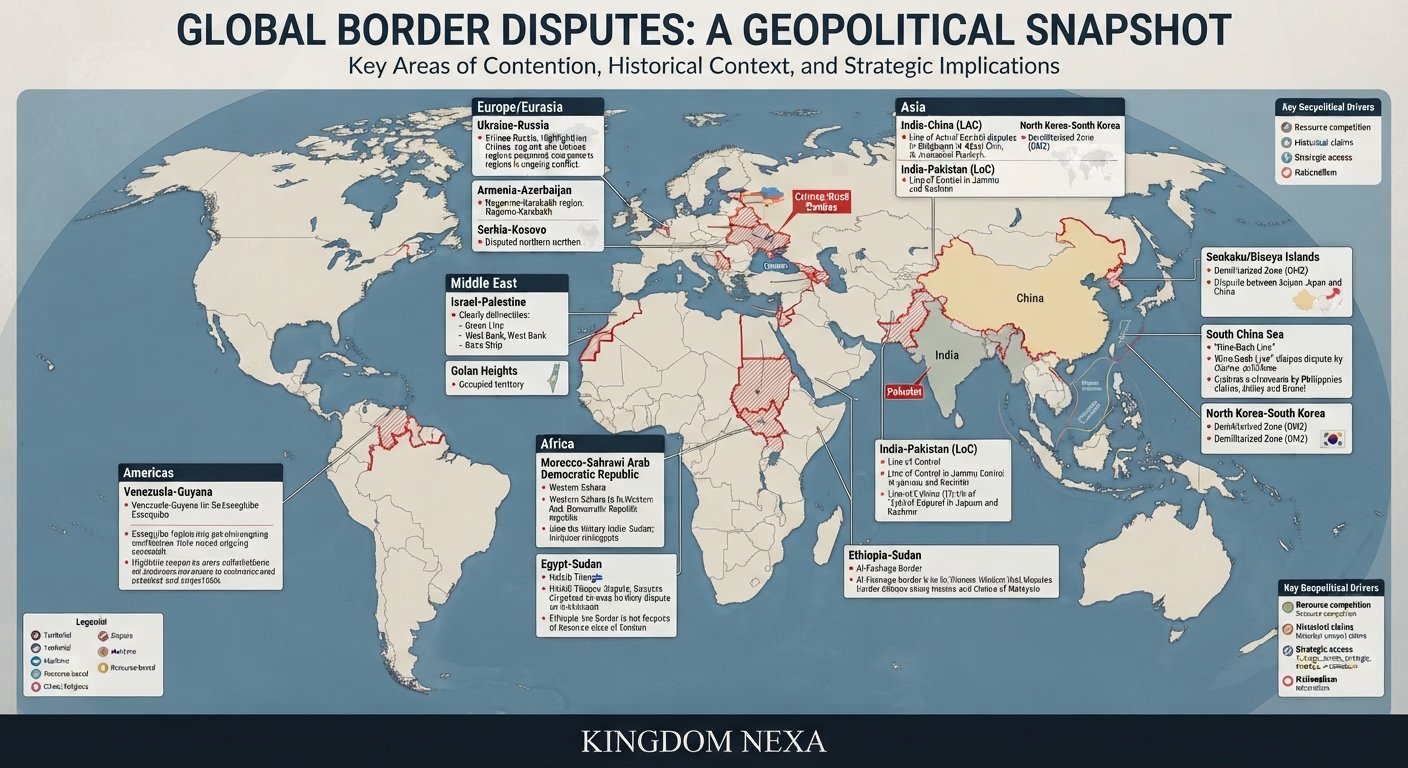
Geopolitics and Geography
Geography has always influenced international relations.
Countries may gain strategic importance because they control:
- Sea lanes
- Mountain passes
- River systems
- Border corridors
- Ports
- Energy routes
- Strategic islands
- Chokepoints
Geopolitics examines how geographic conditions interact with political power.
For example, a country located near major trade routes may have strategic significance beyond its economic size. Similarly, access to warm-water ports, natural resources, or important waterways can affect national strategy.
Technology and International Relations
Technology has become an increasingly important dimension of international power.
Cybersecurity
Governments increasingly consider cyber capabilities part of national security.
Cyber operations can target:
- Government networks
- Financial institutions
- Energy systems
- Telecommunications
- Military infrastructure
- Critical infrastructure
Artificial Intelligence
AI has implications for:
- Military planning
- Intelligence analysis
- Cybersecurity
- Economic competitiveness
- Surveillance
- Information operations
Semiconductors
Advanced semiconductors are important to modern computing, communications, artificial intelligence, and military systems.
Consequently, technology supply chains have become strategic concerns for major economies.
Non-State Actors in International Relations
States remain the central actors in international relations, but they do not operate alone.
Non-state actors include:
- Multinational corporations
- NGOs
- International financial institutions
- Terrorist organizations
- Armed groups
- Technology companies
- Humanitarian organizations
- Transnational advocacy networks
A multinational corporation can influence investment and supply chains. An NGO can shape international debates about human rights. An armed group can alter regional security calculations.
The growing influence of these actors has made international politics more complex than a simple state-versus-state model.
Globalization and International Relations
Globalization has increased connections between countries through:
- Trade
- Investment
- Migration
- Technology
- Finance
- Education
- Communication
- Transportation
Greater interdependence can encourage cooperation because countries benefit from stable relationships.
However, interdependence can also create vulnerabilities.
A disruption in one country can affect factories, markets, consumers, and governments elsewhere.
This is why modern foreign-policy decisions frequently consider economic resilience and supply-chain security alongside traditional military concerns.
Current Trends in International Relations
Several developments are particularly important for understanding international relations today.
A More Competitive Distribution of Power
Global power is increasingly distributed among several major and regional actors.
The United States remains a central military, economic, technological, and diplomatic power. China has become a major economic and strategic actor. Russia retains significant military and nuclear capabilities. India is expanding its economic and diplomatic influence, while the European Union remains an important economic and regulatory power.
This does not mean the world has completely shifted into a stable multipolar system. Instead, the international environment combines overlapping centers of power.
Economic Security
Governments increasingly view trade, technology, energy, and supply chains through a national-security lens.
This has increased attention to:
- Critical minerals
- Semiconductor supply chains
- Energy independence
- Strategic industries
- Foreign investment
- Economic sanctions
Changing Security Priorities
Security increasingly extends beyond conventional warfare.
States must consider cyber threats, disinformation, terrorism, climate risks, pandemics, critical infrastructure vulnerabilities, and technological competition.
Greater Importance of Regional Powers
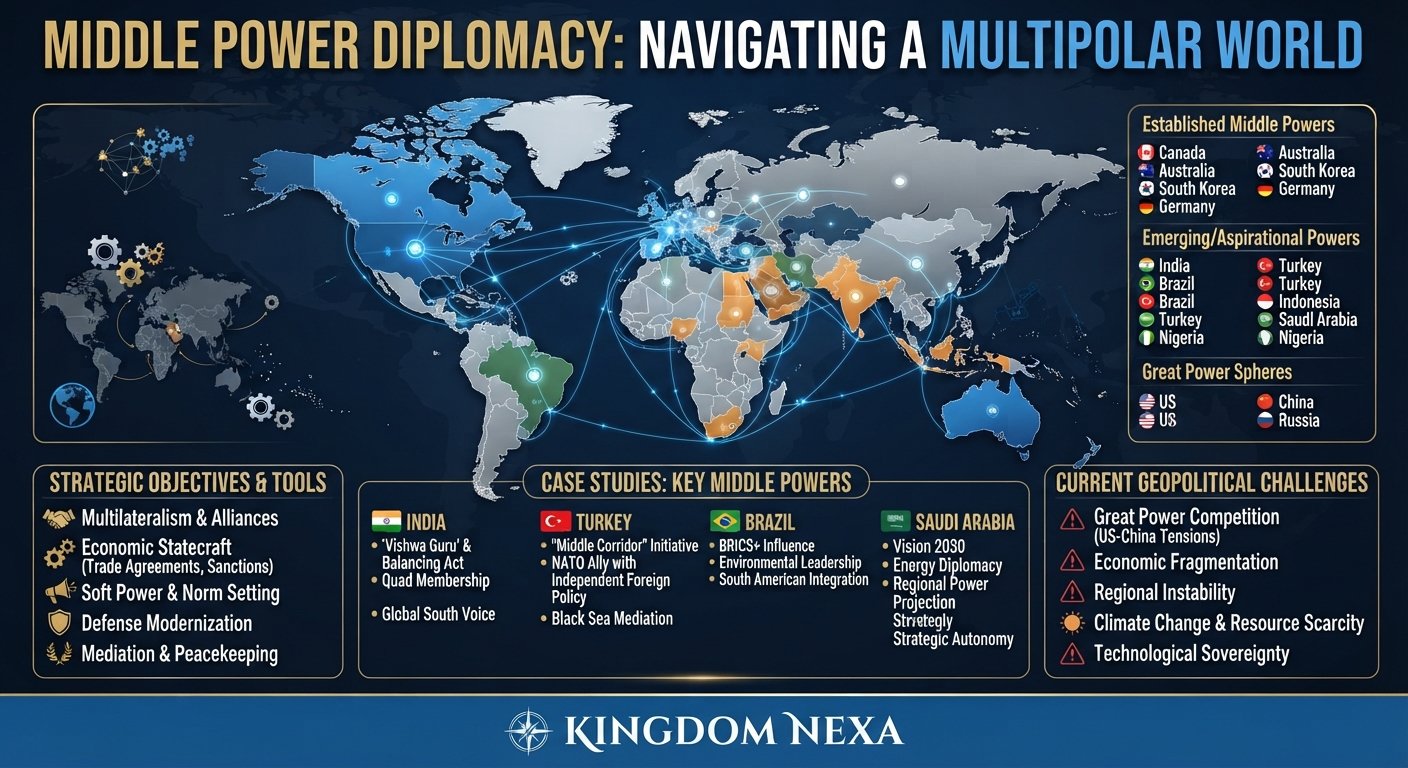
Middle and regional powers increasingly influence international affairs.
Countries do not necessarily have to be global superpowers to affect regional balances, diplomatic negotiations, energy markets, or international institutions.
How to Analyze International Relations
A practical framework can help students and researchers understand complicated international events.
Step 1: Identify the Actors
Determine which states, organizations, companies, institutions, and non-state groups are involved.
Step 2: Identify Their Interests
Ask what each actor wants to achieve.
Step 3: Assess Capabilities
Examine military, economic, technological, diplomatic, demographic, and geographic capabilities.
Step 4: Examine Constraints
Consider domestic politics, economic limitations, international law, alliances, public opinion, and resource constraints.
Step 5: Study the History
Current events rarely emerge from nowhere. Historical conflicts, treaties, alliances, colonial legacies, and previous diplomatic decisions often shape current behavior.
Step 6: Examine Geography
Location can determine strategic importance.
Step 7: Compare Competing Narratives
Government statements are useful primary sources, but they should not automatically be treated as objective descriptions.
Compare official statements with independent evidence and credible research.
Step 8: Develop Scenarios
Instead of assuming one inevitable outcome, identify several plausible possibilities.
This framework helps distinguish what is known from what is inferred.
Why International Relations Matters for Students and Professionals
Students studying political science, international relations, history, economics, law, journalism, security studies, or public policy can benefit from understanding the foundations of the field.
Professionals also need international-relations knowledge.
Businesses monitor:
- Political risk
- Sanctions
- Trade policy
- Regulation
- Currency instability
- Supply-chain disruption
Governments assess:
- Security threats
- Diplomatic relationships
- Alliances
- Economic interests
- Regional instability
Journalists and researchers must understand historical context and competing narratives before interpreting international events.
Frequently Asked Questions
1. What are International Relations Basics?
International Relations Basics refers to the fundamental concepts used to understand how states and other international actors interact through diplomacy, security, economics, law, alliances, trade, and political cooperation.
2. Why is international relations important?
International relations helps explain war, peace, diplomacy, international trade, alliances, sanctions, migration, economic cooperation, and global security.
3. What are the main theories of international relations?
The major approaches include realism, liberalism, constructivism, Marxist and critical approaches, and feminist international-relations perspectives.
4. What is the difference between international relations and foreign policy?
International relations is the broader study of interactions within the international system. Foreign policy refers to the objectives and actions a particular government uses in managing its external relationships.
5. What is diplomacy in international relations?
Diplomacy is the practice of communication, negotiation, representation, and relationship management among states and other international actors.
6. What is sovereignty?
Sovereignty refers broadly to a state’s authority over its territory and domestic political affairs, subject to international obligations it has accepted.
7. What is the role of the United Nations in international relations?
The United Nations provides a framework for international cooperation, diplomacy, peace and security, humanitarian action, development, and international law. Its Security Council has primary responsibility under the UN Charter for international peace and security. (United Nations)
8. Why are alliances important?
Alliances can improve security through collective defense, military cooperation, intelligence sharing, deterrence, and diplomatic coordination.
9. How does economics affect international relations?
Trade, investment, energy, sanctions, financial systems, technology, and supply chains can influence foreign-policy decisions and relationships between states.
10. What is the future of international relations?
The international system is likely to remain shaped by strategic competition, economic interdependence, technological change, regional powers, international institutions, and new security challenges. The exact balance among these forces remains uncertain.
Internal-Link Opportunities
| Suggested Article | Anchor Text | Recommended Placement |
|---|---|---|
| Global Political Affairs | global political affairs | Introduction / conclusion |
| Geopolitics Explained | geopolitics and global power | Geopolitics and Geography |
| Foreign Policy | foreign policy decision-making | Diplomacy and Foreign Policy |
| Global Security | international security | International Security and Conflict |
| International Organizations | international organizations | International Organizations |
| Global Trade | international trade and politics | Economic Relations |
| Geopolitical Risk | geopolitical risk | How to Analyze International Relations |
| International Conflicts | causes of international conflicts | Historical Development |
| Global Power | changing global power dynamics | Current Trends |
| International Law | international law and diplomacy | International Law section |
Conclusion
International relations provides a framework for understanding how countries and other global actors navigate a world characterized by both cooperation and competition. Its core concepts—including sovereignty, national interest, power, diplomacy, alliances, international institutions, international law, security, and economic interdependence—help explain why international events unfold as they do.
The field has evolved considerably from traditional state-to-state diplomacy. Modern international relations now includes technology, cyber capabilities, supply chains, multinational corporations, non-state actors, climate concerns, and complex economic relationships.
For anyone beginning to study geopolitics, the most important lesson is that international events rarely have a single cause. Power, geography, history, economics, domestic politics, security interests, institutions, and national identity can all interact.
Understanding these relationships makes it easier to separate facts from interpretations and short-term events from long-term strategic trends. That analytical foundation is ultimately what makes International Relations Basics valuable—not only for students and researchers, but for anyone seeking to understand an increasingly interconnected world.