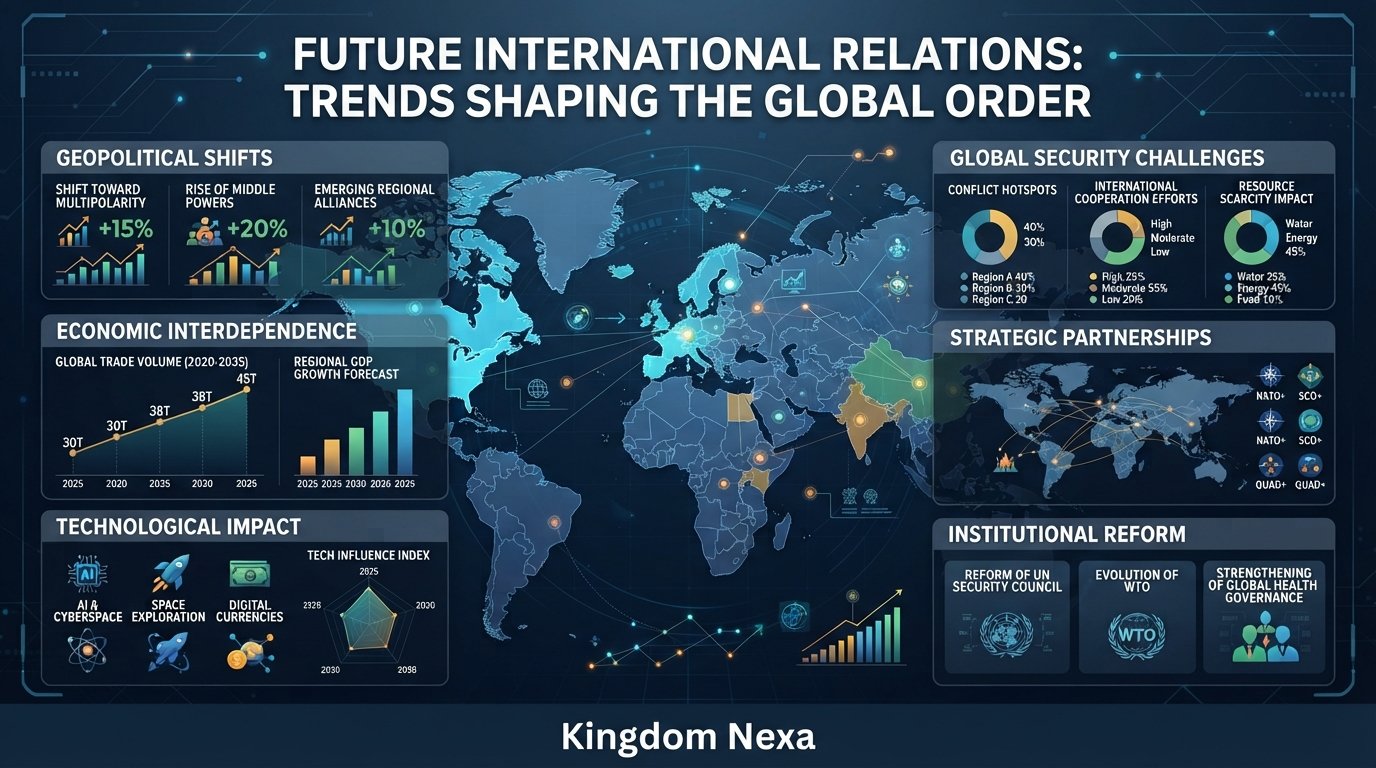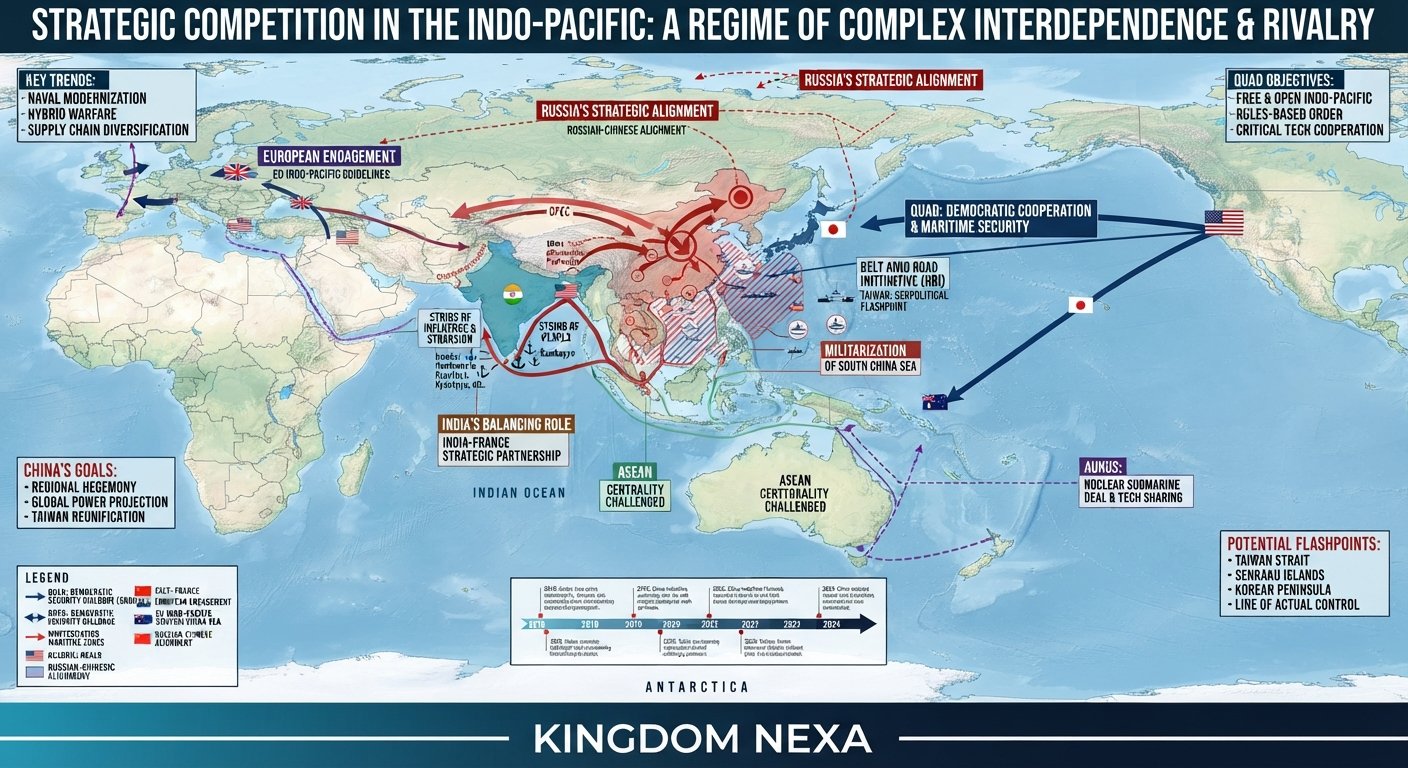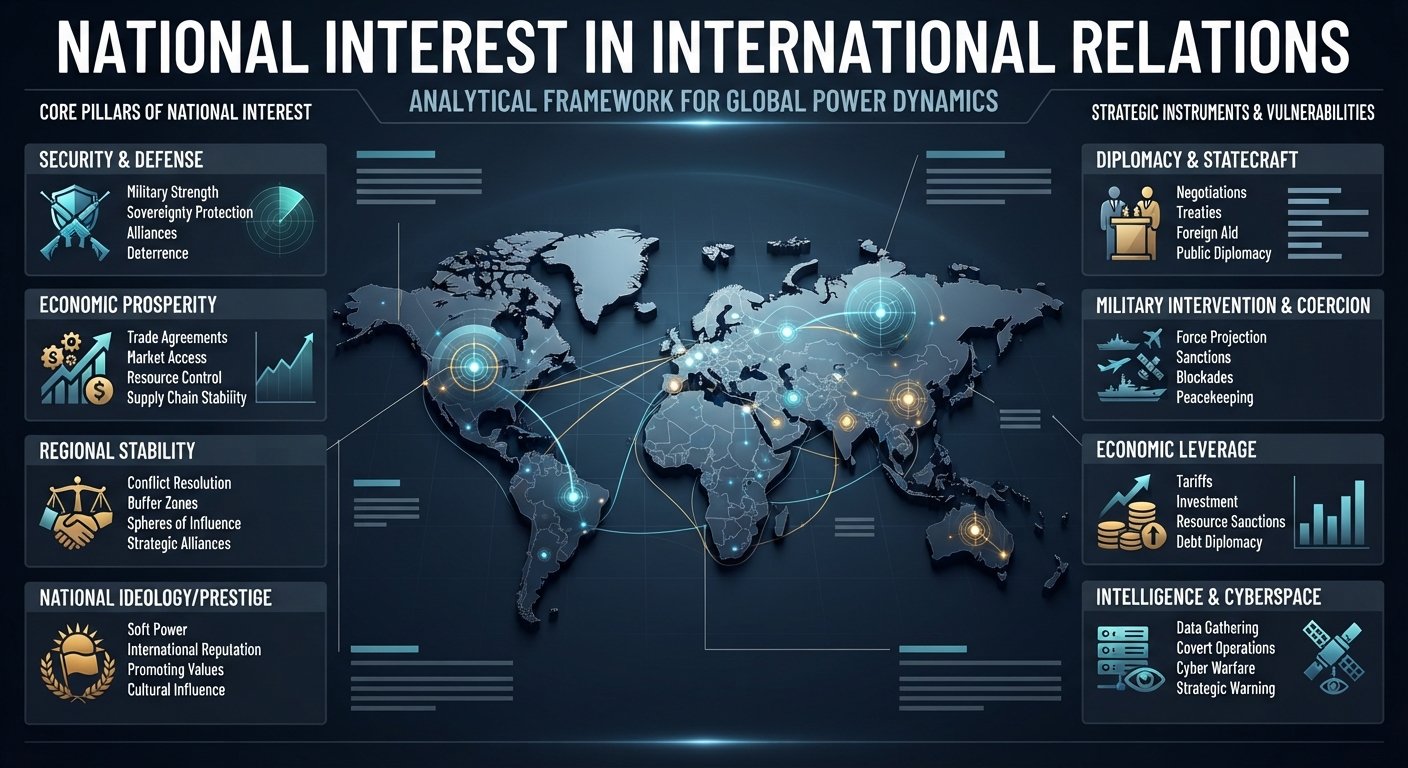
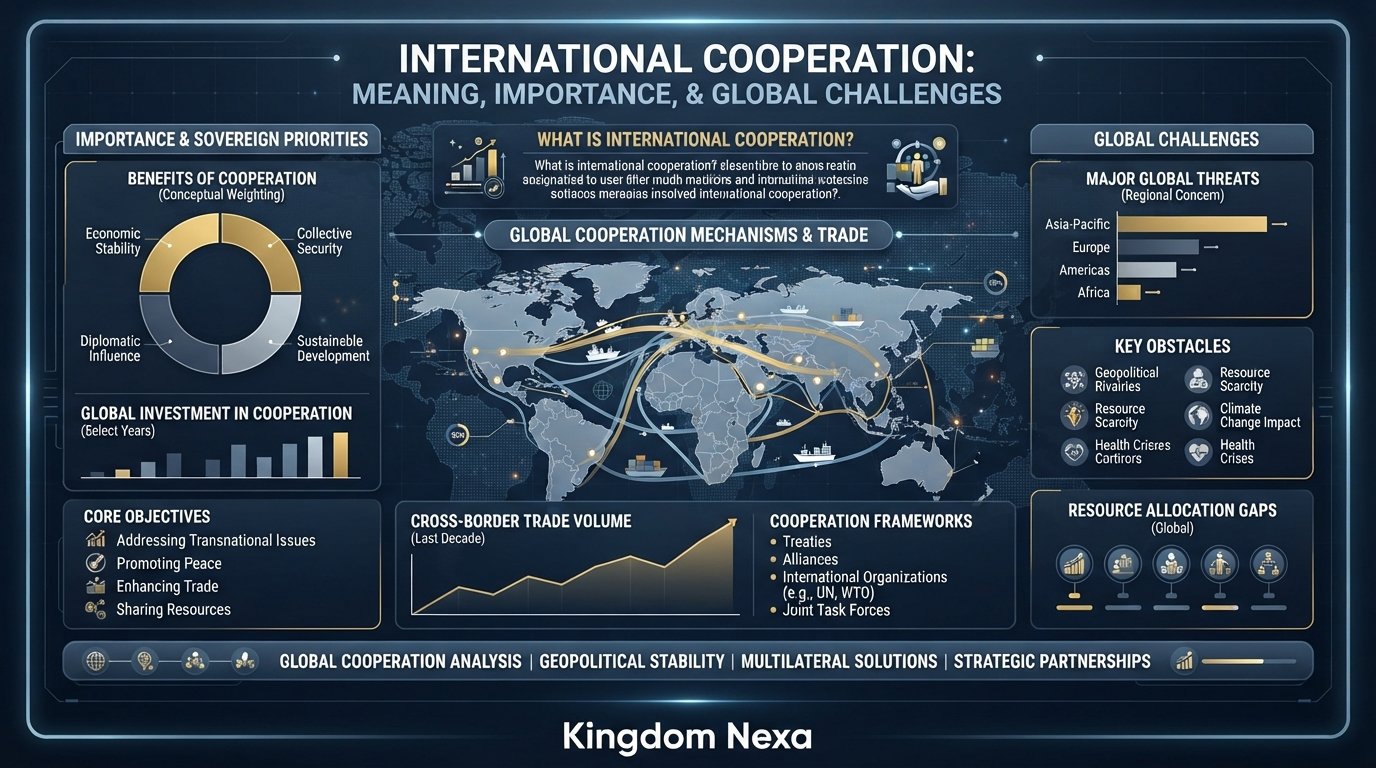
International cooperation is one of the central mechanisms through which countries address problems that cross national borders. From preventing wars and managing pandemics to regulating international trade, tackling climate change, governing artificial intelligence, and financing sustainable development, few major global challenges can be handled effectively by one country acting alone.
Yet international cooperation is under pressure. Geopolitical rivalry, armed conflicts, trade restrictions, economic fragmentation, disagreements over international rules, and unequal access to finance and technology are making collective action more difficult. At the same time, interdependence has not disappeared. Supply chains remain connected, diseases cross borders, climate risks are shared, digital technologies operate globally, and financial instability can spread rapidly between economies.
The result is a paradox: the need for international cooperation is increasing while the political conditions required to sustain it are becoming more difficult.
This article explains what international cooperation means, how it developed, why it matters, which institutions support it, and how cooperation is being tested in 2026. It also examines its economic, security, technological, environmental and legal dimensions, before considering what the future of global cooperation may look like.
What Is International Cooperation?
International cooperation is the process through which countries and other international actors coordinate policies, share resources, establish common rules, exchange information, negotiate agreements, or take collective action to address shared interests and problems.
It can occur between two countries, known as bilateral cooperation, or among several countries through multilateral cooperation. It can also involve regional organizations, international institutions, businesses, universities, civil society organizations and other non-state actors.
A useful distinction is that cooperation does not necessarily mean that countries have identical interests. Governments can cooperate because their interests overlap even when they disagree on other issues.
For example, states may compete economically while simultaneously cooperating on disease surveillance, aviation standards, maritime safety, scientific research or disaster response.
Main Forms of International Cooperation
International cooperation can take several forms:
- Diplomatic cooperation: negotiations, mediation, confidence-building and treaties.
- Economic cooperation: trade agreements, investment frameworks, financial assistance and development partnerships.
- Security cooperation: intelligence sharing, peacekeeping, arms-control arrangements and joint security mechanisms.
- Scientific cooperation: research partnerships, data exchange and technology development.
- Environmental cooperation: climate agreements, biodiversity protection and pollution control.
- Humanitarian cooperation: disaster relief, refugee assistance and emergency response.
- Technological cooperation: digital standards, cybersecurity coordination and artificial-intelligence governance.
- Legal cooperation: treaties, dispute settlement and common international standards.
The United Nations Charter explicitly identifies international cooperation in solving economic, social, cultural and humanitarian problems as one of the purposes of the United Nations.
Why Is International Cooperation Important?
International cooperation matters because many contemporary challenges are inherently transnational.
A country can strengthen its domestic pandemic preparedness, for example, but pathogens do not respect borders. Similarly, one state can reduce its own emissions while remaining exposed to climate-related effects generated globally.
The same logic applies to financial crises, cyber threats, maritime security, migration, organized crime and disruptions to international supply chains.
Managing Problems No Country Can Solve Alone
Global challenges frequently involve what political scientists describe as collective-action problems.
Each country may have an incentive to protect its own short-term interests, while the wider international community benefits when countries act together.
Climate change is a clear example. Reducing emissions can impose immediate economic and political costs, while many benefits are distributed globally and over longer periods.
International cooperation can reduce this problem by establishing common expectations, financing mechanisms, monitoring systems and reciprocal commitments.
Reducing the Risk of Conflict
Cooperation can also create mechanisms for managing disagreements before they become armed conflicts.
Diplomatic negotiations, confidence-building measures, regional organizations, peacekeeping missions, arms-control arrangements and international courts can provide channels through which disputes are managed.
International cooperation does not eliminate war. However, institutions can create opportunities for communication and negotiation that would otherwise be absent.
Supporting Global Economic Stability
Modern economies depend heavily on international trade, investment, financial markets, transportation networks and supply chains.
Consequently, sudden changes in one major economy can affect businesses and consumers elsewhere.
Cooperation through institutions such as the International Monetary Fund, World Bank and World Trade Organization can help establish rules, provide financing and coordinate responses to economic shocks.
Historical Evolution of International Cooperation
International cooperation existed long before the modern United Nations system. States historically negotiated treaties concerning trade, war, borders, navigation and diplomacy.
However, the scale and institutionalization of cooperation expanded substantially during the twentieth century.
From the League of Nations to the United Nations
The First World War demonstrated the destructive consequences of industrialized interstate conflict. The League of Nations was subsequently established as an attempt to create a collective security system.
The League ultimately failed to prevent the Second World War, but the experience influenced the creation of a more comprehensive postwar international system.
The United Nations Charter was signed in 1945 and established a framework based on sovereign equality, peaceful settlement of disputes, collective security and international cooperation.
The Post-1945 Institutional System
After the Second World War, governments developed a network of institutions addressing different aspects of international affairs.
These included:
- the United Nations;
- International Monetary Fund;
- World Bank;
- General Agreement on Tariffs and Trade, later succeeded by the WTO;
- World Health Organization;
- International Civil Aviation Organization;
- International Maritime Organization;
- regional organizations such as the European Union and African Union;
- numerous international treaties and specialized agencies.
The objective was not to eliminate national sovereignty but to create mechanisms through which sovereign states could manage growing interdependence.
Cooperation After the Cold War
The end of the Cold War initially created expectations of deeper global integration.
Trade expanded, international institutions gained influence in several areas, and globalization accelerated. At the same time, new challenges emerged, including terrorism, financial crises, climate change, cyber threats and complex humanitarian emergencies.
The COVID-19 pandemic later demonstrated both the necessity and the difficulty of international cooperation.
How Does International Cooperation Work?
International cooperation operates through a combination of institutions, agreements, norms and practical mechanisms.
Treaties and International Agreements
Treaties are among the most formal instruments of cooperation.
Countries can establish binding obligations covering issues such as climate change, maritime law, arms control, trade, health and human rights.
The effectiveness of a treaty depends partly on participation, implementation, monitoring and enforcement.
International Organizations
International organizations provide platforms where governments can negotiate and coordinate.
The United Nations is the broadest global political forum, while specialized organizations focus on particular areas.
For example, the WHO deals with international public health, the WTO with global trade rules, and the IMF with international monetary and financial stability.
Regional Cooperation
Cooperation does not have to be global.
Regional organizations can sometimes move more quickly because neighboring states share geographical interests and face similar challenges.
Examples include the European Union, African Union, Association of Southeast Asian Nations, Gulf Cooperation Council, South Asian Association for Regional Cooperation and Organization of American States.
Regional cooperation can complement global institutions rather than necessarily replacing them.
International Cooperation and Global Security
Security is one of the most demanding areas of international cooperation because national interests often diverge sharply.
States may cooperate against terrorism, piracy, organized crime, nuclear proliferation and other threats while simultaneously competing for strategic influence.
Peacekeeping and Conflict Management
United Nations peacekeeping represents one important form of institutionalized security cooperation.
Since the first UN peacekeeping operation in 1948, personnel from many countries have served under the UN flag. Peacekeeping missions can help protect civilians, monitor ceasefires, support political processes and create conditions for longer-term peace.
However, peacekeeping depends on political mandates, resources and cooperation from relevant parties.
Arms Control and Strategic Stability
International agreements can also reduce risks associated with weapons.
Arms-control arrangements may establish limits, verification mechanisms, transparency measures or communication channels.
Their effectiveness depends heavily on political trust and compliance.
When strategic rivalry increases, countries may place greater emphasis on national military capabilities, making cooperative security arrangements more difficult.
Economic Cooperation and International Trade
Economic cooperation is one of the most visible forms of international interdependence.
Trade agreements and common rules can reduce uncertainty for businesses and create larger markets.
Yet the international trading system is experiencing significant pressure.
The WTO reported in 2025 that tariffs and trade-policy uncertainty had materially weakened the outlook for world merchandise trade. Its August 2025 update revised projected merchandise trade growth upward for 2025 but lowered the expected growth rate for 2026, illustrating how policy changes and uncertainty can rapidly alter international economic conditions.
By 2026, concerns about fragmentation remain important. The challenge is not simply whether countries trade with one another, but whether they can maintain predictable rules while simultaneously pursuing national industrial, technological and security objectives.
Development Finance
International cooperation is particularly important for developing countries that face limited fiscal space, debt pressures, infrastructure gaps and climate-related vulnerabilities.
The UN’s 2026 Financing for Sustainable Development Report warned that geopolitical fragmentation and financing constraints are threatening development progress. It linked weakening global collaboration, rising trade barriers and geopolitical tensions with growing difficulties in financing internationally agreed development goals.
This illustrates a central problem: cooperation requires resources, while resource shortages can themselves weaken cooperation.
Climate Change and Environmental Cooperation
Climate change is perhaps the clearest example of a global collective-action problem.
The Paris Agreement provides a framework through which countries submit nationally determined contributions and strengthen climate action over time.
International cooperation also occurs through climate finance, technology transfer, scientific research, carbon-market mechanisms and adaptation programs.
Article 6 of the Paris Agreement specifically provides mechanisms for international cooperation, including internationally transferred mitigation outcomes, a UN-supervised crediting mechanism and non-market approaches.
Environmental cooperation is difficult because countries differ in historical emissions, economic capacity, energy needs and development priorities.
Developing countries frequently emphasize finance, technology transfer and climate equity, while developed economies may place greater emphasis on emissions reduction, transparency and implementation.
These differences do not make cooperation impossible, but they make negotiations politically complex.
International Cooperation in Global Health
The COVID-19 pandemic demonstrated the consequences of fragmented responses to a global health emergency.
In May 2025, WHO Member States adopted the WHO Pandemic Agreement after more than three years of negotiations. The agreement seeks to strengthen international coordination for pandemic prevention, preparedness and response while respecting national sovereignty.
The agreement also illustrates how international cooperation develops incrementally.
Adoption of a framework does not automatically resolve every disagreement. In 2026, countries continued work on the Pathogen Access and Benefit Sharing annex, dealing with questions surrounding access to pathogen materials and the equitable sharing of benefits.
This is a broader lesson about international governance: agreement on principles is often only the beginning of implementation.
Technology, AI and Digital Cooperation
Technology is becoming one of the newest major arenas of international cooperation.
Artificial intelligence, semiconductor supply chains, cybersecurity, data governance and digital infrastructure have consequences that cross national borders.
The UN’s Global Digital Compact, adopted in 2024 as part of the Pact for the Future, established a global framework for digital cooperation and AI governance.
It calls for international cooperation on issues including digital divides, data governance, AI capacity-building and interoperable governance approaches.
In 2026, the UN’s international AI governance mechanisms moved from planning toward implementation. The inaugural Global Dialogue on AI Governance took place in Geneva in July 2026, providing a multilateral forum for governments and stakeholders to discuss AI governance.
The importance of this cooperation is growing because national AI regulations can create conflicting standards when systems, data, companies and users operate across borders.
International Cooperation and International Law
International law provides one of the principal foundations for cooperation.
The United Nations Charter establishes basic principles governing relations among states, including peaceful settlement of disputes and international cooperation.
The UN Convention on the Law of the Sea is another important example. Adopted in 1982 and entering into force in 1994, it establishes a comprehensive legal framework covering maritime zones, navigation, resource rights, environmental protection, scientific research and dispute settlement.
International law does not eliminate geopolitical competition. Rather, it establishes rules and procedures within which much of that competition takes place.
The effectiveness of international law ultimately depends on state consent, implementation, institutions and political willingness to comply.
Major Challenges to International Cooperation
International cooperation faces several interconnected obstacles.
Geopolitical Rivalry
Competition among major powers can make collective decision-making harder.
States may fear that cooperation could strengthen strategic competitors or reduce their policy autonomy.
Sovereignty Concerns
Governments remain responsible for their domestic populations and may resist international arrangements perceived as limiting national decision-making.
Effective cooperation therefore requires balancing collective action with sovereign authority.
Unequal Economic Power
Countries do not enter negotiations with identical financial, technological or military capabilities.
Developing countries often argue that global institutions need to provide greater representation and access to finance, technology and decision-making.
Trust Deficits
International agreements require confidence that other participants will honor their commitments.
When governments perceive repeated violations or inconsistent enforcement, willingness to cooperate may decline.
Institutional Limitations
International organizations can be constrained by funding, political disagreement and decision-making structures.
The UN Security Council, for example, can experience paralysis when permanent members disagree on major security questions.
Fragmentation
Economic and geopolitical fragmentation can produce overlapping institutions, competing standards and separate technological or financial systems.
Fragmentation does not necessarily mean complete separation. Countries may remain deeply interconnected while simultaneously attempting to reduce strategic dependence.
The Current State of International Cooperation in 2026
The international system in 2026 presents a mixed picture.
On one hand, there are significant signs of institutional cooperation.
The 2024 Pact for the Future created new frameworks for global governance, digital cooperation and future generations. The WHO Pandemic Agreement demonstrated that governments can still negotiate major multilateral instruments after periods of severe international disagreement.
The 2026 UN Sustainable Development Goals Report also emphasizes that international cooperation and sustained investment have produced measurable gains in areas including water, electricity, healthcare and digital connectivity.
On the other hand, the same evidence points to serious pressures.
The UN’s 2026 financing report identifies fragmentation, geopolitical tensions, trade barriers and financing constraints as threats to development progress. The IMF has also highlighted geopolitical fragmentation and trade tensions as risks to global economic stability.
The picture is therefore neither one of complete multilateral decline nor uninterrupted global integration.
A more accurate description is selective and contested cooperation.
Countries continue cooperating where interests overlap, while competition remains intense in areas involving security, technology, industrial policy, strategic resources and geopolitical influence.
What Is the Future of International Cooperation?
The future will likely depend less on whether countries cooperate in general and more on where, how and under what conditions they cooperate.
Scenario 1: Pragmatic Cooperation
Under this scenario, governments maintain strategic competition but cooperate on areas where mutual benefits are obvious.
Climate adaptation, pandemic preparedness, financial stability, disaster response and AI safety could become examples of practical cooperation despite broader political rivalry.
Scenario 2: Regionalized Cooperation
Countries could increasingly rely on regional organizations and smaller coalitions.
This could make cooperation easier among countries with shared interests, but it could also produce incompatible rules and competing standards.
Scenario 3: Deeper Global Institutional Reform
Another possibility is renewed effort to reform global institutions.
The Pact for the Future reflects this direction by addressing questions involving international governance, sustainable development, digital technology and future generations.
Whether such reforms produce lasting change will depend on implementation and political support.
Scenario 4: Greater Fragmentation
A more fragmented system could emerge if geopolitical competition increasingly affects trade, technology, finance and security cooperation.
Countries might diversify supply chains and reduce strategic dependencies while forming tighter blocs.
This would not end international cooperation, but cooperation could become more transactional and less universal.
What Can Make International Cooperation More Effective?
Several principles can improve the prospects for cooperation.
First, transparency matters. Governments are more likely to cooperate when information is available and commitments can be monitored.
Second, institutions need legitimacy. Countries are more likely to accept international rules when they believe decision-making is representative and fair.
Third, implementation matters as much as agreements. A treaty without resources, monitoring and domestic implementation can have limited practical impact.
Fourth, developing countries need meaningful participation. International cooperation is more sustainable when countries with different economic capacities have credible opportunities to shape decisions.
Fifth, flexible cooperation can complement universal institutions. Smaller groups can sometimes move faster, while broader institutions can provide legitimacy and wider participation.
The objective should not necessarily be to eliminate geopolitical competition. A more realistic goal is to prevent competition from destroying the mechanisms needed to manage shared risks.
Frequently Asked Questions About International Cooperation
What is international cooperation?
International cooperation is the process through which countries and other international actors coordinate policies, resources, rules and actions to address shared interests and cross-border challenges.
Why is international cooperation important?
It helps countries address problems that cannot be effectively solved within national borders, including climate change, pandemics, international trade, financial instability, transnational crime and global security risks.
What is an example of international cooperation?
The Paris Agreement is one example. Countries cooperate through nationally determined contributions and international mechanisms intended to strengthen climate action.
What organizations promote international cooperation?
Major institutions include the United Nations, World Health Organization, World Trade Organization, International Monetary Fund, World Bank and numerous regional organizations.
How does international cooperation affect global security?
It supports diplomacy, peacekeeping, information sharing, arms-control arrangements, conflict prevention and coordinated responses to transnational security threats.
What are the main barriers to international cooperation?
Major barriers include geopolitical rivalry, distrust, competing national interests, sovereignty concerns, unequal economic power, institutional limitations and disagreements over how international rules should be implemented.
Is international cooperation the same as globalization?
No. Globalization describes growing cross-border economic, social, technological and cultural interconnectedness. International cooperation refers more specifically to deliberate coordination among states and other actors.
How does international cooperation help developing countries?
It can provide access to development finance, technology, trade opportunities, scientific expertise, health resources, infrastructure support and international markets.
Why is international cooperation important for artificial intelligence?
AI systems and their economic and social effects cross borders. International cooperation can help countries develop compatible rules, share scientific knowledge, reduce risks and improve access to AI capabilities.
Can countries cooperate while competing with each other?
Yes. States frequently cooperate in one area while competing in another. Strategic rivalry and practical cooperation can exist simultaneously because national interests are rarely identical across every issue.
Conclusion
International cooperation remains a fundamental feature of the international system, even as geopolitical competition becomes more pronounced.
Its importance comes from a simple reality: many of the world’s most consequential problems do not stop at national borders. Pandemics, climate change, financial instability, cyber risks, artificial intelligence, international trade and transnational security threats require some degree of coordination.
The current situation is therefore best understood as a period of contested interdependence. Governments continue to negotiate agreements, operate international institutions and cooperate on practical problems, while simultaneously pursuing national security, economic and technological interests.
Recent developments provide evidence of both pressures and possibilities. The Pact for the Future, the Global Digital Compact, the WHO Pandemic Agreement and continuing cooperation under the Paris Agreement demonstrate that multilateral mechanisms remain possible. At the same time, geopolitical fragmentation, trade tensions, financing constraints and strategic rivalry make implementation more difficult.
The future of international cooperation will depend on whether states can preserve common institutions while adapting them to a more complex distribution of power. Effective cooperation does not require countries to abandon national interests. It requires them to recognize where national interests can be advanced through rules, institutions and collective action.
In an increasingly interconnected world, the central question is not whether countries will cooperate, but whether they can cooperate sufficiently to manage the risks that none of them can control alone.