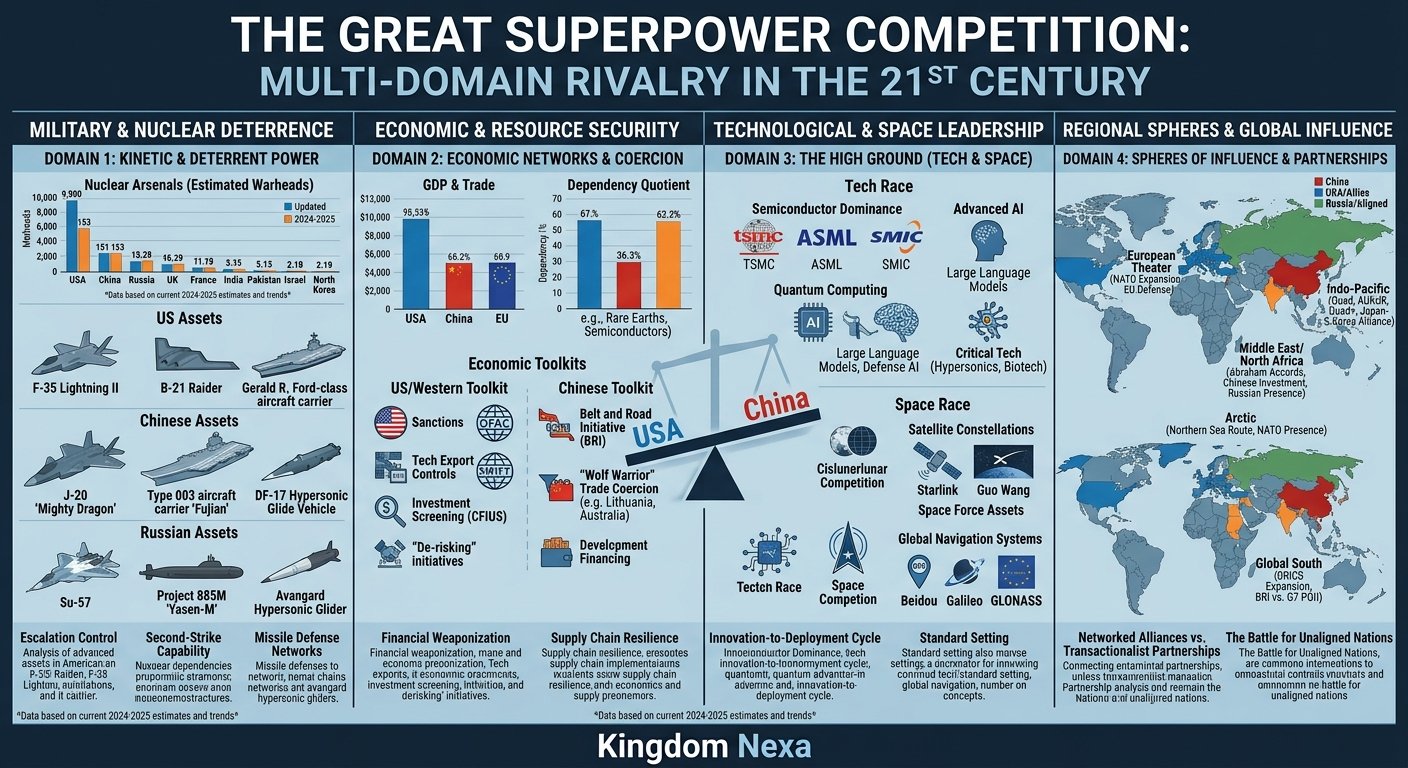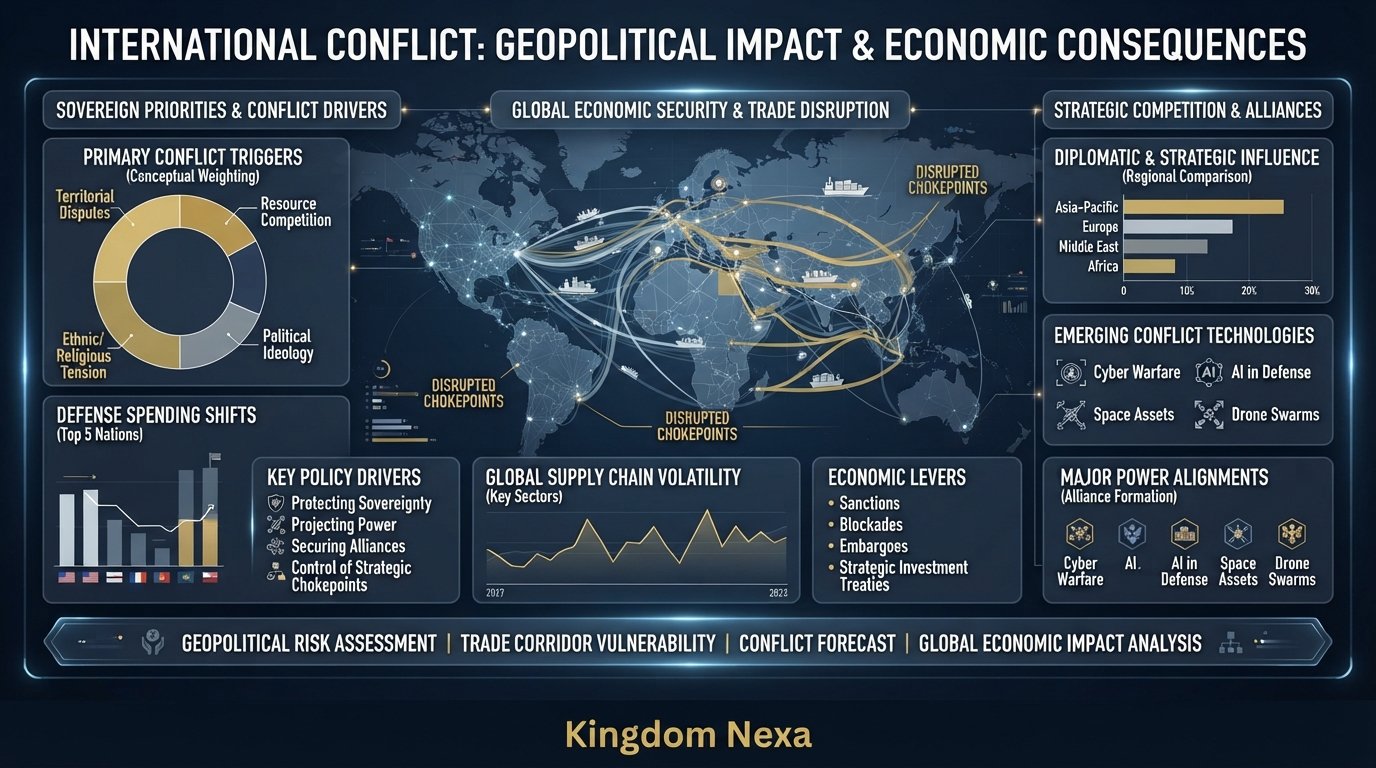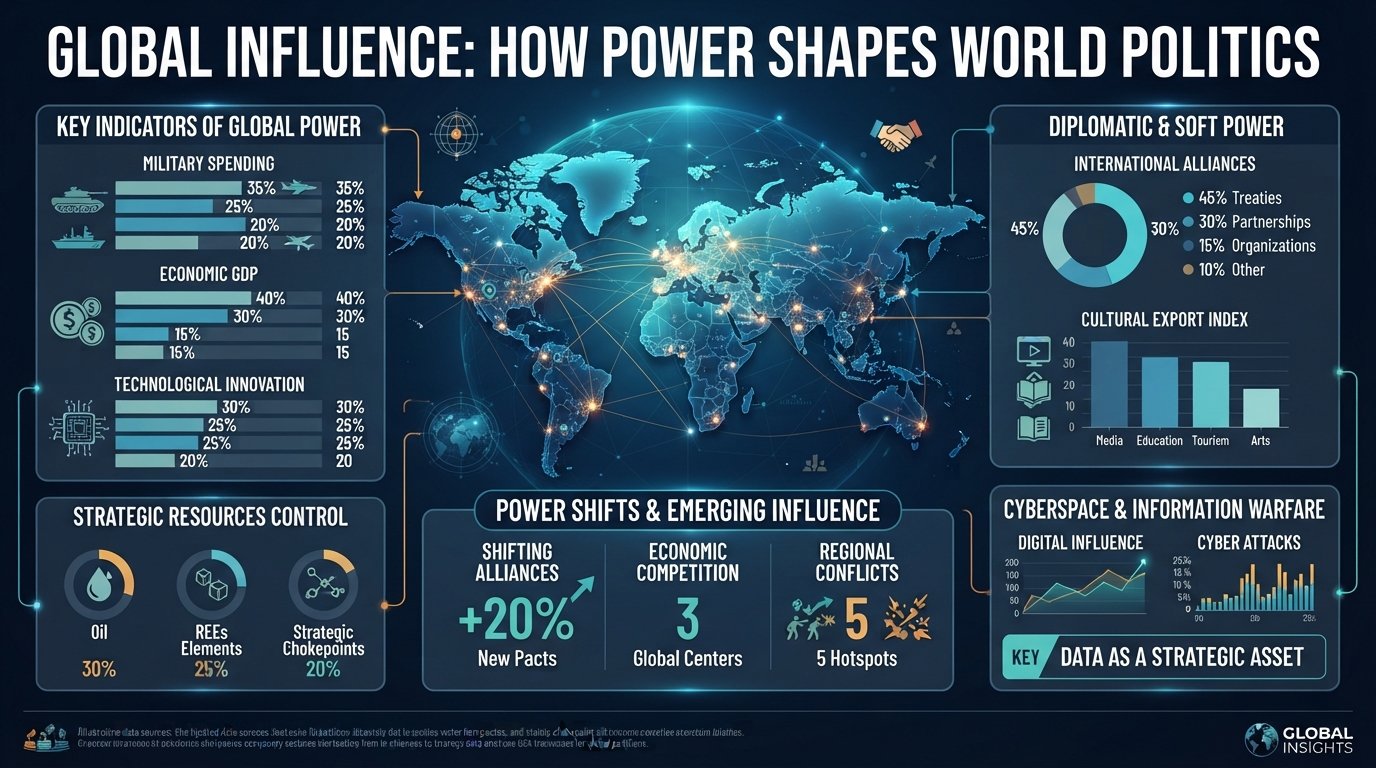

The International Political System is the framework through which sovereign states, international organizations, alliances, multinational institutions, corporations, and other actors interact across borders. It shapes how countries pursue security, trade, influence, diplomacy, economic interests, and strategic objectives in a world where no single government exercises complete authority over all others.
Understanding this system is essential because international politics is not simply a collection of separate foreign policies. Decisions made by one major power can influence energy prices, financial markets, military alliances, supply chains, migration, technological standards, and security far beyond its borders. The system also explains why cooperation and rivalry often exist at the same time.
Today, the international political system combines enduring principles such as sovereignty and international law with changing patterns of power. The United States remains exceptionally influential, China has become a major economic and strategic power, Russia retains significant military and nuclear capabilities, the European Union exercises substantial regulatory and economic influence, and regional powers increasingly shape their surrounding environments. At the same time, institutions such as the United Nations and World Trade Organization continue to provide mechanisms for cooperation.
This article explains how the international political system developed, how it operates, who its major actors are, and why its current transformation matters for global politics.
What Is the International Political System?
The international political system is the broad structure of political relationships among states and other actors operating across national borders.
Unlike a domestic political system, there is no single world government with comprehensive authority over sovereign states. Countries possess sovereignty and generally make their own domestic and foreign-policy decisions. International politics therefore operates through a combination of power, rules, institutions, diplomacy, alliances, economic relationships, and international law.
A simple way to understand the system is:
States + power + institutions + international law + economic interdependence + diplomacy + non-state actors = international political system.
The system is often described as anarchic, but this does not mean that international politics is chaotic or completely lawless. In international-relations theory, anarchy means that there is no central sovereign authority above states comparable to a national government within a country.
States nevertheless establish treaties, institutions, organizations, diplomatic practices, security arrangements, and legal mechanisms that regulate their behavior.
The United Nations, for example, currently has 193 Member States, making it the central universal forum for international diplomacy. (United Nations)
How Did the International Political System Develop?
The modern system developed over centuries rather than appearing at a single historical moment.
From European State Formation to Sovereignty
European state formation contributed to the development of modern concepts of territorial sovereignty and diplomatic relations. The Peace of Westphalia of 1648 is frequently associated with this evolution, although historians caution against treating Westphalia as the single moment when the modern state system was created.
Over time, states increasingly became the principal recognized units of international political organization.
Sovereignty became closely associated with territorial authority, political independence, and the ability of governments to conduct external relations.
The Concert of Europe
After the Napoleonic Wars, European powers attempted to manage competition through the Concert of Europe.
Rather than eliminating power rivalry, the system sought to prevent major disruptions through consultation among leading powers.
This period demonstrated an important characteristic of international politics: great powers frequently cooperate not because their interests are identical, but because managing competition can serve their interests.
The League of Nations
The First World War produced another major experiment in international organization.
The League of Nations sought to institutionalize collective security. Its weaknesses, including problems of enforcement, participation, and great-power commitment, limited its effectiveness.
The experience nevertheless influenced the design of the post-Second World War order.
The United Nations Era
The Second World War fundamentally reshaped international institutions.
The United Nations Charter was signed in 1945, establishing principles including sovereign equality, peaceful dispute settlement, and restrictions on the threat or use of force. Article 2 emphasizes sovereign equality and the obligation to settle international disputes peacefully. (United Nations Legal Affairs)
The post-1945 system also produced institutions for international finance, trade, development, and security.
The Cold War
From the late 1940s through the early 1990s, international politics was strongly influenced by competition between the United States and Soviet Union.
The system became broadly bipolar, with competing political, military, economic, and ideological blocs.
NATO was established in 1949 as a collective-defense alliance. It now has 32 members, following Sweden’s accession in 2024. (NATO)
The Cold War demonstrated how military alliances, nuclear deterrence, ideology, economic systems, and proxy conflicts could combine to shape the international system.
The Post-Cold War Period
The Soviet Union’s dissolution in 1991 created a period in which the United States possessed unusually large concentrations of military, economic, technological, and diplomatic influence.
Yet the post-Cold War system did not remain static.
China’s economic rise, Russia’s renewed strategic ambitions, European integration, India’s growing weight, regional organizations, and the increasing influence of middle powers gradually produced a more complex distribution of power.
The Basic Structure of the International Political System

Image/Infographic: A world political map showing sovereign states, major geopolitical centers, international organizations, and major regional groupings.
Placement: Immediately after the “The Basic Structure of the International Political System” H2.
Purpose: To visually explain that the international system consists of sovereign states interacting through overlapping institutions, alliances, economic networks, and regional organizations rather than operating under one global government.
Sovereign States
States remain the primary actors in international politics.
Governments control territory, maintain diplomatic relations, formulate foreign policy, collect taxes, organize armed forces, and enter into international agreements.
However, state power varies considerably.
A country’s influence can depend on:
- Economic size
- Military capabilities
- Nuclear weapons
- Population
- Geography
- Natural resources
- Technological capacity
- Diplomatic networks
- Political stability
- Industrial capacity
- Financial influence
- Institutional credibility
Therefore, formal sovereignty does not mean that every state possesses equal practical influence.
International Organizations
International organizations create frameworks for cooperation.
The United Nations is the most universal political organization. Its General Assembly includes all 193 Member States, while the Security Council has 15 members, including five permanent members. (United Nations)
Other institutions perform specialized functions.
The International Monetary Fund focuses on international monetary cooperation and financial stability. The World Bank supports development financing. The World Trade Organization provides the institutional framework for global trade rules.
These organizations do not replace sovereign states. Their influence depends heavily on member-state participation, funding, legal commitments, political support, and institutional capacity.
Alliances and Regional Organizations
International politics also operates through regional and security organizations.
NATO represents one of the world’s most important collective-defense arrangements. The European Union represents an unusually deep form of regional political and economic integration, with 27 member states. (European Union)
Regional organizations such as the African Union, ASEAN, Arab League, Organization of American States, and other regional institutions provide additional diplomatic mechanisms.
This creates overlapping layers of international governance.
Who Are the Major Actors?
The international political system contains many types of actors.
Great Powers
Great powers possess substantial military, economic, technological, diplomatic, and geographic capabilities.
The United States, China, and Russia occupy especially important positions in contemporary strategic competition, although their strengths differ considerably.
The United States combines global military reach, a large economy, extensive alliances, financial influence, and advanced technology.
China combines enormous industrial capacity, a large economy, growing military capabilities, technological ambitions, and extensive trade relationships.
Russia has a smaller economic base than the United States or China but possesses major military capabilities, a large nuclear arsenal, energy resources, geographic depth, and a permanent seat on the UN Security Council.
Middle Powers
Middle powers are increasingly important because they can influence regional and issue-specific outcomes without possessing comprehensive global capabilities.
Countries such as India, Japan, Türkiye, Brazil, Indonesia, Australia, Saudi Arabia, South Korea, Canada, and others can exercise significant influence through different combinations of economic, military, diplomatic, geographic, and demographic assets.
Their strategies are particularly important in a more competitive international environment because they may cooperate with different major powers depending on the issue.
International Institutions
Institutions influence international politics by creating rules, information, coordination mechanisms, and diplomatic forums.
The International Court of Justice, for example, settles legal disputes submitted by states and provides advisory opinions on legal questions referred by authorized UN organs and agencies. Its contentious jurisdiction depends on state consent. (International Court of Justice)
This illustrates an important limitation of international institutions: their authority often operates through rules that states have accepted.
Non-State Actors
States are not the only influential participants.
Multinational corporations can influence investment, technology, energy, supply chains, and employment.
International NGOs influence humanitarian policy, human rights debates, development, and environmental governance.
Armed groups can alter security conditions and diplomatic calculations.
Technology companies increasingly affect information flows, artificial intelligence, cybersecurity, satellite communications, and digital infrastructure.
The result is a political environment in which governments remain central but do not operate alone.
What Are the Main Principles of the International Political System?
Several principles form the legal and political foundation of contemporary international relations.
Sovereignty
Sovereignty means that states possess authority over their territories and political systems.
The principle does not mean that states have unlimited freedom. International treaties and customary international law impose obligations on states.
Sovereign Equality
The UN Charter recognizes the sovereign equality of its members. Legally, a small state and a major power are both sovereign states. (United Nations Legal Affairs)
Political influence, however, is not distributed equally.
This creates a recurring tension between formal equality and material inequality.
Non-Use of Force
The UN Charter establishes restrictions on the threat or use of force against the territorial integrity or political independence of states, subject to the Charter’s legal framework. (United Nations)
The interpretation and application of these rules remain central to debates over armed conflict, self-defense, collective security, and international law.
Peaceful Settlement of Disputes
States are expected to seek peaceful methods for resolving international disputes.
These can include negotiation, mediation, arbitration, judicial proceedings, and other diplomatic mechanisms.
International Cooperation
Modern international politics depends heavily on cooperation because many challenges cannot be managed effectively by one government.
Climate change, pandemics, international finance, cyber risks, maritime security, migration, food security, and transnational crime frequently cross borders.
How Does Power Work in the International Political System?
Power is one of the central concepts in international relations.
Hard Power
Hard power generally refers to the ability to influence others through military or economic pressure.
Military power includes conventional forces, nuclear capabilities, intelligence, logistics, and strategic geography.
Economic power can involve sanctions, trade restrictions, investment, access to markets, financial systems, and control over critical resources.
Soft Power
Soft power concerns the ability to attract or persuade rather than compel.
Culture, education, diplomacy, political values, international reputation, media, and perceived legitimacy can contribute to soft power.
Economic and Technological Power
Modern geopolitical competition increasingly involves technology.
Semiconductors, artificial intelligence, quantum computing, telecommunications, satellites, cybersecurity, energy systems, and advanced manufacturing have strategic implications.
Economic interdependence can therefore become both a source of cooperation and a potential source of leverage.
Is the International Political System Unipolar, Bipolar or Multipolar?
This is one of the most debated questions in contemporary international relations.
A unipolar system has one dominant power.
A bipolar system has two especially dominant centers.
A multipolar system contains several major power centers.
The contemporary system is difficult to classify with a single label.
The United States retains exceptional global capabilities, but China has become a major strategic and economic competitor. Russia remains an important military and nuclear power. India and other regional powers are increasing their influence, while the European Union has substantial economic and regulatory power.
It may therefore be more accurate to describe the present environment as complex, competitive, and increasingly plural in its distribution of power, rather than simply declaring that the world has become completely multipolar.
Power is also multidimensional.
A state may be dominant militarily but less dominant economically. Another may possess enormous industrial capacity but weaker alliance networks. A third may have limited military power but considerable diplomatic influence.
How Economics Shapes International Politics
Economic relationships are central to modern geopolitics.
Trade connects countries through supply chains, markets, investment, transport networks, energy systems, and financial institutions.
The WTO reports that global trade in goods and commercial services reached $34.89 trillion in 2025, with total trade increasing by 8 percent. (World Trade Organization)
This interdependence creates opportunities but also vulnerabilities.
Trade as Strategic Leverage
Governments can use tariffs, export controls, sanctions, investment screening, and restrictions on strategic technologies as instruments of national policy.
Critical minerals, energy supplies, advanced chips, shipping routes, and industrial components can become geopolitical assets.
Geoeconomics
Geoeconomics refers to the use of economic instruments to achieve geopolitical objectives.
It has become increasingly important because states can pursue strategic goals without directly using military force.
Economic competition may therefore occur through:
- Trade policy
- Sanctions
- Investment
- Infrastructure
- Development finance
- Export controls
- Currency policy
- Technology restrictions
- Supply-chain diversification
The IMF’s April 2026 outlook highlights how geopolitical fragmentation and trade tensions can weaken global growth and destabilize financial markets. (IMF)
Military and Security Dimensions
Security remains a fundamental component of the international political system.
States continue to invest heavily in military capabilities because governments cannot assume that other states will always respect their interests.
According to SIPRI, global military expenditure reached approximately $2.887 trillion in 2025, rising for the eleventh consecutive year. Military spending increased by 2.9 percent in real terms in 2025, while Europe and Asia and Oceania recorded particularly strong increases. (SIPRI)
Deterrence
Deterrence attempts to prevent hostile action by convincing an opponent that the expected costs will be unacceptable.
Nuclear deterrence is the most extreme example.
Alliances
Alliances allow states to pool capabilities, coordinate defense planning, and increase deterrence.
However, alliances can also create risks. A crisis involving one member can produce pressure on other members to respond.
Security Dilemmas
A security dilemma occurs when one state’s efforts to increase its security make another state feel less secure.
For example, military modernization may be presented as defensive by one government but interpreted as preparation for aggression by another.
This dynamic can generate arms races even when neither side initially seeks war.
The Role of International Law
International law provides rules governing relationships among states and other actors.
Its major areas include:
- Treaties
- Diplomatic relations
- Law of the sea
- International humanitarian law
- Human rights law
- State responsibility
- International criminal law
- Rules governing the use of force
The International Court of Justice plays an important judicial role, but it is not a world government or universal supreme court. It generally requires a legal basis for its jurisdiction, and states must consent to contentious jurisdiction. (International Court of Justice)
This distinction is important when evaluating claims about international law. A rule can exist even when enforcement is politically difficult.
Technology and the Changing International System
Technology is reshaping international political power.
Artificial intelligence can influence military planning, intelligence analysis, economic productivity, surveillance, and information operations.
Cyber capabilities can allow states and non-state actors to disrupt networks without crossing traditional territorial borders.
Satellites provide communications, navigation, surveillance, and intelligence capabilities.
Semiconductor manufacturing has become strategically significant because advanced computing depends on complex global production networks.
Technology therefore increasingly links economic security, national security, industrial policy, and foreign policy.
Why Geography Still Matters
Globalization has not eliminated geography.
Strategic locations can influence:
- Maritime trade
- Energy transportation
- Military access
- Border security
- Infrastructure
- Resource extraction
- Communications
- Regional influence
Chokepoints such as major canals and narrow maritime passages can have consequences far beyond their immediate geography.
Similarly, countries located between major powers may gain strategic importance because their territory, infrastructure, or political alignment affects regional calculations.
Geopolitics therefore remains partly a study of how power interacts with space.
Major Challenges Facing the International Political System
The contemporary system faces several structural pressures.
Great-Power Competition
Competition among major powers can divide international institutions and create competing economic, technological, and security networks.
Institutional Reform
Institutions created after the Second World War face debates over representation, effectiveness, and legitimacy.
The UN Security Council’s permanent-member structure gives five states a distinctive position, while the wider UN membership has grown to 193 states. (United Nations)
This creates continuing debate over whether international institutions adequately reflect contemporary distributions of population, economic weight, and political influence.
Geopolitical Fragmentation
Global economic integration is being challenged by sanctions, export controls, trade disputes, strategic industrial policies, and concerns about supply-chain dependence.
Complete economic separation remains difficult, but governments are increasingly seeking resilience in strategically sensitive sectors.
Conflict and Militarization
Rising military spending suggests that many governments perceive the security environment as deteriorating.
The challenge is preventing deterrence from turning into escalation.
Global Problems Without Global Governments
Climate change, pandemics, cyber threats, financial instability, migration, and technological risks cannot be managed effectively through national policy alone.
Yet international cooperation remains dependent on states with different interests.
This is one of the fundamental contradictions of international politics: many problems are global, while political authority remains largely national.
What Could the International Political System Look Like Next?

Predicting the future is inherently uncertain, so the following possibilities should be treated as analytical scenarios rather than forecasts.
Scenario 1: Managed Multipolar Competition
Major powers continue competing but establish enough diplomatic mechanisms to prevent competition from becoming uncontrolled confrontation.
Economic relationships remain substantial even as strategic sectors become more restricted.
Scenario 2: Deeper Geopolitical Fragmentation
Rival blocs could increasingly separate their technology ecosystems, supply chains, security partnerships, and financial relationships.
Such fragmentation could reduce efficiency and increase economic costs.
Scenario 3: Selective Cooperation
A more likely possibility may be cooperation on some issues and rivalry on others.
Countries could compete militarily while cooperating on climate, trade, health, financial stability, or specific diplomatic problems.
This would produce neither complete globalization nor complete bloc separation.
The IMF’s 2026 assessment illustrates the stakes: geopolitical fragmentation, prolonged conflict, and renewed trade tensions are identified among significant downside risks to the global economy. (IMF)
Why the International Political System Matters
The international political system affects almost every major aspect of global affairs.
It influences whether conflicts escalate, whether trade remains open, how sanctions affect economies, how international institutions respond to crises, and how governments manage emerging technologies.
For businesses, it affects supply chains, investment risk, energy prices, market access, and regulatory environments.
Policymakers, it shapes strategic planning and diplomatic choices.
For researchers and students, it provides the framework for understanding why countries cooperate in some circumstances and compete in others.
Most importantly, the system demonstrates that international outcomes rarely result from one factor alone. Military capabilities interact with economics. Geography interacts with technology. Domestic politics affects foreign policy. International law interacts with state power. Institutions create opportunities for cooperation but remain dependent on political support.
The international political system is therefore best understood as a continuously evolving structure rather than a fixed hierarchy.
Frequently Asked Questions About the International Political System
What is the International Political System?
The International Political System is the framework of relationships among sovereign states and other international actors. It includes diplomacy, international law, alliances, organizations, economic relationships, security competition, and cooperation.
What are the main actors in the international political system?
States are the primary actors, but international organizations, regional organizations, multinational corporations, NGOs, armed groups, and other non-state actors can also influence international outcomes.
Is the international political system anarchic?
Yes, in international-relations theory it is generally described as anarchic because there is no central sovereign authority above states. However, international politics is not necessarily chaotic because states operate through treaties, institutions, diplomacy, norms, and international law.
What is the difference between a unipolar and multipolar international system?
A unipolar system has one dominant power center, while a multipolar system contains several major centers of power. The contemporary international system contains characteristics of both concentrated and distributed power.
What role does the United Nations play?
The United Nations provides a universal forum for diplomacy, collective security, international cooperation, humanitarian activity, and international norm development. It has 193 Member States. (United Nations)
Why is sovereignty important in international relations?
Sovereignty establishes the principle that states possess political authority over their territories and are legally distinct entities. It is a foundational concept of the modern international system.
How does international trade affect geopolitics?
Trade creates economic interdependence but can also create strategic vulnerabilities. Governments can use tariffs, sanctions, export controls, investment policies, and supply-chain strategies to pursue geopolitical objectives.
Why are alliances important?
Alliances can strengthen deterrence, coordinate military capabilities, and increase collective security. They can also create strategic obligations and escalation risks during crises.
How is technology changing international politics?
Artificial intelligence, cybersecurity, satellites, semiconductors, telecommunications, and advanced military technologies are increasingly connected to economic and national security. Technological capabilities can therefore influence both geopolitical power and strategic independence.
Is the world becoming multipolar?
There is substantial evidence of a more complex distribution of economic, military, technological, and diplomatic power. However, describing the entire system simply as “multipolar” can hide important differences between types of power. The emerging order is better understood as increasingly contested and multidimensional.
Conclusion
The International Political System is neither a completely unified global order nor a collection of isolated countries. It is a complex structure in which sovereignty, power, international law, institutions, economic interdependence, alliances, technology, and diplomacy interact continuously.
The post-1945 system created powerful institutions for cooperation, but it never eliminated competition among states. Today, the distribution of power is changing again. The United States remains highly influential, China has become a major strategic and economic force, Russia retains substantial military capabilities, regional powers are becoming more consequential, and institutions such as the United Nations and WTO continue to provide mechanisms for international cooperation.
At the same time, rising military expenditure, geopolitical fragmentation, technological competition, and trade tensions demonstrate that the system faces significant pressures. SIPRI’s latest data show global military expenditure reaching a record $2.887 trillion in 2025, while the IMF continues to identify geopolitical fragmentation as a major risk to global economic stability. (SIPRI)
The future is therefore unlikely to be defined by either pure cooperation or permanent confrontation. More plausibly, the international political system will combine competition and cooperation across different issues.
Understanding that complexity is essential for anyone seeking to interpret modern geopolitics. The central question is no longer simply which country is most powerful. It is how different forms of power interact, how institutions adapt, and whether states can manage strategic competition without undermining the systems of cooperation on which global stability depends.