Introduction
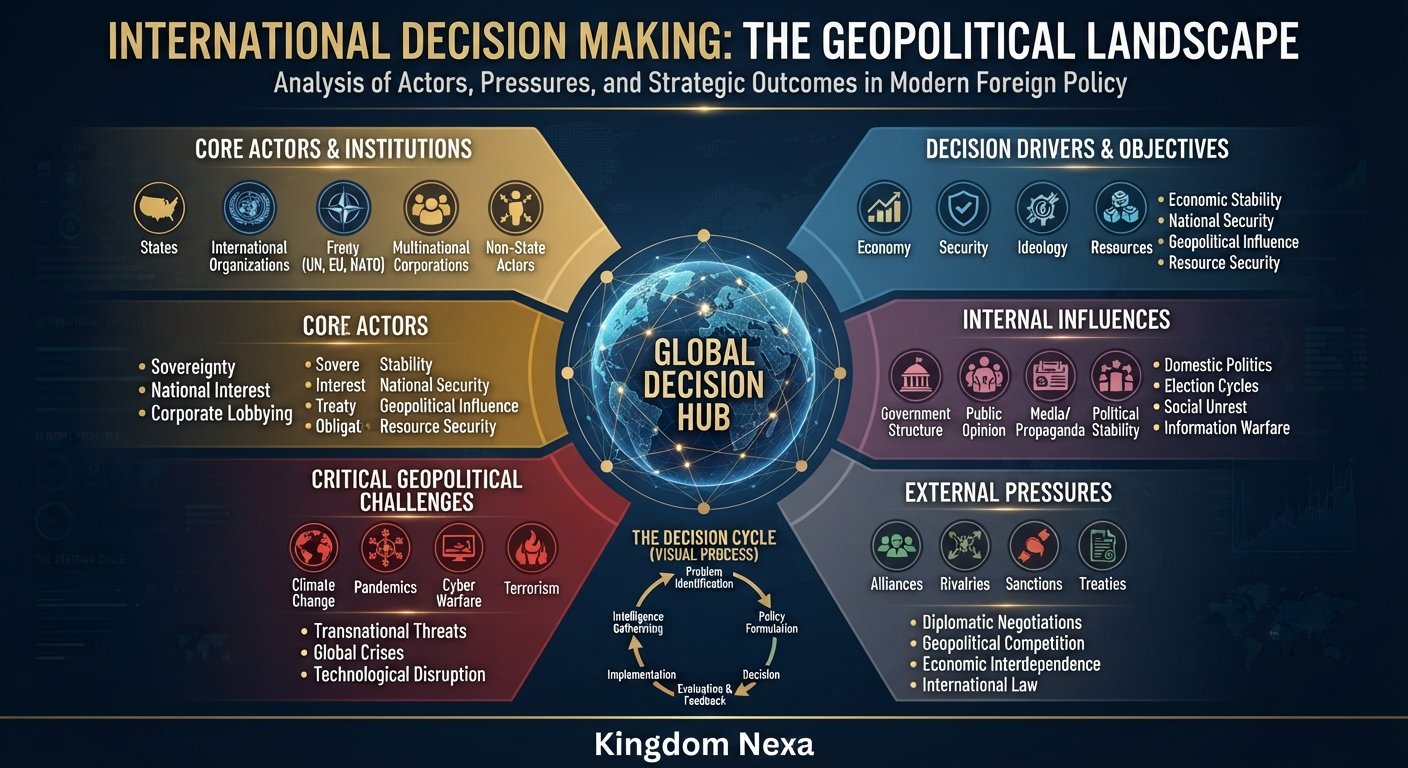
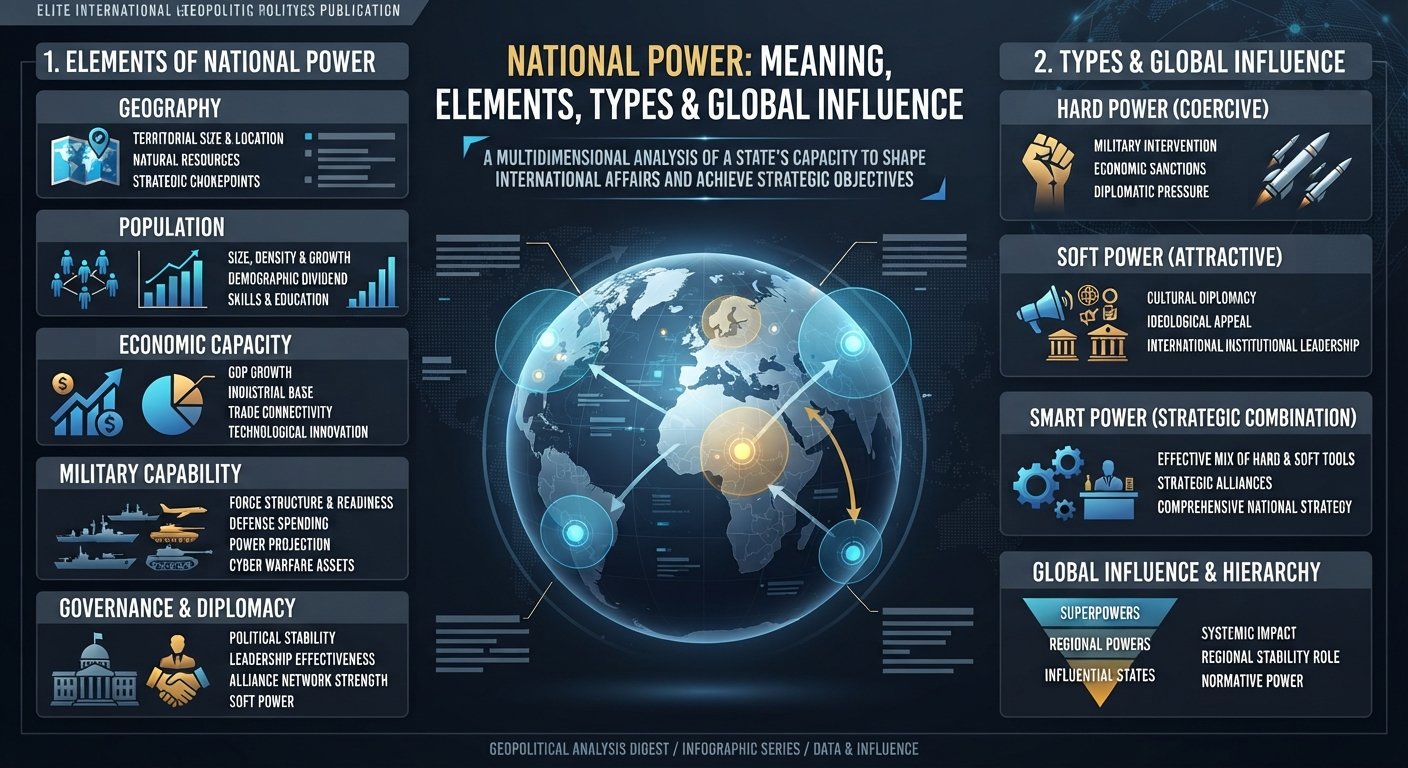
National power is one of the most important concepts in international relations and geopolitics because it helps explain why some states can shape international outcomes while others struggle to protect their interests. A country’s influence does not depend solely on the size of its military. Economic strength, population, geography, natural resources, technology, diplomatic effectiveness, political institutions, national cohesion, and international reputation can all contribute to a state’s ability to achieve its objectives.
National power is therefore best understood as a combination of resources, capabilities, institutions, and influence that a state can mobilize to protect its interests and shape the behavior of other actors. The concept has evolved from traditional emphasis on military and economic capabilities toward a broader understanding that includes soft power, technological capacity, information, financial leverage, resilience, and strategic partnerships.
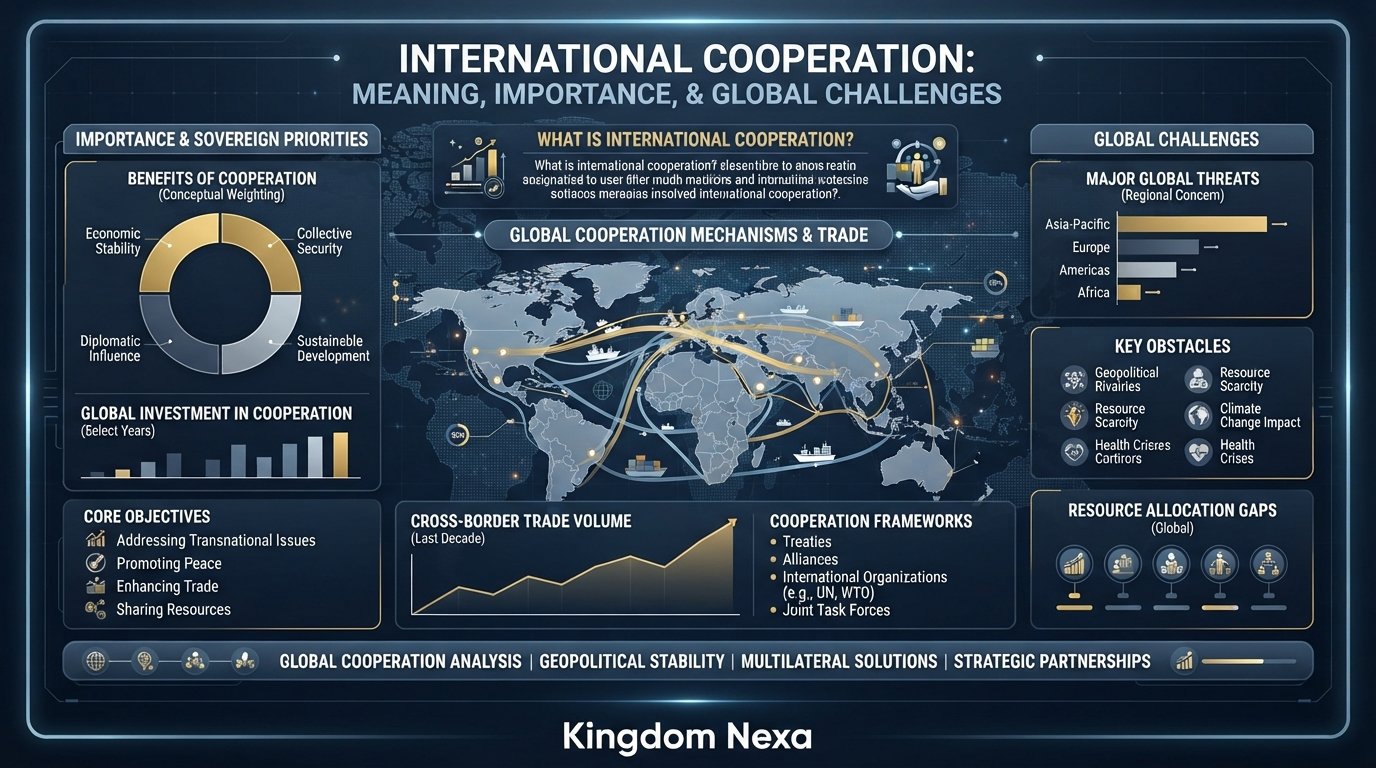
This article explains what national power means, its major elements, different types of power, how it can be measured, why resources do not automatically produce influence, and how national power affects contemporary international geopolitics.
What Is National Power?
National power refers to the overall capacity of a state to pursue its national interests and influence outcomes in international affairs.
It includes both tangible resources and intangible capabilities. A country’s territory, population, economy, armed forces, energy resources, and industrial base are tangible sources of potential power. Political leadership, national cohesion, diplomatic skill, institutional quality, credibility, strategic culture, and international legitimacy are less tangible but can be equally important.
In international relations, power is not simply about possessing resources. The more important question is whether a government can convert those resources into effective influence.
For example, possessing large natural-resource reserves may provide economic potential. However, that potential depends on infrastructure, investment, technology, political stability, markets, and the ability to use resources strategically.
Similarly, a large military does not automatically guarantee geopolitical success. Military capabilities require competent leadership, logistics, intelligence, industrial support, economic sustainability, and a coherent political objective.
The United Nations system formally recognizes the sovereign equality of states, regardless of differences in material capabilities. Yet states clearly possess very different capacities to influence international outcomes. The UN Charter establishes sovereign equality while also providing a framework governing the conduct of states in international relations. (United Nations)


Why Is National Power Important in International Relations?
National power matters because states rarely operate in an environment where every actor has equal capabilities.
A state with strong economic and technological foundations can invest more heavily in defense, infrastructure, research, diplomacy, and international development. A country with significant diplomatic networks can build coalitions and negotiate favorable agreements. A state controlling strategically important geography may gain influence over transportation, trade, energy, or military routes.
National power also affects:
- Foreign-policy choices
- National security
- Deterrence
- Alliance formation
- International negotiations
- Trade relationships
- Economic sanctions
- Crisis management
- Access to strategic resources
- Global institutions
- Regional leadership
- Technological competition
The concept is particularly important when analyzing great-power competition. States may compete simultaneously through military capabilities, trade, investment, technology, diplomatic coalitions, financial systems, and information.
Consequently, national power should not be viewed as a single number. It is a multidimensional and context-dependent concept.
Historical Development of the Concept of National Power
The study of national power has deep roots in classical political thought, but it became especially important with the development of modern international-relations theory.
Classical Understanding of Power
Traditional strategic thinking often emphasized territory, armies, wealth, population, and political leadership.
Military strength was particularly important because states historically depended heavily on armed force to protect territory and national survival.
However, military power has never existed independently of other national capabilities. Armies require taxation, industrial production, transportation, food supplies, technology, manpower, and political organization.
Hans Morgenthau and the Elements of National Power
The realist scholar Hans J. Morgenthau provided one of the most influential approaches to national power in Politics Among Nations.
His framework identified factors including geography, natural resources, industrial capacity, military preparedness, population, national character, national morale, and the quality of diplomacy. (OUP Academic)
This approach remains useful because it demonstrates that national power consists of more than weapons.
It also highlights an important analytical problem: resources are not identical to power. A country may possess considerable resources but lack the political or institutional capacity to convert them into influence.
The Rise of Soft Power
The concept expanded significantly with the work of Joseph S. Nye Jr., who introduced soft power as an important dimension of international influence.
Nye distinguished between influence based on coercion or payment and influence generated through attraction and persuasion. Culture, political values, and policies can contribute to this form of power. (Harvard Kennedy School)
This broadened the traditional understanding of national power and helped explain why countries sometimes achieve international influence without relying primarily on military coercion.
What Are the Main Elements of National Power?
National power is composed of multiple interconnected elements. Their relative importance varies according to geography, history, technology, political objectives, and the international environment.
Geography
Geography is one of the most enduring foundations of national power.
Important geographic factors include:
- Territory
- Location
- Access to oceans
- Borders
- Mountain ranges
- Rivers
- Climate
- Strategic waterways
- Natural barriers
- Proximity to major markets and conflict zones
Geography can create both advantages and vulnerabilities.
A state located near major maritime trade routes may benefit economically, while a landlocked country may face higher transportation costs and strategic constraints.
Likewise, mountains can provide defensive advantages but may complicate infrastructure and economic integration.
Population
Population provides manpower, consumers, workers, taxpayers, soldiers, researchers, and entrepreneurs.
However, population size alone does not determine national power.
A large population can become a strategic advantage when supported by:
- Education
- Public health
- Employment
- Skills
- Productivity
- Infrastructure
- Effective institutions
Demographic structure also matters. Aging populations may create labor shortages and increasing social-security burdens, while youthful populations can generate economic dynamism if sufficient jobs and education are available.
Natural Resources
Energy, minerals, agricultural land, freshwater, forests, and other resources can contribute significantly to national power.
Oil and gas have historically provided major geopolitical leverage. In the contemporary economy, critical minerals and resources associated with advanced manufacturing and clean-energy technologies have also become strategically important.
But resource wealth can create vulnerabilities when economies become excessively dependent on a narrow group of commodities.
Economic Power
Economic capability is one of the most important foundations of modern national power.
A strong economy provides resources for:
- Defense
- Infrastructure
- Research and development
- Diplomacy
- Foreign assistance
- Strategic investment
- Industrial production
- Crisis response
GDP is useful for comparing the size of economies, but it does not capture every dimension of economic power.
Other relevant indicators include:
- Industrial capacity
- Trade volume
- Productivity
- Financial-market depth
- Currency influence
- Foreign-exchange reserves
- Energy production
- Technological industries
- Supply-chain control
World Bank data illustrate the enormous differences in economic scale among major powers. Its 2025 data list nominal GDP at about $30.8 trillion for the United States, $19.5 trillion for China, and $4 trillion for India. (World Bank Open Data)
Military Power
Military capability remains a central component of national power.
It includes more than troop numbers. Important dimensions include:
- Defense spending
- Nuclear capabilities
- Conventional forces
- Airpower
- Naval power
- Missile systems
- Intelligence
- Cyber capabilities
- Space systems
- Logistics
- Military technology
- Defense-industrial capacity
- Readiness
- Command and control
Global military expenditure demonstrates the continued importance of military capability in contemporary geopolitics. SIPRI estimates that global military expenditure reached $2.887 trillion in 2025, increasing for the eleventh consecutive year. (SIPRI)
The United States remained the largest military spender in 2025, followed by China and Russia. The five largest spenders—the United States, China, Russia, Germany, and India—accounted for approximately 58% of global military expenditure. (SIPRI)
Yet defense expenditure should not be interpreted as a complete measurement of military effectiveness. Training, doctrine, industrial capacity, leadership, intelligence, logistics, geography, alliances, and combat experience can substantially affect outcomes.
Diplomatic Power and Foreign Policy
Its capability allows states to convert national resources into international influence without necessarily using force.
Diplomatic power includes:
- Diplomatic networks
- Negotiating skills
- Alliance management
- Mediation
- International reputation
- Coalition building
- Crisis diplomacy
- Institutional influence
A country may have moderate military capabilities but achieve disproportionate influence because it maintains strong relationships with major powers and regional organizations.
Diplomacy also allows governments to coordinate policies with partners. In many situations, the ability to persuade ten countries to support a position can be more valuable than possessing a larger military force.
Soft Power and National Attraction
Soft power is the ability to influence others through attraction and persuasion rather than primarily through coercion or payment. Joseph Nye associated soft power with resources such as culture, values, and policies. (Harvard Kennedy School)
Examples can include:
- Popular culture
- Universities
- Scientific institutions
- International broadcasting
- Tourism
- Humanitarian assistance
- Development programs
- Diplomatic reputation
- Political values
- International credibility
Soft power is difficult to measure precisely because attraction does not automatically produce a predictable policy outcome.
A country may be culturally attractive but politically unpopular. Conversely, another country may have limited cultural influence but possess highly effective diplomacy or economic leverage.
This is why soft power should be treated as one component of a wider national-power framework.
Technological Power
Technology has become increasingly important to national power.
Countries that lead in strategically important technologies can gain economic, military, and diplomatic advantages.
Important areas include:
- Artificial intelligence
- Semiconductors
- Quantum computing
- Biotechnology
- Cybersecurity
- Satellites
- Space systems
- Advanced manufacturing
- Robotics
- Telecommunications
- Autonomous systems
Technological leadership can strengthen military capabilities while simultaneously improving productivity and economic competitiveness.
The relationship is therefore circular: economic strength supports technological innovation, while technological innovation can strengthen economic and military power.
Political Institutions and Government Capacity
Government quality is an often-overlooked component of national power.
A state may possess substantial resources but fail to convert them into influence because of:
- Institutional weakness
- Corruption
- Poor policymaking
- Political instability
- Weak infrastructure
- Ineffective taxation
- Administrative dysfunction
- Social fragmentation
State capacity determines how effectively governments can mobilize national resources.
Strong institutions can coordinate economic policy, maintain infrastructure, support research, collect taxes, regulate markets, and implement long-term national strategies.
National Cohesion and Strategic Culture
National cohesion can influence how effectively a state responds to external pressure.
Social trust, political legitimacy, public confidence, national identity, and willingness to bear costs can affect strategic resilience.
However, cohesion should not be confused with political uniformity. Diverse societies can remain strategically powerful when their institutions provide legitimate mechanisms for resolving disagreement.
Strategic culture also matters because different states interpret security threats and national interests differently.
Two countries with similar economic and military resources may therefore pursue very different foreign policies.
Information and Cyber Power
Information has become a major instrument of geopolitical competition.
States use information capabilities for:
- Intelligence collection
- Strategic communications
- Cyber defense
- Cyber operations
- Public diplomacy
- Influence campaigns
- Crisis communication
- Digital infrastructure
Cyber capabilities are especially significant because they can affect military systems, government networks, financial institutions, telecommunications, and critical infrastructure.
At the same time, digital influence creates new vulnerabilities. National power increasingly depends not only on controlling information but also on protecting societies from manipulation, espionage, disruption, and cyberattacks.
Hard Power, Soft Power and Smart Power
The distinction between different types of power helps explain how states pursue their objectives.
Hard Power
Hard power relies primarily on coercion or material inducements.
Examples include:
- Military force
- Economic sanctions
- Trade restrictions
- Financial pressure
- Security guarantees
- Material incentives
Soft Power
Soft power works through attraction and persuasion.
Examples include:
- Culture
- Values
- Education
- Diplomacy
- International reputation
- Development assistance
Smart Power
Smart power refers broadly to the effective combination of hard and soft-power resources.
A state might combine military deterrence with diplomatic engagement, economic incentives, development assistance, and cultural outreach.
The objective is not to maximize one type of power but to use the right instrument for the strategic problem.
How Is National Power Measured?
There is no universally accepted formula that produces a definitive national-power score.
Researchers use different approaches depending on their purpose.
Material Indicators
These can include:
- GDP
- Population
- Territory
- Military expenditure
- Industrial output
- Energy production
- Trade
- Natural resources
- Technological capacity
These indicators are relatively easier to quantify.
Intangible Indicators
More difficult measurements include:
- Diplomatic effectiveness
- Political stability
- Institutional quality
- National cohesion
- Strategic leadership
- International credibility
- Soft power
- Innovation
- Resilience
The difficulty is that intangible capabilities can dramatically affect how effectively material resources are used.
Composite Indices
Some research institutions construct composite indices that combine economic, military, demographic, technological, and diplomatic variables.
Such indices can be useful for comparisons, but they should not be treated as objective measurements of geopolitical influence. Different weighting systems can produce different rankings.
Why Resources Do Not Automatically Create Power
One of the most important lessons in studying national power is that potential capability and usable power are different things.
Consider a country with:
- A large population
- Significant mineral resources
- A large territory
- Substantial energy reserves
Those resources may appear impressive. But if the country lacks infrastructure, education, technological capacity, political stability, financial institutions, and competent governance, its ability to convert them into international influence may remain limited.
Conversely, smaller states can sometimes exercise influence far beyond their physical size.
This phenomenon is sometimes described as punching above one’s weight.
Singapore, for example, illustrates how geography, trade, institutions, infrastructure, diplomacy, and economic specialization can generate strategic influence disproportionate to population size.
The broader lesson is that national power is not simply an inventory of national assets. It is a question of conversion, coordination, and strategic use.
National Power in Contemporary Geopolitics
Today’s geopolitical environment demonstrates why multidimensional national power is increasingly important.
A major power can compete simultaneously across multiple domains:
Military: deterrence, weapons, alliances, defense production.
Economic: trade, investment, sanctions, financial systems, supply chains.
Technological: semiconductors, AI, telecommunications, space, cyber capabilities.
Diplomatic: coalitions, international institutions, treaties, mediation.
Informational: media, digital platforms, strategic communications.
Energy: oil, gas, electricity, critical minerals, energy infrastructure.
This means modern strategic competition cannot be understood by comparing military forces alone.
A state with superior military capabilities may still encounter constraints if it lacks economic sustainability or diplomatic support. Similarly, a wealthy country may find its influence limited if it lacks credible security capabilities.
National Power and Great-Power Competition
Great-power competition provides one of the clearest examples of multidimensional national power.
The United States, China, Russia, India, European powers, Japan, and other influential states possess different combinations of capabilities.
For example, the United States benefits from a large economy, advanced military capabilities, extensive alliances, technological institutions, global financial influence, and significant diplomatic reach.
China combines a very large economy and population with substantial industrial capacity, growing technological capabilities, military modernization, and expanding diplomatic and economic relationships.
Russia has a smaller economy than the largest global economic powers but retains significant military capabilities, nuclear forces, energy resources, geographic depth, and diplomatic influence.
India combines a large population, rapidly expanding economy, technological capabilities, military strength, geographic importance, and a growing role in major international groupings.
These examples demonstrate why national power should not be reduced to GDP or defense spending alone.
Regional Powers and Middle Powers
National power is also important for countries that are neither superpowers nor traditional great powers.
Regional powers can exercise significant influence within their geographic neighborhoods.
Middle powers may use diplomacy, coalition building, economic relationships, international institutions, peacekeeping, or specialized capabilities to influence international affairs.
Their strategies often emphasize partnerships rather than unilateral dominance.
This makes alliances and institutions important force multipliers.
National Power and Alliances
Alliances can significantly increase the effective power of individual states.
A country may gain access to:
- Intelligence
- Military technology
- Markets
- Investment
- Diplomatic support
- Shared infrastructure
- Security guarantees
- Joint research
- Logistics networks
Consequently, national power should sometimes be analyzed at two levels:
- Individual state capabilities
- Capabilities generated through partnerships and institutions
A state with moderate national resources can become strategically influential when embedded in a powerful alliance network.
Economic Interdependence and National Power
Globalization has changed the relationship between economic power and geopolitical influence.
Economic interdependence creates both opportunities and vulnerabilities.
Trade can provide markets and prosperity, but supply-chain dependence can create strategic risks.
Governments increasingly examine:
- Critical minerals
- Semiconductor supply chains
- Energy security
- Food security
- Maritime routes
- Digital infrastructure
- Foreign investment
- Strategic industries
Economic power therefore increasingly overlaps with national-security policy.
A country’s ability to withstand external economic pressure can itself become a component of national power.
The Limits of National Power
Even powerful states face constraints.
Economic Constraints
Military and foreign-policy ambitions require sustainable economic foundations.
Political Constraints
Domestic opposition, elections, institutional conflicts, and public opinion can limit government action.
Geographic Constraints
Distance, terrain, borders, and logistical challenges can restrict the use of military or economic capabilities.
Diplomatic Constraints
Aggressive policies can generate counter-coalitions.
Legal Constraints
States operate within international legal frameworks, although compliance and enforcement vary.
The UN Charter, for example, establishes principles including sovereign equality, peaceful settlement of disputes, and restrictions on the threat or use of force against states. (United Nations Office of Legal Affairs)
Technological Constraints
Dependence on foreign technologies or supply chains can limit strategic autonomy.
Social Constraints
Governments must also consider the willingness and capacity of their populations to bear the costs of prolonged strategic competition.
What Is the Future of National Power?
National power is likely to become increasingly multidimensional.
Traditional military capabilities will remain important, particularly as geopolitical tensions and defense spending remain elevated. SIPRI’s latest data show that global military expenditure reached a record $2.887 trillion in 2025. (SIPRI)
At the same time, economic resilience, artificial intelligence, semiconductor production, cybersecurity, space systems, energy security, and control of strategic supply chains are becoming more important.
Future geopolitical competition may therefore be less about possessing the largest army and more about building an integrated national system capable of:
- Innovating quickly
- Producing strategically important goods
- Protecting infrastructure
- Maintaining economic resilience
- Building alliances
- Attracting international partners
- Managing information
- Sustaining military readiness
- Maintaining domestic legitimacy
Possible Future Scenarios
1: Intensified great-power competition
Major states increasingly compete across military, economic, technological, and diplomatic domains.
2: Greater multipolarity
More regional powers acquire sufficient economic and technological capabilities to exercise independent strategic influence.
3: Coalition-based power
States increasingly rely on alliances and flexible partnerships to compensate for weaknesses in individual national capabilities.
4: Technology-driven power shifts
Leadership in AI, semiconductors, biotechnology, quantum technologies, and space systems changes the balance among states.
These scenarios are possibilities rather than predictions. Their likelihood will depend on economic conditions, domestic politics, technological developments, wars, diplomacy, and international institutions.
How Should Students Analyze National Power?
Students of international relations can analyze a country’s national power by asking a structured set of questions:
- What are the state’s major material resources?
- How strong is its economy?
- What military capabilities does it possess?
- How effectively can its government mobilize resources?
- What technological advantages or weaknesses exist?
- How effective is its diplomacy?
- What alliances and partnerships does it possess?
- How strong is its international reputation?
- What geographic advantages or vulnerabilities exist?
- How resilient is its society and economy?
- What constraints limit the use of its power?
- Can the state convert resources into actual influence?
This approach prevents analysts from confusing size with effectiveness.
Frequently Asked Questions About National Power
What is national power in international relations?
National power is the overall capacity of a state to protect its interests, influence other actors, and shape international outcomes. It includes military, economic, diplomatic, technological, demographic, geographic, political, and soft-power capabilities.
What are the main elements of national power?
Major elements include geography, population, natural resources, economic capacity, industrial strength, military capability, technology, political institutions, diplomacy, national cohesion, and international reputation.
Is military power the same as national power?
No. Military power is only one component of national power. A country’s economy, diplomacy, technology, institutions, population, geography, and soft power can also determine its international influence.
What is the difference between hard power and soft power?
Hard power primarily uses coercion or material incentives, while soft power relies on attraction and persuasion. Joseph Nye’s framework distinguishes these approaches while emphasizing that both can be important in foreign policy. (Harvard Kennedy School)
Why is economic power important to national power?
Economic power provides governments with resources for defense, infrastructure, technological development, diplomacy, international assistance, and strategic investment. It can also provide leverage through trade and financial relationships.
Can a small country have significant national power?
Yes. Small states can exercise disproportionate influence through strong institutions, specialized economies, strategic geography, diplomacy, technology, financial capabilities, or alliances.
How is national power measured?
There is no universally accepted measurement. Analysts commonly examine GDP, population, military capabilities, technology, natural resources, trade, diplomacy, institutions, and soft power, sometimes combining them into composite indices.
Why does technology matter to national power?
Technology affects economic productivity, military capabilities, intelligence, communications, cyber security, industrial competitiveness, and strategic autonomy. Leadership in critical technologies can therefore produce significant geopolitical advantages.
Does a powerful country always get what it wants?
No. Power creates capabilities, not guaranteed outcomes. Geography, alliances, domestic politics, international law, economic constraints, strategic errors, resistance from other states, and the costs of achieving objectives can all limit a powerful state’s choices.
Conclusion
National power is best understood not as the size of a country’s military or economy alone, but as the combined ability of a state to transform its resources and capabilities into effective influence.
Geography, population, natural resources, economic strength, military capabilities, technology, diplomacy, political institutions, national cohesion, and international reputation all contribute to this capacity. Their importance varies according to circumstances, and their interaction is often more important than any individual factor.
The modern international system also demonstrates that power is increasingly multidimensional. Economic resilience can affect security. Technology can influence military and diplomatic competition. Alliances can multiply national capabilities. Soft power can shape preferences, while domestic institutions determine how effectively resources are mobilized.
For geopolitical analysis, the most useful question is therefore not simply “How powerful is a country?” but “What kinds of power does it possess, how effectively can it convert them into influence, and what constraints limit that influence?”
That distinction is essential for understanding great-power competition, regional rivalries, foreign policy, national security, and the changing structure of international geopolitics.