Introduction
The Elements of National Power explain how a country develops, protects, and uses its ability to influence events at home and abroad. National power is not simply the size of a country’s military or the strength of its economy. It is a broader combination of diplomatic influence, information, military capabilities, economic resources, political institutions, technology, geography, population, national cohesion, and other strategic assets.
In international geopolitics, governments rarely achieve major objectives through a single instrument. A country may use diplomacy to build alliances, economic policies to create leverage, military capabilities to deter threats, technology to strengthen competitiveness, and information to shape international perceptions. These capabilities can reinforce one another—or, when poorly coordinated, undermine one another.
A commonly used contemporary framework is DIME: Diplomatic, Informational, Military, and Economic instruments of power. U.S. joint doctrine describes these four as major instruments of national power, while also recognizing additional resources such as finance, intelligence, and law enforcement.
Understanding these elements is therefore essential for students of international relations, policymakers, geopolitical analysts, diplomats, journalists, and business leaders trying to understand why some states exercise greater influence than others.
What Are the Elements of National Power?
The elements of national power are the major capabilities and resources that enable a state to pursue its national interests and strategic objectives.
There is no single universally accepted list. Strategic studies traditionally examine factors such as geography, natural resources, population, economic capacity, military strength, national character, political institutions, and diplomatic skill. Modern national-security frameworks often organize the instruments a government can employ under categories such as diplomatic, informational, military, and economic power.
A useful distinction is between sources of power and instruments of power.
Sources are the underlying capabilities a country possesses. Geography, population, industrial capacity, technology, natural resources, political stability, and economic strength can all contribute to national power.
Instruments are the means through which governments convert those capabilities into strategic effects. Diplomacy, economic policy, military force, intelligence, strategic communication, and international partnerships are examples.
The distinction matters because possessing resources does not automatically create influence. A country may have a large economy but struggle to translate that economic capacity into diplomatic leverage. Similarly, a state can possess substantial military capabilities but fail to achieve political objectives if its strategy, diplomacy, or domestic support is weak.
Why Is National Power Important in Geopolitics?
National power determines, to a significant extent, what states can accomplish in the international system.
Countries use their capabilities to:
- Protect territorial integrity and national security
- Deter potential adversaries
- Negotiate favorable diplomatic outcomes
- Build alliances and partnerships
- Secure access to markets and resources
- Influence international institutions
- Respond to crises and conflicts
- Promote economic interests abroad
- Protect strategic supply chains
- Shape international narratives
- Advance foreign-policy objectives
However, power is relational. A country’s capabilities matter partly because of how they compare with those of other states and because of the political context in which they are used.
A powerful military, for example, may provide deterrence against one adversary but be less useful against an economic crisis, cyberattack, climate-related disruption, or diplomatic isolation.
This is why modern geopolitics increasingly focuses on the interaction among different dimensions of power rather than treating military strength as the only meaningful measure.
The DIME Framework of National Power
A widely used framework divides the instruments of national power into four major categories:
D — Diplomatic
I — Informational
M — Military
E — Economic
U.S. joint doctrine has long used DIME to describe these instruments, while emphasizing that they work together rather than functioning as completely separate tools.
The framework is particularly useful because it helps analysts examine how states pursue strategic objectives without automatically reducing international competition to military confrontation.
Diplomatic Power
Diplomatic power is a state’s ability to influence other actors through negotiation, representation, persuasion, mediation, partnerships, and international engagement.
Diplomacy is often the first instrument used to manage disputes because it can pursue national interests without resorting to coercive force.
Key Components of Diplomatic Power
Diplomatic capability includes:
- Professional diplomatic services
- Embassies and consulates
- Bilateral relationships
- Multilateral diplomacy
- Treaty-making capacity
- Negotiation skills
- Mediation and conflict resolution
- Alliance management
- International institutional participation
- Diplomatic credibility
Diplomatic power is not simply the number of embassies a country maintains. Its effectiveness depends on the quality of diplomatic personnel, political leadership, credibility, relationships, strategic consistency, and ability to build coalitions.
A country with strong diplomatic networks can sometimes achieve outcomes that its material capabilities alone would not make possible.
Why Diplomatic Power Matters
Diplomacy can create alliances, reduce tensions, facilitate trade, negotiate agreements, manage crises, and prevent military escalation.
It can also amplify other elements of national power. Economic incentives become more effective when supported by diplomatic relationships, while military deterrence can become more credible when supported by alliances and diplomatic communication.
Informational Power
Information has become an increasingly important component of national power because governments compete not only over territory and resources but also over perceptions, narratives, data, communication networks, and public understanding.
The informational element includes:
- Strategic communication
- Public diplomacy
- International broadcasting
- Cyber capabilities
- Information collection
- Government messaging
- Media influence
- Digital diplomacy
- Information security
- Counter-disinformation efforts
The U.S. Army War College, for example, identifies DIME as a recurring framework and treats information as a major component of strategic activity.
Information as a Source of Influence
Information can influence how foreign governments, populations, investors, allies, and international organizations understand an event.
Public diplomacy can help a country explain its policies to foreign audiences. Strategic communication can support diplomatic objectives. Reliable information and institutional credibility can also strengthen a country’s international reputation.
However, information power has limits. Propaganda or misleading information may produce short-term effects but can damage credibility when audiences discover inaccuracies.
In an interconnected global information environment, credibility itself becomes a strategic asset.
Military Power
Military power is the state’s ability to prevent, deter, or respond to armed threats and, when necessary, employ organized force to achieve political objectives.
It includes far more than the number of soldiers a country possesses.
Components of Military Power
Military power can include:
- Armed forces
- Defense budgets
- Air power
- Naval power
- Land forces
- Missile capabilities
- Nuclear deterrence
- Intelligence, surveillance, and reconnaissance
- Cyber capabilities
- Space capabilities
- Logistics
- Military technology
- Defense-industrial capacity
- Training and readiness
- Command and control
- Alliance interoperability
Military power provides a state with coercive capability and deterrence.
But military strength does not automatically translate into strategic success.
U.S. joint strategic doctrine explicitly emphasizes that military instruments need to operate alongside diplomatic, informational, and economic instruments. It also notes that tactical or operational military gains do not necessarily produce the desired political outcome.
Military Power and Deterrence
Deterrence seeks to convince an opponent that the costs of a particular action will outweigh its expected benefits.
It may rely on:
- Military capability
- Threats of retaliation
- Defensive alliances
- Forward deployments
- Strategic ambiguity
- Nuclear deterrence
- Economic consequences
- Diplomatic signaling
Effective deterrence therefore depends not only on weapons but also on credibility, communication, political will, and the opponent’s perception of costs and benefits.
Economic Power
Economic power is a state’s ability to generate, control, mobilize, and deploy economic resources to support national objectives.
It is one of the most important foundations of modern national power because economic strength supports many other capabilities.
Economic power can include:
- Gross domestic product
- Industrial production
- Trade
- Foreign investment
- Financial markets
- Currency strength
- Energy resources
- Natural resources
- Manufacturing capacity
- Technological industries
- Infrastructure
- Tax revenue
- Sovereign financial capacity
- Control of strategic supply chains
Economic Power as Geopolitical Leverage
States may provide investment, development assistance, market access, loans, or trade preferences to strengthen partnerships.
They may also employ:
- Economic sanctions
- Export controls
- Tariffs
- Investment restrictions
- Financial restrictions
- Resource controls
- Trade embargoes
The effectiveness of economic coercion depends on the target’s vulnerabilities, the sender’s economic strength, international cooperation, and the availability of alternative suppliers or markets.
The U.S. government, for example, has described trade, investment, sanctions, financial pressure, and other economic tools as components of broader foreign-policy strategy.
Political and Governmental Capacity
Although DIME is a useful framework for understanding instruments, national power cannot be fully understood without examining the quality of political institutions.
A government needs the capacity to make decisions, implement policies, collect revenue, maintain public order, and coordinate national resources.
Political capacity can include:
- Institutional stability
- Rule of law
- Administrative effectiveness
- Policy consistency
- Civil-military relations
- Government legitimacy
- Strategic decision-making
- Crisis-management capacity
- National cohesion
A state may possess significant economic or military resources but struggle to use them effectively if political institutions are unstable or strategic decision-making is fragmented.
Geographic Power
Geography is one of the oldest foundations of national power.
A country’s location can influence:
- Access to oceans
- Border security
- Trade routes
- Natural resources
- Strategic depth
- Climate
- Agricultural capacity
- Access to energy corridors
- Proximity to major powers
- Control of strategic chokepoints
Geography can create both advantages and vulnerabilities.
A country located along a major maritime trade route may gain strategic importance. A landlocked state may face greater transportation constraints. A state surrounded by powerful neighbors may need particularly sophisticated diplomacy and security partnerships.
Geography does not determine foreign policy by itself, but it establishes important constraints and opportunities.
Population and Human Capital
Population provides labor, consumers, military personnel, entrepreneurs, researchers, and political influence.
However, population size alone is not an adequate measure of national power.
The quality of human capital matters enormously.
Important factors include:
- Education
- Technical skills
- Workforce productivity
- Scientific research
- Public health
- Demographic structure
- Innovation
- Professional institutions
A relatively smaller country with highly educated workers and advanced technological capabilities can possess significant international influence.
This is why modern geopolitical competition increasingly involves competition for talent, scientific expertise, engineers, researchers, and technological entrepreneurs.
Technological Power
Technology has become a central component of national power.
Technological capabilities influence economic competitiveness, military effectiveness, intelligence, communications, infrastructure, and social resilience.
Strategically important technologies include:
- Artificial intelligence
- Semiconductors
- Quantum technologies
- Satellites
- Cybersecurity
- Robotics
- Autonomous systems
- Biotechnology
- Advanced telecommunications
- Space systems
- Advanced manufacturing
Technology also creates new forms of dependence.
A country may have military strength but remain vulnerable if it depends heavily on foreign suppliers for critical components, software, energy technologies, or advanced manufacturing equipment.
Technological power therefore overlaps with economic, military, informational, and diplomatic power.
Natural Resources and Energy
Natural resources can provide substantial strategic advantages.
These may include:
- Oil
- Natural gas
- Coal
- Uranium
- Critical minerals
- Fresh water
- Agricultural land
- Fisheries
- Forests
Energy resources are especially important because modern economies and militaries depend on reliable energy supplies.
Resource wealth, however, does not automatically create comprehensive national power. Political institutions, infrastructure, human capital, technological capacity, and economic diversification determine how effectively resources can be converted into long-term strategic strength.
National Morale, Social Cohesion, and Resilience
National power also has an important social dimension.
A government may possess substantial material resources but struggle to pursue long-term strategy if society is deeply divided or lacks confidence in national institutions.
Social resilience includes the ability of a society to withstand:
- Economic shocks
- Military crises
- Natural disasters
- Information attacks
- Political instability
- Supply disruptions
- Public emergencies
National cohesion can therefore affect a state’s ability to sustain foreign-policy commitments over time.
Soft Power and Hard Power
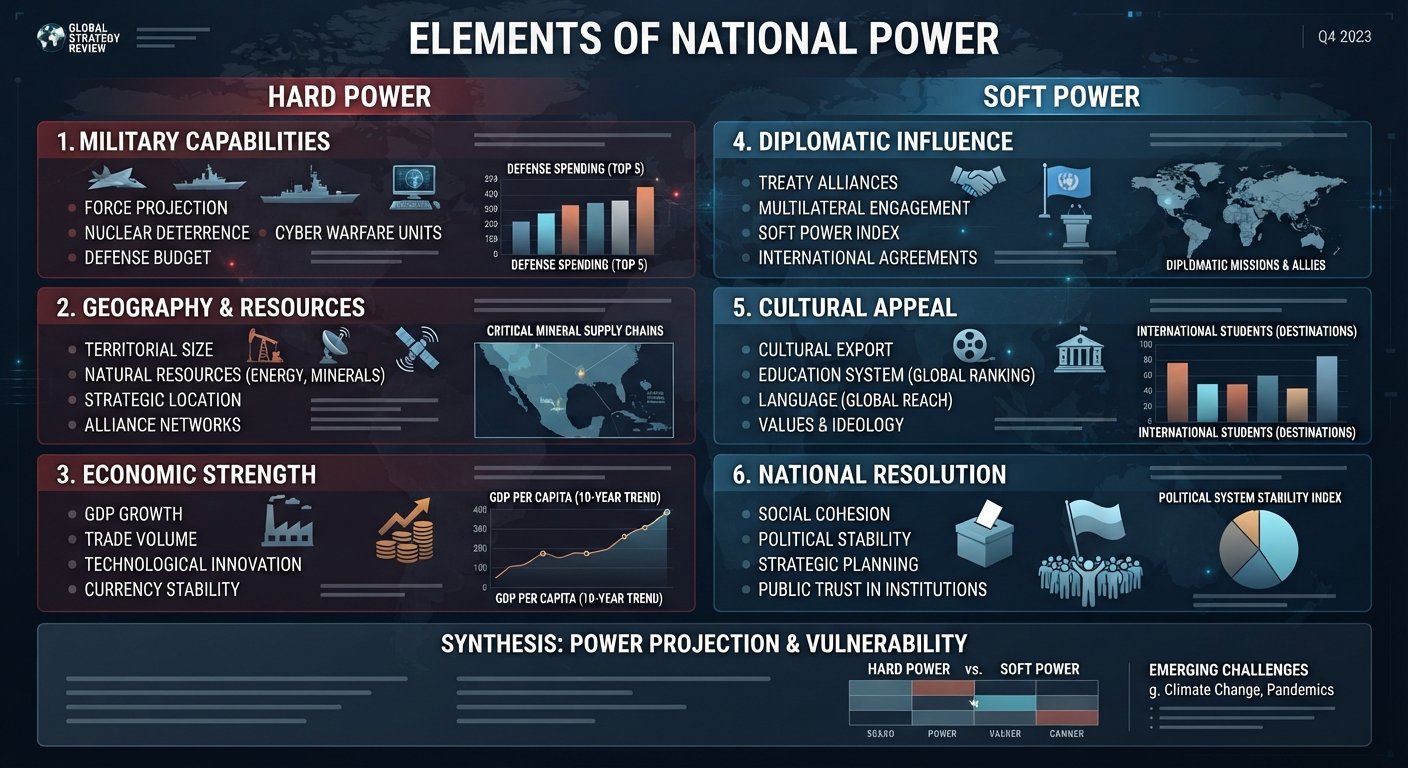
National power is often discussed through the concepts of hard power and soft power.
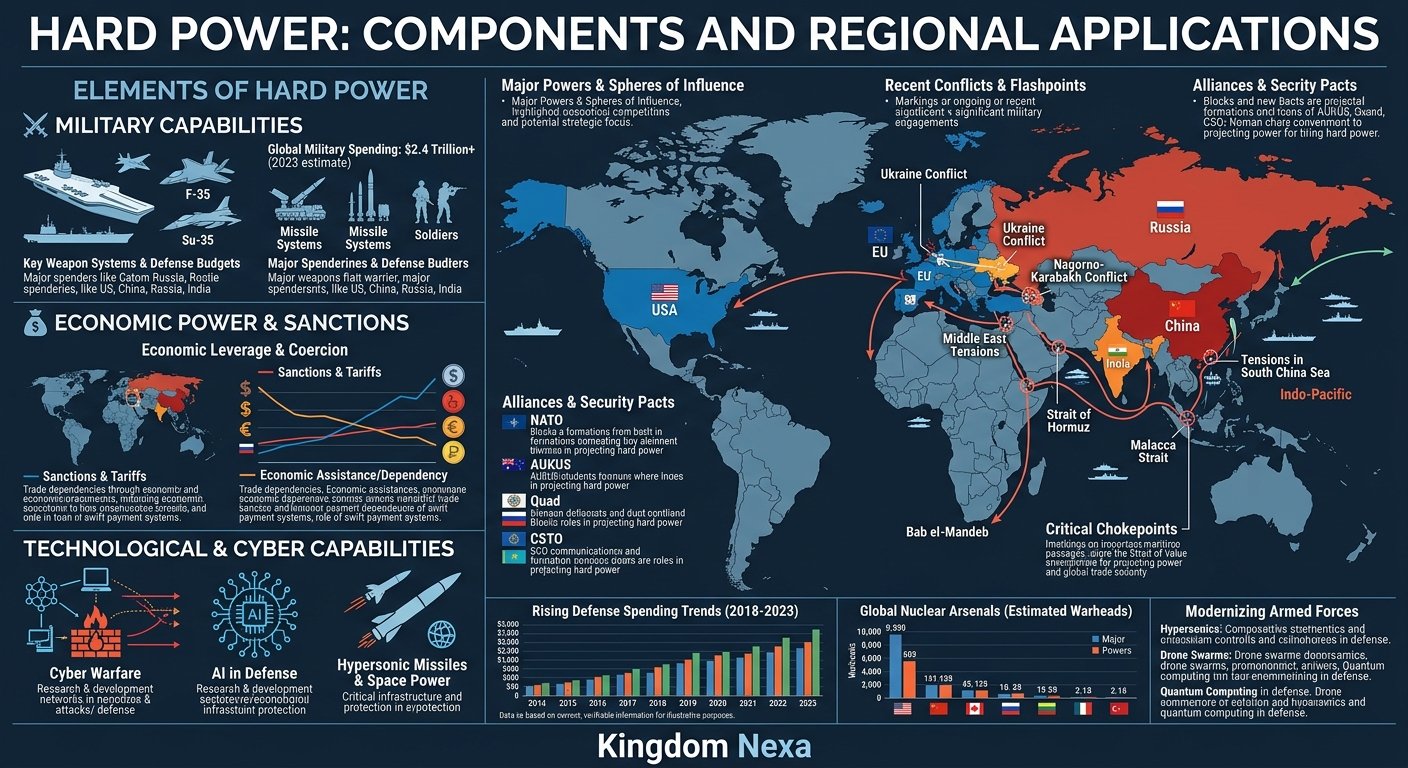
Hard power generally involves coercion or inducement. Military force, economic sanctions, financial pressure, and other forms of material leverage can fall into this category.
Soft power refers to the ability to influence others through attraction, credibility, culture, values, institutions, diplomacy, and perceived legitimacy.
The U.S. National Museum of American Diplomacy describes smart power as the flexible combination of hard and soft power to address foreign-policy challenges.
Why Smart Power Matters
Smart power recognizes that the most effective strategy may involve several instruments simultaneously.
For example, a country responding to a regional crisis might combine:
- Diplomatic negotiations
- Economic incentives
- Security assistance
- Strategic communication
- Humanitarian assistance
- Intelligence cooperation
- Multilateral diplomacy
The objective is not to use every instrument simply because it is available. The objective is to select the combination most likely to achieve the desired political outcome.
How the Elements of National Power Work Together
The elements of national power should not be viewed as isolated categories.
Economic power can finance military modernization.
Technology can strengthen economic competitiveness and military capabilities.
Diplomacy can convert military strength into alliances.
Information can reinforce diplomatic objectives.
Political stability can improve economic performance.
Human capital can accelerate technological innovation.
Geography can shape military strategy and trade policy.
This interaction is sometimes more important than the individual strength of any single element.
A country with extraordinary resources but poor strategic coordination may underperform compared with a state that possesses fewer resources but integrates them more effectively.
U.S. joint guidance similarly emphasizes that national-power instruments can operate as an integrated whole-of-government effort, with one instrument taking the lead while others support the national strategy.
What Determines the Strength of National Power?
National power depends on several factors beyond the raw quantity of resources.
Resources
A state needs economic, military, technological, human, and natural resources.
Conversion Capacity
Resources must be converted into usable capabilities.
For example, a large economy does not automatically produce an advanced defense industry.
Strategic Leadership
Leaders must identify national objectives and establish realistic priorities.
Institutional Capacity
Governments need institutions capable of implementing strategy.
Political Legitimacy
Domestic support can influence how long governments can sustain costly policies.
Alliances and Partnerships
A state can increase its effective power by working with partners.
Strategic Geography
Location can provide advantages or create vulnerabilities.
Resilience
States that can absorb shocks and recover quickly possess an important strategic advantage.
Limitations of the DIME Model
DIME is useful, but it should not be treated as a complete theory of national power.
Its categories can oversimplify complex relationships. For example, technology can simultaneously be economic, military, informational, and diplomatic.
Similarly, intelligence may support diplomacy, military operations, economic policy, and strategic communication.
Some broader frameworks therefore add areas such as:
- Financial power
- Intelligence
- Law enforcement
- Legal authority
- Development assistance
- Political power
- Cultural influence
- Social resilience
The important lesson is that no single acronym can capture every source of state power.
Analysts should select the framework that best fits the strategic problem being studied.
Elements of National Power in International Geopolitics
In practical geopolitical analysis, the framework can be used to compare countries and understand strategic competition.
Consider a hypothetical rivalry between two states.
One country may possess:
- A larger economy
- Superior technological capabilities
- Strong diplomatic partnerships
The other may possess:
- Geographic advantages
- Significant natural resources
- A large military
- Strong domestic mobilization capacity
Neither country’s overall position can be evaluated accurately by examining only GDP or military expenditure.
A meaningful assessment would examine the entire strategic ecosystem and ask how effectively each state can convert its resources into influence.
This is particularly important in an era of economic interdependence, technological competition, sanctions, cyber operations, strategic communications, and complex alliances.
Why National Power Is Different for Every Country
There is no universal formula for national power.
A major continental power may derive considerable influence from population, industrial capacity, natural resources, and strategic depth.
A small maritime state may derive disproportionate influence from financial services, technology, diplomacy, ports, trade networks, or international institutions.
A resource-rich country may possess significant energy leverage.
A technologically advanced country may influence global standards and supply chains.
A state with exceptional diplomatic credibility may play a larger role in international negotiations than its economic or military size would suggest.
National power must therefore be evaluated in context.
Frequently Asked Questions
What are the main elements of national power?
A commonly used framework is DIME: Diplomatic, Informational, Military, and Economic power. Broader approaches may also consider geography, population, technology, political institutions, natural resources, intelligence, finance, social cohesion, and other capabilities.
What does DIME stand for?
DIME stands for Diplomatic, Informational, Military, and Economic instruments of national power. It is widely used in national-security and strategic studies.
Is military power the most important element of national power?
Not necessarily. Military strength is important for deterrence and defense, but national objectives often require diplomacy, economic capacity, information, technology, political legitimacy, and alliances as well.
What is the difference between national power and military power?
National power is a broad concept covering a state’s overall ability to pursue its interests. Military power is one component or instrument of that broader national power.
How does economic power influence geopolitics?
Economic power can provide resources for national defense, strengthen diplomatic leverage, influence trade relationships, support investment abroad, and enable tools such as sanctions and financial pressure.
Why is diplomacy considered an element of national power?
Diplomacy allows governments to negotiate, build partnerships, manage disputes, form coalitions, communicate policies, and pursue interests without relying exclusively on coercion.
What is smart power?
Smart power refers to the strategic combination of hard-power and soft-power tools. It seeks to match the appropriate combination of instruments to a particular foreign-policy challenge.
Does every country use the same elements of national power?
The basic categories are broadly applicable, but countries differ in how they define, organize, and employ their capabilities. Different governments and scholars also use different frameworks.
Why is technology increasingly important to national power?
Technology affects military capabilities, economic productivity, intelligence, communications, cybersecurity, infrastructure, scientific research, and strategic supply chains. It therefore influences several dimensions of power simultaneously.
How can national power be measured?
There is no single universally accepted measurement. Analysts commonly examine economic size, military capabilities, technological capacity, diplomatic reach, population, natural resources, institutional strength, alliances, resilience, and the ability to convert these resources into strategic outcomes.
Conclusion
The Elements of National Power provide a framework for understanding why states behave differently and why some countries can exercise greater influence than others. The traditional emphasis on military strength remains important, but modern geopolitical competition extends far beyond the battlefield.
Diplomatic capability can build coalitions. Economic strength can create leverage. Information can shape perceptions. Military power can provide deterrence. Technology can transform economic and security capabilities. Geography, population, political institutions, natural resources, social cohesion, and human capital can provide the underlying foundations that allow these instruments to function effectively.
The most important lesson is that national power is multidimensional and interconnected. A state does not become strategically powerful simply by accumulating resources. It must be capable of converting those resources into coherent national strategy and sustainable influence.
For geopolitical analysis, DIME remains a useful starting point, but it should be combined with a broader assessment of geography, institutions, society, technology, resilience, alliances, and strategic leadership. Ultimately, the strongest states are not necessarily those with the greatest strength in one category. They are often those most capable of integrating different sources of power to achieve clearly defined national interests.