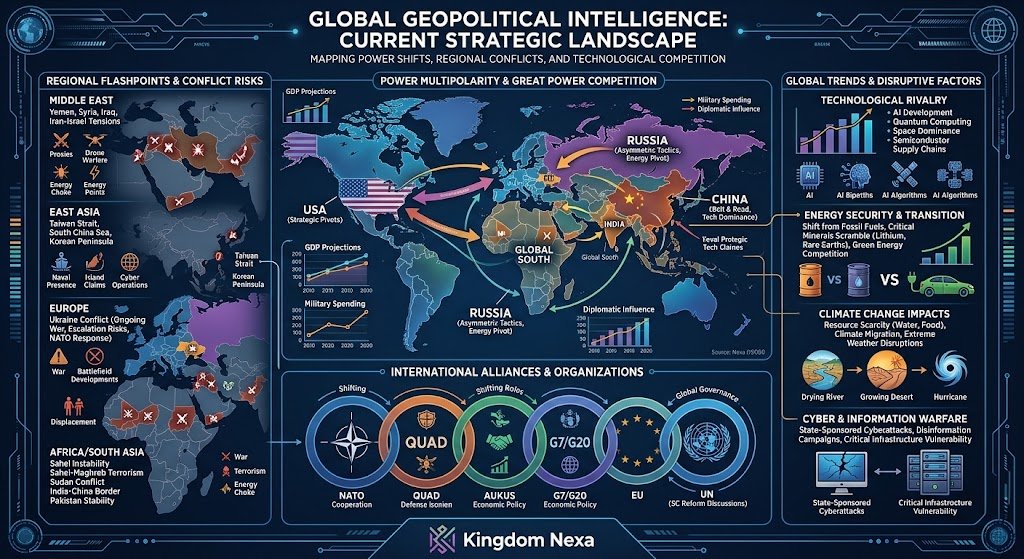
Geopolitical events rarely occur in isolation. A diplomatic dispute can disrupt international trade, military developments can reshape regional security, and a change in government can alter alliances, investment decisions, and global markets. Understanding these developments requires more than following breaking news. It requires the ability to connect information, evaluate competing explanations, and anticipate how political decisions may influence the international system.
Geopolitical Intelligence provides a structured approach to understanding these connections. It combines political analysis, geographic knowledge, economic indicators, security assessments, technological developments, and diplomatic reporting to explain what is happening between countries, why it matters, and what consequences may follow.
Governments use intelligence to inform national security and foreign policy. Businesses apply geopolitical analysis to assess supply-chain vulnerabilities, sanctions, and investment risks. Researchers, journalists, diplomats, and policymakers use similar methods to understand international competition and cooperation.
In an increasingly interconnected world, reliable analysis is especially important because information spreads rapidly, official statements may reflect strategic interests, and misleading reports can distort public understanding. This guide explains the meaning, methods, historical development, practical applications, major challenges, and future of geopolitical intelligence, with particular attention to responsible analysis and the realities of international affairs as of October 2026.
What Is Geopolitical Intelligence?
Geopolitical intelligence is the systematic collection, evaluation, and analysis of information about countries, political actors, geographic conditions, economic relationships, military capabilities, and international developments to support informed decisions.
Its central purpose is to transform scattered information into a useful understanding of strategic interests, emerging risks, and possible future developments.
For example, news that a government has restricted exports of a critical mineral is a piece of information. Assessing which countries depend on that mineral, how quickly alternative suppliers could replace it, whether the restriction could provoke retaliation, and how it might affect strategic industries is geopolitical intelligence analysis.
The concept combines two closely related fields:
- Geopolitics: The study of how geography, resources, location, and spatial relationships influence political power and international relations.
- Intelligence analysis: The disciplined evaluation and interpretation of information to answer questions relevant to decision-makers.
Geopolitical intelligence is not simply the accumulation of secret information. It can rely heavily on public sources, official documents, trade data, satellite imagery, academic research, and established news organizations. Its value lies in the quality of interpretation rather than the quantity of information collected.
The result may be a short risk alert, a country assessment, a regional security report, an economic exposure analysis, or a longer-term strategic forecast.
How Geopolitical Intelligence Developed
The practice has ancient roots, although its modern methods emerged through the development of diplomacy, national security institutions, communications technology, and data analysis.
From diplomatic reporting to modern intelligence
For centuries, rulers and governments relied on diplomats, merchants, military scouts, and travelers to understand neighboring states. Their reports covered leadership disputes, military preparations, trade routes, political alliances, and the intentions of rival powers.
During the nineteenth century, advances in geography, cartography, transportation, and communications improved the ability of governments to assess international developments. Industrialization also increased the strategic importance of ports, railways, energy resources, and overseas markets.
The two world wars accelerated the development of organized intelligence services and systematic assessments of military, industrial, and political capabilities.
The Cold War and strategic forecasting
After 1945, geopolitical intelligence became increasingly associated with superpower competition, nuclear deterrence, alliance politics, espionage, and assessments of military intentions.
The United States, Soviet Union, and their partners developed extensive intelligence systems. Analysts examined military deployments, weapons development, leadership behavior, economic capacity, and ideological competition.
The Cold War also demonstrated a central difficulty: possessing substantial information does not guarantee accurate conclusions. Analysts must distinguish a state’s capabilities from its intentions and consider whether apparently threatening actions have alternative explanations.
The digital transformation
Since the late twentieth century, satellite imagery, digital communications, commercial data, social media, and increasingly sophisticated analytical software have expanded the range of available evidence.
Today, analysts can compare shipping movements, public budget documents, official announcements, commodity prices, and imagery to examine developments that once required specialized access.
However, the volume of available information creates new problems. Disinformation, manipulated media, automated content, cyber operations, and rapidly changing narratives make verification and source evaluation essential.
The fundamental task remains unchanged: converting evidence into a balanced assessment that helps people make better decisions.
How Geopolitical Intelligence Works
Professional intelligence analysis follows a structured process. Although institutions use different models, the general workflow moves from defining a question to collecting evidence, evaluating sources, interpreting findings, communicating conclusions, and reviewing outcomes.
The intelligence cycle
1. Define the intelligence requirement
Identify the decision, question, or risk that needs to be understood.
2. Collect relevant information
Gather official documents, reporting, economic data, imagery, and expert assessments.
3. Verify and evaluate evidence
Check provenance, reliability, corroboration, context, and possible deception.
4. Analyse strategic significance
Connect geography, political interests, capabilities, incentives, and constraints.
5. Develop scenarios and implications
Assess plausible outcomes, warning indicators, risks, and opportunities.
6. Communicate and update
Present findings to decision-makers, incorporate feedback, and revise assessments as evidence changes.
Illustrative intelligence workflow based on established intelligence-cycle principles.
Collection methods and intelligence sources
Geopolitical analysts use several complementary disciplines. No single source provides a complete picture.
- Open-source intelligence (OSINT): Information from publicly available or commercially accessible sources, including government statements, news reporting, research papers, company filings, and public databases.
- Geospatial intelligence (GEOINT): Geographic information, maps, satellite imagery, and aerial photographs used to understand locations, infrastructure, territorial changes, and physical conditions.
- Human intelligence (HUMINT): Information obtained through human sources, including authorized interviews and other lawful collection activities.
- Signals intelligence (SIGINT): Intelligence derived from intercepted communications or other electronic signals, subject to applicable legal authorities.
- Economic intelligence: Analysis of trade flows, investment patterns, sanctions, financial exposures, energy markets, and industrial capacity.
- Cyber threat intelligence: Assessment of cyber threats, hostile digital activity, vulnerabilities, and their potential political or strategic implications.
These categories may overlap. A rigorous assessment can combine official statements with satellite imagery, public shipping data, historical records, and economic indicators. The UK’s National Centre for Geospatial Intelligence describes the use of geographic data, imagery, and open sources in intelligence work.
From evidence to an analytical judgment
Collection alone does not create understanding. Analysts must test explanations against the available evidence.
A useful assessment distinguishes three levels:
- Established facts: What reliable evidence demonstrates.
- Analytical judgments: What the evidence suggests about motivations, capabilities, or likely consequences.
- Uncertainties: What remains unknown, disputed, or dependent on future decisions.
For instance, a country increasing defence expenditure may be responding to a perceived threat, modernising outdated equipment, strengthening domestic industry, or pursuing several objectives simultaneously. Spending data alone cannot establish its intentions.
Good analysis therefore considers alternative explanations, identifies assumptions, and explains what new evidence would strengthen or weaken each conclusion.
Why Geopolitical Intelligence Matters Today
International affairs are increasingly shaped by interactions among military security, economic interdependence, technology, domestic politics, and competition for strategic influence. These connections make isolated assessments less useful.
National security and military planning
Governments use intelligence assessments to evaluate foreign military capabilities, alliance commitments, regional tensions, strategic weapons, and possible escalation pathways.
The distinction between capability and intent is particularly important. A state’s military capacity may increase without an immediate decision to use it, while diplomatic signals may be intended to deter rather than initiate conflict.
Intelligence can help policymakers identify warning signs, compare possible responses, and reduce the likelihood of decisions based on incomplete information. It cannot eliminate uncertainty or guarantee that deterrence will succeed.
Diplomacy and foreign policy
Diplomats need to understand what other governments want, what they can realistically deliver, and which domestic or international constraints influence their positions.
Geopolitical analysis can reveal bargaining opportunities, likely areas of disagreement, potential mediators, and the consequences of different negotiating strategies.
It can also help distinguish public rhetoric from policy changes supported by budgets, formal agreements, institutional decisions, and observable actions. Such distinctions are essential when evaluating diplomatic commitments.
Economic security and business decisions
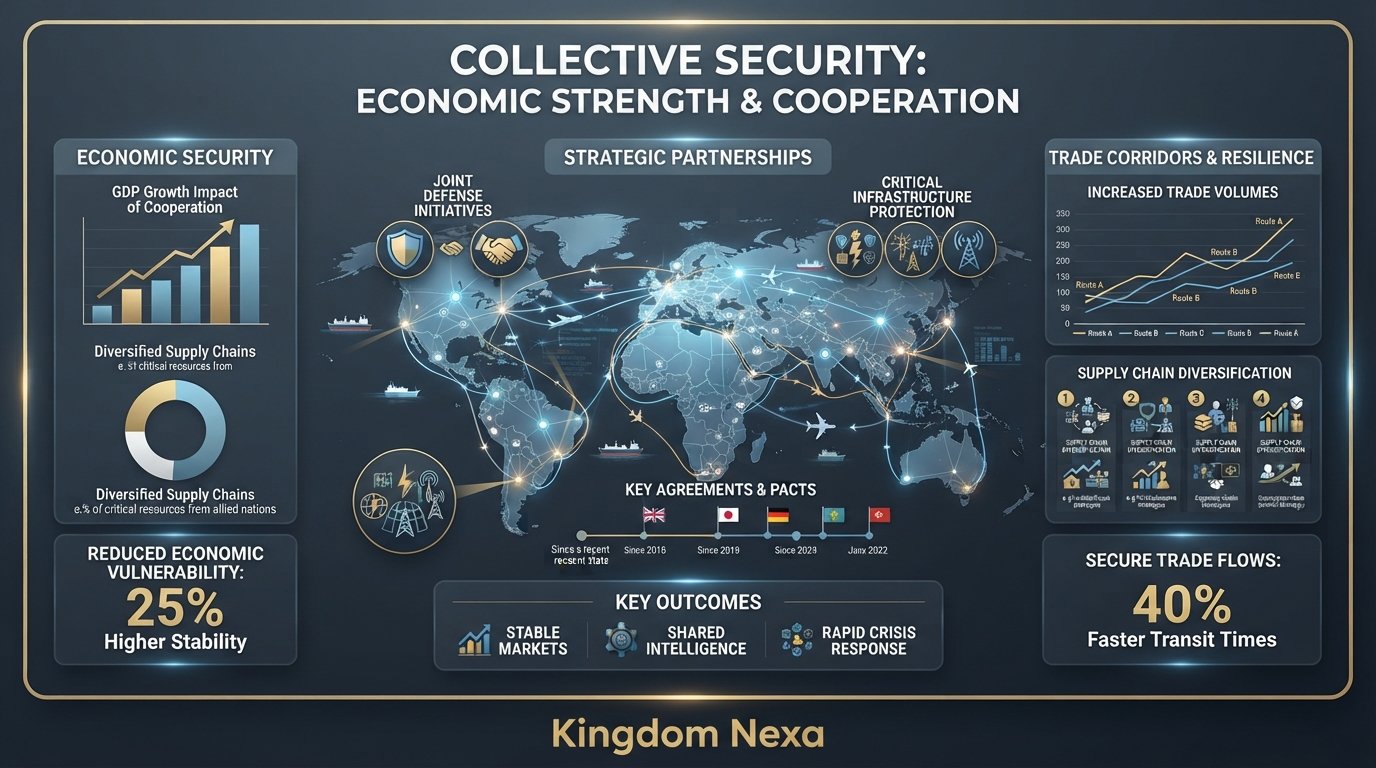
Political developments can affect commodity prices, shipping insurance, market access, foreign investment, export controls, and the availability of critical materials.
Businesses use country-risk and geopolitical assessments to identify exposure to sanctions, political instability, regulatory changes, transport disruptions, and concentrated suppliers.
For example, a company dependent on a single country for a strategically important component may face operational risks if export restrictions or diplomatic tensions interrupt deliveries. Intelligence analysis can help it compare alternative suppliers, assess the cost of diversification, and prepare contingency plans.
Technology and strategic competition
Semiconductors, artificial intelligence, telecommunications, satellite systems, drones, and cybersecurity have become important elements of international competition.
Technology can provide economic advantages and military capabilities, but it can also create dependencies. A country may possess advanced digital infrastructure while relying on foreign suppliers for critical components, specialised software, or manufacturing equipment.
Geopolitical intelligence evaluates these dependencies alongside export controls, research partnerships, technology standards, and the security implications of digital infrastructure.
Humanitarian and societal early warning
Political instability often develops through interacting pressures such as economic hardship, institutional weakness, communal tensions, environmental stress, and conflict.
Analysts can monitor displacement, food prices, access to essential services, political violence, and restrictions on humanitarian assistance to identify deteriorating conditions.
These indicators do not make unrest or conflict inevitable. Their significance depends on local institutions, government responses, social relationships, and external involvement. Responsible analysis should avoid treating populations as homogeneous groups or presenting unverified claims about communities as facts.
How Geopolitical Intelligence Works
Infographic placement: insert a designed infographic here before publication.
1. Define the question
Identify the strategic issue or decision.
2. Collect evidence
Official documents, OSINT, imagery, economic data, and reporting.
3. Verify sources
Assess reliability, context, and corroboration.
4. Analyse strategic interests
Examine geography, political incentives, capabilities, and constraints.
5. Assess risks and scenarios
Identify plausible outcomes, warning indicators, and potential consequences.
6. Communicate and update
Present findings, explain uncertainty, and revise assessments when evidence changes.
Facts
Judgments
Uncertainties
Note: I couldn’t generate a separate infographic image because the image-generation tool was unavailable. This structured visual is a text-based alternative.
Major Geopolitical Intelligence Challenges
Despite advances in technology and analytical methods, several persistent problems can undermine intelligence quality.
Disinformation and information manipulation
Governments, political movements, commercial interests, and other actors may circulate misleading information to influence public opinion, undermine confidence, or shape international perceptions.
A photograph may be authentic but presented with the wrong date or location. A genuine official statement may be selectively quoted. A video may be manipulated or attributed to an unrelated event.
The United Nations Global Service Centre has described methods that combine geospatial, temporal, and contextual analysis to verify digital images and videos.
Analysts should therefore verify the original source, publication date, location, relevant context, and independent corroboration before treating digital material as evidence.
Intelligence bias and political pressure
Analysts may be influenced by prior assumptions, institutional cultures, national interests, or pressure from decision-makers. Confirmation bias is particularly dangerous because it encourages people to favour evidence supporting their existing beliefs while dismissing contradictory information.
A strong analytical process actively tests competing explanations, records assumptions, and communicates dissenting assessments where appropriate.
Intelligence should inform policy rather than merely justify a decision that has already been made.
Incomplete information and strategic ambiguity
Governments rarely reveal every relevant detail about their intentions, negotiations, military plans, or economic policies. Public statements may also be deliberately ambiguous.
Even extensive evidence may not resolve whether a military exercise is intended primarily for training, deterrence, signalling, or preparation for a possible operation.
Analysts should acknowledge these limitations instead of expressing unsupported certainty. Confidence levels should reflect the quality, quantity, consistency, and independence of the evidence.
Ethical, legal, and privacy concerns
Intelligence collection can create risks for privacy, civil liberties, journalists, researchers, and vulnerable communities. Access to publicly available information does not automatically make every use of it ethical or lawful.
Analysts should respect applicable privacy and data-protection laws, organisational rules, source protections, and restrictions on sensitive information. They should also distinguish legitimate public-interest research from intrusive surveillance or the exposure of private individuals without a compelling justification.
Current Geopolitical Intelligence Priorities in 2026
As of 24 October 2026, several interconnected developments make geopolitical risk analysis particularly important. The following are broad analytical priorities rather than claims that any single outcome is inevitable.
Great-power competition and strategic realignment
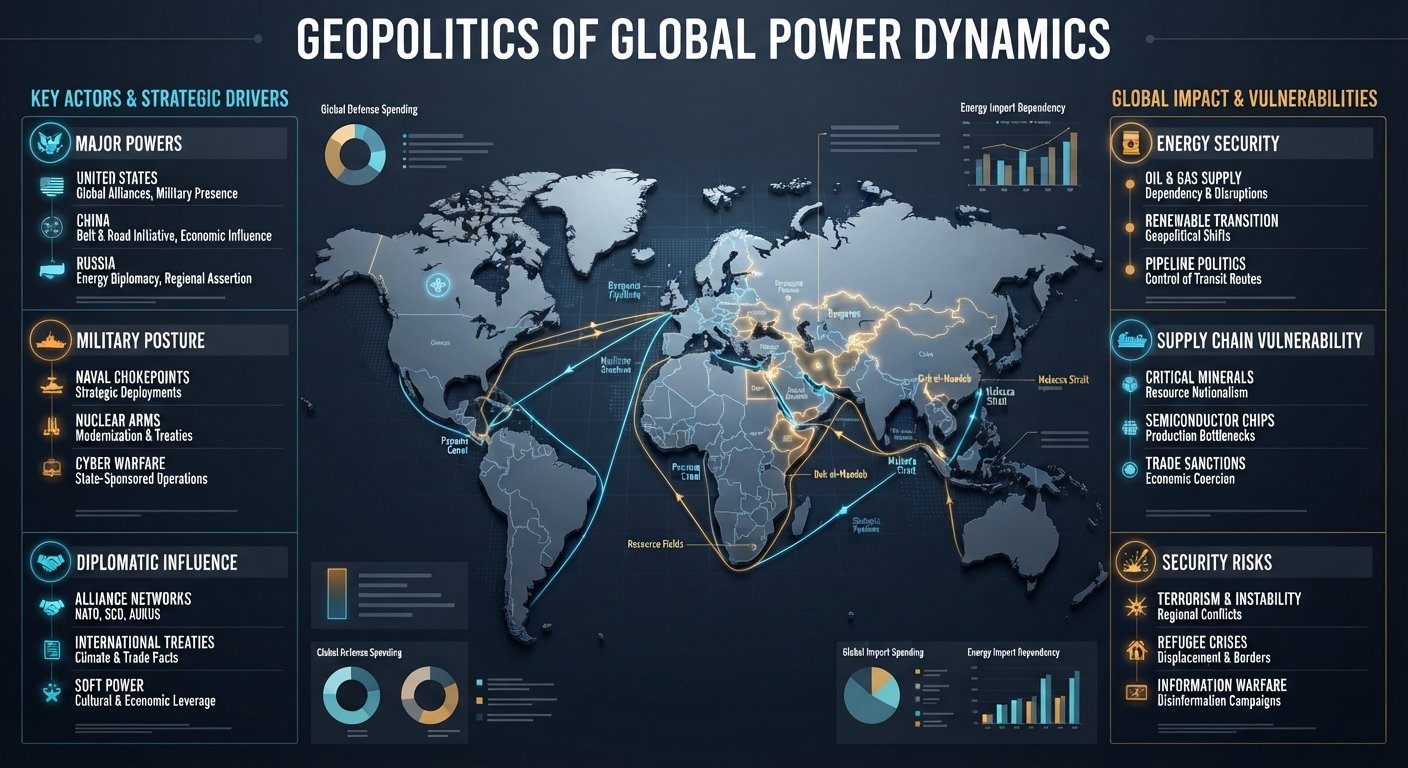
Competition involving the United States, China, Russia, and other influential states affects defence planning, trade, technology, diplomacy, and international institutions.
The World Economic Forum’s Global Risks Report 2026, published in January 2026, identified geoeconomic confrontation as the leading risk in its survey for 2026. Eighteen per cent of respondents selected it as the risk most likely to trigger a material global crisis, compared with 14% selecting state-based armed conflict. These figures reflect respondents’ perceptions, not measured probabilities of events occurring.
For analysts, the implication is that political and economic developments must be examined together. Export restrictions, tariffs, sanctions, investment screening, and strategic industrial policies can influence international relationships as significantly as conventional diplomatic disputes.
Regional conflicts and strategic chokepoints
Conflict can affect neighbouring countries through refugee movements, arms transfers, maritime insecurity, energy prices, and diplomatic realignment.
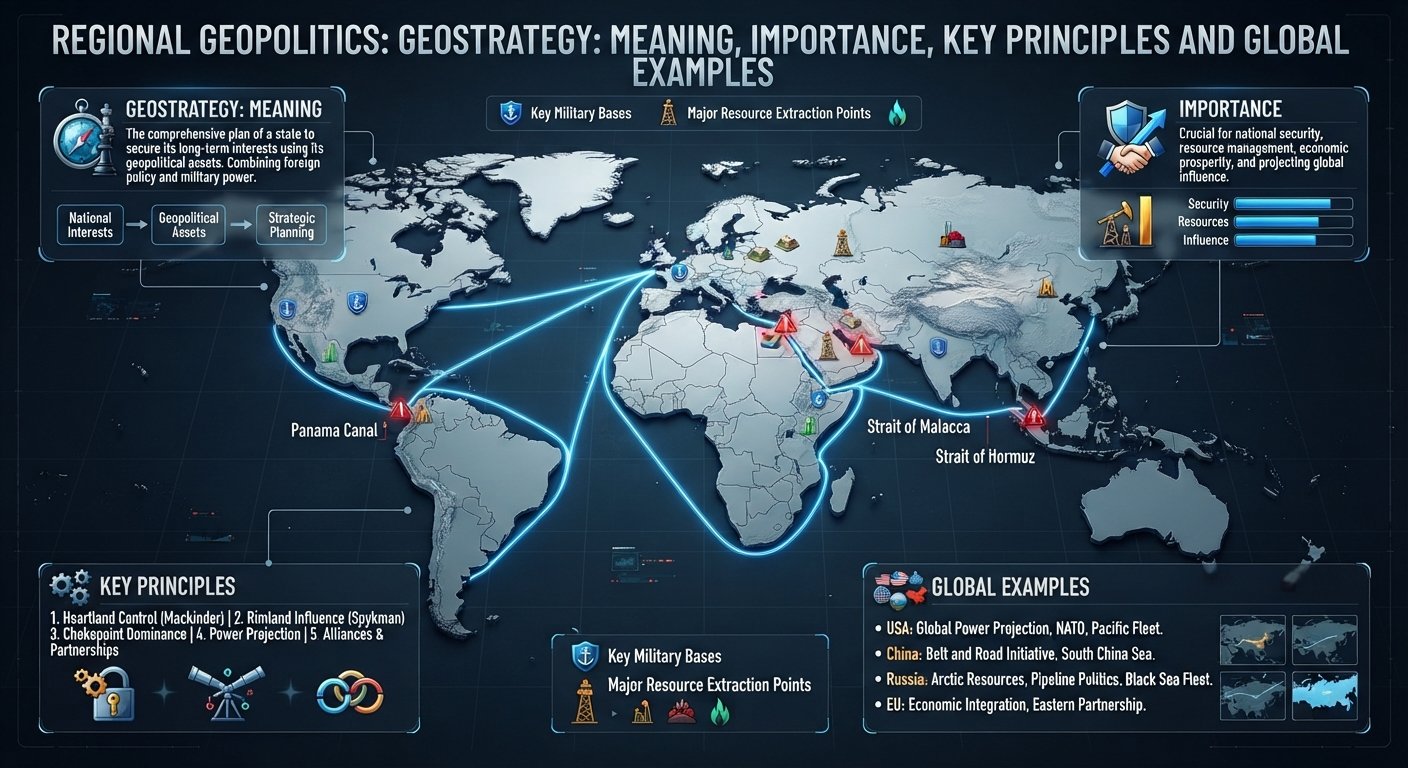
Strategic chokepoints—including narrow maritime passages, major canals, and critical transport corridors—deserve particular attention because disruptions can affect countries far from the immediate conflict zone.
Intelligence assessments should consider the duration of a disruption, available alternatives, the vulnerability of infrastructure, and the potential for escalation. Short-lived interruptions and prolonged closures can have very different consequences.
Critical minerals and supply-chain security
Lithium, cobalt, copper, graphite, rare earth elements, and other strategic materials are important to energy systems, electronics, transport, and defence production.
The geopolitical significance of these resources depends not only on where deposits are located but also on processing capacity, transport access, ownership, export policy, and the availability of substitutes.
An analyst assessing supply-chain risk should map dependencies across multiple stages rather than focusing solely on the country that extracts a raw material.
Artificial intelligence and the information environment
Artificial intelligence can help analysts process large datasets, translate foreign-language material, identify patterns, and generate alternative scenarios. It can also amplify fabricated content, reinforce biases, and produce convincing but incorrect summaries.
A November 2025 study by the World Economic Forum and the OECD examined AI’s growing role in strategic foresight while highlighting concerns about reliability, transparency, and bias.
Human review, source traceability, secure data handling, and independent verification remain essential. AI-generated findings should be treated as analytical assistance, not as verified intelligence by default.
International Law and the Role of Institutions
Geopolitical intelligence does not operate outside the legal and institutional framework governing international relations.
The United Nations Charter establishes principles including the sovereign equality of states, peaceful settlement of disputes, and the prohibition on the threat or use of force against a state’s territorial integrity or political independence, subject to the Charter’s applicable legal framework. Article 51 addresses the inherent right of individual or collective self-defence if an armed attack occurs.
These principles matter because analysts must distinguish between what an actor can do, what it intends to do, and what international law permits.
Different institutions contribute complementary perspectives:
- United Nations: International peace and security, diplomacy, humanitarian affairs, and the international legal framework.
- NATO: Collective defence, alliance planning, and transatlantic security.
- European Union: Foreign policy coordination, sanctions, trade, regulation, and economic security.
- World Trade Organization: International trade rules and dispute settlement.
- International Monetary Fund and World Bank: Economic stability, development, financing, and country-level economic analysis.
- Regional organisations: Local diplomacy, conflict prevention, economic cooperation, and regional security arrangements.
Institutional assessments are not interchangeable, and their mandates differ. Analysts should examine the scope, methodology, and limitations of each source before drawing conclusions.
How to Conduct a Geopolitical Intelligence Assessment
A practical assessment begins with a specific question. Broad questions such as “What will happen in the world?” are difficult to answer meaningfully. More useful questions identify an actor, issue, and time horizon.
For example: What factors could disrupt a country’s access to imported energy over the next twelve months?
A disciplined assessment can follow these steps:
- Define the scope. Specify the country, issue, geographic area, and decision that the analysis will support.
- Establish a baseline. Review the historical relationship, existing agreements, economic dependencies, and relevant political institutions.
- Collect diverse evidence. Compare official statements, credible journalism, statistical data, research, and appropriate geospatial information.
- Assess source quality. Check dates, provenance, independence, potential conflicts of interest, and whether sources are repeating the same original claim.
- Map actors and incentives. Identify their objectives, capabilities, constraints, domestic pressures, and relationships with other stakeholders.
- Develop competing hypotheses. Consider several plausible explanations rather than assuming the first interpretation is correct.
- Identify indicators. Specify observable developments that would strengthen or weaken each hypothesis.
- Communicate the assessment. Explain the evidence, implications, confidence level, key uncertainties, and possible responses.
- Review regularly. Update the assessment as events change and evaluate whether earlier judgments were accurate.
This approach is consistent with the broader principles of strategic foresight: examining alternative futures, challenging assumptions, and preparing for uncertainty instead of relying on a single forecast.
Future Scenarios for Geopolitical Intelligence
The future of intelligence analysis will depend on political developments, technological change, institutional capacity, and the ability to evaluate information responsibly.
Scenario 1: Greater integration of open-source and classified intelligence
Governments, research institutions, and businesses may increasingly combine publicly available information with specialised intelligence sources. This could improve cross-checking and expand the range of perspectives available to analysts.
However, integration will require safeguards for sensitive information, reliable provenance, and clear distinctions between independently confirmed evidence and unverified reporting.
Scenario 2: AI-assisted analysis becomes routine
AI tools may increasingly support translation, document review, anomaly detection, trend monitoring, and scenario generation. This could allow analysts to spend more time testing explanations and assessing strategic implications.
The benefits will depend on data quality, human oversight, security, and the ability to explain how conclusions were reached. Faster processing will not automatically produce better judgment.
Scenario 3: Fragmented information ecosystems
Strategic rivalry could lead to more restricted data access, competing narratives, national technology standards, and reduced information sharing.
In this scenario, analysts may find it harder to verify claims across borders. Independent research networks, transparent methodologies, and trusted professional relationships would become especially valuable.
These scenarios are plausible possibilities, not predictions. Their purpose is to identify choices and preparations that remain useful across different outcomes.
Frequently Asked Questions About Geopolitical Intelligence
1. What is geopolitical intelligence in simple terms?
It is the process of collecting and analysing information about countries, political decisions, geography, economies, security, and international relationships to understand strategic developments and support informed decisions.
2. What is the difference between geopolitics and geopolitical intelligence?
Geopolitics studies how geography and power influence international relations. Geopolitical intelligence applies structured collection, verification, and analysis to understand specific developments, risks, and possible consequences.
3. Is geopolitical intelligence the same as espionage?
No. Espionage is one possible method of obtaining information, often involving secret collection. Geopolitical intelligence is broader and can rely entirely on lawful public sources, economic data, research, official documents, and satellite imagery.
4. What are the main sources of geopolitical intelligence?
Sources include government publications, diplomatic statements, international organisations, credible news outlets, academic research, economic statistics, commercial satellite imagery, public company filings, and other relevant open-source material. Source quality and independent corroboration are essential.
5. Who uses geopolitical intelligence?
National governments, diplomats, intelligence agencies, defence planners, journalists, researchers, international organisations, investors, and multinational businesses use geopolitical analysis for different purposes, including risk management, policy development, reporting, and strategic planning.
6. How does geopolitical intelligence help businesses?
It helps businesses identify exposure to sanctions, political instability, trade restrictions, supply-chain disruption, regulatory changes, and energy-market volatility. These assessments can inform sourcing decisions, investment planning, contingency arrangements, and market entry strategies.
7. How does artificial intelligence affect geopolitical intelligence?
AI can help process documents, translate languages, identify patterns, and monitor emerging developments. However, fabricated content, biased data, and incorrect outputs can mislead analysts. Independent verification and human judgment remain necessary.
8. Can geopolitical intelligence predict wars or political crises?
It can identify risk factors, warning indicators, and plausible scenarios, but it cannot reliably predict every crisis. Political decisions, unexpected events, incomplete information, and strategic deception limit forecasting accuracy.
9. How can students learn geopolitical intelligence analysis?
Students can begin with international relations, political geography, economics, modern history, research methods, and international law. They should practise source verification, country-risk assessments, timeline construction, scenario planning, and clear analytical writing using credible public information.
Conclusion
Geopolitical intelligence is an essential tool for understanding an international system shaped by competing interests, economic interdependence, technological change, and evolving security challenges. Its purpose is not merely to explain headlines but to identify the relationships, incentives, constraints, and uncertainties behind international developments.
Effective analysis combines reliable evidence with historical context, geographic understanding, economic reasoning, political awareness, and careful evaluation of alternative explanations. It also recognises that intelligence judgments are not infallible and that responsible decision-making requires transparency about uncertainty.
As AI, commercial satellite imagery, open-source research, and digital communications expand the information available to analysts, the ability to verify evidence and interpret it critically will become even more important.
For students, researchers, policymakers, diplomats, journalists, and business leaders, mastering geopolitical intelligence offers a practical framework for evaluating international risks and opportunities. In a world where political decisions can have consequences across borders, sound analysis helps turn uncertainty into better-informed choices.