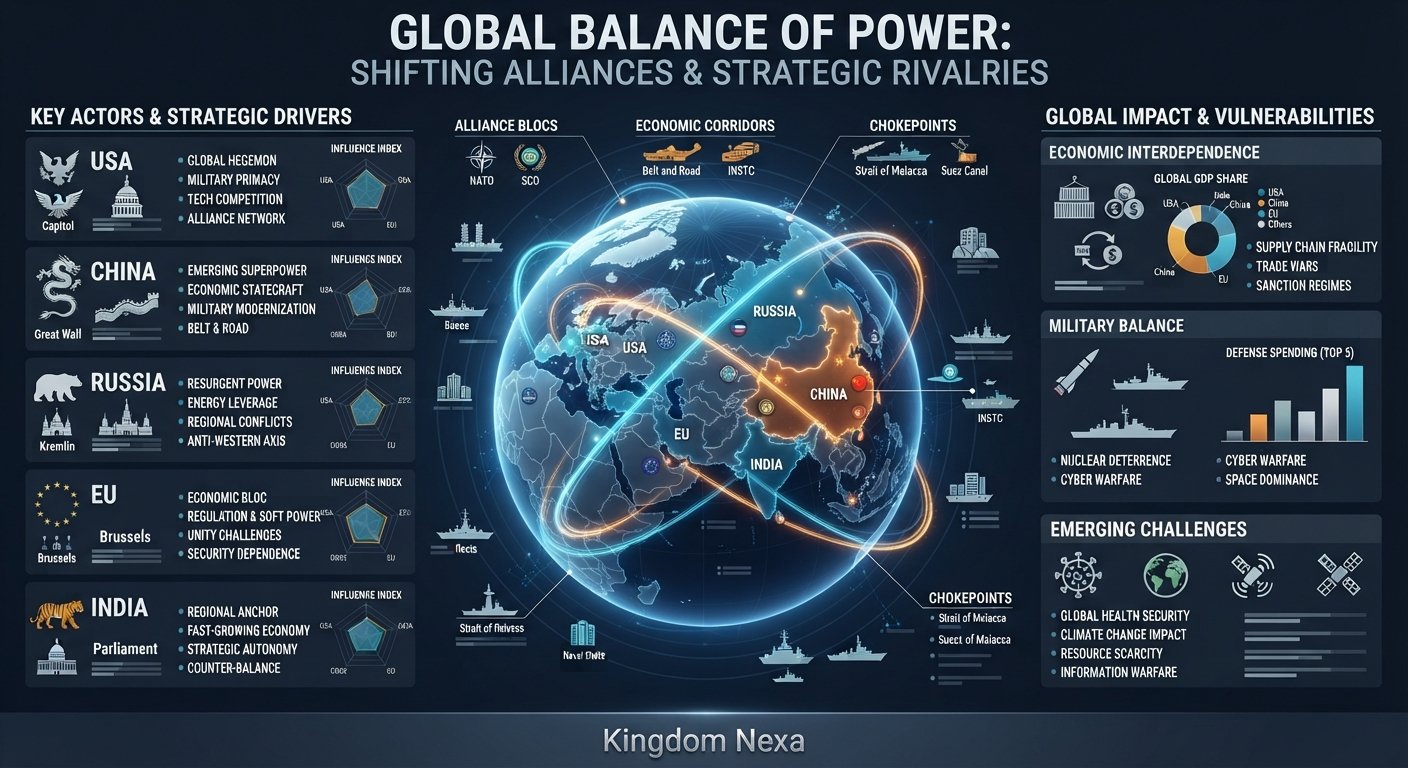
The Global Balance of Power describes how economic strength, military capabilities, technology, diplomacy, alliances, geography, population, institutions, and other sources of influence are distributed among major states and international actors. It is not simply a ranking of which country has the largest army or economy. Power is multidimensional, and a state can be dominant in one area while remaining dependent on others.
For much of the post-Cold War period, the United States possessed an unusually broad combination of military, financial, technological, diplomatic, and institutional advantages. Today, however, the distribution of power is becoming more complex. China has emerged as a major economic, technological, and military competitor; India is expanding its strategic weight; Europe retains enormous economic and regulatory influence; Russia remains a significant nuclear and military power; and regional powers increasingly have the ability to shape outcomes in their own neighborhoods.
As of 2026, the most useful way to understand the Global Balance of Power is not as a simple transition from American dominance to Chinese dominance. It is better understood as a more contested, interconnected, and increasingly multipolar system in which different countries possess different forms of leverage.
What Is the Global Balance of Power?
The Global Balance of Power is the distribution of capabilities and influence among states and other important actors within the international system.
In classical international relations theory, the concept is closely associated with the idea that states seek to prevent any single power from becoming dominant. States may respond by strengthening their own capabilities, forming alliances, balancing against stronger countries, or cooperating with potential rivals when their interests overlap.
Modern global power is broader than military strength. It includes:
- Economic size and resilience
- Military and nuclear capabilities
- Technological innovation
- Diplomatic networks
- Control of strategic resources
- Financial and monetary influence
- Population and human capital
- Geography
- Industrial capacity
- Energy security
- Infrastructure and supply chains
- Cultural and soft power
- Institutional influence
This means that power is relative rather than absolute. A country may be powerful globally but constrained in a particular region, while a middle power may have disproportionate influence over a specific issue.
Why the Balance of Power Matters
The distribution of power influences international stability, conflict, alliances, trade, investment, sanctions, technology policy, energy markets, and diplomatic negotiations.
When one state becomes substantially stronger than its rivals, other countries may respond through balancing coalitions. When power is distributed among several major actors, competition can become more complicated because alliances and partnerships are often fluid.
The modern system also contains a paradox: economic interdependence can reduce incentives for conflict while simultaneously creating new forms of strategic vulnerability.
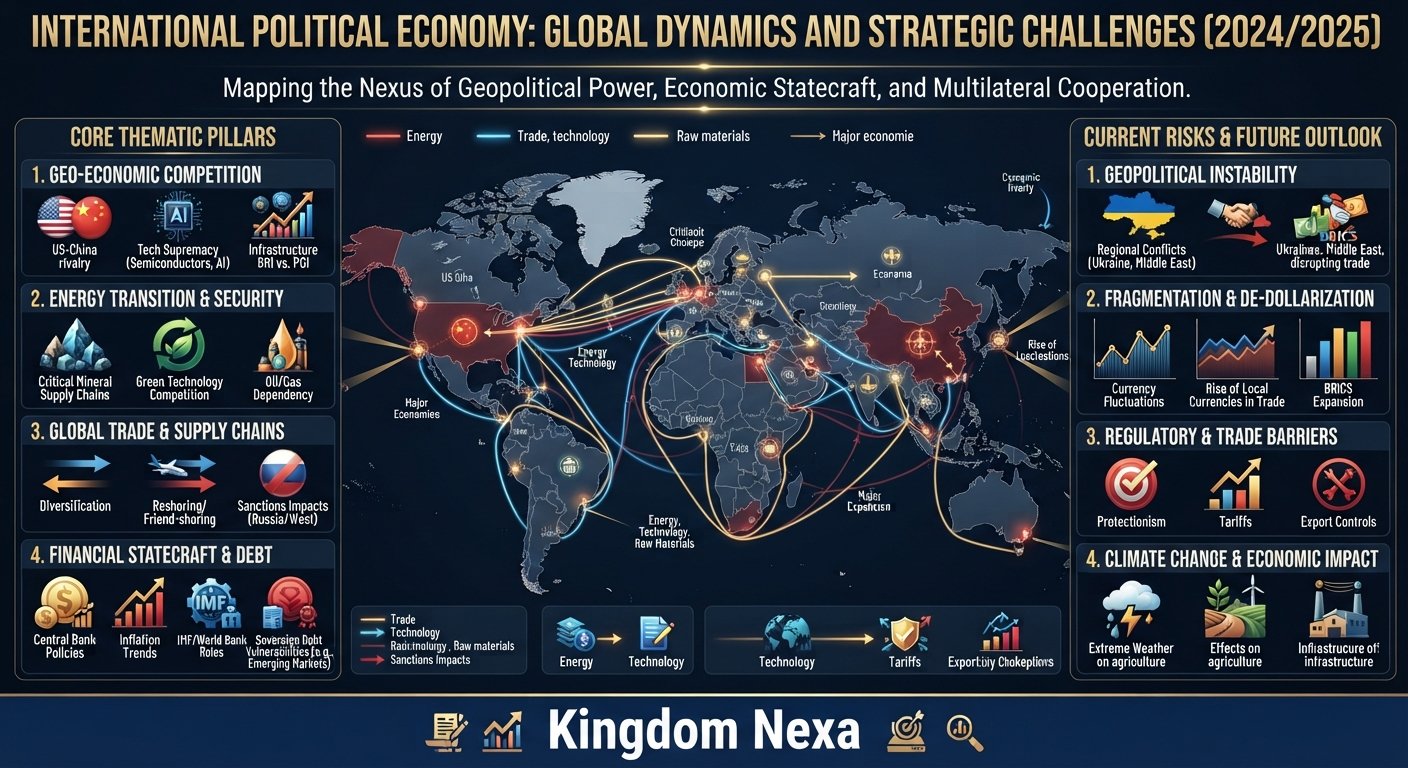
Countries can now exert influence through financial restrictions, export controls, technology standards, investment screening, supply-chain dependencies, cyber capabilities, and control over critical infrastructure.
How Has the Global Balance of Power Changed?
The current system cannot be understood without examining earlier periods of international power distribution.
The European Balance of Power
From the 17th through the 19th centuries, European diplomacy was heavily influenced by balance-of-power politics. Britain, France, Austria, Prussia, Russia and other powers competed to prevent the emergence of an overwhelmingly dominant continental power.
The Congress of Vienna in 1815 represented an important attempt to construct a European order based partly on equilibrium among major powers.
This historical experience demonstrated an important principle: alliances can be instruments of balance rather than permanent friendships. States frequently cooperate because their strategic interests temporarily coincide.
The Rise of the United States
The two world wars dramatically altered the international distribution of power.
European powers emerged weakened from the Second World War, while the United States possessed enormous economic, industrial, military, financial and technological capabilities. The Soviet Union emerged as America’s principal strategic competitor.
The post-1945 system therefore became increasingly bipolar.
The Cold War
The Cold War was the clearest modern example of bipolarity.
The United States and Soviet Union developed competing military alliances, economic systems and ideological blocs. NATO and the Warsaw Pact became major institutional expressions of this competition.
Nuclear deterrence fundamentally changed the meaning of military power. The possibility of catastrophic retaliation placed limits on direct conflict between the two superpowers.
The Unipolar Moment
The collapse of the Soviet Union in 1991 left the United States with unmatched global military reach and substantial economic, technological and diplomatic advantages.
For a period, scholars described the international system as unipolar, meaning that one state possessed significantly greater aggregate power than any other.
However, unipolarity did not mean that the United States controlled every international outcome. Regional powers, international institutions, economic interdependence and domestic political constraints continued to limit American freedom of action.
The Return of Multipolarity
The 21st century brought major changes.
China’s economic transformation increased its global influence. India expanded its economic and diplomatic importance. The European Union developed substantial regulatory and market power. Russia retained significant nuclear, military and energy capabilities despite its smaller economic base relative to the United States and China.
At the same time, middle powers such as Türkiye, Saudi Arabia, Brazil, Indonesia, South Korea, Australia and others gained greater ability to pursue independent strategies.
Recent analysis increasingly describes the system as multipolar or increasingly multipolar, although there is disagreement about how many genuine global “poles” exist. A 2026 BCG analysis, for example, finds the United States and China to be the leading powers while emphasizing that neither dominates every major dimension of power and that coordinated partners remain important. (BCG Global)
What Determines Global Power?
There is no universally accepted formula for measuring national power. A serious assessment therefore needs to examine several dimensions simultaneously.
Economic Power
Economic capacity provides the resources required to sustain military forces, research, infrastructure, diplomacy and international assistance.
Important indicators include:
- GDP
- Industrial production
- Trade
- Investment
- Financial-market depth
- Fiscal capacity
- Energy production
- Access to natural resources
- Supply-chain resilience
Economic power is especially important because it can be converted into other forms of power.
A large economy can finance defense spending, support overseas infrastructure projects, fund scientific research and provide development assistance.
Military Power
Military strength remains one of the most visible components of geopolitical power.
It includes:
- Conventional forces
- Nuclear weapons
- Long-range missiles
- Naval capabilities
- Air power
- Space systems
- Cyber capabilities
- Intelligence
- Logistics
- Defense-industrial capacity
The scale of global military spending illustrates the intensity of contemporary strategic competition. SIPRI estimates that global military expenditure reached $2.887 trillion in 2025, the highest level in its recorded series, with spending rising for the 11th consecutive year. The United States remained the largest spender at $954 billion, followed by China at an estimated $336 billion and Russia at $190 billion. (SIPRI)
Image/Infographic: SIPRI map showing military expenditure as a share of GDP across countries in 2025.
Placement: Immediately after the H2 section, “What Determines Global Power?”
Purpose: Demonstrate that military power is unevenly distributed and that security burdens vary significantly between regions.
Military expenditure alone, however, does not determine military effectiveness. Training, logistics, industrial capacity, command structures, intelligence, geography, alliances and combat experience can be equally important.
Technological Power
Technology has become one of the most important sources of geopolitical influence.
Advanced capabilities in artificial intelligence, semiconductors, biotechnology, quantum computing, satellites, telecommunications, robotics and cybersecurity can affect both economic competitiveness and military effectiveness.
The 2025 Global Innovation Index ranked the United States third and China tenth globally, while India ranked 38th and continued to lead Central and Southern Asia. China has also become the leading middle-income economy in the index. (WIPO)
Technology therefore creates a new form of strategic competition in which control over standards, intellectual property, manufacturing capacity and critical components can be as important as traditional territorial control.
Financial and Monetary Power
Financial influence is another major pillar.
The United States benefits from the international role of the dollar and the depth and liquidity of American financial markets. Although the dollar’s share of global reserves has declined over the long term, it remains the leading international currency by a substantial margin.
The BIS reported in 2025 that the dollar still accounted for around 58% of disclosed foreign-exchange reserves cited in its discussion, compared with roughly 20% for the euro. (Bank for International Settlements)
This matters geopolitically because financial networks can facilitate or constrain international transactions.
Sanctions, export controls, investment restrictions and access to financial infrastructure have consequently become important instruments of statecraft.
Diplomatic and Soft Power
Military and economic capabilities do not automatically produce political influence.
Diplomatic credibility, cultural appeal, education, development assistance, international partnerships and institutional reputation can influence how other states respond.
A country that can attract partners voluntarily may achieve strategic objectives without using coercion.
This is why alliances and diplomatic networks are essential when evaluating the Global Balance of Power.
Who Are the Major Powers Today?
The contemporary system contains several important centers of power, but their strengths differ considerably.
United States
The United States remains the most comprehensive global power.
Its advantages include a large economy, deep financial markets, advanced technology, extensive diplomatic relationships, global military reach and a network of formal alliances.
Its principal challenge is not simply the rise of another country. It is the increasing cost of maintaining influence across multiple regions while managing domestic political and economic constraints.
China
China is the most significant long-term challenger to American predominance.
Its strengths include enormous industrial capacity, a large domestic market, advanced manufacturing, growing military capabilities, technological progress and extensive commercial relationships.
China is also a major supplier in several strategically important clean-energy technology supply chains. The IEA reports that China accounts for around 85% of global solar and 80% of lithium-ion battery supply-chain production capacity, with even higher shares in some upstream stages. (IEA)
China’s challenge is therefore economic and technological as well as military.
Russia
Russia possesses a much smaller economy than the United States or China, but its geopolitical weight remains greater than economic indicators alone would suggest.
Its nuclear arsenal, military capabilities, energy resources, geographic position, permanent membership of the UN Security Council and willingness to use coercive instruments give it substantial strategic influence.
The war in Ukraine has also demonstrated both Russian military capacity and the limits imposed by economic, technological and logistical constraints.
India
India is increasingly important to the Global Balance of Power because of its population, economic potential, military capabilities, technological sector and strategic location.
It has also maintained relationships with multiple major powers rather than becoming completely aligned with one bloc.
India’s growing role illustrates a central feature of the emerging system: countries do not necessarily need to choose a permanent geopolitical camp to exercise influence.
European Union
The European Union is a major economic and regulatory power.
Its influence comes from the size of its single market, trade relationships, regulatory standards, financial capabilities and diplomatic reach.
Its principal geopolitical limitation is the gap between its enormous collective economic weight and the difficulty of converting that weight into unified military and strategic action.
Regional and Middle Powers
Countries such as Japan, Türkiye, Saudi Arabia, Brazil, Indonesia, South Korea, Australia, Canada and others increasingly influence regional and global outcomes.
These states can sometimes act as swing powers, partners or strategic balancers.
Their choices matter because great-power competition increasingly depends on access to markets, ports, technology, energy, critical minerals, diplomatic votes and regional partnerships.
Why Is the World Becoming More Multipolar?
Several structural changes are driving the transformation.
Economic Power Is Spreading
The global economy is no longer concentrated overwhelmingly in North America and Western Europe.
Asian economies have become central to global manufacturing, trade and investment. China has become a major economic center, while India and other emerging economies continue to expand their international weight.
Alliances Are Becoming More Flexible
Traditional alliances remain important, but many states increasingly pursue issue-specific partnerships.
A country may cooperate with the United States on security, China on trade, Gulf states on energy and Russia on particular diplomatic or military matters.
This produces what can be called fluid multipolarity.
Supply Chains Have Become Strategic
Globalization created economic efficiency but also strategic dependencies.
The COVID-19 pandemic, Russia’s war against Ukraine and growing US-China competition accelerated efforts to diversify supply chains and protect critical technologies.
Economic security is consequently becoming part of national security.
Technology Is Reshaping Power
A country does not need overwhelming military superiority to possess strategic leverage.
Control over advanced chips, cloud infrastructure, telecommunications, satellite networks, artificial intelligence or critical minerals can create significant geopolitical advantages.
Regional Theatres of the Global Balance of Power
The global system is increasingly shaped by several interconnected strategic theatres.
Indo-Pacific
The Indo-Pacific is central to the emerging balance because it combines China’s rise, American alliances, India’s growing influence, Japanese and South Korean security concerns, maritime trade routes and unresolved territorial disputes.
The region demonstrates how economic interdependence and strategic rivalry can coexist.
Europe
Europe’s security environment has changed dramatically since Russia’s full-scale invasion of Ukraine.
European states have increased military spending substantially. SIPRI estimates European military expenditure reached $864 billion in 2025, a 14% increase from 2024. (SIPRI)
NATO also remains a major balancing institution. Sweden became NATO’s 32nd member in March 2024, following Finland’s accession earlier that year. (NATO)
Middle East
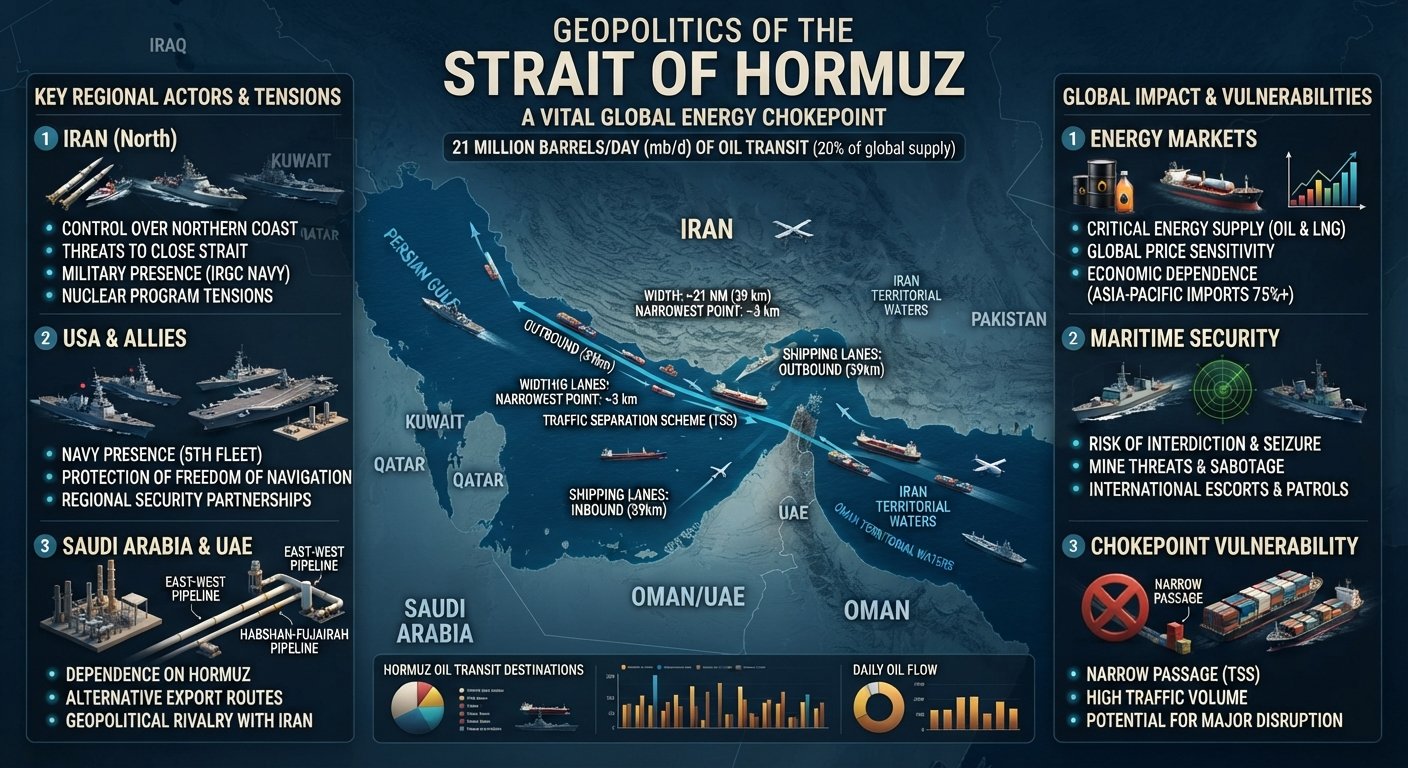
The Middle East remains important because of energy resources, maritime chokepoints, strategic geography, regional rivalries and external-power involvement.
Countries such as Saudi Arabia, Iran, Türkiye, Israel and the Gulf states possess different forms of regional influence and increasingly pursue diversified international partnerships.
Global South
The growing diplomatic importance of Asia, Africa, Latin America and the Middle East is another major feature of the changing balance.
Many developing countries seek greater strategic autonomy rather than alignment with either Washington or Beijing.
Their influence can be seen in international organizations, trade negotiations, energy markets, infrastructure projects and diplomatic coalitions.
The Role of International Organizations and International Law
The Global Balance of Power operates within a formal international system.
The United Nations Charter establishes sovereign equality among members and requires states to settle disputes peacefully while prohibiting the threat or use of force against the territorial integrity or political independence of states, subject to the Charter’s recognized exceptions. (United Nations Office of Legal Affairs)
The UN therefore represents an important institutional constraint on raw power.
However, institutions do not eliminate power politics. The UN Security Council itself reflects the post-1945 distribution of major-power influence through its five permanent members.
Other institutions contribute to different dimensions of global governance:
- NATO — collective defense
- European Union — economic and regulatory power
- WTO — international trade rules
- IMF — monetary and financial stability
- World Bank — development finance
- G20 — major economic coordination
- Regional organizations — regional security, trade and diplomacy
The tension between formal equality under international law and unequal material power is one of the defining characteristics of international relations.
What Are the Main Risks of a Changing Power Balance?
A changing balance does not automatically lead to war. But periods of rapid power transition can create serious risks.
Security Dilemmas
When one country strengthens its military for defensive purposes, rivals may interpret the same actions as preparation for aggression.
This can produce arms races even when neither side initially seeks war.
Miscalculation
The greater the number of powerful actors, the more difficult strategic signaling becomes.
Misreading another country’s intentions can create escalation during crises.
Economic Fragmentation
Trade restrictions, technology controls and competing supply chains can reduce economic efficiency.
Businesses may face higher costs and greater uncertainty as governments prioritize resilience and national security.
Alliance Uncertainty
If countries become uncertain about the reliability of security commitments, they may increase their own military capabilities or pursue alternative partnerships.
Nuclear Risks
The continued existence of large nuclear arsenals means that great-power competition has consequences far beyond conventional military calculations.
Nuclear deterrence can discourage direct war, but crises involving nuclear-armed states remain exceptionally dangerous.
What Could the Global Balance of Power Look Like in the Future?
The future is uncertain, but several scenarios are plausible.
Scenario 1: Competitive Multipolarity
The world develops several major centers of power without one becoming overwhelmingly dominant.
The United States remains the leading overall power, China remains its principal competitor, India rises, Europe acts more strategically, and regional powers retain substantial autonomy.
This is arguably the most plausible medium-term scenario.
Scenario 2: Renewed Bipolar Competition
The United States and China could become so dominant relative to other states that the international system increasingly resembles a new bipolar structure.
Other countries would retain autonomy but face stronger pressure to align with one of the two major powers.
Scenario 3: Fragmented Regional Orders
Instead of two or three dominant poles, several regional systems could emerge.
The Indo-Pacific, Europe, Middle East, Africa and the Americas could develop increasingly distinct security and economic arrangements.
This would create a more fragmented global system rather than a coherent multipolar order.
Scenario 4: Managed Competition
The major powers could compete intensely while maintaining cooperation on issues where their interests overlap, such as climate change, financial stability, pandemics, nuclear risk and global trade.
This would not eliminate rivalry. Instead, it would create mechanisms to prevent competition from becoming uncontrolled confrontation.
How Should Businesses and Policymakers Read the New Power Balance?
The changing system has practical consequences beyond diplomacy and military affairs.
Businesses increasingly need to assess:
- Geopolitical supply-chain exposure
- Sanctions risk
- Technology restrictions
- Energy security
- Political instability
- Market access
- Currency exposure
- Critical-mineral dependencies
- Cybersecurity
- Regulatory fragmentation
Policymakers similarly need to think beyond traditional military alliances.
A state’s resilience may depend on its ability to secure energy, technology, food, finance, infrastructure and information systems.
The most influential countries of the future may therefore be those capable of combining economic resilience, technological innovation, military credibility, diplomatic flexibility and institutional strength.
Frequently Asked Questions About the Global Balance of Power
What does the Global Balance of Power mean?
The Global Balance of Power refers to the distribution of political, economic, military, technological and diplomatic capabilities among major international actors.
Is the world currently unipolar or multipolar?
The international system is increasingly multipolar, but the classification is debated. The United States remains the most comprehensive global power, while China and several other major and regional powers possess substantial independent capabilities.
Which countries are the major global powers?
The United States and China are generally the two most consequential global powers. Russia, India, the European Union and other major states also possess significant forms of international influence.
Why is China important to the Global Balance of Power?
China combines a large economy, industrial capacity, military modernization, technological development, extensive trade relationships and growing diplomatic influence.
Is military power the most important measure of global power?
No. Military strength is important, but economic capacity, technology, finance, diplomacy, geography, population, alliances and soft power also determine a country’s ability to influence international affairs.
What role does India play in the emerging world order?
India is becoming an increasingly important economic, military, technological and diplomatic power. Its strategy of maintaining relationships with multiple major powers gives it considerable strategic flexibility.
How does technology affect the balance of power?
Technology affects military capabilities, economic competitiveness, communications, intelligence, industrial production and critical infrastructure. Leadership in areas such as AI and semiconductors can therefore generate significant geopolitical leverage.
Does multipolarity make the world more dangerous?
Not necessarily. Multipolarity can create opportunities for cooperation and greater strategic autonomy. However, more actors and overlapping alliances can also increase uncertainty, miscalculation and competition.
Will the US lose its position as the world’s leading power?
A relative decline in some areas does not necessarily mean the end of American primacy. The United States continues to possess substantial economic, military, technological, financial and alliance advantages. The more likely question is whether those advantages remain sufficient to preserve broad strategic leadership in a more competitive system.
Conclusion
The Global Balance of Power is undergoing a structural transformation. The post-Cold War period of overwhelming American predominance has given way to a more complicated environment in which China has become a formidable competitor, India is gaining strategic weight, Europe retains substantial economic influence, Russia remains a major military and nuclear power, and regional states increasingly exercise independent geopolitical choices.
The emerging order should not be understood simply as a contest in which one country replaces another at the top. Power is now distributed across several dimensions. The United States retains exceptional strengths in military reach, finance, technology and alliances. China combines economic scale, manufacturing capacity and growing technological and military capabilities. Other powers can exert disproportionate influence through geography, energy, resources, markets, diplomacy or regional partnerships.
The central feature of the coming era is therefore likely to be competitive multipolarity: several centers of power competing, cooperating and balancing one another simultaneously.
Understanding that complexity is essential for students, diplomats, policymakers, investors, journalists and business leaders. The future international system will be shaped not only by who possesses the most power, but by how effectively states convert different forms of power into influence—and how successfully they manage competition without allowing it to become conflict.