Introduction
Geoeconomics explains how countries use economic power to achieve geopolitical objectives—and how international competition, security concerns, and strategic rivalry increasingly shape economic relationships. Trade, investment, finance, technology, energy, sanctions, supply chains, infrastructure, and access to critical resources are no longer purely economic matters. They can also become instruments of national power.
The concept has gained renewed importance as governments increasingly connect economic policy with national security. The International Monetary Fund noted in 2026 that the boundary between economic policy and national security is becoming increasingly blurred, with tariffs, sanctions, export controls, industrial policy, and financial measures playing larger strategic roles.
For businesses, policymakers, and governments, this transformation creates both opportunities and risks. Economic interdependence can generate prosperity and cooperation, but asymmetric dependencies can also create leverage.
This article explains what geoeconomics means, how it developed, the major tools of economic statecraft, how countries build geoeconomic power, and why geoeconomic competition is reshaping global trade, technology, investment, energy, and international relations.
What Is Geoeconomics?
Geoeconomics is the study and practice of using economic relationships, resources, institutions, and policies to pursue geopolitical and strategic objectives.
There is no single universally accepted definition. Chatham House describes geoeconomics broadly as the interaction between international economics, geopolitics, and strategy, while a more policy-oriented definition emphasizes using economic instruments to advance geopolitical objectives.
In practical terms, geoeconomics asks questions such as:
- Who controls critical resources?
- Which country dominates a strategic supply chain?
- Who has leverage over financial systems?
- Can trade dependencies be converted into political influence?
- How can sanctions change another government’s behavior?
- Which technologies are strategically important?
- How does infrastructure investment create long-term influence?
- What happens when economic efficiency conflicts with national security?
The central idea is simple: economic power can become political power when countries possess important assets, markets, technologies, financial networks, or resources that others depend upon.
Geoeconomics vs. Geopolitics
Geopolitics traditionally emphasizes how geography, territory, military capabilities, strategic location, and political power influence international relations.
Geoeconomics focuses more heavily on the economic dimensions of that competition.
The two increasingly overlap.
For example, a strategically located port can have geopolitical importance because of its location. But ownership, financing, trade flows, infrastructure contracts, and control of associated logistics can create additional geoeconomic influence.
Similarly, an energy-producing state can use resource exports for economic revenue while also gaining diplomatic leverage from the dependence of importing countries.
Geoeconomics vs. Economics
Ordinary economics generally examines how individuals, firms, and governments allocate scarce resources.
Geoeconomics adds a strategic question:
How can economic relationships affect national power and international political outcomes?
A government may therefore accept a higher economic cost if it believes doing so improves national security, protects a strategic industry, reduces dependence on a rival, or increases geopolitical leverage.
The Historical Development of Geoeconomics
Geoeconomics is not entirely a new phenomenon. Governments have used trade, finance, resources, infrastructure, and economic restrictions as instruments of power for centuries.
The academic foundations of modern geoeconomic thinking can be traced particularly to economist Albert O. Hirschman’s 1945 work National Power and the Structure of Foreign Trade. Hirschman demonstrated that international trade can create political leverage when economic relationships are unequal or asymmetric.
The term itself became more prominent after Edward Luttwak’s 1990 argument that economic competition was becoming increasingly important in international affairs following the Cold War.
From Military Competition to Economic Competition
During the Cold War, military power dominated strategic thinking, although economic tools were also important.
The United States and its allies used export controls and other restrictions to limit the Soviet bloc’s access to strategically important technologies. The Coordinating Committee for Multilateral Export Controls, or COCOM, was established in 1949 to coordinate Western export restrictions during the Cold War.
After the Cold War, globalization encouraged a different model.
Trade liberalization, foreign investment, multinational production, and global supply chains created deeper economic interdependence. For several decades, many policymakers assumed that greater economic integration would reduce the importance of traditional geopolitical rivalry.
That assumption has weakened.
The Return of Economic Statecraft
The financial crisis, the COVID-19 pandemic, supply-chain disruptions, rising strategic competition, and major geopolitical conflicts have all encouraged governments to reconsider the relationship between economic efficiency and national security.
The result is a renewed emphasis on economic statecraft.
Governments increasingly ask not only whether an economic policy produces growth, but also whether it creates strategic vulnerability or strengthens national resilience.
How Does Geoeconomics Work?
Geoeconomic power generally emerges from economic asymmetry.
Two countries may trade extensively with one another, but the relationship does not have to provide equal strategic leverage.
If one country can easily replace a supplier while the other cannot replace its trading partner, the relationship is asymmetric.
That asymmetry can create bargaining power.
Economic Interdependence
Interdependence can produce cooperation because countries benefit from stable economic relationships.
However, dependence can also create vulnerability.
A country heavily dependent on another state for energy, critical minerals, advanced technology, financial services, food, or industrial components may face significant costs if that relationship is disrupted.
The IMF’s 2026 research highlights the importance of critical dependencies and economic networks in determining geoeconomic power.
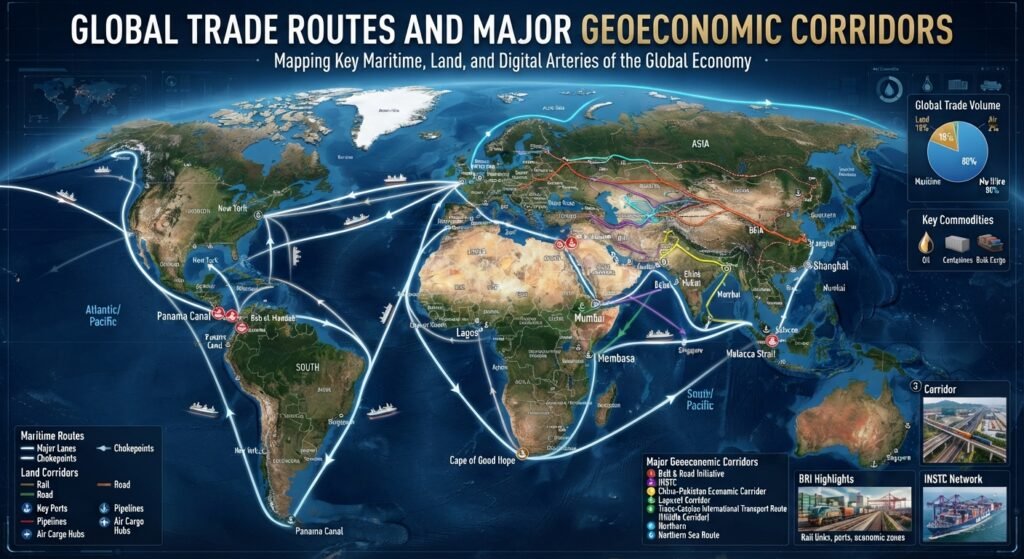
Chokepoints and Strategic Dependencies
A chokepoint is a strategically important point in an economic network where control can create disproportionate leverage.
Examples can include:
- Financial payment systems
- Major ports
- Semiconductor technologies
- Critical minerals
- Energy pipelines
- Maritime shipping routes
- Telecommunications infrastructure
- Advanced computing technologies
- Specialized industrial machinery
The strategic importance of a chokepoint increases when alternatives are expensive, scarce, or difficult to develop.
Network Power
Modern economies are interconnected through complex networks.
A country can gain influence not simply because it produces a large quantity of goods, but because it occupies an important position within global economic networks.
Financial centers, technology platforms, payment systems, logistics hubs, and advanced manufacturing ecosystems can therefore create forms of power that are difficult to measure using traditional indicators such as GDP alone.
Major Tools of Geoeconomics
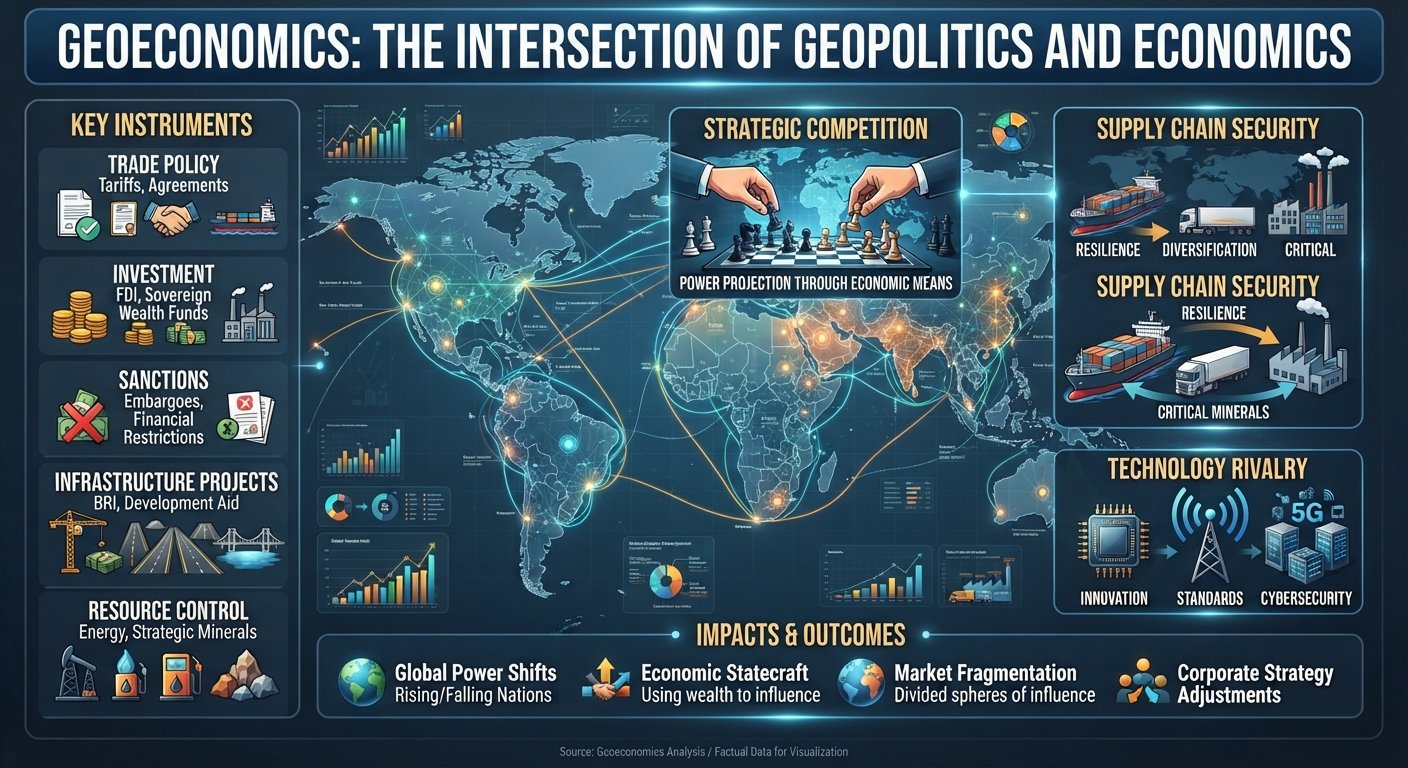
Geoeconomic competition uses a wide range of instruments. Some encourage cooperation, while others impose costs or restrict access.
Trade Policy and Tariffs
Trade policy is one of the most visible instruments of geoeconomic power.
Governments can use:
- Tariffs
- Import quotas
- Export restrictions
- Trade agreements
- Preferential trade arrangements
- Local-content requirements
- Anti-dumping measures
- Trade barriers
Tariffs can protect domestic industries, generate government revenue, or create bargaining leverage.
However, tariffs can also increase prices, disrupt supply chains, provoke retaliation, and reduce economic efficiency.
The World Trade Organization reported that world trade in goods and commercial services reached about $34.89 trillion in 2025, demonstrating the enormous scale of the economic system within which these strategic disputes occur.
Financial Sanctions
Financial sanctions attempt to restrict access to money, banking systems, assets, or international financial networks.
They can include:
- Asset freezes
- Banking restrictions
- Restrictions on financial transactions
- Restrictions on access to international financial markets
- Sovereign asset measures
- Restrictions involving specific financial institutions
Financial sanctions are particularly powerful when the sanctioning state or coalition controls an important part of the financial infrastructure used by the target.
The IMF notes that sanctions and other coercive economic policies can pursue geopolitical objectives without directly using military force, although they also impose costs and involve significant trade-offs.
Export Controls
Export controls restrict the transfer of selected goods, technologies, software, or equipment to particular destinations or users.
They have become especially important in strategic technologies such as:
- Advanced semiconductors
- Artificial intelligence hardware
- Semiconductor manufacturing equipment
- Aerospace technologies
- Cybersecurity technologies
- Advanced computing systems
- Dual-use technologies
Export controls demonstrate how technological capabilities can become instruments of geopolitical competition.
Their effectiveness depends partly on whether alternative suppliers exist and whether restrictions can be coordinated among multiple countries.
Investment Screening
Foreign investment can create jobs and economic growth, but governments may become concerned when foreign ownership involves strategic infrastructure or sensitive technologies.
Investment screening can therefore target areas such as:
- Semiconductors
- Telecommunications
- Artificial intelligence
- Critical minerals
- Energy infrastructure
- Defense-related industries
- Digital infrastructure
- Advanced manufacturing
UN Trade and Development reported in 2026 that national-security investment screening has expanded significantly, with strategic sectors attracting a growing share of greenfield investment.
Industrial Policy
Industrial policy seeks to strengthen domestic production in strategically important industries.
Governments may provide:
- Subsidies
- Tax incentives
- Public financing
- Research support
- Procurement preferences
- Infrastructure
- Workforce development
The objective may be economic competitiveness, employment, technological leadership, resilience, or national security.
Industrial policy becomes geoeconomic when governments deliberately use these measures to strengthen their strategic position relative to other countries.
Energy as a Geoeconomic Instrument
Energy has long been closely connected to geopolitics.
Oil, natural gas, electricity infrastructure, pipelines, liquefied natural gas facilities, nuclear technology, and renewable-energy supply chains can all have strategic significance.
Energy dependence can influence foreign policy because states must consider the consequences of supply disruptions.
Energy exporters may gain additional diplomatic influence, while import-dependent countries often seek diversification to reduce vulnerability.
The broader geoeconomic lesson is that energy security is simultaneously an economic and strategic issue.
Critical Minerals and Natural Resources
Critical minerals have become increasingly important because modern economies depend on them for technologies such as batteries, electric vehicles, renewable-energy systems, electronics, and defense equipment.
Countries therefore increasingly seek:
- Domestic mineral production
- Strategic reserves
- Recycling capacity
- Alternative suppliers
- Processing capabilities
- Long-term supply agreements
Control over mining is only one dimension of the problem. Processing and refining can be equally important.
This creates competition over the entire value chain rather than simply over physical resources.
Infrastructure and Connectivity
Infrastructure can also generate geoeconomic influence.
Ports, railways, roads, pipelines, power grids, telecommunications networks, data centers, and logistics corridors can connect economies while simultaneously creating long-term strategic relationships.
Infrastructure finance may therefore have economic, diplomatic, and strategic consequences.
China’s Belt and Road Initiative is one prominent example of how infrastructure, trade, finance, and foreign policy can intersect. The IMF’s 2026 analysis describes how bundled economic relationships can potentially increase geoeconomic leverage.
Technology and the New Geoeconomic Competition
Technology is becoming one of the most important dimensions of modern geoeconomics.
Advanced technologies can generate both commercial advantages and military capabilities.
Semiconductors
Semiconductors are particularly strategic because they underpin:
- Artificial intelligence
- Smartphones
- Data centers
- Automobiles
- Telecommunications
- Advanced weapons systems
- Industrial automation
This makes semiconductor supply chains a major focus of national security and industrial policy.
Artificial Intelligence
AI has economic and strategic significance because it can influence productivity, military capabilities, intelligence analysis, cybersecurity, scientific research, and industrial competitiveness.
Competition over AI therefore extends beyond technology companies.
It increasingly involves governments, universities, semiconductor producers, cloud infrastructure, energy systems, and capital markets.
Digital Infrastructure
Data centers, cloud computing, telecommunications networks, undersea cables, satellites, and digital payment systems are becoming part of strategic infrastructure.
As economies become more digital, control over these systems can create new forms of economic and geopolitical influence.
Geoeconomics and Global Trade Fragmentation
One of the most important consequences of rising geoeconomic competition is the possibility of economic fragmentation.
Instead of one deeply integrated global market, the world could develop overlapping economic blocs.
Countries may increasingly trade, invest, and cooperate with partners considered politically or strategically reliable.
However, complete fragmentation has not occurred.
The WTO reported in 2026 that approximately 72% of global merchandise trade was still conducted under most-favoured-nation terms, showing that multilateral trade remains highly significant despite growing geopolitical tensions.
Friend-Shoring and Supply-Chain Diversification
Companies and governments increasingly consider political reliability when choosing suppliers.
This has encouraged concepts such as:
- Friend-shoring
- Near-shoring
- Supply-chain diversification
- Strategic stockpiling
- Reshoring
- Dual sourcing
The objective is not necessarily to eliminate globalization.
Instead, governments may seek to reduce excessive dependence on a single country or supplier.
The Cost of Fragmentation
Geoeconomic fragmentation can improve resilience in some circumstances, but excessive fragmentation can reduce efficiency.
The WTO’s 2026 analysis estimates that a scenario involving deep geopolitical fragmentation of the multilateral trading system could reduce global GDP by approximately 5.1%, while a more severe scenario replacing the WTO system with a fragmented free-trade-agreement structure could produce larger losses. These are modeled scenarios rather than forecasts and should therefore be interpreted as estimates of potential costs under specified assumptions.
The central policy challenge is finding a balance between efficiency, resilience, security, and openness.
Geoeconomics and Foreign Direct Investment
Investment is another major channel through which economic power and geopolitics interact.
Countries compete to attract investment while simultaneously becoming more cautious about foreign ownership in strategic sectors.
UN Trade and Development reported that global FDI rose by 6% to approximately $1.6 trillion in 2025, but the recovery was highly concentrated. The world’s top 20 host economies attracted more than 80% of global FDI, while strategic sectors accounted for 44% of global greenfield project values.
This demonstrates an important shift.
Investment decisions increasingly reflect not only market size and labor costs, but also:
- Political stability
- National security
- Supply-chain resilience
- Technology access
- Regulatory conditions
- Strategic alliances
- Geopolitical risk
Why Geoeconomics Matters for Developing Countries
Geoeconomic competition creates both opportunities and vulnerabilities for developing economies.
Countries located between major powers may benefit from:
- Trade diversion
- New manufacturing investment
- Infrastructure investment
- Technology partnerships
- Expanded export markets
- Supply-chain diversification
However, they can also face pressure to align with competing geopolitical blocs.
The Challenge for Middle Powers
Middle powers often try to avoid excessive dependence on any single great power.
Their strategies may include:
- Diversifying trade partners
- Maintaining multiple diplomatic relationships
- Developing domestic industrial capacity
- Building regional economic partnerships
- Attracting investment from multiple sources
- Protecting strategic sectors
- Maintaining policy flexibility
This approach can be described as strategic diversification rather than strict alignment.
The Role of International Organizations
International institutions remain important even as geopolitical rivalry increases.
World Trade Organization
The WTO provides rules governing international trade and gives countries a framework for negotiations and dispute management.
Its importance becomes especially visible when major economies disagree.
The WTO’s 2026 assessment emphasizes that multilateral trade rules continue to provide a legal and institutional foundation for international commerce.
International Monetary Fund
The IMF plays an important role in global financial stability and has increasingly analyzed geoeconomic fragmentation, sanctions, capital flows, and the relationship between economic policy and national security.
World Bank and Regional Institutions
The World Bank and regional development institutions can influence infrastructure, development finance, connectivity, and investment.
These institutions can therefore affect the economic foundations on which countries build long-term strategic capacity.
What Are the Main Risks of Geoeconomic Competition?
Geoeconomics can provide governments with powerful tools, but those tools involve costs.
Economic Inefficiency
Tariffs, export restrictions, and investment barriers can move production away from its most efficient location.
Retaliation
One country’s economic restrictions can trigger countermeasures.
This can produce escalating trade disputes.
Supply-Chain Disruption
Rapid economic decoupling can create shortages and increase costs.
Political Fragmentation
Economic rivalry can reinforce political divisions and weaken international cooperation.
Higher Costs for Businesses
Companies may face additional expenses from compliance requirements, duplicated supply chains, tariffs, investment restrictions, and regulatory uncertainty.
Risks for Developing Economies
Countries with limited fiscal and institutional capacity may struggle to navigate competing demands from larger powers.
The IMF emphasizes that geoeconomic coercion can generate strategic benefits but also impose costs on the countries using it, including reduced efficiency, disrupted commercial relationships, and possible long-term reputational effects.
How Should Countries Respond to Geoeconomic Competition?
There is no universal strategy, but several principles can improve resilience.
Diversify Critical Dependencies
Countries should avoid excessive reliance on a single supplier for strategically important goods where alternatives are realistically available.
Strengthen Domestic Capabilities
Developing domestic capacity in critical technologies, infrastructure, energy, and strategic industries can reduce vulnerability.
Maintain Multiple Economic Partnerships
Diversification can prevent excessive dependence on one market or geopolitical bloc.
Preserve International Cooperation
Economic security does not necessarily require economic isolation.
Countries can strengthen resilience while maintaining international trade and investment relationships.
Use Economic Power Carefully
Economic coercion may achieve short-term strategic objectives but produce long-term costs.
Effective geoeconomic strategy therefore requires evaluating both the immediate geopolitical benefit and the broader economic consequences.
What Does the Future of Geoeconomics Look Like?
The future is unlikely to involve a complete return either to unrestricted globalization or to total economic isolation.
A more plausible outcome is a selectively integrated global economy in which countries continue trading extensively while treating certain technologies, resources, financial systems, and infrastructure as strategically sensitive.
Several trends are likely to remain important:
- Greater competition over advanced technologies
- Stronger supply-chain resilience strategies
- Increased investment screening
- Competition over critical minerals
- Greater use of industrial policy
- Strategic competition over digital infrastructure
- Continued importance of sanctions
- More attention to economic security
- Expansion of regional trade arrangements
- Greater efforts to diversify financial and payment networks
The IMF’s 2026 research describes this period as one in which economic policy and national security are increasingly intertwined.
The key uncertainty is whether this process produces manageable strategic competition or deeper economic fragmentation.
Frequently Asked Questions About Geoeconomics
What is geoeconomics in simple terms?
Geoeconomics is the use of economic power and economic relationships to achieve geopolitical or strategic objectives. It includes tools such as trade policy, sanctions, investment, finance, technology controls, and infrastructure.
What is the difference between geopolitics and geoeconomics?
Geopolitics focuses broadly on power, geography, security, territory, and international competition. Geoeconomics concentrates on how economic instruments and dependencies influence geopolitical outcomes.
What are examples of geoeconomics?
Examples include economic sanctions, tariffs, export controls, investment screening, strategic infrastructure investment, technology restrictions, energy diplomacy, and competition over critical minerals.
Why is geoeconomics becoming more important?
Economic and national-security policies are increasingly connected. Supply-chain disruptions, technological competition, sanctions, trade disputes, and strategic rivalry have made economic dependencies more politically significant.
How do sanctions work as a geoeconomic tool?
Sanctions attempt to impose economic or financial costs on a government, organization, company, or individual to influence behavior without directly using military force. Their effectiveness depends on factors including enforcement, international cooperation, economic alternatives, and the resilience of the target.
Why are semiconductors important in geoeconomics?
Semiconductors are fundamental to modern digital economies and many advanced military systems. Their strategic importance makes semiconductor manufacturing, equipment, design, and supply chains central to technology competition.
Can geoeconomics benefit countries?
Yes. Economic statecraft can protect strategic industries, strengthen resilience, attract investment, improve bargaining power, and support national security. However, excessive restrictions can also create significant economic costs.
What is geoeconomic fragmentation?
Geoeconomic fragmentation occurs when economic relationships become increasingly organized around geopolitical blocs or strategic alignments rather than global economic integration alone.
Why does geoeconomics matter to businesses?
Businesses increasingly face geopolitical risks involving tariffs, sanctions, export controls, investment restrictions, supply-chain disruptions, technology rules, and political instability. Understanding geoeconomics can therefore improve strategic planning and risk management.
Conclusion
Geoeconomics has become one of the most important ways to understand the changing relationship between economics and international power.
Trade is no longer only about commercial exchange. Investment can influence strategic relationships. Technology can become a national-security asset. Financial infrastructure can create leverage. Energy and critical minerals can affect diplomatic calculations. Supply chains can become strategic vulnerabilities.
The central lesson is that economic interdependence creates both opportunity and power. Countries benefit from open markets and international cooperation, but they also recognize that dependence can become a source of vulnerability when geopolitical relationships deteriorate.
The challenge for governments is therefore not simply to choose between globalization and isolation. It is to determine where economic openness remains beneficial, where strategic resilience is necessary, and how economic power can be exercised without creating unnecessary fragmentation.
As competition among major powers continues, understanding geoeconomics will be essential for policymakers, businesses, diplomats, researchers, and anyone seeking to understand how global power is changing.