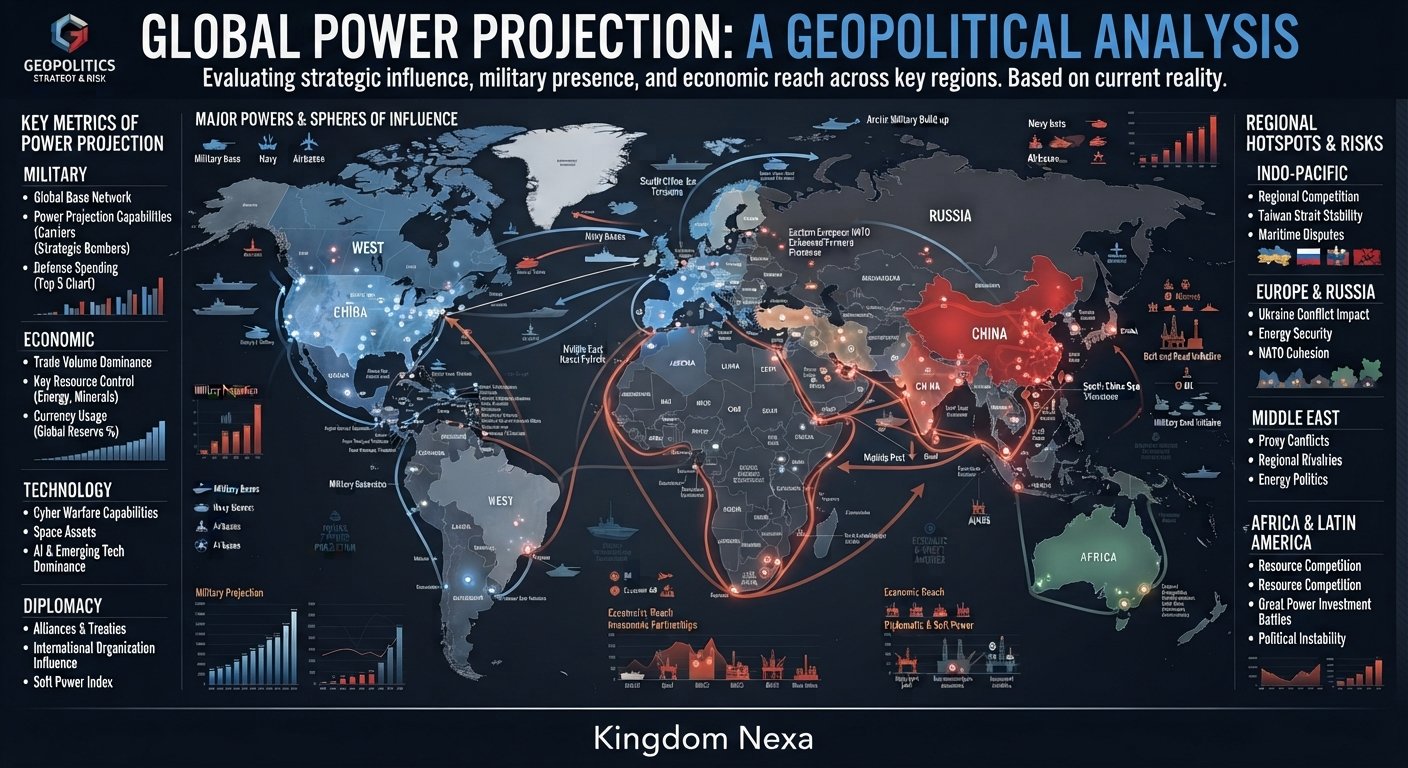
Power Projection is the ability of a state to extend its military, economic, diplomatic, technological, or political influence beyond its own territory and sustain that influence at meaningful distance. In traditional military terminology, it refers especially to the capacity to deploy and support armed forces away from home. In contemporary geopolitics, however, power projection increasingly involves satellites, cyber capabilities, economic statecraft, alliances, logistics networks, information systems, and technological advantages alongside conventional military forces.
The concept matters because geography still imposes limits on national power. A country may possess substantial military resources but struggle to use them effectively far from its territory if it lacks transportation, overseas access, logistics, intelligence, communications, political partnerships, or economic resilience.
As of 2026, renewed military investment, strategic competition, contested maritime routes, space capabilities, technological competition, and economic fragmentation are reshaping how states project influence. Global military expenditure reached an estimated $2.887 trillion in 2025, according to SIPRI, with the United States, China, Russia, European states, and several Asian powers accounting for much of the world’s military capability. (SIPRI)

This article explains what Power Projection means, how it developed historically, its major instruments, why geography and logistics matter, how leading powers approach it, and how technology and economic statecraft are changing the concept.
What Is Power Projection?
Power Projection is the capability to move, sustain, and employ national power beyond a state’s immediate territory to influence events, deter threats, protect interests, or achieve strategic objectives.
In military studies, the term normally emphasizes the ability to deploy armed forces at distance. A broader geopolitical interpretation includes the supporting political, economic, technological, diplomatic, and informational capabilities that make distant influence possible.
A useful way to understand the concept is:
Power projection = capability + reach + access + sustainment + political purpose.
Having advanced weapons is therefore not enough. A state needs the ability to transport personnel and equipment, maintain supply chains, communicate securely, obtain intelligence, operate from suitable locations, and sustain the effort over time.
This distinction explains why military size and power-projection capability are not identical.
Power Projection vs. National Power
National power is the broader concept. It encompasses military strength, economic capacity, technology, population, institutions, diplomacy, geography, political cohesion, and other sources of influence.
Power projection concerns the ability to translate those resources into effects beyond national borders.
For example, a large economy may provide a government with financial resources, but those resources become a projection capability only when they can support overseas investment, diplomatic leverage, sanctions, development finance, infrastructure partnerships, or military operations.
Hard Power and Broader Influence
Military power remains one of the most visible forms of projection, but modern states can project influence without deploying combat forces.
Important instruments include:
- Armed forces and long-range weapons
- Naval and air forces
- Overseas bases and logistics facilities
- Strategic airlift and sealift
- Alliances and security partnerships
- Economic sanctions and trade policy
- Foreign investment and infrastructure
- Diplomatic networks
- Cyber capabilities
- Space-based communications and surveillance
- Technology and industrial capacity
- Information and public diplomacy
These instruments often work together rather than independently.
How Power Projection Developed Historically
Power projection is not a new phenomenon. Maritime empires, trading states, and imperial powers historically developed mechanisms for influencing distant territories.
Maritime Empires and Sea Power
Before modern aircraft and satellites, naval power provided the principal means of sustained long-distance military reach.
Control of sea routes allowed states to transport troops, protect commerce, establish overseas settlements, and maintain distant military positions. Ports became strategic assets because fleets needed replenishment, maintenance, intelligence, and secure access.
The historical importance of naval power later became a major subject of strategic thought, particularly in debates about sea control, maritime commerce, and overseas bases.
The Industrial Revolution
Industrialization transformed power projection.
Railways accelerated mobilization on land, while steam-powered ships increased the predictability and speed of maritime movement. Industrial production allowed states to manufacture weapons and supplies on a scale that earlier governments could not sustain.
The telegraph also reduced the communications barrier between governments and distant forces.
World Wars and Strategic Air Power
The two World Wars expanded power projection into the air.
Aircraft allowed states to strike targets far beyond conventional artillery range. Strategic bombing, long-range naval aviation, amphibious operations, and large-scale logistics demonstrated that modern warfare depended on the ability to coordinate forces across enormous distances.
The Second World War also highlighted the importance of industrial capacity and transportation networks.
The Cold War
The Cold War transformed power projection into a global strategic system.
The United States and Soviet Union developed nuclear forces, long-range bombers, ballistic missiles, submarine fleets, overseas military facilities, intelligence networks, and alliance structures.
The development of intercontinental ballistic missiles meant that some forms of strategic power no longer depended on physically occupying or traversing distant territory.
At the same time, conventional forces continued to depend heavily on bases, ports, airfields, transportation, and logistics.
The Post-Cold War Period
After the Cold War, expeditionary warfare became an important feature of several major military operations.
The United States demonstrated extensive global reach through carrier strike groups, air forces, overseas installations, strategic transportation, satellite networks, and allied access.
At the same time, other states increasingly invested in long-range missiles, submarines, air forces, cyber capabilities, and overseas logistics.
The result was a shift from a relatively simple concept of “sending forces abroad” toward a more complex network of capabilities.
What Are the Main Components of Power Projection?
Modern Power Projection depends on several mutually reinforcing capabilities.
Military Forces
Conventional military forces remain central.
These include:
- Aircraft carriers
- Surface combatants
- Submarines
- Long-range aircraft
- Air-refueling tankers
- Transport aircraft
- Amphibious forces
- Long-range missiles
- Special operations forces
- Ground forces
- Air and missile defenses
The U.S. Navy, for example, describes aircraft carriers as central to operating forward and conducting sustained power-projection operations for U.S. and coalition forces. (U.S. Navy)
Strategic Mobility
A force cannot project power if it cannot reach the theater.
Strategic mobility includes:
- Airlift
- Sealift
- Military transport aircraft
- Cargo ships
- Pre-positioned equipment
- Fuel supplies
- Maintenance infrastructure
- Port facilities
- Air bases
Mobility is particularly important for states attempting to respond to crises far from home.
Logistics and Sustainment
Logistics is often less visible than weapons but can determine whether power projection is sustainable.
A distant force requires fuel, ammunition, spare parts, food, medical support, maintenance, personnel rotation, communications, and transportation.
This creates the logistical distance problem: the farther forces operate from their home infrastructure, the more complicated and vulnerable their supply network becomes.
China’s expanding overseas logistics ambitions illustrate this issue. The U.S. Department of Defense’s 2025 assessment says Beijing seeks a global logistics and basing network capable of allowing the People’s Liberation Army to project and sustain military power at greater distances. It identifies China’s Djibouti support base as an established overseas facility and describes different possible forms of overseas access. (Defense Media)
Overseas Bases and Access
Permanent bases are only one form of strategic access.
States may instead rely on:
- Host-nation military facilities
- Rotational deployments
- Port visits
- Airfield access
- Logistics agreements
- Pre-positioned stocks
- Commercial infrastructure
- Temporary arrangements
This can reduce the political and financial costs of maintaining large permanent installations.
Alliances and Partnerships
Alliances can multiply power projection.
A state with access to allied airfields, ports, intelligence, communications networks, and logistical facilities can operate farther and for longer than it could from its homeland alone.
NATO’s strategic approach illustrates the importance of collective capabilities. Its 2022 Strategic Concept identifies deterrence and defence, crisis prevention and management, and cooperative security as its three core tasks. (NATO)
Why Geography Matters
Power projection is fundamentally geographical.
Distance, terrain, oceans, chokepoints, infrastructure, climate, and political borders all affect how effectively a state can operate.
Maritime Geography
Sea lanes connect major economic centers and military theaters.
Important maritime chokepoints can influence both commercial and military movement. A navy capable of operating globally still depends on access to ports, replenishment, repair facilities, and secure communications.
Strategic Chokepoints
Places such as major canals, narrow straits, and important maritime passages can become strategically significant because disruptions can increase transportation distances and costs.
This is one reason maritime security has consequences well beyond naval warfare.
Geography and Anti-Access Strategies
Distance can also protect a state.
Modern missiles, submarines, aircraft, mines, drones, and surveillance systems can make approaches to a defended region more dangerous.
China’s growing missile capabilities are one example of this broader trend. The Center for Strategic and International Studies assesses that China’s expanding missile arsenal contributes to anti-access/area-denial capabilities designed to threaten military assets operating in the Asia-Pacific region. (Missile Threat)
This creates a central strategic problem:
The ability to project power is increasingly dependent on surviving sophisticated defenses before forces can reach their intended operating area.
Power Projection Through Technology
Technology is changing both the reach and vulnerability of national power.
Air Power and Long-Range Weapons
Long-range aircraft, cruise missiles, ballistic missiles, and increasingly sophisticated unmanned systems allow states to generate effects without moving large conventional armies deep into another country.
This can reduce some logistical requirements, although long-range systems still require intelligence, targeting, command networks, maintenance, and resupply.
Space Capabilities
Space has become an essential enabler of modern power projection.
Satellites support:
- Navigation
- Secure communications
- Missile warning
- Weather forecasting
- Intelligence, surveillance and reconnaissance
- Positioning and timing
- Command and control
The U.S. Space Force describes satellite capabilities as force multipliers providing global coverage, secure communications, navigation, weather information, and threat warning. (Space Force)
NATO likewise recognizes space as an operational domain and identifies satellite communications, navigation, intelligence, missile warning, and related capabilities as important to deterrence and defence. (NATO)
Cyber Capabilities
Cyber operations introduce another dimension.
A state may attempt to influence or disrupt another state’s military networks, critical infrastructure, communications, financial systems, or information environment without physically deploying conventional forces.
At the same time, attribution difficulties and the interconnected nature of cyberspace complicate deterrence and escalation management.
Artificial Intelligence and Autonomous Systems
Artificial intelligence can improve:
- Intelligence analysis
- Target recognition
- Logistics
- Decision support
- Autonomous systems
- Cyber defense
- Surveillance
- Predictive maintenance
But AI does not eliminate traditional constraints. Algorithms still depend on reliable data, computing infrastructure, communications, human decision-making, and resilient supply chains.
Economic Power as a Projection Tool
Military power is only one part of modern geopolitical competition.
Economic statecraft can extend national influence through:
- Sanctions
- Export controls
- Investment
- Development finance
- Trade agreements
- Infrastructure
- Energy relationships
- Currency and financial systems
- Supply-chain dependencies
The IMF’s 2026 discussion of economic statecraft notes that governments are increasingly using tools such as trade policy, investment screening, sanctions, and industrial strategy to pursue national interests. (IMF eLibrary)
This has consequences beyond the immediate target. The IMF has also warned that geoeconomic fragmentation can affect trade, financial flows, technology diffusion, and global value chains. (IMF eLibrary)
Economic projection therefore does not necessarily mean coercion. Investment, market access, infrastructure finance, and commercial relationships can also create political influence.
Diplomatic and Political Dimensions
Power projection becomes more effective when military capabilities are supported by diplomatic relationships.
Diplomacy can secure:
- Basing rights
- Overflight permissions
- Port access
- Intelligence cooperation
- Defense agreements
- Coalition participation
- Crisis-management mechanisms
Political legitimacy can also affect the willingness of partners to cooperate.
A technologically sophisticated military may therefore have limited practical reach if surrounding states refuse access.
International Law and Power Projection
Power projection exists within an international legal framework.
The United Nations Charter establishes sovereign equality and requires states to settle international disputes peacefully. Article 2(4) requires UN members to refrain from the threat or use of force against the territorial integrity or political independence of states, subject to the Charter’s legal framework. (United Nations Legal Affairs)
Consequently, the ability to project military power does not by itself establish a legal right to use that power.
The legality of a particular military action can depend on factors including:
- Consent of the territorial state
- UN Security Council authorization
- Self-defense under Article 51
- Applicable treaty obligations
- International humanitarian law
- The circumstances and conduct of the operation
Military capability and legal authority are therefore separate questions.
Contemporary Examples of Power Projection
United States
The United States combines geographically distributed military forces, alliances, overseas facilities, strategic transportation, carrier forces, long-range aircraft, nuclear capabilities, and extensive space infrastructure.
Its power-projection model also relies heavily on allies and partners.
In 2025, the U.S. Department of Defense stated that the emerging National Defense Strategy process would prioritize homeland defense, deterring China in the Indo-Pacific, and greater burden-sharing with allies and partners. (Defense.gov)
China
China has rapidly expanded its military capabilities and is developing greater ability to operate beyond the immediate Western Pacific.
Its overseas support base in Djibouti provides an established example of China’s growing external military infrastructure. The Pentagon’s 2025 assessment describes broader Chinese efforts to develop logistics and basing arrangements that could support operations at greater distances. (Defense Media)
China’s growing naval, missile, space, cyber, and aerospace capabilities also affect the strategic environment in the Indo-Pacific.
Russia
Russia combines nuclear forces, long-range missiles, aerospace capabilities, naval assets, and geographically significant military infrastructure.
Its ability to project power is shaped simultaneously by its enormous territory, proximity to several strategic regions, military-industrial capacity, and the constraints created by ongoing warfare and international economic restrictions.
European Powers
European states have traditionally relied heavily on NATO for collective defense while maintaining their own expeditionary capabilities.
Recent changes in European defense spending are significant. SIPRI estimates that European military expenditure increased by 14% in 2025, while Asia and Oceania increased by 8.1%. (SIPRI)
These trends indicate that power projection is not limited to the world’s two largest military powers.
How Much Does Power Projection Cost?
Power projection is expensive because distance creates recurring costs.
A state must finance not only major weapons platforms but also:
- Personnel
- Fuel
- Maintenance
- Training
- Transportation
- Ammunition
- Intelligence
- Satellites
- Communications
- Infrastructure
- Industrial capacity
- Diplomatic networks
Global military expenditure reached approximately $2.887 trillion in 2025, according to SIPRI, representing an 11th consecutive year of global growth. The United States accounted for about one-third of global military spending, while China accounted for approximately 12%. (SIPRI)
Spending alone, however, should not be interpreted as a direct measure of power-projection effectiveness. Training quality, readiness, geography, industrial capacity, alliance access, logistics, and political objectives all influence outcomes.
What Are the Main Limits of Power Projection?
Even major powers face significant constraints.
Distance
Operations far from home require longer and more vulnerable supply lines.
Access
Foreign governments can restrict basing, transit, or overflight rights.
Anti-Access Weapons
Missiles, submarines, mines, drones, electronic warfare, and air defenses can threaten forward forces.
Political Constraints
Domestic opinion, legislative institutions, alliance politics, and diplomatic opposition can limit overseas action.
Economic Constraints
Long campaigns can impose substantial fiscal and industrial costs.
Escalation Risk
Military operations involving nuclear-armed states can create risks that go far beyond the immediate theater.
Resilience
Modern forces increasingly depend on satellites, digital communications, data networks, fuel supplies, semiconductor components, and commercial infrastructure. Disruption in one domain can therefore affect operations across several others.
What Does Power Projection Mean for the Global Balance of Power?
Power Projection is becoming increasingly distributed across domains.
Military reach remains essential, but effective geopolitical influence increasingly depends on the ability to combine:
military capability + economic capacity + technology + logistics + alliances + diplomacy + information.
This is particularly important as more states acquire precision weapons, drones, cyber capabilities, satellites, and long-range strike systems.
The global military environment is also becoming more competitive. SIPRI reports that the world’s 15 largest military spenders accounted for 80% of global military expenditure in 2025, demonstrating the continuing concentration of military resources among major powers. (SIPRI)
At the same time, military power is becoming harder to translate automatically into political outcomes. A state may be able to reach another region but still struggle to achieve its political objectives because of resistance, alliance dynamics, economic costs, legal constraints, or escalation risks.
Future of Power Projection
Several developments are likely to shape the concept in the coming years.
Distributed Forces
Instead of concentrating expensive platforms in a small number of locations, militaries are increasingly considering distributed networks of ships, aircraft, missiles, drones, sensors, and smaller units.
Resilient Space Networks
Space capabilities are becoming more important while also becoming more contested. NATO’s 2026 approach highlights efforts to strengthen connectivity and resilience through multinational satellite capabilities. (NATO)
Commercial Technology
Commercial satellite communications, cloud computing, artificial intelligence, drones, and other technologies can increasingly contribute to national security capabilities.
Economic Fragmentation
Trade restrictions, investment screening, supply-chain diversification, and technological controls may make economic resilience an increasingly important component of strategic power. (IMF eLibrary)
More Contested Access
Future power projection may involve greater competition over ports, airfields, undersea infrastructure, satellite networks, maritime routes, and digital infrastructure.
These developments suggest that future reach will depend less on a single platform and more on resilient, interconnected systems.
FAQs About Power Projection
What is Power Projection in simple terms?
Power Projection is a state’s ability to extend and sustain its military or other forms of national influence beyond its own territory.
Why is Power Projection important?
It allows states to protect overseas interests, deter threats, support allies, respond to crises, influence regional security, and operate beyond their immediate borders.
What are the main types of Power Projection?
Major forms include military, naval, air, economic, diplomatic, technological, cyber, space, and informational power projection.
What is military Power Projection?
Military Power Projection is the ability to deploy, operate, and sustain armed forces away from a country’s home territory.
Why are overseas bases important for Power Projection?
Overseas bases can provide access to airfields, ports, maintenance facilities, fuel, supplies, communications, and personnel support, reducing the logistical distance between a military and its intended operating area.
Can economic power be projected without military force?
Yes. States can use trade, investment, sanctions, financial systems, technology, infrastructure, and economic partnerships to pursue geopolitical objectives without deploying combat forces.
How does technology affect Power Projection?
Satellites, cyber systems, drones, artificial intelligence, precision weapons, long-range missiles, and advanced communications can increase the reach and effectiveness of national power while creating new vulnerabilities.
Is Power Projection the same as national power?
No. National power describes a state’s overall resources and capabilities. Power projection describes its ability to translate those capabilities into influence or effects beyond its borders.
What limits Power Projection?
Major constraints include distance, logistics, access agreements, military defenses, economic costs, domestic politics, alliance relationships, international law, and escalation risks.
Conclusion
Power Projection is ultimately about converting national capabilities into influence beyond national borders. Historically, that capability depended heavily on fleets, armies, ports, and overseas bases. Today, the concept has become much broader.
Aircraft carriers and long-range aircraft remain important, but they operate within networks involving satellites, cyber systems, intelligence, logistics, economic relationships, alliances, industrial capacity, and diplomatic access. The growth of precision weapons, unmanned systems, contested space, and geo economic competition is making those networks increasingly important.
Current trends reinforce this transformation. Global military expenditure reached a record $2.887 trillion in 2025, while major powers and regional states continued investing in military modernization and strategic resilience. (SIPRI)
The central lesson is that reach alone does not guarantee strategic success. Effective Power Projection requires the ability to reach, sustain, protect, communicate, adapt, and translate capability into achievable political objectives while operating within diplomatic and legal constraints. That combination will remain a defining feature of international geopolitics as strategic competition becomes increasingly multidimensional.