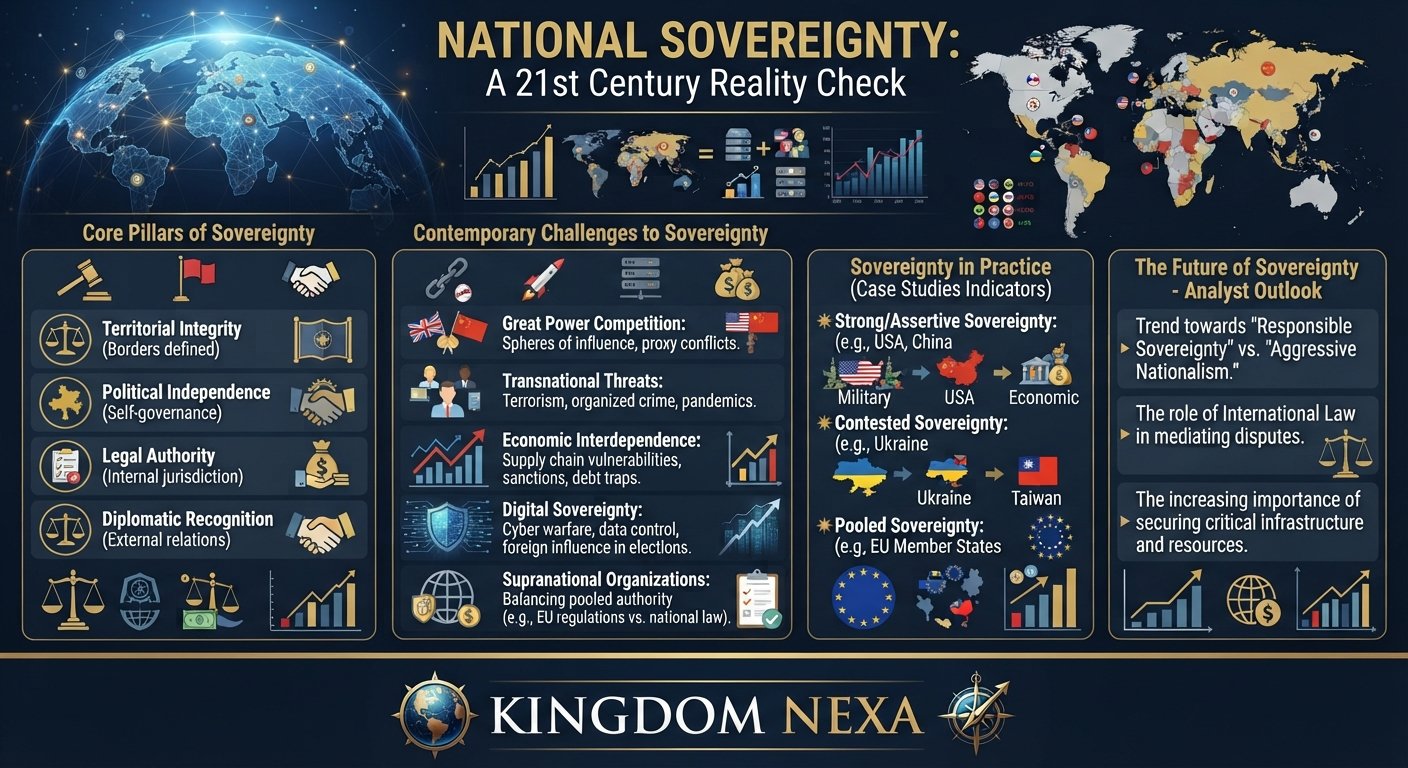
National sovereignty is one of the foundational ideas of the modern international system. It explains why states possess authority over their territory, institutions, laws, resources, and political affairs—and why other states are generally expected to respect that authority. Yet sovereignty is not simply a matter of controlling borders. In the 21st century, it is increasingly connected to economic interdependence, international treaties, cybersecurity, artificial intelligence, energy security, supply chains, military power, human rights, and global institutions.
The concept is also under constant pressure. Wars, territorial disputes, sanctions, cyber operations, foreign economic influence, cross-border environmental problems, and technological dependence can all challenge a state’s ability to exercise effective control. At the same time, governments voluntarily accept international obligations that place legal limits on how they can use their sovereign powers.
As of September 2026, national sovereignty remains central to debates about Ukraine, the Middle East, territorial disputes, digital governance, international law, and the future of multilateralism. This article explains what sovereignty means, how it developed, how international law protects it, and why its practical meaning is changing in an increasingly interconnected world.
What Is National Sovereignty?
National sovereignty is the supreme legal and political authority of a state over its territory and domestic affairs, combined with its independence and legal equality in relations with other states.
In practical terms, sovereignty gives a state the authority to make and enforce laws, administer territory, control public institutions, conduct foreign policy, manage borders, and determine its political and economic arrangements, subject to applicable international law.
The principle has two closely connected dimensions.
Internal Sovereignty
Internal sovereignty concerns authority within a state’s territory. It includes:
- Making and enforcing laws
- Maintaining public institutions
- Administering courts and government agencies
- Managing borders and immigration
- Collecting taxes
- Regulating economic activity
- Controlling public infrastructure
- Maintaining domestic security
- Managing natural resources within applicable legal limits
A state with effective internal sovereignty can exercise its governmental authority throughout its territory rather than merely possessing sovereignty as a legal principle.
External Sovereignty
External sovereignty concerns independence in relations with other states.
It means that states are legally independent and generally have the right to conduct their foreign relations without unlawful external interference. The UN Charter establishes the principle of the sovereign equality of states and requires members to refrain from the threat or use of force against another state’s territorial integrity or political independence.
This does not mean that states can do anything they want internationally. Sovereign states are also bound by international obligations they have accepted and by rules of international law that apply to them.
What Are the Main Elements of National Sovereignty?
National sovereignty is easier to understand when divided into several related components.
Territorial Sovereignty
Territorial sovereignty refers to a state’s authority over its internationally recognized territory.
It encompasses land territory and, under applicable international law, associated maritime zones and airspace. Territorial sovereignty is particularly important in border disputes, military occupations, secessionist conflicts, and territorial claims.
The principle is reflected in the UN Charter’s protection of territorial integrity and political independence.
Political Sovereignty
Political sovereignty concerns a state’s ability to organize its government and political institutions without unlawful external control.
States have different political systems, constitutions, electoral arrangements, and institutional structures. Sovereignty does not require every country to use the same political model.
However, sovereignty exists alongside international legal obligations, including obligations arising from treaties and international human-rights law.
Legal Sovereignty
Legal sovereignty concerns the state’s authority to legislate, administer justice, and exercise jurisdiction within the scope recognized by domestic and international law.
The international system also treats states as juridically equal. The 1933 Montevideo Convention, for example, stated that states are juridically equal and possess equal rights and capacity in exercising those rights.
Economic Sovereignty
Economic sovereignty refers to a government’s ability to make decisions about taxation, public spending, industrial policy, trade regulation, investment, natural resources, monetary arrangements, and economic development.
Modern economic sovereignty is complicated by globalization.
A country may legally control its domestic economy while depending heavily on foreign energy, imported technology, international finance, foreign investment, or global supply chains. Consequently, legal sovereignty and economic autonomy are not always the same thing.
Security and Military Sovereignty
A sovereign state normally maintains responsibility for its national defense and territorial security.
Military sovereignty includes control over armed forces, defense policy, strategic infrastructure, and national security institutions. Yet the exercise of military power is constrained by international law, including the UN Charter’s restrictions on the threat or use of force.
How Did the Modern Idea of Sovereignty Develop?
The modern concept of sovereignty emerged gradually rather than at a single historical moment.
From Medieval Authority to the Modern State
Medieval Europe contained overlapping systems of authority involving monarchs, religious institutions, feudal authorities, cities, and empires. Political authority was therefore more fragmented than the modern state system suggests.
The development of centralized territorial states gradually changed this arrangement.
The Peace of Westphalia of 1648 is frequently associated with the development of the modern sovereign-state system. However, historians and international-relations scholars caution against treating Westphalia as the single moment when modern sovereignty was created. State sovereignty developed through a much longer historical process involving diplomacy, warfare, state-building, colonialism, legal developments, and changing ideas about political authority.
Sovereignty and Colonialism
The development of European sovereignty occurred alongside imperial expansion and colonialism.
Colonial territories were frequently denied the same political independence enjoyed by European powers. This created a major contradiction between the theoretical equality of states and the actual structure of international power.
The 20th-century decolonization process transformed international society by creating numerous independent states and strengthening the principle of self-determination.
The United Nations Era
After the Second World War, sovereignty became firmly embedded in the institutional architecture of international law.
The 1945 UN Charter established sovereign equality as a fundamental principle while also imposing obligations concerning peaceful dispute settlement and the prohibition of unlawful force.
The 1970 Declaration on Friendly Relations further articulated principles including sovereign equality, non-intervention, peaceful settlement of disputes, self-determination, and the prohibition on the threat or use of force.
National Sovereignty and International Law
Sovereignty is a central principle of international law, but international law also establishes limits on state conduct.
Sovereignty Is Not Absolute
A common misunderstanding is that sovereignty means unlimited freedom.
In contemporary international law, states possess sovereign rights while simultaneously accepting legal obligations.
For example, a state may voluntarily become party to treaties governing:
- Trade
- Maritime affairs
- Human rights
- International aviation
- Environmental protection
- Nuclear activities
- Refugees
- Diplomatic relations
- International criminal cooperation
The UN Charter itself establishes obligations that constrain how states exercise power internationally.
Sovereignty and Non-Intervention
The principle of non-intervention generally protects states from unlawful external interference in matters within their domestic jurisdiction.
The Declaration on Friendly Relations identifies the duty of states not to intervene in matters within another state’s domestic jurisdiction and also emphasizes sovereign equality.
But the boundary between domestic and international affairs can become complicated when internal events produce international consequences or implicate international legal obligations.
Sovereignty and the Use of Force
One of the most important modern restrictions on sovereignty concerns military force.
Article 2(4) of the UN Charter requires states to refrain from the threat or use of force against the territorial integrity or political independence of another state, or in other ways inconsistent with the purposes of the United Nations.
The Charter also recognizes the Security Council’s role in maintaining international peace and security and preserves the inherent right of individual or collective self-defense in the circumstances provided by Article 51.
Consequently, sovereignty cannot be separated from the international legal rules governing armed force.
National Sovereignty vs Territorial Integrity
These concepts are related but not identical.
National sovereignty refers broadly to a state’s supreme legal and political authority and independence.
Territorial integrity concerns the protection of the state’s territorial boundaries and political unity from unlawful external force.
A state can therefore face a territorial-integrity problem without losing its legal status as a sovereign state.
This distinction is particularly important in armed conflicts and territorial disputes. International recognition, effective control, military occupation, and legal title can raise different questions that should not automatically be treated as equivalent.
The International Court of Justice continues to address sovereignty and territorial questions. In May 2025, for example, the Court issued its judgment on the merits in the case concerning land and maritime delimitation and sovereignty over islands between Gabon and Equatorial Guinea.
Why Is National Sovereignty Important in Geopolitics?
Sovereignty provides the legal foundation for the international state system.
Without a broadly accepted principle that states possess territorial authority and political independence, international relations would become far less predictable.
Sovereignty Creates a Framework for Diplomacy
Diplomatic relations assume that states are distinct political entities.
Embassies, treaties, negotiations, international organizations, and diplomatic recognition all operate within this framework.
Sovereign equality does not mean that states have equal military or economic power. It means that legal equality exists despite enormous differences in territory, population, wealth, or military capability.
Sovereignty Supports Territorial Stability
International stability depends heavily on the expectation that borders cannot simply be altered through unlawful force.
This principle has become particularly significant in contemporary conflicts. In February 2026, the UN Secretary-General reiterated that a durable settlement to the war in Ukraine should respect Ukraine’s independence, sovereignty, and territorial integrity and comply with the UN Charter and international law.
Sovereignty Influences Great-Power Competition
Major powers often compete over strategic geography, alliances, resources, technology, and economic influence.
For smaller and middle-sized states, sovereignty can therefore involve more than defending territory. It can also mean maintaining sufficient strategic autonomy to make national decisions without becoming excessively dependent on a larger power.
How Globalization Challenges National Sovereignty
Globalization has not eliminated sovereignty, but it has changed how sovereign power operates.
Economic Interdependence
Modern economies depend on international markets.
A government can regulate domestic businesses, but it may still be exposed to:
- Foreign investment
- International capital flows
- Energy imports
- Global commodity prices
- Overseas manufacturing
- Foreign technology
- Shipping routes
- International financial institutions
This creates a distinction between formal sovereignty and effective policy autonomy.
A country can legally make its own decisions while facing substantial economic costs for certain choices.
Recent IMF research illustrates this problem. A 2025 study examining geoeconomic fragmentation in the Middle East, North Africa, Central Asia, and the Caucasus found that changing trade restrictions and geopolitical fragmentation can reshape trade flows and economic outcomes.
International Organizations
Membership in international organizations can involve accepting rules that limit unilateral policy choices.
This does not necessarily represent the disappearance of sovereignty. In many cases, states voluntarily accept common rules because cooperation produces benefits that individual action cannot easily provide.
The central question is therefore not simply whether sovereignty has been surrendered, but how states choose to exercise sovereign authority through cooperation.
National Sovereignty in the Digital Age
Technology has created an entirely new dimension of sovereignty.
Cybersecurity and Cyber Sovereignty
Cyberattacks can affect government networks, financial systems, energy infrastructure, communications, transportation, and military systems without a traditional military invasion.
This complicates traditional ideas about borders.
A cyber operation may originate in one jurisdiction, use infrastructure in several others, target systems in another country, and involve private companies located around the world.
The UN’s 2024 Pact for the Future specifically addresses risks arising from digital technologies and artificial intelligence and reaffirms the importance of international law and responsible state behavior in cyberspace.
Data Sovereignty
Governments increasingly debate who should control data generated within their jurisdictions.
Issues include:
- Data localization
- Privacy
- Cloud infrastructure
- Cross-border data transfers
- Government access to information
- Digital identification
- Artificial intelligence
- Critical digital infrastructure
The Global Digital Compact adopted alongside the Pact for the Future promotes international cooperation on data governance and AI while emphasizing that digital governance should operate consistently with international law and human rights.
Technology Dependence
A country may have complete legal sovereignty but remain dependent on foreign suppliers for semiconductors, telecommunications equipment, satellite services, cloud computing, advanced software, or artificial intelligence infrastructure.
This creates a new form of strategic vulnerability.
Digital sovereignty therefore increasingly involves capacity, not merely legal authority.
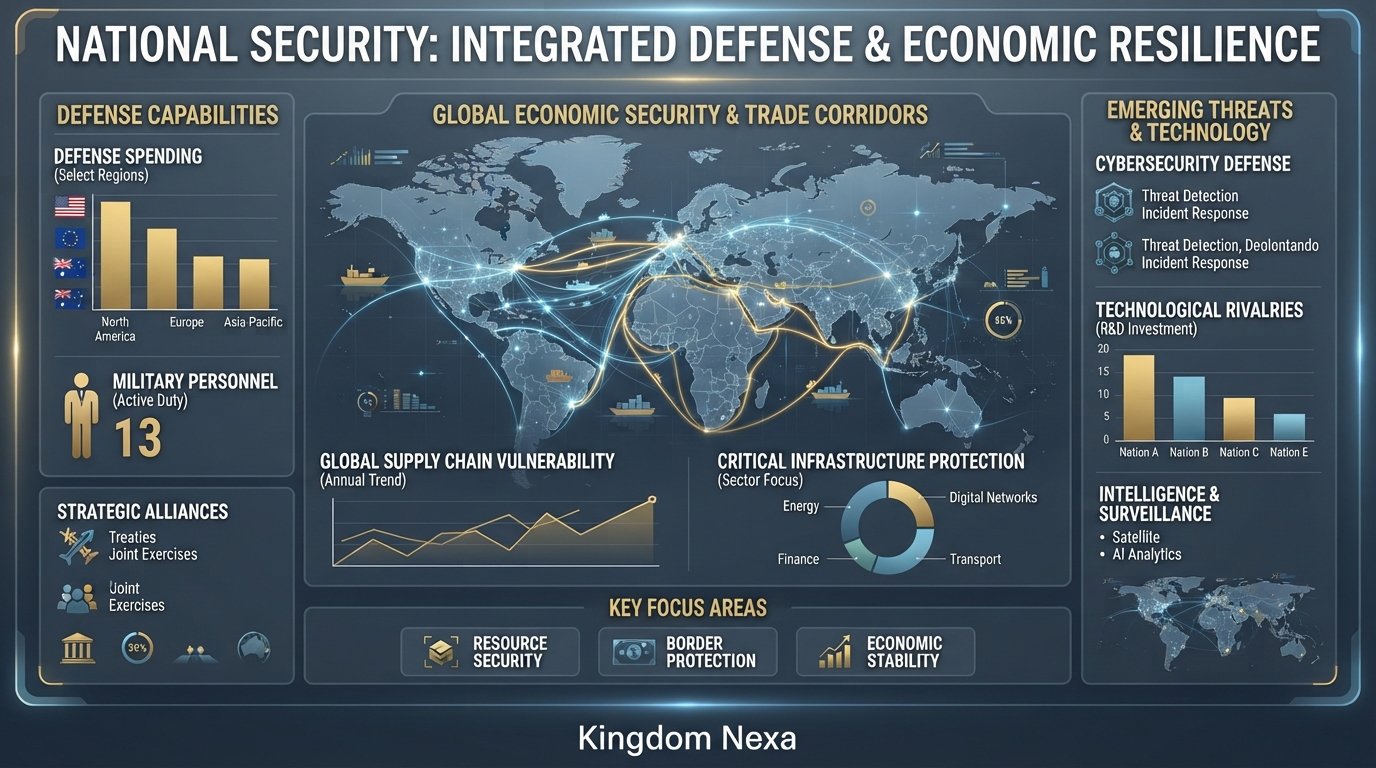
National Sovereignty and Economic Security
Economic security has become an increasingly important component of geopolitical strategy.
Governments are paying greater attention to critical supply chains, energy infrastructure, food security, strategic minerals, advanced technology, and industrial capacity.
Supply Chains
Dependence on a single foreign supplier can become a national-security concern when the product is strategically important.
Governments may respond by:
- Diversifying suppliers
- Building domestic production
- Creating strategic reserves
- Strengthening regional partnerships
- Screening foreign investment
- Supporting critical industries
These policies can strengthen resilience, but they may also increase costs or contribute to international trade fragmentation.
Energy Sovereignty
Energy dependence can influence foreign policy.
Countries that rely heavily on imported oil, gas, electricity, or nuclear fuel may have less room for maneuver during geopolitical crises.
Energy sovereignty does not necessarily mean producing every energy resource domestically. It can also involve diversified suppliers, resilient infrastructure, strategic reserves, renewable capacity, and secure transport routes.
National Sovereignty and Military Power
Sovereignty ultimately depends partly on a state’s ability to protect its territorial and political independence.
Military power is one element of that capability, but it is not the only one.
Deterrence
Deterrence seeks to discourage hostile action by convincing potential adversaries that aggression would impose unacceptable costs.
Nuclear weapons, conventional military forces, alliances, missile defenses, intelligence capabilities, and military technology can all influence deterrence calculations.
Alliances and Sovereignty
Military alliances create an interesting sovereignty question.
A state may enter an alliance precisely because collective security strengthens its ability to remain independent. At the same time, alliance commitments can constrain some national choices.
This demonstrates an important principle of modern geopolitics: sovereignty and cooperation are not necessarily opposites.
States frequently pool, coordinate, or constrain aspects of their power to protect broader national interests.
National Sovereignty and the European Union
The European Union provides an important example of sovereignty exercised through shared institutions.
EU member states retain statehood and major sovereign functions while transferring or sharing authority in specific policy areas through treaties and common institutions.
This arrangement illustrates the distinction between:
- Sovereignty as legal statehood
- Sovereignty as decision-making authority
- Sovereignty as practical capacity
- Sovereignty exercised collectively
The European experience demonstrates that international cooperation can reshape sovereign decision-making without making the participating states equivalent to ordinary provinces of a single state.
Sovereignty, Human Rights and the Responsibility of States
One of the most difficult issues in international relations is the relationship between sovereignty and human rights.
Traditional sovereignty emphasizes non-intervention and domestic jurisdiction. Modern international law also places significant obligations on states concerning human rights and humanitarian protection.
This produces difficult questions when governments claim domestic jurisdiction while other states or international institutions argue that serious international legal obligations are involved.
These questions should be approached carefully because international law distinguishes between political criticism, diplomatic pressure, lawful international measures, and unlawful intervention or force.
The UN Charter framework does not simply erase sovereignty, nor does sovereignty provide an unlimited exemption from international obligations.
Current State of National Sovereignty in 2026
As of September 2026, sovereignty remains one of the central principles around which major international disputes are framed.
The UN continues to emphasize sovereign equality, territorial integrity, political independence, peaceful dispute settlement, and international law. The 2024 Pact for the Future also reaffirmed respect for sovereignty and territorial integrity while recognizing that global institutions must adapt to new security, technological, and economic challenges.
The continuing relevance of sovereignty can be seen across several areas.
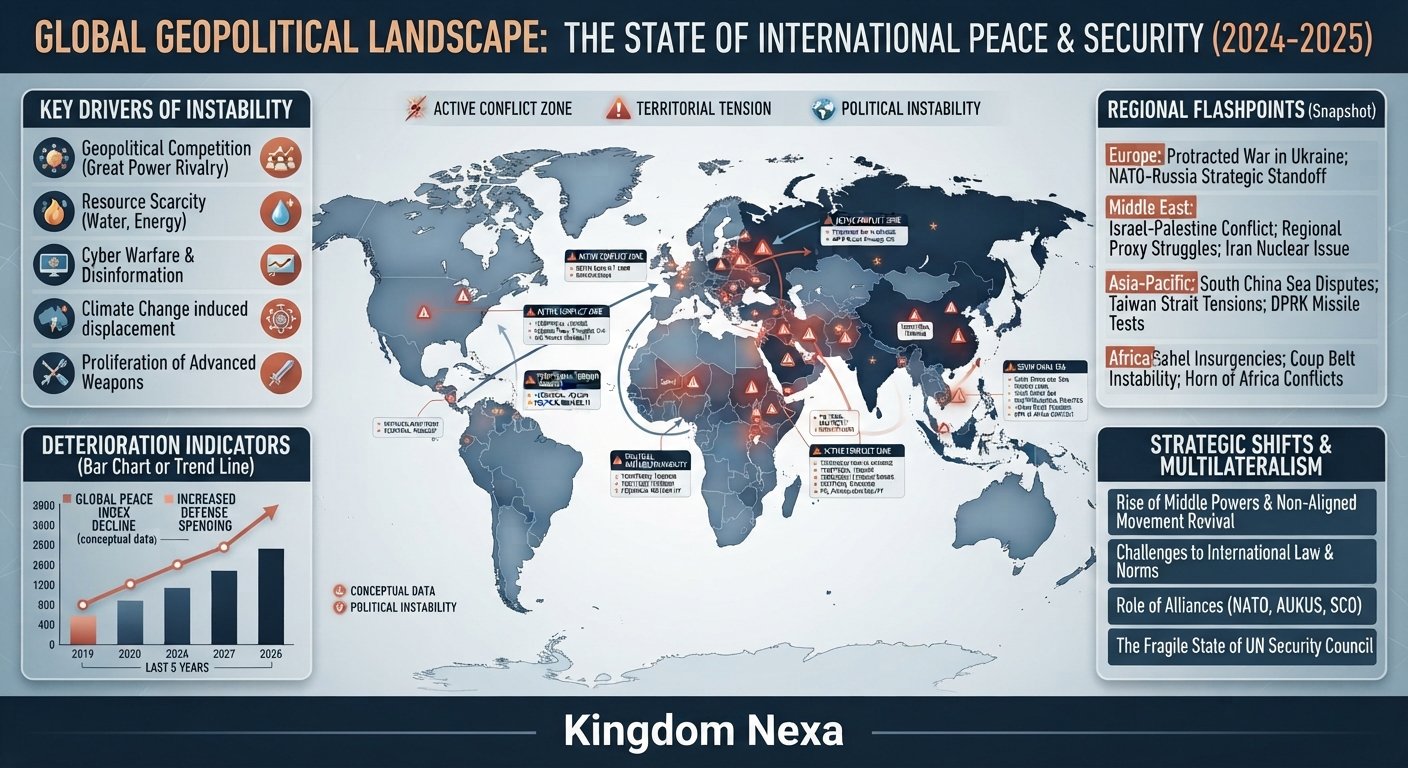
Armed Conflicts and Territorial Disputes
Wars in Europe and the Middle East demonstrate that territorial sovereignty remains a practical security issue, not merely a legal concept.
In June 2026, the UN Secretary-General called for a settlement concerning Lebanon that respects its sovereignty, territorial integrity, and political independence within internationally recognized borders.
In September 2026, UN officials again emphasized the importance of sovereignty, independence, unity, and territorial integrity in relation to Ukraine and broader international peace and security.
International Law Is Still Evolving
The international legal system itself continues to develop.
The UN International Law Commission’s 77th session in 2026 examined issues including state succession, state responsibility, dispute settlement, due diligence, compensation for internationally wrongful acts, and extraterritorial jurisdiction.
This matters because sovereignty is not a static concept. Its practical application continues to evolve as new technologies, conflicts, economic relationships, and legal questions emerge.
Digital and Artificial Intelligence Governance
AI and digital technologies increasingly cross national borders.
The Global Digital Compact recognizes both the opportunities and risks of emerging technologies and calls for international cooperation, responsible AI governance, data governance, human rights protections, and secure digital infrastructure.
The challenge for governments is to retain meaningful regulatory capacity without isolating themselves from international technological cooperation.
Major Challenges to National Sovereignty
Several forces are likely to remain important in the coming years.
Great-Power Competition
Competition among major powers can pressure smaller and middle-sized countries to align economically, diplomatically, technologically, or militarily.
Maintaining room for independent decision-making can therefore become a major foreign-policy objective.
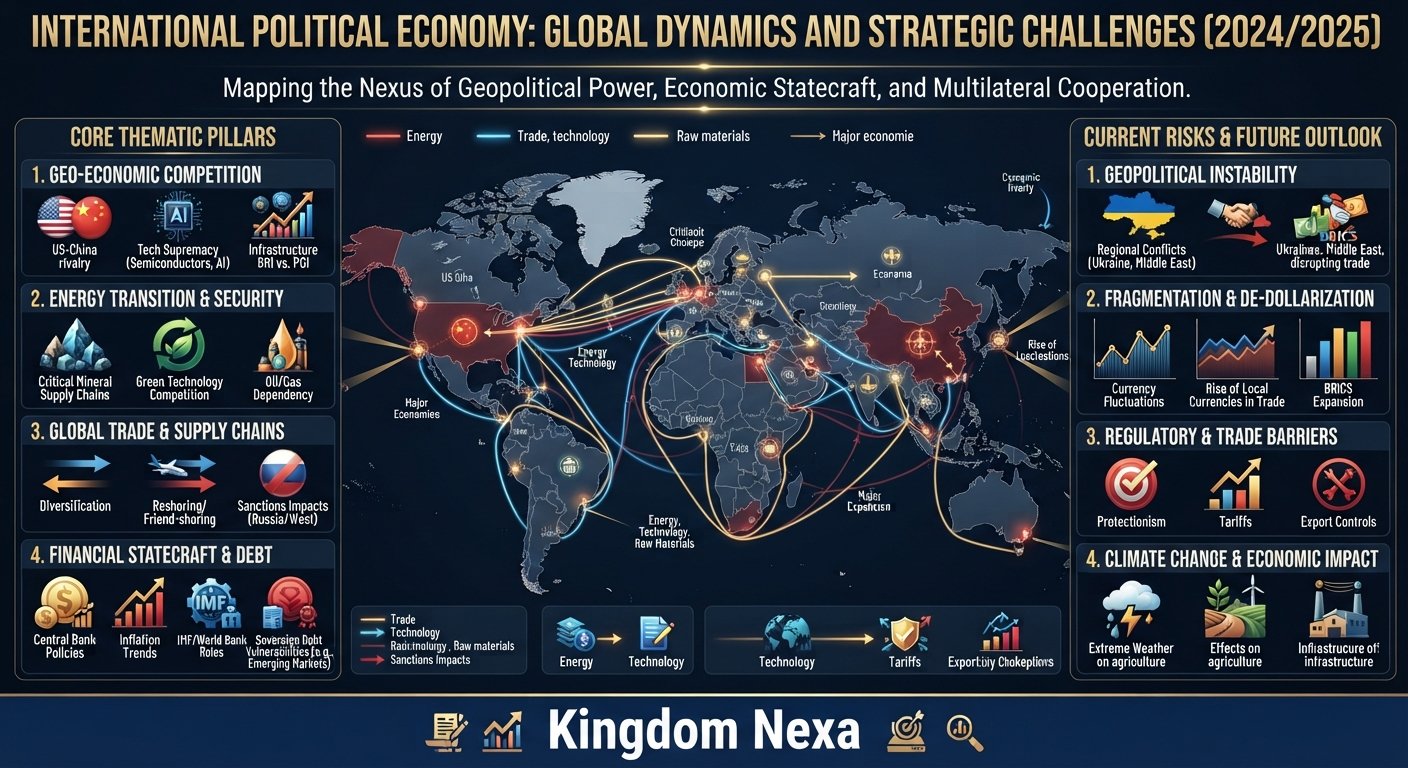
Geoeconomic Fragmentation
Trade restrictions, sanctions, export controls, investment screening, and strategic industrial policies can increase national resilience but may also fragment global markets.
IMF research published in 2025 documented increased trade interventions and examined how geopolitical fragmentation could alter trade and economic outcomes in several regions.
Cyber and Information Operations
Digital interference can challenge political institutions without crossing a traditional physical border.
Governments therefore increasingly view cyber resilience, information integrity, and critical digital infrastructure as sovereignty-related issues.
Climate and Transnational Problems
Climate change, pandemics, financial instability, migration, maritime security, and environmental degradation cannot always be managed effectively by one country acting alone.
This creates a paradox: states may need more international cooperation precisely because they want to preserve their ability to protect national interests.
Future Scenarios for National Sovereignty
The future of sovereignty is uncertain, but several broad possibilities can be identified.
Scenario 1: Stronger Sovereign Resilience
States could invest more heavily in domestic energy, technology, defense, food security, strategic industries, and resilient supply chains.
This could increase national policy autonomy but potentially raise economic costs.
Scenario 2: Deeper International Cooperation
States could increasingly address climate change, AI, cyber threats, pandemics, trade, and security through international institutions and regional agreements.
Under this model, sovereignty would remain important but would be exercised increasingly through negotiated rules.
Scenario 3: A More Fragmented International System
Persistent geopolitical competition could produce separate economic, technological, financial, and security ecosystems.
Countries would retain formal sovereignty while facing stronger pressure to choose strategic partners.
Scenario 4: Flexible Strategic Autonomy
Many states may pursue a middle path: cooperating with different powers on different issues while avoiding excessive dependence on any single bloc.
For smaller and middle powers, this approach can involve diversified trade, multiple diplomatic partnerships, technological investment, and flexible security relationships.
These are analytical scenarios rather than predictions. Actual outcomes will depend on conflicts, economic conditions, technological developments, domestic politics, international institutions, and decisions taken by governments.
Frequently Asked Questions About National Sovereignty
What is national sovereignty in simple terms?
National sovereignty is a state’s authority and independence to govern its territory, institutions, laws, and political affairs while conducting external relations subject to international law.
Why is national sovereignty important?
It provides the legal foundation for state independence, territorial integrity, diplomacy, and the principle that states are sovereign equals in the international system.
Is national sovereignty absolute?
No. Modern states exercise sovereign authority while being bound by applicable international law, treaties, and obligations such as the UN Charter.
What is the difference between sovereignty and territorial integrity?
Sovereignty concerns a state’s overall authority and independence. Territorial integrity specifically concerns the protection of its territory and political unity from unlawful external force.
How does globalization affect national sovereignty?
Globalization increases economic and technological interdependence. Governments retain legal sovereignty but may have less practical freedom when their economies depend heavily on foreign markets, technology, finance, energy, or supply chains.
Does joining an international organization reduce sovereignty?
Membership can constrain certain policy choices through agreed rules, but states generally join such organizations voluntarily because cooperation can advance national interests. Sovereignty can therefore be exercised through international cooperation rather than only through unilateral action.
Why is digital sovereignty becoming important?
Governments increasingly depend on data, cloud systems, telecommunications, AI, semiconductors, and digital infrastructure. Control and resilience in these areas can directly affect economic security and national decision-making.
What protects national sovereignty under international law?
The UN Charter’s principles of sovereign equality, peaceful dispute settlement, non-intervention, and restrictions on the threat or use of force form important foundations of the international legal framework.
Can sovereignty coexist with international cooperation?
Yes. Modern states routinely cooperate through treaties, alliances, international organizations, trade arrangements, and regional institutions while retaining their status as sovereign states.
Conclusion
National sovereignty remains a fundamental organizing principle of international relations, but its meaning has become considerably more complex than simple control over territory. A sovereign state requires legal authority, political independence, institutional capacity, economic resilience, security capabilities, and increasingly technological capabilities.
International law protects sovereignty through principles such as sovereign equality, territorial integrity, political independence, non-intervention, and restrictions on the use of force. At the same time, states voluntarily accept international obligations and cooperate through institutions because many modern challenges cannot be managed effectively in isolation.
The central geopolitical question is therefore not whether globalization has eliminated national sovereignty. It has not. The more important question is how states can preserve meaningful decision-making power while navigating interdependence.
In 2026, that question extends from traditional borders and military security to supply chains, energy, cyber operations, artificial intelligence, data, finance, and international law. National sovereignty remains highly relevant—but increasingly, its strength depends not only on what a state legally controls, but also on its capacity to act independently in an interconnected world.