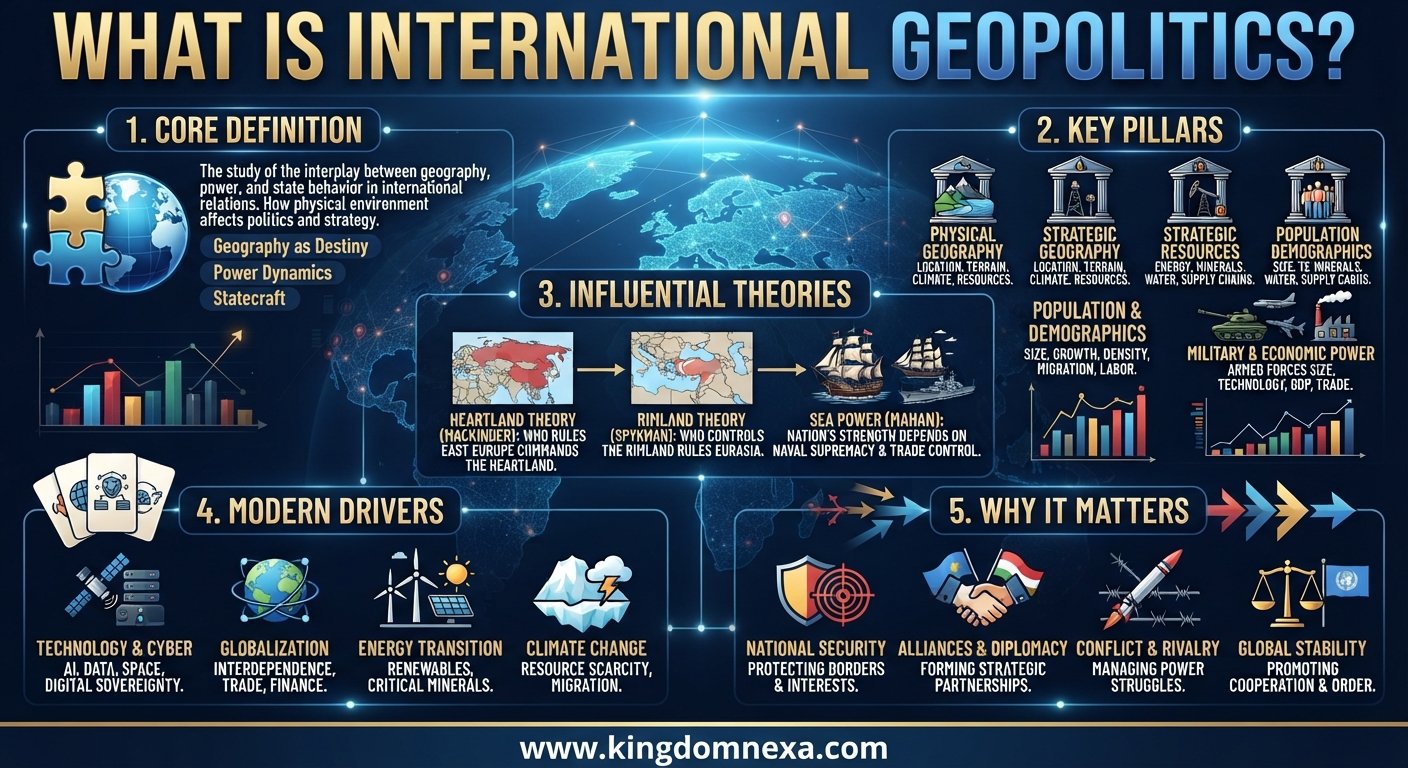
What happens when geography influences the ambitions of powerful states? Why do countries compete over strategic waterways, energy resources, borders, trade routes, and military positions? And why can an event thousands of miles away affect national security, trade, energy prices, or diplomatic relations?
These questions sit at the heart of International Geopolitics.
Geopolitics examines the relationship between geography, political power, national interests, and international relations. Geography does not mechanically determine what countries will do, but it can create opportunities, constraints, vulnerabilities, and strategic advantages. Oxford describes geopolitics as involving questions of power and influence over space and territory while also emphasizing geographical ways of understanding world affairs. (OUP Academic)
Today, geopolitics extends far beyond traditional territorial disputes. Energy security, global trade, technology, military alliances, economic sanctions, supply chains, maritime routes, climate pressures, and access to critical resources all influence international competition.
This article explains what International Geopolitics means, how it developed, why geography matters, the major forces shaping geopolitical power, and how these concepts help us understand an increasingly interconnected world.
What Is International Geopolitics?
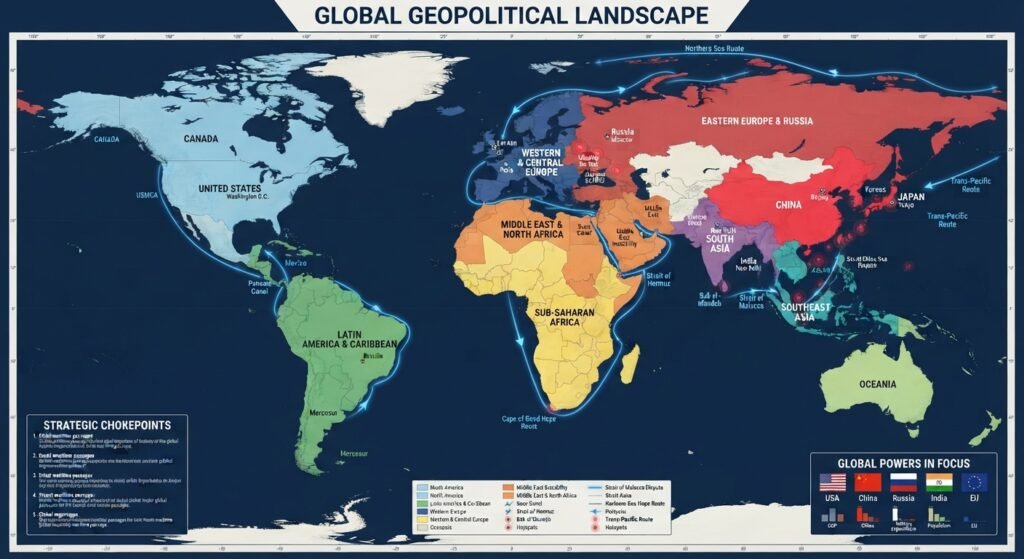
International Geopolitics is the study of how geography, power, resources, strategic interests, and political relationships influence interactions among states and other international actors.
A simpler way to understand it is:
Geopolitics studies how location and power interact in international affairs.
Oxford’s definition emphasizes political relations between countries as influenced by geography, while Cambridge describes geopolitics in terms of how a country’s size and position can influence its power and relationships with other countries. (Oxford Learner’s Dictionaries)
Geopolitics therefore asks questions such as:
- Where is a country located?
- What countries border it?
- Does it have access to oceans?
- Which resources does it possess?
- What strategic routes pass through its territory?
- How vulnerable is it to external pressure?
- Which alliances does it have?
- What are its economic and military capabilities?
- How does it use geography to pursue national interests?
International Geopolitics is not simply the study of maps. It is an analytical framework for understanding how space, power, interests, and strategy interact.
Why Is International Geopolitics Important?
Geopolitical decisions can affect almost every major aspect of international life.
A conflict between two countries can disrupt energy supplies. A dispute over a maritime route can affect international shipping. A new military alliance can alter regional security calculations. A major infrastructure project can create new economic connections while also changing strategic relationships.
This is why geopolitical analysis matters to governments, businesses, researchers, investors, journalists, and ordinary citizens.
Understanding Global Power
Countries possess different forms of power.
Military strength is important, but it is only one component. Economic size, technological capability, diplomatic influence, population, natural resources, geography, institutional strength, and cultural influence can also shape a country’s international position.
A country with a smaller military may still possess significant geopolitical importance if it controls a critical trade route or possesses strategically important resources.
Understanding International Conflict
Geopolitics can help explain why particular locations become strategically important.
Mountains, rivers, deserts, coastlines, islands, ports, straits, and borderlands can influence military planning and diplomatic strategy.
Geography does not make conflict inevitable. Instead, it can influence the choices available to governments and the costs associated with those choices.
Understanding Global Economics
Modern geopolitics is closely connected to economics.
Trade networks, energy markets, financial systems, semiconductor supply chains, infrastructure projects, and sanctions can all become instruments of geopolitical influence.
The relationship between geopolitics and economic governance has become increasingly important as global economic integration has distributed power among a wider range of states and actors. (OUP Academic)
The Relationship Between Geography and Political Power
Geography provides the physical environment within which political decisions occur.
Some geographic characteristics change very slowly:
- Location
- Mountains
- Rivers
- Coastlines
- Major deserts
- Ocean access
- Natural resource deposits
Other factors can change much faster:
- Infrastructure
- Ports
- Railways
- Roads
- Military bases
- Pipelines
- Trade networks
- Population distribution
- Political boundaries
This distinction is important.
A country’s geographic location may remain constant for centuries, while its geopolitical significance can change dramatically because technology, economic relationships, military capabilities, or political alliances have changed.
For example, the strategic value of a particular maritime passage can increase when global trade becomes more dependent on shipping. Likewise, an inland region can gain importance after the construction of a major railway, pipeline, or economic corridor.
Geopolitics therefore examines both relatively permanent geographic conditions and changing human systems.
Historical Development of Geopolitics
The term “geopolitics” has a relatively modern intellectual history, although political leaders have considered geography and strategic location for centuries.
Oxford research notes that the term was coined in 1899 and subsequently developed into several different approaches. These include classical geopolitics, strategic geography, critical geopolitics, and other schools of thought. (OUP Academic)
Classical Geopolitics
Classical geopolitical thinkers attempted to understand how geographic conditions influenced national power and international competition.
Thinkers such as Alfred Thayer Mahan, Halford Mackinder, and Nicholas Spykman developed influential ideas concerning sea power, land power, strategic regions, and international competition.
Their theories emerged during periods when industrialization, imperial competition, railways, naval power, and global exploration were transforming international politics.
Some classical theories have been criticized for placing too much emphasis on geographic determinism—the idea that geography almost inevitably determines political outcomes.
Modern geopolitical analysis generally takes a more nuanced approach.
Critical Geopolitics
Critical geopolitics examines how political leaders, media, institutions, and societies construct ideas about geographic space.
Rather than asking only:
“How does geography influence politics?”
critical geopolitics may also ask:
“How do political actors describe and interpret geography to justify particular policies?”
This distinction matters because maps and geographic narratives are not always politically neutral.
Oxford’s overview of geopolitics identifies critical geopolitics as an approach that places greater emphasis on discourse and ideology compared with classical approaches centered on territorial interests and geographical environments. (OUP Academic)
Major Elements of International Geopolitics
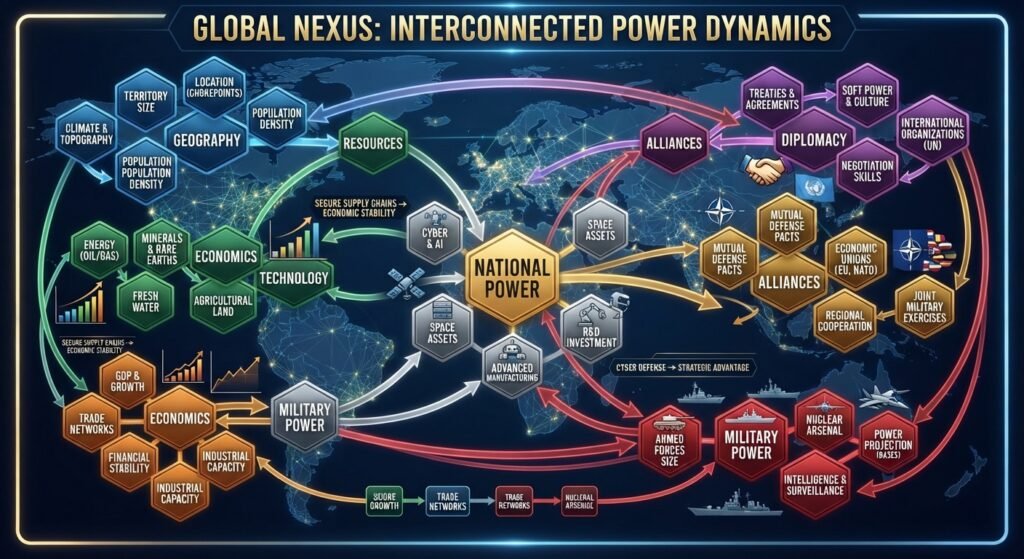
International Geopolitics is multidimensional. Geography provides the physical setting, but numerous other factors determine how states exercise power.
Geography and Territory
Territory remains one of the most fundamental elements of international politics.
States care about territory because it can provide:
- Security
- Resources
- Population centers
- Agricultural land
- Strategic depth
- Access to transportation networks
- Political legitimacy
Border disputes can therefore become much more than arguments over lines on a map.
Natural Resources
Oil, natural gas, minerals, freshwater, agricultural land, and other resources can have major strategic significance.
Resource-rich countries may gain economic leverage, while resource-dependent states may become vulnerable to supply disruptions.
The geopolitical significance of a resource also depends on:
Availability + Accessibility + Demand + Transportation + Alternatives
A resource is strategically valuable only if it can be extracted, transported, traded, and used.
Sea Power and Maritime Geography
Oceans carry a large share of international trade, making maritime geography a major component of global geopolitics.
Important locations can include:
- Strategic ports
- Naval bases
- Maritime chokepoints
- Major shipping routes
- Offshore energy fields
- Important islands
Control or influence over maritime infrastructure can affect trade, military mobility, and energy security.
Strategic Chokepoints
A chokepoint is a geographically constrained route through which significant movement must pass.
Examples include:
- Strait of Hormuz
- Strait of Malacca
- Suez Canal
- Bab el-Mandeb
- Bosporus and Dardanelles
Their importance comes from concentration.
When large volumes of trade or energy pass through a narrow route, disruption can produce consequences far beyond the immediate region.
Economic Power and Geoeconomics
Modern International Geopolitics cannot be understood through military power alone.
Economic relationships increasingly influence strategic competition.
Trade
Countries may use trade relationships to strengthen alliances, gain market access, or increase strategic dependence.
Trade can create cooperation, but it can also create vulnerabilities.
Sanctions
Economic sanctions are another geopolitical instrument.
Governments may use restrictions on:
- Banking
- Exports
- Imports
- Technology
- Investment
- Financial transactions
to pressure another state.
Sanctions can influence political calculations without direct military confrontation, although their effectiveness varies according to the target’s economic structure, alternative markets, domestic resilience, and international support.
Supply Chains
Globalization has created highly interconnected supply networks.
Modern geopolitical competition increasingly involves:
- Semiconductors
- Critical minerals
- Energy
- Telecommunications
- Advanced computing
- Batteries
- Pharmaceutical inputs
- Food supplies
This has made economic security an increasingly important part of national security.
Military Power and Geopolitical Strategy
Military capabilities remain a major component of international power.
However, military power involves much more than the number of soldiers or weapons.
Relevant factors include:
- Geography
- Logistics
- Naval capabilities
- Air power
- Missile systems
- Intelligence
- Cyber capabilities
- Nuclear deterrence
- Defense industries
- Military alliances
- Strategic mobility
A country’s ability to deploy military power far from its territory can be particularly significant.
Logistics matters because military forces require fuel, ammunition, food, spare parts, communications, and transportation.
Geography therefore interacts directly with military strategy.
Diplomacy and International Geopolitics
Geopolitics is not synonymous with conflict.
Diplomacy is one of the principal mechanisms through which states manage geopolitical competition.
Countries negotiate:
- Treaties
- Trade agreements
- Security arrangements
- Border settlements
- Maritime agreements
- Ceasefires
- Strategic partnerships
- Multilateral agreements
International organizations also provide platforms for diplomacy.
The United Nations, regional organizations, economic institutions, and security partnerships can influence how states manage competing interests.
A geopolitical relationship can therefore contain competition and cooperation simultaneously.
Two countries may compete strategically while continuing to trade, communicate diplomatically, or cooperate on specific global issues.
Balance of Power in International Geopolitics
The balance of power is a central concept in international relations.
It refers broadly to situations in which states seek to prevent excessive concentration of power in the international system or within a particular region.
Countries can influence the balance of power through:
- Alliances
- Military modernization
- Economic partnerships
- Diplomatic coalitions
- Arms agreements
- Strategic partnerships
Balance-of-power politics should not be understood as a simple numerical calculation.
A country’s influence depends on how different capabilities interact.
For example:
Economic Power + Military Capability + Technology + Alliances + Geography + Diplomatic Influence
may provide a better picture of geopolitical strength than military expenditure alone.
Soft Power and Hard Power
Geopolitical influence can operate through different forms of power.
Hard Power
Hard power generally involves coercive capabilities such as:
- Military force
- Economic pressure
- Sanctions
- Strategic coercion
Soft Power
Soft power concerns the ability to attract or influence others through:
- Culture
- Diplomacy
- Institutions
- Political values
- Education
- International reputation
In reality, countries often use combinations of hard and soft power.
A state may use economic partnerships to build relationships while simultaneously maintaining military capabilities to deter threats.
International Geopolitics and Global Alliances
Alliances can change the strategic calculations of states.
A country may join or strengthen an alliance because it seeks:
- Collective security
- Military assistance
- Intelligence cooperation
- Economic benefits
- Diplomatic support
- Strategic deterrence
Major alliances can also influence regional stability by changing the perceived costs and benefits of military action.
However, alliances are not always permanent or uniform. Members can disagree about threats, priorities, burden-sharing, or foreign policy.
The Role of Technology in Modern Geopolitics
Technology has expanded the meaning of geopolitical power.
Traditional geopolitics focused heavily on territory, resources, and military geography. Modern analysis must also consider digital infrastructure and technological networks.
Important areas include:
- Artificial intelligence
- Semiconductors
- Cybersecurity
- Satellites
- Telecommunications
- Quantum technologies
- Space systems
- Digital infrastructure
Technology can influence both economic competitiveness and military capabilities.
Control over critical technologies can therefore become a strategic objective.
This is one reason the boundary between economic policy, technology policy, and national security has become increasingly difficult to separate.
International Geopolitics and Energy Security
Energy has historically played a major role in geopolitical strategy.
Oil and natural gas can influence:
- National revenues
- Trade relationships
- Industrial production
- Military logistics
- Diplomatic partnerships
- Strategic dependence
Energy infrastructure can also have geopolitical significance.
Pipelines, LNG terminals, refineries, electricity grids, ports, and shipping routes connect energy producers and consumers.
At the same time, the transition toward renewable energy is changing the resource map.
Critical minerals used in batteries, electric vehicles, renewable-energy systems, and advanced technologies are becoming increasingly important to economic and strategic planning.
International Geopolitics in a Multipolar World
The international system is often described as becoming more multipolar, meaning that power and influence are distributed among several significant actors rather than concentrated overwhelmingly in one dominant center.
The rise of emerging powers, regional powers, economic networks, and non-state actors has made global politics increasingly complex.
The diffusion of economic and political agency has become an important feature of the contemporary international system. Research on global economic governance emphasizes that geopolitical influence is no longer adequately understood through a single hierarchy of power. (OUP Academic)
A multipolar system can create opportunities for:
- Greater diplomatic choice
- New economic partnerships
- Regional cooperation
- More diverse international institutions
But it can also create:
- Strategic uncertainty
- Rival alliances
- Competing spheres of influence
- Security dilemmas
- Increased diplomatic complexity
International Geopolitics vs International Relations
The two concepts overlap but are not identical.
International Relations is the broader academic field concerned with relationships among states and other international actors.
Geopolitics is one way of analyzing international affairs, particularly through the relationship between geography, space, territory, power, and strategy.
A useful distinction is:
International Relations = The broader study of international interaction
Geopolitics = A geographical and power-oriented lens for understanding that interaction
The distinction is not absolute. Different academic traditions define geopolitics differently, and there is no single universally accepted definition. Oxford research specifically notes the diversity of competing definitions within the field. (OUP Academic)
How to Analyze a Geopolitical Event
A useful geopolitical analysis should go beyond describing what happened.
A practical framework is:
1. Identify the actors
Who are the states, organizations, companies, or groups involved?
2. Identify the geography
Where is the event occurring, and why does that location matter?
3. Identify interests
What does each actor want?
4. Identify capabilities
What political, economic, military, technological, or diplomatic resources does each actor possess?
5. Identify constraints
What prevents an actor from achieving its preferred outcome?
6. Examine relationships
Which countries are supporting, opposing, or remaining neutral?
7. Assess consequences
What could change regionally and globally?
8. Separate fact from forecast
Which conclusions are supported by evidence, and which are possible scenarios?
This framework can help researchers avoid reducing complex events to simple narratives.
Examples of International Geopolitics
Geopolitical analysis can be applied to almost every major international issue.
Indo-Pacific Competition
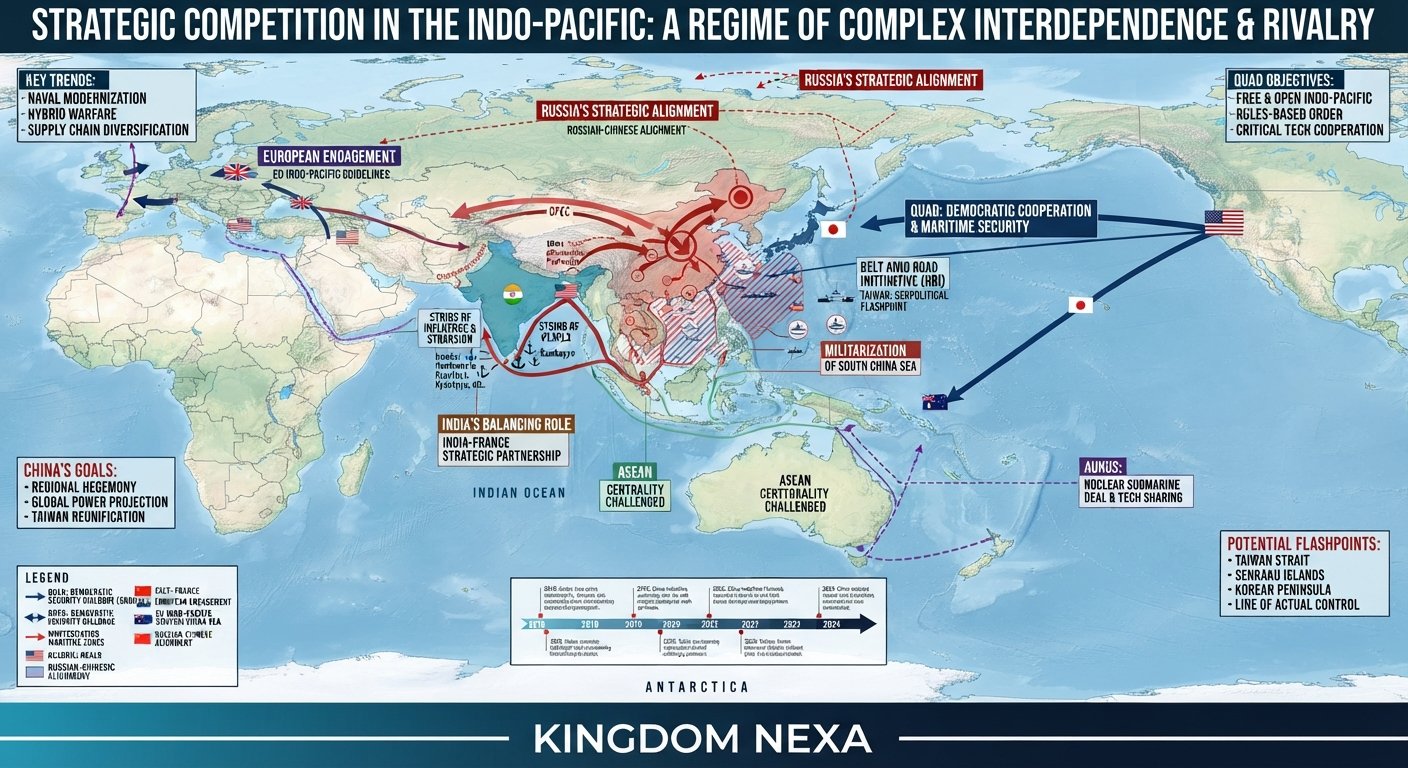
The Indo-Pacific combines major economic centers, important maritime routes, military capabilities, and strategic competition among major powers.
Its geography makes maritime access, trade, alliances, technology, and regional security especially important.
European Security
European geopolitics demonstrates how borders, military alliances, energy security, economic integration, and relations among major powers can interact.
Middle Eastern Energy Politics
The Middle East remains strategically significant because of its geographic position, energy resources, maritime routes, regional rivalries, and external security relationships.
Central Asian Connectivity
Central Asia illustrates how landlocked geography, energy resources, transport corridors, relations with neighboring powers, and infrastructure projects can interact.
These examples demonstrate why geopolitics should not be reduced to military conflict. Infrastructure, commerce, diplomacy, resources, and geography can all produce geopolitical consequences.
Why Geography Does Not Determine Everything
One of the most important principles in modern geopolitical analysis is avoiding geographic determinism.
Geography matters, but it does not dictate a country’s future.
Technology can change the strategic value of geography.
Infrastructure can overcome physical barriers.
Diplomacy can reduce tensions.
Economic integration can alter incentives.
Political leadership can change foreign policy.
International institutions can create mechanisms for cooperation.
This is why two countries with similar geographic constraints can pursue very different strategies.
Geography creates conditions. Political choices, institutions, technology, economics, and human agency determine how those conditions are used.
Future of International Geopolitics
The future of International Geopolitics will likely involve an increasingly complicated interaction between traditional territorial competition and new forms of strategic power.
Several trends deserve close attention:
Technology Competition
Artificial intelligence, semiconductors, cyber capabilities, satellites, and advanced computing are becoming strategic assets.
Climate and Resource Security
Climate change can affect migration, agriculture, water availability, infrastructure, and resource competition.
Changing Energy Systems
The energy transition could reshape relationships between resource producers, technology providers, manufacturers, and consumers.
Economic Fragmentation
Global trade is unlikely to disappear, but governments may increasingly prioritize resilience, diversification, and strategic autonomy.
Greater Regional Competition
Regional powers may play increasingly important roles in shaping security and economic relationships.
The future is unlikely to be determined by one variable alone. Geopolitical outcomes will emerge from interactions among geography, economics, technology, military capabilities, diplomacy, domestic politics, and international institutions.
Frequently Asked Questions About International Geopolitics
What is International Geopolitics?
International Geopolitics is the study of how geography, territory, resources, power, strategic interests, and political relationships influence international affairs.
Why is International Geopolitics important?
It helps explain why countries compete or cooperate over territory, resources, trade routes, security, alliances, technology, and political influence.
What are the main factors of geopolitics?
Major factors include geography, territory, natural resources, population, economic power, military capability, technology, alliances, diplomacy, and strategic location.
Is geopolitics the same as international relations?
No. International relations is the broader field studying interactions among international actors. Geopolitics is a particular analytical approach that places strong emphasis on geography, space, territory, and power.
Does geography determine a country’s foreign policy?
No. Geography can create opportunities and constraints, but foreign policy also depends on political leadership, institutions, economic conditions, technology, historical experience, and national interests.
What is geopolitical power?
Geopolitical power is a state’s ability to influence international outcomes. It can arise from military strength, economic resources, technology, geography, alliances, diplomacy, and other forms of influence.
What is the balance of power?
The balance of power describes the distribution of capabilities among states and the strategies they use to prevent or respond to excessive concentrations of power.
How does economics affect geopolitics?
Trade, energy, investment, financial systems, sanctions, technology, and supply chains can create strategic dependencies and influence relations among countries.
How does technology affect geopolitics?
Technology can change military capabilities, economic competitiveness, communications, intelligence, and control over strategic industries. Advanced technologies can therefore become sources of geopolitical influence.
Is the world becoming multipolar?
There is substantial discussion about increasing diffusion of power among major and regional actors. However, whether the international system should be described as fully multipolar depends on the specific dimensions of power being examined.
Conclusion
International Geopolitics provides a powerful framework for understanding why geography, power, resources, economics, security, and diplomacy matter in world affairs. It explains why certain territories become strategically important, why countries compete over trade routes and resources, and why alliances and economic relationships can influence global stability.
Yet modern geopolitics is much broader than traditional competition over land. Technology, supply chains, energy systems, financial networks, cyber capabilities, infrastructure, and international institutions have expanded the meaning of geopolitical power.
The most useful geopolitical analysis therefore avoids simple explanations. Geography matters, but it interacts with political decisions, economic capabilities, military strategy, technology, diplomacy, and historical circumstances. Different actors can interpret the same geographic reality in very different ways.
For students, researchers, journalists, policymakers, and anyone trying to understand global affairs, geopolitics provides a structured way to ask better questions: Who has power? Where is that power located? What interests are at stake? What constraints exist? And how could today’s decisions reshape tomorrow’s international order?
Understanding those relationships is essential to understanding the modern world.