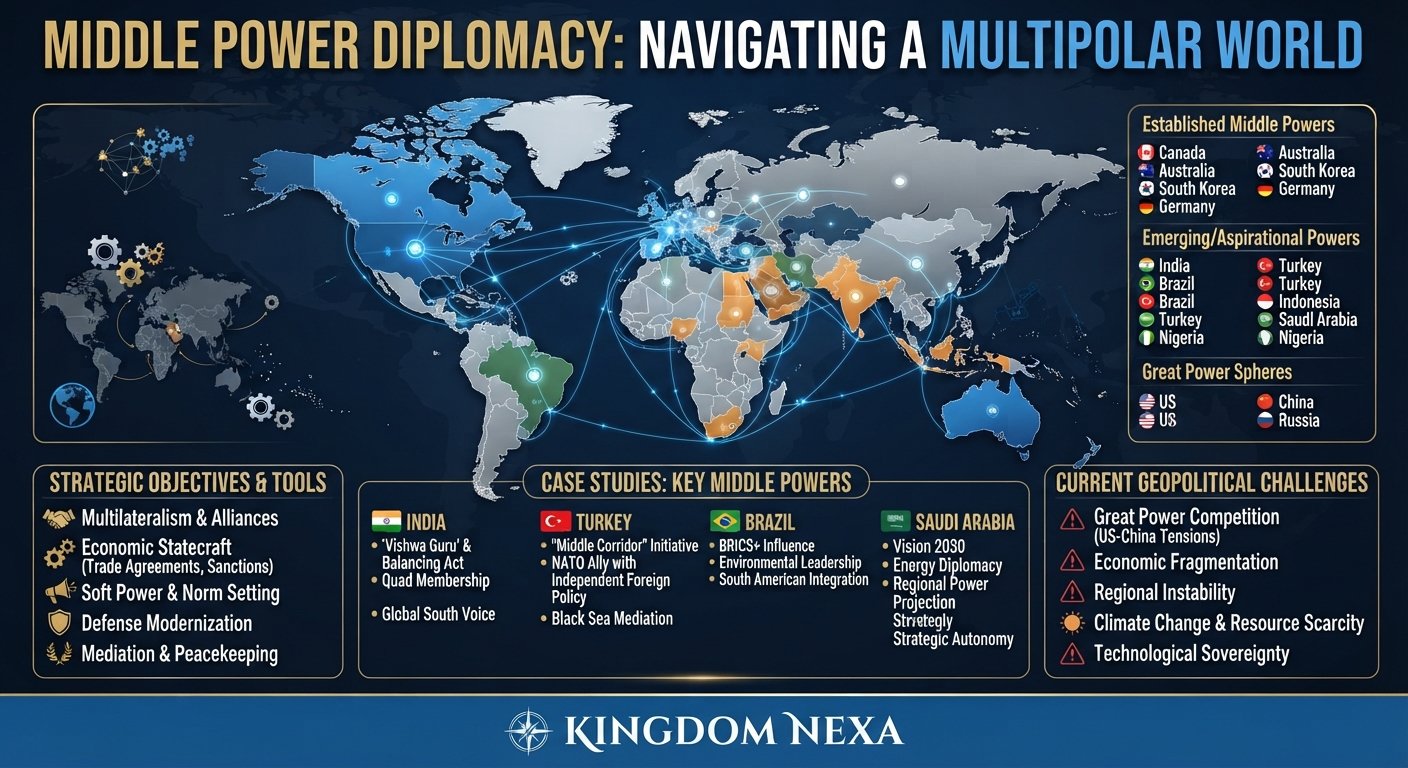
In an increasingly competitive international system, global influence is no longer determined exclusively by the military and economic strength of superpowers. Countries that occupy the middle of the international power hierarchy are finding new ways to influence negotiations, build strategic partnerships, protect economic interests, and shape international rules. This approach is known as Middle Power Diplomacy.
Traditionally associated with countries such as Canada and Australia, middle power diplomacy now encompasses a wider range of states, including South Korea, Indonesia, Brazil, South Africa, and Türkiye. Although these countries differ considerably in their resources, political systems, and regional ambitions, they share an important strategic challenge: how to influence international outcomes without possessing the overwhelming capabilities of a great power.
As strategic competition intensifies, economic dependencies become instruments of pressure, and international institutions face growing disagreements, middle powers must navigate increasingly difficult choices. Some strengthen alliances, others pursue strategic autonomy, and many cooperate with different partners depending on the issue.
This article examines the meaning, historical development, diplomatic methods, major actors, and geopolitical significance of middle power diplomacy. It also explores contemporary examples, economic and security implications, major limitations, and future scenarios to explain how these states can shape the evolving international order.
What Is Middle Power Diplomacy?
Middle power diplomacy refers to the foreign-policy strategies through which states with neither superpower status nor negligible international influence seek to shape global and regional affairs. These countries use negotiation, coalition-building, international institutions, economic partnerships, mediation, and specialized expertise to achieve objectives that would be difficult to accomplish independently.
There is no universally accepted list of middle powers. Their classification depends on economic strength, military capabilities, population, geographic position, diplomatic reach, and demonstrated influence. Scholars also distinguish between a country’s material resources and its actual diplomatic behavior.
How does it differ from great-power diplomacy?
Great powers can often influence international outcomes through extensive military capabilities, financial resources, technological advantages, and their ability to establish or enforce rules. Middle powers generally have fewer independent options, making cooperation and selective leadership especially important.
| Dimension | Great-power diplomacy | Middle-power diplomacy |
|---|---|---|
| Primary advantage | Extensive material and military resources | Coalition-building and specialized influence |
| Typical approach | Strategic competition, deterrence, and major-power bargaining | Negotiation, mediation, and issue-based partnerships |
| International role | Often shapes the overall strategic environment | Can influence particular issues, institutions, and regions |
| Main constraint | High costs and risks of maintaining dominance | Limited resources and dependence on larger actors |
These are analytical tendencies, not rigid categories. Middle powers can maintain substantial armed forces, participate in military alliances, impose economic measures, or compete aggressively with neighbors. Their behavior varies according to national interests and circumstances.
What distinguishes a middle power from a regional power?
A middle power has influence across particular international issues or institutions, sometimes extending well beyond its immediate neighborhood. A regional power primarily exercises influence within a particular geographic area. The categories can overlap: Indonesia, Türkiye, Brazil, and South Africa, for example, are discussed in scholarship as both significant regional actors and potential or established middle powers.
The essential question is not simply how large a country is. It is whether its resources, relationships, and diplomatic choices enable it to shape outcomes beyond what its material capabilities alone would predict.
Historical Development of Middle Power Diplomacy
The concept has historical roots in European diplomacy, but middle power diplomacy acquired its modern identity during the twentieth century.
From the Congress of Vienna to the Second World War
The Congress of Vienna of 1814–1815 reorganized European diplomacy after the Napoleonic Wars. Although power hierarchies differed from those of today, the period helped establish the historical vocabulary of states occupying intermediate positions within an international order.
In subsequent decades, countries outside the strongest European powers sought security and influence through diplomatic coordination, commercial ties, and participation in international conferences. However, the modern concept should not be projected backward as if all these governments shared a single middle-power strategy.
The post-1945 international order
The creation of the United Nations in 1945 expanded opportunities for countries without superpower status to participate in collective diplomacy. Canada, Australia, and several European states became prominent examples in discussions of middle-power behavior.
Rather than relying exclusively on bilateral relationships with stronger countries, they often pursued multilateral solutions, peacekeeping, arms-control initiatives, development cooperation, and international institution-building.
During the Cold War, these methods provided ways to exercise influence despite the dominance of the United States and the Soviet Union. They did not eliminate power asymmetries, but they allowed states to contribute to negotiations and shape particular international agendas.
Timeline of major developments
1814–1815
Congress of Vienna
Historical foundations of diplomatic hierarchy and intermediate-power status.
1945
United Nations founded
A broader multilateral framework creates additional channels for diplomatic participation.
1990s
Post-Cold War expansion
Research on middle-power behavior gains momentum as global governance and regional cooperation evolve.
2000s–2020s
Emerging diplomatic centers
Brazil, Indonesia, South Africa, Türkiye, and other states seek greater influence in international institutions and regional affairs.
2025–2026
Strategic autonomy and coalition diplomacy
Middle-power debates increasingly focus on economic resilience, great-power competition, and cooperation through overlapping partnerships.
The historical pattern is not a steady rise toward a single middle-power bloc. It is an evolving search for influence within changing international structures.
Which Countries Practise Middle Power Diplomacy?
Middle-power status is contested, so the countries below are illustrative examples rather than an official or exhaustive ranking.
Canada has traditionally emphasized multilateral institutions, alliances, trade, development assistance, and international cooperation. Its diplomatic challenge is to protect national interests while maintaining constructive relations with the United States and diversifying international partnerships. In a September 2025 address, Prime Minister Mark Carney explicitly discussed how a middle power could respond to intensifying great-power rivalry and weakening confidence in the established international order.
Australia
Australia combines strong security ties with the United States with extensive economic engagement across the Indo-Pacific. Its diplomacy involves regional partnerships, maritime security, economic cooperation, and participation in forums addressing strategic competition.
Add to Favorites
South Korea
South Korea possesses advanced industrial and technological capabilities and a strategically important position in Northeast Asia. It must manage its alliance with the United States, economic relations with China, and security challenges involving North Korea. Its technology base also creates opportunities for diplomacy around semiconductors, digital infrastructure, and supply-chain resilience.

Add to Favorites
Indonesia
Indonesia’s diplomatic approach emphasizes ASEAN centrality, regional stability, sovereignty, and freedom of maneuver between major powers. Its geographic position and role in Southeast Asian cooperation give it influence that extends beyond its bilateral relationships.

Add to Favorites
Brazil
Brazil seeks influence through regional diplomacy, trade, climate negotiations, development priorities, and multilateral forums. Its relationships with China, the United States, and other partners illustrate how a country can preserve diplomatic options without automatically aligning with one strategic camp.

Add to Favorites
South Africa
South Africa uses African regional institutions, the G20, BRICS, and other diplomatic platforms to pursue development interests and greater representation for emerging economies. Its international role is influenced by both its continental position and its relationships with major external powers.
Other countries frequently examined through the middle-power framework include New Zealand, Norway, Malaysia, Mexico, and Türkiye. India is also described as an emerging or major middle power in some analyses, although its size, nuclear capabilities, and strategic ambitions make its classification particularly dependent on the framework used.
How Does Middle Power Diplomacy Work?
Middle powers rarely depend on a single diplomatic instrument. Their influence generally comes from combining several methods that reinforce one another.
Multilateralism and international institutions
Multilateralism enables countries to coordinate positions, negotiate common rules, and make proposals through institutions such as the United Nations, World Trade Organization, G20, and regional organizations.
A middle power acting alone may struggle to change a major power’s policy. A group of states, however, can sometimes influence negotiations by building a broader consensus, coordinating economic measures, or demonstrating that a proposed rule has international support.
Institutional membership does not guarantee success. The United Nations Security Council’s permanent-member veto, disagreements within the WTO, and competing national interests can constrain collective action.
Coalition-building and flexible partnerships
Middle powers often form coalitions around specific issues rather than demanding agreement on every strategic question. One partnership might focus on maritime security, another on clean-energy investment, and a third on digital trade.
This flexibility helps governments work with states that share some interests but differ on others. It also reduces the risk of treating every international disagreement as a choice between two opposing camps.
Niche diplomacy and specialized expertise
Niche diplomacy means concentrating resources on an issue where a country has relevant expertise, credibility, diplomatic access, or a practical advantage.
Examples include climate negotiations, public health, peacebuilding, cyber governance, humanitarian assistance, and specialized arms-control discussions.
The approach is useful because diplomatic influence is not evenly distributed across every policy area. A country with limited military reach may still be an influential negotiator on a technical issue if other governments value its expertise and proposals.
Mediation and bridge-building
Middle powers can sometimes facilitate dialogue because they are less threatening than dominant military powers or because they maintain relationships with multiple sides.
Successful mediation requires more than a reputation for neutrality. It depends on access to decision-makers, an understanding of the parties’ interests, credible proposals, confidentiality where appropriate, and the willingness of disputants to negotiate.
Mediation should therefore be understood as a potential diplomatic advantage, not an automatic characteristic of every middle power.
Soft power and economic diplomacy
Cultural exchange, educational partnerships, development assistance, scientific collaboration, and credible public institutions can strengthen a country’s international reputation.
Economic diplomacy adds another layer. Governments can promote investment, diversify export markets, negotiate trade agreements, protect supply chains, and cooperate on energy or critical minerals.
These tools become particularly important when military coercion would be impractical or excessively costly.
Contemporary Geopolitical Examples: Middle Powers in 2025–2026
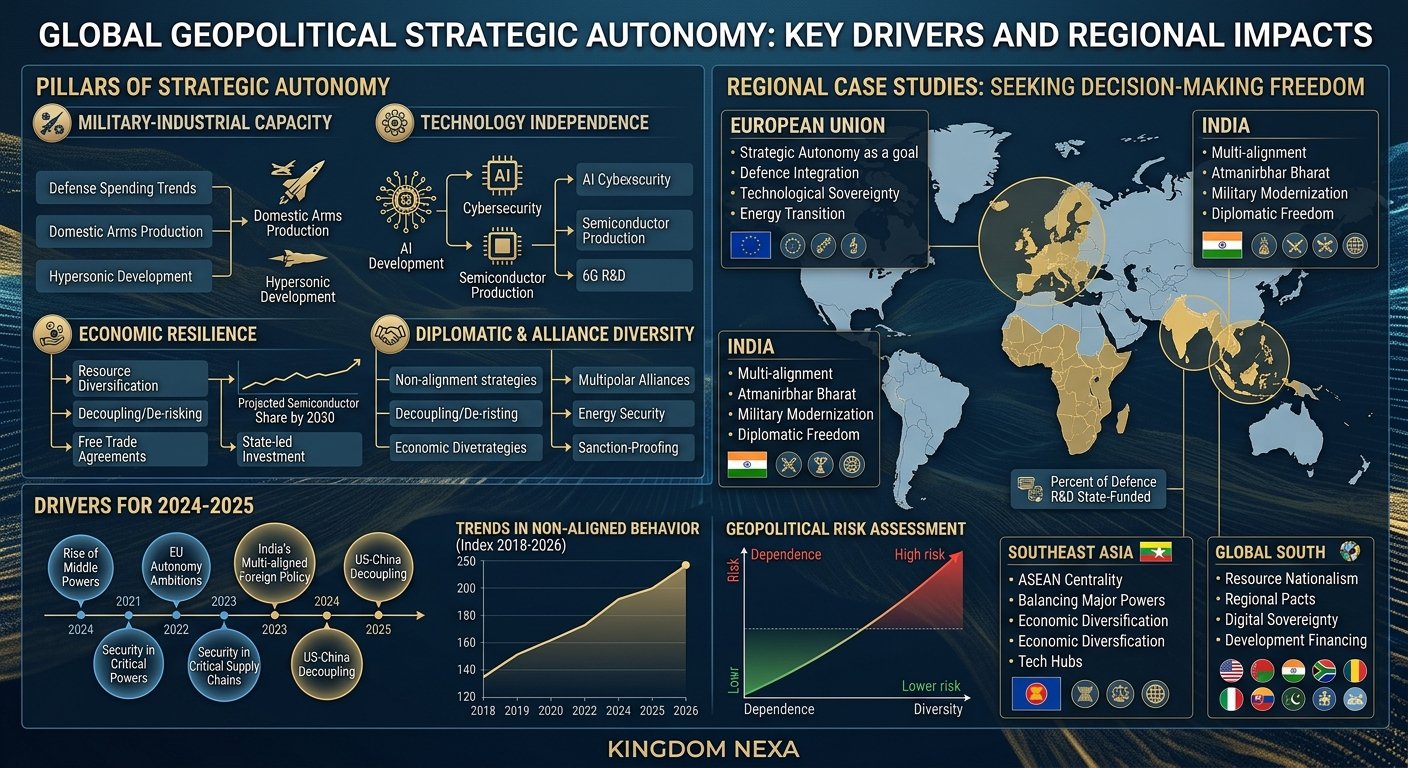
The international environment in 2025–2026 highlights a central feature of middle-power diplomacy: governments seek greater room for maneuver without necessarily abandoning existing alliances or partnerships.
Canada’s search for strategic autonomy
Canada’s diplomatic debate reflects concerns about great-power rivalry, economic vulnerability, and the reliability of established international arrangements. In September 2025, Carney publicly framed the challenge in terms of how a middle power could respond to an eroding rules-based order and more intense strategic competition.
The broader strategic question is how Canada can diversify trade and diplomatic relationships while retaining the advantages of geographic proximity to the United States and participation in NATO. Diversification can increase resilience, but it cannot quickly remove deep economic and security dependencies.
Indonesia and ASEAN’s regional role
Indonesia’s approach illustrates the importance of regional institutions. ASEAN provides a forum in which Southeast Asian governments can coordinate positions and maintain dialogue with external powers, including China, the United States, Japan, India, and Australia.
At the October 2025 East Asia Summit in Kuala Lumpur, participating leaders reaffirmed the forum’s role in dialogue and cooperation on political, strategic, and economic questions. The meeting also connected discussions of regional resilience with wider BRICS and G20 engagement.
ASEAN’s convening power is significant, but its members do not always agree on security threats, economic priorities, or how to respond to disputes. Its influence therefore depends on sustained diplomatic engagement and the ability to find workable common positions.
Brazil and South Africa in wider governance debates
Brazil and South Africa illustrate how middle-power diplomacy can seek changes to global governance while continuing to participate in existing institutions.
Their engagement through the G20 and BRICS provides channels for discussing development finance, representation, trade, and international economic reform. Yet these groupings are not unified middle-power alliances: their members differ in capabilities, domestic priorities, and relations with established powers.
The Council on Foreign Relations’ December 2025 analysis highlights the dual role of middle powers: they can challenge aspects of great-power leadership while also seeking to preserve the institutions that facilitate international cooperation.
India and multi-alignment
India demonstrates why middle-power diplomacy should not be reduced to neutrality or equidistance between rival powers. It participates in BRICS and the Shanghai Cooperation Organisation while also cooperating with the United States, Japan, and Australia through the Quad.
These relationships serve different interests. They allow India to engage with multiple diplomatic groupings without accepting an exclusive strategic alignment across every issue. Carnegie Endowment’s 2026 analysis identifies this pattern of multi-alignment as an important feature of contemporary diplomacy.
The broader lesson is that a country’s diplomatic flexibility can be a source of influence, but it may also generate tensions when partners expect clearer commitments.
The Economic, Military, and Technological Dimensions
Middle power diplomacy is not limited to political negotiations. Economic relationships, defense capabilities, technological expertise, and geographic position all influence what a country can accomplish internationally.
Economic interdependence and trade diversification
Middle powers often depend on international markets for exports, energy, investment, and industrial inputs. These connections create opportunities for cooperation but also expose governments to external pressure.
Diversifying trade partners, securing alternative supply routes, attracting investment, and coordinating standards can improve resilience. However, economic diversification is costly when existing partners dominate a country’s market access or supply chains.
Governments must balance efficiency against resilience. Maintaining multiple suppliers may increase short-term costs, but it can reduce the consequences of sanctions, export restrictions, shipping disruptions, or sudden diplomatic disputes.
Military capabilities, alliances, and deterrence
Middle powers differ considerably in military strength. Australia and South Korea have advanced defense capabilities and established security partnerships; other states rely more heavily on regional cooperation, diplomacy, or geographically favorable positions.
Military alliances can amplify a middle power’s security, interoperability, and influence. At the same time, alliance commitments may constrain diplomatic flexibility or create risks of entanglement in conflicts.
The strategic challenge is to combine credible defense, diplomatic engagement, and crisis management without assuming that military cooperation alone can resolve political disputes.
Technology, cybersecurity, and critical infrastructure
Technology is an increasingly important field of international competition. Semiconductors, artificial intelligence, telecommunications, satellite systems, cybersecurity, and critical minerals affect national security and economic competitiveness.
Middle powers with specialized technological capabilities can influence international standards, negotiate technology partnerships, and participate in supply-chain coalitions. Countries with smaller domestic industries may gain influence by developing regulatory expertise or coordinating regional approaches.
Digital diplomacy also creates vulnerabilities. Cyberattacks, disinformation, dependence on foreign platforms, and restrictions on advanced technology can reduce strategic autonomy. Cooperation on cybersecurity and responsible technology governance can help address these risks.
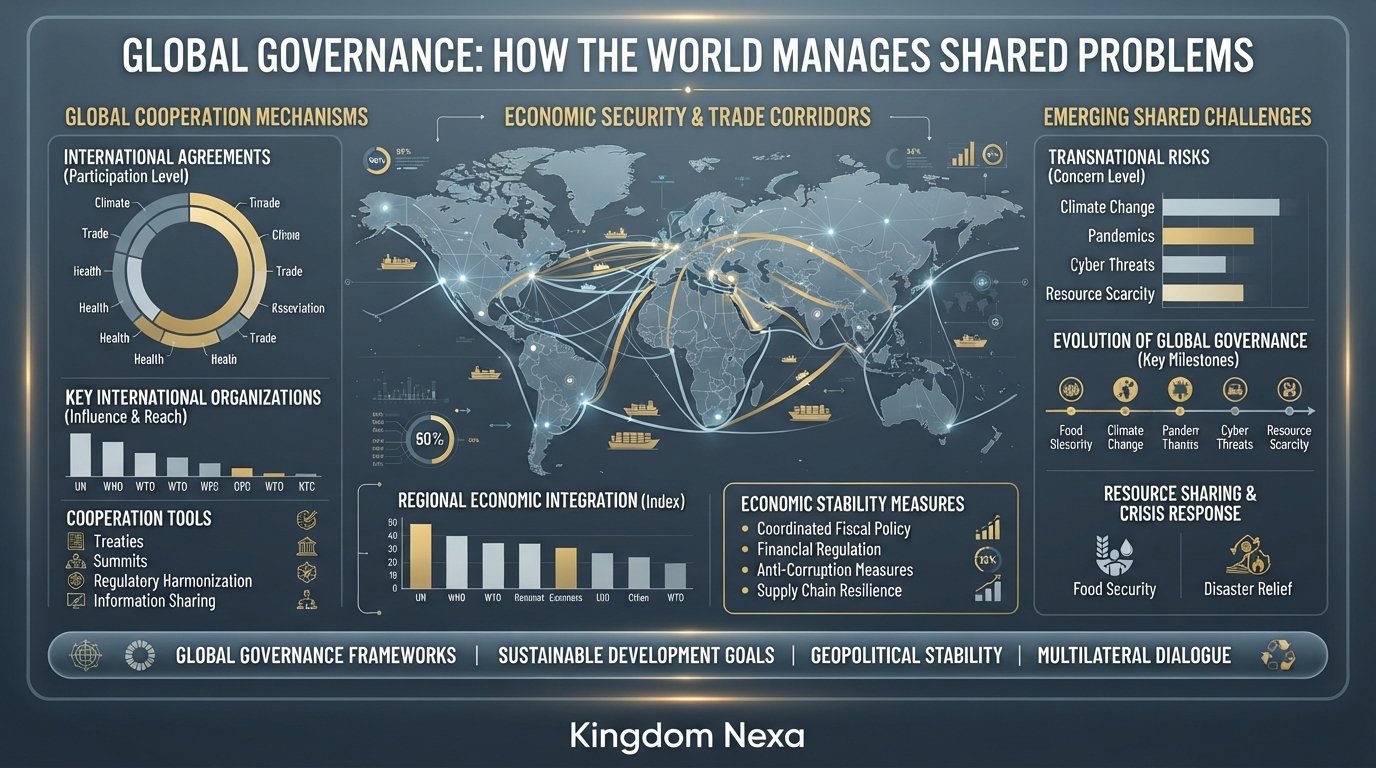
The Role of International Organizations and International Law
International institutions offer middle powers platforms for negotiation and coalition-building, although the extent of their influence varies by institution.
| Institution or forum | Diplomatic opportunity | Principal limitation |
|---|---|---|
| United Nations | Peace and security, international law, development, and humanitarian cooperation | Security Council vetoes and divisions among members |
| G20 | Economic coordination, financial stability, trade, and development | Decisions depend heavily on political agreement and implementation |
| WTO | Trade rules and dispute settlement | Negotiating deadlock and enforcement challenges |
| ASEAN | Regional dialogue, economic cooperation, and security consultations | Consensus requirements and differing national priorities |
| BRICS | Coordination on development, finance, and reform of global governance | Diverse interests and limited agreement on some strategic issues |
Participation in these forums can help a middle power amplify its voice, but membership does not confer equal influence over outcomes. Formal voting rights, institutional rules, financial contributions, economic leverage, and relationships with larger countries all matter.
Sovereignty, treaties, and international law
International law can be especially important to states that lack the capacity to impose their preferences through coercion. Rules concerning sovereignty, the peaceful settlement of disputes, treaty obligations, and maritime rights provide frameworks for challenging unilateral actions and managing disagreements.
Middle powers can contribute by supporting treaty implementation, strengthening legal institutions, participating in international courts and tribunals, and encouraging peaceful dispute settlement.
However, legal rules do not enforce themselves. Their effectiveness depends on state compliance, institutional capacity, political pressure, and the willingness of governments to accept legal outcomes. Middle powers must also apply legal principles consistently if they want their advocacy to retain credibility.
Domestic Politics and Non-State Actors
A government’s international strategy depends partly on its domestic political environment. Elections, public opinion, economic pressures, legislative oversight, and national identity can influence foreign-policy choices.
A government may favor international cooperation but face resistance from industries concerned about competition, voters worried about security, or political groups opposed to international commitments. Changes of government can also alter diplomatic priorities and the continuity of long-term initiatives.
Non-state actors matter as well. Multinational companies influence investment and supply-chain decisions; universities and research institutions contribute technical expertise; humanitarian organizations provide field knowledge; and civil-society groups can mobilize attention around human rights and environmental issues.
These actors can strengthen diplomatic capacity, but their interests do not always align with public policy. Effective governments must distinguish private commercial objectives from broader national and international interests.
Major Challenges and Limitations of Middle Power Diplomacy
Despite its potential, middle power diplomacy faces persistent structural constraints.
Limited material capabilities
Diplomatic skill cannot fully compensate for a lack of military, financial, technological, or economic resources. A middle power may help shape negotiations but lack the leverage to compel a larger state to change its behavior.
Dependence on great powers
Security alliances, export markets, energy supplies, and technology imports can limit a government’s freedom of action. When major powers demand competing commitments, middle powers may have to accept trade-offs rather than find a solution that satisfies every partner.
Fragmentation among middle powers
Countries classified as middle powers do not necessarily share the same strategic interests. They may disagree over territorial disputes, sanctions, human rights, development priorities, or the appropriate response to military aggression.
Their coalitions are therefore usually issue-specific rather than permanent. Shared status does not automatically create political solidarity.
Credibility and inconsistent principles
A country that advocates international law in one dispute but applies different standards in another may lose diplomatic credibility. This can undermine mediation, coalition-building, and claims to principled leadership.
Maintaining consistency is difficult when security dependencies or domestic economic interests conflict with stated values. Nevertheless, transparent explanations and reasonably consistent policies help preserve trust.
Domestic resources and public expectations
Diplomatic initiatives require sustained funding, professional expertise, development programs, defense readiness, and political attention. Governments may struggle to maintain these commitments when facing fiscal pressure or competing domestic priorities.
Middle powers also risk overstating their international influence. A strong diplomatic profile is not the same as a measurable ability to change outcomes.
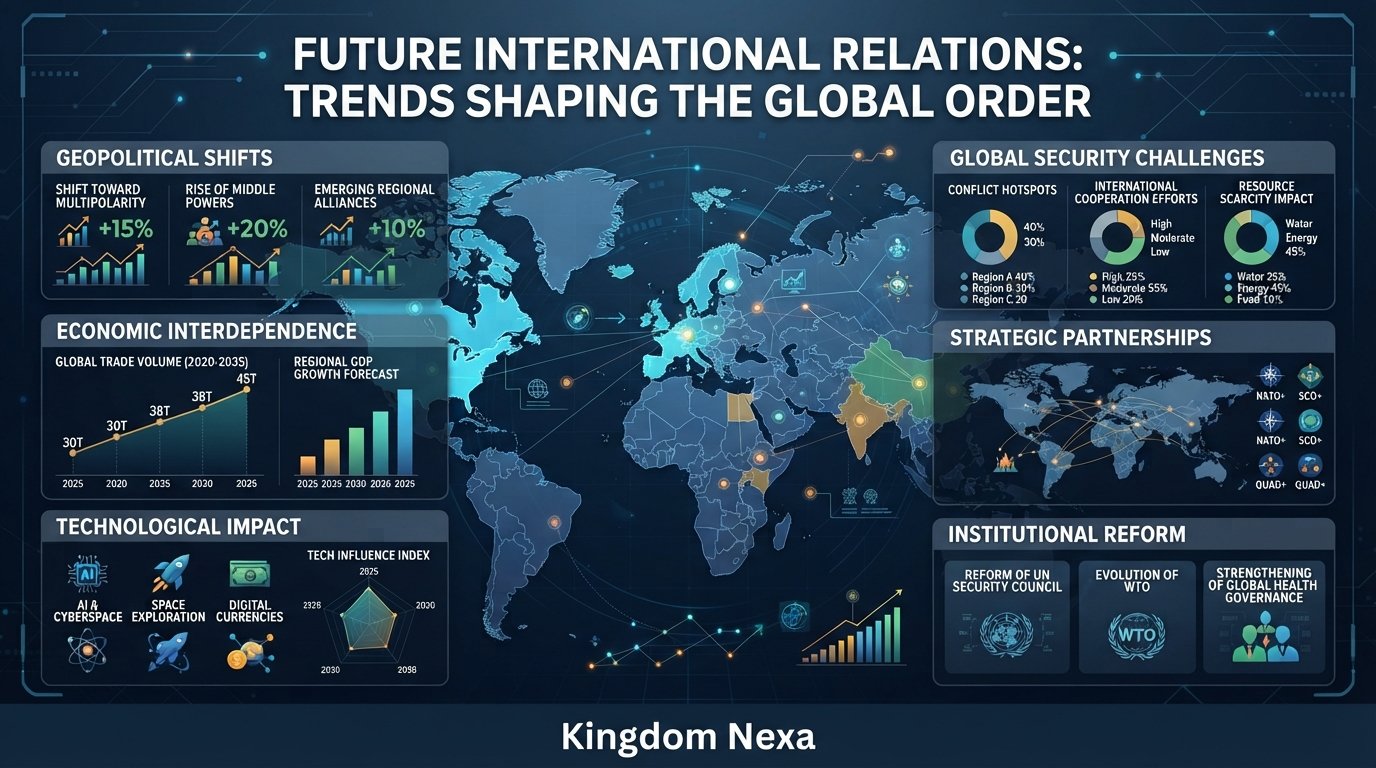
Future Scenarios: How Could Middle Power Diplomacy Evolve?
The future will depend on how international competition develops, whether multilateral institutions remain effective, and how middle powers manage their own differences. Three broad scenarios are plausible; none should be treated as a certain prediction.
Scenario 1: Stronger issue-based coalitions
Middle powers expand cooperation on climate, trade, maritime security, public health, and emerging technologies. Rather than creating a single new bloc, they establish flexible partnerships that can deliver practical results in specific areas.
What would support this scenario: sustained diplomatic investment, shared objectives, and credible implementation.
Scenario 2: Selective alignment with competing powers
Intensifying strategic rivalry encourages governments to strengthen some security partnerships while maintaining economic or diplomatic ties with other major powers. This may preserve flexibility, but it can also produce inconsistent positions and expose countries to pressure from multiple sides.
What would support this scenario: persistent great-power competition and continued economic interdependence.
Scenario 3: Reduced diplomatic room for maneuver
More restrictive trade policies, fragmented technology standards, military crises, and competing demands from major powers make independent initiatives harder to sustain. Middle powers may prioritize national resilience and immediate security over broader international cooperation.
What would support this scenario: severe geopolitical crises, weakened institutions, and growing pressure to choose strategic sides.
The scenarios can coexist. A country might expand climate cooperation with one group, deepen defense ties with another, and disagree with both over trade policy. This flexibility is a defining feature of contemporary diplomacy, but it also requires careful prioritization.
The most useful indicators to monitor are the durability of international institutions, the frequency of successful cross-regional coalitions, changes in trade and technology dependencies, the implementation of diplomatic agreements, and the willingness of governments to bear the costs of collective action.
Frequently Asked Questions About Middle Power Diplomacy
1. What is middle power diplomacy in simple terms?
Middle power diplomacy is the practice of using negotiation, international partnerships, economic cooperation, and specialized expertise to influence global affairs without possessing the overwhelming power of a superpower.
2. Which countries are considered middle powers?
Common examples include Canada, Australia, South Korea, Indonesia, Brazil, South Africa, and Türkiye. Classification varies according to a country’s resources, diplomatic behavior, regional influence, and the analytical framework being used.
3. Why is middle power diplomacy important?
It can help bridge diplomatic disagreements, strengthen international institutions, promote cooperation, and provide smaller coalitions with greater negotiating influence. It also gives countries alternatives to relying exclusively on great powers.
4. What is the difference between a middle power and a great power?
Great powers possess extensive military, economic, and strategic capabilities that allow them to influence the international system broadly. Middle powers generally have more limited resources and rely more heavily on partnerships, specialized expertise, and institutional cooperation.
5. What is niche diplomacy?
Niche diplomacy is a strategy in which a country concentrates diplomatic resources on selected issues where it has particular expertise or influence. Examples include climate negotiations, public health, peacebuilding, and technology governance.
6. Can middle powers remain neutral during great-power competition?
Some can maintain non-alignment or strategic autonomy on particular issues, but neutrality is not universal. Many middle powers have military alliances, economic dependencies, or regional security interests that influence their decisions. They may cooperate with competing powers in different policy areas.
7. How do international organizations help middle powers?
Organizations such as the United Nations, G20, WTO, and ASEAN provide platforms for negotiation, collective action, and agenda-setting. Their effectiveness depends on institutional rules, member-state agreement, and the implementation of decisions.
8. What are the main limitations of middle power diplomacy?
The principal limitations include insufficient material resources, dependence on major powers, competing domestic priorities, disagreements among potential partners, and the difficulty of enforcing international commitments.
9. How does middle power diplomacy affect the global economy?
It can support trade diversification, investment partnerships, supply-chain resilience, development finance, and international economic rules. It can also help governments coordinate responses to economic coercion and market disruptions, although outcomes depend on their collective leverage.
10. What is the future of middle power diplomacy?
Its future will likely depend on flexible coalitions, strategic autonomy, regional cooperation, and the capacity to address shared challenges. However, increasing geopolitical fragmentation could restrict cooperation and intensify pressure on countries to choose between competing strategic partners.
Conclusion
Middle Power Diplomacy has become an important framework for understanding how countries outside the traditional great-power hierarchy influence international affairs. Through multilateral institutions, issue-based coalitions, mediation, economic partnerships, and specialized expertise, these states can contribute to negotiations and shape outcomes beyond what their individual resources might suggest.
Canada, Australia, South Korea, Indonesia, Brazil, and South Africa demonstrate that there is no single model. Their strategies reflect different security environments, economic dependencies, political priorities, and regional ambitions. Some rely heavily on alliances, while others emphasize strategic autonomy and diversified international relationships.
Yet middle powers face real constraints. Diplomatic credibility cannot replace material capabilities entirely, and cooperation is difficult when national interests diverge. Their influence depends on selecting achievable objectives, building durable partnerships, and translating diplomatic commitments into practical results.
In a world marked by great-power competition, technological rivalry, economic uncertainty, and pressure on international institutions, middle power diplomacy offers neither a guaranteed solution nor an alternative to power politics. Its significance lies in creating additional channels for cooperation, negotiation, and collective influence. Whether these states can preserve that role will depend on their willingness to work together and their ability to turn shared interests into effective international action.