Introduction
Global affairs analysis has become increasingly important as political, economic, security, technological, and environmental developments interact across national borders. A conflict in one region can affect energy prices, shipping routes, migration, financial markets, food security, and diplomatic relations thousands of kilometers away. At the same time, competition over artificial intelligence, semiconductors, critical minerals, trade, and military capabilities is reshaping the international system.
As of 18 September 2026, the global environment is marked by several overlapping pressures: continuing wars and security crises, sharper strategic competition between major powers, renewed debates over the effectiveness of multilateral institutions, economic fragmentation, rapid technological change, and persistent climate and humanitarian challenges. The UN’s 2026 Global Risk Report identifies political risks and the possibility of large-scale war as especially prominent, while also highlighting AI and climate-related risks. (United Nations)
This article explains how to conduct meaningful Global Affairs Analysis, examines the major forces shaping international relations in 2026, and shows how geopolitical developments connect with economics, technology, security, international law, and global governance.
What Is Global Affairs Analysis?
Global Affairs Analysis is the systematic study of international events, relationships, institutions, policies, conflicts, economic trends, technological developments, and transnational challenges to understand how they affect the international system.
Unlike a simple news summary, global affairs analysis asks deeper questions:
- Who are the principal actors?
- What are they trying to achieve?
- Why are their interests converging or conflicting?
- How does geography influence their choices?
- What economic and security constraints exist?
- Which international institutions can influence the situation?
- What are the regional and global consequences?
- What plausible developments could follow?
A useful analysis therefore separates facts from interpretation. A government statement, for example, establishes what that government said; it does not automatically establish that its claims are independently verified.
Why Global Affairs Analysis Matters
International developments increasingly have cross-border consequences.
A military conflict can disrupt commodity markets. Trade restrictions can affect semiconductor production. A diplomatic dispute can alter investment decisions. A technological breakthrough can change military calculations. Climate-related shocks can influence migration and food prices.
The IMF’s July 2026 outlook illustrates this interconnectedness: it projects global growth of 3.0% in 2026 and 3.4% in 2027, while warning that the outlook remains uneven and exposed to renewed conflict, financial repricing, and stalled disinflation. (The NewsMarket)


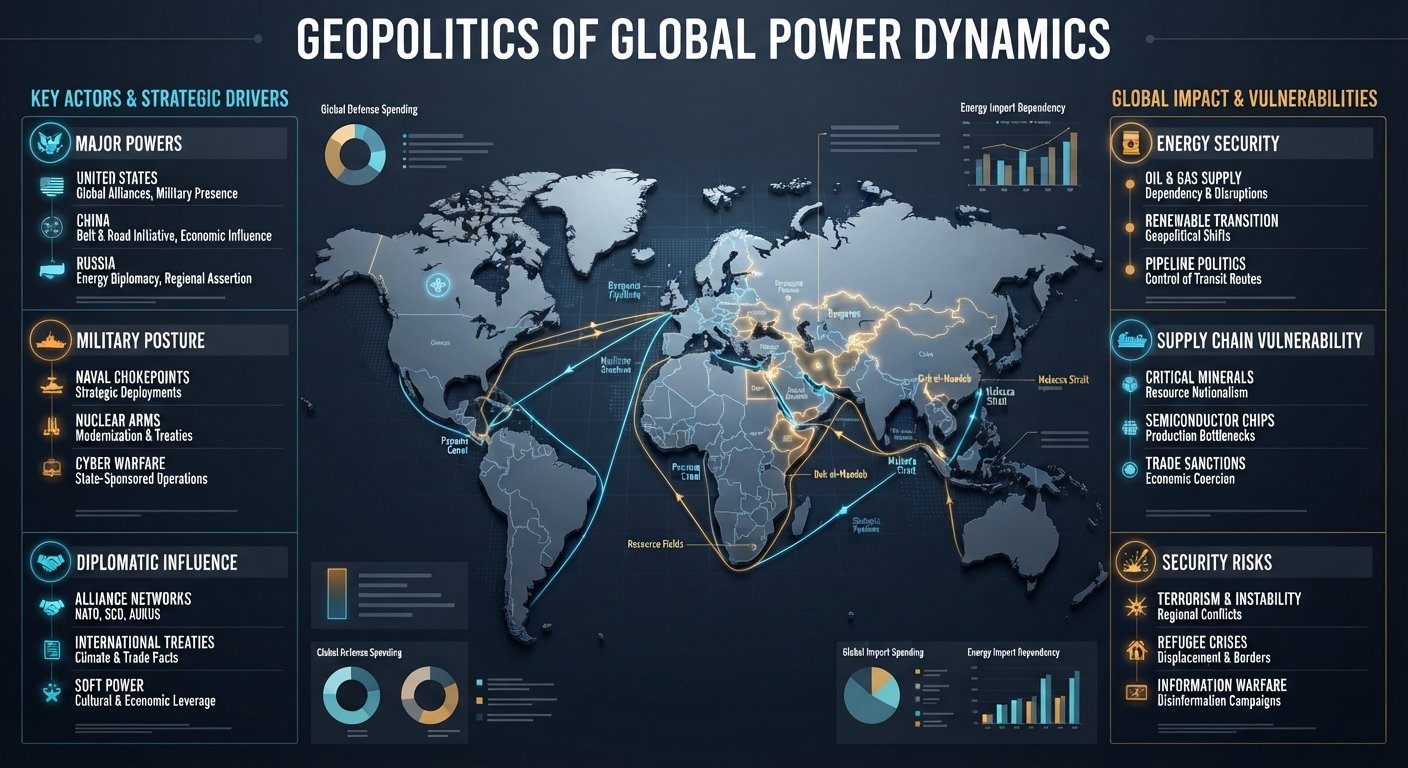
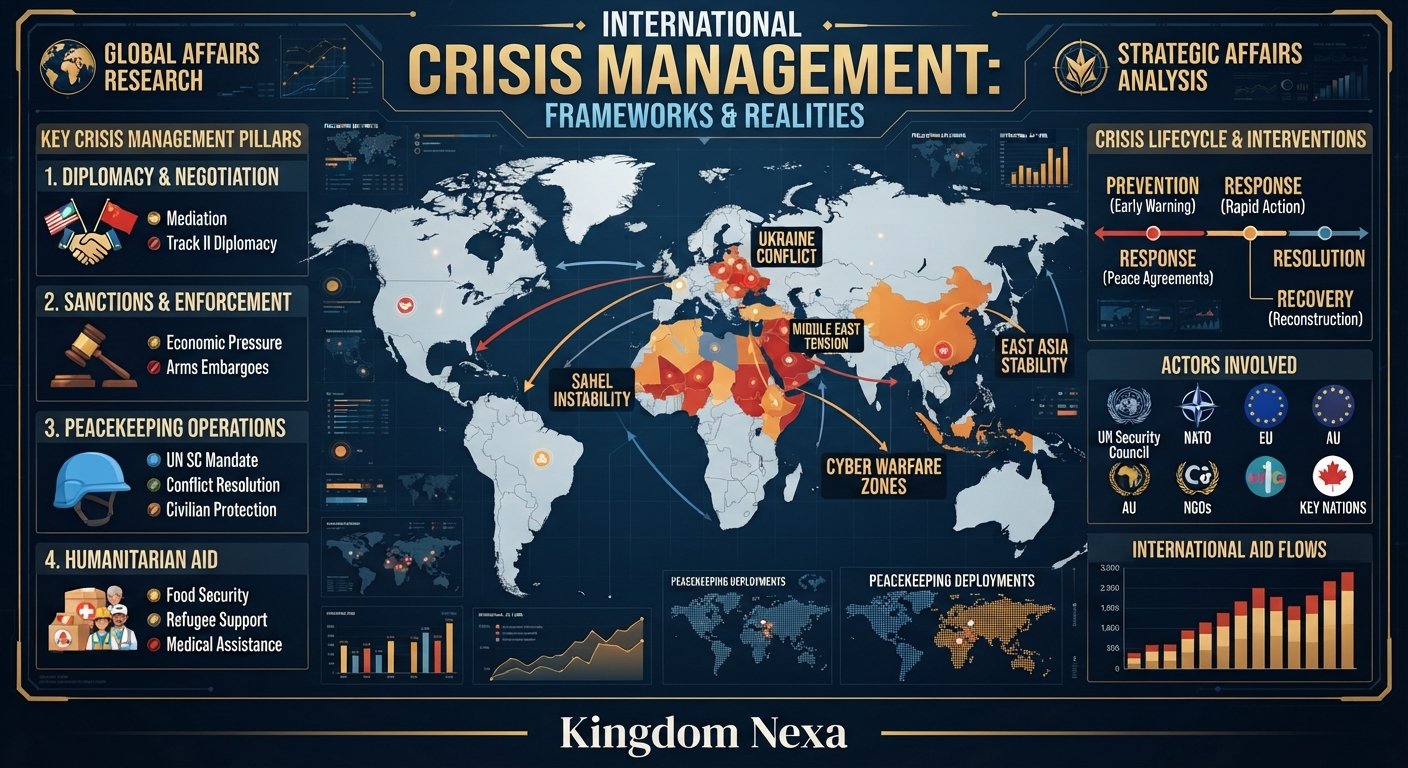
Image/Infographic: A world geopolitical map showing major powers, strategic regions, major trade corridors, energy routes, and important geopolitical flashpoints.
Placement: Immediately after this H2 section.
Purpose: Demonstrate visually how political, economic, and security developments are interconnected across regions.
The Changing International System
The international system is not simply moving from one dominant power to another. Instead, it is becoming more complicated, with military, economic, technological, demographic, and diplomatic power distributed across multiple centers.
From Unipolarity Toward a More Competitive System
The post-Cold War period was characterized by considerable U.S. influence, but the international environment has evolved substantially.
China has expanded its economic, technological, diplomatic, and military capabilities. India has become an increasingly important economic and strategic actor. The European Union remains a major economic and regulatory power, while Russia continues to exercise significant military and energy influence despite economic constraints and international isolation.
Middle powers are also becoming more consequential. Countries such as Türkiye, Saudi Arabia, Indonesia, Brazil, South Korea, Australia, and others increasingly seek room for independent diplomatic maneuver.
This does not necessarily mean that the world has become completely multipolar. Rather, power is becoming more distributed and issue-specific.
Strategic Autonomy and Flexible Partnerships
Countries increasingly seek relationships that provide options rather than permanent alignment.
A state may cooperate with the United States on defense, China on trade, Gulf states on energy, India on technology, and regional organizations on diplomacy.
The expansion and evolution of BRICS illustrates this complexity. At its 2026 New Delhi summit, the expanded grouping discussed trade, health, agriculture, technology, and other international issues, while differences among members remained visible. (Financial Times)
The important analytical point is that institutional membership does not automatically produce unified strategic behavior.
Major Geopolitical Issues Shaping 2026
War, Deterrence, and Strategic Competition
Security remains one of the central dimensions of contemporary global affairs.
SIPRI estimates that global military expenditure reached $2.887 trillion in 2025, representing an 11th consecutive year of growth. Global military spending increased 2.9% in real terms, while European spending increased 14% and spending in Asia and Oceania increased 8.1%. (SIPRI)
The numbers demonstrate an important structural trend: governments are allocating greater resources to defense amid perceived security risks.
Europe and the Russia-Ukraine War
The Russia-Ukraine conflict remains a major factor in European security calculations.
Russia’s continuing military operations and European support for Ukraine have contributed to higher European defense spending. NATO members committed at the 2025 Hague Summit to reach 5% of GDP annually by 2035, consisting of at least 3.5% for core defense requirements and up to 1.5% for defense- and security-related expenditures. (NATO)
Recent developments continue to demonstrate how the conflict affects relations between Russia and European states. For example, Reuters reported on September 18, 2026, that Russia summoned Britain’s chargé d’affaires over London’s military support for Ukraine. (Reuters)
The broader analytical issue is not simply battlefield activity. It involves European defense policy, NATO’s future force posture, sanctions, energy security, industrial capacity, Ukraine’s long-term security arrangements, and relations between Russia and Western governments.
Middle Eastern Security
The Middle East remains another major source of geopolitical uncertainty.
As of September 18, 2026, Reuters reported that the United States-Iran war remained unresolved and was affecting regional security, shipping, energy markets, and diplomatic relationships. (Reuters)
The conflict demonstrates why regional events cannot be examined in isolation. Disruptions involving the Red Sea or Persian Gulf can affect shipping costs, insurance premiums, oil markets, supply chains, and inflation far beyond the Middle East.
U.S.-China Strategic Competition
The relationship between the United States and China remains one of the most consequential bilateral relationships in global affairs.
The competition extends beyond military power. It includes:
- Semiconductors
- Artificial intelligence
- Trade
- Critical minerals
- Supply chains
- Industrial policy
- Investment
- Taiwan
- Cybersecurity
- Space technology
- Global diplomatic influence
A planned Trump-Xi meeting in Washington on September 24, 2026, illustrates the combination of rivalry and continued engagement. Reuters reports that trade, Taiwan, Iran, and artificial intelligence are among the issues surrounding the meeting. (Reuters)
The relationship therefore should not be characterized simply as cooperation or confrontation. It contains both simultaneously.
How Economics Has Become a Geopolitical Tool
Economic policy has become increasingly intertwined with national security.
Trade Fragmentation
For decades, globalization encouraged countries to build highly integrated production networks. Today, governments increasingly consider resilience, strategic dependence, and national security when making trade and investment decisions.
Export controls, tariffs, investment screening, sanctions, industrial subsidies, and restrictions on sensitive technologies are increasingly part of geopolitical competition.
The WTO’s 2026 World Trade Report estimates that a highly fragmented global economy divided into geopolitical blocs could reduce global GDP by 5.1% and global exports by 18.6% compared with a more integrated baseline. (World Trade Organization)
These are scenario estimates rather than predictions, but they demonstrate the economic cost associated with deep fragmentation.
Energy Security
Energy remains a strategic issue because states depend on reliable supplies of oil, gas, electricity, and increasingly critical minerals.
Wars or sanctions can alter energy flows. Maritime insecurity can increase transportation costs. The energy transition creates new dependencies involving lithium, cobalt, nickel, rare earth elements, copper, and other materials.
Consequently, energy policy is no longer only an economic or environmental issue. It is also a foreign-policy and national-security issue.
Supply Chains and Economic Resilience
Companies and governments increasingly examine where strategic goods are produced.
The objective is often not complete economic self-sufficiency, which would be costly and difficult, but greater resilience.
This can involve:
- Diversifying suppliers
- Increasing domestic production
- Building strategic reserves
- Developing alternative shipping routes
- Strengthening semiconductor capacity
- Protecting critical infrastructure
Global affairs analysis therefore increasingly requires understanding corporate supply chains alongside conventional diplomacy.
Technology and the New Geopolitics
Technology has become one of the defining dimensions of international competition.
Artificial Intelligence
Artificial intelligence affects economic productivity, military systems, information environments, cybersecurity, scientific research, and political communication.
The United Nations has established an Independent International Scientific Panel on AI and a Global Dialogue on AI Governance. The first Global Dialogue took place in Geneva in July 2026, with another scheduled for New York in May 2027. (United Nations)
The challenge is particularly difficult because governments want technological benefits while also worrying about military applications, misinformation, surveillance, cybersecurity, employment disruption, and concentration of technological power.
Semiconductors
Advanced semiconductors are strategically important because they underpin AI systems, communications, advanced weapons, automobiles, industrial machinery, and consumer electronics.
This makes semiconductor manufacturing and access to advanced chips a geopolitical issue rather than merely a commercial one.
The U.S.-China relationship illustrates the problem. Reuters reports that advanced chip access and technology restrictions are among the issues surrounding current bilateral negotiations. (Reuters)
Cybersecurity and Digital Infrastructure
Cyber operations can affect governments, financial systems, telecommunications, energy networks, transportation, and military infrastructure.
Unlike conventional military power, cyber capabilities can sometimes be deployed below the threshold of open warfare. This creates difficulties for deterrence, attribution, and international law.
The Role of International Institutions
Multilateral institutions remain central to global affairs even when their effectiveness is contested.
United Nations
The United Nations provides a forum for diplomacy, humanitarian coordination, peacekeeping, development, international law, and global norm-setting.
The 81st General Assembly session opened on September 8, 2026, under the theme “Restoring Trust, Managing Transformation: A United Nations That Delivers for All.” Its priorities include peace and security, sustainable development, climate resilience, human rights, AI governance, and multilateral reform. (United Nations)
The 2026 General Debate is scheduled for September 22–26 and September 28. The agenda also includes high-level meetings on climate action, sea-level rise, pandemic preparedness, and nuclear disarmament. (United Nations)
The significance is broader than the speeches themselves. The UN remains one of the few institutions in which virtually every sovereign state participates in a common diplomatic framework.
NATO
NATO remains central to Euro-Atlantic security.
Its 2025 decision to pursue 5% of GDP in defense and security-related expenditure by 2035 represents a substantial change in the alliance’s defense planning framework. (NATO)
This affects defense industries, military procurement, infrastructure, readiness, deterrence, and relations between European allies and North America.
IMF and WTO
The IMF and WTO address different dimensions of international economic governance.
The IMF focuses primarily on macroeconomic stability, financial support, surveillance, and monetary and fiscal issues. The WTO provides rules and institutional mechanisms for international trade.
Both face a more complicated geopolitical environment in which economic integration increasingly intersects with national-security concerns.
Humanitarian Affairs and Global Stability
Humanitarian conditions are a major component of global affairs analysis because conflict and instability often produce consequences beyond the battlefield.
According to UNHCR’s Global Trends 2025, 117.8 million people were forcibly displaced worldwide at the end of December 2025. This included refugees, asylum-seekers, people in need of international protection, and internally displaced people. (UNHCR)
Large-scale displacement can influence neighboring countries, international aid systems, domestic politics, labor markets, urban infrastructure, and migration policy.
Humanitarian analysis should therefore consider both immediate needs and longer-term political consequences.
Climate Change as a Geopolitical Issue
Climate change increasingly intersects with security, development, migration, agriculture, energy, and international finance.
Climate-related shocks can intensify competition over water, food, land, and infrastructure. They can also increase pressure on vulnerable states.
The UN’s 81st General Assembly has made climate resilience a major priority, with a high-level meeting on climate action and a separate meeting addressing sea-level rise scheduled during the September 2026 high-level period. (United Nations)
Climate diplomacy is therefore no longer confined to environmental negotiations. It increasingly affects development finance, energy security, trade policy, migration, and strategic stability.
A Practical Framework for Global Affairs Analysis
A strong analysis can be organized around eight questions.
Who?
Identify governments, leaders, international organizations, corporations, armed groups, civil society organizations, and other relevant actors.
What?
Establish exactly what happened, using dated and verifiable information.
Why?
Examine political interests, economic incentives, security concerns, history, geography, and domestic pressures.
Where?
Geography often determines strategic importance. Ports, borders, waterways, energy corridors, mountains, chokepoints, and proximity to markets can influence state behavior.
When?
Historical context prevents analysts from treating recent developments as isolated events.
How?
Examine the tools available to actors, including diplomacy, sanctions, military force, trade, investment, alliances, technology, and information campaigns.
So What?
Identify the consequences for regional security, economic stability, humanitarian conditions, and international institutions.
What Next?
Develop several plausible scenarios while clearly identifying uncertainty rather than presenting one outcome as inevitable.
What Could Shape the International System Next?
Future developments will depend on several interacting variables.
Scenario 1: Managed Strategic Competition
Major powers could maintain intense competition while preserving diplomatic channels and economic relationships.
Under this scenario, rivalry would continue in technology, security, and trade, but crisis-management mechanisms could limit escalation.
Scenario 2: Deeper Fragmentation
A more divided international economy could emerge if geopolitical blocs become increasingly separated.
Trade restrictions, technology controls, sanctions, competing standards, and duplicated supply chains could increase costs.
The WTO’s fragmentation scenarios demonstrate that deeper economic separation could carry significant global economic costs. (World Trade Organization)
Scenario 3: Renewed Multilateral Cooperation
A different trajectory would involve stronger cooperation on areas where national interests overlap, including climate change, AI safety, pandemic preparedness, trade, maritime security, and nuclear risk reduction.
The UN’s current AI governance mechanisms demonstrate that multilateral institutions are attempting to create such frameworks, although their effectiveness will depend on sustained participation by major powers. (United Nations)
These scenarios are analytical frameworks, not predictions. Actual outcomes could combine elements of all three.
Frequently Asked Questions
What is Global Affairs Analysis?
Global Affairs Analysis is the systematic examination of international political, economic, security, technological, social, environmental, and diplomatic developments and their wider consequences.
Why is Global Affairs Analysis important?
It helps readers understand how events in one country or region can influence international security, trade, investment, migration, energy markets, technology, and diplomatic relations.
What is the difference between geopolitics and global affairs?
Geopolitics emphasizes how geography, power, strategic interests, and international competition shape state behavior. Global affairs is broader and also includes economics, international institutions, technology, climate, humanitarian issues, and transnational challenges.
What are the major global affairs issues in 2026?
Major issues include ongoing armed conflicts, strategic competition among major powers, economic fragmentation, energy security, AI governance, technological competition, climate risks, humanitarian displacement, and reform of international institutions.
How does the economy influence geopolitics?
Trade, sanctions, investment, energy supplies, critical minerals, financial systems, and supply chains can provide states with both economic opportunities and strategic leverage.
Why is AI becoming a geopolitical issue?
AI can affect military capabilities, economic competitiveness, cybersecurity, information environments, scientific research, and national security. Governments are therefore increasingly treating advanced AI as a strategic technology.
What role does the United Nations play in global affairs?
The UN provides a forum for diplomacy and international cooperation while supporting peace and security, humanitarian action, development, human rights, international law, and global governance.
How does military spending affect global affairs?
Military expenditure provides an indication of how governments are allocating resources toward defense and security. Rising spending can strengthen deterrence but can also contribute to arms competition and place pressure on public finances.
Can Global Affairs Analysis predict future events?
It can identify trends, risks, drivers, and plausible scenarios, but international politics contains substantial uncertainty. Responsible analysis distinguishes evidence-based assessment from speculation and does not treat scenarios as guaranteed outcomes.
Conclusion
Global Affairs Analysis is ultimately about understanding connections. Military conflicts affect economies. Economic dependencies influence diplomacy. Technology changes strategic competition. Climate pressures influence migration and development. International institutions attempt to manage these interactions, often under significant political constraints.
The international system in 2026 is characterized by overlapping forms of competition rather than a single geopolitical contest. Military expenditure is rising, trade fragmentation remains a concern, strategic competition between major powers continues, AI is becoming an increasingly important governance issue, and humanitarian pressures remain substantial. At the same time, institutions such as the UN, NATO, IMF, and WTO continue to provide mechanisms through which states can cooperate, negotiate, and manage disputes. (SIPRI)
The most useful approach is therefore neither to view international affairs through a single national perspective nor to reduce complex events to headlines. Effective global affairs analysis examines actors, interests, geography, capabilities, institutions, constraints, evidence, and consequences together. That approach provides a more reliable foundation for understanding an international system that is increasingly interconnected, competitive, and difficult to predict.