Introduction
Why do states form alliances against some powerful countries while cooperating with others that may be equally or even more powerful? The answer cannot always be found by simply comparing military strength. A state may possess enormous economic and military capabilities yet generate relatively little fear if it is geographically distant, primarily defensive, or perceived as non-aggressive. Another state with fewer resources may appear more dangerous because it is nearby, possesses offensive capabilities, or is believed to have hostile intentions.
This puzzle lies at the heart of Balance of Threat Theory, one of the most influential approaches to understanding alliance formation and international security. Developed most prominently by political scientist Stephen M. Walt in The Origins of Alliances (1987), the theory argues that states tend to align against the state they perceive as the greatest threat, rather than automatically against the state with the greatest aggregate power. (JSTOR)
The theory refined traditional balance-of-power thinking by introducing threat perception into the analysis of international politics. This article explains its origins, four major sources of threat, balancing and bandwagoning, real-world applications, criticisms, contemporary relevance, and its value for understanding strategic competition.
What Is Balance of Threat Theory?
Balance of Threat Theory states that countries generally respond to perceived threats rather than simply to the distribution of material power.
Stephen Walt developed the theory as a refinement of balance-of-power theory. His central argument was that states are more likely to form alliances against countries they consider threatening than simply against countries that possess the greatest amount of power. (JSTOR)
A simplified representation is:
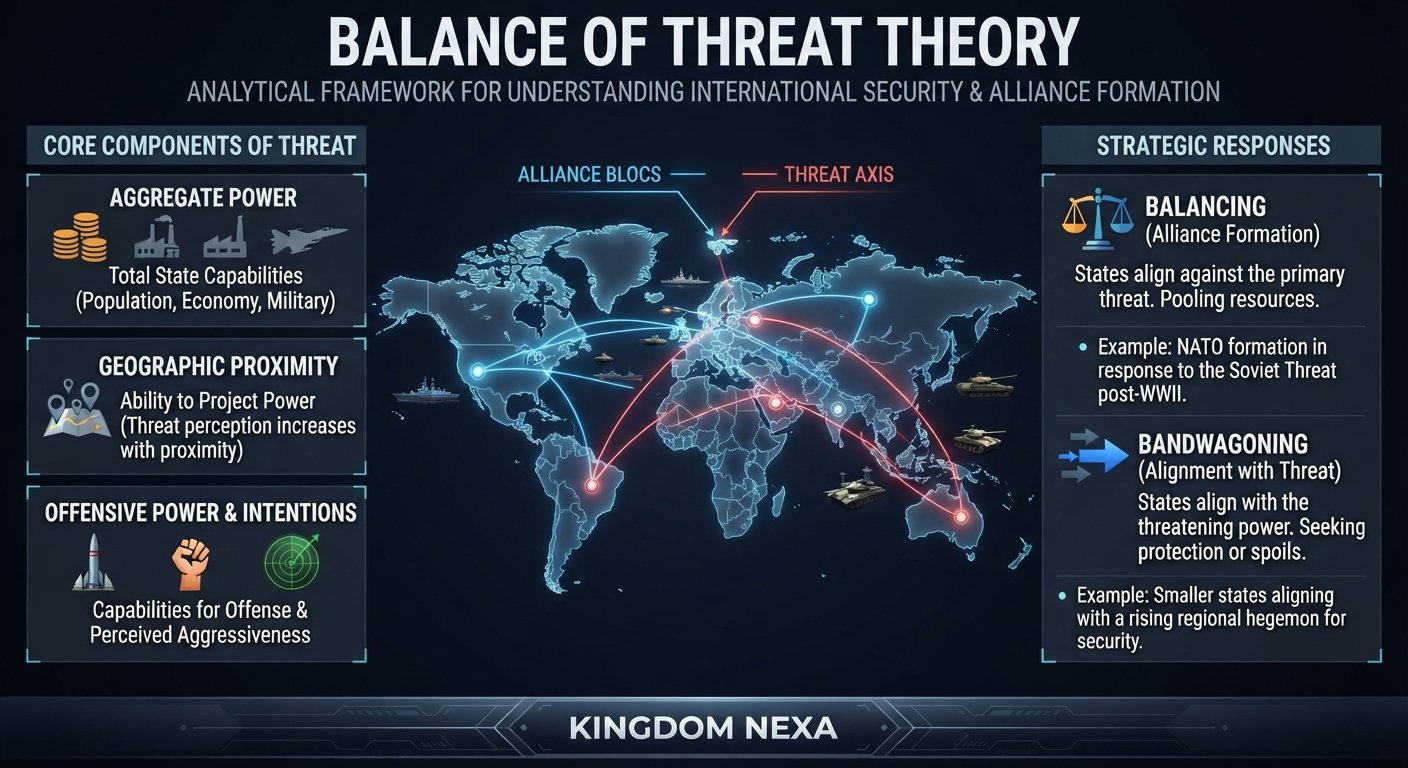
Perceived Threat = Aggregate Power + Geographic Proximity + Offensive Capability + Perceived Aggressive Intentions
These factors do not operate like a precise mathematical formula. Walt’s argument is that each contributes to a state’s assessment of how dangerous another state might be. Contemporary scholarship continues to describe these four variables as the core components of the theory. (OUP Academic)
The distinction between power and threat is crucial.
A powerful state is not automatically the most threatening state. A distant superpower may be less immediately threatening than a smaller neighboring country with substantial offensive capabilities and hostile intentions.
This makes Balance of Threat Theory particularly useful for explaining alliance behavior that appears puzzling under a simple balance-of-power model.
Historical Origins of Balance of Threat Theory
From Balance of Power to Balance of Threat
Balance of Threat Theory emerged from the broader realist tradition in international relations.
Classical and structural realists have long emphasized the importance of power and the distribution of capabilities. Kenneth Waltz’s structural realism, for example, places significant emphasis on the international system’s distribution of capabilities and the tendency of states to respond to shifts in relative power.
Walt challenged the assumption that states necessarily balance against the most powerful actor.
In The Origins of Alliances, published by Cornell University Press in 1987, Walt examined competing explanations for alliance formation and used diplomatic history and cases from the Middle East between 1955 and 1979 to develop his argument. His research concluded that states were more likely to align against perceived threats than automatically against the strongest state. (JSTOR)
The Southwest Asian Evidence
Walt subsequently tested the theory in a 1988 International Organization article examining Iran, Turkey, India, and Pakistan.
The study concluded that Balance of Threat Theory provided a better explanation of several alliance choices than alternative approaches because states tended to balance against the most threatening state rather than simply the most powerful one. (IDEAS/RePEc)
This helped establish Balance of Threat Theory as an important development within realist international-relations scholarship.
The Four Main Sources of Threat


Aggregate Power
Aggregate power refers broadly to the resources and capabilities available to a state.
These can include:
- Population
- Economic strength
- Military capabilities
- Industrial capacity
- Technological resources
- Natural resources
- Strategic infrastructure
- State capacity
Greater aggregate power can increase a state’s potential to threaten others because it gives the state more resources with which to influence events.
However, power alone does not determine threat.
A highly capable state located thousands of kilometers away may generate less immediate concern than a weaker state located directly on a country’s border.
Geographic Proximity
Geography strongly influences threat perception.
A state located nearby can generally project military power against its neighbors more easily than a distant state. Geographic proximity therefore increases the potential consequences of another state’s capabilities.
This helps explain why regional security dilemmas can become intense even when the countries involved are not global superpowers.
For example, a state’s assessment of a neighboring military power may differ substantially from its assessment of an equally powerful country separated by oceans.
Geography also affects:
- Mobilization times
- Supply lines
- Missile ranges
- Naval access
- Border security
- Strategic depth
- Economic vulnerability
- Access to transportation corridors
The importance of proximity means that geopolitical analysis cannot rely solely on global rankings of military or economic power.
Offensive Power
The third factor is offensive capability.
A state may have considerable military power but pose a relatively limited threat if its forces are primarily designed for territorial defense. Conversely, capabilities that allow a state to project force beyond its borders can increase perceptions of danger.
Examples may include:
- Long-range missiles
- Expeditionary forces
- Large naval capabilities
- Airpower
- Cyber capabilities
- Space-based systems
- Offensive military doctrines
- Strategic strike capabilities
The technological dimension has become increasingly complicated. Cyber operations, autonomous systems, artificial intelligence, precision weapons, drones and space capabilities can affect how states evaluate offensive potential.
Recent scholarship has specifically applied Balance of Threat Theory to emerging technologies, arguing that technological capabilities can become part of threat perception when they affect intelligence, warfare, critical infrastructure, or national security. (Springer)
Aggressive Intentions
The fourth component is perceived aggressive intention.
This is arguably the most difficult element to measure because intentions are not directly observable.
Governments may describe their military programs as defensive while neighboring states interpret them differently. Strategic doctrines, diplomatic statements, military deployments and historical behavior can therefore influence perceptions of intention.
Importantly, Balance of Threat Theory deals with perceived intentions, not necessarily objectively proven intentions.
That distinction matters.
A state can be perceived as aggressive even when its leaders insist that their policies are defensive. Conversely, a state may possess substantial offensive capabilities but generate less concern if others believe it has no intention of using them aggressively.
How Does Balance of Threat Theory Work?
The theory can be understood through a simple sequence:
Capabilities → Perception of threat → Strategic response → Alliance behavior
Suppose Country A observes a rapidly strengthening Country B.
If B is geographically distant, maintains defensive military policies, and has cooperative diplomatic relations with A, A may not regard B as its primary threat.
But if B is a nearby military power, possesses significant offensive capabilities, and appears willing to use force to alter the regional status quo, A’s threat perception may rise sharply.
Country A could then respond by:
- Increasing defense spending
- Strengthening its military
- Seeking external allies
- Deepening existing alliances
- Improving intelligence cooperation
- Developing new technologies
- Pursuing diplomatic partnerships
This is the essence of balancing against threat.
Balancing vs. Bandwagoning
What Is Balancing?
Balancing occurs when a state responds to a perceived threat by strengthening its position against that threat.
Balancing can be:
Internal balancing:
A state increases its own military, economic or technological capabilities.
External balancing:
A state forms or strengthens alliances and partnerships with other countries.
For example, a country might increase defense production while simultaneously expanding military cooperation with neighboring states.
What Is Bandwagoning?
Bandwagoning occurs when a state aligns with the threatening or powerful actor instead of opposing it.
Walt’s formulation treats balancing as the more common expected response, but recognizes circumstances in which bandwagoning can occur. (OUP Academic)
A vulnerable country might bandwagon because it:
- Fears abandonment by potential allies
- Believes resistance is impossible
- Expects economic benefits
- Wants protection
- Hopes to gain influence
- Seeks access to resources or territory
This differs from balancing because the state accepts alignment with the threatening power rather than organizing against it.
Balancing and Bandwagoning Are Not Always Binary
Real-world foreign policy is often more complicated.
Countries may simultaneously:
- Cooperate economically with a powerful state
- Maintain military ties with its competitors
- Avoid formal alliance commitments
- Build domestic military capabilities
- Participate in regional institutions
This behavior is often described using concepts such as hedging, strategic autonomy, or multi-alignment.
Consequently, Balance of Threat Theory is most useful as an analytical framework rather than a mechanical prediction of every foreign-policy decision.
Balance of Threat Theory vs. Balance of Power Theory
The difference can be summarized simply:
| Balance of Power | Balance of Threat |
|---|---|
| Focuses heavily on relative power | Focuses on perceived threat |
| Power is central | Power is one component |
| Strong states may trigger balancing | Threatening states trigger balancing |
| Less emphasis on intentions | Intentions matter |
| Geography is less central | Proximity matters |
| Offensive capabilities receive less independent emphasis | Offensive capability is a major variable |
Balance of Threat Theory does not reject power.
Instead, it argues that power becomes more threatening when combined with proximity, offensive capability and perceived aggressive intentions.
This is why it is better understood as a refinement of balance-of-power reasoning rather than a complete rejection of realism.
Why Threat Perception Matters in International Relations
One of the theory’s most important contributions is its recognition that international politics is influenced by perception.
States do not respond to capabilities in a vacuum.
Decision-makers interpret:
- Military exercises
- Force deployments
- Alliances
- Weapons programs
- Economic policies
- Diplomatic statements
- Historical behavior
- Leadership rhetoric
- Strategic geography
Two countries can observe the same military capability and reach different conclusions about its meaning.
This creates a fundamental problem known as the security dilemma: measures one country considers defensive may be interpreted by another as preparations for aggression.
Balance of Threat Theory therefore connects structural realism with elements of perception and strategic interpretation.
Historical and Contemporary Applications
The Middle East
The Middle East was central to Walt’s original empirical work.
His research examined alliance formation in the region from 1955 to 1979 and argued that states frequently aligned against perceived threats rather than simply joining the strongest actor. (JSTOR)
This was significant because Middle Eastern states faced changing combinations of military power, geography, ideology, external intervention and regional rivalry.
The case demonstrated why raw measurements of national power could not adequately explain alliance behavior.
Japan, China and the United States
The theory has also been applied to relations among Japan, China and the United States.
Research examining Japan’s threat perception toward China argues that aggregate power, geographical proximity, offensive capability and perceived intentions help explain changes in the U.S.-Japan alliance. (KCI)
The case is particularly useful because Japan faces a powerful nearby state while simultaneously maintaining extensive economic interaction with China.
From a Balance of Threat perspective, economic interdependence does not automatically eliminate security concerns. Military geography and threat perception can push states toward stronger security partnerships even when commercial relationships remain important.
NATO and Russia
European security provides another important contemporary application.
NATO’s 2022 Strategic Concept identified Russia as the Alliance’s “most significant and direct threat” and strengthened the emphasis on collective deterrence and defense. NATO also identified China as presenting challenges to Allied security, interests and values. (NATO)
From a Balance of Threat perspective, the important analytical question is not simply how much military power Russia possesses. It is how NATO members assess Russia’s capabilities, geographic position, military behavior and intentions.
That does not mean Balance of Threat Theory alone explains NATO policy. Institutions, historical relationships, domestic politics, treaty commitments and perceptions of U.S. credibility also matter.
Emerging Technologies
The theory is increasingly relevant beyond traditional military alliances.
Artificial intelligence, cyber capabilities, satellites, autonomous systems and advanced weapons can alter threat calculations even when they do not immediately change the conventional balance of power.
Research on emerging technologies argues that Balance of Threat Theory can help explain balancing behavior when technological capabilities affect intelligence, warfare and critical infrastructure. (Springer)
This expands the theory from traditional military power toward technological geopolitics.
How International Alliances Reflect Balance of Threat
Alliances are among the clearest mechanisms through which states balance threats.
A state facing a perceived threat can obtain security through:
Military Alliances
Formal defense treaties can create deterrence by making aggression against one member potentially costly for the entire alliance.
Intelligence Cooperation
Threat perception can encourage intelligence sharing, surveillance cooperation and information integration.
Joint Military Exercises
Exercises improve interoperability and signal political commitment.
Defense-Industrial Cooperation
States may coordinate weapons production, supply chains and technology development.
Diplomatic Coordination
Countries can align positions in international institutions and coordinate sanctions or diplomatic pressure.
These mechanisms demonstrate that balancing does not necessarily mean preparing for immediate war. Much of balancing is intended to prevent war through deterrence.
Economic and Technological Dimensions
Balance of Threat Theory is primarily a security theory, but modern threat perceptions increasingly incorporate economic and technological factors.
A state may become more concerning when it controls:
- Critical minerals
- Energy supplies
- Semiconductor production
- Major ports
- Digital infrastructure
- Telecommunications networks
- Strategic transportation routes
- Financial infrastructure
Economic interdependence can therefore have two contradictory effects.
It may reduce incentives for conflict by raising the economic costs of confrontation.
At the same time, asymmetric dependence can create vulnerabilities that become part of national-security calculations.
Technology intensifies this dilemma because civilian and military systems increasingly overlap.
Limitations and Criticisms of Balance of Threat Theory
No international-relations theory explains every case.
Difficulty Measuring Intentions
Intentions are inherently difficult to observe.
Analysts must infer them from behavior, statements, military deployments and historical evidence. Different governments can interpret the same evidence differently.
Perception Can Become Circular
If threat perception explains balancing, researchers must determine how threat perception itself was formed.
Otherwise, there is a risk of reasoning backward:
A state balanced because it perceived another state as threatening; we know it was threatening because the state balanced.
Good empirical research must therefore identify independent evidence of threat perception.
Domestic Politics Matter
States are not perfectly unified actors.
Foreign-policy decisions can be influenced by:
- Elections
- Political parties
- Bureaucratic competition
- Military institutions
- Public opinion
- Economic interests
- National identity
- Leadership preferences
Balance of Threat Theory can understate these domestic variables when applied too rigidly.
Alliances Have Multiple Purposes
An alliance may be created to address a security threat but also serve economic, diplomatic or political objectives.
Research on historical Japan, for example, has found that alliances could function both as military responses to threats and as political instruments for managing regional influence. (J-STAGE)
Balancing Does Not Always Produce Security
Balancing may sometimes intensify the very threat it is intended to reduce.
One line of scholarship argues that balancing can contribute to a security dilemma by encouraging the targeted state to respond with additional military measures. (SSRN)
The result can be a cycle:
Threat perception → balancing → counter-balancing → increased threat perception
This is one of the most important limitations of any theory that treats balancing as an inherently stabilizing response.
What Does Balance of Threat Theory Explain Well?
The theory is particularly valuable for explaining:
- Alliance formation
- Alliance strengthening
- Military buildups
- Regional security competition
- Strategic partnerships
- Threat perception
- Balancing behavior
- Bandwagoning
- Security dilemmas
It is less effective when used alone to explain:
- Domestic political struggles
- Economic policy unrelated to security
- Ideological motivations
- Leadership psychology
- International institutions
- Norms and identity
- Humanitarian policy
For complex geopolitical analysis, it should therefore be combined with other approaches.
Balance of Threat Theory and Other IR Theories
Neorealism
Neorealism emphasizes the structure of the international system and distribution of capabilities.
Balance of Threat Theory retains the realist focus on security but gives greater importance to how states perceive threats.
Liberalism
Liberal theories emphasize institutions, economic interdependence and domestic political structures.
These perspectives can complement Balance of Threat Theory by explaining why states sometimes cooperate despite security competition.
Constructivism
Constructivism emphasizes identity, norms, ideas and socially constructed perceptions.
This is particularly relevant because the concept of “threat” is partly interpretive.
Neoclassical Realism
Neoclassical realism incorporates systemic pressures while also emphasizing domestic political and perceptual variables.
This makes it useful for explaining why similarly positioned states sometimes respond differently to comparable external threats.
Why Balance of Threat Theory Still Matters
Balance of Threat Theory remains relevant because the international system is not organized around military power alone.
Modern states evaluate threats across multiple dimensions:
Military → Economic → Technological → Geographic → Diplomatic → Political
The rise of cyber operations, artificial intelligence, space systems, drones and economic-security competition makes the distinction between “power” and “threat” increasingly important.
A country may possess extraordinary capabilities without seeking confrontation. Another may possess fewer resources but be considered dangerous because its capabilities are geographically concentrated, offensive, or interpreted as revisionist.
Recent research continues to use and refine Walt’s framework, including studies of Japan’s defense transformation and contemporary U.S.-China competition. Some scholars argue that the theory needs additional variables, such as the balance between an alliance as a whole and the threat it faces, or distinctions between local-theater and global deterrence. (Vrije Universiteit Brussel)
This suggests that the theory remains useful precisely because scholars continue to test and modify it.
Frequently Asked Questions
What is Balance of Threat Theory?
Balance of Threat Theory is an international-relations theory developed by Stephen M. Walt arguing that states tend to balance against perceived threats rather than simply against the most powerful state.
Who developed Balance of Threat Theory?
Political scientist Stephen M. Walt developed the theory most prominently in his 1987 book The Origins of Alliances. (JSTOR)
What are the four factors in Balance of Threat Theory?
The four major factors are aggregate power, geographic proximity, offensive capability, and perceived aggressive intentions. (Cambridge University Press)
What is the difference between balance of power and balance of threat?
Balance of power emphasizes the distribution of capabilities, while Balance of Threat Theory argues that states respond more specifically to perceived threats, incorporating proximity, offensive capability and intentions.
What is balancing in international relations?
Balancing is a strategy through which a state strengthens its own capabilities or forms partnerships and alliances to counter a perceived external threat.
What is bandwagoning?
Bandwagoning occurs when a state aligns with a powerful or threatening actor rather than balancing against it. It may do so to obtain protection, avoid losses or gain political and economic benefits.
Does Balance of Threat Theory explain all alliances?
No. Alliances can also be influenced by domestic politics, ideology, institutions, economic interests, historical relationships and leadership preferences. Balance of Threat Theory is best treated as one analytical framework among several.
Why is geographic proximity important in Balance of Threat Theory?
Nearby states can generally project military power against each other more easily, making their capabilities more immediately relevant to national security.
Is Balance of Threat Theory still relevant today?
Yes. Researchers continue applying it to contemporary alliance politics, including U.S.-Japan relations, European security, China-related threat perceptions and emerging military technologies. (Springer)
Conclusion
Balance of Threat Theory changed the study of international alliances by challenging the assumption that states automatically balance against the most powerful country. Stephen Walt’s central insight was that power matters, but the way power is positioned, exercised and perceived matters as well.
Aggregate power, geographic proximity, offensive capabilities and perceived aggressive intentions together shape how states evaluate danger. Those assessments can encourage military buildups, alliances, strategic partnerships or, under different circumstances, bandwagoning.
The theory is not a complete explanation of international politics. Domestic politics, institutions, economic interests, ideology, identity and leadership decisions can all modify state behavior. Yet its enduring value lies in providing a disciplined way to ask a crucial geopolitical question: Why does one powerful state generate balancing behavior while another does not?
In an international system increasingly shaped by military power, economic interdependence, emerging technologies and strategic competition, that question remains central to understanding global affairs.