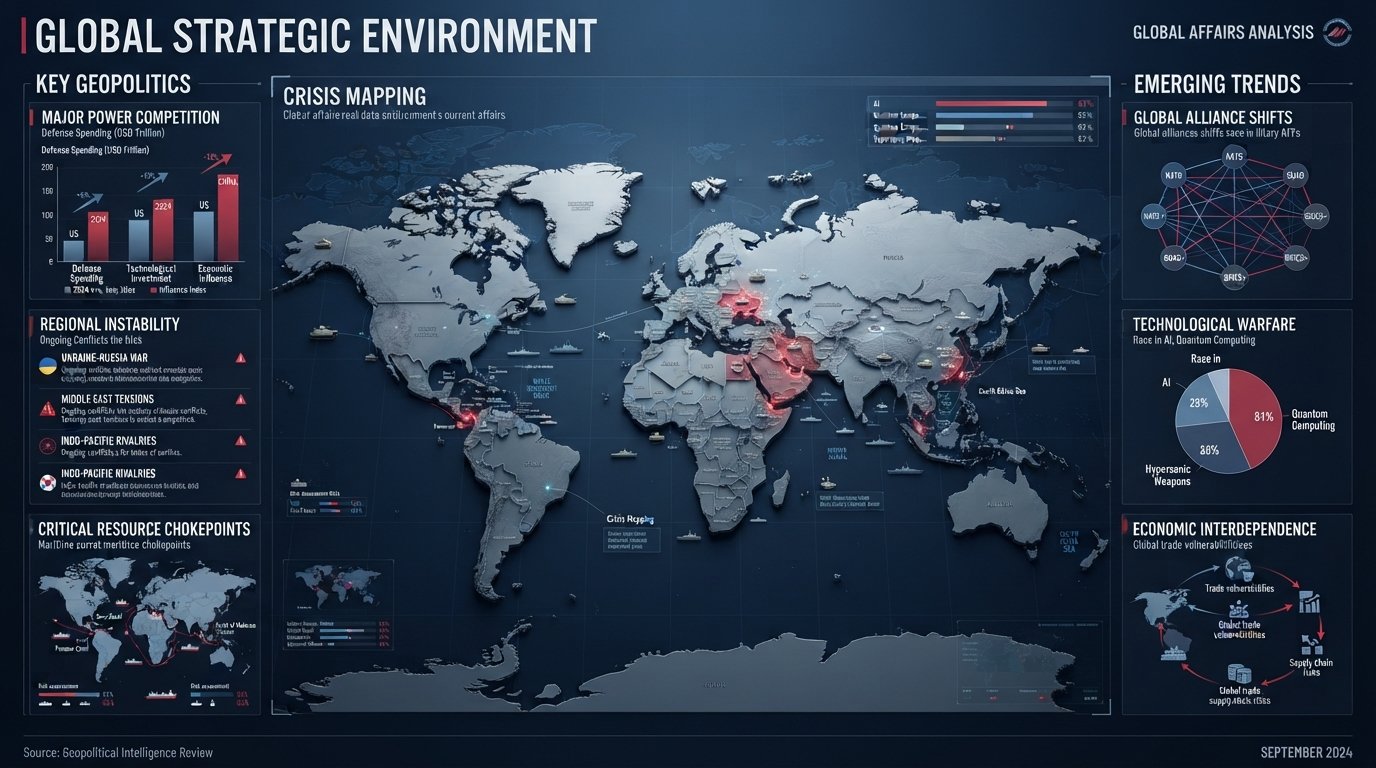
The Global Strategic Environment describes the broad international conditions in which states, alliances, institutions, businesses, and other actors pursue security, economic, political, and technological objectives. It is shaped not by one crisis or rivalry, but by the interaction of power, geography, military capabilities, economics, technology, diplomacy, international law, demographics, and transnational risks.
Today, that environment is becoming more complex. Strategic competition among major powers is occurring alongside regional conflicts, economic fragmentation, technological rivalry, climate pressures, energy insecurity, cyber threats, and uncertainty about the future of multilateral institutions. Global military expenditure reached an estimated $2.887 trillion in 2025, according to SIPRI, marking an eleventh consecutive year of growth.
At the same time, international institutions continue to provide mechanisms for cooperation. The United Nations’ 2024 Pact for the Future explicitly recognizes that the existing multilateral system is under strain and calls for reforms to make global governance more representative and effective.
Understanding the Global Strategic Environment therefore requires looking beyond individual conflicts. It means examining how power is distributed, how states calculate risk, how economic and technological dependencies are changing, and how international rules are being tested.
What Is the Global Strategic Environment?

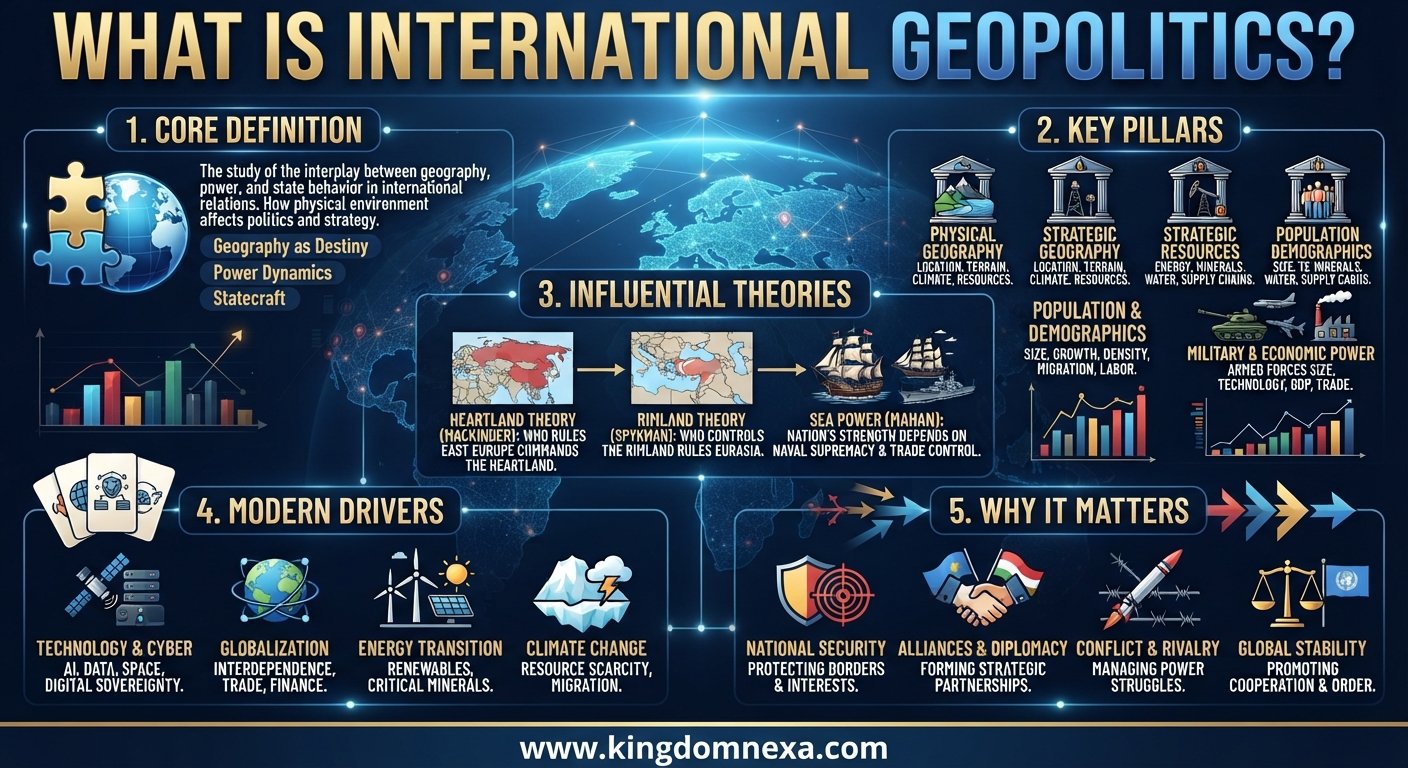
The Global Strategic Environment is the overall set of external conditions that influence the strategic decisions of states and other international actors.
In simple terms, it answers a fundamental question:
What international conditions determine how countries perceive threats, opportunities, power, and security?
The concept is broader than military strategy. A country’s strategic environment can include:
- The distribution of global and regional power
- Military capabilities and alliances
- Nuclear deterrence
- Diplomatic relationships
- Trade and investment dependencies
- Energy and critical-mineral supplies
- Technological capabilities
- Cybersecurity and information operations
- Demographic changes
- Climate and environmental pressures
- International institutions and law
- Domestic political constraints
- Regional conflicts and instability
A useful distinction is between the environment and strategy. The environment represents the conditions and pressures surrounding an actor. Strategy is the way that actor responds to those conditions.
For example, growing competition over advanced semiconductors is part of the strategic environment. Export controls, domestic industrial policies, supply-chain diversification, and technology partnerships are strategic responses.
Why the Concept Matters
The Global Strategic Environment matters because international events rarely occur in isolation.
A conflict can affect energy prices. Energy prices can influence inflation. Inflation can affect domestic politics. Domestic politics can alter foreign policy. Foreign-policy changes can affect alliances and trade. Trade restrictions can then reshape technology supply chains.
This interconnectedness makes strategic analysis increasingly multidimensional.
How Has the Global Strategic Environment Changed?
The contemporary environment emerged through several historical transitions rather than a single turning point.
From the Cold War to the Post-Cold War Period
During the Cold War, international politics was largely organized around competition between the United States and Soviet Union, with military alliances and ideological rivalry defining much of the strategic landscape.
After the Soviet Union collapsed in 1991, the international system became considerably less bipolar. The United States possessed unmatched global military and economic capabilities, while globalization expanded trade, investment, and economic interdependence.
However, the post-Cold War expectation of increasingly integrated international politics has not fully materialized.
The Return of Great-Power Competition
China’s economic and technological rise, Russia’s challenge to European security, shifting US foreign-policy priorities, and the strengthening of regional powers have contributed to a more competitive international system.
The result should not automatically be described as a simple return to a new Cold War. The current environment is more economically interconnected and strategically complicated than the US-Soviet confrontation.
Instead, the world increasingly combines great-power competition, regional balancing, economic interdependence, and issue-specific cooperation.
The Rise of Strategic Uncertainty
Another important change is the speed at which strategic conditions can shift.
Cyber incidents, financial sanctions, technological breakthroughs, military developments, elections, commodity disruptions, and information campaigns can alter calculations much faster than traditional diplomatic processes.
The World Economic Forum’s 2025 Global Risks Report described a fragmented international landscape in which geopolitical, economic, technological, environmental, and societal risks increasingly interact.
Major Actors Shaping the Global Strategic Environment
No single actor determines the international strategic environment. Influence is distributed among major powers, middle powers, regional organizations, international institutions, corporations, and non-state actors.
United States
The United States remains a central actor because of its global military reach, economic scale, technological capabilities, diplomatic partnerships, and alliance networks.
Its strategic environment includes competition with China, European security, Indo-Pacific stability, Middle Eastern security, technological competition, and the future of global economic rules.
Changes in US domestic politics can also have international consequences because allies and competitors closely monitor Washington’s willingness to use economic, diplomatic, and military power.
China
China’s growing economic, technological, diplomatic, and military capabilities make it one of the most important actors in the international system.
Beijing’s strategic priorities include national development, technological advancement, territorial and sovereignty concerns, military modernization, economic security, and expanded international influence.
China’s role also extends beyond traditional military power through trade, infrastructure, investment, manufacturing capacity, and technological ecosystems.
Russia
Russia remains an important strategic actor because of its nuclear arsenal, military capabilities, energy resources, geographic position, and permanent membership of the UN Security Council.
The war in Ukraine has significantly affected European security, defense spending, energy relationships, sanctions policy, and debates over deterrence.
SIPRI’s 2025 assessment also highlighted the deterioration of the global security environment and the weakening of traditional nuclear arms-control mechanisms.
European Powers and the European Union
Europe is both a strategic theater and an increasingly important security actor.
The war in Ukraine has encouraged European governments to reconsider defense capabilities, military readiness, energy security, industrial capacity, and strategic dependence.
The European Union also possesses significant economic and regulatory influence. Its role extends beyond conventional military power into trade, technology regulation, climate policy, sanctions, and market access.
Middle Powers and Regional Powers
Countries such as India, Japan, Türkiye, Saudi Arabia, Brazil, Indonesia, Australia, South Korea, South Africa, and others can exert influence beyond what traditional measures of military power might suggest.
Many middle powers are attempting to preserve strategic autonomy rather than permanently align with one major bloc.
This creates a more flexible environment in which states may cooperate with one partner on security, another on trade, and another on technology.
International Organizations
International organizations remain important even when major powers disagree.
The United Nations provides diplomatic forums and mechanisms for peace and security. NATO remains central to collective defense among its members. The EU integrates economic and political power. The WTO provides rules for international trade. The IMF and World Bank influence global financial and development policies.
The challenge is that these institutions operate within a political environment increasingly characterized by strategic rivalry.
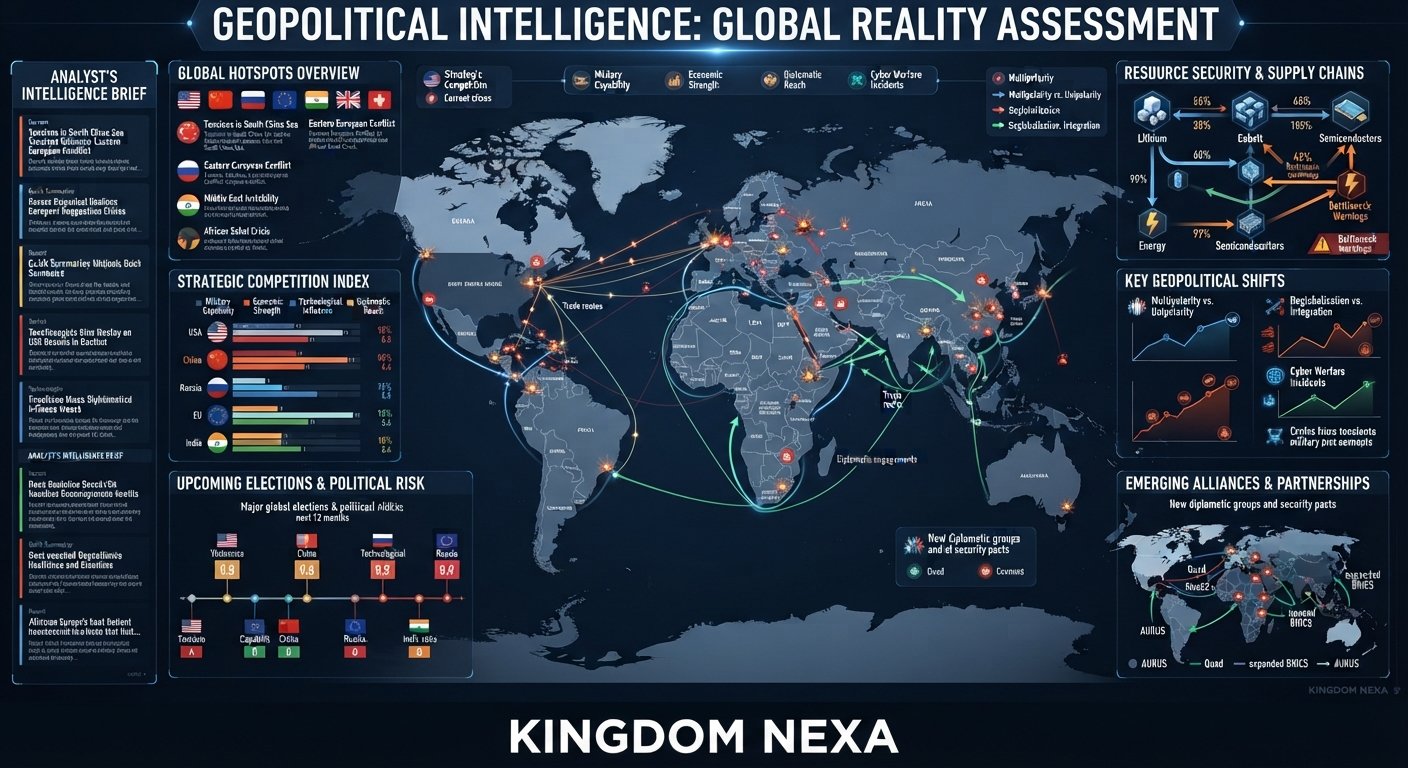
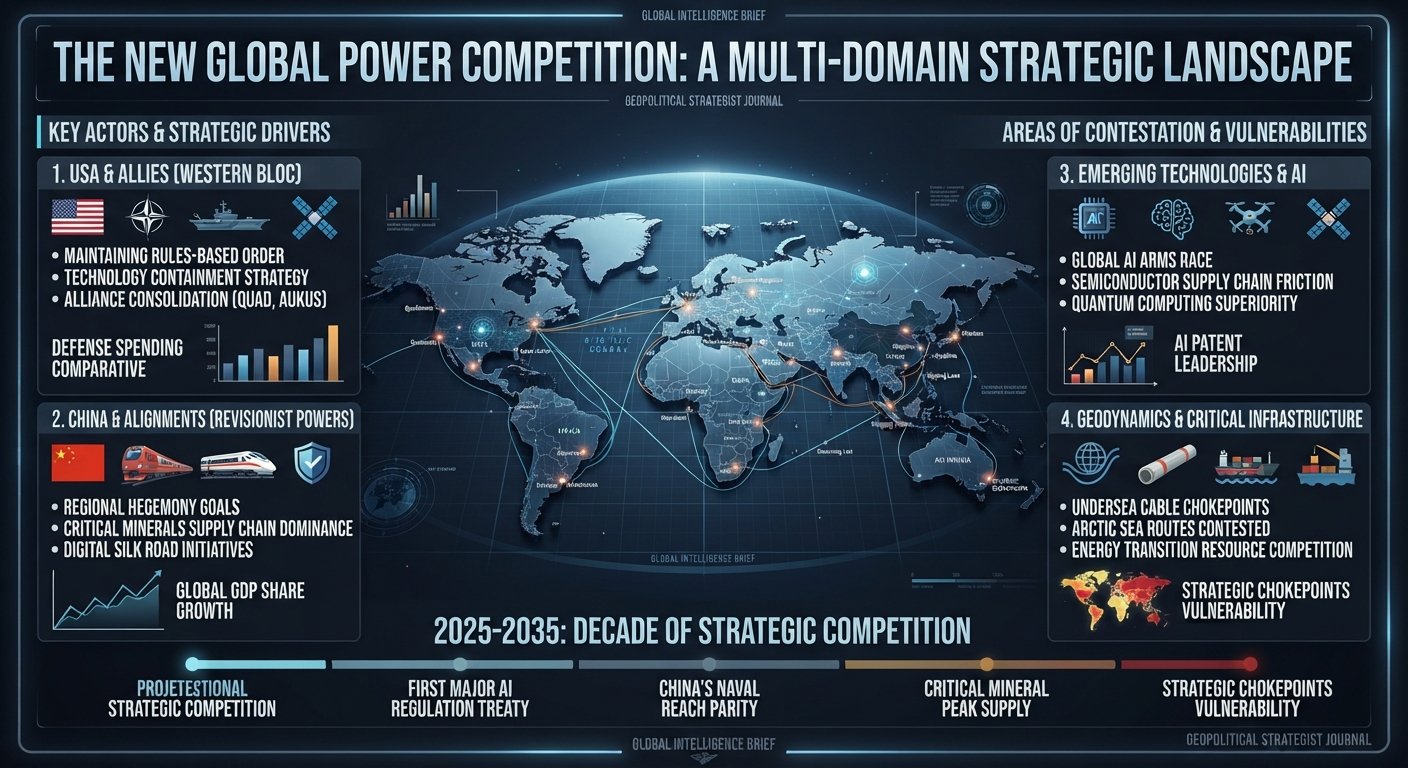
Image/Infographic: Global Strategic Environment Map
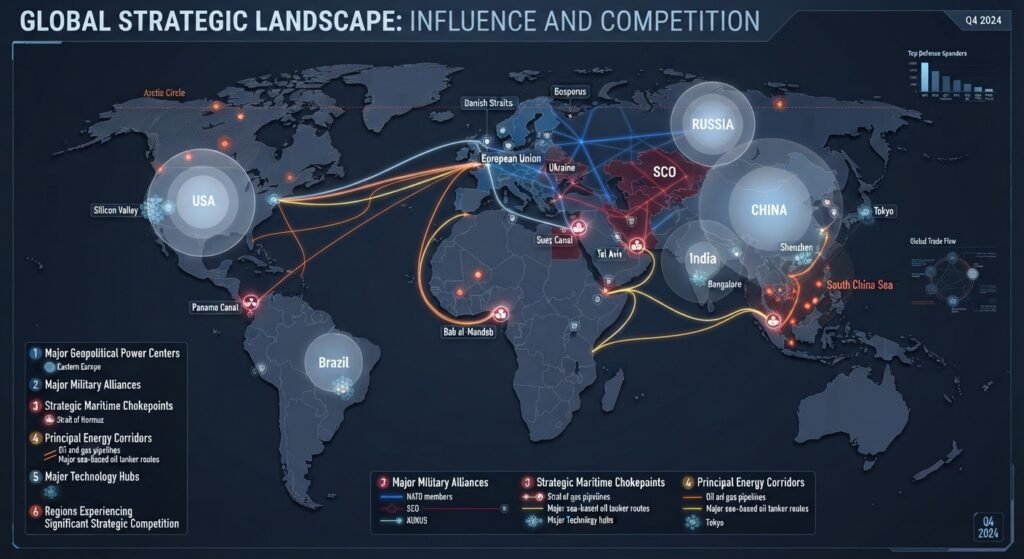
Placement: Immediately after this H2 section, “Major Actors Shaping the Global Strategic Environment.”
Visual description: A world map showing major geopolitical power centers, major military alliances, strategic maritime chokepoints, principal energy corridors, major technology hubs, and regions experiencing significant strategic competition. Use different visual layers rather than assigning the world into simplistic political blocs.
Purpose: Demonstrate that the Global Strategic Environment is multidimensional and geographically interconnected rather than a simple two-bloc system.
The Military and Security Dimension
Military power remains a fundamental component of strategic competition.
SIPRI reported that global military expenditure reached $2.887 trillion in 2025, up 2.9% in real terms from 2024. The increase represented the eleventh consecutive year of global military-spending growth.
This trend reflects several factors, including wars, deterrence concerns, military modernization, alliance requirements, and perceptions of worsening security conditions.
Nuclear Deterrence
Nuclear weapons remain central to the strategic environment because they create a unique relationship between deterrence and catastrophic risk.
SIPRI estimated that the world possessed approximately 12,241 nuclear warheads in January 2025, including roughly 9,614 in military stockpiles potentially available for use. Nearly all nine nuclear-armed states were continuing modernization programs.
The deterioration of arms-control arrangements is particularly significant. SIPRI has warned that the expiry of the US-Russia New START treaty in 2026 creates additional uncertainty over strategic nuclear limitations.
Conventional Warfare and Deterrence
Modern deterrence increasingly depends on combinations of:
- Conventional military forces
- Precision missiles
- Air and missile defense
- Uncrewed systems
- Space capabilities
- Cyber capabilities
- Intelligence and surveillance
- Electronic warfare
- Logistics and industrial capacity
The strategic environment is therefore becoming increasingly multi-domain.
Cyber and Information Security
Military competition is no longer confined to physical territory.
States can attempt to disrupt communications, influence information environments, steal sensitive data, target infrastructure, or degrade digital systems without immediately crossing the threshold of conventional warfare.
This creates difficult attribution problems. A cyber incident may produce strategic effects while making it difficult to determine precisely who was responsible.
Economic Power and Geoeconomic Competition
Economic relationships are increasingly part of strategic competition.
Trade, investment, sanctions, export controls, financial networks, critical minerals, energy supplies, and supply chains can all become instruments of statecraft.
The WTO’s 2026 World Trade Report describes the trading system as being at a critical juncture. It highlights the growing dispersion of economic power, geopolitical tensions, government intervention, global value chains, digitalization, artificial intelligence, and environmental pressures as forces testing existing trade rules.
From Globalization to Strategic Resilience
Globalization has not disappeared, but governments increasingly distinguish between ordinary economic efficiency and strategic resilience.
Critical sectors may include:
- Semiconductors
- Telecommunications
- Artificial intelligence
- Batteries
- Rare earth elements
- Energy
- Pharmaceuticals
- Food
- Defense production
- Digital infrastructure
The result is a growing emphasis on diversification, domestic capacity, trusted suppliers, and economic security.
The Cost of Geoeconomic Fragmentation
Trade fragmentation can impose substantial economic costs.
The WTO’s 2026 analysis estimates that a hypothetical world divided into geopolitical trading blocs could reduce global GDP by 5.1% and global exports by 18.6% relative to a cooperative baseline. These are scenario estimates, not forecasts of what will necessarily happen.
This distinction is important. Geoeconomic fragmentation is a strategic risk, but its eventual scale depends on policy choices and the ability of governments to preserve areas of cooperation.
Technology as a Strategic Domain
Technology has moved from being primarily an economic issue to becoming a core component of national power.
Artificial Intelligence
Artificial intelligence can influence military planning, intelligence analysis, cybersecurity, logistics, economic productivity, surveillance, and information environments.
Its strategic importance creates a difficult policy problem: governments want technological advantage while also needing mechanisms to control dangerous applications.
The UN’s Pact for the Future and Global Digital Compact reflect attempts to establish broader international cooperation around emerging digital technologies.
Semiconductors
Advanced semiconductors have strategic significance because they support artificial intelligence, telecommunications, advanced weapons systems, data centers, automobiles, and numerous civilian industries.
Consequently, semiconductor manufacturing capacity and access to advanced chip technologies have become important elements of national security and industrial policy.
Space
Satellites support navigation, communications, weather forecasting, intelligence, financial systems, and military operations.
As dependence on space-based infrastructure increases, competition over space security becomes another component of the Global Strategic Environment.
The UN Pact for the Future calls for stronger international cooperation on the peaceful use of outer space and efforts to prevent an arms race in space.
Regional Dynamics
The Global Strategic Environment cannot be understood only through relations among the largest powers.
Europe
European security has been transformed by the war in Ukraine, increasing defense requirements, energy considerations, and debates over strategic autonomy.
NATO’s 2026 Ankara Summit reaffirmed collective defense and reviewed implementation of alliance priorities established after the 2025 summit.
Indo-Pacific
The Indo-Pacific has become one of the principal centers of strategic competition because it combines economic importance, maritime trade, advanced technology, military modernization, and unresolved territorial and sovereignty disputes.
The United States, China, Japan, India, Australia, South Korea, ASEAN members, and Pacific states all have interests in maintaining regional stability while preserving national strategic autonomy.
Middle East
The Middle East remains strategically important because of its energy resources, maritime routes, conflicts, political rivalries, and connections to global markets.
Events in the region can generate effects far beyond the immediate geography, particularly through energy prices, shipping routes, food costs, migration, and financial markets.
The World Bank’s 2026 Global Economic Prospects reported that Middle East conflict had contributed to sharp energy-price increases and projected global growth of 2.5% for 2026, while emphasizing downside risks from prolonged hostilities and commodity disruptions.
Africa
Africa’s strategic importance is increasing because of its demographic growth, natural resources, maritime geography, emerging markets, and diplomatic significance.
African states are also seeking greater influence in global governance. The UN Pact for the Future specifically identifies correcting Africa’s historical underrepresentation on the Security Council as a priority in reform discussions.
Climate, Demographics, and Human Security
Strategic analysis increasingly includes issues that were once treated primarily as development or environmental concerns.
Climate change can affect food production, water availability, migration, infrastructure, public health, and political stability.
Demographic trends can similarly influence labor markets, military recruitment, economic growth, and social spending.
These factors rarely cause conflict by themselves. Instead, they can intensify existing political, economic, and institutional pressures.
This is why modern strategic analysis increasingly connects traditional security with human security.
International Law and Global Governance
International law remains an important framework for managing strategic competition.
The UN Charter establishes principles concerning sovereign equality, peaceful settlement of disputes, territorial integrity, political independence, and restrictions on the threat or use of force. The UN’s Pact for the Future reaffirmed these principles in response to the changing security environment.
The difficulty is not simply the existence of international rules. It is the challenge of securing consistent compliance when major strategic interests collide.
Reforming Global Institutions
The current institutional architecture was largely created after the Second World War.
The distribution of economic and political power has changed substantially since then. The UN Pact for the Future therefore calls for reforms to make global institutions more representative, effective, and responsive, including Security Council reform and changes to international financial governance.
This creates a central strategic tension:
The world needs more international cooperation at precisely the moment when geopolitical competition makes cooperation more difficult.
What Are the Main Risks in the Global Strategic Environment?
Several risks deserve particular attention.
Strategic Miscalculation
When rival powers misunderstand each other’s intentions, deterrence can fail.
The risk is especially serious when military deployments, cyber operations, nuclear signaling, or rapidly changing technologies reduce decision-making time.
Escalation
A regional conflict can expand through alliance commitments, external intervention, economic pressure, or miscalculation.
Nuclear-armed states make escalation management particularly important.
Economic Fragmentation
A prolonged division of trade, technology, investment, and financial systems could reduce economic efficiency and make international cooperation harder.
Technological Disruption
AI, cyber capabilities, autonomous systems, biotechnology, and space technologies may develop faster than international governance mechanisms.
Institutional Weakness
International institutions can struggle when major powers disagree about rules, representation, enforcement, or burden sharing.
The central problem is therefore not simply that institutions are outdated. It is that their effectiveness depends heavily on political willingness to cooperate.
What Does the Future Global Strategic Environment Look Like?
The future cannot be predicted with certainty, but several plausible scenarios can be identified.
Scenario 1: Managed Strategic Competition
Major powers continue competing but establish guardrails to prevent direct conflict.
Trade restrictions remain significant, alliances strengthen, and technology competition continues, but diplomacy limits escalation.
This would resemble competitive coexistence rather than either full confrontation or complete cooperation.
Scenario 2: Deeper Geopolitical Fragmentation
Strategic competition spreads into trade, finance, technology, energy, and information.
Countries increasingly operate through competing networks, supply chains become less global, and smaller states face greater pressure to align.
This scenario would likely impose significant economic and political costs. The WTO’s 2026 scenario analysis illustrates how costly deeper trade fragmentation could become.
Scenario 3: Selective Multilateral Renewal
A third possibility is not a return to the idealized globalization of the past, but a more pragmatic form of cooperation.
States could compete intensely in some areas while cooperating in others, such as climate resilience, pandemic preparedness, nuclear-risk reduction, maritime safety, financial stability, and AI governance.
The UN Pact for the Future reflects this possibility by seeking to strengthen multilateral institutions while recognizing that the global system must adapt to new realities.
The most likely future may ultimately combine elements of all three scenarios.
How Should Students and Analysts Study the Global Strategic Environment?
A useful analytical method is to examine every major international issue through eight questions:
- Who? Identify states, alliances, institutions, companies, and non-state actors.
- What? Establish what has actually happened.
- Why? Examine interests, incentives, history, and constraints.
- Where? Assess the strategic importance of geography.
- When? Place the event within its historical and contemporary timeline.
- How? Examine diplomatic, economic, military, technological, and informational instruments.
- So what? Determine the regional and global consequences.
- What next? Develop multiple plausible scenarios while clearly identifying uncertainty.
This framework prevents analysis from becoming a simple description of headlines.
It also helps separate facts from interpretations. For example, a government statement is a fact as a statement made by that government; the claim contained within the statement may require independent verification.
That distinction is essential for credible geopolitical analysis.
Frequently Asked Questions
What is the Global Strategic Environment?
The Global Strategic Environment is the collection of international political, military, economic, technological, diplomatic, legal, social, and environmental conditions that influence strategic decision-making.
Why is the Global Strategic Environment important?
It helps explain why countries make particular security and foreign-policy decisions and how conflicts, alliances, trade, technology, and global risks interact.
Is the world becoming multipolar?
The international system is becoming more distributed in terms of economic, military, technological, and diplomatic capabilities. However, “multipolar” should be used carefully because power remains unevenly distributed and different issues have different leading actors.
What are the main components of the Global Strategic Environment?
Major components include great-power competition, military capabilities, nuclear deterrence, alliances, economic interdependence, technology, energy, international institutions, geography, demographics, climate risks, and international law.
How does technology affect global strategy?
Technology affects military capabilities, economic competitiveness, intelligence, communications, cybersecurity, industrial capacity, and political influence. AI, semiconductors, cyber capabilities, satellites, and autonomous systems are particularly important.
How does the economy influence national security?
Economic strength provides resources for defense and diplomacy, while trade and financial relationships can create both interdependence and strategic vulnerability. Sanctions, export controls, investment restrictions, and supply-chain policies can therefore become instruments of statecraft.
Why is nuclear deterrence still important?
Nuclear weapons can deter direct attacks between nuclear-armed states because the consequences of escalation can be catastrophic. At the same time, their existence creates risks involving accidents, miscalculation, proliferation, and escalation.
What is geoeconomic competition?
Geoeconomic competition occurs when states use economic tools—including tariffs, sanctions, investment policies, export controls, industrial policy, and access to critical resources—to pursue strategic objectives.
Will global cooperation disappear?
There is no basis for assuming that cooperation will disappear. Competition and cooperation can coexist. The more realistic question is which areas will remain cooperative and where strategic rivalry will dominate.
Conclusion
The Global Strategic Environment is best understood as a constantly changing system of power, interests, risks, dependencies, and opportunities.
Its defining feature is complexity. Military power still matters, but it operates alongside economic leverage, technological capability, diplomacy, information, geography, demographics, energy security, and international law. A state may possess considerable military strength yet remain vulnerable to supply-chain disruption, cyberattacks, financial pressure, political instability, or technological dependence.
The contemporary environment is also characterized by a difficult paradox. Global problems increasingly require cooperation, while strategic competition makes that cooperation harder to achieve. Rising military expenditure, nuclear modernization, geopolitical tensions, economic fragmentation, and technological competition illustrate the pressures facing the international system.
Yet competition does not make cooperation impossible. The UN’s Pact for the Future demonstrates that states continue to recognize the need for stronger multilateral mechanisms, international law, digital cooperation, and institutional reform.
For policymakers, businesses, researchers, and students, the most useful approach is therefore neither excessive optimism nor inevitable-conflict thinking. The Global Strategic Environment must be assessed through evidence, competing interests, geographic realities, institutional constraints, and multiple possible futures.
The central strategic challenge of the coming years will be managing competition without allowing it to destroy the cooperation required to address problems that no country can solve alone.