Introduction
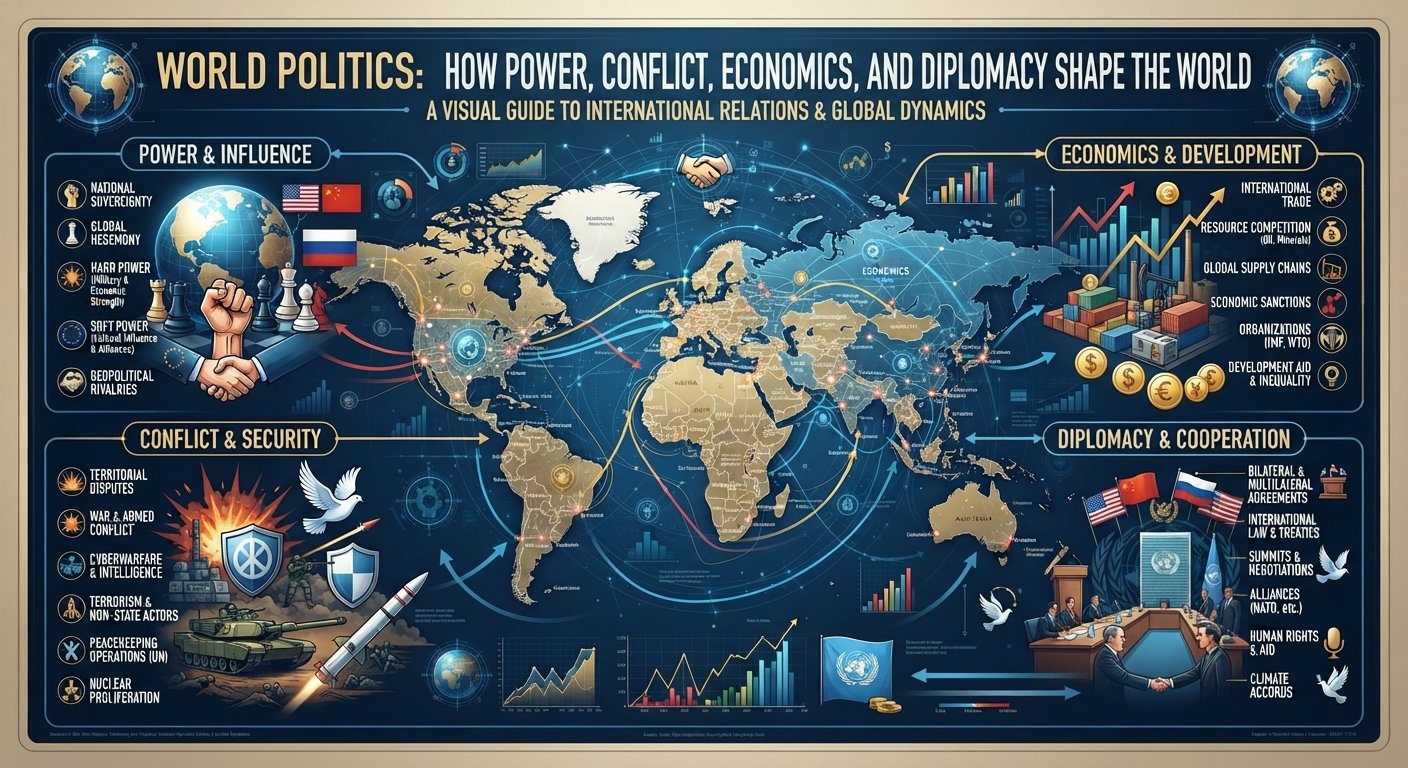
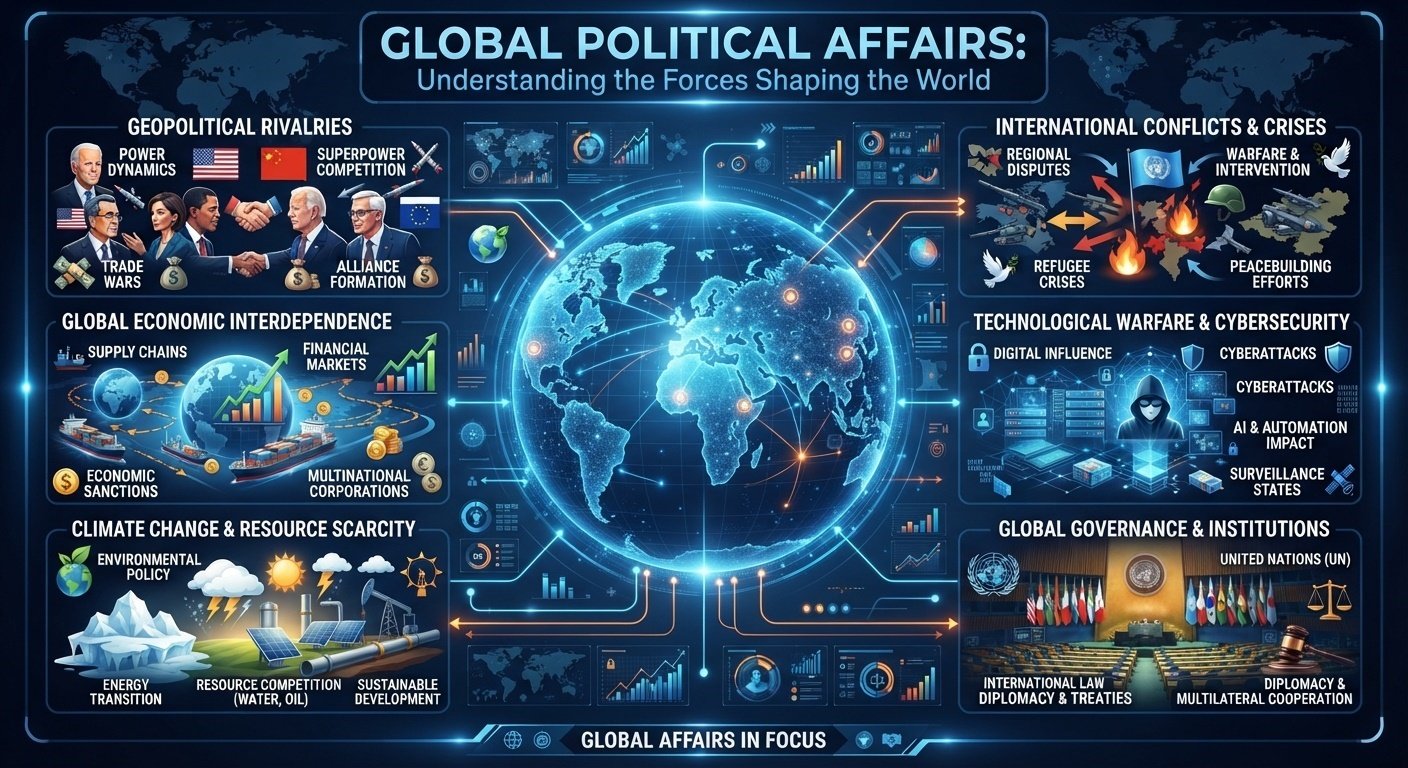
Global Political Affairs refers to the political relationships, strategic decisions, conflicts, alliances, negotiations, institutions, and power struggles that influence countries and societies around the world. It extends beyond traditional diplomacy. Today, global political affairs are shaped by military competition, international trade, technology, energy security, climate pressures, migration, economic sanctions, information warfare, and the growing influence of non-state actors.
The international system is entering a particularly competitive period. The World Economic Forum’s 2026 assessment identifies geoeconomic confrontation as the leading global risk for 2026, followed by state-based armed conflict. (World Economic Forum) At the same time, global military expenditure reached approximately $2.887 trillion in 2025, according to SIPRI, marking the 11th consecutive year of growth. (SIPRI)
These developments illustrate why understanding global political affairs requires looking beyond individual countries. Decisions made in Washington, Beijing, Moscow, Brussels, New Delhi, Riyadh, Tehran, Ankara, Islamabad, and other capitals can affect markets, security, supply chains, diplomacy, and ordinary people far beyond their borders.
This article examines the foundations of global political affairs, the major forces shaping international relations, current geopolitical trends, key global actors, economic and security dimensions, and possible directions for the international system.
What Are Global Political Affairs?
Global political affairs encompass the interactions between states and other influential actors within the international system.
These interactions can include:
- International diplomacy
- Foreign policy
- Military alliances
- Armed conflicts
- International trade
- Economic sanctions
- Energy security
- Strategic competition
- International organizations
- Human rights
- Migration
- Climate diplomacy
- Cybersecurity
- Technology competition
- Nuclear deterrence
- Global development
- Regional cooperation
At its core, global politics concerns power, interests, influence, security, cooperation, and competition.
A country may pursue diplomatic cooperation in one area while competing aggressively with the same state in another. For example, two countries can be economic trading partners while simultaneously competing over technology, military influence, or regional security.
That complexity makes international politics different from a simple division between “friends” and “enemies.”
How Global Political Affairs Have Evolved
Modern global political affairs have developed through several major historical periods.
The Post-World War II International Order
The end of World War II produced institutions designed to reduce the likelihood of another catastrophic global conflict.
The creation of the United Nations, International Monetary Fund, World Bank and other institutions established a framework for international cooperation.
The UN Security Council remains one of the central institutions for international peace and security. It consists of 15 members: five permanent members—China, France, Russia, the United Kingdom and the United States—and ten elected members. (United Nations)
The Cold War
The Cold War transformed international politics into a competition primarily between the United States and Soviet Union.
Military alliances such as NATO and the Warsaw Pact divided much of Europe, while ideological competition spread across Asia, Africa, Latin America and the Middle East.
Nuclear deterrence became one of the defining characteristics of the international system.
The Post-Cold War Period
The collapse of the Soviet Union in 1991 created a period in which the United States possessed unmatched global influence.
However, the international system did not remain static.
China’s economic and strategic rise, Russia’s renewed geopolitical ambitions, India’s growing influence, the expansion of regional organizations and the increasing importance of middle powers have contributed to a more complicated distribution of power.
The Emerging Multipolar System
The contemporary world is increasingly characterized by multipolarity.
Rather than being dominated exclusively by one or two powers, influence is distributed among multiple states and institutions.
The United States remains a central global power, while China has become a major economic and strategic competitor. Russia retains significant military and nuclear capabilities. India is expanding its economic, diplomatic and strategic role. The European Union remains an important economic and regulatory power, while countries across the Middle East, Africa, Latin America and Asia increasingly seek greater strategic autonomy.
Major Forces Shaping Global Political Affairs


Global political affairs are influenced by several interconnected forces rather than one single factor.
1. Great-Power Competition
Competition among major powers is one of the most important features of contemporary geopolitics.
The United States and China compete across multiple domains, including:
- Trade
- Semiconductors
- Artificial intelligence
- Military technology
- Maritime security
- Supply chains
- Investment
- Diplomacy
- Space technology
Russia’s confrontation with Western states has also transformed European security calculations.
The result is not necessarily a new Cold War in the historical sense. Instead, today’s competition involves greater economic interdependence alongside strategic rivalry.
2. Geoeconomic Competition
Economic policy has increasingly become a geopolitical instrument.
Governments can use:
- Tariffs
- Export controls
- Investment restrictions
- Sanctions
- Financial regulations
- Technology restrictions
- Supply-chain policies
- Energy policy
to advance national strategic objectives.
The World Economic Forum describes this environment as an era in which trade, finance and technology are increasingly being used as instruments of strategic influence. (World Economic Forum)
This means economic news can no longer be separated easily from geopolitical analysis.
A semiconductor export restriction, for example, can have consequences for national security, industrial policy and military technology simultaneously.
Major Geopolitical Flashpoints
Russia and Ukraine
The Russia-Ukraine war remains one of the most consequential security issues affecting Europe and the wider international system.
Its consequences extend beyond the battlefield to:
- European defense policy
- Energy security
- Food markets
- Sanctions
- NATO strategy
- Russia-West relations
- Arms production
- Nuclear deterrence
The conflict has also contributed to a significant increase in European defense spending.
SIPRI reported that European military expenditure increased by 14% in 2025, while global military spending reached $2.887 trillion. (SIPRI)
Middle East
The Middle East remains another major center of global political affairs.
The region’s geopolitical importance stems from several factors:
- Energy resources
- Maritime trade routes
- Regional rivalries
- Israel-Palestinian conflict
- Iran’s regional strategy
- Gulf security
- Armed non-state groups
- US military presence
- Competition among external powers
Instability in the Middle East can have consequences far beyond the region because disruptions to shipping and energy markets can affect international economies.
Indo-Pacific
The Indo-Pacific is increasingly important to global political affairs because it combines major economic powers, strategic waterways and significant military capabilities.
Key issues include:
- US-China strategic competition
- Taiwan
- South China Sea disputes
- North Korea
- India-China relations
- Japan’s security policy
- ASEAN diplomacy
- Maritime trade
The region is also central to global semiconductor and manufacturing supply chains.
The Role of Major Global Powers
United States
The United States remains one of the world’s most influential military, economic, technological and diplomatic powers.
Its global influence is supported by:
- Military alliances
- Dollar-based financial influence
- Technology companies
- Global diplomatic networks
- Economic strength
- Advanced military capabilities
- Extensive international partnerships
US foreign policy therefore has significant consequences for global security and economic affairs.
China
China has emerged as one of the most important forces in international politics.
Its influence comes from its:
- Large economy
- Manufacturing capacity
- Trade relationships
- Technological development
- Military modernization
- Diplomatic engagement
- Infrastructure investment
US-China relations are therefore likely to remain a defining feature of global political affairs for years to come.
Russia
Russia remains particularly important because of its nuclear arsenal, military capabilities, energy resources, geographic position and permanent seat on the UN Security Council.
Its relations with European countries, NATO and the United States continue to influence global security calculations.
European Union
The European Union exercises influence through economic power, trade regulation, diplomacy and development assistance.
Its geopolitical importance has increased as European governments reassess defense, energy and economic security.
India
India’s growing economy, large population, military capabilities and strategic position between major regions make it an increasingly important global actor.
India also plays a significant role in forums involving emerging and developing economies and seeks strategic relationships with multiple major powers rather than relying exclusively on one geopolitical bloc.
The Growing Influence of the Global South
One of the most important developments in global political affairs is the growing diplomatic importance of countries outside the traditional Western power centers.
Countries across:
- Asia
- Africa
- Latin America
- The Middle East
are increasingly seeking greater influence over international institutions and global economic decision-making.
Many governments prefer strategic autonomy rather than choosing permanently between competing geopolitical blocs.
This can be seen through expanding relationships among emerging economies, greater South-South cooperation and efforts to reform international institutions.
The Global South is therefore not a single political bloc. Its countries have different national interests, political systems and foreign-policy priorities.
International Organizations and Global Governance
International institutions remain essential despite growing geopolitical competition.
United Nations
The United Nations provides a platform for:
- Diplomacy
- Peacekeeping
- Humanitarian coordination
- International law
- Development cooperation
- Conflict resolution
However, geopolitical disagreements among powerful states can limit the effectiveness of collective action.
NATO
NATO remains central to European and transatlantic security.
The alliance’s strategic importance has increased as European governments respond to the changing security environment.
European Union
The EU combines economic integration with diplomatic and regulatory influence.
Its decisions on trade, sanctions, technology and regulation can have consequences far beyond Europe.
G20
The G20 provides an important forum for major advanced and emerging economies to discuss global economic challenges.
Its significance illustrates how global economic governance increasingly requires participation from a diverse group of countries.
Military Power and Global Security
Military capabilities remain a fundamental component of global political affairs.
SIPRI estimates that global military expenditure reached $2.887 trillion in 2025, representing 2.5% of global GDP and the highest level recorded in its data. (SIPRI)
The five largest military spenders in 2025—the United States, China, Russia, Germany and India—accounted for approximately 58% of global military expenditure. (SIPRI)
This increase reflects several factors:
- Armed conflicts
- Perceived security threats
- Military modernization
- Alliance commitments
- Technological competition
- Strategic uncertainty
Military power, however, is only one component of national power. Economic resilience, technological capabilities, diplomatic credibility, political stability and demographic trends also influence geopolitical strength.
Nuclear Weapons and Strategic Deterrence
N. Weapons continue to influence the calculations of major powers.
Nuclear deterrence is based on the idea that the devastating consequences of nuclear retaliation can discourage states from launching nuclear attacks.
However, nuclear risks extend beyond deliberate use.
Potential dangers include:
- Miscalculation
- Accidental escalation
- Cyber interference
- Arms-race dynamics
- Proliferation
- Breakdown of communication
As major powers modernize their nuclear arsenals and geopolitical tensions increase, arms-control diplomacy remains an important element of global security.
Technology as a New Geopolitical Battlefield
Technology has become inseparable from international politics.
Artificial intelligence, semiconductors, quantum computing, satellites, drones and cyber capabilities can influence national security and economic competitiveness.
Artificial Intelligence
AI has implications for:
- Military decision-making
- Intelligence analysis
- Cybersecurity
- Economic productivity
- Surveillance
- Information operations
Countries that achieve leadership in advanced AI could gain significant economic and strategic advantages.
Semiconductors
Semiconductors are essential for smartphones, vehicles, data centers, military systems and artificial intelligence.
As a result, semiconductor manufacturing has become a strategic issue rather than simply a commercial matter.
Cybersecurity
Cyber operations can target:
- Governments
- Banks
- Energy networks
- Telecommunications
- Transportation
- Military systems
Cyber competition allows states and other actors to exert influence without traditional military operations.
Global Political Affairs and the World Economy
Politics and economics are deeply interconnected.
Geopolitical instability can influence:
- Oil and gas prices
- Food security
- Investment
- Currency markets
- Shipping costs
- Insurance premiums
- Supply chains
- Infrastructure projects
Likewise, economic dependence can influence foreign-policy decisions.
This creates a feedback loop:
Political tension → economic disruption → domestic pressure → foreign-policy response → additional geopolitical tension.
The increasing use of tariffs, sanctions, export controls and investment restrictions demonstrates how economic instruments have become central to strategic competition.
Energy Security and Geopolitics
Energy has historically been one of the strongest connections between economics and geopolitics.
Oil and natural gas influence relationships among producing countries, consuming states and transit countries.
Meanwhile, renewable energy and electrification are creating new geopolitical questions involving:
- Lithium
- Cobalt
- Copper
- Rare earth elements
- Battery technology
- Solar manufacturing
- Critical minerals
The energy transition may therefore change the geography of geopolitical competition rather than eliminate resource politics.
Climate Change and Global Political Affairs
Climate change is increasingly a security and foreign-policy issue.
Climate-related pressures can contribute to:
- Water scarcity
- Food insecurity
- Migration
- Resource competition
- Disaster-related instability
- Infrastructure damage
Climate diplomacy also influences relations between developed and developing countries, particularly concerning financing, emissions reductions and technology transfer.
Information Warfare and Public Opinion
The modern geopolitical environment is also shaped by information.
Governments, political movements, media organizations and non-state actors compete to influence public perceptions.
Social media has made information campaigns faster and more international.
Major challenges include:
- Disinformation
- Deepfakes
- Propaganda
- Manipulated videos
- Fake accounts
- Foreign influence operations
- Political polarization
Consequently, media literacy and source verification have become increasingly important for understanding global political affairs.
Non-State Actors Are Changing International Politics
States remain the principal actors in international relations, but they are no longer the only influential participants.
Other actors include:
- Multinational corporations
- International NGOs
- Armed groups
- Terrorist organizations
- Financial institutions
- Technology companies
- Humanitarian organizations
- Diaspora networks
- Transnational advocacy groups
Armed conflicts increasingly involve combinations of governments, militias, insurgent organizations and other non-state actors.
ACLED recorded more than 185,000 violent events worldwide in 2025, nearly twice its recorded level in 2021, highlighting the complexity of contemporary political violence. (ACLED)
The Economic Cost of Geopolitical Instability
Geopolitical instability can create substantial economic consequences.
Supply-Chain Disruption
Wars and political disputes can interrupt transportation routes and manufacturing networks.
Higher Defense Spending
Rising military budgets can strengthen national security but may also create difficult trade-offs with social and economic spending.
Investment Uncertainty
Businesses may delay investment when political risks become difficult to predict.
Commodity Price Volatility
Conflict involving major energy or food producers can influence global commodity prices.
Sanctions
Economic sanctions can restrict trade and financial transactions while also affecting countries and businesses beyond the immediate target.
Global Political Affairs and International Law
International law provides principles governing relations among states.
Important areas include:
- Sovereignty
- Use of force
- International humanitarian law
- Human rights
- Maritime law
- Refugee protection
- Diplomatic relations
- Treaty obligations
Yet enforcement remains a major challenge.
Powerful countries can sometimes resist international pressure, while weaker states may have fewer diplomatic and economic tools available to defend their interests.
This tension between international rules and national power remains one of the central questions in global political affairs.
What Could the Future of Global Politics Look Like?
The future cannot be predicted with certainty, but several scenarios are plausible.
Scenario 1: Competitive Multipolarity
Multiple major powers continue competing while maintaining diplomatic and economic relationships.
This could produce a world characterized by rivalry without complete geopolitical separation.
Scenario 2: Greater Fragmentation
Trade restrictions, sanctions and technological competition could divide the global economy into partially separate systems.
Such fragmentation could increase costs and reduce economic efficiency.
Scenario 3: Renewed Multilateral Cooperation
Major powers could recognize that challenges such as climate change, pandemics, nuclear risks and financial instability cannot be managed independently.
This could create renewed investment in international institutions.
Scenario 4: Prolonged Geopolitical Instability
Continued conflicts, arms races and regional rivalries could produce a period of persistent instability.
The World Economic Forum’s 2026 assessment emphasizes that geopolitical and geoeconomic risks are increasingly interconnected rather than isolated problems. (World Economic Forum)
The most likely future may ultimately contain elements of all four scenarios.
How to Analyze Global Political Affairs
A strong geopolitical analysis should avoid looking at events from only one perspective.
A useful framework is to examine:
1. Actors
Who is involved?
2. Interests
What does each actor want?
3. Capabilities
What economic, military, diplomatic or technological resources do they possess?
4. Constraints
What limits their ability to achieve their objectives?
5. Alliances
Who supports whom?
6. Geography
Why does the location matter?
7. Economics
What resources, trade routes or markets are involved?
8. Domestic Politics
How might public opinion, elections or internal political pressures influence decisions?
9. International Institutions
What role do the UN, regional organizations or international law play?
10. Possible Outcomes
What are the most realistic short-, medium- and long-term scenarios?
This approach helps separate facts from interpretation and interpretation from prediction.
Why Global Political Affairs Matter to Ordinary People
Geopolitics may appear distant from everyday life, but international political decisions can have direct consequences.
Global events can influence:
- Fuel prices
- Food prices
- Employment
- Inflation
- Immigration
- Travel
- Internet technology
- Investment
- National security
- Education
- International business
A conflict thousands of kilometers away can affect shipping costs, energy prices or supply chains in another continent.
Understanding global political affairs is therefore increasingly important for citizens, businesses, students and policymakers.
Frequently Asked Questions
1. What are global political affairs?
Global political affairs refer to international political relationships, conflicts, diplomacy, alliances, foreign policies and strategic interactions among countries and other influential actors.
2. Why are global political affairs important?
They influence international security, economic conditions, trade, energy markets, migration, diplomacy and many decisions that affect people worldwide.
3. What are the major issues in global politics today?
Major issues include great-power competition, armed conflicts, economic fragmentation, military modernization, technology competition, energy security, climate change and international institutional reform.
4. Who are the most important actors in global political affairs?
Major states such as the United States, China, Russia, India and European countries play important roles, alongside international organizations, regional powers, corporations and non-state actors.
5. What is multipolarity in international relations?
Multipolarity describes an international system in which power and influence are distributed among several major actors rather than being concentrated primarily in one or two dominant powers.
6. How does geopolitics affect the global economy?
Geopolitical events can influence trade, investment, energy prices, supply chains, sanctions, currencies, transportation costs and commodity markets.
7. What role does the United Nations play in global politics?
The United Nations provides a platform for diplomacy, international cooperation, peace and security, humanitarian coordination and international law.
8. Why is military spending increasing?
Military expenditure is influenced by armed conflicts, perceived security threats, military modernization, alliance commitments and strategic competition. Global military spending reached $2.887 trillion in 2025. (SIPRI)
9. How is technology changing global politics?
Technology increasingly affects economic competitiveness, military capabilities, intelligence, cybersecurity, communications and influence operations.
10. What is the future of global political affairs?
The future is likely to involve a mixture of multipolar competition, regional conflicts, economic interdependence, technological rivalry and selective international cooperation.
Conclusion
Global Political Affairs are entering a period of profound transformation. Power is becoming more distributed, economic policy is increasingly connected to national security, technology is creating new forms of strategic competition, and conflicts continue to reshape regional and international relationships.
The international system is neither completely cooperative nor permanently divided into opposing blocs. Instead, countries increasingly cooperate in some areas while competing in others.
Military power remains important, but economic resilience, technological capability, diplomatic influence, energy security and control over strategic supply chains are equally significant.
The central challenge for policymakers is therefore not simply managing competition. It is preventing competition from becoming uncontrolled confrontation.
Understanding global political affairs requires examining events through multiple perspectives, verifying evidence, recognizing national interests, and distinguishing established facts from interpretation and prediction. In an increasingly interconnected world, informed geopolitical analysis is essential for understanding both today’s international system and the forces that will shape tomorrow’s world.