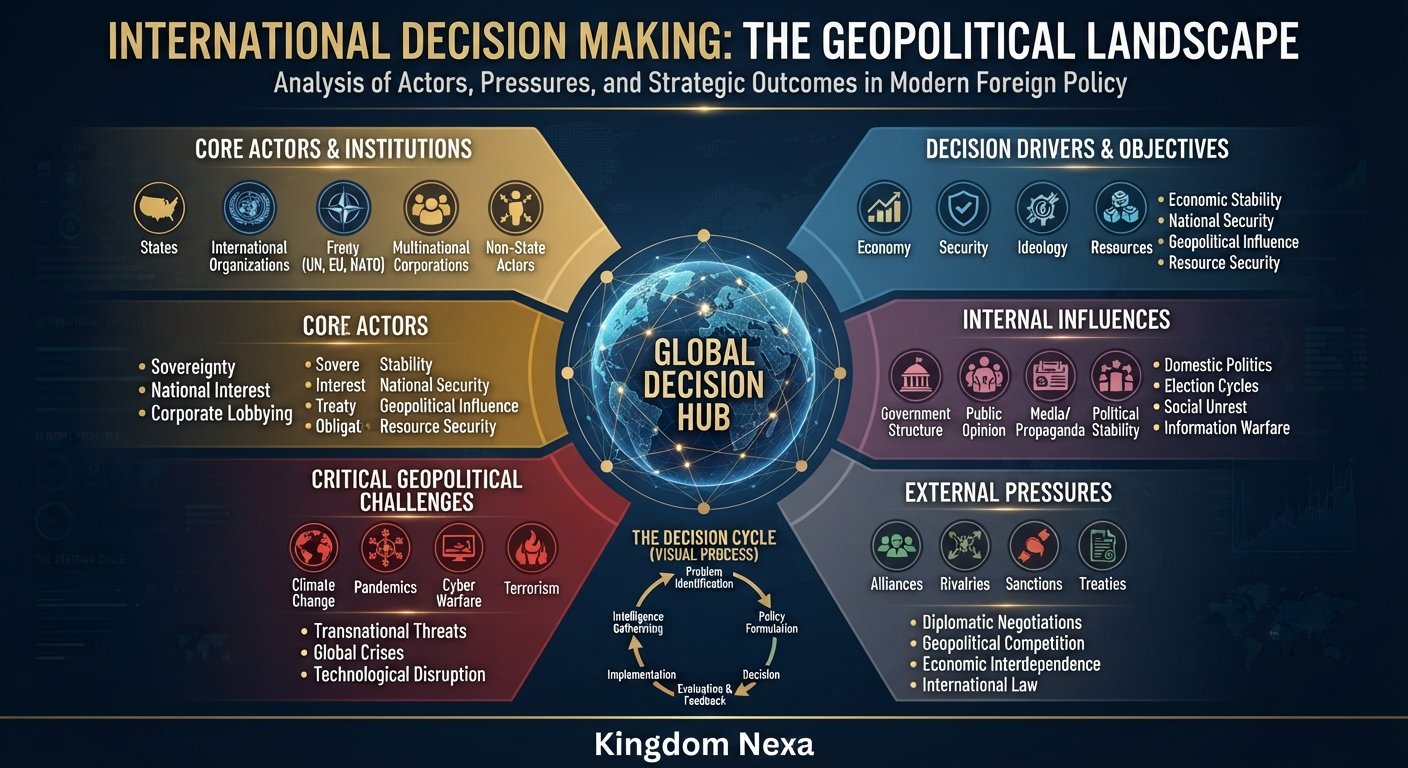
International decisions shape the world in ways that extend far beyond diplomatic meetings and government announcements. Decisions about war and peace, international trade, climate change, economic sanctions, technological competition, and security alliances can influence millions of people across different regions. Understanding how these decisions are made is therefore essential for anyone studying international relations, geopolitics, diplomacy, or global affairs.
International decision making is the process through which states, international organizations, and other influential actors assess global problems, negotiate competing interests, select policies, and determine actions that affect relations between countries. It involves much more than rational calculations. Political leadership, domestic pressures, economic dependencies, military capabilities, historical experiences, public opinion, and uncertainty all influence the final outcome.
In an increasingly interconnected world, a decision made in one capital can affect financial markets, energy supplies, migration, regional stability, and international security elsewhere. At the same time, countries rarely share identical priorities, and international institutions operate under different voting rules and political constraints.
This article explains the meaning, historical development, major actors, theoretical models, strategic considerations, and practical consequences of international decision making. It also examines real-world examples, contemporary challenges, and possible future developments to show how global decisions emerge and why they matter.
Add to Favorites

International decision making takes place through diplomatic negotiations, national policy processes, multilateral institutions, and strategic interactions among states.
What Is International Decision Making?
International decision making refers to the process of identifying international problems, evaluating available choices, negotiating among competing interests, and selecting policies that influence relations between countries or outcomes beyond national borders.
These decisions can be unilateral, bilateral, regional, or multilateral. A government may independently impose a trade restriction, negotiate a defense agreement with another country, coordinate monetary measures with international partners, or participate in a United Nations resolution.
The process includes both who makes a decision and how that decision is reached. The distinction matters because two governments facing similar circumstances may adopt different policies due to differences in leadership, institutions, public opinion, resources, and perceptions of risk.
For example, governments responding to a regional security crisis might choose military deterrence, economic sanctions, diplomatic negotiations, humanitarian assistance, or a combination of these approaches.
International decision making is not limited to formal government policy. Decisions by international organizations, multinational companies, humanitarian agencies, and other influential actors can also affect global outcomes.
International Decision Making vs. Foreign Policy Decision Making
These concepts overlap, but they are not identical.
- Foreign policy decision making primarily examines how a government determines its external policies and relationships.
- International decision making has a broader scope, including negotiations and collective choices involving multiple states, international institutions, and transnational actors.
- Global governance concerns the rules, institutions, and cooperative arrangements through which international problems are managed.
Foreign policy analysis often examines the internal process behind a country’s choices. International decision-making analysis also investigates how those choices interact with other actors and institutional rules to produce collective outcomes.
Historical Evolution of International Decision Making
The methods used to make international decisions have changed considerably over time. Diplomacy, strategic bargaining, alliances, and negotiations have longstanding historical roots, but modern international institutions have created more formalized ways to manage shared problems.
From Traditional Diplomacy to Modern International Institutions
Before the development of today’s multilateral system, international decisions were frequently shaped by dynastic interests, imperial competition, military power, bilateral treaties, and shifting alliances.
The 1648 Peace of Westphalia is commonly associated with the historical development of the modern state system, although historians debate how directly it established the principles of sovereignty that characterize contemporary international relations.
The Congress of Vienna in 1814–1815 introduced a more coordinated approach to managing relations among major European powers following the Napoleonic Wars. Its diplomatic arrangements sought to preserve a balance of power and reduce the likelihood of another continent-wide conflict.
The First World War exposed the limitations of existing diplomatic arrangements. The League of Nations subsequently attempted to institutionalize collective security, but it lacked the political support and enforcement capacity necessary to prevent another global war.
The Post-1945 International Order
The establishment of the United Nations in 1945 marked a major development in international decision making. The UN Charter provided a framework for international cooperation, peaceful dispute settlement, and restrictions on the use of force, subject to recognized legal exceptions.
During the Cold War, international decisions were heavily influenced by competition between the United States and the Soviet Union. Nuclear deterrence, ideological rivalry, proxy conflicts, and alliance commitments frequently constrained diplomatic choices.
After the Cold War ended, economic globalization and expanding multilateral cooperation created additional channels for international policymaking. Institutions such as the World Trade Organization, the European Union, and international financial organizations became important venues for collective decisions.
In the twenty-first century, digital technology, cyber threats, climate change, supply-chain vulnerabilities, and renewed great-power competition have made international decisions more interconnected and complex.
Who Are the Main Actors in International Decision Making?
International decisions rarely emerge from a single individual or institution. Their outcomes reflect interactions among political leaders, national agencies, international organizations, regional powers, businesses, and civil society.
National Governments and Political Leaders
National governments remain the principal actors in many international affairs. Heads of government, foreign ministers, defense officials, finance ministries, intelligence agencies, and diplomatic services contribute to policy development.
Their influence varies according to constitutional arrangements and political systems. In some countries, executive leaders exercise considerable discretion over foreign policy. In others, legislatures, coalition partners, courts, or other institutions impose significant constraints.
Leaders also interpret information differently. Their beliefs, experiences, risk tolerance, and perceptions of foreign intentions can influence decisions involving negotiations, military deployments, and international agreements.
International and Regional Organizations
Multilateral institutions provide established procedures for addressing issues that individual countries cannot manage effectively alone.
- United Nations: Provides a forum for diplomacy, international cooperation, and collective security.
- European Union: Makes binding decisions in areas covered by its treaties and institutional competences.
- NATO: Coordinates collective defense and political consultation among its members.
- World Trade Organization: Provides rules and procedures governing international trade relations.
- International Monetary Fund and World Bank: Support international financial cooperation, economic stability, development, and related policy programs.
These institutions do not all operate in the same way. Their authority depends on membership agreements, treaty obligations, voting procedures, and the powers delegated to them by participating states.
Businesses, NGOs, and Other Non-State Actors
Multinational corporations can influence international decisions through investment, employment, technology, trade, and supply-chain relationships. Their decisions may affect how governments approach industrial policy, sanctions, energy security, and strategic infrastructure.
Nongovernmental organizations contribute research, humanitarian assistance, advocacy, and monitoring. Academic institutions and policy research organizations provide analysis that can shape diplomatic discussions and public debate.
Armed groups, criminal networks, and other non-state actors may also affect international choices by creating security threats or disrupting trade and transportation. Their participation does not necessarily confer legal recognition or legitimacy.
How Does International Decision Making Work?
Although procedures differ across countries and institutions, international decisions often follow a recognizable sequence.
The international decision-making process
1. Identify the problem
Recognize a crisis, opportunity, dispute, or shared challenge.
2. Gather information and assess interests
Evaluate intelligence, evidence, legal obligations, costs, and risks.
3. Develop and negotiate alternatives
Compare policy options, bargain with partners, and manage disagreements.
4. Make the decision
Approve a policy through the relevant national or international procedure.
5. Implement, monitor, and revise
Put the policy into practice, evaluate results, and adapt when necessary.
This sequence is an analytical framework rather than a universal rule. During an armed conflict or sudden financial crisis, governments may act before they have complete information. In international negotiations, implementation may begin gradually while some details remain unresolved.
Information, Negotiation, and Implementation
Reliable information is essential because governments must estimate other actors’ intentions, capabilities, and likely responses. However, intelligence may be incomplete, statistics may be disputed, and official statements may not accurately reveal private objectives.
Negotiation allows participants to exchange concessions, establish safeguards, and identify mutually acceptable outcomes. Successful agreements often depend on credible commitments, monitoring mechanisms, and a shared understanding of what each side has promised.
Implementation presents a separate challenge. A treaty may be signed but not fully implemented because of insufficient resources, domestic opposition, weak enforcement, or conflicting interpretations. Therefore, the announcement of a decision should not be confused with evidence that it has achieved its intended results.
Major Theories and Models of International Decision Making
International relations scholars use different models to explain why governments make particular choices. No single theory explains every decision, but comparing several approaches can reveal the influence of strategic interests, institutions, psychology, and political bargaining.
1. Rational Actor Model
The rational actor model treats a state as an actor that identifies its objectives, compares available options, estimates likely consequences, and selects a policy intended to maximize its interests.
For example, a government considering economic sanctions might assess their expected effect on a target, the costs to domestic industries, the possibility of retaliation, and the availability of diplomatic alternatives.
The model is useful for examining strategic bargaining and deterrence. However, it can overstate how much governments know and how consistently they calculate. Leaders frequently act with incomplete information, limited time, and conflicting objectives.
2. Bounded Rationality Model
Bounded rationality recognizes that decision-makers have limited attention, information, time, and analytical capacity. Instead of identifying the theoretically best possible option, they may select an alternative that appears sufficiently effective and politically achievable.
This approach helps explain why governments rely on established procedures, intelligence summaries, expert advice, and familiar policy instruments.
In a fast-moving crisis, a leader may choose a previously tested diplomatic channel rather than develop a completely new strategy. Such shortcuts can improve speed but may also prevent officials from recognizing better alternatives.
3. Bureaucratic Politics Model
The bureaucratic politics model emphasizes that governments are not always unified actors. Ministries, military organizations, intelligence agencies, and economic departments can have different priorities, institutional cultures, and assessments of risk.
A defense ministry may prioritize deterrence, while a finance ministry worries about sanctions and market stability. A foreign ministry may focus on preserving negotiations and international partnerships.
The final policy can therefore reflect bargaining, compromise, and the relative influence of competing institutions rather than a single, perfectly coordinated national strategy.
4. Organizational Process Model
The organizational process model explains how established routines and standard operating procedures shape decisions.
Military forces, diplomatic services, and intelligence agencies cannot redesign their entire operations for every new situation. They depend on existing capabilities, reporting systems, planning assumptions, and institutional experience.
These routines create consistency and enable rapid action. However, they can also make adaptation difficult when a crisis differs significantly from previous experience.
5. Prospect Theory and Political Psychology
Prospect theory examines how people evaluate potential gains and losses relative to a reference point. Under some conditions, decision-makers become more willing to accept risks when they believe they are facing losses than when they expect gains.
In international politics, leaders who believe their country is losing strategic influence may accept risks that they would otherwise avoid. This does not mean that all leaders behave this way; the response depends on context, perceptions, and available alternatives.
Other psychological influences include overconfidence, confirmation bias, historical analogies, and misperceptions of an opponent’s intentions.
6. Groupthink and Collective Decision Making
Groupthink describes a pattern in which the desire for agreement discourages meaningful criticism. Advisers may suppress doubts, underestimate risks, or reinforce a leader’s preferred interpretation.
The opposite problem can also arise: a group may become divided among competing viewpoints, making it difficult to develop a coherent policy.
Effective decision-making groups therefore need both constructive disagreement and clear procedures for reaching a final decision. Diverse perspectives are most useful when decision-makers can challenge assumptions without fear of retaliation.
What Factors Influence International Decisions?
International decisions are shaped by a combination of structural conditions and immediate political pressures.
Political leadership and domestic interests
Leaders must consider elections, coalition stability, public opinion, national identity, and political legitimacy. A policy that is strategically attractive may be rejected if its domestic costs threaten the government’s survival.

Security and military capabilities
Threat perceptions, deterrence, alliance commitments, geography, and military readiness affect the options available to states. A government with limited military capacity may prefer coalition-building or diplomatic mediation.

Economic interests and dependencies
Trade, investment, energy supplies, access to critical minerals, and supply chains influence bargaining power. Governments may avoid measures that would damage important domestic industries even when they support the underlying political objective.

Information and technology
Intelligence, cyber capabilities, satellite systems, digital communications, and artificial intelligence can improve analysis. They can also create new vulnerabilities through misinformation, cyberattacks, and unreliable automated assessments.
Geography, History, and Strategic Culture
Geography shapes both opportunities and constraints. Countries dependent on maritime routes may prioritize freedom of navigation, while landlocked states may emphasize transit agreements and access to neighboring markets.
Historical experiences influence how governments interpret threats. Previous wars, colonial rule, territorial disputes, and broken agreements may affect the level of trust between negotiating parties.
Strategic culture—the accumulated assumptions and traditions through which political and military institutions interpret security—can also influence policy. It should not, however, be treated as a fixed national personality that determines every decision.
How Do International Organizations Make Decisions?
International institutions provide formal rules for collective action, but the rules differ according to each institution’s mandate and treaty framework.
United Nations Security Council
The UN Security Council has 15 members: five permanent members and ten non-permanent members elected for two-year terms. Under Article 27 of the UN Charter, substantive decisions require at least nine affirmative votes and no veto from a permanent member.
The permanent members are China, France, Russia, the United Kingdom, and the United States.
This arrangement reflects a central tension in international governance. The veto can prevent action opposed by a major power, but it can also obstruct collective responses to serious international crises. The Council’s effectiveness consequently depends on political agreement as well as its formal authority.
European Union Decision Making
The European Union uses several decision-making procedures, including qualified majority voting, unanimity, and simple majority voting, depending on the policy area and applicable treaty rules.
For many Council decisions under the ordinary legislative procedure, qualified majority requires at least 55% of member states—at least 15 of the 27—representing at least 65% of the EU population. Certain policy areas require unanimity instead.
These arrangements balance the interests of individual member states with the need to make decisions for the Union as a whole. They also demonstrate why the institutional design of a decision-making body matters: different voting thresholds produce different incentives for negotiation and coalition-building.
Multilateral Climate Negotiations
The Paris Agreement, adopted on 12 December 2015 and in force since 4 November 2016, illustrates the challenge of coordinating countries with different economic circumstances and emissions profiles. As of 27 January 2026, the UN Framework Convention on Climate Change reported 194 parties to the agreement.
The agreement establishes a shared framework for climate action while requiring countries to prepare and communicate nationally determined contributions. Its implementation depends on national policies, transparency, finance, technological development, and successive efforts to strengthen climate ambition.
The example highlights a recurring feature of international decision making: countries may agree on a common objective while disagreeing about responsibility, costs, financing, and the pace of implementation.
Real-World Examples of International Decision Making
The Cuban Missile Crisis, 1962
The Cuban Missile Crisis demonstrated the relationship between intelligence, leadership, military readiness, and diplomatic communication.
After the United States discovered Soviet nuclear missile installations in Cuba, President John F. Kennedy and his advisers considered military strikes, invasion, diplomatic pressure, and a naval quarantine. The administration ultimately announced a quarantine while pursuing negotiations with the Soviet Union.
The crisis ended through a combination of public and private understandings, including the removal of Soviet missiles from Cuba and a US public commitment not to invade Cuba. A separate US commitment concerning Jupiter missiles in Turkey was also part of the broader resolution.
The episode illustrates why crisis decisions cannot be understood solely as calculations of military strength. Perceptions, communication, domestic pressures, and opportunities to provide reciprocal assurances can determine whether a confrontation escalates or ends peacefully.
The Iran Nuclear Agreement, 2015
The Joint Comprehensive Plan of Action, concluded in July 2015 between Iran and the E3/EU+3, demonstrated the potential of multilateral negotiations to address nuclear proliferation concerns.
The agreement linked restrictions on Iran’s nuclear program with sanctions-related commitments and verification arrangements. Its subsequent trajectory also revealed the vulnerability of diplomatic agreements to changes in national leadership and policy.
The United States withdrew from the agreement in 2018 during President Donald Trump’s first administration. Iran subsequently expanded aspects of its nuclear activities beyond the agreement’s original limits, while diplomatic efforts to restore the arrangement faced substantial obstacles.
The case demonstrates that negotiating an agreement is only one stage of international decision making. Durability also depends on compliance, verification, domestic political support, incentives, and the willingness of participants to maintain commitments over time.
Regional Dynamics in International Decision Making
Geopolitical decisions are rarely isolated from regional power relationships. A policy adopted by one country may change the calculations of its neighbors, encourage new alliances, or create concerns about regional stability.
Asia-Pacific and Indo-Pacific
Strategic competition involving the United States and China influences decisions concerning trade, maritime security, advanced technology, defense partnerships, and regional institutions. Countries throughout the region must weigh economic relationships with China against their security interests and other strategic partnerships.
India, Japan, Australia, South Korea, and ASEAN member states pursue different combinations of cooperation, deterrence, and diplomatic engagement. Their priorities are not identical, and it would be inaccurate to treat the region as divided into two uniformly aligned blocs.
Europe and Eurasia
Russia’s war against Ukraine has influenced European decisions on defense spending, military assistance, energy security, sanctions, and NATO cooperation. European governments also face questions about long-term deterrence, support for Ukraine, and the economic implications of security policy.
These decisions involve coordination among national governments, EU institutions, NATO members, and other partners. Different threat perceptions and domestic political constraints can complicate the formation of a unified response.
The Middle East
International decisions in the Middle East are shaped by regional rivalries, armed conflicts, energy markets, maritime routes, diplomatic normalization, and external security partnerships.
Governments may simultaneously pursue deterrence, economic diversification, mediation, and diplomatic engagement. A policy intended to strengthen one country’s security can generate concerns among neighboring states, creating incentives for countermeasures or renewed negotiations.
Africa and Latin America
African governments participate in international decision making through the African Union, regional organizations, the United Nations, and bilateral partnerships. Priorities include development finance, conflict prevention, food security, infrastructure, debt sustainability, and control over natural resources.
Latin American governments engage in regional diplomacy, trade negotiations, climate policy, migration management, and debates about relations with major powers. Across both regions, states seek to preserve policy autonomy while attracting investment and addressing domestic development needs.
Economic, Technological, and Security Implications
International decision making has consequences that extend beyond diplomacy. Government choices can reshape the global economy, technological competition, and security environment.
Trade, Sanctions, and Supply Chains
Trade agreements can expand market access and encourage investment, while tariffs and sanctions can alter commercial relationships. Their effects depend on the targeted sectors, enforcement arrangements, alternative suppliers, and the capacity of affected economies to adapt.
Economic interdependence can discourage conflict by increasing its costs. However, dependencies can also become sources of strategic leverage when governments control critical resources, infrastructure, or markets.
For businesses, international decisions can affect compliance requirements, shipping costs, insurance, investment conditions, and access to advanced technologies. Political-risk analysis helps organizations evaluate these exposures before committing capital or changing suppliers.
Artificial Intelligence and Digital Security
Artificial intelligence increasingly supports translation, information analysis, forecasting, and the processing of large datasets. Governments can use these tools to identify patterns that might otherwise remain difficult to detect.
However, AI-generated assessments can contain errors, reproduce biases, or create unwarranted confidence in uncertain conclusions. Cyberattacks, manipulated media, and disinformation can further complicate assessments of foreign intentions.
Human review, independent verification, transparent assumptions, and secure information systems remain essential. In decisions involving military force or other high-consequence actions, automated recommendations should not replace accountable human judgment.
Military Strategy and Deterrence
Military decisions involve estimates of adversary capabilities, alliance reliability, escalation risks, and the likely consequences of action or inaction.
Deterrence seeks to discourage an opponent from taking an unwanted action by influencing its expectations about costs and outcomes. It can fail when threats are not credible, signals are misunderstood, or opposing leaders interpret the same events differently.
International decision makers must also consider arms control, crisis communication, military transparency, and the risks of unintended escalation. These considerations are especially important when nuclear-armed states confront one another.
International Law and the Limits of State Decisions
States retain substantial authority over their foreign policies, but their choices operate within an international legal framework.
The UN Charter establishes the sovereign equality of member states and generally prohibits the threat or use of force against the territorial integrity or political independence of any state, subject to recognized exceptions, including self-defense under Article 51 and measures authorized by the Security Council.
Other legal frameworks govern diplomatic relations, international trade, human rights, the law of the sea, and armed conflict. Treaty obligations can constrain national choices, although their precise effect depends on the applicable instrument and circumstances.
Legal questions are not always straightforward. States may disagree about treaty interpretation, jurisdiction, attribution of cyber operations, or whether particular conduct satisfies the requirements for self-defense.
A rigorous analysis therefore distinguishes three issues:
- Legality: Is the decision consistent with applicable international and domestic law?
- Political legitimacy: Is the decision considered justified or acceptable by relevant governments, populations, or institutions?
- Practical effectiveness: Is the decision likely to achieve its intended objectives?
These dimensions can overlap, but they are not interchangeable. A policy may be politically popular yet legally contested, or legally permissible but strategically ineffective.
Major Challenges in International Decision Making
Even well-designed processes can produce poor outcomes when political pressures, limited information, or institutional constraints interfere with sound judgment.
Conflicting National Interests
Countries may agree that an international problem exists while disagreeing about who should bear its costs. Climate negotiations, migration arrangements, sanctions, and defense burden-sharing all illustrate this difficulty.
Negotiators must identify areas of common interest without assuming that participants have identical priorities.
Misinformation and Uncertainty
International crises often develop faster than reliable information can be collected. Governments may receive contradictory intelligence, incomplete reports, or claims designed to influence their assessments.
Overconfidence can lead to premature action, while excessive caution can allow a threat or opportunity to develop. Good decision making requires explicit recognition of uncertainty and a willingness to revise assessments.
Domestic Political Constraints
Leaders must reconcile international commitments with domestic political realities. Elections, coalition agreements, public opinion, legislative oversight, and economic conditions can narrow the range of feasible choices.
These constraints may make a negotiated agreement difficult to approve or implement, even when diplomats have reached a compromise.
Weak Enforcement and Coordination
International institutions frequently depend on member states for funding, implementation, and enforcement. A decision may therefore lack practical impact if governments refuse to cooperate or cannot meet their commitments.
Institutional fragmentation creates another problem. Different agencies and organizations may pursue overlapping objectives without effective coordination, resulting in duplicated effort or conflicting policies.
The Future of International Decision Making
The future will likely involve greater interaction between traditional diplomacy, data-driven analysis, economic security, and emerging technologies. The exact consequences remain uncertain, but several developments deserve attention.
More Data-Driven Policy Analysis
Advances in forecasting, satellite observation, economic modeling, and AI may help governments assess risks earlier and compare possible responses. These capabilities will be most valuable when the underlying data are reliable and the models’ limitations are clearly understood.
Greater Competition Over Strategic Dependencies
Governments are likely to continue examining exposure to concentrated supply chains, critical minerals, semiconductors, energy infrastructure, and digital networks. Decisions about resilience may increasingly influence trade and investment policy.
The challenge will be to reduce genuine vulnerabilities without creating unnecessary economic fragmentation or escalating strategic competition.
Changing Patterns of Multilateral Cooperation
International institutions will remain important, but their ability to act will depend on whether member states can agree on priorities and procedures. Reform debates may intensify where existing voting arrangements or representation are viewed as insufficiently responsive to changes in global power.
At the same time, regional agreements and smaller coalitions may offer practical ways to cooperate when universal consensus is difficult to achieve.
More Attention to Forecasting and Accountability
Governments can improve decisions by comparing multiple scenarios, recording assumptions, inviting independent criticism, and reviewing outcomes after implementation.
Forecasts should be treated as estimates rather than certainties. Decision makers should also establish clear criteria for evaluating whether a policy is working and when it should be modified.
How Can International Decision Making Be Improved?
Better outcomes require more than stronger leadership or access to additional information. They depend on sound procedures, institutional accountability, and realistic assessments of trade-offs.
Practical improvements include:
- Verify information: Compare official statements with independent evidence and reliable reporting.
- Consider competing explanations: Test whether alternative interpretations better explain an opponent’s behavior.
- Consult relevant experts: Include diplomatic, economic, legal, military, scientific, and regional expertise as appropriate.
- Encourage constructive disagreement: Allow advisers to challenge assumptions and identify overlooked risks.
- Compare multiple options: Evaluate diplomacy, economic measures, deterrence, cooperation, and inaction where relevant.
- Assess consequences: Consider direct effects, unintended outcomes, humanitarian costs, and likely responses from other actors.
- Establish accountability: Define responsibilities, monitoring arrangements, implementation milestones, and review procedures.
- Adapt when evidence changes: Revise policy when assumptions prove incorrect or circumstances change.
These practices cannot eliminate geopolitical uncertainty. They can, however, reduce avoidable errors and make the reasoning behind consequential decisions more transparent.
Frequently Asked Questions About International Decision Making
1. What is international decision making in simple terms?
International decision making is the process through which countries and international actors choose policies, negotiate agreements, and respond to issues that affect relations between nations or the wider world.
2. Why is international decision making important?
It influences peace and security, international trade, climate policy, economic stability, technological development, humanitarian assistance, and cooperation between countries. Its outcomes can affect both national interests and global welfare.
3. What are the main models of international decision making?
Major models include the rational actor model, bounded rationality, bureaucratic politics, organizational process theory, prospect theory, and groupthink. Each explains different influences on how governments evaluate choices and reach decisions.
4. Who makes international decisions?
National leaders, foreign ministries, legislatures, defense and intelligence agencies, international organizations, and other authorized institutions play important roles. Businesses, researchers, civil society groups, and non-state actors can also influence international outcomes.
5. What factors influence international decisions?
Key factors include national interests, military capabilities, economic conditions, political leadership, domestic opinion, geography, historical experiences, international law, alliances, available information, and the behavior of other states.
6. How do international organizations influence decision making?
Organizations such as the United Nations, European Union, and NATO provide forums, rules, and coordination mechanisms. Their influence depends on their mandates, decision procedures, member-state support, and available implementation powers.
7. What is the difference between international and foreign policy decision making?
Foreign policy decision making focuses primarily on how a government determines its external policies. International decision making has a broader scope, examining interactions and collective choices among multiple states, institutions, and other international actors.
8. How does international decision making affect the global economy?
Decisions on tariffs, sanctions, trade agreements, energy, investment, and technology can change prices, supply chains, market access, and business confidence. Their effects depend on implementation, market responses, and the economic relationships involved.
9. How does technology affect international decision making?
AI, satellite systems, digital communications, and data analysis can improve information processing and forecasting. They also introduce risks involving misinformation, cyberattacks, biased assessments, and overreliance on automated systems.
10. What makes international decision making effective?
Effective decision making combines reliable information, realistic objectives, legal awareness, informed negotiation, consideration of alternatives, institutional coordination, accountability, and the ability to adapt as circumstances change.
Conclusion
International decision making is a central process through which national interests, diplomatic relationships, strategic competition, and global cooperation shape the international system. Its outcomes depend not only on the resources available to states but also on leadership, institutional rules, political psychology, economic relationships, and the quality of information used to assess alternatives.
Historical examples demonstrate that decisions made under pressure can have lasting consequences, while multilateral agreements reveal both the possibilities and limitations of international cooperation. Contemporary challenges involving security, climate change, economic interdependence, and emerging technologies make sound decision processes increasingly important.
Understanding international decision making requires looking beyond official announcements to examine how choices are developed, whose interests influence them, what constraints apply, and whether implementation achieves the intended results.
For students, researchers, diplomats, policymakers, and business leaders, this perspective offers a practical foundation for interpreting geopolitical developments. Ultimately, better-informed decisions cannot eliminate disagreement among nations, but they can improve the prospects for effective diplomacy, responsible policy, and a more stable international order.