Introduction
Superpower competition has returned as one of the defining forces of international politics. Unlike the Cold War, however, today’s rivalry is not organized around two completely separate economic and ideological blocs. The United States and China remain deeply connected through trade, finance, technology, supply chains, and global institutions even as they compete for strategic influence. Russia, India, the European Union, Japan, and other regional powers further complicate the picture.
In 2026, the competition is particularly visible across the Indo-Pacific, advanced technology, critical minerals, military modernization, economic security, artificial intelligence, semiconductor supply chains, space, and diplomatic influence. Yet rivalry does not automatically mean inevitable war. Washington and Beijing have continued to negotiate and manage parts of their relationship even while competing intensely.
This article explains what superpower competition means, how today’s rivalry developed, why the United States and China are central to it, how military and economic power interact, what role other countries play, and what the competition could mean for the international system. The analysis reflects information available as of October 8, 2026, because several relevant developments remain fluid.
What Is Superpower Competition?
Superpower competition is a sustained strategic rivalry between states possessing exceptional economic, military, technological, diplomatic, and political capabilities that allow them to influence events far beyond their own regions.
A superpower is therefore more than a country with a large military. Its power normally rests on several interconnected foundations:
- Economic size and productive capacity
- Military and nuclear capabilities
- Technological leadership
- Financial and monetary influence
- Diplomatic networks and alliances
- Access to strategic resources
- Demographic and human-capital advantages
- Space, cyber, and information capabilities
- Ability to shape international institutions and global rules
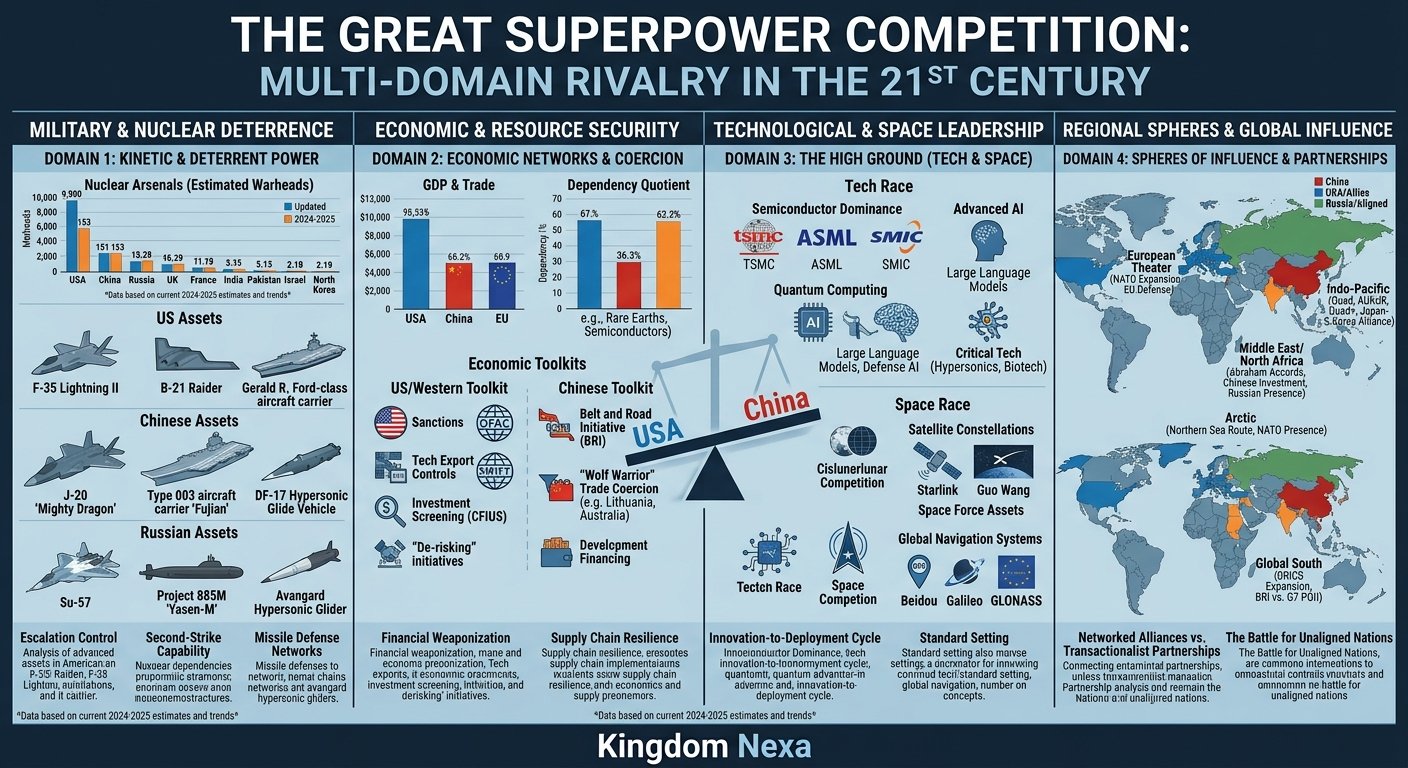
Today’s competition is multidimensional. Military power remains important, but economic resilience, semiconductor production, artificial intelligence, critical minerals, energy security, financial infrastructure, and control over supply chains can also create strategic leverage.
This makes contemporary rivalry different from the classic Cold War model. The United States and China compete while remaining economically interconnected, and many countries refuse to choose permanently between them.
How Did Modern Superpower Competition Develop?
The present rivalry cannot be understood without the transformation of the international system after the Cold War.
From American Primacy to Strategic Rivalry
After the Soviet Union collapsed in 1991, the United States possessed unmatched global military, economic, diplomatic, and technological influence. China, meanwhile, entered a period of extraordinary economic expansion.
China’s integration into global markets accelerated after its 2001 accession to the World Trade Organization. Manufacturing, exports, infrastructure investment, technological development, and rising domestic consumption progressively increased Beijing’s international influence.
The relationship was initially characterized by substantial economic engagement. Over time, however, disagreements expanded into questions about technology, industrial policy, military power, maritime security, Taiwan, human rights, trade practices, and the structure of the international order.
The Strategic Shift Toward Competition
The relationship increasingly moved from engagement toward strategic competition during the 2010s.
The United States strengthened its focus on the Indo-Pacific, while China expanded its naval capabilities, overseas economic relationships, technological ambitions, and regional military presence.
The trade conflict that began in 2018 was particularly important because it demonstrated that economic interdependence could itself become a source of strategic vulnerability.
The COVID-19 pandemic, Russia’s invasion of Ukraine in 2022, semiconductor export controls, supply-chain disruptions, and growing concern over critical minerals further encouraged governments to treat economic resilience as part of national security.
Why Are the United States and China at the Center?
The United States and China occupy the core of contemporary superpower competition because their capabilities overlap across nearly every major dimension of international power.
United States: Global Network Power
The United States retains major advantages in military reach, alliances, advanced research, financial influence, global basing, and high-end technology.
Its network of formal and informal partnerships is particularly important. NATO remains central to European security, while U.S. alliances with Japan, South Korea, Australia, and the Philippines provide strategic depth in the Indo-Pacific.
Washington also benefits from the global importance of the dollar, major capital markets, advanced universities, technology companies, and a large defense-industrial base.
China: Scale, Manufacturing and Regional Power
China’s principal strengths include its enormous industrial base, large domestic market, infrastructure capacity, technological progress, expanding military capabilities, and central position in many global manufacturing networks.
The IMF’s 2026 discussion of geoeconomics notes that China produces roughly 30% of global manufacturing output compared with about 16% for the United States, illustrating the significance of China’s industrial scale.
China is also seeking greater influence over critical supply chains, emerging technologies, infrastructure, finance, and international institutions.
The competition therefore involves two different but overlapping power models: the United States has exceptional alliance and financial networks, while China possesses enormous industrial and manufacturing depth.
What Are the Main Areas of Superpower Competition?
Military and Nuclear Competition
Military power remains one of the clearest dimensions of rivalry.
SIPRI estimated that global military expenditure reached $2.887 trillion in 2025, the highest level in its historical series. The United States spent approximately $954 billion, while China’s estimated expenditure was $336 billion.
The figures should not be interpreted as a simple measure of military strength. Different countries have different costs, accounting systems, force structures, strategic objectives, and levels of purchasing power.
China has rapidly modernized its navy, missile forces, air power, nuclear arsenal, space capabilities, cyber forces, and command structures. U.S. assessments have also highlighted China’s growing nuclear force. The Pentagon’s 2024 China Military Power Report estimated that China possessed more than 600 operational nuclear warheads as of mid-2024 and could exceed 1,000 by 2030.
The United States nevertheless maintains a much broader global military footprint and extensive alliance network.
Taiwan and the Indo-Pacific
Taiwan is arguably the most dangerous potential flashpoint in the rivalry.
Beijing considers Taiwan part of China and has not renounced the possibility of using force. Taiwan maintains its own democratic government and military, while the United States maintains a policy of strategic ambiguity combined with legal commitments under U.S. domestic law.
The military dimension has become increasingly visible. A 2025 U.S. Defense Department report documented China’s use of military exercises, maritime forces, information operations, and economic pressure as part of its broader campaign concerning Taiwan.
As of October 2026, pressure remains significant. Taiwan has also received the first two of 66 new U.S.-made F-16V Block 70 aircraft, strengthening its air-defense capabilities.
Importantly, claims that China is certain to invade Taiwan on a particular date should be treated cautiously. Military readiness milestones are not the same thing as political decisions to initiate war.
South China Sea Competition
The South China Sea is another major arena.
China has developed and militarized several disputed features, while the Philippines, Vietnam, Malaysia, Brunei, and Taiwan maintain overlapping claims in different areas.
The United States conducts freedom-of-navigation and other military activities in the region, while China views growing U.S. military involvement as part of a broader effort to constrain Chinese power.
Recent developments demonstrate how quickly competition can alter the regional military balance. Satellite imagery reported in October 2026 showed rapid Chinese construction activity at Antelope Reef in the disputed Paracel Islands, including work associated with a potential runway. Analysts have assessed that such infrastructure could increase China’s operational reach, although Beijing has described activities in the area in civilian terms.
Economic and Trade Competition
Economic competition is more complicated than a simple contest over trade balances.
Washington increasingly views economic dependencies through a national-security lens. Beijing likewise seeks to reduce vulnerabilities arising from dependence on foreign technology, markets, and financial systems.
U.S.-China goods and services trade was estimated at $494.6 billion in 2025, according to U.S. government trade data. Goods trade declined substantially compared with 2024, demonstrating how tariffs, restrictions, and changing supply chains have altered the relationship.
Yet the two economies have not become completely separated.
This is better described as selective de-risking, managed interdependence, or partial decoupling rather than total economic separation.
Technology and Artificial Intelligence
Technology may ultimately become the most consequential long-term arena.
Artificial intelligence, advanced computing, semiconductors, quantum technologies, biotechnology, telecommunications, drones, satellites, and cyber capabilities can influence both economic competitiveness and military power.
The United States has attempted to restrict China’s access to some advanced semiconductor technologies. At the same time, U.S. policy has not always moved in a single direction.
For example, in January 2026, the U.S. Bureau of Industry and Security revised its licensing policy so that applications for certain advanced chips, including Nvidia H200 and AMD MI325X products, could be reviewed individually subject to security requirements.
This illustrates an important characteristic of modern competition: governments must balance national-security restrictions against the economic interests of their own technology industries.
Critical Minerals and Supply Chains
Critical minerals have become strategic assets because modern economies depend on them for batteries, electronics, renewable-energy systems, defense equipment, and advanced manufacturing.
China’s major role in processing several critical minerals has created concerns in Washington and other capitals about supply-chain vulnerability.
The United States has responded by promoting domestic production, reshoring, and allied supply chains. A July 2026 White House executive order explicitly connected defense supply-chain security with the need to source critical materials domestically or from allied countries.
This represents a broader shift from the traditional idea of economic efficiency toward resilience and strategic redundancy.
What Role Do Alliances Play?
Superpower competition is not simply a contest between Washington and Beijing.
The United States and Its Allies
The American advantage is significantly amplified by alliances and partnerships.
NATO’s strategic documents describe the rise of China and renewed Russian aggression as major features of the changing security environment.
In Asia, partnerships with Japan, South Korea, Australia, the Philippines and other countries help the United States distribute military responsibilities and increase deterrence.
However, alliances also create challenges. Partners have different economic interests, threat perceptions, domestic politics, and relationships with China.
China’s Partnerships
China does not possess an alliance network identical to the U.S. system.
Instead, Beijing combines strategic partnerships, economic relationships, infrastructure projects, diplomatic influence, trade, and security cooperation.
Its relationship with Russia is particularly important, although China and Russia remain distinct powers with different long-term interests.
China also seeks stronger ties with countries in Southeast Asia, the Middle East, Africa, Latin America, Central Asia, and the Pacific.
Why Do Middle Powers Matter?
The future of superpower competition will be heavily influenced by countries that are powerful enough to shape regional outcomes but do not necessarily want to become subordinate to either Washington or Beijing.
India is the clearest example.
New Delhi cooperates closely with the United States, Japan, and Australia through the Quad while maintaining its own strategic autonomy and important relationships with Russia and other states.
The European Union represents another major center of economic and regulatory power. European countries may cooperate with Washington on security while simultaneously maintaining substantial economic interests in China.
Countries across Southeast Asia similarly seek flexibility. Many want U.S. security involvement without abandoning commercial relations with China.
This means the emerging system is not automatically bipolar.
How Is Geopolitical Power Changing?
Contemporary power is becoming increasingly distributed.
The United States remains the world’s leading military power and possesses exceptional financial, technological, and alliance advantages. China has become a major economic, technological, diplomatic, and military power. Russia retains significant nuclear and military capabilities despite economic limitations. India is expanding its economic and strategic weight. The European Union remains a major economic and regulatory power.
Consequently, the emerging international system is better understood as competitive multipolarity with a central U.S.-China rivalry than as a perfect two-power system.
From Hard Power to Integrated Power
Modern geopolitical competition increasingly combines:
- Military force
- Economic statecraft
- Sanctions
- Export controls
- Investment restrictions
- Technology standards
- Supply-chain policy
- Cyber operations
- Information campaigns
- Diplomatic coalitions
- Infrastructure investment
- Financial leverage
The boundaries between economic policy and national security are therefore becoming less distinct.
What Are the Risks of Superpower Competition?
Risk of Military Miscalculation
The greatest danger is not necessarily deliberate war.
Military aircraft and naval vessels increasingly operate close to one another in contested regions. Miscommunication, accidents, or political escalation could transform a localized incident into a larger crisis.
Risk of Economic Fragmentation
The IMF has warned that the renewed use of tariffs, sanctions, and export controls can produce greater fragmentation and volatility.
Businesses may face duplicated supply chains, higher costs, restricted technology access, and greater uncertainty.
Risk to Smaller States
Smaller countries can face pressure to align with one major power.
Such pressure may affect trade, infrastructure projects, defense procurement, telecommunications, energy policy, and diplomatic choices.
Risk of an Arms Race
Military modernization can produce security dilemmas.
One country’s defensive investment may be interpreted by another as preparation for offensive action, encouraging further military spending.
SIPRI’s 2026 data already show the wider consequences: military expenditure increased globally for the eleventh consecutive year in 2025.
Is a New Cold War Inevitable?
No.
The comparison with the Cold War is useful but incomplete.
The United States and Soviet Union developed largely separate economic systems, while the United States and China remain deeply connected. China is also much more integrated into global trade than the Soviet Union was.
Moreover, today’s international system contains many influential actors that can pursue independent strategies.
The more plausible description is managed strategic rivalry: competition may remain intense while governments simultaneously establish mechanisms to prevent competition from becoming uncontrolled conflict.
Recent developments demonstrate this possibility. In September 2026, U.S. and Chinese officials announced additional mechanisms for managing bilateral economic relations, including recommendations concerning more favorable tariff treatment for $30 billion in non-sensitive goods in each direction.
The existence of negotiations does not eliminate rivalry. It demonstrates that competition and cooperation can coexist.
What Could Happen Next?
Several broad scenarios are plausible.
Scenario 1: Managed Strategic Competition
Washington and Beijing continue competing over technology, security, trade, and influence while maintaining crisis-management mechanisms and selective economic cooperation.
This may be the most stable outcome.
Scenario 2: Intensifying Economic Separation
Export controls, investment restrictions, tariffs, and competing technology standards could gradually create parallel economic ecosystems.
Such a process would not necessarily produce complete decoupling but could make global commerce more fragmented.
Scenario 3: Regional Military Crisis
A serious confrontation around Taiwan or in the South China Sea could sharply escalate military competition.
The consequences would extend well beyond East Asia because of the region’s role in global trade, semiconductor production, shipping, and financial markets.
Scenario 4: A More Multipolar System
India, the European Union, Japan, Gulf states, ASEAN countries, Brazil, and others could gain greater strategic autonomy.
Instead of choosing between two blocs, many states may practice issue-based alignment—cooperating with one power on security, another on trade, and a third on energy or technology.
Why Does Superpower Competition Matter to the World?
Superpower competition affects far more than Washington and Beijing.
It influences:
- Global trade
- Energy security
- Semiconductor availability
- Artificial intelligence development
- Shipping routes
- Defense spending
- Currency and financial systems
- Investment decisions
- International institutions
- Technology standards
- Climate and energy cooperation
- Regional conflicts
- Development finance
For businesses, geopolitical risk increasingly becomes a core strategic consideration. For governments, economic policy increasingly overlaps with national security. For ordinary consumers, the effects can appear through prices, technology availability, employment, investment, and energy costs.
The central question is therefore not simply which country will become more powerful. It is whether major powers can compete without destroying the economic and institutional systems on which global stability depends.
FAQs About Superpower Competition
What is superpower competition?
Superpower competition is strategic rivalry between exceptionally powerful states seeking to protect their interests and increase influence through military, economic, technological, diplomatic, and political means.
Who are the main superpowers today?
The United States and China are generally regarded as the principal contemporary superpowers. Russia remains a major military and nuclear power, while India and the European Union have substantial and growing global influence.
Is the United States still the world’s leading superpower?
The United States retains exceptional military, financial, technological, diplomatic, and alliance advantages. However, China’s rapid economic, industrial, technological, and military development has made the international balance more competitive.
Why are the United States and China competing?
Their rivalry reflects overlapping strategic interests involving technology, trade, military power, Taiwan, regional influence, supply chains, international institutions, and competing visions of national security and global order.
Is Taiwan the biggest risk in U.S.-China competition?
Taiwan is one of the most serious potential flashpoints because China’s sovereignty claim, Taiwan’s self-government, and U.S. security commitments intersect there. Other risks, including incidents in the South China Sea and technological or economic escalation, also matter.
Is today’s rivalry another Cold War?
Not exactly. The United States and China are strategic competitors, but their economies remain much more interconnected than those of the United States and Soviet Union during the Cold War.
How does superpower competition affect other countries?
It can affect trade, investment, military procurement, technology access, diplomatic choices, energy security, supply chains, and development opportunities. Middle powers increasingly seek to preserve strategic flexibility.
What role does technology play in superpower competition?
Technology is central because advanced semiconductors, artificial intelligence, quantum computing, telecommunications, cyber capabilities, satellites, and autonomous systems can generate both economic and military advantages.
Could superpower competition lead to World War III?
Competition alone does not make a global war inevitable. The greatest danger comes from escalation, miscalculation, alliance dynamics, or a major crisis—particularly in a strategically sensitive region such as the Taiwan Strait.
What is the likely future of superpower competition?
The most plausible future is prolonged strategic competition combined with selective cooperation. The international system is also likely to become more multipolar as countries such as India, Japan, European states, and regional powers gain greater strategic importance.
Conclusion
Superpower competition is becoming a defining feature of the twenty-first-century international system, but it is not simply a replay of the Cold War. The United States and China are competing across military power, technology, trade, finance, critical minerals, diplomatic influence, and regional security while remaining economically interconnected.
The central strategic challenge is managing rivalry without allowing competition to become uncontrolled escalation. Taiwan, the South China Sea, advanced technology, supply-chain security, and economic coercion will remain important pressure points.
At the same time, the international system is broader than the U.S.-China relationship. India, Europe, Japan, Russia, ASEAN states, Gulf countries, and other middle powers can influence the balance by choosing when to align, cooperate, hedge, or pursue strategic autonomy.
The future of superpower competition will therefore depend not only on which major power accumulates the most capabilities, but also on whether diplomacy, deterrence, economic interdependence, and international institutions can keep rivalry within manageable limits. The defining question is increasingly not whether competition will continue, but whether the major powers can compete without making the international system substantially less stable.
Current-information note: This article reflects developments available through October 8, 2026. Geopolitical, military, trade, and diplomatic conditions can change rapidly.