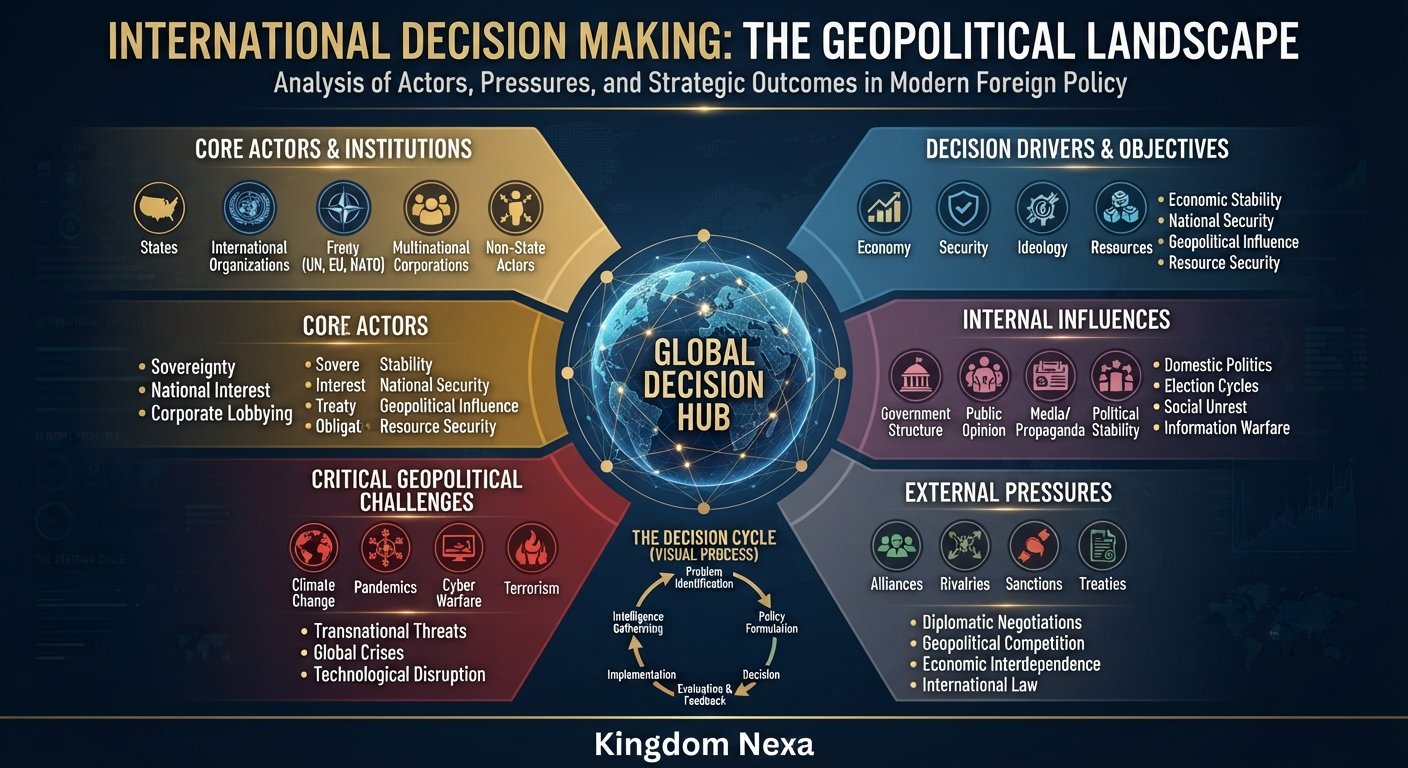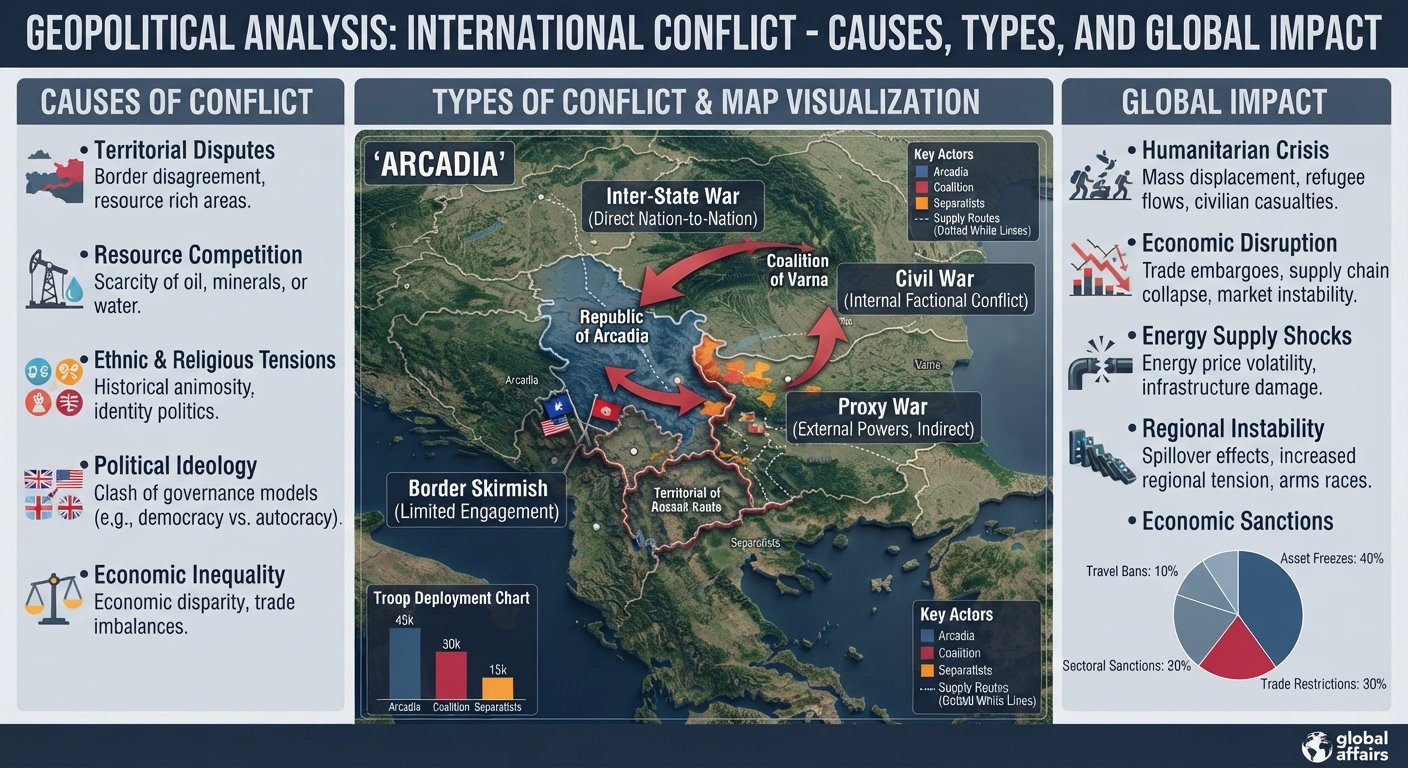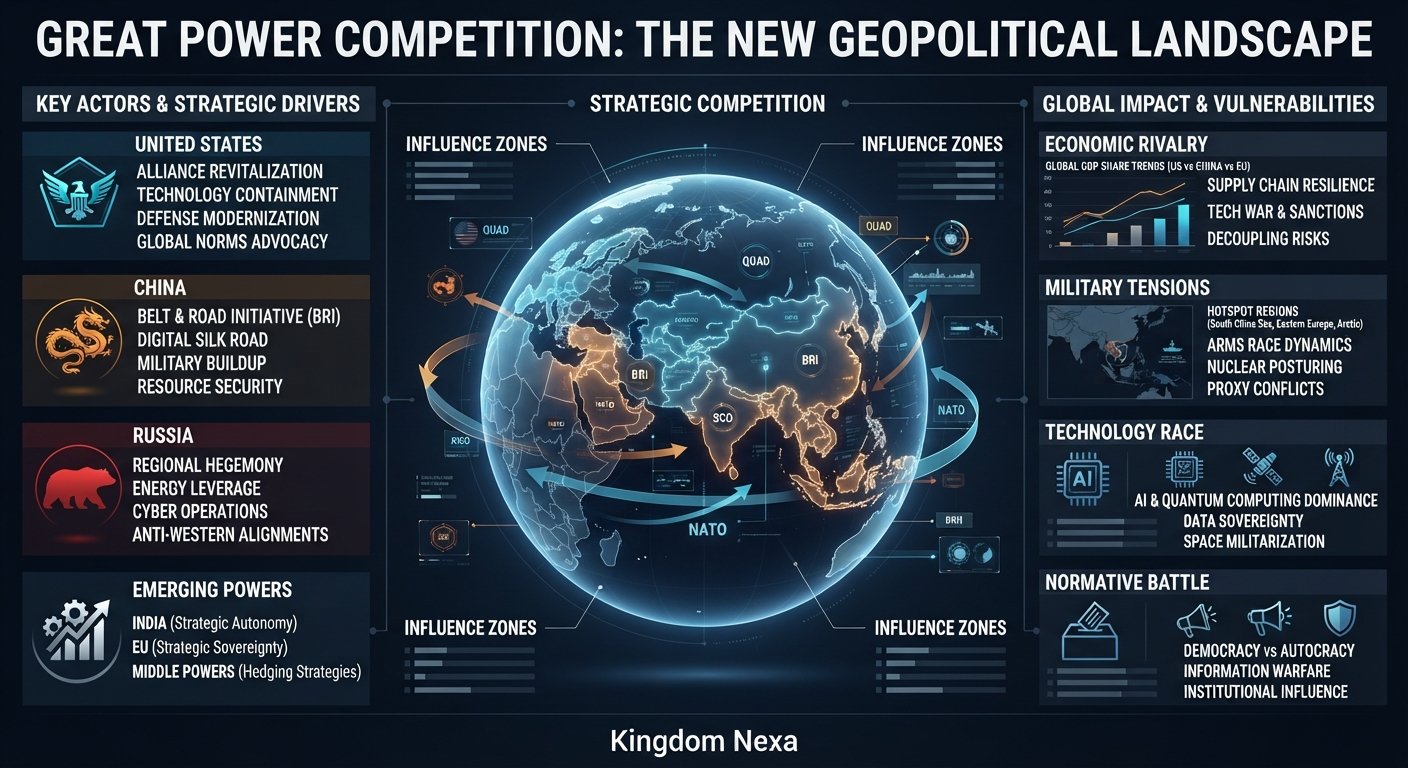
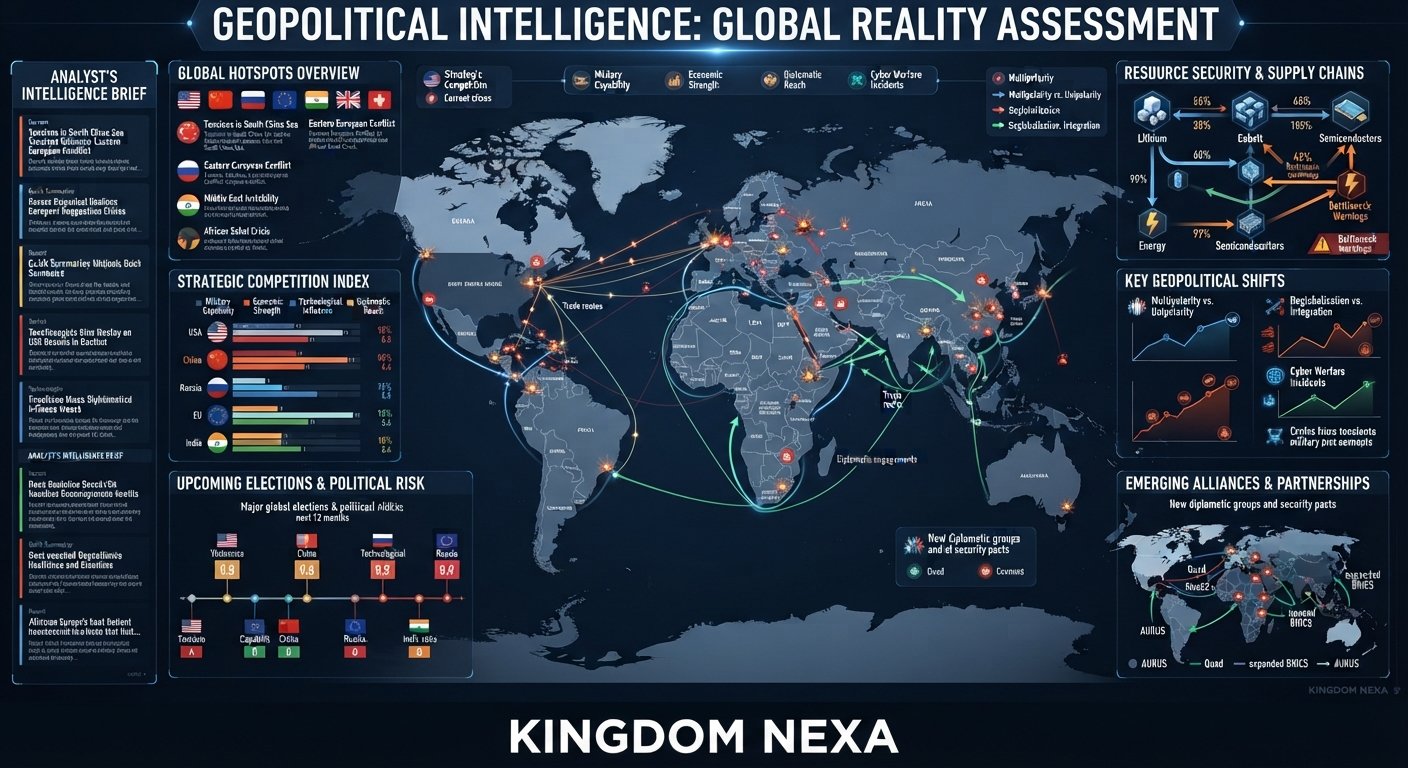
As international competition becomes more complex, decision-makers face a problem that is larger than simply knowing what happened. They need to understand why events are happening, which actors are involved, what interests are driving them, and what could happen next. This is where Geopolitical Intelligence becomes increasingly important.
Geopolitical intelligence combines information about states, political relationships, military capabilities, economic dependencies, technology, geography, societies, institutions, and global trends to reduce uncertainty around international developments. It can support governments and diplomats, but it is also increasingly relevant to businesses, journalists, researchers, investors, and security professionals.
The need for this capability is particularly visible in 2026. The World Economic Forum’s Global Risks Report 2026 identifies geoeconomic confrontation and state-based armed conflict among the leading short-term global risks, while technological change, misinformation, supply-chain vulnerabilities, and geopolitical fragmentation are becoming increasingly interconnected. (World Economic Forum)
This article explains what Geopolitical Intelligence means, how it is produced, the sources and analytical methods involved, its applications, limitations, and why it matters in today’s increasingly contested international environment.


What Is Geopolitical Intelligence?
Geopolitical Intelligence is the systematic collection, verification, analysis, and interpretation of information about international political, economic, military, geographic, technological, and social developments to understand strategic risks, interests, relationships, and potential consequences.
It is more than monitoring international news. Intelligence becomes useful when scattered information is transformed into a structured assessment that helps answer questions such as:
- What is changing?
- Which actors are involved?
- What are their interests and constraints?
- What evidence supports competing explanations?
- Which developments could affect security, markets, diplomacy, or policy?
- What indicators should decision-makers monitor?
The broader intelligence discipline traditionally distinguishes between raw information and finished intelligence. The U.S. Office of the Director of National Intelligence describes an intelligence cycle involving planning and direction, collection, processing and exploitation, analysis and production, dissemination, and evaluation. (ODNI)
Geopolitical intelligence applies this general logic specifically to the international environment.
Geopolitical Intelligence vs. Geopolitical Analysis
The two concepts overlap but are not identical.
Geopolitical analysis focuses on explaining international events, relationships, power structures, geography, and strategic behavior.
Geopolitical intelligence places greater emphasis on a structured intelligence process: identifying requirements, gathering relevant information, assessing reliability, integrating different sources, identifying implications, and delivering findings to a decision-maker.
A newspaper article can provide information. An analyst may turn several such reports, official statements, economic indicators, satellite imagery, historical records, and other sources into an intelligence assessment.
Why Is Geopolitical Intelligence Important?
International affairs increasingly operate across interconnected political, economic, technological, and security systems.
A military confrontation can affect shipping. Shipping disruptions can affect energy prices. Higher energy costs can influence inflation. Inflation can affect domestic politics. Domestic political pressure can then alter foreign-policy decisions.
This creates chains of consequences that are difficult to understand through a single news story.
The World Economic Forum’s 2026 assessment describes a global environment in which geopolitical competition, economic instruments, technological change, societal polarization, and misinformation increasingly interact. Its survey of more than 1,300 experts identified geoeconomic confrontation as the leading global risk for 2026, followed by state-based armed conflict. (World Economic Forum)
For businesses, the implications can include:
- sanctions exposure;
- trade restrictions;
- supply-chain disruption;
- energy-price volatility;
- political instability;
- regulatory changes;
- transportation chokepoint risks;
- technology restrictions; and
- country-level investment uncertainty.
A September 2026 European Commission report, drawing on European Investment Bank and Commission research, found that 64% of surveyed EU firms considered themselves prepared to manage geopolitical risks, while tariffs and regulatory compliance had become major trade obstacles. (Internal Market & SMEs)
How Does Geopolitical Intelligence Work?
A useful geopolitical intelligence process can be understood as a continuous cycle rather than a one-time research exercise.
1. Define the Intelligence Requirement
The first question should be: What decision needs better information?
For example, a company considering investment in a foreign market may need to know:
- whether political conditions are changing;
- whether sanctions could affect operations;
- whether supply routes are vulnerable;
- whether regulations are likely to change;
- and which political developments could materially affect the investment.
Without a defined requirement, analysts can collect enormous quantities of information without producing useful intelligence.
2. Collect Relevant Information
Collection can involve multiple intelligence disciplines and publicly available sources.
Common sources include:
- government documents;
- diplomatic statements;
- legislation;
- international organizations;
- economic statistics;
- academic research;
- satellite imagery;
- commercial databases;
- corporate filings;
- local and international media;
- maritime and aviation data;
- social-media material;
- expert assessments; and
- historical records.
Open-source intelligence, or OSINT, has become especially important. In 2024, ODNI and the CIA described OSINT as intelligence derived exclusively from publicly or commercially available information addressing specific intelligence requirements or gaps. (CIA)
3. Verify and Evaluate Sources
Information is not automatically intelligence simply because it is available.
An analyst should consider:
- Who produced the information?
- What is the source’s access?
- Is the information independently corroborated?
- Could the source have an incentive to mislead?
- Is the material current?
- Does other evidence support or contradict it?
- Is the evidence direct or indirect?
This is particularly important during conflicts, when governments, armed groups, political organizations, companies, and media outlets may present competing narratives.
4. Analyze the Information
Analysis converts individual observations into broader judgments.
An analyst might examine:
- capabilities;
- intentions;
- interests;
- constraints;
- geographic factors;
- economic dependencies;
- alliance relationships;
- domestic political pressures;
- historical patterns; and
- indicators of future change.
The objective is not simply to predict the future. It is to reduce uncertainty by establishing what is known, what is probable, what is disputed, and what remains unknown.
5. Communicate the Assessment
Good intelligence must reach the intended user in a usable form.
A policymaker may need a short briefing. A corporate risk team may require a country-risk assessment. A journalist may need source verification. A military organization may require a detailed operational assessment.
ODNI’s current mission-integration framework similarly emphasizes integrating collection and analysis to provide timely, objective, accurate, and relevant intelligence to decision-makers. (ODNI)
Major Sources of Geopolitical Intelligence
Open-Source Intelligence
OSINT includes information legally accessible through public or commercial sources.
Examples include government websites, official statistics, court records, satellite imagery, academic publications, company reports, media reports, and publicly accessible databases.
Its importance has grown because digital connectivity produces enormous amounts of information. However, abundance creates another problem: information overload.
More information does not necessarily mean better intelligence.
Geospatial Intelligence
GEOINT uses geographic information and imagery to understand activities and changes occurring in physical space.
Satellite imagery can help analysts examine:
- military infrastructure;
- ports;
- transportation networks;
- industrial facilities;
- border areas;
- environmental changes;
- infrastructure development; and
- changes in strategic locations.
Imagery is particularly valuable when combined with other sources rather than interpreted in isolation.
Human Intelligence
HUMINT derives information from human sources.
CIA’s public glossary describes HUMINT as intelligence collected from human sources. (CIA)
In geopolitical analysis, human reporting can provide context about political attitudes, institutional behavior, local developments, or decision-making environments that may not be visible through technical data alone.
Signals and Technical Intelligence
Signals intelligence and other technical disciplines can provide information from communications, electronic emissions, or technical systems. These capabilities are generally associated with government and military intelligence organizations and may involve legal, security, and privacy restrictions.
Economic Intelligence
Economic intelligence examines the strategic significance of:
- trade flows;
- sanctions;
- investment;
- energy;
- critical minerals;
- industrial capacity;
- financial systems;
- supply chains;
- shipping;
- technology exports; and
- economic dependencies.
The boundary between economic policy and national security has become increasingly important. The 2026 Global Risks Report identifies growing use of economic tools in pursuit of national-security objectives and describes geoeconomic confrontation as a major source of systemic risk. (World Economic Forum)
What Makes Geopolitical Intelligence Different From News?
News generally answers what happened.
Geopolitical intelligence attempts to answer:
What happened, why did it happen, who benefits or loses, what constraints exist, and what developments should be monitored next?
Consider a hypothetical announcement that a country has imposed export controls on a strategically important technology.
A news report might describe the announcement.
A geopolitical intelligence assessment could additionally examine:
- the stated reason for the policy;
- the targeted technologies;
- affected trading partners;
- dependence on foreign suppliers;
- potential retaliation;
- alternative suppliers;
- implications for domestic industries;
- effects on allied relationships; and
- indicators showing whether the policy is likely to expand.
That additional layer of structured analysis is what makes intelligence strategically valuable.
Geopolitical Intelligence and Current Global Competition
The contemporary international environment illustrates why geopolitical intelligence has become multidimensional.
The National Intelligence Council’s Global Trends 2040 identified a future international environment characterized by greater contestation and highlighted the growing importance of information, technology, economic power, regional actors, and non-state actors alongside traditional military capabilities. (Archive DNI)
The 2026 environment reinforces several of these trends.
Geoeconomic Competition
Trade restrictions, sanctions, investment controls, industrial policies, technology restrictions, and supply-chain diversification can all become instruments of strategic competition.
The UK’s September 2026 foresight assessment on global supply chains emphasizes that geopolitical pressures and climate-related disruptions can interact across complex, multi-tier networks, making vulnerabilities difficult to identify from conventional trade relationships alone. (GOV.UK)
Military and Hybrid Competition
Modern geopolitical competition does not necessarily remain confined to conventional military operations.
It can involve:
- cyber operations;
- sabotage;
- information campaigns;
- economic pressure;
- maritime disruption;
- electronic warfare;
- political influence;
- proxy relationships; and
- pressure against critical infrastructure.
Recent European security discussions have highlighted concerns about hybrid activities involving sabotage, cyberattacks, and airspace incidents connected to the broader Russia-Ukraine confrontation. These are claims and assessments by officials and should be distinguished from independently established facts in individual cases. (Reuters)
Technology and Artificial Intelligence
Artificial intelligence is changing both information production and the information environment.
AI can help analysts process large datasets, identify patterns, translate documents, monitor developments, and generate initial summaries. At the same time, it can increase the scale of misinformation, synthetic media, automated influence operations, and analytical error.
The National Intelligence Council has previously warned that increasingly sophisticated information technologies could enable actors to target audiences more precisely and manipulate information environments at scale. (National Intelligence Office)
The challenge is therefore two-sided: analysts can use AI to process information, but they must also assess whether the information itself has been artificially manipulated.
How Businesses Use Geopolitical Intelligence
Geopolitical intelligence is no longer limited to governments.
Businesses can use it for country risk, market-entry analysis, supply-chain planning, investment decisions, sanctions compliance, infrastructure planning, and crisis preparedness.
A manufacturer, for example, may depend on several countries for raw materials, components, shipping, energy, and technology. A political shock in one location can therefore create consequences elsewhere.
This is why modern geopolitical risk analysis increasingly considers networks rather than isolated countries.
A company may ask not only:
“Is Country A stable?”
but also:
“Which political, economic, logistical, technological, and regulatory dependencies connect our operations to Country A?”
That distinction can materially improve risk assessment.
Key Challenges and Limitations
Geopolitical intelligence has significant limitations.
Information Overload
Analysts may have access to more information than they can meaningfully process. The challenge becomes identifying the information that changes the assessment.
Deception and Disinformation
False or manipulated information can enter the intelligence cycle at the collection stage. Social media can spread unverified claims rapidly, while sophisticated actors may deliberately create misleading narratives.
Analytical Bias
Analysts can unconsciously favor evidence that confirms an existing hypothesis.
Good analytical practice therefore requires competing explanations, explicit assumptions, source evaluation, and clear confidence levels.
Uncertainty
Even high-quality intelligence cannot eliminate uncertainty.
Political leaders can change policy unexpectedly. Governments can miscalculate. Domestic crises can alter foreign-policy priorities. Accidents can trigger escalation.
The purpose of intelligence is therefore not to provide certainty where none exists. It is to improve understanding of uncertainty.
A Practical Framework for Geopolitical Intelligence Analysis
A simple framework can help students, researchers, journalists, and professionals structure an assessment.
Who?
Identify the principal state and non-state actors.
What?
Establish the verified facts and distinguish them from claims.
Why?
Examine interests, objectives, incentives, historical grievances, and constraints.
Where?
Assess the strategic importance of geography, borders, ports, resources, transportation routes, and neighboring states.
When?
Identify the historical context and recent turning points.
How?
Examine diplomacy, economic policy, military activity, technology, alliances, influence, and other instruments of power.
So What?
Determine the regional, economic, security, or diplomatic implications.
What Next?
Identify plausible developments and the indicators that would suggest movement toward one scenario or another.
This framework should produce scenarios and indicators rather than unsupported predictions.
The Future of Geopolitical Intelligence
The future of Geopolitical Intelligence will likely involve greater integration of human expertise with large-scale data processing.
Several developments are particularly important:
- AI-assisted information processing;
- satellite and geospatial analytics;
- real-time economic monitoring;
- automated multilingual collection;
- cyber and digital-domain analysis;
- supply-chain mapping;
- commercial intelligence platforms;
- open-source verification; and
- scenario-based strategic forecasting.
NATO’s 2026 Digital Strategy explicitly includes data-centric capabilities and references intelligence, surveillance and reconnaissance, OSINT, and related data architectures as components of the alliance’s digital environment. (NATO)
However, technological sophistication does not eliminate the need for experienced analysts. A machine may identify an unusual movement or correlation, but understanding its geopolitical meaning requires context, source criticism, historical knowledge, and awareness of alternative explanations.
Frequently Asked Questions About Geopolitical Intelligence
What is Geopolitical Intelligence in simple terms?
Geopolitical Intelligence is the structured process of collecting and analyzing information about countries, political relationships, conflicts, economies, geography, technology, and other international factors to understand strategic risks and developments.
What is the difference between geopolitical intelligence and geopolitics?
Geopolitics is the study of how geography, power, interests, and international relationships influence global affairs. Geopolitical intelligence is the practical process of collecting and analyzing information about those factors for decision-making.
Is OSINT part of Geopolitical Intelligence?
Yes. Open-source intelligence is an important component of modern geopolitical intelligence. It uses publicly or commercially available information to address defined intelligence requirements. (CIA)
What sources are used in Geopolitical Intelligence?
Sources can include government documents, diplomatic statements, international organizations, economic data, academic research, media reporting, satellite imagery, corporate information, shipping and aviation data, and other publicly or commercially available datasets.
Why is satellite imagery important for geopolitical analysis?
Satellite imagery can provide geographic and visual evidence about infrastructure, transportation, military facilities, environmental changes, and activity at strategic locations. Its value increases when imagery is combined with other independently assessed information.
Can Geopolitical Intelligence predict wars?
It cannot reliably predict every conflict. Its purpose is to reduce uncertainty by identifying risks, indicators, possible scenarios, capabilities, intentions, and constraints. Major geopolitical events can remain unpredictable because decision-makers can change course rapidly.
How does Geopolitical Intelligence help businesses?
It can help businesses assess country risk, supply-chain vulnerabilities, sanctions exposure, market-entry conditions, regulatory developments, transportation chokepoints, energy risks, and political changes that could affect commercial operations.
What are the biggest weaknesses of Geopolitical Intelligence?
Major weaknesses include incomplete information, deception, disinformation, analytical bias, rapidly changing circumstances, source limitations, and the difficulty of distinguishing correlation from causation.
Will artificial intelligence replace geopolitical analysts?
AI can automate parts of collection, processing, translation, pattern detection, and summarization, but geopolitical interpretation still requires human judgment, contextual knowledge, source evaluation, and the ability to challenge assumptions. AI-generated analysis can also introduce new errors if its underlying information is incomplete or manipulated.
Conclusion
Geopolitical Intelligence has become an essential way of understanding an international environment in which political power, military competition, economic dependencies, technology, information, and geography increasingly overlap.
Its fundamental purpose is not simply to collect more information. It is to transform relevant information into a disciplined assessment of actors, interests, capabilities, constraints, risks, and possible developments.
Current global conditions demonstrate the importance of this approach. Geoeconomic confrontation, armed conflict, supply-chain vulnerability, technological competition, hybrid activity, and information manipulation increasingly interact across national borders. The 2026 Global Risks Report describes this environment as a more competitive international landscape in which geopolitical and economic risks are closely interconnected. (World Economic Forum)
For governments, businesses, researchers, journalists, and other decision-makers, the central challenge is therefore not knowing everything. It is knowing which information matters, how reliable it is, what it means in context, and which indicators deserve attention next.
That is the enduring value of Geopolitical Intelligence: helping decision-makers navigate uncertainty without confusing analysis with certainty.