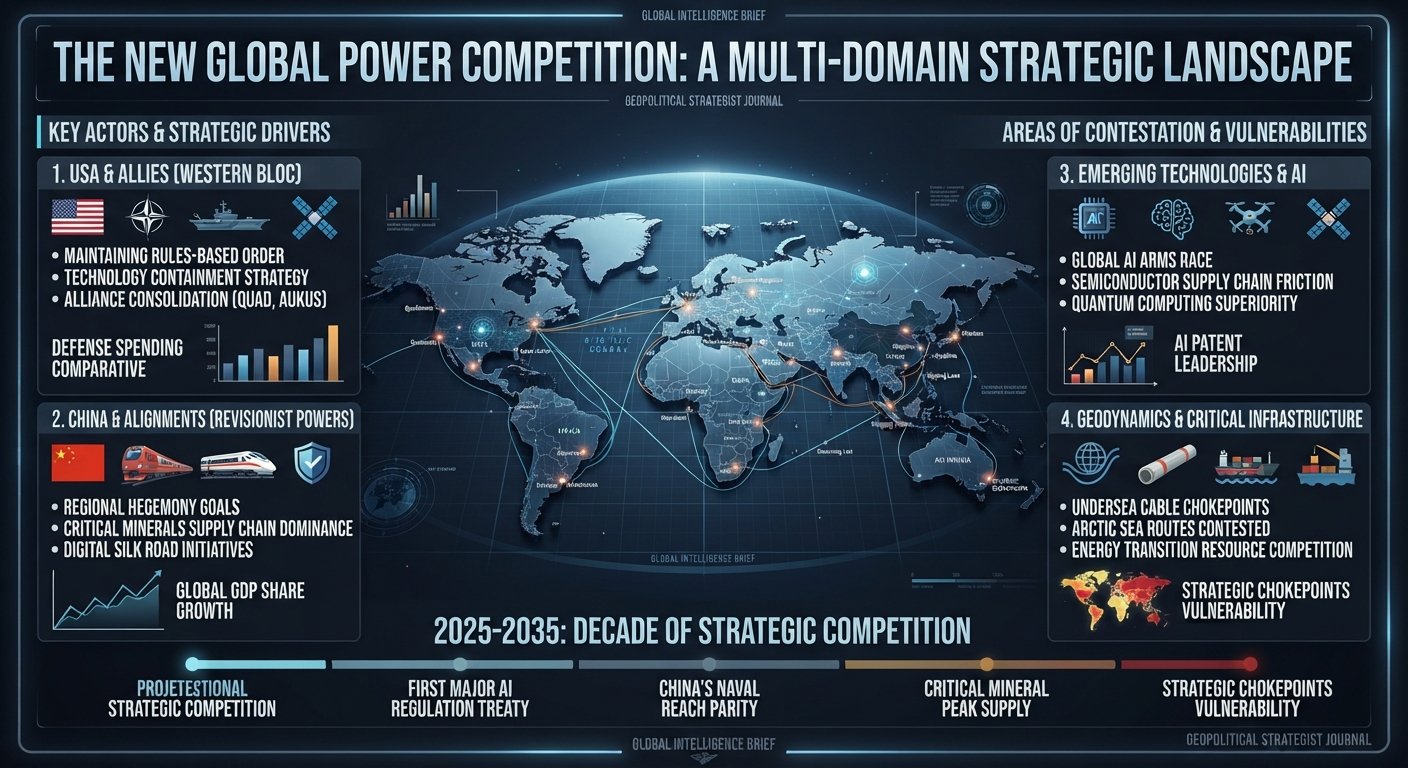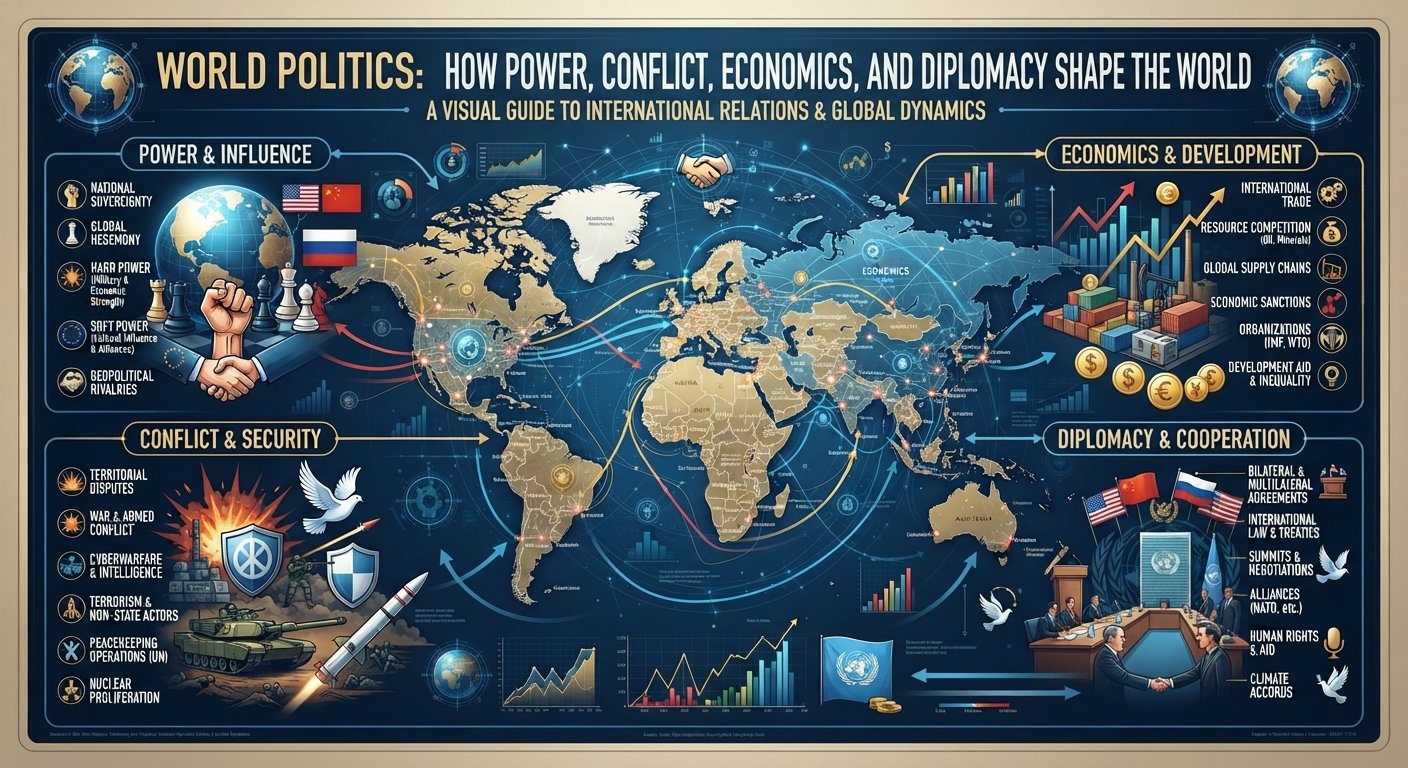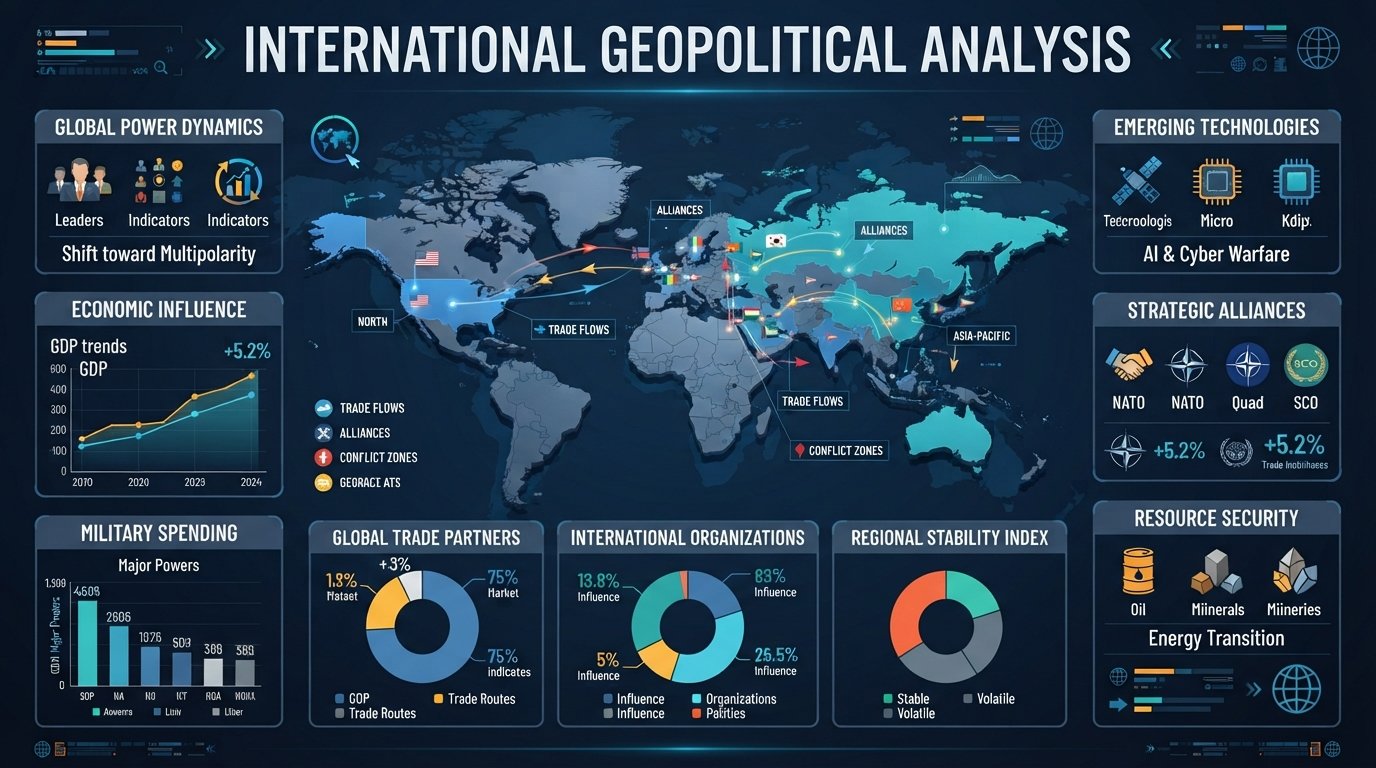
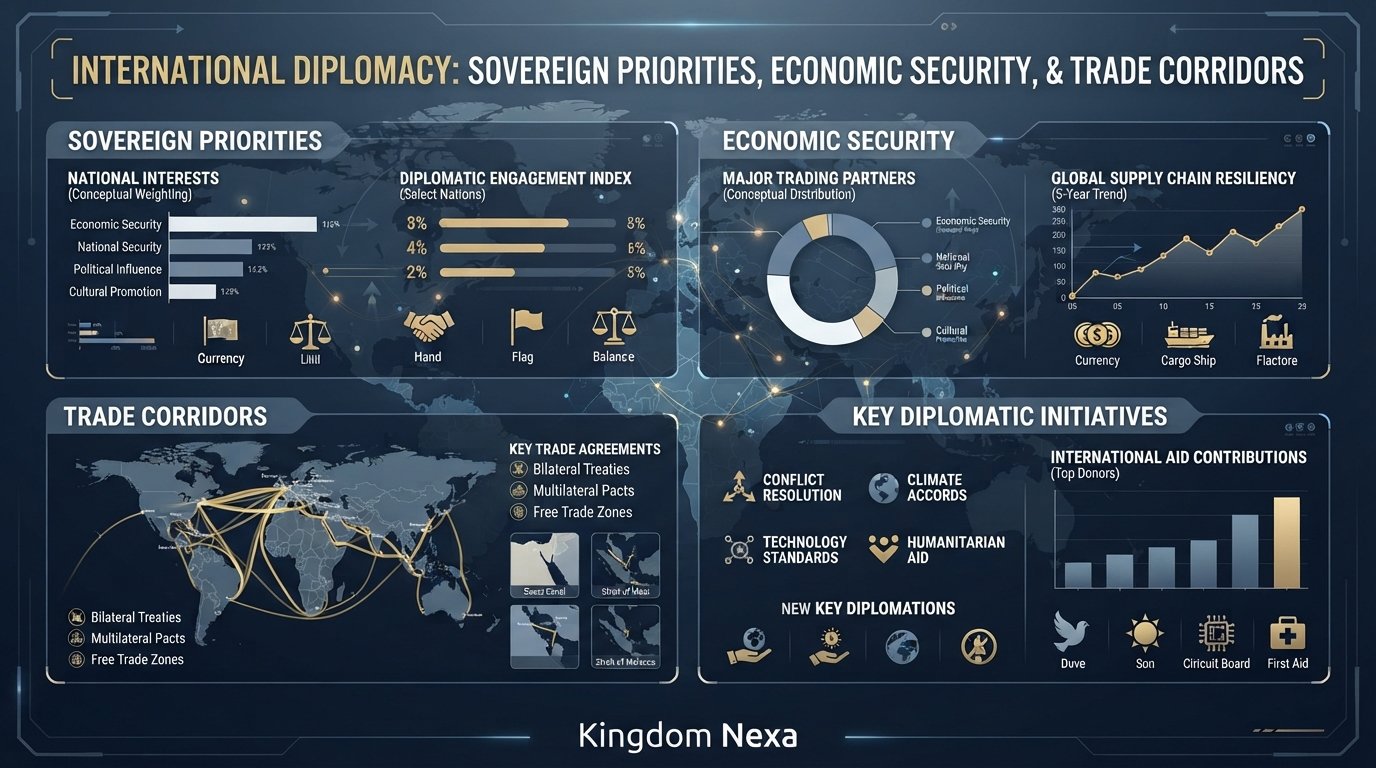
International diplomacy is the organized process through which states and other international actors communicate, negotiate, manage disputes, build agreements, and pursue their interests without relying solely on coercion or military force. It operates through embassies, summits, negotiations, international organizations, treaties, mediation, economic engagement, and increasingly through digital and technological channels.
Its importance is particularly visible in the current international environment. Governments are dealing simultaneously with armed conflicts, strategic competition, trade disputes, energy insecurity, climate pressures, technological rivalry, sanctions, migration, and disagreements over the rules of global governance. At the same time, international cooperation remains essential because problems such as climate change, pandemics, cyber risks, artificial intelligence, financial instability, and cross-border trade cannot be managed effectively by one country alone.
This article explains International Diplomacy from historical, political, economic, security, technological, legal, and geopolitical perspectives. It examines how diplomacy works, who participates in it, why it succeeds or fails, and how diplomatic practice is changing in 2026.
What Is International Diplomacy?
International diplomacy is the practice of conducting relations and negotiations between states and other international actors through communication, representation, bargaining, mediation, and peaceful engagement.
In its traditional form, diplomacy primarily involved sovereign governments communicating through ambassadors and foreign ministries. Modern diplomacy is broader. International organizations, regional institutions, businesses, civil-society groups, experts, and sometimes non-state armed actors can influence diplomatic processes.
A useful distinction is between diplomacy and foreign policy:
- Foreign policy establishes a country’s external objectives and priorities.
- Diplomacy is one of the principal instruments used to pursue those objectives.
- International relations is the broader field encompassing interactions among states and other actors.
- International law provides rules and principles that shape many diplomatic interactions.
The modern diplomatic system is closely associated with the sovereign-state system, although diplomatic practices existed long before the modern state.
The United Nations currently has 193 Member States, providing the most comprehensive multilateral diplomatic forum in the international system. (United Nations)
Core Functions of Diplomacy
Diplomacy performs several interconnected functions:
- Communication — maintaining channels between governments.
- Negotiation — seeking mutually acceptable agreements.
- Representation — representing national interests abroad.
- Conflict management — reducing tensions and preventing escalation.
- Information gathering — helping governments understand foreign developments.
- Alliance building — developing partnerships and coalitions.
- Economic engagement — supporting trade, investment, and economic cooperation.
- Crisis management — maintaining communication during emergencies.
- Mediation — helping opposing parties explore negotiated solutions.
- Implementation — monitoring and maintaining agreements after they are concluded.
How International Diplomacy Developed
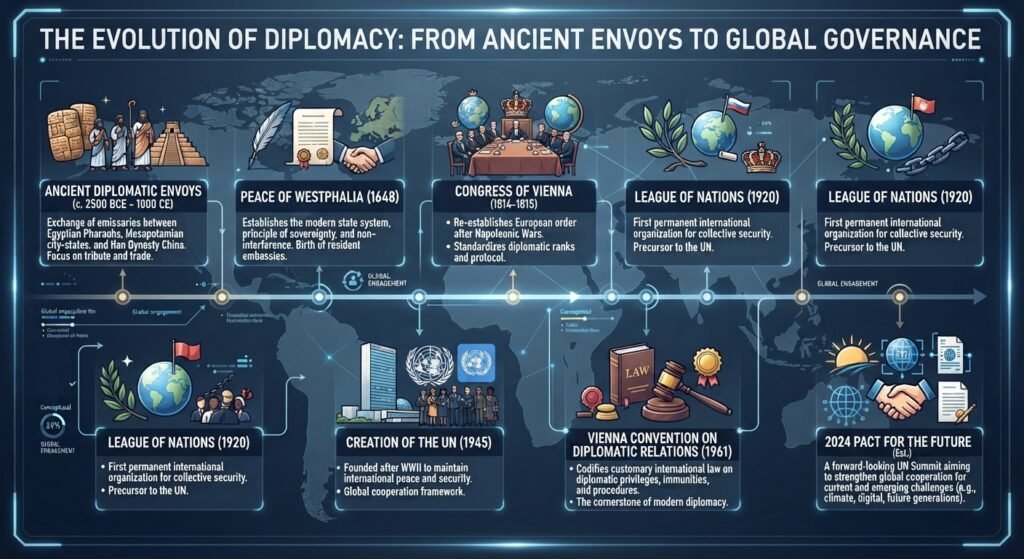
Diplomacy has ancient roots, but its institutional structure evolved significantly over centuries.
Ancient civilizations in Mesopotamia, Egypt, India, China, Greece, and Rome used envoys, treaties, alliances, marriage arrangements, and negotiated settlements. These practices demonstrated an enduring principle: political communities often need communication mechanisms even when their interests conflict.
European diplomatic practice changed substantially during the Renaissance. Italian city-states developed more permanent diplomatic missions, contributing to the emergence of resident ambassadors.
The Peace of Westphalia in 1648 is frequently associated with the development of modern European concepts of sovereignty, although historians caution against treating it as a single moment that created the modern international system.
The Congress of Vienna in 1814–1815 further developed diplomatic practices, including principles concerning diplomatic representation and the management of relations among major European powers.
The two world wars accelerated institutional change. The League of Nations represented an early attempt at organized multilateral diplomacy. Its limitations contributed to post-1945 efforts to establish a stronger international system.
The creation of the United Nations in 1945 placed multilateral diplomacy at the center of international governance. (United Nations)
The Vienna Convention and Diplomatic Practice
A major legal milestone was the Vienna Convention on Diplomatic Relations, adopted on 18 April 1961 and entering into force on 24 April 1964. It codified important principles governing diplomatic relations and diplomatic missions. (United Nations Legal Affairs)
The convention helped establish a common legal framework covering matters such as diplomatic functions, privileges and immunities, and the responsibilities of diplomatic missions.
This legal framework remains fundamental to modern state-to-state diplomacy.
Why Is International Diplomacy Important?
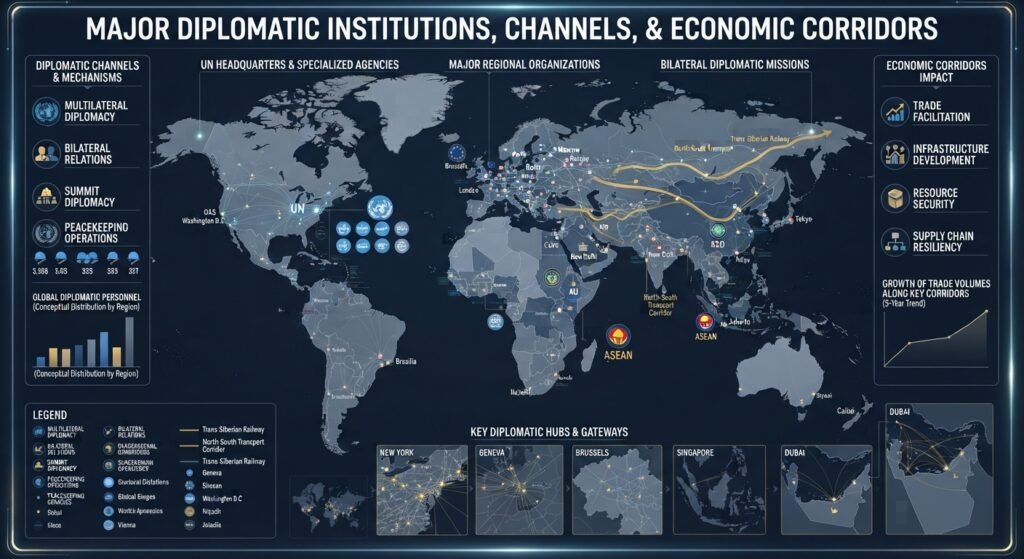

International diplomacy matters because international politics rarely consists of simple cooperation or confrontation. Governments frequently have overlapping interests.
Two states can compete strategically while simultaneously trading with each other. Countries that disagree over security issues may cooperate on climate change or humanitarian assistance. Rivals may maintain diplomatic channels precisely because communication becomes more important during crises.
Preventing and Managing Conflict
Diplomacy cannot eliminate every conflict, but it can provide mechanisms for communication, negotiation, mediation, ceasefire discussions, prisoner exchanges, humanitarian arrangements, and confidence-building measures.
Maintaining communication can also reduce the danger of miscalculation.
In a nuclear environment, for example, diplomatic communication has significance beyond ordinary political dialogue because misunderstanding between major military powers can carry exceptionally high consequences.
Protecting National Interests
Diplomacy allows governments to pursue national objectives without relying exclusively on military or economic coercion.
A foreign ministry may negotiate:
- trade agreements;
- security partnerships;
- investment arrangements;
- visa agreements;
- border mechanisms;
- maritime arrangements;
- development assistance;
- environmental commitments;
- technology cooperation; and
- humanitarian access.
Managing Global Problems
Many contemporary challenges cross national borders.
Climate change, pandemics, cyber threats, financial instability, migration, maritime security, and artificial intelligence all create incentives for international cooperation.
The 2024 UN Pact for the Future explicitly sought to strengthen multilateral cooperation and adapt international institutions to contemporary challenges. It was adopted on 22 September 2024 together with the Global Digital Compact and Declaration on Future Generations. (United Nations)
Who Are the Main Actors in International Diplomacy?
Diplomacy is no longer conducted exclusively between presidents, prime ministers, and ambassadors.
States and Governments
States remain the central actors because sovereign governments control foreign policy, diplomatic recognition, armed forces, treaties, borders, and many economic instruments.
Foreign ministries coordinate much of a government’s diplomatic activity, while embassies provide representation in individual countries.
International Organizations
International organizations create forums where governments can negotiate collectively.
The United Nations is the central global multilateral institution. Other institutions perform specialized roles involving trade, finance, security, health, development, aviation, maritime affairs, and communications.
The UN General Assembly illustrates the breadth of multilateral diplomacy: all 193 UN Member States are represented, with each holding one vote. (United Nations)
Regional Organizations
Regional institutions can sometimes act more quickly or address issues that require geographic proximity.
Examples include the European Union, African Union, Association of Southeast Asian Nations, Organization of American States, Arab League, and South Asian Association for Regional Cooperation.
Their diplomatic roles vary according to institutional authority and member-state interests.
Non-State Actors
Corporations, humanitarian organizations, research institutions, advocacy groups, and technology companies increasingly participate in international policy discussions.
Their influence can be substantial in areas such as:
- energy;
- infrastructure;
- artificial intelligence;
- cybersecurity;
- telecommunications;
- finance;
- supply chains;
- public health; and
- climate policy.
They do not possess the same legal status as sovereign states, but they can shape the environment in which diplomacy occurs.
Major Forms of International Diplomacy
Diplomacy takes several forms, often operating simultaneously.
Bilateral Diplomacy
Bilateral diplomacy involves two states.
Examples include negotiations over:
- borders;
- trade;
- security cooperation;
- migration;
- water resources;
- investment;
- consular matters.
Bilateral diplomacy can be relatively focused because only two governments are directly negotiating.
Multilateral Diplomacy
Multilateral diplomacy involves several states and is commonly conducted through international organizations or international conferences.
The UN system is the most prominent example.
Multilateral negotiations can produce broader legitimacy, but reaching consensus among many governments is often difficult because participants have different interests and political systems.
Summit Diplomacy
Summit diplomacy involves direct meetings among heads of government or heads of state.
High-level meetings can accelerate negotiations, resolve political blockages, or demonstrate commitment.
However, summits rarely substitute entirely for technical negotiations. Foreign ministries, diplomats, military officials, economists, legal experts, and technical specialists often conduct detailed work before and after leaders meet.
Shuttle Diplomacy
In shuttle diplomacy, a mediator moves between opposing parties rather than bringing them immediately into direct negotiations.
It can be useful when political relationships are too hostile for face-to-face talks.
Public Diplomacy
Public diplomacy seeks to influence foreign audiences through communication, cultural exchange, educational programs, media, international broadcasting, and other forms of engagement.
It differs from traditional diplomacy because its audience is not only another government but also foreign societies.
Economic Diplomacy
Economic diplomacy connects foreign policy with trade, investment, finance, energy, development, sanctions, and economic security.
Trade itself can create diplomatic incentives. According to WTO statistics, global trade in goods and commercial services reached approximately US$34.89 trillion in 2025, with services accounting for 27.5% of global trade. (World Trade Organization)
This illustrates why economic relationships are inseparable from contemporary diplomacy.
International Diplomacy and Global Power Politics
Diplomacy operates within an international system characterized by differences in economic resources, military capabilities, technological capacity, geographic position, demographic weight, and political influence.
Power affects bargaining positions, but it does not determine every diplomatic outcome.
Smaller and middle powers can exercise influence by:
- building coalitions;
- controlling strategically important geographic locations;
- providing specialized resources;
- mediating disputes;
- participating actively in international institutions;
- developing niche technological capabilities; or
- using diplomatic networks effectively.
This is particularly important in a more complex international environment where countries often avoid choosing permanently between competing major powers.
Great-Power Competition
Competition among major powers increasingly affects diplomacy involving trade, technology, military security, supply chains, energy, and international institutions.
Diplomatic relationships therefore operate on several levels simultaneously.
A government may cooperate with one country on climate policy while competing with the same country over semiconductors or maritime security.
This overlap makes contemporary diplomacy more transactional and issue-specific in many circumstances.
The Role of International Organizations


International organizations provide structures for states to negotiate rules, coordinate policies, and address common problems.
United Nations
The UN remains the principal global forum for multilateral diplomacy.
Its General Assembly provides universal representation, while the Security Council has primary responsibility within the UN system for international peace and security.
As of 2026, the Security Council has 15 members: five permanent members—China, France, Russia, the United Kingdom, and the United States—and ten elected members. (United Nations)
The structure illustrates both the reach and limitations of multilateral diplomacy. Permanent members possess veto power, meaning major disagreements among them can constrain Security Council action.
WTO and Economic Diplomacy
The World Trade Organization provides a framework for trade rules and negotiations.
Its 2026 annual report notes that world trade remained resilient during 2025 despite geopolitical tensions and that 72% of world trade continued under most-favoured-nation terms. (World Trade Organization)
The WTO’s work also demonstrates how modern diplomacy extends into emerging technologies. Its 2025 World Trade Report examined the relationship between artificial intelligence, trade, productivity, digital infrastructure, and inclusive growth. (World Trade Organization)
International Diplomacy and International Law
Diplomacy and international law are closely connected.
Treaties establish legal obligations between states. International customary law, international judicial decisions, and other legal instruments also influence diplomatic behavior.
The UN Charter provides foundational principles concerning sovereignty, peaceful dispute settlement, and restrictions on the use of force.
The Vienna Convention on Diplomatic Relations establishes important rules governing diplomatic missions and their operation. (United Nations Legal Affairs)
International law does not eliminate political disagreement. States sometimes interpret legal obligations differently, and enforcement mechanisms vary considerably.
For this reason, effective diplomatic analysis should distinguish:
- what international law formally provides;
- how states interpret those provisions;
- how international institutions apply them; and
- what actually occurs in practice.
The Economic Dimension of Diplomacy
Economic relationships are among the most powerful tools available to governments.
Diplomacy can involve:
- trade negotiations;
- tariffs;
- investment agreements;
- development finance;
- sanctions;
- export controls;
- energy partnerships;
- infrastructure projects;
- supply-chain agreements; and
- access to strategic resources.
Economic interdependence can encourage cooperation, but it can also create vulnerabilities.
A country that depends heavily on another state for energy, critical minerals, technology, food, finance, or major markets may have less freedom of action in a diplomatic dispute.
This has contributed to the growing importance of economic security diplomacy.
Technology Is Changing Diplomacy
Technology has transformed both the tools and subject matter of diplomacy.
Diplomats now operate in an environment shaped by:
- artificial intelligence;
- cybersecurity;
- satellite communications;
- social media;
- digital surveillance;
- drones;
- semiconductors;
- quantum technologies;
- data governance; and
- space systems.
The diplomatic significance of AI is especially important because it intersects with military power, economic competitiveness, information security, employment, trade, and governance.
The UN’s Global Digital Compact, adopted as an annex to the Pact for the Future in 2024, represents an effort to establish a shared framework for digital cooperation and AI-related governance. (United Nations)
Digital Diplomacy
Diplomatic communication now occurs through official websites, social media, video conferences, digital platforms, and rapid-response communication.
This creates opportunities for faster engagement but also introduces new risks.
False information can circulate rapidly, while hacked communications, deepfakes, cyberattacks, and manipulated media can complicate crisis management.
Diplomats therefore increasingly need technological literacy alongside traditional negotiation skills.
Current State of International Diplomacy in 2026
International diplomacy in 2026 operates under significant pressure from overlapping geopolitical and transnational challenges.
The international system is simultaneously experiencing strategic competition, regional conflicts, economic fragmentation pressures, technological transformation, and debates about institutional reform.
The UN’s Pact for the Future reflects recognition that existing institutions need adaptation. The agreement calls for stronger international cooperation and reaffirmation of international law while addressing peace and security, sustainable development, technology, and global governance. (United Nations)
The transition between UN General Assembly sessions also illustrates the continuing nature of multilateral diplomacy. The 81st session opened on 8 September 2026, following the conclusion of the 80th session. (United Nations)
The important point is that diplomacy has not become less relevant because geopolitical competition has intensified. Instead, competition itself increases the need for communication, negotiation, signaling, coalition-building, and crisis management.
Major Challenges Facing International Diplomacy
Strategic Rivalry
When major powers perceive each other as strategic competitors, even routine diplomatic actions can be interpreted through a security lens.
This makes confidence-building more difficult.
Armed Conflicts
Active conflicts can severely restrict diplomatic options. Negotiators must often balance military realities, humanitarian concerns, domestic political pressures, and international legal considerations.
Economic Fragmentation
Trade restrictions, sanctions, investment screening, export controls, and supply-chain restructuring can turn economic policy into a major instrument of geopolitical competition.
Declining Trust
Diplomatic agreements depend partly on confidence that commitments will be honored.
When governments distrust one another, even technically beneficial agreements can become politically difficult.
Information Warfare and Disinformation
Diplomats increasingly operate in an environment where competing narratives emerge instantly.
Distinguishing authentic information from manipulated or deliberately misleading material is becoming an important component of foreign-policy decision-making.
Institutional Reform
International institutions face continuing debates about representation, decision-making power, financing, effectiveness, and accountability.
The Pact for the Future explicitly recognizes the need to make multilateral institutions more representative, effective, inclusive, and capable of responding to contemporary challenges. (United Nations)
What Makes Diplomacy Successful?
Diplomatic success rarely depends on rhetoric alone.
Effective diplomacy generally requires a combination of:
- clearly defined objectives;
- credible information;
- realistic bargaining positions;
- understanding of the other side’s interests;
- credible incentives;
- carefully managed communication;
- domestic political support;
- institutional capacity;
- patience; and
- mechanisms for implementing agreements.
A diplomatic agreement is only as strong as the political willingness and institutional capacity behind its implementation.
This is why negotiations should be evaluated not only by what governments announce but also by what happens afterward.
Future of International Diplomacy
The future of diplomacy is likely to become more multilevel, technological, economic, and networked.
States will remain central, but diplomacy will increasingly involve international institutions, regional organizations, corporations, technology companies, civil society, and expert networks.
Three trends are particularly significant.
More Issue-Specific Coalitions
Countries may increasingly cooperate through flexible coalitions rather than relying exclusively on universal institutions.
Different groups can form around climate finance, AI governance, maritime security, critical minerals, health security, or digital standards.
Greater Integration of Economic and Security Policy
Trade, technology, energy, investment, and national security are becoming increasingly interconnected.
Foreign ministries therefore need closer coordination with economic, defense, technology, finance, and intelligence institutions.
Technology-Enabled Diplomacy
AI-assisted analysis, digital communication, satellite information, cyber capabilities, and automated translation may improve diplomatic efficiency.
At the same time, governments will need safeguards against manipulation, cyberattacks, algorithmic bias, and unreliable information.
The central challenge will be ensuring that technological speed does not undermine careful diplomatic judgment.
International Diplomacy: Possible Future Scenarios
Predicting diplomatic outcomes with certainty is impossible, but several broad scenarios are plausible.
Competitive multilateralism: States continue strategic competition while preserving international institutions where cooperation remains mutually beneficial.
Fragmented diplomacy: Geopolitical blocs become more distinct, with competing economic, technological, and security networks.
Renewed multilateral cooperation: Major powers and middle powers find stronger incentives to cooperate on shared challenges such as climate, AI, trade, health, and financial stability.
Flexible network diplomacy: Governments increasingly shift between bilateral, regional, and issue-specific coalitions depending on the problem.
These scenarios are not mutually exclusive. Different forms of diplomacy can coexist within the same international system.
Frequently Asked Questions About International Diplomacy
What is international diplomacy?
International diplomacy is the process through which states and other international actors communicate, negotiate, manage disputes, build partnerships, and pursue interests through peaceful political engagement.
Why is international diplomacy important?
It provides mechanisms for negotiation, conflict management, cooperation, crisis communication, treaty-making, economic engagement, and collective responses to international problems.
What is the difference between diplomacy and foreign policy?
Foreign policy defines a government’s external objectives, while diplomacy is one of the principal instruments used to communicate, negotiate, and pursue those objectives internationally.
What are the main types of international diplomacy?
Major forms include bilateral diplomacy, multilateral diplomacy, summit diplomacy, shuttle diplomacy, public diplomacy, economic diplomacy, and increasingly digital diplomacy.
What role does the United Nations play in diplomacy?
The United Nations provides a global forum where governments negotiate, adopt resolutions, establish international frameworks, address security issues, and cooperate on economic, humanitarian, environmental, and social challenges. It currently has 193 Member States. (United Nations)
What is economic diplomacy?
Economic diplomacy uses trade, investment, finance, development assistance, sanctions, energy policy, and other economic relationships to pursue foreign-policy objectives.
How has technology changed diplomacy?
Technology has accelerated communication and expanded diplomatic activity into areas such as cybersecurity, AI, digital governance, satellites, semiconductors, social media, and information security.
Does diplomacy prevent wars?
Diplomacy cannot prevent every war, but negotiation, communication, mediation, deterrence, confidence-building, and international institutions can help manage disputes and reduce the risk of escalation.
What is multilateral diplomacy?
Multilateral diplomacy involves three or more governments negotiating through international organizations, conferences, coalitions, or other collective frameworks.
Conclusion
International Diplomacy remains one of the central mechanisms through which the international system manages competition and cooperation. Its role extends far beyond formal meetings between ambassadors. Modern diplomacy encompasses security negotiations, trade, sanctions, investment, technology, climate policy, international law, humanitarian affairs, public communication, and crisis management.
The contemporary diplomatic environment is more complicated because power is distributed across states, regional organizations, international institutions, economic networks, and technological systems. Strategic competition can make cooperation harder, yet shared global problems simultaneously make cooperation indispensable.
The direction of international diplomacy will therefore depend not only on the relative power of major states but also on whether governments can preserve communication, negotiate practical compromises, adapt international institutions, and maintain credible rules.
The 2024 Pact for the Future demonstrates that governments continue to recognize the need for multilateral cooperation even amid substantial geopolitical disagreement. (United Nations)
For students, researchers, policymakers, diplomats, and geopolitical analysts, understanding International Diplomacy means looking beyond individual negotiations. Diplomacy is ultimately about how political actors manage conflicting interests in an international system where cooperation, competition, law, economics, technology, and security increasingly overlap.