Introduction
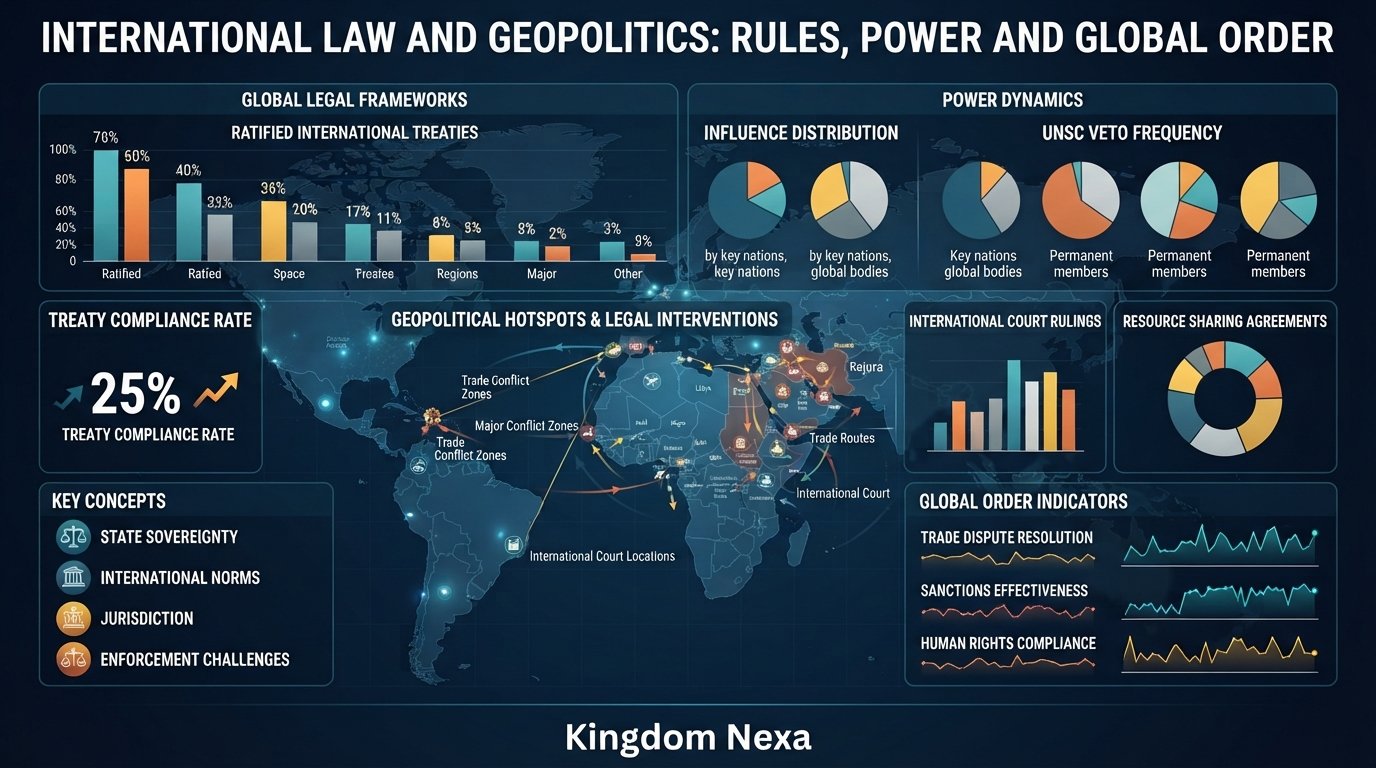
International relations are shaped by two forces that often appear to pull in different directions: law and power. International law establishes rules concerning sovereignty, the use of force, armed conflict, human rights, trade, territorial disputes, oceans, diplomacy, and state responsibility. Geopolitics, meanwhile, focuses on how states pursue security, influence, resources, strategic access, and national interests within an unequal international system.
This relationship makes International Law and Geopolitics one of the most important subjects for understanding contemporary global affairs. International law does not eliminate competition among powerful states, nor does geopolitical power automatically determine what is legally permissible. Instead, the two interact continuously. Governments use legal arguments to defend strategic positions, courts interpret contested rules, international organizations attempt to enforce obligations, and states sometimes resist legal decisions when they conflict with perceived vital interests.
As conflicts, maritime disputes, sanctions, territorial claims, cyber operations, emerging technologies, and global governance challenges evolve, understanding this interaction has become increasingly important. This article examines how international law works, how geopolitical power affects its implementation, where the two reinforce or constrain each other, and what these dynamics mean for the international system.
What Is International Law and Geopolitics?
International law is the body of rules and principles governing relations among states and, increasingly, international organizations, individuals, and other actors. Its sources include treaties, customary international law, general principles of law, and judicial decisions and scholarly writings as subsidiary means for determining legal rules.
Geopolitics examines how geography, power, resources, strategic position, military capabilities, economic relationships, and political interests influence international affairs.
The two concepts overlap because geopolitical competition occurs within a legal environment.
For example, a state may seek access to a strategically important sea route for economic and military reasons. International maritime law can determine which activities are legally permitted, while geopolitical considerations influence how strongly the state pursues its interests and how other states respond.
The key point is that international law and geopolitics should not be treated as competing explanations in which one automatically replaces the other. Law establishes legal claims, rights, duties, and procedures; geopolitics helps explain how states behave within that legal framework.
How International Law Shapes Geopolitical Relations
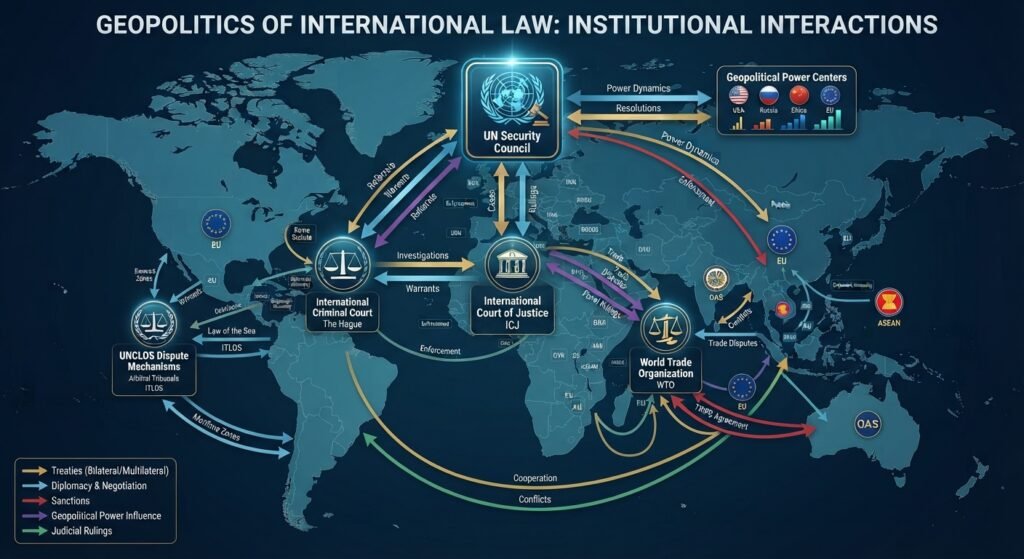
The modern international legal order rests heavily on the United Nations Charter. Article 2 establishes principles including sovereign equality, peaceful settlement of disputes, and the prohibition on the threat or use of force against the territorial integrity or political independence of states. Article 51 preserves the inherent right of individual or collective self-defence in the event of an armed attack.
These principles provide a legal framework for some of the most consequential geopolitical questions.
Sovereignty and Territorial Integrity
Sovereignty is central to international relations. States generally possess authority over their territory and political institutions, while international law places limits on how that authority can be exercised internationally.
Territorial disputes therefore involve both geography and law. Governments may advance historical, geographical, treaty-based, or customary claims, while international courts and tribunals may assess those claims according to applicable legal rules.
The geopolitical importance of sovereignty is particularly visible where territory provides access to:
- Strategic waterways
- Energy resources
- Ports
- Military bases
- Mineral deposits
- Trade corridors
- Agricultural land
- Airspace and maritime zones
A relatively small territory can therefore have geopolitical significance far beyond its physical size.
The Prohibition on the Use of Force
The UN Charter’s prohibition on the use of force is one of the foundations of the post-1945 international order. It is closely connected to sovereignty and territorial integrity.
The legal framework nevertheless recognizes limited circumstances involving force, most prominently Security Council-authorized action under the Charter and the inherent right of self-defence under Article 51.
This creates an important distinction between political justification and legal justification. A government may argue that military action is necessary for security or strategic reasons, but necessity in political terms does not automatically establish legality under international law.
International Humanitarian Law
International humanitarian law, often called the law of armed conflict, regulates conduct during armed conflict.
Its purpose is not to determine whether a war is politically justified. Instead, it limits how hostilities may be conducted and establishes protections for civilians, wounded personnel, prisoners, and other protected persons.
Core principles include distinction, proportionality, precautions in attack, and restrictions on particular methods and means of warfare.
This distinction is crucial for geopolitical analysis. A dispute about whether a state was legally entitled to use force is different from a question about whether particular conduct during an armed conflict complied with international humanitarian law.
Why Geopolitical Power Matters to International Law
International law operates in a decentralized international system. Unlike a domestic state, the international community does not possess a single universally dominant government with unlimited enforcement authority.
That makes power relevant.
The Security Council and Great-Power Politics
The UN Security Council has primary responsibility for international peace and security and consists of 15 members, including five permanent members: China, France, Russia, the United Kingdom, and the United States.
The permanent members possess veto power over substantive Council decisions. This institutional design means that geopolitical relationships among major powers can directly affect collective security decisions.
The Security Council remained active in 2026, adopting resolutions addressing issues including the Red Sea, Afghanistan, the Middle East, Libya, the Democratic Republic of the Congo, and other situations.
The result is a structural tension:
International law seeks common rules, while international security institutions operate partly through political decision-making by states with unequal power.
That does not make international law irrelevant. It means that implementation can depend on institutions, state cooperation, diplomatic pressure, domestic legal systems, and political circumstances.
Enforcement and Compliance
A legal rule and its enforcement are not always the same thing.
States may comply because they:
- Accept a treaty obligation
- Expect reciprocal compliance
- Value international legitimacy
- Face diplomatic or economic costs
- Want access to international institutions
- Fear reputational consequences
- Face domestic judicial enforcement
- Depend on international cooperation
Compliance can therefore occur without direct coercion.
At the same time, enforcement gaps can arise when powerful states or their allies have sufficient political leverage to resist collective measures.
This is one of the central issues in International Law and Geopolitics: the existence of a legal rule does not guarantee uniform enforcement.
International Courts and Geopolitical Disputes
International courts provide mechanisms for interpreting legal obligations and resolving disputes, but their jurisdiction and enforcement mechanisms differ from those of domestic courts.
I Court of Justice
The International Court of Justice (ICJ) is the principal judicial organ of the United Nations. It hears disputes between states when jurisdictional requirements are satisfied and also provides advisory opinions when authorized UN organs or agencies request them.
The Court’s docket illustrates how international law intersects with major geopolitical disputes.
In 2024, for example, the ICJ issued an advisory opinion concerning the legal consequences arising from policies and practices relating to the Occupied Palestinian Territory, including East Jerusalem. The Court addressed questions concerning self-determination, the status of the territory, and the legal consequences of the policies and practices examined.
The Court has also dealt with litigation involving Russia and Ukraine under the Genocide Convention. In February 2024, it found that it had jurisdiction over one part of Ukraine’s request and that the relevant claim was admissible; the proceedings subsequently continued into the merits phase.
The significance of such cases extends beyond the courtroom. Judicial decisions can influence diplomatic positions, sanctions debates, domestic litigation, international negotiations, and the legitimacy of competing state narratives.
International Criminal Court
The International Criminal Court (ICC) addresses individual criminal responsibility for crimes within its jurisdiction, including genocide, crimes against humanity, war crimes, and aggression under applicable conditions.
This distinguishes the ICC from the ICJ.
The ICJ primarily addresses disputes between states and certain advisory questions. The ICC prosecutes individuals.
The distinction is especially important in geopolitical analysis because governments and individual leaders are not legally interchangeable.
In November 2024, the ICC issued arrest warrants for Benjamin Netanyahu and Yoav Gallant in the Situation in the State of Palestine, after rejecting challenges concerning jurisdiction and related issues. The warrants alleged responsibility for specified war crimes and crimes against humanity and were issued at the pre-trial stage; an arrest warrant is not itself a conviction.
The political consequences of such proceedings can be substantial even where immediate enforcement is uncertain.
International Law, War and Security
International law affects warfare at several levels.
First, the jus ad bellum framework concerns when force may lawfully be used.
Second, international humanitarian law governs conduct during armed conflict.
Third, international criminal law can establish individual responsibility for specified crimes.
These layers should not be conflated.
The Ukraine War as a Legal and Geopolitical Case
The war involving Russia and Ukraine demonstrates the interaction of law, diplomacy, military power, and institutional politics.
The legal disputes extend beyond the battlefield. They include questions involving territorial sovereignty, the prohibition on force, humanitarian obligations, state responsibility, sanctions, accountability, and the jurisdiction of international courts.
The ICJ’s Ukraine-related proceedings under the Genocide Convention demonstrate how a major geopolitical conflict can generate complex litigation involving multiple states. The Court’s proceedings are legal processes with specific jurisdictional questions and should not be interpreted as a simple judicial determination of every political or historical issue surrounding the conflict.
The broader lesson is that legal proceedings can operate alongside military and diplomatic competition rather than replacing them.
The Middle East and International Legal Institutions
The Middle East provides another major example of the interaction between international law and geopolitics.
The ICJ has considered proceedings concerning the Genocide Convention in relation to Gaza and issued provisional measures in 2024. The proceedings remain legally distinct from political debates about the conflict and from criminal proceedings before the ICC.
Separately, the UN Security Council continues to address the regional situation through resolutions, meetings, and reporting mechanisms. A June 2026 UN report concerning Resolution 2334, for example, reviewed implementation during the period from March to June 2026 and reaffirmed the Council’s position concerning settlements in occupied Palestinian territory.
These developments illustrate an important analytical principle: international legal institutions can generate authoritative legal findings without possessing unlimited power to implement them directly.
International Maritime Law and Geopolitical Competition
Oceans are among the clearest examples of international law shaping geopolitics.
The United Nations Convention on the Law of the Sea (UNCLOS) establishes a comprehensive legal framework concerning maritime zones, navigation, resources, environmental protection, and dispute settlement. Its preamble describes the objective of establishing a legal order for the seas and oceans that facilitates communication and peaceful uses while addressing resource and environmental interests.
UNCLOS also provides mechanisms for peaceful settlement of disputes concerning interpretation and application of the Convention.
Maritime law matters geopolitically because oceans contain:
- Major shipping routes
- Fisheries
- Offshore hydrocarbons
- Subsea cables
- Strategic naval routes
- Critical infrastructure
- Potential seabed minerals
Consequently, disputes over maritime boundaries can involve both legal interpretation and major national-security interests.
The South China Sea
The South China Sea illustrates this interaction particularly clearly.
The dispute involves overlapping maritime claims, strategic waterways, fisheries, resources, military activity, and competing interpretations of historical rights and maritime entitlements.
The 2016 South China Sea arbitration under UNCLOS demonstrated that an international legal tribunal can issue a ruling on specific legal questions even when geopolitical disagreement remains unresolved.
The broader lesson is not that legal proceedings automatically settle geopolitical disputes. Rather, legal decisions can establish a framework for assessing claims while political and strategic competition continues.
Economic Power, Sanctions and International Law
Geopolitics increasingly operates through economic instruments.
States use:
- Sanctions
- Export controls
- Investment restrictions
- Financial regulations
- Trade measures
- Asset freezes
- Technology restrictions
- Development assistance
These instruments can have major geopolitical consequences.
International law enters the picture through treaty obligations, customary rules, domestic implementation, jurisdictional questions, international economic agreements, and disputes concerning state responsibility.
Sanctions illustrate the complexity particularly well. A government may regard sanctions as a legitimate foreign-policy tool, while another government may challenge their legality, extraterritorial reach, or compatibility with treaty obligations.
This means geopolitical economic pressure cannot be understood simply by asking whether a measure is politically effective. A legal analysis must examine its authority, applicable obligations, jurisdiction, exemptions, and institutional basis.
Technology and Emerging Areas of International Law
Technological change is creating new areas of geopolitical competition faster than legal systems can always develop detailed rules.
Cyber Operations
Cyber operations can affect:
- Military systems
- Energy infrastructure
- Financial networks
- Government databases
- Communications
- Critical infrastructure
A central legal question is whether existing international law adequately governs cyber operations or how established principles should be applied to new technological circumstances.
States increasingly make legal arguments about cyber activities, sovereignty, non-intervention, due diligence, and the prohibition on force.
Artificial Intelligence and Autonomous Systems
Artificial intelligence introduces further questions concerning military decision-making, surveillance, autonomous weapons, accountability, and cross-border technological competition.
The challenge is not necessarily that every emerging technology requires an entirely new body of international law. Existing legal principles may apply in many circumstances, while new agreements or interpretive developments may address areas where existing rules are insufficient.
The UN’s 2024 Pact for the Future included a Global Digital Compact and identified digital cooperation and emerging technologies as part of the broader effort to adapt international governance.
International Law and the Global South
International law is also connected to debates about representation and institutional legitimacy.
Many developing states argue that institutions created in the aftermath of the Second World War do not fully reflect today’s distribution of population, economic weight, or regional representation.
This debate affects discussions concerning:
- UN Security Council reform
- International financial institutions
- Development finance
- Climate responsibility
- Technology governance
- Sovereignty over natural resources
- International investment law
The 2024 Pact for the Future explicitly recognized the need to make the multilateral system more effective, inclusive, representative, and responsive to contemporary challenges.
International law is therefore not simply about enforcing existing rules. It is also about who participates in developing those rules and how international institutions evolve.
The International Law Commission and the Evolution of Global Rules
International law changes through treaties, state practice, judicial decisions, institutional processes, and the progressive development and codification of legal principles.
The UN International Law Commission plays an important role in this process.
In its 2026 session, the Commission worked on subjects including general principles of law, immunity of state officials, settlement of disputes, piracy and armed robbery at sea, state succession, non-legally binding agreements, and compensation for damage. It also added the identification and legal consequences of obligations erga omnes to its programme of work.
The 2026 developments demonstrate that international law is not static. It continues to evolve as states confront new political, technological, economic, and security problems.
Why International Law Does Not Eliminate Geopolitical Competition
A common misunderstanding is that the existence of international law should automatically prevent conflict.
International law does not operate in a political vacuum.
States possess different military capabilities, economic resources, diplomatic influence, alliance networks, geographic advantages, and institutional relationships.
Consequently, the same legal rule may produce different practical outcomes depending on the surrounding political environment.
This does not mean that international law is merely an expression of power.
States routinely rely on treaties, arbitration, courts, diplomatic agreements, international organizations, and reciprocal legal commitments because rules can reduce uncertainty and facilitate cooperation.
International aviation, maritime navigation, diplomatic relations, trade, telecommunications, environmental cooperation, and many other activities depend on legal frameworks that states generally find useful.
The more accurate conclusion is that international law and power operate together.
Law constrains, legitimizes, structures, and channels geopolitical behavior. Power affects interpretation, negotiation, implementation, and enforcement.
International Organizations and the Future of Global Governance
International organizations remain central to the legal and geopolitical system.
The UN provides the central framework for collective security and international cooperation. The ICJ adjudicates disputes and issues advisory opinions within its jurisdiction. The ICC addresses individual criminal responsibility under its legal framework. UNCLOS institutions address maritime issues. Regional organizations provide additional mechanisms for diplomacy, security, economic integration, and dispute management.
The 2024 Pact for the Future reflected an explicit effort by UN Member States to strengthen multilateral cooperation and reaffirm international law. It contains commitments covering peace and security, sustainable development, technology, digital cooperation, future generations, and global governance.
The challenge is implementation.
International institutions must operate in an environment where states have different interests and where major powers may disagree over security priorities, institutional reform, and legal interpretation.
Current Trends in International Law and Geopolitics
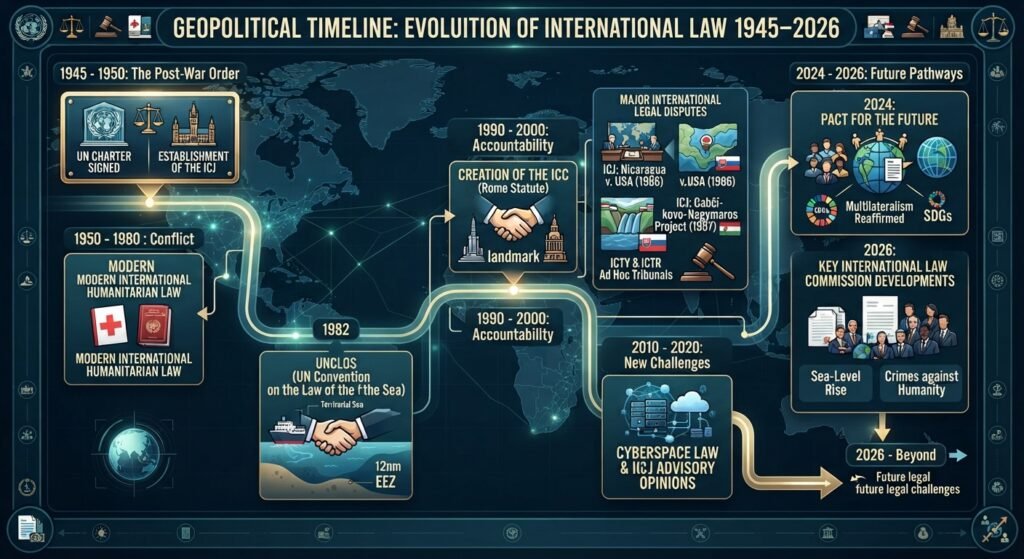
Several trends are particularly important as of September 2026.
Greater Use of Legal Forums
States increasingly use international courts and tribunals to address disputes involving territory, human rights, armed conflict, maritime claims, and treaty obligations.
Expansion Into New Domains
International legal analysis is increasingly relevant to cyber operations, artificial intelligence, autonomous systems, climate change, digital governance, outer space, and emerging technologies.
Competition Over Institutional Reform
Questions about representation, veto power, global financial governance, and the role of developing countries remain central to debates about the future international order.
Persistent Enforcement Problems
International legal institutions can clarify rules and produce decisions, but implementation may depend on state cooperation, domestic law, diplomacy, economic pressure, and collective political action.
Increasing Importance of Legal Narratives
Governments increasingly use international law not only as a source of obligations but also as part of diplomatic strategy. Legal arguments can influence international legitimacy, coalition-building, sanctions policy, public diplomacy, and negotiations.
Future Scenarios for International Law and Geopolitics
The future is uncertain, but several broad scenarios can be considered.
Scenario 1: Stronger Multilateral Cooperation
States could strengthen international institutions, improve dispute-resolution mechanisms, develop rules for emerging technologies, and expand cooperation on global challenges.
Scenario 2: Competitive Legalism
States may increasingly use courts, arbitration, sanctions, treaty mechanisms, and international organizations to advance geopolitical interests while strategic competition continues.
Scenario 3: Greater Fragmentation
If major powers increasingly reject common institutions or selectively comply with international obligations, the international system could become more fragmented.
Scenario 4: Adaptation of Existing Rules
Rather than replacing the current legal order, states may progressively interpret existing principles and develop additional agreements to address cyber conflict, AI, environmental challenges, and new forms of economic coercion.
These are analytical scenarios rather than predictions. Actual developments will depend on state behavior, conflicts, negotiations, institutional reforms, technological change, and the evolution of international practice.
FAQs About International Law and Geopolitics
What is the relationship between international law and geopolitics?
International law establishes rules governing international conduct, while geopolitics examines how states pursue interests and exercise power. They interact because geopolitical competition takes place within a legal and institutional environment.
Does international law have power over sovereign states?
International law creates obligations for states through treaties, customary international law, and other recognized sources. However, implementation and enforcement are decentralized and often depend on state consent, institutions, domestic mechanisms, diplomacy, reciprocity, and political circumstances.
Why is the UN Charter important to geopolitics?
The UN Charter establishes fundamental principles concerning sovereignty, peaceful dispute settlement, international cooperation, and the prohibition on the threat or use of force. These principles form a central part of the modern international legal order.
What is the difference between the ICJ and ICC?
The ICJ primarily handles disputes between states and provides advisory opinions when authorized. The ICC prosecutes individuals for specified international crimes within its jurisdiction.
Can international courts stop a war?
International courts can issue judgments, provisional measures, or other legally significant decisions within their jurisdiction, but they do not possess unlimited independent enforcement capabilities. The practical effect of their decisions depends partly on state and institutional cooperation.
How does international law affect territorial disputes?
International law provides principles and procedures for assessing sovereignty, territorial title, maritime boundaries, self-determination, occupation, treaties, and other claims. Courts and tribunals may help clarify specific legal questions when jurisdiction exists.
Why does the Security Council matter in international law?
The Security Council has primary responsibility for maintaining international peace and security. Its permanent-member structure and veto system mean that geopolitical relationships among major powers can affect collective decisions.
Does international law apply to cyber warfare?
Existing international law can be relevant to cyber operations, although questions remain about how particular rules apply to specific cyber activities. Issues can include sovereignty, non-intervention, use of force, self-defence, state responsibility, and international humanitarian law.
Is international law changing because of artificial intelligence?
International institutions and states are increasingly examining how existing legal principles apply to AI and how additional governance frameworks may be required. The UN’s Global Digital Compact is one recent multilateral initiative addressing digital cooperation and emerging technologies.
Why is international law important for geopolitical analysis?
It helps analysts distinguish between what a state wants to achieve, what it claims is legally permissible, what international institutions have determined, and what other states recognize or contest. This produces a more complete understanding of international disputes.
Conclusion
International Law and Geopolitics are deeply interconnected dimensions of global affairs. International law provides rules governing sovereignty, force, armed conflict, maritime rights, human rights, state responsibility, diplomacy, and international cooperation. Geopolitics explains how states pursue interests within that legal framework while responding to strategic geography, military capabilities, economic dependencies, alliances, and institutional power.
The modern international system is therefore neither purely a system of legal rules nor simply a contest of power. It is an interaction between both.
Courts can clarify legal questions. Treaties can establish predictable obligations. International organizations can create mechanisms for cooperation. At the same time, geopolitical competition can complicate enforcement, influence negotiations, and generate disagreements over interpretation.
Current developments—including international litigation over major conflicts, maritime disputes, technological governance, Security Council activity, and the continuing work of the International Law Commission—show that international law remains an active and evolving component of global politics. The central challenge for the international system is not simply creating rules, but maintaining credible institutions and sufficient political cooperation to apply them consistently.
Understanding that relationship is essential for anyone studying diplomacy, foreign policy, international security, political risk, global economics, or contemporary world affairs.