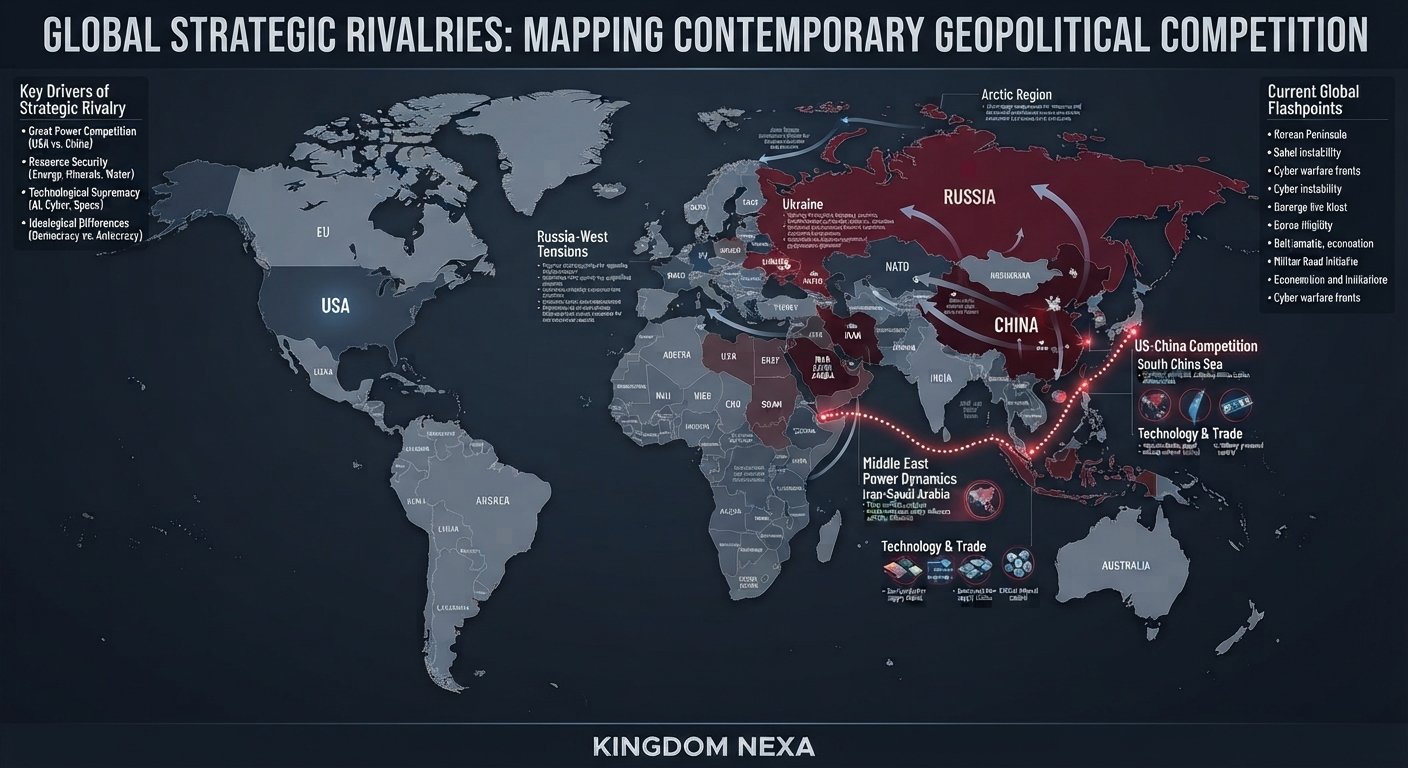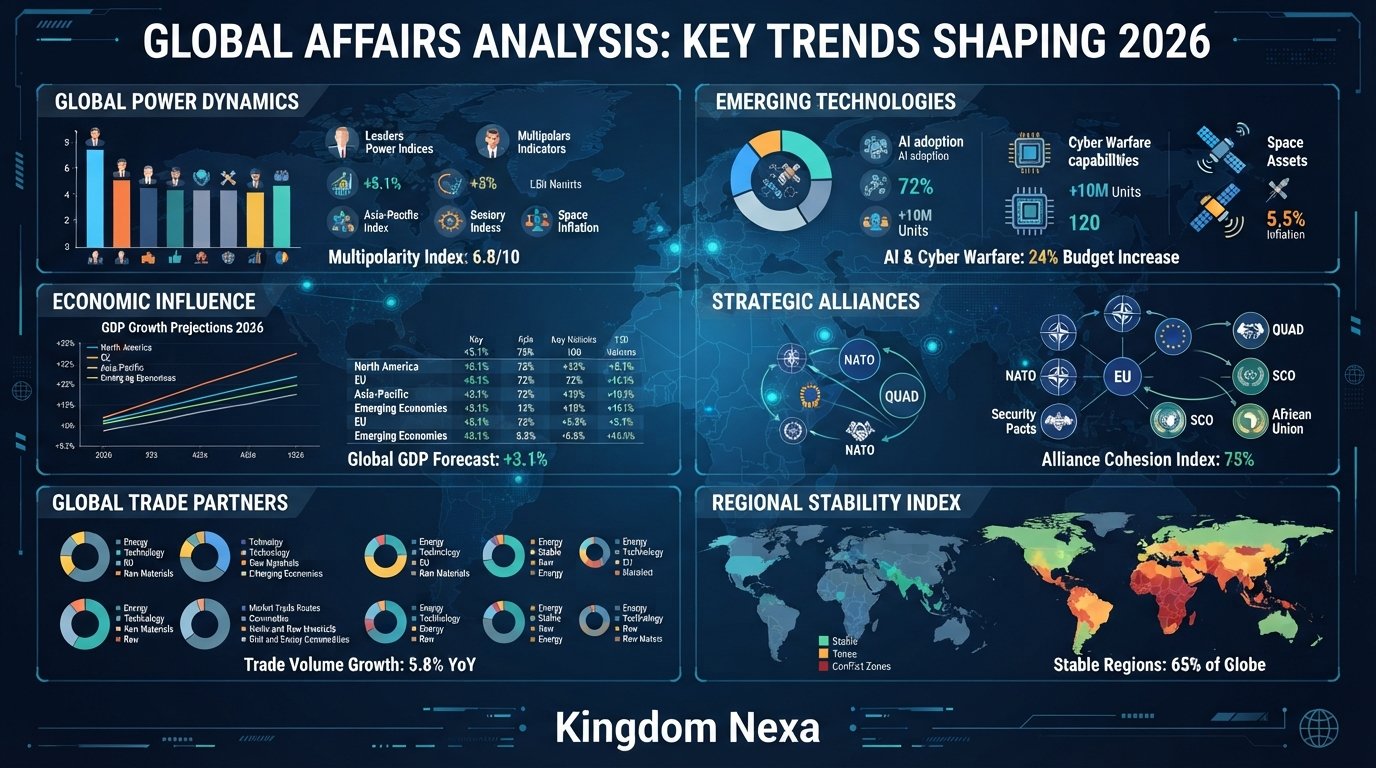
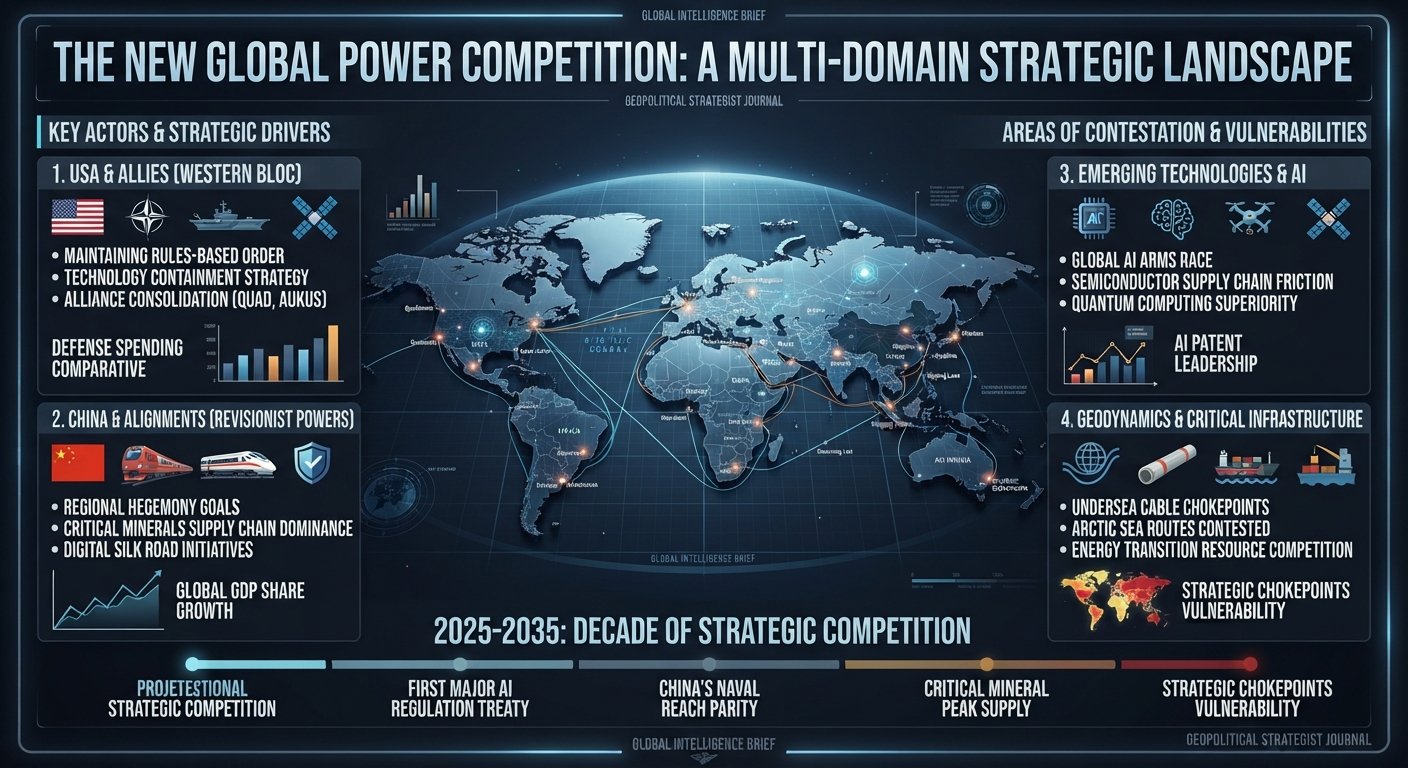
Global Power Competition is one of the defining forces shaping international relations in the 21st century. It describes the struggle among major and emerging powers to protect national interests, expand influence, shape international rules, secure economic advantages, and maintain strategic freedom.
Unlike the Cold War, today’s competition is not organized around two completely separate ideological or economic blocs. The United States remains the most globally capable power, China has emerged as its principal long-term strategic competitor across multiple domains, Russia retains major military and nuclear capabilities, and India and other influential states increasingly pursue independent strategies. At the same time, middle powers, regional powers, multinational corporations, international institutions, and technology companies can influence outcomes.
The competition therefore extends far beyond military strength. Trade, semiconductors, artificial intelligence, critical minerals, energy, financial systems, infrastructure, diplomacy, alliances, information, space, and cyber capabilities have all become instruments of geopolitical power.
This article examines how global power competition developed, who the major actors are, what they want, how economic and technological rivalry is changing international affairs, and what possible future world orders could emerge.
What Is Global Power Competition?
Global Power Competition is the strategic rivalry among major states and other influential actors to shape international affairs, protect national interests, acquire strategic advantages, and influence the rules and institutions governing the international system.
Power in this context is multidimensional. A country may possess substantial military capabilities but have weaker economic influence, while another may have enormous economic weight but prefer diplomatic or technological instruments.
The main dimensions include:
- Military power: armed forces, nuclear weapons, bases, logistics, intelligence and defence industries.
- Economic power: GDP, trade, investment, financial influence and access to markets.
- Technological power: artificial intelligence, semiconductors, telecommunications, space systems and cybersecurity.
- Diplomatic power: alliances, partnerships, international institutions and negotiation capacity.
- Resource power: energy, food, water and critical minerals.
- Soft power: culture, education, political appeal, media and international reputation.
- Institutional power: the ability to shape international rules, standards and organizations.
The important point is that these forms of power interact. A technologically advanced economy can strengthen military capabilities; military alliances can protect trade routes; financial power can support sanctions; and diplomatic relationships can determine access to critical resources.
How Did Global Power Competition Develop?
Modern global power competition has deep historical roots.
From European Balance of Power to World Wars
European international politics for centuries revolved around balancing powerful states against one another. Britain, France, Russia, Austria, Prussia and later Germany competed for territory, trade, resources and influence.
The two World Wars demonstrated the destructive consequences of industrialized great-power rivalry. After 1945, the United States and Soviet Union emerged as the dominant military and ideological competitors.
The Cold War
The Cold War created a relatively clear bipolar structure.
The United States and its allies built a Western alliance system centered on NATO, while the Soviet Union led the Warsaw Pact and maintained a broader network of partnerships.
Competition occurred through:
- nuclear deterrence;
- military alliances;
- proxy conflicts;
- ideological competition;
- economic assistance;
- intelligence operations;
- space technology; and
- diplomatic influence.
Yet Washington and Moscow also cooperated when their interests converged, particularly in arms control.
The Post-Cold War Unipolar Moment
The Soviet Union collapsed in 1991, leaving the United States with an unusually dominant position.
The following decades were characterized by U.S. military superiority, expanding globalization, and the growing importance of institutions such as the World Trade Organization.
However, the distribution of economic power gradually changed.
China’s rapid economic development transformed the balance of power in Asia and globally. India expanded its economic and strategic weight, while Russia retained substantial nuclear and military capabilities despite losing much of the Soviet Union’s economic influence.
The result is an international system that is neither clearly unipolar nor a simple recreation of Cold War bipolarity.
The Major Actors in Global Power Competition
The United States and China are central to today’s strategic competition, but the system involves considerably more than two countries.
United States
The United States retains an unusually broad portfolio of power: a large economy, global military reach, extensive alliance networks, advanced technological capabilities, major financial influence and significant diplomatic reach.
Its partnerships are particularly important. NATO remains the central U.S.-linked security institution in Europe, while relationships with Japan, South Korea, Australia and the Philippines are important to Indo-Pacific strategy.
NATO’s 2025 Hague Summit also produced a major shift in defence planning: allies committed to reach 5% of GDP annually for defence and defence-related security investment by 2035, including at least 3.5% for core defence requirements. (NATO)
The U.S. challenge is therefore not simply maintaining military strength. It is balancing competition with China, deterrence involving Russia, alliance management, domestic political pressures and economic relationships that remain deeply interconnected with the wider world.
China
China is the most significant long-term challenger to U.S. influence across multiple dimensions.
Its rise combines economic scale, industrial capacity, technological development, military modernization, diplomatic outreach and extensive trade relationships.
China’s strategy does not depend solely on military expansion. Infrastructure financing, manufacturing, technology, trade, diplomatic partnerships and initiatives associated with the Belt and Road framework all contribute to its international influence.
Beijing also seeks greater representation for developing and emerging countries in international institutions and promotes a more multipolar international system.
The central strategic question is whether China will primarily seek to operate within existing institutions, reshape them, or develop alternatives alongside them. In practice, elements of all three approaches can be observed.
Russia
Russia’s economic weight is considerably smaller than that of the United States or China, but its geopolitical significance remains substantial.
Its principal sources of power include:
- nuclear weapons;
- a large military-industrial base;
- energy resources;
- geographic depth;
- diplomatic relationships;
- cyber capabilities; and
- a permanent seat and veto in the UN Security Council.
Russia’s war against Ukraine has also accelerated European defence spending and changed the security environment across Europe.
SIPRI estimates that Russia spent approximately $190 billion on its military in 2025, making it the world’s third-largest military spender behind the United States and China. (SIPRI)
India
India is increasingly important because of its population, economic growth potential, military capabilities, strategic geography and diplomatic flexibility.
Unlike a traditional alliance-dependent strategy, India generally seeks strategic autonomy. It maintains partnerships with the United States, Europe, Japan and Australia while preserving important relationships with Russia and other non-Western states.
Its position demonstrates why the current international system cannot be understood simply as an American-versus-Chinese contest.
India can cooperate with Washington on Indo-Pacific security while participating in BRICS and maintaining defence and energy relationships with Russia.
Middle Powers and the Global South
Countries such as Brazil, Indonesia, Türkiye, Saudi Arabia, the United Arab Emirates, South Africa, Iran, Australia, Japan and South Korea can influence the strategic environment well beyond their individual size.
Many are attempting to avoid rigid alignment.
This creates an important characteristic of contemporary geopolitics: major powers increasingly compete for the choices of states that do not want to choose sides permanently.


Why Is Global Power Competition Increasing?
Several structural changes are driving today’s rivalry.
The Distribution of Economic Power Is Changing
Economic globalization created extensive interdependence, but it also created strategic vulnerabilities.
Governments increasingly recognize that dependence on a foreign country for critical goods can become a national-security risk.
This is particularly visible in:
- semiconductors;
- pharmaceuticals;
- batteries;
- telecommunications equipment;
- energy;
- rare earth elements;
- advanced manufacturing;
- shipping; and
- critical infrastructure.
The result is a growing emphasis on economic security and supply-chain resilience.
Military Competition Is Intensifying
Global military expenditure reached approximately $2.887 trillion in 2025, according to SIPRI, representing the 11th consecutive year of growth. The United States, China and Russia together accounted for about 51% of the global total. (SIPRI)
This does not mean war between major powers is inevitable.
In fact, military competition can serve two contradictory purposes: preparing for conflict while attempting to prevent conflict through deterrence.
The danger arises when one state interprets another’s defensive preparations as offensive intentions.
Technology Has Become a Strategic Battlefield
Technology is increasingly inseparable from national power.
Artificial intelligence can affect intelligence analysis, autonomous systems, logistics, cyber operations and economic productivity. Semiconductors underpin modern military and civilian technologies.
The United States has imposed restrictions designed to limit China’s access to certain advanced semiconductor technologies. In December 2024, U.S. export-control measures expanded restrictions involving semiconductor manufacturing equipment, high-bandwidth memory and related technologies.
Such policies illustrate a major change in geopolitical strategy: control over technological ecosystems can be used as an instrument of national security.
The competition is not simply about who invents the next technology. It is also about who controls the standards, supply chains, manufacturing equipment, data, talent and infrastructure required to deploy it at scale.
Economic Power and the Weaponization of Interdependence
Economic interdependence once appeared primarily as a force encouraging cooperation.
Today, governments increasingly recognize that interdependence can also create leverage.
Trade
Tariffs, export controls, investment restrictions and industrial subsidies can influence strategic competition.
The World Trade Organization has warned that geopolitical fragmentation could impose significant economic costs. Its 2026 analysis estimates that a highly fragmented world economy organized around geopolitical blocs could reduce global GDP by 5.1% and global exports by 18.6% compared with a more integrated baseline. (World Trade Organization)
These figures illustrate an important tension: governments may accept some economic inefficiency to gain greater strategic resilience.
Sanctions and Financial Power
Financial infrastructure is another source of geopolitical influence.
Sanctions can restrict access to banking systems, technology, investment and international markets. However, extensive use of sanctions can also encourage targeted states to search for alternative financial channels.
This is one reason debates about de-dollarization, alternative payment systems and local-currency trade have become increasingly prominent.
That does not mean the global financial system has suddenly abandoned the dollar. Rather, it reflects efforts by several countries to reduce vulnerability to financial pressure.
Critical Minerals and Energy Security
Energy has always influenced geopolitics, but the energy transition is adding new strategic resources.
Lithium, cobalt, nickel, graphite, copper and rare earth elements are increasingly important for batteries, electric vehicles, renewable energy, electronics and defence technologies.
The International Energy Agency warns that critical-mineral supply chains remain highly concentrated. Its 2025 analysis highlighted vulnerabilities arising from supply concentration, processing bottlenecks and export restrictions. (IEA)
This creates a new geopolitical equation:
Control of resources + processing capacity + technology + transportation = strategic leverage.
Countries therefore increasingly seek to diversify suppliers, build domestic processing capacity and establish partnerships with resource-producing states.


Image/Infographic: World map showing major geopolitical powers, critical-mineral production and processing hubs, semiconductor manufacturing centers, major maritime routes and strategic chokepoints.
Placement: Under the H2 section “Economic Power and the Weaponization of Interdependence”, following the discussion of critical minerals.
Purpose: Demonstrate visually how economic dependencies connect distant regions and why supply chains have become part of geopolitical strategy.
Alliances, Partnerships and Strategic Balancing
Alliances remain one of the most important instruments of global power.
The United States benefits from an extensive network of formal and informal partnerships. China has developed strategic partnerships and economic relationships across Asia, Africa, Latin America and the Middle East. Russia maintains security and political relationships in several regions.
But today’s system is increasingly characterized by flexible alignment rather than permanent bloc membership.
A country can cooperate with one power on defence, another on energy and a third on trade.
India provides a particularly important example of this strategy. Its participation in multiple forums demonstrates that strategic autonomy can coexist with extensive partnerships.
BRICS has also become an important platform for emerging and non-Western powers. Its membership has expanded significantly since its original formation, although its members have divergent interests and do not constitute a conventional military alliance. Current reporting on the 2026 summit highlights both its growing international weight and internal disagreements. (Reuters)
This distinction matters: a larger group does not automatically become a cohesive geopolitical bloc.
Regional Flashpoints
Global power competition is most dangerous where major-power interests overlap with unresolved regional disputes.
Indo-Pacific
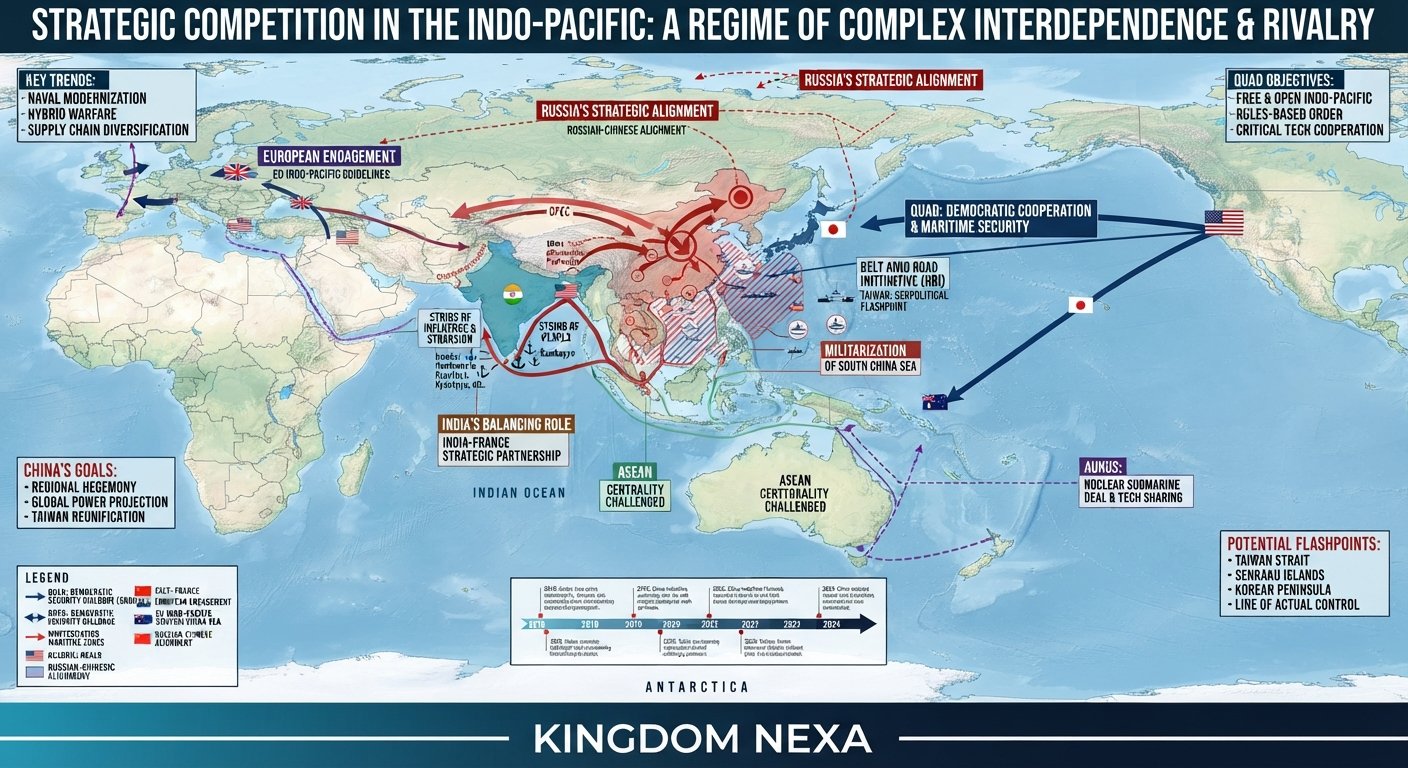
The Indo-Pacific is central to U.S.-China competition because it combines major economies, strategic sea lanes, advanced technology industries and unresolved security disputes.
Taiwan is particularly important because its security has implications for China-U.S. relations, regional military planning and global semiconductor supply chains.
The South China Sea also combines territorial disputes, maritime security and freedom-of-navigation concerns.
Europe
Russia’s war against Ukraine has reinforced the importance of NATO and European defence.
The European security environment has changed substantially since Russia’s full-scale invasion of Ukraine in 2022. European states have increased defence spending, while NATO has strengthened its military posture.
Middle East
The Middle East remains strategically important because of energy resources, maritime routes, conflicts, military bases and competing regional partnerships.
External powers—including the United States, China, Russia and European states—have overlapping interests, while regional powers pursue their own agendas.
Africa and the Global South
Africa is increasingly important to global power competition because of its population growth, natural resources, markets, geographic position and diplomatic influence.
Competition for African partnerships increasingly involves infrastructure, minerals, defence cooperation, investment, development finance and political relationships.
International Organizations and the Struggle Over Global Rules
Power competition also occurs inside international institutions.
The United Nations remains central to international legitimacy, conflict management and diplomacy. The UN Security Council has five permanent members—China, France, Russia, the United Kingdom and the United States—with veto powers over substantive decisions. (United Nations)
This structure gives the major powers exceptional institutional influence.
Yet it also creates limitations. When permanent members disagree, collective action can become difficult.
The broader question is whether international institutions can adapt to a world in which economic and political power is more widely distributed than it was when many institutions were created.
Emerging powers increasingly call for greater representation, while established powers seek to preserve institutions they consider important to international stability.
International Law and Global Power Competition
International law establishes important constraints on state behavior, even when enforcement is imperfect.
The UN Charter emphasizes sovereign equality, territorial integrity, political independence and the peaceful settlement of disputes, while restricting the threat or use of force contrary to the purposes of the Charter. (United Nations)
At the same time, geopolitical competition frequently produces disagreements over how international law applies to specific circumstances.
Questions involving:
- self-defence;
- sovereignty;
- territorial disputes;
- maritime rights;
- sanctions;
- occupation;
- humanitarian law; and
- use of force
can become intensely contested.
For analysts, an important distinction is therefore necessary: a government’s legal argument is not automatically proof that the argument is universally accepted or independently established.
What Are the Main Risks?
Global Power Competition can create stability through deterrence, but it can also produce serious risks.
Miscalculation
Military deployments, exercises or weapons development can be interpreted differently by rival governments.
Security Dilemmas
When one state increases its military capabilities for defensive reasons, another may perceive the change as threatening and respond with further military expansion.
Economic Fragmentation
If strategic rivalry produces competing technology ecosystems and trading blocs, companies may face higher costs and less efficient supply chains.
Arms-Race Dynamics
Growing defence spending can create pressure for neighboring states to increase their own military budgets.
Crisis Escalation
A regional confrontation could draw in major powers through alliances, military commitments or strategic interests.
Cyber and Information Competition
Cyber operations and information campaigns can create uncertainty because attribution is often difficult and escalation can occur below the threshold of conventional warfare.
What Could the Future Global Order Look Like?
Predicting the future international system with certainty is impossible. Several plausible scenarios deserve attention.
Scenario 1: Managed Multipolar Competition
Major powers continue competing but establish safeguards to prevent rivalry from becoming open conflict.
Trade remains substantial, diplomatic channels remain active and countries retain freedom to cooperate across competing blocs.
This may be the most practical model because complete separation is extremely costly.
Scenario 2: Intensified U.S.-China Bipolarity
The international system could become increasingly organized around Washington and Beijing.
Technology, trade, military alliances and financial systems could divide into partially separate ecosystems.
Other countries would retain autonomy but face increasing pressure to align on particular issues.
Scenario 3: Fragmented Multipolarity
Several major and regional powers become strong enough to pursue independent strategies.
The United States and China remain dominant, but India, Russia, the European Union, Japan, Türkiye, Gulf states and others exercise greater autonomy.
This would create a more fluid system with temporary coalitions rather than permanent blocs.
Scenario 4: Renewed International Cooperation
Major powers could eventually conclude that climate change, economic instability, pandemics, nuclear risks and technological disruption are too costly to manage through rivalry alone.
Competition would remain, but cooperation would expand in areas of shared interest.
The most likely future may ultimately combine elements of several scenarios.
Frequently Asked Questions About Global Power Competition
1. What is Global Power Competition?
Global Power Competition is the strategic rivalry among major and emerging powers to protect national interests, expand influence and shape international rules, institutions and economic systems.
2. Who are the main powers involved?
The United States and China are the central competitors, while Russia, India, the European powers, Japan and influential regional and middle powers also play major roles.
3. Is Global Power Competition the same as the Cold War?
No. The Cold War was primarily a bipolar U.S.-Soviet confrontation. Contemporary competition is more economically interconnected and involves more independent actors.
4. Why is China important to global power competition?
China combines substantial economic scale, industrial capacity, technological development, military modernization and extensive international trade relationships, making it a major strategic competitor to the United States.
5. What role does India play?
India increasingly acts as an autonomous strategic pole. It cooperates with Western powers in some areas while maintaining relationships with Russia, BRICS members and other partners.
6. How does technology affect geopolitical competition?
Technologies such as AI, semiconductors, cybersecurity, satellites, telecommunications and autonomous systems can directly influence economic productivity and military capabilities.
7. Why are critical minerals geopolitically important?
Critical minerals are essential for batteries, electronics, renewable technologies and many defence systems. Concentrated production and processing can therefore create strategic dependencies.
8. Can Global Power Competition lead to war?
It can increase the risk of conflict, especially through miscalculation and security dilemmas, but competition does not automatically lead to war. Deterrence, diplomacy and economic interdependence can also discourage escalation.
9. Is the world becoming multipolar?
There is strong evidence of greater diffusion of economic and political influence, but the exact structure remains contested. The contemporary system is better described as increasingly complex and fluid than as a fully consolidated multipolar order.
Conclusion
Global Power Competition is transforming the international system across military, economic, technological, diplomatic and institutional dimensions. The central U.S.-China rivalry is important, but it does not explain the entire geopolitical landscape.
Russia remains a major military and nuclear power. India is pursuing greater strategic autonomy. European countries are strengthening defence capabilities. Middle powers and Global South states are using their economic resources, geography and diplomatic relationships to gain greater strategic freedom.
At the same time, competition increasingly extends into areas that were once treated primarily as economic or technological issues. Semiconductor supply chains, critical minerals, artificial intelligence, energy infrastructure, financial networks and trade routes have become strategic assets.
The defining feature of the emerging order may therefore be competitive interdependence: states compete intensely while remaining too economically, technologically and environmentally interconnected to separate completely.
Whether this competition produces confrontation, fragmentation or a more balanced international system will depend not only on the capabilities of the major powers, but also on diplomacy, institutional reform, crisis management and the choices made by countries that refuse to become permanent members of any single geopolitical camp.
As of September 2026, the international system is clearly undergoing strategic transformation, but its final structure has not yet been determined. That uncertainty is precisely why understanding Global Power Competition is essential for students, policymakers, businesses, researchers and anyone seeking to understand the future of world politics.