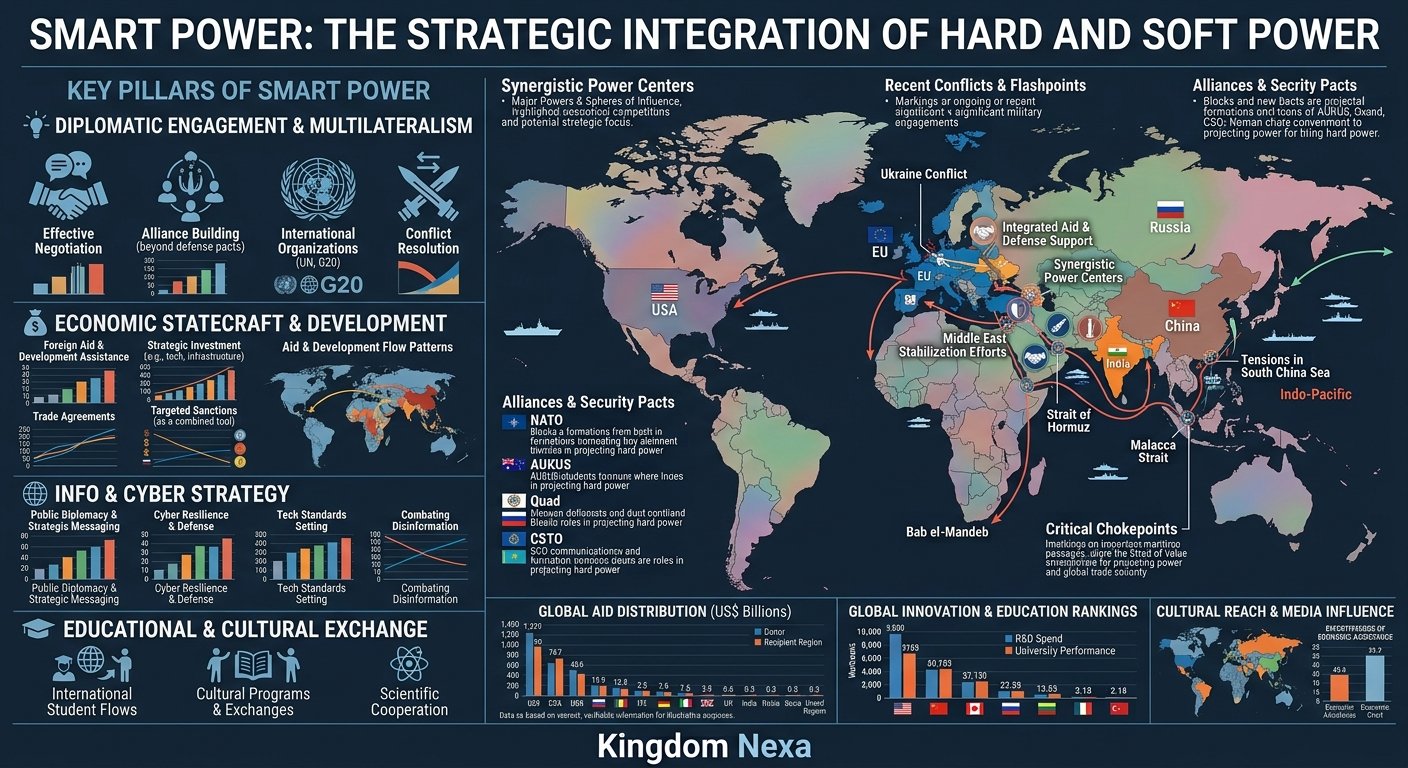
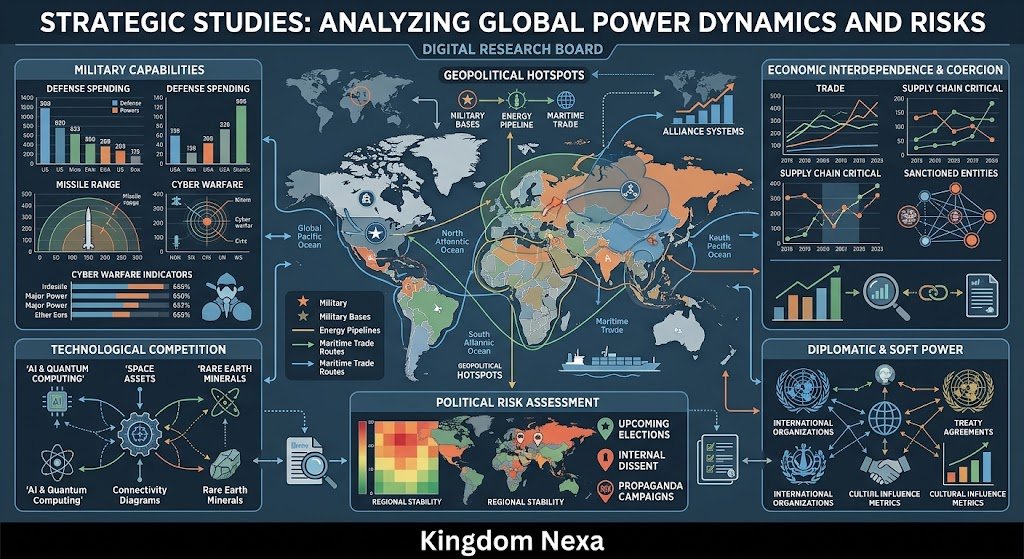
Strategic Studies helps explain why countries compete for power, build military capabilities, form alliances, impose economic restrictions, and negotiate with rivals. From great-power competition and nuclear deterrence to artificial intelligence, cyber warfare, and critical supply chains, strategic decisions increasingly shape international politics and the security of societies worldwide.
In an era of geopolitical uncertainty, understanding strategy requires more than studying military operations. Governments must assess political objectives, economic resources, technological advantages, geographical constraints, public opinion, and the possibility of unintended consequences. Decisions made in one region can influence energy prices, trade routes, diplomatic relationships, and security calculations across the world.
Strategic Studies is an interdisciplinary field that examines how states and other actors pursue political and security objectives through the coordinated use of power, resources, diplomacy, and coercion. It connects international relations theory with practical questions about conflict prevention, deterrence, military planning, and national security.
This guide explains the meaning and historical development of the field, its central concepts, major institutions, regional applications, emerging technologies, and contemporary challenges. It also examines how strategic thinking can help policymakers, researchers, students, and business leaders interpret global developments without confusing political rhetoric with demonstrated capabilities or likely outcomes.
What Are Strategic Studies?
Strategic Studies is an interdisciplinary field concerned with the relationship between political objectives, power, security, and the methods used to achieve national or collective interests. It examines how governments assess threats, allocate resources, prepare for conflict, deter adversaries, and manage competition without necessarily resorting to war.
Although military affairs remain important, the discipline extends beyond armed forces. Economic pressure, diplomatic bargaining, intelligence, industrial capacity, technological innovation, geography, and public resilience can all influence strategic outcomes.
For example, a government may seek to protect a maritime trade route. Its response could involve naval deployments, diplomatic agreements, port investments, intelligence sharing, insurance arrangements, and cooperation with commercial shipping companies. The strategic problem is therefore broader than a military mission.
Strategy, policy and tactics: understanding the difference
These terms are related but describe different levels of decision-making.
- Policy establishes the desired political outcome and the interests to be protected.
- Strategy connects those objectives to available resources and a practical approach.
- Operations organize major activities to implement the strategy.
- Tactics concern the immediate methods used in particular engagements or situations.
A state can possess sophisticated weapons and still pursue an ineffective strategy if its objectives are unrealistic, its resources inadequate, or its political assumptions mistaken.
What questions do strategic analysts ask?
Strategic analysis typically examines several connected questions:
- What political outcome is the actor trying to achieve?
- Which interests are vital, and which are negotiable?
- What capabilities and resources are available?
- How might opponents respond?
- What economic, legal, diplomatic, and domestic constraints apply?
- What are the likely costs, risks, and unintended consequences?
- How can success be measured and the strategy adjusted?
These questions make Strategic Studies useful for understanding both military conflict and competition below the threshold of armed force.
Historical Development of Strategic Studies
Strategic thinking is ancient, but Strategic Studies emerged as a more recognizable academic and policy discipline through the development of modern warfare, state power, and nuclear deterrence.
From classical strategy to modern warfare
Key historical turning points
- Fifth century BCE: Sun Tzu’s The Art of War explored intelligence, deception, leadership, and the relationship between political objectives and military action.
- 1832: Carl von Clausewitz’s On War, published posthumously, examined war as an instrument of political purpose and emphasized the uncertainty and friction inherent in conflict.
- Late nineteenth and early twentieth centuries: Industrialization, railways, mass conscription, naval competition, and imperial rivalries transformed military planning and national mobilization.
- 1914–1945: Two world wars demonstrated the importance of industrial production, alliances, logistics, intelligence, economic mobilization, and civilian resilience.
- 1945–1991: The nuclear age placed deterrence, escalation management, arms control, and superpower competition at the center of strategic analysis.
- 1990s–2000s: The end of the Cold War broadened attention toward regional conflicts, peace operations, terrorism, humanitarian intervention, and fragile states.
- 2010s–2020s: Renewed great-power competition, cyber operations, economic coercion, drones, space systems, and artificial intelligence expanded the field further.
How the Cold War transformed the discipline
The rivalry between the United States and the Soviet Union made nuclear deterrence a central subject. Analysts studied how states could prevent an attack when both possessed weapons capable of inflicting catastrophic destruction.
Concepts such as second-strike capability, escalation control, arms limitation, and strategic stability became especially important. Strategic stability generally concerns conditions under which neither side has strong incentives to initiate a conflict or rapidly escalate an existing one.
The Cold War also demonstrated the limitations of purely military calculations. Ideology, alliances, domestic politics, economic performance, and perceptions of credibility influenced how both superpowers behaved.
After 1991, the disappearance of the Soviet Union did not eliminate strategic competition. Instead, the discipline adapted to a more complex environment involving regional powers, transnational threats, emerging technologies, and increasingly interconnected economies.
Core Areas of Strategic Studies
The field covers several overlapping subjects. Their relative importance depends on the strategic problem under examination.
Military strategy and defence planning
Military strategy considers how armed forces support political objectives. It examines force structure, readiness, logistics, command arrangements, deterrence, operational concepts, and the relationship between military action and diplomatic outcomes.
Effective defence planning requires more than acquiring advanced equipment. Governments must also fund training, maintenance, ammunition, personnel, transport, and resilient communications. A technologically sophisticated force may underperform if it cannot sustain operations or coordinate effectively with partners.
Geostrategy and strategic geography
Geostrategy examines how geographical conditions influence political and security decisions. Geography affects access to resources, transportation networks, military mobility, border defence, and maritime commerce.
Straits, mountain passes, ports, islands, and major shipping corridors can carry strategic importance because they influence the movement of goods and forces. However, geography does not determine outcomes by itself. Infrastructure, technology, political relationships, and economic incentives can change the value of a location.
Nuclear deterrence and arms control
Nuclear strategy explores how nuclear-armed states attempt to deter attacks, manage escalation, and prevent catastrophic miscalculation.
Arms control and risk-reduction measures may include communication channels, transparency arrangements, verification procedures, and agreements limiting particular weapons or activities. Deterrence and diplomacy are not necessarily opposites: both can contribute to stability when supported by credible commitments and reliable communication.
Economic statecraft and geoeconomics
Economic statecraft uses trade policy, financial measures, sanctions, investment, export controls, development assistance, and access to markets to pursue political objectives.
The effectiveness of these instruments depends on the target’s vulnerabilities, alternative suppliers, domestic political response, and the willingness of other states to cooperate. Economic restrictions may impose costs, but they can also produce unintended effects, encourage substitution, or strengthen the target’s incentives to develop independent capabilities.
Intelligence and strategic forecasting
Intelligence supports decision-making by collecting and assessing information about intentions, capabilities, vulnerabilities, and emerging developments.
Strategic forecasting goes a step further by considering how current trends could develop under different conditions. Responsible analysts distinguish confirmed information from assumptions, estimates, and judgments. They also communicate uncertainty rather than presenting forecasts as guaranteed outcomes.
Major Actors and Institutions in Strategic Studies
Strategic outcomes emerge from interactions among states, alliances, international organizations, businesses, and non-state groups.
States and great-power competition
Major powers possess varying combinations of military strength, economic resources, technological capacity, diplomatic influence, and global partnerships. The United States, China, Russia, India, and the European powers feature prominently in different strategic debates, although their capabilities and objectives differ substantially.
China’s economic and technological development, for example, has influenced regional security calculations and debates over supply-chain resilience. The United States combines global alliances with significant military and financial influence. Russia’s military posture and war against Ukraine have reshaped European defence planning. India’s geographic position, economic growth, and strategic autonomy affect calculations across the Indo-Pacific.
These examples should not be interpreted as evidence that every state follows a single, fixed strategy. National priorities evolve in response to leadership, economic pressures, domestic politics, and external events.
Alliances and international organizations
Alliances can increase deterrence, improve interoperability, and distribute defence responsibilities. They can also create coordination problems when members disagree over priorities, costs, or acceptable risks.
NATO’s 2022 Strategic Concept identifies deterrence and defence, crisis prevention and management, and cooperative security as its three core tasks. It also addresses cyber threats, technological disruption, strategic competition, and climate-related security risks. NATO News+1
The United Nations contributes through diplomacy, peace operations, sanctions established under its Charter, and international cooperation. Regional organizations, including the European Union, African Union, and Association of Southeast Asian Nations, provide additional mechanisms for consultation and collective action.
Their effectiveness varies according to legal authority, institutional capacity, political consensus, and the willingness of member states to implement decisions.
Non-state actors and private companies
Multinational corporations can influence strategic calculations through control of critical technologies, energy infrastructure, shipping, financial networks, and semiconductor supply chains. Technology companies may operate infrastructure essential to communications, cloud computing, and cybersecurity.
Armed groups, criminal networks, advocacy organizations, research institutions, and civil society can also influence security environments. Their resources and objectives differ, so analysts should avoid treating all non-state actors as equivalent.
Contemporary Applications: How Strategic Studies Explains Global Competition
Strategic Studies is especially relevant when political, economic, military, and technological developments interact.
The war in Ukraine and European security
Russia’s full-scale invasion of Ukraine in February 2022 transformed European security planning. It highlighted the importance of territorial defence, military logistics, industrial production, intelligence, external assistance, sanctions, and alliance cohesion.
The conflict also illustrates the difference between battlefield outcomes and strategic success. Capturing territory, inflicting losses, or disrupting infrastructure does not automatically produce the desired political settlement. Analysts must consider sustainability, domestic support, international assistance, economic capacity, and the terms under which a conflict might end.
NATO’s official strategic assessment identifies Russia’s war as a fundamental factor in the deteriorated Euro-Atlantic security environment. This is the alliance’s institutional assessment, not a substitute for examining the perspectives and policies of all relevant actors. NATO Topic+1
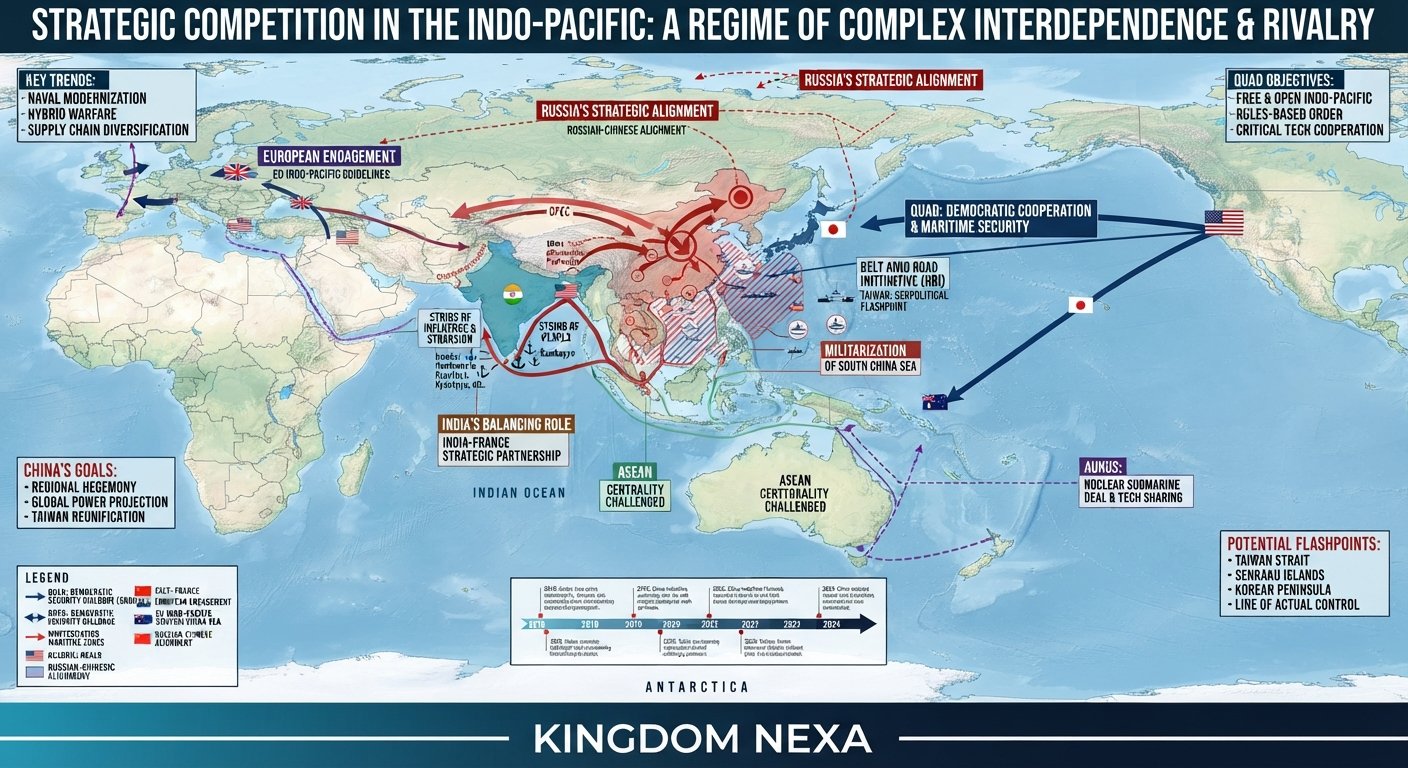
Strategic competition in the Indo-Pacific
The Indo-Pacific is important because it connects major economies, maritime trade routes, advanced manufacturing networks, and contested security relationships.
Competition involving China, the United States, India, Japan, Australia, and other regional actors includes military modernization, maritime access, technology controls, infrastructure investment, and diplomatic partnerships. Taiwan’s security and the South China Sea remain particularly significant because of their implications for sovereignty claims, regional stability, and international commerce.
Strategic analysis must assess both deterrence and escalation risk. Stronger defence capabilities may discourage aggression, but poorly managed signalling, incidents at sea, or misinterpretation of military exercises can intensify tensions.
Economic security and supply-chain competition
Semiconductors, critical minerals, energy systems, telecommunications equipment, and advanced manufacturing have become strategic concerns. Governments increasingly evaluate not only the cost of imports but also the risks associated with excessive dependence on particular suppliers.
Diversification, strategic stockpiles, domestic production, and partnerships can improve resilience. However, attempts to eliminate every external dependency can be costly and impractical. Strategic policy therefore requires balancing security, efficiency, innovation, and international cooperation.
Cybersecurity, space and artificial intelligence
Digital infrastructure has created additional avenues for espionage, disruption, and coercion. Cyber incidents can affect public services, financial systems, energy networks, and military communications. Space-based systems support navigation, weather forecasting, surveillance, and communications, making their resilience strategically important.
Artificial intelligence may improve intelligence analysis, logistics, decision support, and autonomous systems. It also creates concerns involving unreliable outputs, accelerated decision cycles, accountability, and the possibility that decision-makers act on incomplete or misleading information.
The central strategic question is not simply which country adopts a technology first. It is whether institutions can integrate it securely, reliably, and responsibly while maintaining human oversight where needed.
Strategic Studies Framework: From Assessment to Action
The following infographic summarizes a practical framework for strategic analysis. It connects the assessment of the external environment with the identification of interests, formulation of objectives, evaluation of capabilities, implementation, and continuous review.
Infographic: Strategic Studies Framework — assess, prioritize, plan, implement, and adapt.
A useful framework should be iterative rather than strictly linear. New intelligence, unexpected political developments, technological changes, or economic shocks can require governments to reassess their assumptions and revise their plans.
International Law, Ethics and Strategic Decision-Making
Strategy operates within a legal and political environment. Military capability does not automatically confer legal authority, and strategic advantage does not remove obligations under international law.
The United Nations Charter establishes the prohibition on the threat or use of force against the territorial integrity or political independence of states, subject to recognized exceptions, including self-defence under Article 51 and measures authorized by the Security Council. International humanitarian law governs the conduct of hostilities and the protection of people affected by armed conflict.
Strategic analysts must distinguish three questions:
- Can an action achieve its objective? This is a question of capability and effectiveness.
- Is the action lawful? This requires analysis of applicable legal obligations and circumstances.
- Is the action strategically wise? This requires consideration of consequences, costs, escalation, legitimacy, and long-term interests.
Ethical questions also matter when evaluating civilian harm, surveillance, autonomous weapons, intelligence methods, and the distribution of security risks. Ignoring these dimensions can undermine public trust, diplomatic relationships, and the durability of strategic outcomes.
Major Challenges and the Future of Strategic Studies
The discipline faces a more interconnected environment in which crises can spread across military, technological, economic, and political systems.
The principal challenges
- Uncertainty and miscalculation: Leaders often make decisions with incomplete intelligence and limited time. Incorrect assumptions about an opponent’s intentions can produce unnecessary escalation.
- Nuclear risks: Modernization, weakening arms-control arrangements, and inadequate crisis communication can complicate deterrence.
- Hybrid threats: Cyber operations, disinformation, economic pressure, and covert interference can blur the distinction between peace and conflict.
- Resource constraints: Governments must reconcile defence commitments with public services, debt, industrial capacity, and competing domestic priorities.
- Climate and human security: Climate-related disasters, food insecurity, water stress, and displacement can intensify existing political vulnerabilities, although their effects vary by location and governance capacity.
- Technology governance: Rapid innovation can outpace regulation, training, doctrine, and institutional safeguards.
Three plausible future scenarios
Scenario 1: Intensified strategic competition
States increase defence investment, protect critical industries, strengthen partnerships, and compete over technology and influence. Crisis management becomes more important as overlapping rivalries increase the possibility of miscalculation.
Scenario 2: Fragmented economic and security blocs
Governments prioritize trusted suppliers and political alignment over some forms of economic efficiency. Separate technology standards and supply chains may emerge, raising costs while reducing selected strategic dependencies.
Scenario 3: Selective cooperation and risk reduction
Strategic rivals continue competing but cooperate on areas of shared interest, such as nuclear risk reduction, maritime safety, climate resilience, and selected technology standards. Competition persists, yet stronger communication helps manage its dangers.
These are analytical scenarios, not predictions. The eventual trajectory will depend on political leadership, economic performance, conflict outcomes, technological change, and the willingness of states to manage shared risks.
Skills needed by future strategic analysts
Students and professionals can prepare by developing expertise in international relations, military history, political economy, regional studies, international law, and research methods. Quantitative analysis, scenario planning, open-source intelligence assessment, and clear writing are also valuable.
The strongest analysts combine specialized knowledge with intellectual humility. They test competing explanations, identify gaps in evidence, distinguish capability from intention, and update their conclusions when credible new information becomes available.
Frequently Asked Questions About Strategic Studies
1. What is Strategic Studies in simple terms?
Strategic Studies examines how states and other actors use military, political, economic, diplomatic, and technological resources to achieve security objectives and protect their interests.
2. Why is Strategic Studies important?
It helps decision-makers understand threats, evaluate options, anticipate consequences, manage crises, and develop policies that connect national objectives with available resources.
3. What are the main branches of Strategic Studies?
Major branches include military strategy, security studies, nuclear deterrence, geostrategy, intelligence studies, economic statecraft, cyber strategy, and conflict analysis.
4. What is the difference between Strategic Studies and International Relations?
International Relations examines a broad range of interactions among states and other international actors, including cooperation, institutions, trade, and diplomacy. Strategic Studies concentrates more directly on power, security, conflict, deterrence, and the pursuit of strategic objectives. Their subject matter overlaps considerably.
5. Is Strategic Studies only about military affairs?
No. Military affairs are important, but the discipline also examines diplomacy, economic dependencies, intelligence, technological competition, political decision-making, and non-military threats.
6. What careers are related to Strategic Studies?
Related career paths include policy research, defence analysis, diplomacy, political-risk consulting, intelligence analysis, journalism, international development, academic research, and national security planning. Specific roles may require additional qualifications, language skills, or professional experience.
7. How does Strategic Studies help explain great-power competition?
It examines the objectives, capabilities, threat perceptions, alliances, and constraints of competing powers. This helps explain why states cooperate in some areas while competing or confronting one another in others.
8. How has technology changed Strategic Studies?
Cyber capabilities, artificial intelligence, satellites, drones, semiconductors, and digital communications have expanded the instruments of competition. They also create new vulnerabilities and increase the importance of resilience, intelligence, and responsible decision-making.
9. What is the difference between strategy and tactics?
Strategy connects political objectives to resources and an overall approach. Tactics concern the immediate methods used to accomplish specific tasks or engagements. Tactical success does not necessarily guarantee strategic success.
10. How can beginners study Strategic Studies?
Begin with military history, international relations, basic strategic concepts, and contemporary security issues. Compare official documents with independent research, assess the reliability of evidence, and practice analyzing objectives, capabilities, constraints, and possible outcomes.
Conclusion
Strategic Studies provides a framework for understanding how power is exercised, how security interests are defined, and how governments respond to uncertainty in an interconnected world. Its scope extends from military deterrence and alliance management to economic statecraft, technological competition, intelligence, and international law.
Contemporary developments demonstrate why strategic outcomes cannot be explained through military strength alone. Political legitimacy, economic resilience, diplomatic relationships, industrial capacity, and sound decision-making all influence whether a strategy achieves its intended objectives.
For students, researchers, policymakers, and geopolitical analysts, the discipline offers practical tools for evaluating competing interests, recognizing strategic risks, and distinguishing evidence-based assessments from speculation. It also highlights the importance of understanding an opponent’s perspective without accepting that perspective uncritically.
As international competition evolves, Strategic Studies will remain essential to interpreting global power shifts, managing security challenges, and identifying opportunities for cooperation. Its enduring value lies not in predicting every crisis, but in helping decision-makers prepare for uncertainty and make more informed choices.