The international political landscape is increasingly shaped by regional conflicts, strategic rivalries, territorial disputes, economic competition, and shifting security alliances. From Eastern Europe and the Middle East to the Indo-Pacific and Africa, developments in one region can produce consequences far beyond national borders. A military confrontation can disrupt global energy supplies, a maritime dispute can threaten international trade, and a diplomatic breakdown can increase tensions between major powers.
These areas of heightened political and security tension are commonly described as Geopolitical Hotspots. They represent locations where competing national interests, historical grievances, strategic geography, military capabilities, and economic dependencies intersect. Some remain under active conflict, while others are characterized by fragile ceasefires, unresolved territorial claims, military buildups, or the possibility of escalation.
Understanding these flashpoints requires more than following daily headlines. It involves examining historical developments, the objectives of key actors, regional power balances, international diplomacy, and the wider consequences for global stability.
This article examines the major geopolitical hotspots shaping international affairs in 2026, their underlying causes, strategic importance, economic implications, and possible future developments.
Current-affairs reference date: 30 October 2026. Conflict conditions, diplomatic positions, and military developments can change rapidly.
What Are Geopolitical Hotspots?
Geopolitical hotspots are geographical areas experiencing significant political, military, diplomatic, economic, or security tensions that could threaten regional or international stability.
They often emerge where countries or other political actors compete over territory, resources, strategic influence, national security, or control of important transportation routes.
A hotspot does not necessarily mean that a war is taking place. It may involve an ongoing armed conflict, a territorial dispute, military confrontation, political instability, insurgency, or a prolonged diplomatic crisis.
Several characteristics commonly distinguish these locations:
- Strategic geography: Their location provides access to important maritime routes, borders, resources, or military positions.
- Competing national interests: Two or more actors have conflicting political, economic, or security objectives.
- Military concentration: States deploy military forces, strengthen defensive positions, or conduct exercises in contested areas.
- Economic importance: The region influences energy supplies, international trade, critical infrastructure, or investment.
- Historical grievances: Earlier wars, colonial boundaries, territorial claims, and unresolved political disputes contribute to tensions.
- International involvement: Major powers, regional organisations, and external governments influence developments through diplomacy, economic measures, military assistance, or political support.
The significance of a hotspot depends not only on the intensity of local tensions but also on its potential to affect other countries.
For example, instability around a major maritime chokepoint can affect international shipping costs, energy prices, insurance markets, and supply chains even when distant countries are not directly involved in the conflict.
Historical Background: Why Global Flashpoints Develop
Today’s international flashpoints have roots in historical processes that shaped national borders, political institutions, security relationships, and regional power structures.
Colonialism and the formation of modern borders
European colonial expansion significantly influenced the political geography of Africa, the Middle East, and parts of Asia. In some territories, colonial boundaries were established without adequately considering existing communities, political structures, or historical relationships.
After independence, newly formed states inherited these boundaries and faced challenges involving national identity, territorial administration, and political legitimacy.
However, colonialism is not the explanation for every modern conflict. Contemporary disputes also reflect domestic political decisions, resource competition, security dilemmas, and changing international power relationships.
The Cold War and competing alliances
Between 1947 and 1991, competition between the United States and the Soviet Union influenced conflicts and political alignments across Europe, Asia, Africa, and Latin America.
Military alliances, ideological competition, nuclear deterrence, arms transfers, and proxy conflicts shaped regional security arrangements.
Although the Soviet Union dissolved in 1991, several security disputes associated with the Cold War continued. Others emerged from the political and territorial changes that followed its collapse.
Globalisation and strategic interdependence
The expansion of international trade, energy markets, financial systems, and technological supply chains created new forms of geopolitical vulnerability.
Countries became increasingly dependent on foreign suppliers for energy, semiconductors, food, industrial materials, and critical technologies.
Consequently, geopolitical competition increasingly involves economic restrictions, sanctions, export controls, infrastructure investment, and control over strategic resources.
Major Geopolitical Hotspots Around the World in 2026
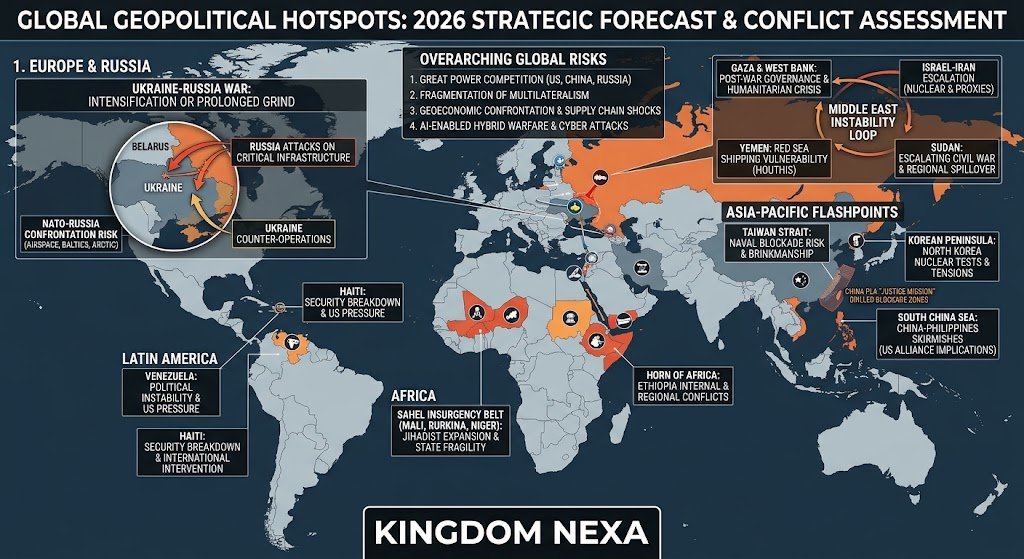
The following regions represent important areas of international concern. Their inclusion reflects their strategic significance, conflict dynamics, or potential implications for regional and global security, rather than a precise ranking of danger.
1. Eastern Europe: Russia–Ukraine War
Russian invasion of Ukraine 2022 — MSTYSLAV CHERNOV
The Russia–Ukraine war remains one of the most consequential security challenges in Europe. Russia’s full-scale invasion of Ukraine on 24 February 2022 transformed the European security environment and intensified tensions between Moscow and Western governments.
Key geopolitical interests
Russia’s stated security concerns, opposition to Ukraine’s Western alignment, and objective of maintaining influence in its neighbouring region have shaped its policy. Ukraine considers the defence of its sovereignty, territorial integrity, and independent foreign policy fundamental national priorities.
The United States and European governments have supported Ukraine through various combinations of military assistance, economic support, sanctions, and diplomatic engagement. NATO members have also strengthened their defence posture in response to the conflict.
Strategic implications
The war has affected European defence spending, energy relationships, refugee movements, agricultural exports, and international security debates.
It has also reinforced the importance of NATO’s collective-defence framework and raised broader questions about territorial sovereignty, military deterrence, and the European security order.
The conflict’s future will depend on battlefield developments, military resources, external support, domestic political conditions, and the prospects for credible negotiations.
2. Middle East: Israel–Palestine and Regional Security
How Gaza City’s high street became a landscape of debris | Israel-Gaza war | The Guardian
The Israel–Palestine conflict remains a central source of instability in the Middle East. Its historical roots include competing national aspirations, displacement, territorial disputes, occupation, security concerns, and the unresolved question of Palestinian statehood.
The Hamas-led attacks against Israel on 7 October 2023 and Israel’s subsequent military campaign in Gaza intensified the conflict and generated a severe humanitarian crisis.
Key actors and interests
Israel prioritises national security, the prevention of further attacks, and the return of hostages. Palestinians seek political self-determination, security, rights, and an end to occupation. Hamas, the Palestinian Authority, and other political actors have different objectives and sources of authority.
Regional governments, including Egypt, Qatar, Jordan, Saudi Arabia, Iran, and Türkiye, influence developments through diplomacy, security relationships, political positions, and regional interests.
Wider geopolitical consequences
The conflict affects relations between Israel and Arab states, US regional policy, Iranian influence, humanitarian diplomacy, and the wider debate over international law.
The future of Gaza, Palestinian governance, Israeli security arrangements, settlement policy, and prospects for a negotiated political settlement remain major questions.
3. Indo-Pacific: Taiwan Strait
The Taiwan Strait is one of the world’s most strategically sensitive geopolitical flashpoints. China considers Taiwan part of its territory and maintains its objective of reunification. Taiwan, meanwhile, operates with its own elected government, military, and political institutions.
The United States maintains unofficial relations with Taiwan and provides defensive support under its domestic legal framework. Its position regarding a potential military intervention remains deliberately ambiguous.
Strategic interests
China seeks to prevent permanent Taiwanese independence and limit external support for Taiwan. Taiwan prioritises its democratic institutions, security, and international economic relationships. The United States seeks to preserve regional stability, maintain its Indo-Pacific position, and discourage unilateral changes to the status quo.
Japan, South Korea, Australia, and other regional partners also have important security and economic interests in the Taiwan Strait.
In September 2026, Taiwan’s Mainland Affairs Council described continuing structural differences between Washington and Beijing over security, technology, and cross-strait relations. The Council also emphasised the importance of maintaining peace and the status quo. mac.gov.tw+1
Why this hotspot matters
Taiwan occupies a central position in global semiconductor manufacturing. A serious military confrontation could disrupt advanced electronics production, international shipping, financial markets, and technology supply chains.
The greatest danger is not limited to a deliberate invasion. Accidental military encounters, maritime confrontations, miscalculation, or coercive measures could trigger a wider crisis.
4. South China Sea: Maritime Territorial Disputes
The South China Sea is a major maritime geopolitical hotspot involving overlapping territorial and maritime claims by China, the Philippines, Vietnam, Malaysia, Brunei, and Taiwan.
Its importance comes from shipping routes, fisheries, potential energy resources, military geography, and access to the wider Indo-Pacific.
Competing interests
China asserts extensive maritime claims and seeks to protect its strategic position in the region. The Philippines relies on its maritime rights, national sovereignty, and security partnerships. Vietnam, Malaysia, and other coastal states also seek to defend their respective maritime interests.
The United States conducts freedom-of-navigation operations and supports regional partners, while Japan and Australia have increased their engagement in regional maritime security.
International law and security
The 2016 arbitral tribunal ruling under the United Nations Convention on the Law of the Sea rejected the legal basis for China’s expansive historic-rights claims within the nine-dash line, where they exceeded the entitlements permitted under UNCLOS. China rejects the ruling.
On 30 October 2026, China reported conducting combat-readiness patrols around Scarborough Shoal, illustrating how maritime encounters remain a source of friction. Global Conflict Tracker+1
The main concern is that repeated confrontations between coast guard vessels, naval forces, and fishing fleets could escalate into a more serious security incident.
5. South Asia: India–Pakistan Rivalry and Kashmir
The India–Pakistan relationship remains one of the most consequential geopolitical flashpoints because both countries possess nuclear weapons and have a long history of military confrontation.
The dispute over Kashmir has shaped bilateral relations since the 1947 Partition of British India. Competing territorial claims, cross-border militancy allegations, military deployments, and unresolved political questions continue to influence regional security.
Strategic and security dimensions
India emphasises territorial integrity, national security, and the prevention of cross-border terrorism. Pakistan maintains that Kashmir’s political status remains unresolved and advocates a settlement consistent with the aspirations of its population and relevant international commitments.
Both governments maintain different interpretations of the dispute, and allegations concerning militancy and external involvement remain contested.
The military confrontation in May 2025 demonstrated how quickly tensions can escalate. A ceasefire subsequently reduced immediate hostilities, but the underlying disputes remained unresolved.
The water-security dimension
The Indus river system adds an important economic and environmental dimension. The Indus Waters Treaty of 1960 established arrangements for sharing the river system between the two countries.
India’s suspension of treaty-related cooperation following the 2025 crisis created additional uncertainty for bilateral relations. Water management is particularly significant for Pakistan because agriculture, energy production, and livelihoods depend heavily on the river system.
In September 2026, the two countries also experienced a naval collision in the Arabian Sea, followed by diplomatic protests. The Council on Foreign Relations reported the incident and continuing disagreements over Kashmir and the Indus Waters Treaty in its October 2026 assessment. Global Conflict Tracker+1
The risk is not only a major conventional confrontation. A crisis involving terrorism allegations, border incidents, water disputes, or military miscalculation could produce wider regional consequences.
6. Middle East: Iran, Israel, and Gulf Security
The wider Iran–Israel rivalry represents another important source of geopolitical uncertainty.
The relationship involves competing security doctrines, regional influence, missile capabilities, nuclear concerns, sanctions, and the activities of armed groups and political partners across the Middle East.
Iran seeks to protect its political system, deter external threats, and maintain regional influence. Israel regards Iranian military capabilities and nuclear ambitions as major security concerns. The United States maintains extensive regional security interests and partnerships with Gulf countries.
Regional implications
Saudi Arabia, the United Arab Emirates, Qatar, Bahrain, Iraq, and other regional states must balance security cooperation, economic development, diplomatic engagement, and concerns about escalation.
The Strait of Hormuz is particularly important because of its role in international energy transportation.
Any prolonged confrontation could affect oil and gas prices, maritime insurance, regional investment, and international trade.
Diplomatic channels, nuclear negotiations, regional confidence-building, and de-escalation arrangements are therefore important instruments for reducing the risk of a wider conflict.
7. Africa: Sudan’s Civil War
Sudan is experiencing one of the world’s most severe humanitarian and security crises. The conflict began on 15 April 2023 between the Sudanese Armed Forces (SAF), led by General Abdel Fattah al-Burhan, and the Rapid Support Forces (RSF), led by Mohamed Hamdan Dagalo.
The conflict emerged from a breakdown in the transitional political process and disagreements over military integration, power-sharing, and control of the state.
Strategic importance
Sudan occupies a strategically significant position between North Africa, the Horn of Africa, the Sahel, and the Red Sea.
Its location, agricultural potential, natural resources, and proximity to important maritime routes attract regional and international attention.
Neighbouring countries face challenges involving refugee movements, border security, arms flows, and the potential expansion of regional instability.
Humanitarian consequences
The humanitarian situation remains exceptionally serious. A UK government assessment published in September 2026, drawing on UN and other sources, reported that approximately 33.7 million people required humanitarian assistance in Sudan during 2026. It also estimated that 8.7 million people were internally displaced as of June.
On 16 October 2026, the United Nations told the Security Council that fighting continued particularly in North Kordofan, South Kordofan, and Blue Nile, with drone and air strikes continuing to endanger civilians. GOV.UK+2
The crisis demonstrates how internal struggles for political and military control can develop into regional security problems with substantial international humanitarian consequences.
8. Eastern Democratic Republic of Congo: The Great Lakes Conflict
The eastern Democratic Republic of Congo (DRC) remains a major security hotspot in Central Africa.
The conflict involves the Congolese armed forces, the M23 movement, other armed groups, and regional actors. It is connected to long-standing insecurity following the 1994 Rwandan genocide, unresolved regional tensions, local political grievances, and competition over mineral resources.
Regional geopolitical interests
The DRC possesses significant deposits of cobalt, copper, tantalum, and other minerals important to global manufacturing and energy technologies.
Rwanda’s security concerns, the Congolese government’s territorial objectives, and regional competition have complicated diplomatic negotiations.
The United States, Qatar, the African Union, and regional governments have been involved in various diplomatic initiatives.
Despite peace efforts, fighting continued in North and South Kivu during 2026. On 29 October, the United States announced sanctions against Rwanda’s defence minister and a Rwandan bank over alleged support for M23, according to reporting cited by the Council on Foreign Relations. Global Conflict Tracker+1
The conflict highlights the connection between resource security, regional rivalry, weak governance, and civilian protection.
9. Myanmar: Political Instability and Civil War
Myanmar has remained unstable since the military coup of February 2021, which removed the elected government and triggered widespread resistance.
The military authorities face opposition from pro-democracy resistance groups, ethnic armed organisations, and other forces controlling or contesting different areas.
Geopolitical significance
Myanmar occupies an important position between South Asia and Southeast Asia, sharing borders with China, India, Bangladesh, Thailand, and Laos.
Its ports, transport corridors, natural resources, and strategic location make it important to neighbouring powers.
China has significant economic and infrastructure interests, while India is concerned about border security, regional connectivity, and the influence of external powers.
The conflict also affects regional migration, humanitarian assistance, trade, and border management.
According to UNICEF’s September 2026 mid-year report, 16.2 million people required humanitarian assistance in Myanmar, while nearly 3.8 million were internally displaced as of June 2026. United Nations in Myanmar
10. The Sahel: Security Instability Across West Africa
The Sahel, stretching across parts of West Africa south of the Sahara, is an increasingly important security and geopolitical region.
Countries including Mali, Burkina Faso, and Niger have experienced military coups, insurgencies, political instability, and changing external partnerships.
Why the region matters
Armed extremist organisations, local militias, weak state institutions, economic hardship, and limited government control contribute to persistent insecurity.
The withdrawal or reduction of some Western security partnerships and the development of alternative relationships have changed the region’s diplomatic environment.
Russia, China, Türkiye, European governments, and regional actors have varying security, commercial, and political interests.
The security situation also affects migration routes, agricultural production, mineral development, and neighbouring coastal states.
Effective stabilisation requires more than military operations. Governance reform, public services, economic opportunity, regional cooperation, and civilian protection are equally important.
11. Red Sea and Bab el-Mandeb: Global Maritime Security
The Red Sea and Bab el-Mandeb Strait form an important maritime connection between the Indian Ocean and the Mediterranean through the Suez Canal.
Disruptions in this corridor can affect international shipping, energy transportation, supply chains, and trade between Europe and Asia.
Attacks on commercial vessels associated with the Yemen-based Houthi movement have previously forced shipping companies to reroute vessels around the Cape of Good Hope.
This alternative route increases transit times, fuel consumption, insurance costs, and operational complexity.
However, maritime conditions can change rapidly. A shipping industry assessment dated 29 October 2026 reported that traffic was recovering unevenly, with some carriers cautiously restoring selected Red Sea services while security risks remained significant. World Shipping Council+2
The Red Sea demonstrates why geopolitical hotspots can affect countries that are geographically distant from the immediate source of insecurity.
12. Haiti: Political Crisis and Armed Gang Violence
Haiti represents a different type of geopolitical hotspot, where institutional fragility, political instability, organised criminal violence, and humanitarian challenges intersect.
Armed gangs have expanded their influence, weakened state authority, disrupted transportation, and restricted access to essential services.
The crisis is particularly important for the Caribbean because of its implications for migration, regional security, humanitarian assistance, and international intervention.
On 29 September 2026, the UN Security Council extended the mandate of the Gang Suppression Force until 31 March 2027. The United Nations also highlighted the continuing challenge of restoring state authority and protecting civilians. UNSOH+2
The long-term solution requires effective security institutions, political legitimacy, economic recovery, judicial capacity, and protection of human rights.
Why Geopolitical Hotspots Matter to the Global Economy
Regional conflicts and political tensions rarely remain confined to their immediate geographical locations. Their economic effects can spread through international trade, financial markets, energy systems, investment relationships, and industrial supply chains.
Energy security and commodity markets
The Middle East, Russia, and parts of Africa are important to global energy markets. Conflict affecting oil production facilities, pipelines, export terminals, or maritime transportation can create supply uncertainty.
Energy-importing economies may face higher import bills, inflationary pressure, and increased fiscal challenges. Energy-exporting countries may benefit from higher prices in the short term but also face production and investment risks.
International trade and supply chains
Maritime chokepoints such as the Strait of Hormuz, Bab el-Mandeb, and the Strait of Malacca are important to international commerce.
Geopolitical instability can cause:
- Higher shipping and insurance costs.
- Delays in the delivery of industrial components.
- Disruptions to agricultural and energy exports.
- Increased costs for manufacturers and consumers.
- Greater uncertainty for foreign investment.
Defence spending and investment
Heightened security concerns can encourage governments to increase defence budgets, modernise military capabilities, and invest in domestic defence industries.
Although such spending can support technological development and employment, prolonged military competition can also divert resources from education, healthcare, infrastructure, and economic development.
Key Factors Driving Geopolitical Hotspots
Although each flashpoint has its own historical and political circumstances, several recurring factors contribute to international instability.
Territorial disputes and national sovereignty
Unresolved borders, competing territorial claims, separatist movements, and disagreements over maritime boundaries frequently create long-term tensions.
These disputes become more dangerous when governments connect territorial questions to national identity, political legitimacy, or vital security interests.
Competition for natural resources
Oil, gas, water, minerals, agricultural land, and access to critical infrastructure can influence international relations.
Resource competition does not automatically produce conflict. However, unequal access, weak institutions, cross-border dependencies, and disputes over resource management can increase political tensions.
Military alliances and strategic rivalries
Security partnerships can discourage aggression by increasing the potential costs of military action.
However, alliance commitments and military deployments may also contribute to security dilemmas when one country’s defensive measures are interpreted by another as offensive preparations.
Domestic political instability
Leadership changes, economic crises, nationalism, weak institutions, and political polarisation can influence foreign policy.
Governments facing internal pressure may adopt more assertive external positions, although domestic instability does not automatically lead to international confrontation.
Climate change and resource insecurity
Water shortages, desertification, extreme weather, and declining agricultural productivity can intensify existing vulnerabilities.
Climate change should not be treated as an independent explanation for every conflict. Its effects are usually mediated by governance, economic inequality, population pressures, and existing political tensions.
The Role of International Organisations in Managing Global Flashpoints
International organisations provide diplomatic mechanisms, legal frameworks, humanitarian assistance, and security cooperation.
Their ability to manage geopolitical crises depends on political consensus, institutional authority, financial resources, and the willingness of governments to cooperate.
United Nations
The United Nations plays a central role in international peace and security.
Its Security Council can impose sanctions, authorise certain international measures, establish peacekeeping operations, and address threats to international stability.
However, disagreements among permanent members and the veto system can limit its ability to respond effectively to major-power conflicts.
NATO
The North Atlantic Treaty Organization provides collective defence among its members under Article 5 of the North Atlantic Treaty.
Its role is particularly important in European security, military coordination, deterrence, and defence planning.
European Union
The European Union uses diplomacy, economic assistance, trade policy, sanctions, and regulatory instruments to influence international developments.
Its economic influence makes it an important actor in managing political and security risks.
Regional organisations
Regional institutions also contribute to conflict prevention and diplomatic engagement.
Important examples include:
- African Union (AU).
- Association of Southeast Asian Nations (ASEAN).
- Gulf Cooperation Council (GCC).
- South Asian Association for Regional Cooperation (SAARC).
- Organization of American States (OAS).
Regional organisations can sometimes facilitate dialogue more effectively because of their geographical proximity and understanding of local political circumstances.
International Law and the Management of Geopolitical Conflicts
International law provides principles and obligations governing state conduct, territorial sovereignty, armed conflict, and peaceful dispute resolution.
The United Nations Charter prohibits the threat or use of force against the territorial integrity or political independence of states, subject to recognised exceptions, including self-defence under Article 51 and Security Council-authorised action.
International humanitarian law, particularly the Geneva Conventions, establishes protections for civilians, prisoners of war, and other persons affected by armed conflict.
The United Nations Convention on the Law of the Sea provides a legal framework for maritime zones, navigation rights, and the peaceful resolution of maritime disputes.
Nevertheless, international law does not eliminate geopolitical competition. Its effectiveness depends on implementation, institutional capacity, political cooperation, and accountability.
An important analytical distinction is that a government’s political justification for an action does not automatically establish its legality under international law.
Future Geopolitical Hotspots: Three Possible Scenarios
The international environment will continue to evolve. The following scenarios illustrate possible developments over the coming years rather than predictions of specific events.
Scenario 1: Managed competition and diplomatic stabilisation
In this scenario, major powers recognise the economic and security costs of prolonged confrontation.
Diplomatic negotiations, regional confidence-building measures, trade agreements, and arms-control initiatives reduce the likelihood of escalation.
Existing conflicts may remain unresolved, but mechanisms for communication and crisis management become stronger.
Scenario 2: Increasing fragmentation and regional rivalries
A second possibility involves greater strategic competition, weakened international cooperation, and the expansion of economic and technological restrictions.
Countries may strengthen regional alliances, diversify trade partnerships, increase military spending, and develop competing technology systems.
This could create a more fragmented international environment in which smaller states face increasing pressure to balance relationships with powerful countries.
Scenario 3: Wider escalation and interconnected crises
The most concerning scenario involves simultaneous deterioration across several regions.
A military confrontation in the Indo-Pacific, escalation in the Middle East, or renewed instability in Europe could interact with existing economic and security vulnerabilities.
Higher energy prices, disrupted shipping, financial uncertainty, and increased defence spending could amplify the consequences.
Although such an outcome is possible, it is not inevitable. Diplomatic engagement, deterrence, international cooperation, and effective crisis management can reduce escalation risks.
Frequently Asked Questions About Geopolitical Hotspots
1. What are geopolitical hotspots?
Geopolitical hotspots are regions experiencing significant political, military, territorial, economic, or diplomatic tensions that could threaten regional or international stability.
2. What are the major geopolitical hotspots in 2026?
Important hotspots include Ukraine, Gaza and the wider Middle East, the Taiwan Strait, the South China Sea, Kashmir, Sudan, eastern Democratic Republic of Congo, Myanmar, the Sahel, the Red Sea, and Haiti.
Their relative importance depends on conflict intensity, humanitarian consequences, strategic geography, and potential international spillover.
3. Why do geopolitical hotspots develop?
They can develop because of territorial disputes, historical grievances, competition for resources, political instability, security rivalries, weak governance, and conflicting national interests.
Most major conflicts involve several interconnected causes rather than a single underlying issue.
4. Which geopolitical hotspot poses the greatest threat to global security?
There is no universally accepted ranking. A potential Taiwan Strait conflict, a major escalation between nuclear-armed states, or a wider Middle Eastern war could have particularly serious international consequences.
The assessment depends on escalation probability, military capabilities, economic exposure, and the potential involvement of external powers.
5. How do geopolitical hotspots affect the global economy?
They can disrupt trade routes, increase energy prices, affect financial markets, interrupt supply chains, raise insurance costs, and discourage foreign investment.
Their consequences often extend to countries that are not directly involved in the conflict.
6. What is the difference between a geopolitical hotspot and an active war zone?
An active war zone is an area experiencing ongoing armed conflict. A geopolitical hotspot is a broader concept that also includes territorial disputes, military standoffs, political instability, and regions where tensions could develop into armed confrontation.
7. How do major powers influence geopolitical hotspots?
Major powers influence regional developments through diplomatic relationships, military assistance, economic investment, sanctions, trade agreements, intelligence cooperation, and security alliances.
Their involvement can discourage escalation in some circumstances but may also intensify competition.
8. Can geopolitical hotspots develop into global conflicts?
Yes, although this is not inevitable. Regional conflicts can involve external powers through alliances, military assistance, economic interests, or direct intervention.
Diplomatic negotiations, crisis communication, international law, and deterrence mechanisms can reduce the risk of wider confrontation.
9. How can students and researchers monitor geopolitical hotspots?
They should follow credible international reporting, government publications, United Nations documents, academic research, conflict-monitoring organisations, and economic indicators.
Comparing multiple independent sources and distinguishing verified information from political claims are essential research practices.
10. Why are geopolitical hotspots important for Pakistan?
Pakistan’s geographical position connects South Asia, Central Asia, the Middle East, and the Arabian Sea.
Developments involving India, Afghanistan, Iran, China, the Gulf region, and maritime trade can affect its national security, energy supplies, economic stability, foreign policy, and regional connectivity.
Understanding these developments is important for Pakistan’s diplomatic planning, security policy, and long-term economic interests.
Conclusion
Geopolitical hotspots are among the most important indicators of changing international power relationships. They reveal where national interests, historical grievances, territorial disputes, economic dependencies, and security concerns intersect.
The conflicts and tensions across Europe, the Middle East, South Asia, the Indo-Pacific, and Africa demonstrate that regional instability can have far-reaching consequences. Disruptions to energy supplies, maritime transportation, international investment, and diplomatic relationships can affect countries thousands of kilometres away.
However, geopolitical developments should not be understood exclusively through military competition. Economic cooperation, international law, domestic political conditions, technological change, humanitarian concerns, and diplomatic engagement are equally important to understanding why tensions emerge and how they might be resolved.
For policymakers, researchers, journalists, diplomats, and business leaders, monitoring Geopolitical Hotspots provides a valuable framework for identifying emerging risks, evaluating international developments, and anticipating possible changes in the global balance of power.
Ultimately, the future of international stability will depend not only on the capabilities of powerful states but also on their willingness to manage competition responsibly, respect international obligations, and pursue diplomatic solutions to shared challenges.