The international system depends on more than military strength and economic power. It also relies on rules, treaties, institutions, and shared expectations that help countries manage disputes, conduct trade, protect sovereignty, and cooperate on problems that cross national borders. This framework is commonly described as the Rules-Based International Order.
From the United Nations Charter and international humanitarian law to global trade agreements and diplomatic conventions, international rules influence how states interact. Yet the system faces a fundamental challenge: countries disagree about which rules should apply, how they should be interpreted, and whether powerful states are held to the same standards as weaker ones.
These questions have become increasingly important amid strategic competition, armed conflicts, economic coercion, sanctions, technological rivalry, and declining trust in multilateral institutions. Understanding the international order therefore requires examining both its formal legal foundations and the political realities that shape its enforcement.
This article explains the meaning, historical development, core principles, major institutions, contemporary challenges, and possible future of the rules-based international system. It also considers why consistent application of international law matters for global security, economic stability, and the credibility of international cooperation.
What Is the Rules-Based International Order?
The Rules-Based International Order refers to an international system in which states are expected to conduct their relations according to agreed rules, legal principles, treaties, institutions, and established diplomatic practices.
Its purpose is to make international behaviour more predictable, provide mechanisms for resolving disputes, and reduce the likelihood that powerful states can determine outcomes solely through coercion.
The term is widely used in diplomatic and political debate, particularly by governments that support multilateral cooperation. However, it does not describe one single treaty or universally agreed legal framework. Its precise meaning can differ among countries, scholars, and institutions.
It is useful to distinguish three connected elements:
- International law: Binding legal obligations arising from treaties, customary international law, and other recognised sources.
- International institutions: Organisations and mechanisms through which states negotiate agreements, coordinate policies, monitor compliance, and settle disputes.
- Political norms and practices: Expectations concerning cooperation, restraint, transparency, sovereignty, and responsible state behaviour.
These elements overlap but are not identical. A political commitment may not be legally binding, while a treaty obligation can remain legally binding even when enforcement is difficult.
The United Nations Charter provides a central foundation for the modern international legal order. It establishes sovereign equality among member states, requires peaceful settlement of disputes, and generally prohibits the threat or use of force against another state’s territorial integrity or political independence, subject to recognised exceptions and the Charter’s applicable framework.
The central question is not whether international rules eliminate conflict. They do not. It is whether common standards and institutions can constrain behaviour, manage disagreements, and create meaningful consequences for violations.
Historical Development of the International Order
The contemporary system emerged from centuries of competition over sovereignty, territory, commerce, and political authority. Its foundations reflect both efforts to limit conflict and the unequal distribution of power among states.
From sovereign states to global institutions
The 1648 Peace of Westphalia is commonly associated with the historical development of state sovereignty in Europe, although historians caution against treating it as the single origin of the modern sovereign-state system. Over subsequent centuries, diplomacy, customary practices, and international agreements gradually shaped relations among states.
The nineteenth century saw the development of multilateral conferences and international agreements covering subjects such as navigation, communications, and the laws of war. However, colonial domination and imperial competition meant that principles of sovereign equality were not applied universally.
The First World War exposed the destructive consequences of major-power rivalry. The League of Nations, established after the war, sought to promote collective security and peaceful dispute settlement. It ultimately failed to prevent another global conflict, weakened by limited enforcement capacity, the absence or withdrawal of key powers, and the unwillingness of governments to bear the costs of collective action.
The post-1945 settlement
The Second World War prompted the creation of a more extensive international framework.
- 1945: The United Nations Charter was signed on 26 June and entered into force on 24 October. It established the legal foundation for the UN and a framework for international peace and security. United Nations+1
- 1944–1947: The Bretton Woods institutions and the General Agreement on Tariffs and Trade helped shape the postwar monetary and trading systems.
- 1948: The Universal Declaration of Human Rights articulated a common standard of human rights, although it was not itself a treaty.
- 1949: The North Atlantic Treaty established NATO, a regional collective-defence alliance.
- 1995: The World Trade Organization began operating, providing a framework for trade agreements and dispute settlement.
- 2002: The Rome Statute-based International Criminal Court began functioning, establishing a permanent court with jurisdiction over specified international crimes under defined conditions.
The postwar system was never free of contradictions. The Cold War divided major powers, colonialism persisted during the early decades, and conflicts continued despite international legal commitments. Nevertheless, the system created institutions and procedures through which states could negotiate, cooperate, and challenge certain forms of conduct.
The post-Cold War period and contemporary pressures
The end of the Cold War created expectations of broader international cooperation. Yet subsequent wars, humanitarian crises, terrorism, financial instability, and intensifying great-power competition exposed the limitations of the existing framework.
The 2003 invasion of Iraq, Russia’s annexation of Crimea in 2014, Russia’s full-scale invasion of Ukraine in 2022, and repeated disagreements over conflicts in the Middle East have intensified debates about sovereignty, the use of force, accountability, and selective enforcement.
These events differ in their legal and political circumstances. They should not be treated as identical cases. Together, however, they demonstrate why the credibility of international rules depends on evidence-based legal assessment and consistent standards.
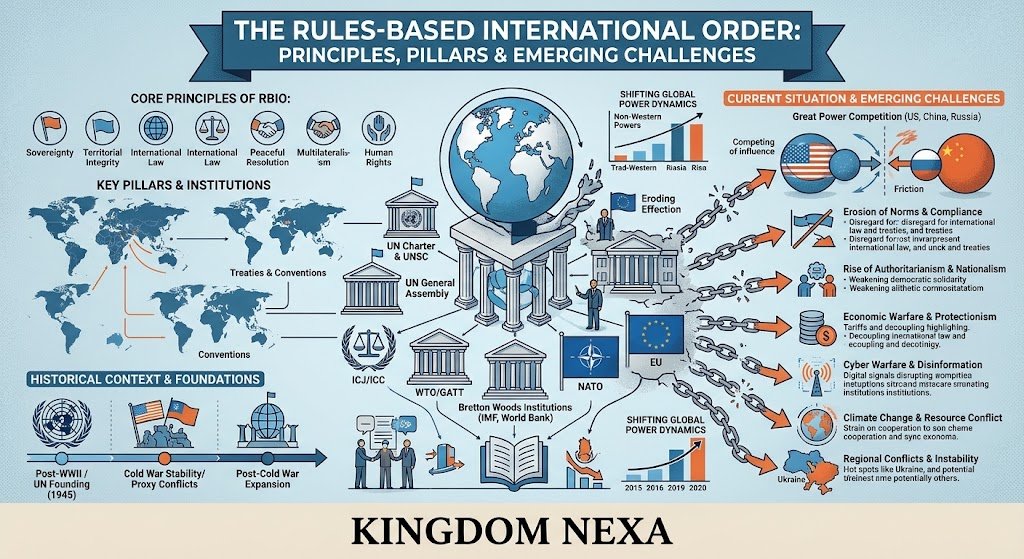
Core Principles of the Rules-Based International Order
Although governments disagree about the precise meaning of the term, several principles form the foundation of the modern international system.
Sovereign equality and territorial integrity
Under Article 2 of the UN Charter, states are sovereign equals within the organisation, regardless of their population, military strength, or economic output. Territorial integrity and political independence are protected by the Charter’s restrictions on the use of force.
Sovereign equality does not mean that all states possess equal influence. Permanent membership and veto powers in the UN Security Council, for example, give five states a special institutional position.
The distinction between legal equality and political power is central to debates about reforming global governance.
Peaceful settlement of disputes
International law encourages states to resolve disagreements through negotiation, mediation, arbitration, judicial settlement, and other peaceful methods.
These mechanisms can reduce the risk of escalation by providing alternatives to coercion. Their effectiveness depends on jurisdiction, state consent where required, political willingness, and the ability to implement agreed outcomes.
Human rights and humanitarian protection
International human rights law establishes obligations concerning fundamental rights and freedoms. International humanitarian law regulates the conduct of parties during armed conflict, including protections for civilians and other persons who are not, or are no longer, participating in hostilities.
These legal frameworks are related but distinct. Humanitarian law does not determine whether a state was legally entitled to initiate force; the law governing the use of force addresses that separate question.
Respect for these rules matters regardless of the identity of the parties involved.
Treaty obligations and good-faith cooperation
Treaties create legal obligations for the states that are parties to them. The principle of pacta sunt servanda, reflected in Article 26 of the Vienna Convention on the Law of Treaties, requires treaties in force to be performed in good faith.
States may have legitimate disagreements about interpretation, jurisdiction, or implementation. Those disagreements do not automatically erase their legal obligations.
Accountability and consistent application
An international order based on rules requires credible ways to identify violations and respond to them.
Accountability can involve domestic courts, international tribunals, diplomatic pressure, sanctions, treaty mechanisms, or collective measures authorised under international law. The appropriate mechanism depends on the circumstances and applicable legal framework.
The essential test is whether standards are applied consistently rather than adjusted according to the identity or strategic importance of the state concerned.
Major Institutions That Sustain the International Order
International institutions provide forums for cooperation, establish rules in specific fields, and create procedures for managing disputes. They do not all possess the same authority, membership, or enforcement powers.
The United Nations and the Security Council
The UN is the principal universal organisation for international peace and security, diplomacy, development cooperation, and human rights.
The Security Council has primary responsibility for maintaining international peace and security under the Charter. Its permanent members—the United States, China, Russia, the United Kingdom, and France—hold veto power over substantive decisions.
This arrangement reflects the political compromise underpinning the organisation’s creation. It also creates a persistent difficulty: when a permanent member or its close partner is involved in a crisis, geopolitical rivalry can prevent the Council from adopting substantive measures.
The General Assembly provides a broader forum in which all UN member states are represented, although most of its resolutions are recommendations rather than binding decisions.
International courts and legal institutions
The International Court of Justice settles legal disputes submitted by states when it has jurisdiction and issues advisory opinions when requested by authorised UN organs and agencies. It is not a general criminal court for individual leaders. INTERNATIONAL COURT OF JUSTICE+1
The International Criminal Court is a separate institution that prosecutes individuals for crimes within its jurisdiction, subject to the Rome Statute’s conditions. Other tribunals address specific legal questions, including maritime disputes.
These institutions strengthen the international legal system, but their reach depends on jurisdiction, cooperation, evidence, and the practical ability to implement decisions.
Economic and regional institutions
The WTO provides a framework for international trade rules. Its dispute settlement system has faced significant difficulties, including the long-running inability to maintain a fully functioning Appellate Body. Consequently, the effectiveness of trade adjudication has been constrained even though many WTO agreements remain in force.
The IMF and World Bank contribute to international financial stability and development financing. The European Union, African Union, Association of Southeast Asian Nations, and other regional bodies facilitate cooperation according to their respective mandates.
No single institution can resolve every international problem. The order depends on overlapping systems of law, diplomacy, finance, regional cooperation, and national implementation.
The Rules-Based Order in Practice: Global Challenges
The credibility of international rules is tested most severely when they conflict with the interests of powerful states or when governments disagree about how legal obligations should apply.
Great-power competition and selective enforcement
The United States, China, Russia, the European Union, and other influential actors have different strategic priorities and interpretations of the international system.
Western governments frequently emphasise the UN Charter, territorial integrity, democratic governance, and the importance of established alliances. China stresses sovereign equality, non-interference, development, and reform of global governance, while criticising what it regards as selective or politically motivated applications of international rules. Russia’s official positions also emphasise sovereignty and opposition to Western dominance, although its actions must be assessed separately against its applicable legal obligations.
These positions are not internally uniform, and stated principles do not necessarily correspond to every policy decision.
The underlying challenge is that states may defend international rules when they serve their interests while resisting them when compliance becomes costly. This inconsistency damages trust and encourages governments to interpret legal principles through the lens of strategic rivalry.
A credible order therefore requires scrutiny of all states, including allies and rivals, using the same relevant legal standards.
Armed conflicts and the prohibition on force
Armed conflicts expose the gap between legal principles and political enforcement. The UN Charter generally prohibits interstate threats or uses of force, subject to recognised exceptions, including self-defence under Article 51 and measures authorised by the Security Council.
International humanitarian law separately regulates conduct during armed conflict. Its protections apply regardless of which party initiated the conflict or whether its resort to force was lawful.
Political disagreement may prevent collective action even when serious allegations of violations arise. Security Council vetoes, limited access to conflict zones, contested evidence, and difficulties securing compliance can all restrict accountability.
These obstacles do not mean that international law has no effect. Legal findings, investigations, diplomatic pressure, and national proceedings can influence state behaviour and establish records that remain important long after immediate political circumstances change.
Economic coercion, sanctions, and trade disputes
Economic measures are increasingly used to influence state behaviour. Sanctions, export controls, tariffs, investment restrictions, and financial measures can serve foreign-policy and security objectives, but they may also create spillover effects for businesses and third countries.
Their legality depends on the specific measure, the applicable treaty obligations, domestic and international legal authorities, and the circumstances in which it is imposed. Not every sanction is unlawful, and not every measure described as an economic security policy is automatically justified.
The WTO dispute settlement system illustrates the institutional problem. Its Appellate Body has remained unable to hear appeals since December 2019 because it lacks members. This has weakened a key component of the multilateral trading framework. Dispute settlement – Appellate Body+1
When states cannot rely on predictable dispute resolution, the risk increases that trade conflicts will be managed through unilateral pressure rather than mutually accepted procedures.
Maritime disputes and strategic geography
Disagreements over maritime boundaries, navigation, fisheries, and offshore resources demonstrate the relationship between international law and geopolitical competition.
The United Nations Convention on the Law of the Sea, adopted in 1982 and in force since 1994, provides a comprehensive legal framework for ocean use, maritime zones, navigation, and marine resources. International Maritime Organization+1
In contested waters, governments may disagree over sovereignty, maritime entitlements, or the interpretation of legal provisions. Such disagreements require careful analysis of treaty obligations, relevant legal decisions, historical claims, and the facts of each case.
Consistent application of maritime law is important not only for coastal states but also for international shipping, energy transportation, fisheries, and global commerce.
Why the International Order Matters for the Global Economy
International rules help create the predictability on which cross-border economic activity depends. Businesses make long-term decisions based on expectations about contracts, trade access, property, investment protections, and the movement of goods and capital.
When international disputes are managed through established procedures, governments and companies can better estimate costs and risks. When rules become unpredictable, they may respond by diversifying suppliers, relocating production, building strategic reserves, or avoiding particular markets.
Trade and supply-chain stability
Multilateral trade rules establish expectations about tariffs, non-discrimination, and the treatment of trade partners, subject to the agreements’ terms and exceptions.
These arrangements cannot prevent all protectionism or trade disputes. They can, however, provide a common reference point for negotiations and legal challenges.
For developing economies, predictable market access and transparent trade procedures can be especially important because sudden restrictions may affect employment, foreign exchange earnings, industrial investment, and essential imports.
Financial stability and development
International financial institutions support monetary cooperation, development lending, and responses to economic crises. Their effectiveness depends partly on member-state cooperation and the perceived fairness of their governance structures.
Developing countries have frequently called for reforms that better reflect their economic weight, financing needs, and representation in international decision-making.
If institutions are perceived as serving a narrow group of powerful states, their legitimacy can weaken. More representative governance, transparent decisions, and credible accountability can improve cooperation without eliminating differences in national interests.
Technology, Cybersecurity, and the Changing Rules-Based Order
The international system was largely developed before artificial intelligence, global digital platforms, advanced cyber operations, and today’s interconnected data infrastructure became central to national power.
These technologies create new governance challenges because digital activity can cross borders instantly while legal authority remains divided among states.
Cyber operations and digital sovereignty
Cyber incidents can affect hospitals, energy networks, financial institutions, government systems, and critical infrastructure. Determining responsibility may be difficult because attackers can conceal their identities, use intermediaries, or operate through compromised systems.
International law applies to state conduct in cyberspace, although important questions remain contested regarding how particular rules apply to specific operations. Attribution should therefore be based on evidence and transparent reasoning rather than political accusation alone.
Artificial intelligence and international cooperation
AI creates opportunities for scientific progress, productivity, and public services, but it also raises concerns about surveillance, misinformation, discrimination, autonomous capabilities, and security.
On 22 September 2024, UN member states adopted the Pact for the Future, which includes the Global Digital Compact. The Compact sets out a framework for international digital cooperation, including efforts to address digital divides and improve AI governance. Office for Digital and Emerging Technologies+1
The initiative illustrates how international governance can evolve in response to new technologies. Its impact will depend on implementation, institutional cooperation, and the willingness of governments and private-sector actors to translate commitments into practice.
Reforming the International Order for a Multipolar World
The international system is becoming more complex as economic influence, technological capabilities, and diplomatic partnerships spread across a wider range of countries. This creates pressure to reform institutions designed in the aftermath of the Second World War.
Representation and institutional legitimacy
Many developing countries argue that existing institutions do not adequately reflect contemporary demographic and economic realities. Calls for reform include changes to Security Council representation, greater voice for emerging economies in international financial institutions, and more inclusive approaches to global rule-making.
Reform is difficult because established powers may resist changes that reduce their influence, while states seeking reform do not always agree on the preferred alternative.
Nevertheless, broader representation can strengthen legitimacy when it improves participation, transparency, and confidence in collective decisions.
The 2024 Pact for the Future
The UN General Assembly adopted the Pact for the Future on 22 September 2024. It addresses international peace and security, sustainable development, digital cooperation, and the reform of global governance. United Nations+1
The Pact reflects a shared recognition that international cooperation must adapt to contemporary challenges. However, adoption of an agreement is not the same as successful implementation. Progress depends on political commitment, financing, institutional capacity, and follow-through by member states.
What meaningful reform requires
A stronger international order would benefit from several practical improvements:
- More consistent application of international law to powerful and less powerful states.
- Greater transparency in international decision-making and sanctions policies.
- More effective mechanisms for peaceful dispute settlement.
- Institutional reforms that improve representation without undermining established legal obligations.
- Better international coordination on cyber threats, AI, climate risks, and emerging technologies.
- Stronger support for fact-based investigations and independent legal processes.
Reform should strengthen common rules rather than create competing standards for different geopolitical blocs.
Future Scenarios for the Rules-Based International Order
The future will depend on the interaction between great-power competition, institutional reform, economic interdependence, and states’ willingness to cooperate. Three broad scenarios illustrate the range of possibilities.
Scenario 1: Gradual institutional renewal
Governments may reach practical agreements on selected issues, including trade, digital governance, maritime security, and conflict prevention. Incremental reforms could improve institutional credibility without requiring consensus on every major geopolitical dispute.
This scenario would be more likely if states recognise the costs of unmanaged competition and identify areas where cooperation serves mutual interests.
Scenario 2: A fragmented, bloc-based system
Strategic rivalry could deepen divisions between competing political and economic blocs. Countries might increasingly rely on separate technology standards, financial arrangements, trade networks, and security partnerships.
Such fragmentation would not necessarily end international cooperation. However, overlapping and conflicting rules could increase costs, reduce predictability, and make dispute resolution more difficult.
Scenario 3: Selective cooperation amid continuing rivalry
A third possibility is a mixed system in which competition persists while governments cooperate where their interests align. States might disagree over security issues yet continue working together on public health, climate adaptation, maritime safety, or financial stability.
This scenario reflects an important reality: international cooperation does not require complete political agreement. Its durability depends on whether governments can preserve shared mechanisms despite deeper disagreements.
These scenarios are analytical possibilities, not predictions. The direction of change will depend on decisions by states, international institutions, businesses, and civil society.
Frequently Asked Questions About the Rules-Based International Order
1. What does the Rules-Based International Order mean?
It describes an international system in which states are expected to follow agreed legal rules, treaties, institutional procedures, and diplomatic norms. The objective is to promote predictable relations, peaceful dispute settlement, and international cooperation.
2. Is the rules-based international order the same as international law?
No. International law is a recognised body of legal obligations and rules. The rules-based international order is a broader political term that may encompass international law, institutions, diplomatic practices, and shared norms. The two overlap, but they are not identical.
3. What are the main principles of the international order?
Key principles include sovereign equality, territorial integrity, peaceful settlement of disputes, restrictions on the use of force, treaty compliance, human rights, and cooperation. Their precise legal application depends on the relevant treaties, customary law, and circumstances.
4. Which organisation is responsible for maintaining the international order?
The United Nations plays a central role in international peace and security, but responsibility is distributed across states, international courts, regional organisations, and specialised institutions. Each has different powers and responsibilities.
5. Why is the rules-based international order criticised?
Critics point to selective enforcement, unequal institutional influence, inconsistent responses to violations, and the limited ability of international organisations to compel compliance. Some also argue that powerful states use the language of international rules to advance their own strategic interests.
6. Is the international order collapsing?
There is no single measure that establishes that the entire system is collapsing. Armed conflicts, institutional deadlocks, and geopolitical rivalry have weakened confidence in some arrangements, while treaties, international organisations, and diplomatic cooperation continue to operate. The system is under pressure, but its future remains uncertain.
7. How does the international order affect developing countries?
It influences trade access, debt negotiations, development financing, sovereignty, maritime rights, security partnerships, and the ability to challenge coercive behaviour. Predictable rules can benefit smaller economies, although unequal bargaining power and institutional representation remain significant concerns.
8. What role does China play in the rules-based international order?
China participates in major international institutions and supports aspects of multilateral cooperation while advocating changes to elements of the existing order. Its positions and actions should be evaluated individually, distinguishing official statements, treaty obligations, policy decisions, and independently verified conduct.
9. How can the international order be strengthened?
It can be strengthened through more consistent legal accountability, effective dispute settlement, institutional reform, broader representation, transparent decision-making, and cooperation on shared challenges. Implementation matters as much as the adoption of new agreements.
Conclusion
The Rules-Based International Order remains an important framework for managing relations among states in a world shaped by strategic rivalry, economic interdependence, technological change, and regional conflicts. Its institutions and legal principles cannot eliminate power politics, but they can provide standards against which state conduct is evaluated and mechanisms through which disputes may be managed.
Its greatest weakness is the gap between proclaimed principles and their consistent application. When governments demand accountability from rivals but resist comparable scrutiny of their own actions or those of their partners, institutional credibility suffers. When rules are applied transparently and consistently, they have a stronger chance of earning international support.
The future of the system will depend not only on major-power relationships but also on the participation of developing countries, the effectiveness of international institutions, and the willingness of governments to accept constraints on their own conduct.
Ultimately, preserving a credible international order requires more than defending existing institutions. It requires making them fairer, more representative, more effective, and better equipped to address contemporary challenges. In an increasingly interconnected world, reliable international rules remain essential to global stability, economic confidence, and peaceful cooperation.