
International events rarely remain confined to the countries where they begin. A regional conflict can disrupt global energy supplies, a diplomatic agreement can reshape security partnerships, and a technological breakthrough can alter the balance of economic and military power. Understanding these connections requires a broader perspective that considers national interests, geography, diplomacy, economics, security, and the institutions governing international relations.
International Strategic Affairs examines how states and other influential actors pursue their long-term objectives, manage competing interests, respond to threats, and influence the global order. It connects foreign policy with military strategy, economic security, technological competition, international law, and regional power dynamics.
For policymakers, diplomats, researchers, journalists, and business leaders, this field provides a framework for interpreting international developments beyond daily headlines. It helps explain why countries cooperate despite disagreements, why strategic rivalries persist, and how decisions made in one region can create consequences elsewhere.
In an increasingly interconnected yet competitive world, understanding strategic affairs is essential for evaluating geopolitical risks and opportunities. This article explores the field’s meaning, historical evolution, major actors, contemporary challenges, practical applications, and possible future directions, using established analytical frameworks and developments documented through October 2026.
What Are International Strategic Affairs?
International strategic affairs is the study and practice of how states, alliances, international organisations, and other influential actors pursue long-term objectives in a competitive and interconnected world.
The field examines the relationship between national interests, political power, geography, military capabilities, diplomacy, economic resources, technological advantages, and international institutions. It asks not only what governments do, but why they do it, what constraints they face, and how their decisions affect other actors.
Strategic affairs is broader than military strategy. Military power remains important, but states also exercise influence through trade agreements, financial systems, energy supplies, technological standards, diplomatic coalitions, development assistance, and cultural influence.
For example, a government seeking greater regional influence might strengthen its armed forces while simultaneously investing in transport infrastructure, negotiating trade agreements, and expanding diplomatic partnerships. These activities can reinforce one another.
Strategic affairs versus related disciplines
| Field | Main focus |
|---|---|
| International relations | Relationships among states and other international actors |
| Strategic studies | Strategy, war, deterrence, military power, and security |
| Geopolitics | The relationship between geography and political power |
| Foreign policy analysis | How governments formulate and implement external policies |
| International strategic affairs | The interaction of these fields across security, diplomacy, economics, technology, and global governance |
These fields overlap considerably. International strategic affairs offers an integrated perspective that connects their insights to real-world decisions.
Historical Evolution of International Strategic Affairs
Strategic thinking has developed alongside changes in political organisation, military technology, economic power, and the international system.
From classical statecraft to modern geopolitics
Ancient political and military thinkers examined alliances, leadership, territorial control, and the relationship between resources and power. The writings associated with Thucydides, Sun Tzu, and later strategic theorists remain influential because they explore enduring problems involving competition, uncertainty, deterrence, and decision-making.
During the nineteenth century, industrialisation, imperial competition, railway networks, naval power, and changing borders made geography and economic capacity increasingly important to national strategy.
The world wars demonstrated how military planning, industrial production, alliances, intelligence, and economic mobilisation could determine the outcome of major international conflicts.
The Cold War and nuclear deterrence
After 1945, international strategy was heavily influenced by the rivalry between the United States and the Soviet Union. Nuclear weapons, ideological competition, alliance systems, proxy conflicts, and the risk of escalation became central concerns.
The formation of NATO in 1949 and the Warsaw Pact in 1955 institutionalised opposing security alignments in Europe. Nuclear deterrence encouraged both superpowers to consider not only how to win a conflict, but how to prevent one from becoming catastrophic.
The Cuban Missile Crisis of October 1962 illustrated the dangers of miscalculation and the importance of communication during high-stakes confrontation.
The post-Cold War period
The Soviet Union dissolved in 1991, ending the bipolar structure of the Cold War. The following decades brought greater economic integration, expanding international institutions, regional conflicts, counterterrorism campaigns, and growing expectations that globalisation would deepen cooperation.
However, economic interdependence did not eliminate strategic rivalry. Russia’s war against Ukraine, intensifying US–China competition, conflicts in the Middle East, and disputes over technology and trade have reinforced the importance of power politics.
By the 2020s, strategic planning increasingly encompassed cyber operations, supply-chain resilience, critical minerals, space systems, climate-related security risks, and economic coercion.
The Major Pillars of International Strategic Affairs
International strategic affairs draws on several connected areas of national and international power.
Infographic: The Six Pillars of International Strategic Affairs
International Strategic Affairs infographic showing key pillars, historical evolution, actors, risks, and FAQs
The infographic provides an overview of the field. Its central dimensions can be understood in greater detail through the following pillars.
Military power and national security
Military strategy addresses the use, threat, and organisation of armed force to achieve political objectives. It includes deterrence, defence planning, alliance commitments, force readiness, and the management of escalation.
Military capability depends on more than personnel and weapons. Logistics, industrial capacity, training, intelligence, command systems, geography, and political will all influence effectiveness.
According to the Stockholm International Peace Research Institute (SIPRI), global military expenditure reached an estimated $2.887 trillion in 2025, a real-terms increase of 2.9% from 2024. This continued a decade-long upward trend in worldwide military spending. SIPRI+1
The figures demonstrate the scale of resources devoted to defence, but spending alone does not establish which country is strategically strongest or whether its policies will succeed.
Diplomacy and statecraft
Diplomacy enables governments to negotiate agreements, manage disputes, communicate intentions, and coordinate responses to shared challenges.
Strategic diplomacy involves more than maintaining formal relationships. It includes coalition-building, mediation, signalling, economic negotiations, confidence-building measures, and efforts to prevent misunderstandings.
Effective statecraft often requires balancing competing priorities. A government may cooperate with another country on trade while disagreeing with it over maritime security or human rights. Such selective cooperation is common in international relations.
Geoeconomics and economic security
Economic resources can support national influence, while economic dependencies can create vulnerabilities.
States use tariffs, sanctions, export controls, investment screening, development financing, and trade agreements to pursue strategic objectives. These measures may achieve specific goals, but they can also create retaliation, market disruption, and unintended costs.
Strategic economic analysis therefore considers both leverage and exposure. A country may benefit from access to an important export market while remaining vulnerable to restrictions on imported energy, advanced technology, or industrial components.
Technology and information power
Artificial intelligence, semiconductors, cyber capabilities, satellite communications, drones, and advanced manufacturing are changing the relationship between economic strength and national security.
Technological advantages can improve intelligence collection, military effectiveness, logistics, and industrial productivity. At the same time, dependence on foreign technology providers can create risks related to supply disruptions, cyber vulnerabilities, and strategic pressure.
International competition increasingly involves the ability to develop, manufacture, secure, and govern critical technologies—not simply to purchase them.
International institutions and global governance
The United Nations, World Trade Organization, International Monetary Fund, World Bank, European Union, NATO, and regional organisations shape different aspects of international cooperation.
Their effectiveness depends on their mandates, resources, member-state support, and political circumstances. International institutions can facilitate negotiations and establish rules, but they cannot always overcome disagreement among influential states.
Political values, legitimacy, and influence
National identity, ideology, public opinion, political legitimacy, and cultural influence affect strategic choices. Governments may seek to strengthen their international standing through education, public diplomacy, humanitarian assistance, cultural exchanges, or development partnerships.
Soft power can complement military and economic capabilities, but its influence depends on credibility and how foreign audiences perceive a country’s actions.
Key Actors Shaping International Strategic Affairs
Strategic outcomes rarely depend on one country acting alone. They emerge from interactions among major powers, regional states, international organisations, private companies, and non-state groups.
Major powers and strategic competition
The United States retains extensive global military, financial, diplomatic, and technological capabilities. China combines substantial industrial capacity with expanding diplomatic and military influence. Russia continues to shape European and wider security calculations through its military capabilities, nuclear arsenal, energy relationships, and foreign policy.
India, Japan, European powers, and other influential states also affect the distribution of international power. Their priorities differ, and they do not necessarily align with either Washington or Beijing on every issue.
Strategic competition should not be interpreted as a simple division into two permanent camps. Countries frequently cooperate in one area while competing in another.
Regional powers and strategic autonomy
Regional powers can influence security arrangements, trade routes, energy markets, and diplomatic settlements within their neighbourhoods.
Countries such as Türkiye, Saudi Arabia, Brazil, Indonesia, and South Africa pursue different combinations of regional leadership, economic development, and diplomatic independence.
Strategic autonomy refers to a state’s ability to make important decisions without excessive dependence on external powers. It does not necessarily mean neutrality or isolation. A state can maintain alliances while diversifying its economic and diplomatic relationships.
Non-state actors
Multinational companies, technology firms, financial institutions, humanitarian organisations, research centres, and armed non-state groups can influence strategic outcomes.
Technology companies may control infrastructure essential to communications and data processing. Energy producers influence supply security, while humanitarian organisations document civilian needs and contribute to crisis response.
These actors differ in their legal status, resources, accountability, and objectives. Their influence should be assessed according to the specific issue rather than assumed to be equivalent to that of sovereign states.
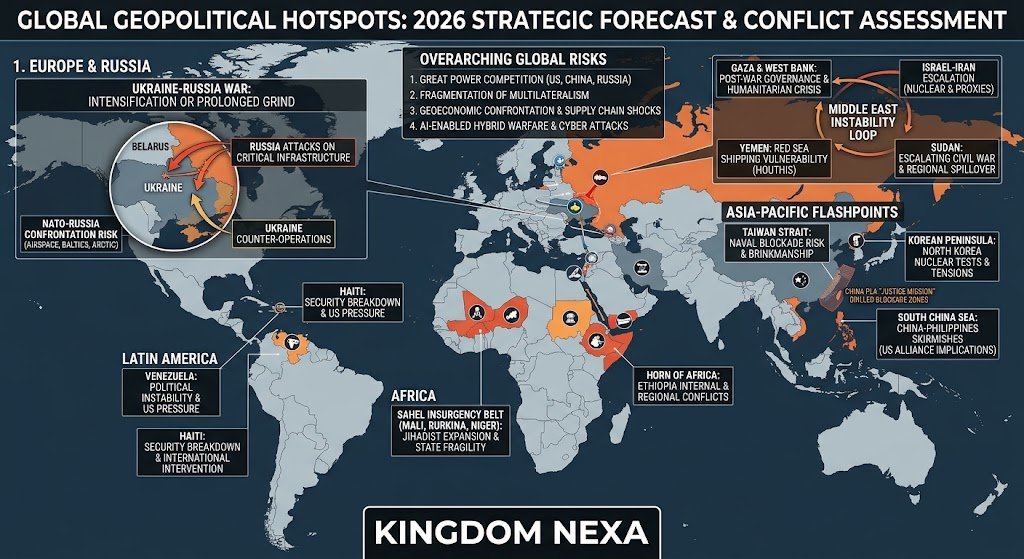
Regional Dynamics and Strategic Flashpoints
Regional developments can affect international stability through alliance commitments, trade relationships, migration, energy markets, and the movement of military forces.
Europe and transatlantic security
Russia’s full-scale invasion of Ukraine in February 2022 transformed European security planning. Governments reassessed defence capabilities, energy dependencies, military readiness, and support for Ukraine.
NATO’s 2022 Strategic Concept identifies deterrence and defence, crisis prevention and management, and cooperative security as the alliance’s three core tasks. It also addresses cyber threats, emerging technologies, and wider strategic competition. NATO Topic+1
The strategic challenge is to maintain credible defence and alliance cohesion while reducing the risk of unintended escalation.
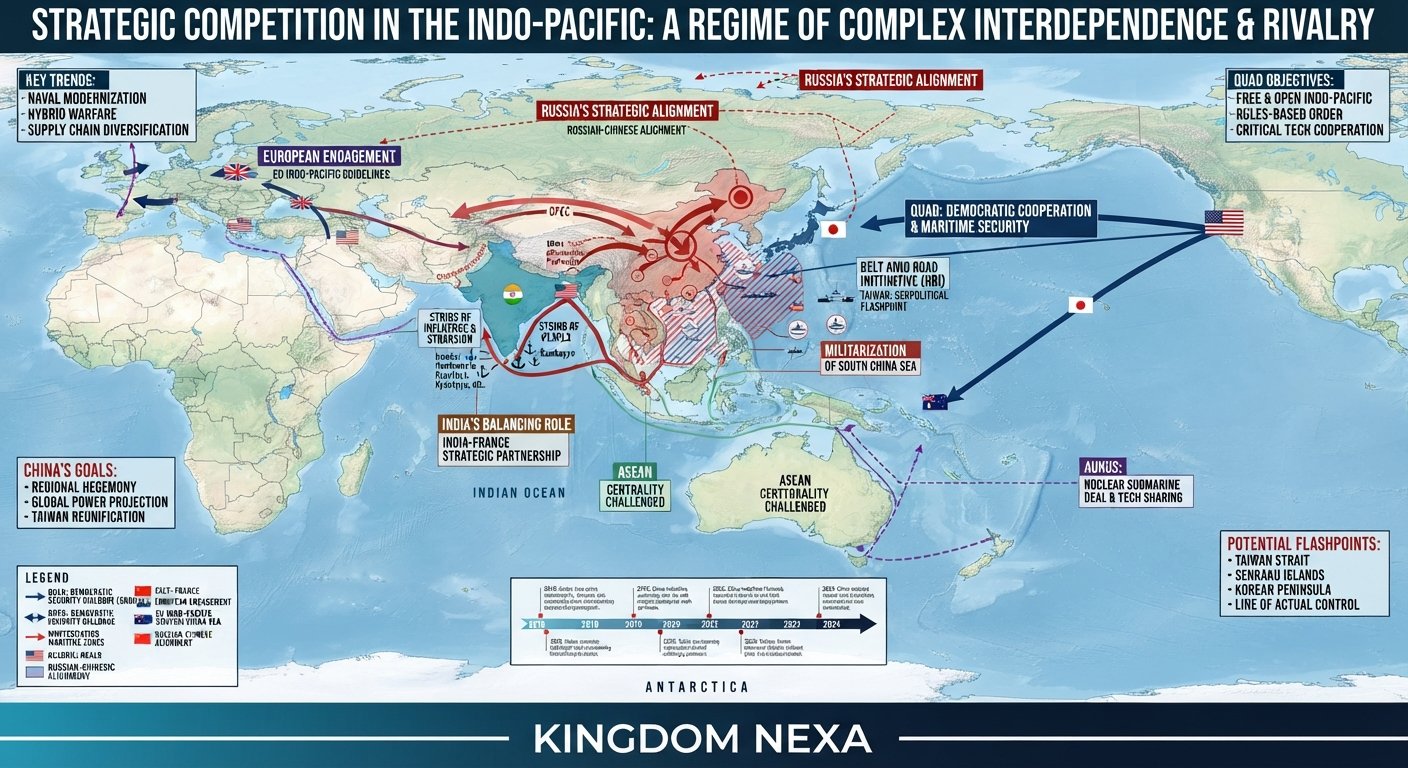
The Indo-Pacific
The Indo-Pacific is central to global trade, advanced manufacturing, maritime transport, and strategic competition.
US–China relations influence regional security, technological restrictions, investment decisions, and the diplomatic calculations of countries including Japan, India, Australia, South Korea, and members of the Association of Southeast Asian Nations.
Taiwan Strait tensions and disputes in the South China Sea create risks involving maritime access, military signalling, and competing territorial claims. Diplomatic communication, crisis-management mechanisms, and respect for applicable international law are important to reducing escalation risks.
The Middle East and energy security
The Middle East connects regional security with global energy markets, maritime routes, religious and political identities, and international diplomacy.
Conflict, sanctions, rivalries, and shifts in external involvement can affect shipping, investment, humanitarian conditions, and energy prices. The consequences extend beyond the region, particularly for energy-importing countries and economies dependent on secure maritime transport.
South Asia and regional stability
South Asian strategic affairs are shaped by India–Pakistan relations, China’s regional role, Afghanistan’s security situation, nuclear deterrence, water management, economic connectivity, and domestic political developments.
For Pakistan, strategic planning includes national security, economic resilience, relations with China and Gulf countries, ties with the United States, and the management of regional tensions. India’s growing economic and military capabilities also influence the regional balance.
Long-term stability depends not only on military preparedness but also on crisis communication, economic resilience, effective institutions, and practical cooperation where shared interests exist.
International Law and Strategic Decision-Making
Power operates within a legal framework, even when states disagree about how particular rules apply.
The United Nations Charter establishes the principle of sovereign equality and requires member states to settle international disputes by peaceful means. Article 2(4) generally prohibits the threat or use of force against the territorial integrity or political independence of states, while Article 51 addresses self-defence in the event of an armed attack. United Nations
Other relevant legal frameworks include international humanitarian law, the law of the sea, arms-control agreements, international human rights law, and treaty obligations.
Strategic analysis should distinguish legal obligations from political arguments and military capabilities. A state may have the capacity to undertake an action without having a lawful basis for doing so.
International law also matters beyond armed conflict. Trade agreements, sanctions regimes, investment rules, and technology regulations can shape the options available to governments and businesses.
Contemporary Challenges and Future Scenarios
As of October 2026, international strategic affairs is being shaped by overlapping security, economic, political, and technological pressures. The precise trajectory of individual conflicts and diplomatic negotiations remains uncertain, so scenario planning is more useful than treating a single forecast as inevitable.
Principal risks
- Escalation and miscalculation: Military signalling, unclear red lines, or communication failures may turn a limited confrontation into a wider crisis.
- Economic fragmentation: Tariffs, sanctions, export controls, and strategic decoupling can increase costs and weaken supply-chain resilience.
- Cybersecurity and disinformation: Digital attacks and manipulated information can undermine critical infrastructure, public trust, and decision-making.
- Nuclear and arms-control risks: Modernisation, weakened confidence-building arrangements, and strategic mistrust may increase instability.
- Climate and resource pressures: Extreme weather, water scarcity, and competition over essential resources can intensify existing vulnerabilities.
- Institutional constraints: Disagreement among major powers can obstruct collective responses to humanitarian emergencies and international crises.
The World Economic Forum’s Global Risks Report 2025, based on a survey of more than 900 experts, highlighted armed conflict, geoeconomic confrontation, and misinformation among the concerns shaping its assessment of global risks. Such surveys measure expert perceptions, not the objective probability of each event. World Economic Forum+1
Three plausible strategic scenarios
Scenario 1: Managed competition. Major powers continue competing while preserving communication channels and selective cooperation on trade, climate, health, or crisis prevention.
Scenario 2: Intensified fragmentation. Economic restrictions, rival technology systems, regional conflicts, and competing alliances reduce trust and raise the costs of international cooperation.
Scenario 3: Selective strategic realignment. Middle powers diversify partnerships, regional organisations gain influence in specific areas, and governments pursue greater autonomy without abandoning all existing alliances.
These scenarios can overlap. Their likelihood depends on political leadership, economic conditions, institutional effectiveness, military developments, and unexpected events.
For policymakers and businesses, the practical response is to monitor early-warning indicators, diversify critical dependencies, test contingency plans, and update assumptions when circumstances change.
Frequently Asked Questions About International Strategic Affairs
1. What is the main purpose of international strategic affairs?
Its main purpose is to understand how countries and other influential actors pursue long-term objectives, manage security risks, exercise power, and respond to international opportunities and challenges.
2. What is the difference between strategic affairs and strategic studies?
Strategic studies traditionally focuses on military strategy, warfare, deterrence, and security. International strategic affairs takes a broader approach by incorporating diplomacy, economic competition, technology, international institutions, and political relationships.
3. Why are international strategic affairs important?
They help explain conflicts, alliances, trade disputes, technological competition, and changes in global power. This understanding supports foreign policy, national security, investment decisions, and international cooperation.
4. What are the main components of international strategic affairs?
The principal components include national security, military strategy, diplomacy, geopolitics, geoeconomics, technological competition, international law, and global governance.
5. Which countries have the greatest influence on international strategic affairs?
The United States and China are central to global strategic competition. Russia, India, Japan, European powers, and influential regional states also shape international outcomes. Their relative influence varies by issue and region.
6. How do international organisations influence strategic affairs?
International organisations establish rules, facilitate negotiations, coordinate collective responses, and provide forums for dispute resolution. Their effectiveness depends on their mandates, resources, and the willingness of member states to cooperate.
7. How does technology affect international strategic affairs?
Artificial intelligence, cyber capabilities, satellites, semiconductors, and autonomous systems affect economic competitiveness, intelligence, military operations, and national security. Technological dependence can also create strategic vulnerabilities.
8. What is the role of economics in strategic affairs?
Economic strength supports national power through industrial capacity, trade, investment, and access to resources. Governments may also use sanctions, export restrictions, tariffs, and financial measures to pursue foreign policy objectives.
9. How can students begin studying international strategic affairs?
Students should build foundations in international relations, political geography, history, economics, security studies, and international law. Reading primary documents, comparing credible sources, and practising scenario analysis can develop practical analytical skills.
Conclusion
International Strategic Affairs provides a framework for understanding how political power, military security, diplomacy, economic relationships, technology, and international institutions interact to shape the global order.
Its importance extends beyond major-power rivalry. Regional conflicts, energy security, supply-chain vulnerabilities, cyber threats, climate pressures, and domestic political developments can all influence international stability. Understanding these connections requires historical context, reliable evidence, balanced analysis, and a clear distinction between established facts and uncertain outcomes.
The future will not be determined by military strength or economic size alone. Diplomacy, institutional credibility, technological adaptability, domestic resilience, and the ability to manage uncertainty will also shape international outcomes.
Ultimately, a sound understanding of international strategic affairs helps decision-makers evaluate competing interests, prepare for plausible risks, and pursue cooperation without overlooking the realities of strategic competition.