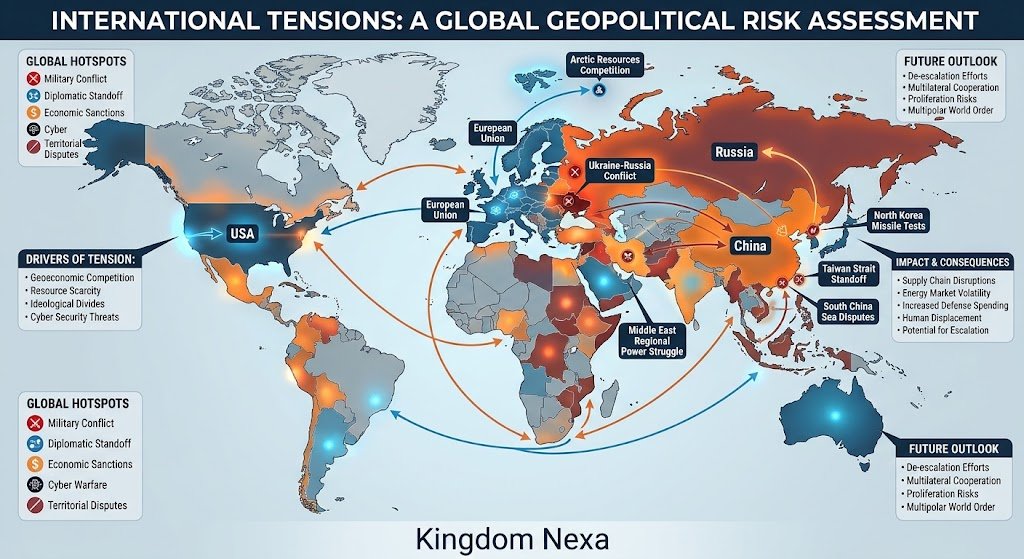
International relations are shaped not only by cooperation and diplomacy but also by disagreements over territory, political influence, economic interests, military security, and access to strategic resources. When these competing interests become difficult to reconcile, international tensions can emerge, affecting relationships between governments and creating consequences that extend far beyond national borders.
From strategic competition between major powers to regional conflicts, trade disputes, maritime security concerns, and diplomatic confrontations, international tensions remain a defining feature of the contemporary global order. Their effects are visible in defence policies, energy markets, international investment, migration, technological competition, and the activities of global institutions.
Understanding these developments requires more than following daily headlines. It involves examining historical grievances, national interests, geopolitical geography, domestic political pressures, military capabilities, and the effectiveness of international diplomacy.
As of 30 October 2026, the international environment continues to demand careful analysis of both established rivalries and emerging security challenges. This article examines the meaning, historical evolution, major causes, key actors, regional dynamics, economic consequences, international legal dimensions, and possible future developments associated with tensions between countries.
What Are International Tensions?
International tensions refer to strained relationships, disagreements, rivalries, or confrontations between countries or other international actors that threaten diplomatic cooperation, political stability, economic relationships, or security.
They can develop between two countries or involve several states, military alliances, regional organisations, and non-state actors.
Not every disagreement constitutes a security crisis. Governments regularly compete over trade policies, diplomatic recognition, international regulations, and political influence without approaching armed conflict. Tensions become particularly concerning when communication deteriorates, military forces mobilise, economic restrictions intensify, or diplomatic disagreements become connected to territorial and security disputes.
Different forms of international tensions
International tensions generally appear in several interconnected forms:
- Political tensions: Disagreements over governance, foreign policy, ideological differences, political influence, or diplomatic recognition.
- Military tensions: Increased defence deployments, military exercises, arms competition, border incidents, and deterrence confrontations.
- Economic tensions: Trade restrictions, sanctions, investment controls, tariffs, and competition over strategic resources.
- Territorial tensions: Disputes concerning borders, islands, maritime zones, sovereignty, and territorial control.
- Diplomatic tensions: Breakdown of negotiations, withdrawal of ambassadors, diplomatic expulsions, and disagreements over international agreements.
- Technological tensions: Competition involving semiconductors, artificial intelligence, telecommunications, cybersecurity, and advanced military technologies.
These categories frequently overlap. An economic disagreement can become a diplomatic dispute, while a maritime confrontation can create military and commercial consequences.
Historical Background: How International Tensions Have Evolved
International rivalry is not a modern phenomenon. Competition over territory, resources, trade routes, political authority, and strategic influence has influenced international relations throughout recorded history.
1 for 8 Billion: Rethinking Leadership at a Time of Multilateral Crisis — 1 for 8 Billion
Historical rivalries and the development of the state system
European political competition, colonial expansion, and the emergence of modern sovereign states contributed to the development of international rivalry.
The 1648 Peace of Westphalia is traditionally associated with the development of the modern state system, although historians caution against treating it as the single origin of sovereignty or modern international relations.
During the nineteenth century, industrialisation, imperial expansion, nationalism, and competition for overseas markets intensified geopolitical rivalries.
The two World Wars
The First World War (1914–1918) demonstrated how alliances, militarisation, nationalism, imperial competition, and diplomatic failures could combine to produce a major international conflict.
The Second World War (1939–1945) further transformed international politics. Its consequences included the establishment of the United Nations in 1945, the emergence of the United States and Soviet Union as superpowers, and the beginning of a new international security environment.
The Cold War and bipolar competition
Between approximately 1947 and 1991, international relations were heavily influenced by competition between the United States and the Soviet Union.
Major characteristics included:
- Nuclear weapons competition and deterrence.
- Military alliances, particularly NATO and the Warsaw Pact.
- Proxy conflicts in Asia, Africa, and Latin America.
- Ideological competition between capitalism and communism.
- Intelligence operations and technological competition.
- Political and economic influence over developing countries.
The Cuban Missile Crisis of October 1962 demonstrated how a regional confrontation could create a global nuclear danger.
The post-Cold War international environment
The Soviet Union dissolved in December 1991, ending the Cold War’s bipolar structure.
The following decades witnessed expanding globalisation, the enlargement of NATO, China’s growing economic influence, regional conflicts, international counterterrorism operations, and increasing economic interdependence.
The international financial crisis of 2008, Russia’s annexation of Crimea in 2014, the COVID-19 pandemic beginning in 2020, and Russia’s full-scale invasion of Ukraine in February 2022 further demonstrated the vulnerability of international cooperation.
The contemporary international system is consequently characterised by overlapping competition, cooperation, economic dependencies, and security challenges rather than a simple division into two opposing blocs.
Major Causes of International Tensions
International tensions rarely result from a single disagreement. They usually develop through a combination of structural competition, historical grievances, security concerns, economic interests, and political decisions.
1. Competition for geopolitical power
Major powers seek to protect their strategic interests, maintain international influence, and shape the rules governing the global system.
The United States, China, Russia, the European Union, and other influential actors have different priorities concerning security arrangements, international trade, technological development, and regional influence.
Strategic competition does not necessarily produce military confrontation. It can also involve diplomatic negotiations, economic incentives, technological restrictions, military partnerships, and competition within international institutions.
The central challenge arises when one country’s efforts to strengthen its security or influence are perceived by another as a threat.
2. Territorial disputes and national sovereignty
Disagreements over borders, islands, maritime territories, and resource-rich regions remain important sources of international instability.
Examples include:
- The South China Sea disputes involving China and several Southeast Asian states.
- The India-Pakistan dispute over Jammu and Kashmir.
- The Russia-Ukraine conflict and disputes concerning territorial sovereignty.
- Maritime boundary disagreements in different parts of the world.
- Competing claims involving strategically important islands and coastal areas.
Territorial disagreements become particularly difficult when they involve nationalism, historical grievances, military deployments, or valuable natural resources.
3. Military competition and security dilemmas
A security dilemma develops when one country increases its military capabilities for defensive purposes, but another interprets those actions as preparation for aggression.
This can encourage reciprocal military expansion, creating an atmosphere of mistrust.
Military exercises, missile deployments, nuclear modernisation, naval operations, and defence agreements may therefore influence regional stability even when governments describe them as defensive measures.
According to the Stockholm International Peace Research Institute (SIPRI), global military expenditure reached approximately $2.887 trillion in 2025, representing a real increase of 2.9% over 2024. This was the eleventh consecutive annual increase. Military expenditure represented approximately 2.5% of global GDP. SIPRI+1
These figures demonstrate the scale of global defence spending, although military expenditure alone does not establish whether a country intends to initiate a conflict.
4. Economic competition and trade restrictions
Economic interdependence can encourage cooperation, but it can also create vulnerabilities that governments may attempt to exploit or reduce.
Tariffs, sanctions, export controls, investment restrictions, and competition over strategic industries can increase tensions between trading partners.
Economic statecraft has become particularly important in areas such as:
- Semiconductor manufacturing.
- Energy supplies and transportation.
- Critical minerals and rare earth elements.
- Advanced artificial intelligence.
- Telecommunications infrastructure.
- Defence-related manufacturing.
The World Trade Organization’s 2026 World Trade Report identifies geopolitical rivalry, supply-chain concentration, technological competition, and national security concerns as important pressures on rules-based international trade. It also highlights the risk that defensive economic restrictions can generate further restrictions by other governments. Executive summary+1
5. Ideological differences and political rivalries
Political systems, national identities, competing ideological perspectives, and disagreements over governance can influence diplomatic relationships.
However, ideological differences do not automatically create international confrontation. Countries with different political systems can maintain productive economic and diplomatic partnerships when their interests overlap.
Tensions become more pronounced when governments connect ideological disagreements with national security, regional influence, or domestic political legitimacy.
6. Competition over natural resources
Energy, water, minerals, agricultural land, and strategic transport routes influence international relationships.
Countries dependent on imported oil, natural gas, food, or industrial materials may become vulnerable to disruptions caused by sanctions, armed conflict, export restrictions, or political instability.
Climate change can intensify existing resource pressures by affecting agricultural productivity, water availability, and population movements. However, environmental stress should not be treated as an automatic cause of war; its effects depend heavily on political institutions, economic conditions, and cooperation mechanisms.
Major Countries and Actors Shaping International Tensions
The contemporary international system involves established powers, emerging economies, regional actors, international organisations, and non-state participants.
United States and China
Así Fue la Reunión Entre Joe Biden y Xi Jinping | Internacional | N+
The United States and China are central participants in contemporary strategic competition.
Washington’s stated priorities include maintaining alliances, protecting national security, supporting a favourable Indo-Pacific balance, and restricting access to certain sensitive technologies.
Beijing emphasises national sovereignty, economic development, technological advancement, and its regional and international interests.
Major areas of disagreement include Taiwan, maritime security, trade restrictions, semiconductor exports, military activities, and the future of the international order.
Nevertheless, both countries have substantial reasons to maintain communication, including trade, financial stability, climate-related issues, and the management of military risks.
Their relationship is therefore characterised by a mixture of competition, selective cooperation, and mutual economic exposure.
Russia and Western countries
Relations between Russia and Western governments have been significantly affected by the war in Ukraine, NATO’s security posture, sanctions, energy policy, and disagreements over European security.
Russia’s government presents its security concerns in terms of NATO expansion and regional military developments. Ukraine and its supporting governments emphasise Ukraine’s sovereignty and territorial integrity.
These competing positions must be understood alongside the established international legal framework and the documented consequences of Russia’s full-scale invasion in February 2022.
The conflict has influenced European defence planning, energy diversification, economic restrictions, and diplomatic relations far beyond Eastern Europe.
European Union
The European Union is an important geopolitical and economic actor.
Its influence comes from its combined economic market, regulatory framework, diplomatic relationships, development assistance, and growing emphasis on defence and strategic autonomy.
The EU faces several interconnected challenges, including European security, energy independence, migration, economic competitiveness, relations with China, and cooperation with the United States.
Its member states do not always share identical foreign policy priorities, making internal coordination an important factor in its international influence.
India and Pakistan
Relations between India and Pakistan remain shaped by the history of partition, the Kashmir dispute, military competition, cross-border security concerns, and domestic political considerations.
Both countries possess nuclear weapons, making crisis management, communication channels, and military restraint particularly significant.
Their relationship also affects South Asian regional cooperation, connectivity, trade opportunities, and security arrangements.
China’s relationship with both countries and wider competition in the Indian Ocean add further strategic complexity.
Other influential actors
Several other countries and organisations influence international tensions:
- Japan and South Korea: Important actors in East Asian security, technology, and economic cooperation.
- Turkey: A strategically positioned NATO member with interests spanning Europe, the Black Sea, the Middle East, and the Caucasus.
- Iran and Saudi Arabia: Regional powers whose security policies, energy interests, and diplomatic relationships influence Middle Eastern developments.
- Brazil and South Africa: Important voices in discussions about multilateralism, development, and the representation of emerging economies.
- ASEAN: A regional organisation promoting dialogue and cooperation in Southeast Asia.
- African Union: A continental organisation involved in peace, security, political cooperation, and regional integration.
Regional Hotspots and Their Global Implications
International tensions have different causes and consequences across geographical regions. Understanding local historical and political conditions is essential to avoiding oversimplified explanations.
Europe: The Ukraine conflict and continental security
The war in Ukraine has reshaped European security since February 2022.
Its consequences include increased defence spending, sanctions, military assistance, population displacement, energy-market adjustments, and changes in European security planning.
NATO has expanded to include Finland in 2023 and Sweden in 2024, bringing the alliance to 32 members.
The conflict has also raised broader questions concerning territorial sovereignty, deterrence, military assistance, diplomatic negotiations, and the future of European security architecture.
Middle East: Regional rivalries and security concerns
The Middle East remains strategically significant because of its energy resources, maritime geography, religious and political diversity, and overlapping regional rivalries.
Important sources of tension include the Israeli-Palestinian conflict, Iran’s regional relationships, security concerns involving Israel and neighbouring states, instability in parts of the region, and competition over strategic waterways.
The Strait of Hormuz, Bab el-Mandeb, and the Suez Canal are especially important to international trade and energy transportation.
Developments in the region can affect global oil and gas markets, maritime insurance, shipping costs, humanitarian conditions, and international diplomacy.
Indo-Pacific: Maritime and strategic competition
The Indo-Pacific has become a major centre of geopolitical competition because of its economic importance, maritime trade routes, technological industries, and strategic geography.
The South China Sea and Taiwan Strait are particularly sensitive areas.
China’s maritime claims, the competing claims of several Southeast Asian countries, Taiwan’s political status, and the military presence of external powers contribute to regional uncertainty.
Japan, Australia, India, South Korea, ASEAN members, and the United States all have interests in regional security and the preservation of economic connectivity.
South Asia: Nuclear security and regional stability
South Asia faces a combination of traditional security disputes and emerging challenges.
India-Pakistan relations, Afghanistan’s political and security situation, border management, terrorism concerns, water-sharing questions, and economic connectivity all influence regional stability.
The Indus Waters Treaty of 1960 has historically provided an institutional framework for water cooperation between India and Pakistan. Disputes over its interpretation and implementation illustrate how resource management can become connected to wider political tensions.
Regional economic cooperation remains constrained by political disagreements, limited trade integration, and security concerns.
Africa: Resource competition and political instability
Several African countries face challenges involving armed conflict, unconstitutional changes of government, resource competition, foreign military involvement, and humanitarian emergencies.
The Sahel, the Horn of Africa, Sudan, and the Great Lakes region require particular attention because of the interaction between local conflicts, weak institutions, external interests, and displacement.
At the same time, Africa’s growing importance in critical minerals, renewable energy, agriculture, and demographic development creates opportunities for international partnerships.
African governments and regional organisations are increasingly important participants in shaping the continent’s diplomatic and security priorities.
Diplomatic Relations and International Conflict Management
Diplomacy provides governments with mechanisms to manage disagreements without resorting to military confrontation.
Bilateral negotiations, multilateral conferences, mediation, confidence-building measures, and international agreements can help reduce tensions.
The importance of diplomatic communication
Communication channels allow governments to clarify intentions, exchange information, and reduce the possibility of miscalculation.
Hotlines between military authorities, diplomatic consultations, and agreed procedures for managing maritime or aerial incidents can be particularly useful during crises.
Even countries with serious political disagreements may maintain communication because avoiding uncontrolled escalation serves their mutual interests.
Mediation and international negotiations
Third-party mediation can help opposing governments explore compromises that would be politically difficult to propose directly.
The United Nations, regional organisations, and individual states can support negotiations through diplomatic facilitation, peacekeeping, monitoring, and humanitarian coordination.
However, mediation does not guarantee success. Its effectiveness depends on the willingness of the parties, the credibility of mediators, the implementation of agreements, and the political conditions surrounding negotiations.
Military deterrence and arms control
Deterrence seeks to discourage hostile action by demonstrating that the potential costs would outweigh expected benefits.
It can operate through conventional military capabilities, nuclear forces, alliances, and clearly communicated defensive commitments.
Arms-control agreements and confidence-building measures complement deterrence by reducing uncertainty and limiting certain military risks.
A sustainable security arrangement requires both credible defence and functioning diplomatic channels.
Economic Consequences of International Tensions
Political confrontations can have consequences far beyond the countries directly involved.
UR E26 and E27 Requirements In Practice – Marlink
International trade and supply chains
Conflict and economic restrictions can interrupt shipping routes, delay industrial production, increase transportation costs, and reduce access to important markets.
Businesses with concentrated suppliers may face greater disruption than companies operating diversified supply networks.
Governments increasingly consider supply-chain resilience part of national economic security.
Energy markets and commodity prices
International tensions can influence oil, natural gas, electricity, and critical mineral markets.
A disruption involving a major producer or transport corridor may affect prices and availability even when consumers are geographically distant from the underlying dispute.
Energy-importing countries can be particularly exposed to sudden price increases, while exporters may experience revenue volatility and changing diplomatic relationships.
Foreign investment and financial stability
Political uncertainty can discourage investment, increase borrowing costs, and encourage companies to reconsider their international operations.
Sanctions and financial restrictions may also affect banks, shipping companies, insurers, and international investors.
Businesses therefore increasingly incorporate geopolitical risk into investment decisions, country assessments, and long-term operational planning.
Humanitarian and social consequences
Armed conflict and political instability can cause displacement, food insecurity, unemployment, infrastructure damage, and interruptions to education and healthcare.
The economic consequences may persist long after active fighting ends because reconstruction, institutional recovery, and the restoration of investor confidence require substantial time and resources.
International tensions are consequently not just matters of state policy; they directly affect individuals, households, and communities.
Organisations and Their Role in Reducing Tensions
International organisations provide mechanisms for dialogue, cooperation, dispute management, and collective responses to threats against international peace.
United Nations
The United Nations is the central global institution for international peace and security.
Its Security Council has primary responsibility for maintaining international peace and security under the UN Charter. It can adopt resolutions, establish sanctions regimes, authorise certain enforcement measures, and establish peacekeeping operations within its mandate.
However, disagreements among permanent Security Council members can limit collective action, particularly when major powers have conflicting interests.
NATO
The North Atlantic Treaty Organization provides a collective-defence framework for its members.
Article 5 of the North Atlantic Treaty establishes that an armed attack against one or more members in the treaty’s specified geographical scope is considered an attack against them all, subject to the treaty’s provisions.
NATO’s deterrence posture, military exercises, defence planning, and partnerships influence European and transatlantic security.
European Union
The EU contributes to international stability through diplomatic engagement, economic cooperation, sanctions, development programmes, and common foreign and security policy initiatives.
Its economic relationships also provide instruments for encouraging cooperation and responding to international disputes.
Regional organisations
Regional organisations often understand local political conditions better than distant institutions.
Examples include:
- African Union: Peace and security initiatives across Africa.
- ASEAN: Regional dialogue and cooperation in Southeast Asia.
- Organization of American States: Political and diplomatic cooperation in the Americas.
- Gulf Cooperation Council: Cooperation among participating Gulf states.
- Organization for Security and Co-operation in Europe: Conflict prevention, security dialogue, and monitoring activities.
These organisations have different mandates and levels of authority. Their effectiveness depends on political consensus, resources, institutional capacity, and cooperation among members.
International Law and the Management of Disputes
International law provides important principles for regulating relations between states, even when political tensions are high.
The UN Charter establishes sovereign equality, peaceful settlement of disputes, and restrictions on the threat or use of force.
Article 2(4) prohibits the threat or use of force against the territorial integrity or political independence of states, while Article 51 recognises the inherent right of individual or collective self-defence if an armed attack occurs, subject to the Charter’s conditions. United Nations+1
Other relevant legal frameworks include:
- Geneva Conventions: Establish important rules for the protection of people during armed conflict.
- United Nations Convention on the Law of the Sea (UNCLOS): Provides a legal framework for maritime zones, navigation, and ocean resources.
- International humanitarian law: Regulates the conduct of hostilities and protects civilians and other persons who are not participating in combat.
- International human rights law: Establishes obligations concerning the protection of fundamental rights.
- International treaties and arms-control agreements: Provide rules governing specific weapons, military activities, and international commitments.
Legal disagreements may remain unresolved, and enforcement can be difficult when powerful states refuse cooperation. Nevertheless, international law provides standards for evaluating state conduct and establishing diplomatic accountability.
Domestic Politics and the Influence of Non-State Actors
International tensions are not determined exclusively by foreign ministries or military establishments. Domestic political considerations and non-state actors can substantially influence how governments respond to international developments.
Domestic political pressures
Foreign policy decisions are frequently influenced by:
- Elections and changes of government.
- Public opinion and national identity.
- Economic performance and employment.
- Parliamentary and institutional constraints.
- Political parties and influential interest groups.
- Nationalism and historical narratives.
Leaders may face competing domestic expectations. For example, diplomatic compromise might be economically beneficial but politically unpopular among groups that favour a tougher position.
Understanding domestic political incentives is therefore essential when assessing the likely direction of foreign policy.
The role of non-state actors
Corporations, international NGOs, media organisations, armed groups, research institutions, and technology companies can influence international relationships.
Multinational companies affect supply chains, investment, technology standards, and energy markets. Humanitarian organisations document civilian needs and support relief operations. Armed groups may complicate peace negotiations and create security challenges across borders.
Digital platforms also influence international information environments by accelerating the distribution of political narratives, images, and claims.
These actors do not possess the same legal status or authority as sovereign states, but their activities can have substantial geopolitical consequences.
Major Risks and Challenges in the Contemporary International System
Several risks deserve continued attention from policymakers, researchers, and international security professionals.
Escalation and military miscalculation
Military incidents, misunderstood signals, and communication failures can turn limited confrontations into wider crises.
Nuclear-armed states face especially serious risks because escalation could have catastrophic consequences.
Fragmentation of the international economy
Increasing restrictions on trade, investment, and technology can create competing economic networks.
Although diversification may improve national resilience, excessive fragmentation can raise costs, reduce efficiency, and weaken international cooperation.
Cybersecurity and technological threats
Cyberattacks against critical infrastructure, government networks, financial institutions, and communications systems can create international disputes.
Attribution is particularly difficult because cyber operations may involve proxies, compromised infrastructure, or actors operating across several jurisdictions.
Artificial intelligence also introduces challenges involving automated disinformation, surveillance, military applications, and the concentration of technological capabilities.
Humanitarian emergencies and forced displacement
Conflict, political instability, and economic disruption can create refugee movements and humanitarian crises.
Neighbouring countries may experience pressure on housing, employment, public services, and border management.
International cooperation is essential to support displaced populations and address the conditions that cause forced migration.
Weakening diplomatic institutions
When governments increasingly rely on unilateral measures, diplomatic institutions may struggle to maintain consensus.
The weakening of arms-control arrangements, reduced trust, and limited communication can make disputes more difficult to manage.
The UN Global Risk Report 2026 illustrates the seriousness of current perceptions of geopolitical danger. Its survey covered approximately 1,300 stakeholders across 155 countries; 36% of respondents expected a large-scale war within one year. This is a measure of perceived risk among survey participants, not an objective probability that such a war will occur. United Nations
Future Outlook: Three Possible Scenarios for International Relations
The future of global security will depend on political leadership, economic conditions, military developments, diplomatic decisions, and the effectiveness of international institutions.
Three broad scenarios illustrate possible directions.
Scenario 1: Intensified geopolitical competition
In this scenario, major powers continue strengthening military capabilities, expanding strategic partnerships, imposing economic restrictions, and competing over technological leadership.
Regional governments may face pressure to align with particular security or economic arrangements.
The main risks would include increased defence expenditure, reduced diplomatic trust, supply-chain fragmentation, and a greater possibility of regional confrontation.
Scenario 2: Managed competition and selective cooperation
Governments may continue competing strategically while maintaining communication and cooperation in areas of shared interest.
Potential areas include:
- Nuclear risk reduction.
- Climate change and environmental protection.
- International trade and financial stability.
- Maritime security.
- Public health.
- Artificial intelligence governance.
- Counterterrorism and organised crime.
This scenario would not eliminate international disagreements. Instead, it would create mechanisms for preventing competition from becoming uncontrolled confrontation.
Scenario 3: Greater multipolar cooperation
In this scenario, emerging economies and regional organisations play a larger role in international decision-making.
Reforms to global institutions could provide more opportunities for developing countries to participate in discussions concerning international finance, security, trade, and technology.
A more representative international system could encourage cooperation, although differences in national interests would continue to create disagreements.
These scenarios are analytical possibilities rather than predictions. Their purpose is to highlight the decisions and institutional conditions that may influence the international environment.
Frequently Asked Questions About International Tensions
1. What are international tensions?
International tensions are strained relationships or disagreements between countries that may threaten diplomatic cooperation, economic relationships, regional stability, or international security. They can involve political, military, economic, territorial, and ideological disputes.
2. What are the main causes of international tensions?
The main causes include competition for geopolitical influence, territorial disputes, military rivalry, economic restrictions, ideological differences, resource competition, historical grievances, and disagreements over national security.
3. How do international tensions affect the global economy?
They can disrupt international trade, increase energy prices, interrupt supply chains, discourage foreign investment, create financial uncertainty, and increase transportation and insurance costs.
4. Which regions are most affected by geopolitical tensions?
Europe, the Middle East, the Indo-Pacific, South Asia, and parts of Africa experience significant geopolitical and security challenges. However, international tensions can affect countries worldwide through trade, migration, energy markets, and diplomatic relationships.
5. What is the difference between international tensions and international conflict?
International tensions refer to strained relationships and disagreements that may or may not involve violence. International conflict is a broader category of confrontation that can include diplomatic, political, economic, and military disputes. Armed conflict specifically involves organised violence.
6. How can diplomacy reduce international tensions?
Diplomacy can reduce tensions through negotiations, mediation, confidence-building measures, communication channels, international agreements, and peaceful dispute settlement. These mechanisms help governments clarify intentions and identify areas of compromise.
7. What role does the United Nations play in international tensions?
The United Nations promotes international peace and security through diplomatic engagement, Security Council action, peacekeeping operations, humanitarian coordination, and international legal frameworks. Its effectiveness depends partly on cooperation among member states, particularly the permanent Security Council members.
8. Can international tensions lead to a world war?
They can increase the risk of wider conflict when major powers become directly involved, military escalation occurs, and diplomatic mechanisms fail. However, international tensions do not automatically lead to world war. Deterrence, diplomacy, economic interdependence, and crisis-management arrangements can help prevent escalation.
9. How do international tensions affect developing countries?
Developing countries may experience higher energy and food prices, reduced investment, trade disruptions, currency pressure, and increased debt-servicing costs. They may also face diplomatic pressure to support competing international positions despite having economic relationships with multiple powers.
10. What is the future of international relations?
International relations are likely to remain shaped by strategic competition, technological developments, economic interdependence, regional security challenges, and diplomatic cooperation. The balance between confrontation and collaboration will depend on government decisions and the strength of international institutions.
Conclusion
International tensions are a fundamental feature of global politics, reflecting the competing interests, security priorities, historical experiences, and economic ambitions of states and other international actors. Their causes extend beyond military rivalry to include territorial disagreements, technological competition, trade restrictions, resource dependencies, domestic political pressures, and changing distributions of global power.
The contemporary international environment demonstrates how developments in one region can produce consequences across the world. A regional conflict can disrupt international energy supplies, a diplomatic disagreement can affect global trade, and technological restrictions can reshape investment and industrial relationships.
Managing these challenges requires more than military preparedness. Effective diplomacy, respect for international law, responsible economic policies, reliable communication, and stronger multilateral cooperation are essential to reducing the risks of escalation.
Ultimately, understanding International Tensions means understanding how power, national interests, geography, and diplomacy interact within the international system. For policymakers, researchers, diplomats, journalists, and business leaders, this understanding is vital for evaluating geopolitical risks, anticipating possible developments, and supporting decisions that contribute to international stability.