Strategic autonomy has become one of the defining concepts of contemporary geopolitics. As great-power competition intensifies, economic interdependence becomes more politically sensitive, and technology increasingly shapes national security, governments are asking a fundamental question: How much freedom does a country or political bloc have to make strategic decisions without being forced to follow another power?
The answer is not simply about military strength. Strategic autonomy can involve defence capabilities, energy security, critical minerals, technology, finance, industrial capacity, supply chains, diplomacy, intelligence, and the ability to withstand economic coercion. It can also mean preserving enough diplomatic flexibility to cooperate with different powers without becoming dependent on any one of them.
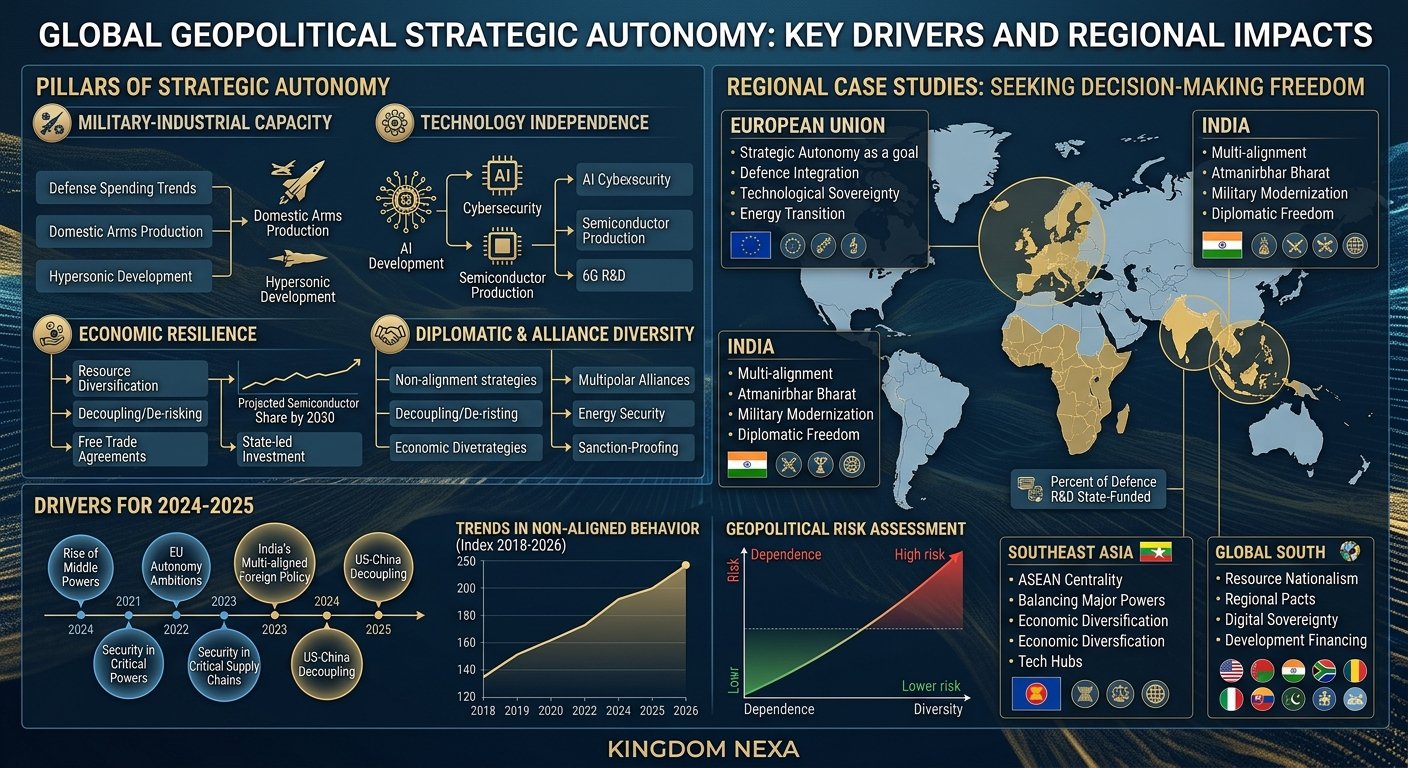
The concept is especially important for the European Union, India, France and ASEAN, although each applies it differently. In 2026, European debates increasingly connect autonomy with defence readiness, economic security and reduced strategic dependencies, while India continues to emphasize strategic space and independent decision-making, and ASEAN frames autonomy around inclusive engagement rather than exclusive alignment. (Consilium)


What Is Strategic Autonomy?
Strategic autonomy is the ability of a state or political grouping to independently assess threats, make strategic decisions, and act on its interests while retaining the freedom to cooperate with allies and partners.
The crucial distinction is between autonomy and isolation. An autonomous country does not need to produce everything domestically or reject alliances. Instead, it seeks sufficient capabilities, alternatives and political freedom to avoid being compelled into decisions because of excessive dependence on another actor.
The concept therefore has three closely related dimensions:
- Decision-making autonomy: the freedom to establish policy according to one’s own interests.
- Capability autonomy: possessing enough military, technological, economic and institutional capacity to implement those decisions.
- Resilience: the ability to absorb external shocks without losing essential freedom of action.
This is why strategic autonomy is broader than military self-reliance. A country may possess sophisticated armed forces but remain strategically vulnerable if it depends heavily on foreign energy, semiconductors, financial infrastructure, satellite services, critical minerals or external intelligence.
The European Parliament has similarly emphasized that European strategic autonomy involves the ability to assess crises and make decisions autonomously while remaining compatible with alliances and partnerships. It explicitly does not mean acting alone everywhere and at all times. (Eur-Lex)
Why Has Strategic Autonomy Become More Important?
Strategic autonomy has gained prominence because globalization has created both interdependence and vulnerability.
For much of the post-Cold War period, economic integration was generally viewed as a source of efficiency and stability. Countries specialized, companies built global supply chains, and governments relied on international markets for energy, technology and manufactured goods.
That model has not disappeared. However, geopolitical crises have demonstrated that interdependence can also create leverage.
Russia’s war against Ukraine exposed the strategic consequences of energy dependence in Europe. The US-China rivalry has highlighted vulnerabilities involving semiconductors, advanced technologies, investment and critical supply chains. The COVID-19 pandemic demonstrated how disruptions can spread rapidly across borders.
The result is a growing emphasis on economic security and resilience.
The OECD’s 2025 Supply Chain Resilience Review found that extensive relocalisation is not automatically a solution: its modelling suggested that broad supply-chain relocalisation could reduce global trade by more than 18% and global real GDP by more than 5%. The implication is important: resilience does not necessarily mean bringing everything home. Diversification and flexibility can sometimes provide better protection at lower economic cost. (OECD)
Strategic autonomy therefore represents a difficult balancing exercise between security, efficiency and openness.
Historical Evolution of Strategic Autonomy
The Early European Origins
The intellectual roots of European strategic autonomy can be traced to post-Second World War debates about European defence and political independence. European states had to confront a fundamental dilemma: how could they rebuild their power while operating in a security environment dominated by the United States and the Soviet Union?
France subsequently became particularly associated with the idea of strategic independence. During the Gaullist era, independent military capabilities, including nuclear deterrence and access to strategic technologies, became central elements of French thinking about national freedom of action.
Academic research traces the evolution of European strategic autonomy to early post-war defence cooperation and shows how the concept changed in response to international pressures and the interests of European powers. (Taylor & Francis)
The concept was gradually Europeanised. The end of the Cold War, the conflicts of the 1990s and the evolution of European security cooperation encouraged policymakers to consider whether European states could exercise greater collective influence.
From European Defence to Broader Strategic Autonomy
The idea expanded significantly during the 2010s.
Instead of referring only to defence, strategic autonomy increasingly encompassed:
- energy security;
- industrial policy;
- technology;
- cybersecurity;
- financial resilience;
- supply chains;
- diplomatic capacity;
- sanctions;
- trade policy;
- critical infrastructure.
The COVID-19 pandemic accelerated this transformation by exposing vulnerabilities in global production and supply chains.
Russia’s full-scale invasion of Ukraine in 2022 then placed defence, energy and resilience at the centre of European strategic thinking.
The EU Strategic Compass, approved in March 2022, established a common security and defence vision built around four pillars: act, secure, invest and partner. It explicitly links stronger EU capabilities with strategic autonomy while maintaining complementarity with NATO. (Consilium)
Strategic Autonomy vs Strategic Independence
The two terms are sometimes used interchangeably, but they are not identical.
Strategic independence can imply a stronger ambition to minimize external reliance.
Strategic autonomy is generally more flexible. It recognizes that modern states operate through networks of alliances, markets and institutions.
For example, an EU member can strengthen its ability to act independently while remaining inside NATO. Likewise, India can cooperate with the United States, Russia, Europe, Japan and other partners without formally subordinating its foreign policy to any one bloc.
The distinction matters because complete self-sufficiency is usually unrealistic.
Modern economies depend on international trade, foreign investment, global technologies and specialized production. The objective is therefore not necessarily to eliminate dependence but to prevent critical dependencies from becoming strategic vulnerabilities.
The Main Dimensions of Strategic Autonomy
Military and Defence Autonomy
Military capability is the most traditional dimension.
A state needs sufficient forces, ammunition, logistics, intelligence, communications, air defence, naval capability and industrial capacity to protect its interests.
For Europe, the challenge is particularly complicated because national militaries remain primarily under national control, while European security is deeply connected to NATO.
The EU’s current defence agenda seeks to close capability gaps, expand defence production and improve readiness. In June 2026, the European Council called for European defence readiness to be decisively strengthened by 2030 and emphasized reducing strategic dependencies. (Consilium)
At the same time, NATO remains central to the collective defence of its members. NATO’s 2025 Hague commitment requires Allies to invest 5% of GDP annually in defence-related spending by 2035, with at least 3.5% devoted to core defence requirements. (NATO)
This illustrates an important point: European strategic autonomy does not necessarily require separation from NATO.
It can instead mean greater European capacity within the alliance.
Economic Autonomy
Economic autonomy concerns a country’s ability to maintain prosperity and strategic policy without becoming excessively vulnerable to another economy.
Important areas include:
- energy;
- food;
- industrial production;
- financial systems;
- trade routes;
- critical minerals;
- foreign investment;
- strategic infrastructure;
- supply chains.
The objective is not economic autarky. Excessive protectionism can reduce competitiveness and increase costs.
Instead, governments increasingly seek diversification, redundancy and alternative suppliers.
The EU’s 2026 competitiveness agenda illustrates this approach. European leaders have linked the Single Market, industrial renewal, innovation, investment, energy affordability and reduced dependencies with strategic autonomy and economic security. (Consilium)
Technological Autonomy
Technology has become one of the most important components of modern strategic power.
Semiconductors, artificial intelligence, cloud computing, quantum technologies, cybersecurity, satellites, telecommunications and advanced manufacturing can have both civilian and military applications.
Dependence on foreign technology can therefore create strategic exposure.
China, the United States and the EU are all attempting in different ways to strengthen technological resilience. China’s official policy increasingly emphasizes greater scientific and technological self-reliance, while Europe is attempting to reduce critical dependencies without abandoning international trade. (Scio)
Technological autonomy does not necessarily mean inventing every technology domestically. It can involve:
- domestic research capacity;
- diversified suppliers;
- secure infrastructure;
- access to critical intellectual property;
- domestic manufacturing in strategically important areas;
- trusted international partnerships.
Energy Autonomy
Energy is closely connected to national security.
A country that depends heavily on one external supplier may face serious strategic constraints during a crisis.
Europe’s experience with Russian fossil-fuel dependence demonstrated this vulnerability. In April 2026, the EU Council explicitly connected energy security, technology supply chains and strategic autonomy, while identifying the clean-energy transition as an important route toward reducing geopolitical exposure. (Consilium)
Energy autonomy therefore does not simply mean producing more oil and gas domestically. It can also mean:
- renewable generation;
- nuclear energy where politically and technically appropriate;
- electricity interconnection;
- energy storage;
- diversified imports;
- efficient infrastructure;
- resilient grids.
Diplomatic Autonomy
A state can possess substantial military and economic capabilities but still have limited diplomatic autonomy if it cannot maintain relationships with different power centres.
Diplomatic autonomy involves the capacity to:
- negotiate independently;
- maintain multiple partnerships;
- resist pressure to join rival blocs;
- mediate between competing powers;
- participate actively in international institutions.
This dimension is particularly visible in India’s foreign policy.
India’s Ministry of External Affairs describes the country’s foreign-policy objectives in terms of maintaining strategic space and autonomy while developing relations with major powers and neighbouring states. This approach evolved from the earlier tradition of non-alignment but is better understood today as a broader effort to preserve decision-making flexibility. (Ministry of External Affairs)
Strategic Autonomy: Europe, India, France and ASEAN
European Union
The European Union provides perhaps the clearest contemporary example of multidimensional strategic autonomy.
Its approach includes defence readiness, industrial policy, technology, energy, economic security, trade and diplomatic influence.
The EU faces a distinctive problem: it possesses enormous economic and regulatory power but its military capabilities remain primarily national.
The challenge is therefore not simply building more power. It is converting collective economic weight into coordinated strategic action.
In 2026, EU leaders have continued to connect strategic autonomy with competitiveness, energy, industrial renewal, technological innovation and defence. (Consilium)
France
France has historically placed unusually strong emphasis on strategic autonomy.
Its approach is rooted partly in the experience of the Cold War and the development of an independent nuclear deterrent. Today, Paris promotes both French and European capacity for independent action.
France’s Indo-Pacific strategy explicitly describes strategic autonomy as a distinctive feature of its approach, while emphasizing partnerships, cooperation and its status as an Indo-Pacific power through its overseas territories. (France Diplomatie)
French policy therefore demonstrates that autonomy does not necessarily mean disengagement. It can mean greater freedom of action while remaining deeply embedded in alliances.
India
India provides a different model.
Its strategic autonomy is closely related to its historical non-alignment but is not identical to Cold War non-alignment.
India seeks relationships with multiple major powers while preserving room for independent decisions. It can cooperate with the United States through mechanisms such as the Quad while maintaining relationships with Russia and other states.
The central objective is not neutrality on every issue. It is maintaining the ability to decide each issue according to India’s interests.
ASEAN
ASEAN’s approach is primarily regional and diplomatic.
The organization seeks to avoid being forced into exclusive alignment between major powers. ASEAN’s 2019 Indo-Pacific Outlook emphasizes openness, inclusiveness, ASEAN centrality and cooperation.
In February 2026, the ASEAN Secretary-General described the organization’s approach as “active engagement and strategic autonomy,” emphasizing constructive relations with multiple partners while avoiding exclusive alignments that would undermine regional freedom of action. (ASEAN Main Portal)
ASEAN therefore demonstrates an important form of strategic autonomy based less on military independence and more on collective diplomatic agency, economic integration and institutional centrality.
The Geopolitical Logic Behind Strategic Autonomy
Strategic autonomy can be understood through the question:
Who controls the resources required to make strategic choices?
This makes power increasingly dependent on networks.
A country’s vulnerability may come from:
- dependence on foreign energy;
- dependence on a single technology supplier;
- dependence on another country’s financial system;
- dependence on foreign military logistics;
- dependence on vulnerable shipping routes;
- dependence on imported critical minerals;
- dependence on external intelligence or satellite services.
The strategic problem is not simply dependence itself. Interdependence is normal.
The problem arises when dependence becomes concentrated, difficult to replace and politically exploitable.
This is why diversification has become a central instrument of strategic autonomy.
Strategic Autonomy and International Law
Strategic autonomy does not create a separate legal category of sovereignty.
States remain subject to international law, treaties and the obligations they voluntarily accept.
The UN Charter establishes sovereign equality among its members and prohibits the threat or use of force against the territorial integrity or political independence of states, subject to the Charter’s legal framework. (United Nations)
For the EU, autonomy also operates within the Union’s treaty framework.
Article 42 of the Treaty on European Union provides the legal basis for the Common Security and Defence Policy and states that it must remain compatible with NATO obligations for member states whose common defence is organized through NATO. (Eur-Lex)
Consequently, strategic autonomy is better understood as a policy objective and strategic condition, rather than a legal right to ignore international commitments.
The Economic Trade-Off: Autonomy Can Be Expensive
One of the greatest misconceptions about strategic autonomy is that more domestic production is automatically better.
It is not.
Producing something domestically may increase security but also raise costs. Duplicating supply chains can reduce efficiency. Subsidizing strategically important industries can distort markets. Maintaining spare capacity is expensive.
The European Commission’s research on the Single Market has found that deeper internal integration can help offset some of the costs associated with strategic autonomy. (Internal Market and SMEs)
This suggests an important principle:
Strategic autonomy should optimize resilience rather than maximize self-sufficiency.
A resilient system can combine:
- domestic capabilities;
- trusted allies;
- diversified suppliers;
- strategic reserves;
- substitute technologies;
- emergency production capacity;
- functioning international markets.
Technology and Strategic Autonomy in the AI Era
Artificial intelligence is making strategic autonomy even more complicated.
AI depends on a chain of capabilities that includes:
- advanced chips;
- semiconductor manufacturing;
- data centres;
- electricity;
- cloud infrastructure;
- algorithms;
- research talent;
- data;
- cybersecurity;
- capital.
No major power completely controls all these components.
This creates an interesting paradox. The pursuit of technological autonomy may actually increase international competition because governments seek control over technologies that other states also consider strategic.
The EU’s current competitiveness strategy therefore links innovation, digitalisation, investment, industrial capacity and reduced dependencies. (European Commission)
The broader geopolitical lesson is that technological power increasingly determines the range of strategic choices available to states.
Major Challenges to Strategic Autonomy
Financial Constraints
Defence industries, semiconductor plants, energy infrastructure and research ecosystems require enormous investment.
Poorer states may struggle to build autonomous capabilities without sacrificing other development priorities.
Domestic Political Divisions
Strategic autonomy requires sustained political support.
Governments may agree that dependence is risky but disagree over which partners to trust, how much to spend or which industries deserve protection.
Allied Tensions
An ally may interpret autonomy as competition rather than burden-sharing.
This is particularly relevant to the transatlantic relationship. European strategic autonomy can strengthen NATO if it increases European capabilities, but it can create friction if interpreted as an attempt to weaken the alliance.
Technological Dependence
Even countries with strong industrial bases may remain dependent on foreign technologies, patents, minerals, software or specialized equipment.
Economic Efficiency
Reducing dependence can increase costs.
The OECD’s analysis demonstrates why large-scale relocalisation is not necessarily synonymous with greater resilience. (OECD)
Fragmentation of the Global Economy
If every major power tries to become self-sufficient, global trade may become more fragmented.
IMF research has highlighted the economic risks associated with geopolitical fragmentation and changing trade patterns. (IMF eLibrary)
Future Scenarios for Strategic Autonomy
Scenario 1: Open Strategic Autonomy
Countries maintain international trade but diversify strategic dependencies.
This is arguably the most economically sustainable model. It combines domestic capacity with international partnerships.
Scenario 2: Competitive Blocs
The world becomes divided into competing technological, financial and security ecosystems.
Strategic autonomy would become increasingly difficult for middle powers because choosing standards, suppliers and security partners would carry larger geopolitical consequences.
Scenario 3: Networked Multipolarity
Rather than joining rigid blocs, countries maintain multiple overlapping partnerships.
India and ASEAN provide useful examples of this approach, while the EU could potentially pursue a similar model through diversified strategic partnerships.
Scenario 4: Strategic Protectionism
Governments prioritize domestic production and national champions, even at substantial economic cost.
This could strengthen selected industries but risk reducing global efficiency and increasing tensions.
The most likely future may combine elements of all four. Strategic competition is unlikely to eliminate globalization, but globalization is increasingly being reshaped by security concerns.
How Can a Country Build Strategic Autonomy?
A credible strategy should begin with a dependency audit.
Governments should identify which external dependencies could threaten national security or policy freedom during a crisis.
They should then prioritize:
- critical infrastructure;
- energy;
- food security;
- defence production;
- cybersecurity;
- telecommunications;
- semiconductors;
- critical minerals;
- financial resilience;
- satellite and space capabilities;
- strategic transport routes;
- research and development.
The next step is diversification.
A country should avoid replacing one concentrated dependency with another. Multiple suppliers, regional partnerships and substitute technologies can often provide greater resilience than expensive attempts at total self-sufficiency.
Finally, strategic autonomy requires institutional capacity. Governments need reliable intelligence, competent diplomacy, effective industrial policy, fiscal resources and the ability to make decisions quickly during crises.
Why Strategic Autonomy Matters for the Global Order
Strategic autonomy is ultimately about power, choice and resilience.
The concept reflects a changing international system in which economic networks, technology and security are increasingly intertwined. States can no longer separate foreign policy from industrial policy as easily as they once did.
For Europe, the central question is whether its economic and regulatory weight can be converted into sufficient geopolitical capability. India, the challenge is preserving strategic space while engaging multiple major powers. For ASEAN, it is maintaining regional agency amid great-power rivalry. For France, autonomy remains closely connected to independent strategic capability and European influence.
The broader lesson is that strategic autonomy does not require isolation.
In fact, the strongest version of autonomy may be the ability to choose interdependence rather than be trapped by it.
FAQs About Strategic Autonomy
What is strategic autonomy in simple terms?
Strategic autonomy means having enough political, economic, military, technological and diplomatic capacity to make important decisions independently while retaining the freedom to cooperate with other countries.
Is strategic autonomy the same as self-sufficiency?
No. Self-sufficiency seeks to produce most essential goods and capabilities domestically. Strategic autonomy focuses on maintaining freedom of action, which can be achieved through a combination of domestic capacity, diversification and reliable international partnerships.
Why is strategic autonomy important in geopolitics?
It reduces the risk that another country can use economic, technological, military or diplomatic dependence to influence a state’s strategic decisions.
Which countries pursue strategic autonomy?
France, India and China have long emphasized different forms of strategic autonomy or self-reliance. The European Union increasingly pursues strategic autonomy across defence, technology, energy and economic security, while ASEAN emphasizes strategic autonomy through inclusive regional engagement.
Does strategic autonomy mean leaving NATO?
No. European strategic autonomy and NATO membership are not inherently incompatible. EU policy explicitly describes stronger European defence capabilities as complementary to NATO, which remains the foundation of collective defence for its members. (Consilium)
How is strategic autonomy related to economic security?
Economic security is a major component of strategic autonomy. Secure energy supplies, resilient supply chains, access to technology and diversified trade relationships can prevent economic dependencies from becoming geopolitical vulnerabilities.
What is open strategic autonomy?
Open strategic autonomy is an approach that combines resilience and competitiveness with continued international cooperation. It seeks to reduce dangerous dependencies without abandoning open markets or multilateral engagement. The EU’s policy literature uses the concept in this sense. (Raw Materials Information System)
Can small countries achieve strategic autonomy?
Yes, but usually not through complete self-sufficiency. Smaller states can increase strategic autonomy through diversified partnerships, regional integration, specialized capabilities, diplomatic flexibility, strategic reserves and collective security arrangements.
What is the biggest obstacle to strategic autonomy?
The biggest obstacle is often the gap between strategic ambitions and available capabilities. Autonomy requires money, technology, industrial capacity, political cohesion and institutions capable of turning policy decisions into practical capabilities.
Conclusion
Strategic autonomy is becoming a central principle of international geopolitics because the meaning of power is changing. Military strength remains important, but so do technology, energy, supply chains, finance, industrial capacity, diplomatic flexibility and control over critical infrastructure.
The strongest form of strategic autonomy is not isolation from the world. It is the ability to participate in global interdependence without becoming strategically captive to it.
Current European policy illustrates this transformation particularly clearly. The EU is linking defence readiness with industrial renewal, technological innovation, energy security and economic resilience, while still emphasizing cooperation with NATO and international partners. (Consilium)
India’s multi-alignment, ASEAN’s inclusive regionalism and France’s emphasis on independent strategic capability demonstrate that there is no single model.
Ultimately, strategic autonomy means preserving meaningful choice in an uncertain world. As geopolitical competition becomes more economically and technologically interconnected, the states and regional organizations best positioned to shape the international order will likely be those capable of combining resilience at home with flexible partnerships abroad.