Introduction
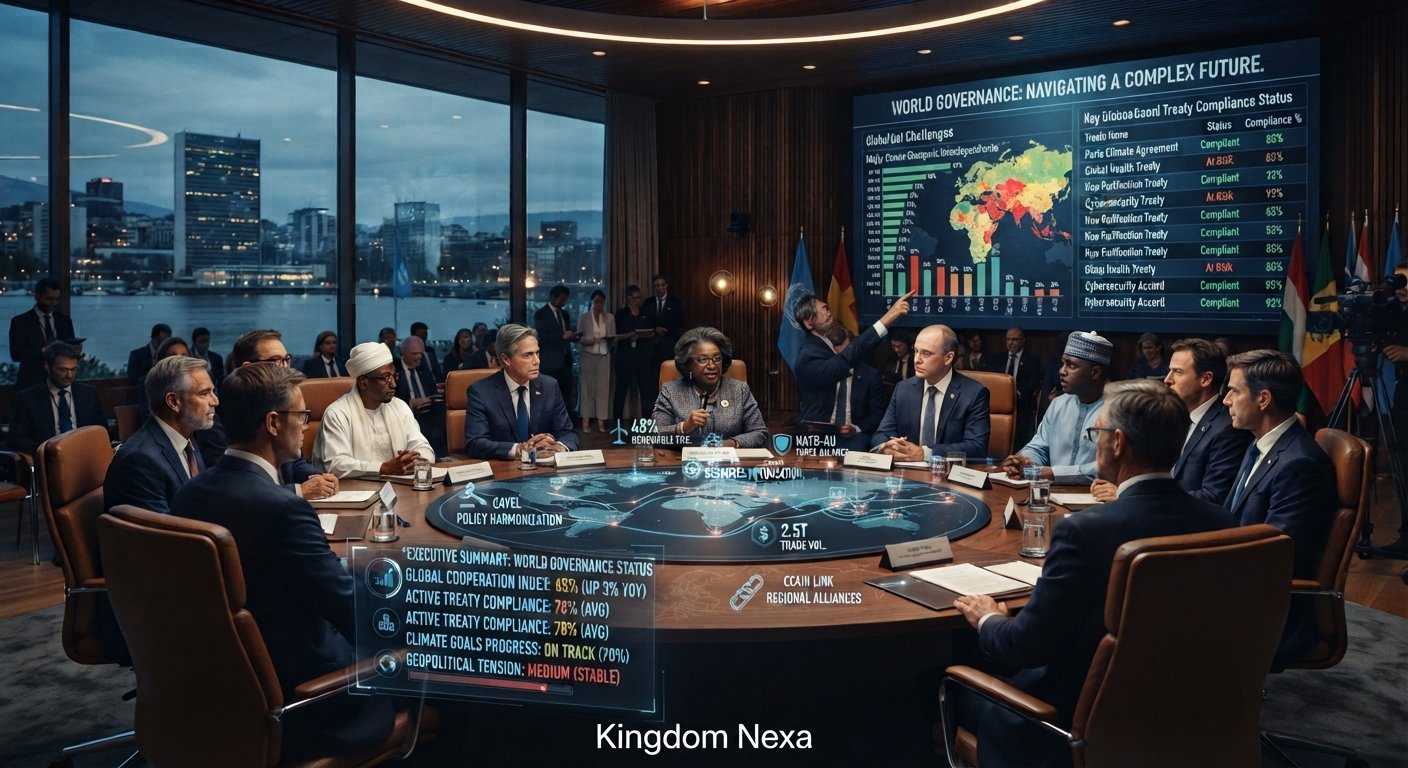
The world has no single government, parliament, police force, or constitution governing all countries. Yet decisions made in one country can affect security, trade, financial markets, public health, technology, migration, climate, and peace far beyond its borders. This is the central challenge of World Governance: how can sovereign states and other international actors manage problems that no country can solve alone?
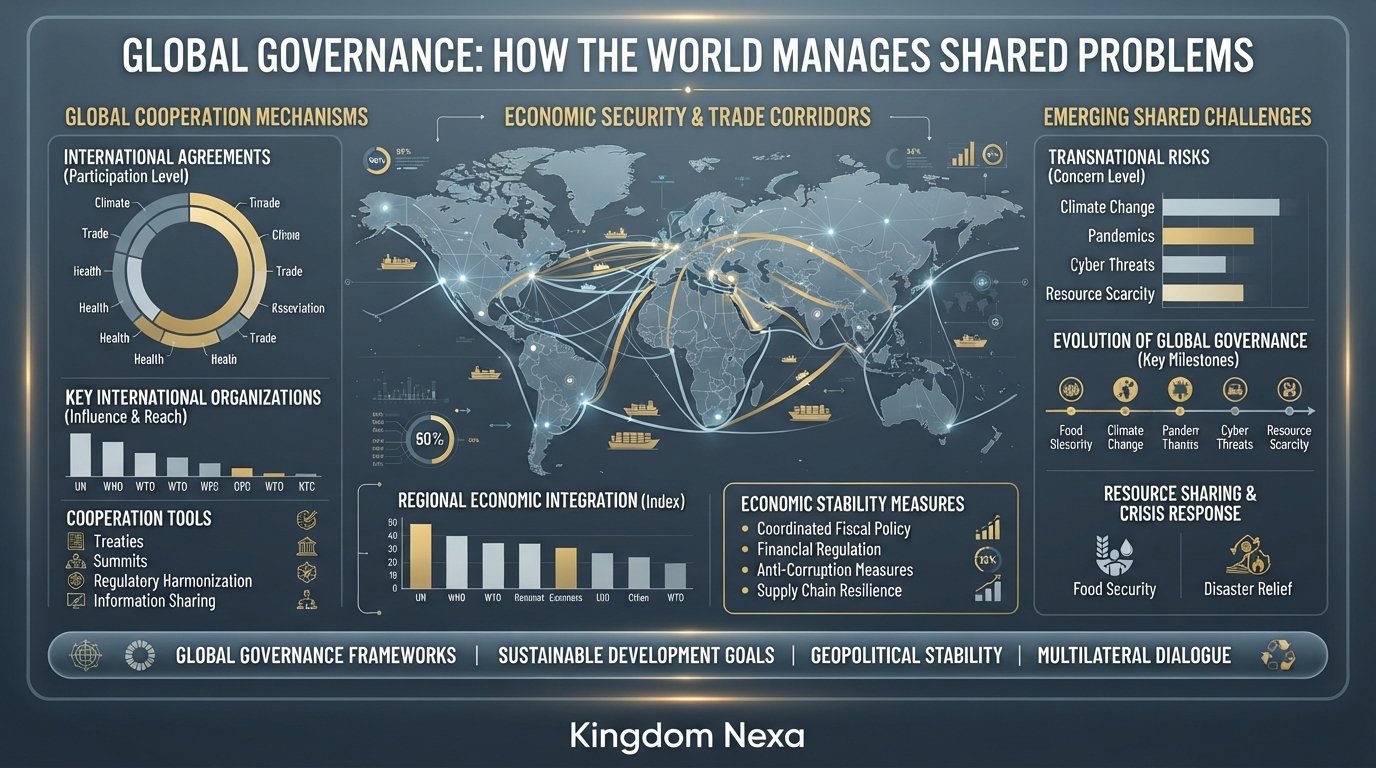
World Governance is therefore not a world government. It is the collection of institutions, rules, treaties, norms, negotiations, and cooperative mechanisms through which countries and other actors address shared international problems. The United Nations remains its central political institution, but global governance also involves the WTO, IMF, World Bank, WHO, regional organizations, international courts, financial institutions, corporations, civil society, and increasingly technology platforms.
In 2026, this system is under significant pressure. Strategic competition, wars, trade tensions, technological change, climate risks, and disagreements over institutional representation are testing established forms of multilateral cooperation. At the same time, new initiatives on artificial intelligence, pandemic preparedness, digital cooperation, and UN reform demonstrate that international cooperation is still evolving rather than disappearing.
What Is World Governance?
World Governance refers to the systems through which states and other international actors establish rules, coordinate policies, resolve disputes, manage common problems, and provide international public goods.
Unlike national governance, it does not operate through a single sovereign authority.
World Governance vs. World Government
These concepts are often confused.
A world government would imply a centralized political authority with sovereign powers over countries and populations. No such government exists.
World Governance, by contrast, is decentralized. States remain sovereign while voluntarily accepting obligations through treaties, international organizations, customary international law, economic agreements, and other mechanisms.
For example:
- The UN provides a forum for diplomacy and collective security.
- The WTO establishes rules for international trade.
- The IMF supports international monetary and financial cooperation.
- The World Bank finances development.
- WHO coordinates international health cooperation.
- International courts provide legal mechanisms for particular disputes.
- Regional organizations address regional political, economic, and security concerns.
This makes global governance a network rather than a hierarchy.
Why Does World Governance Matter?
Modern problems frequently cross borders.
Climate change cannot be managed by one state alone. A pandemic can spread internationally within days. Financial instability can move across markets almost instantly. Cyberattacks can originate in one jurisdiction and affect infrastructure in another. AI systems, digital platforms, supply chains, shipping routes, and energy markets similarly create cross-border dependencies.
The basic purpose of World Governance is therefore coordination under conditions of national sovereignty.
That creates a permanent tension: governments want international cooperation when it serves their interests, but they also want to preserve freedom of action.
How Did Modern World Governance Develop?
Modern World Governance developed gradually rather than appearing through one event.
From Balance of Power to International Institutions
For centuries, international politics was largely organized around diplomacy, alliances, war, treaties, and balance-of-power arrangements.
The devastation of the First World War encouraged attempts to create more institutionalized international cooperation, particularly through the League of Nations.
The League ultimately failed to prevent another world war. After the Second World War, governments created a more extensive institutional architecture.
The United Nations was established in 1945, alongside the Bretton Woods institutions and other arrangements that eventually developed into today’s international economic system.
The Post-1945 International Order
The postwar system combined several principles:
- State sovereignty
- Territorial integrity
- International legal obligations
- Collective security
- Economic cooperation
- Human rights
- International development
- Multilateral diplomacy
The system subsequently expanded through institutions and agreements dealing with trade, development, health, refugees, human rights, environmental protection, aviation, telecommunications, maritime affairs, and other areas.
Globalization Changed Governance
From the late twentieth century onward, globalization increased the importance of international governance.
Production became distributed across countries. Capital became increasingly mobile. International supply chains connected distant economies. Information crossed borders rapidly.
As economic interdependence increased, governments required more mechanisms for managing cross-border consequences.
At the same time, globalization also created disagreements over who benefits, who bears adjustment costs, and how much authority should be exercised internationally.
Who Are the Main Actors in World Governance?
World Governance involves far more than national governments.
States
States remain the most important actors because they possess sovereignty, armed forces, taxation systems, diplomatic services, and the authority to sign treaties.
Major powers have particularly significant influence because of their economic, military, technological, demographic, or diplomatic capabilities.
However, smaller and middle powers can also influence international outcomes through coalitions, institutions, diplomacy, trade relationships, and agenda-setting.
United Nations
The UN is the central universal political institution in the global system.
Its major organs include:
- General Assembly
- Security Council
- Economic and Social Council
- International Court of Justice
- Secretariat
- Trusteeship Council, whose active functions are suspended
The Security Council has primary responsibility within the UN system for international peace and security, while the General Assembly provides the broadest forum for participation by member states.
International Economic Institutions
The IMF, World Bank Group, and WTO perform different functions within global economic governance.
The WTO currently has 166 members, representing about 98% of global trade, according to its 2026 World Trade Report. The organization says its rules remain an important legal foundation for international commerce despite substantial pressure on the multilateral trading system.
Regional Organizations
Global governance is also increasingly regional.
Examples include:
- European Union
- African Union
- ASEAN
- NATO
- Organization of American States
- Arab League
- Gulf Cooperation Council
- Pacific Islands Forum
- Shanghai Cooperation Organisation
These organizations differ significantly in their legal powers, membership, institutional structures, and political objectives.
Non-State Actors
Corporations, NGOs, universities, research institutions, financial markets, technology companies, humanitarian organizations, and civil-society groups increasingly influence global governance.
Technology companies are particularly important because digital infrastructure, cloud computing, AI systems, social media, cybersecurity, and data flows have consequences that frequently cross jurisdictions.
What Are the Core Principles of World Governance?
There is no single universally accepted model of global governance, but several principles are central to the existing international system.
Sovereignty
States retain primary authority over their territories and domestic affairs.
International cooperation therefore generally depends on consent, treaty obligations, or recognized international legal rules.
Multilateralism
Multilateralism means cooperation involving multiple states around shared rules or objectives.
The UN system is the clearest example, but multilateralism also operates through economic institutions, environmental agreements, health arrangements, and regional organizations.
International Law
International law provides rules governing relationships between states and, in some areas, other international actors.
Treaties, customary international law, international judicial decisions, and other legal instruments contribute to the framework.
However, enforcement remains uneven because the international system lacks a universal sovereign authority equivalent to a national government.
Collective Security
Collective security is based on the principle that threats to international peace can require collective responses.
The UN Security Council is the principal institutional mechanism for this purpose, although political disagreements among permanent members can limit its effectiveness.
Why Is World Governance Under Pressure in 2026?
The contemporary system faces several overlapping pressures.
Great-Power Competition
Strategic competition among major powers affects diplomacy, technology, trade, military security, investment, energy, and international institutions.
As power becomes more distributed, agreement on common rules can become harder.
This does not mean international cooperation has ended. Instead, cooperation increasingly exists alongside competition.
Conflict and Security Fragmentation
Wars and prolonged security crises place pressure on collective-security mechanisms.
They also create disagreements over sanctions, arms transfers, humanitarian access, territorial claims, peace negotiations, and interpretation of international law.
The result is a difficult environment in which states may simultaneously cooperate in one institution while competing elsewhere.
Trade Fragmentation
International economic governance is experiencing particularly strong pressure.
The WTO’s 2026 World Trade Report describes the multilateral trading system as being at a critical juncture, citing geopolitical tensions, changing economic power, government intervention, digitalization, AI, environmental policies, and increasingly complex trade relationships.
The report estimates that a highly fragmented trading environment could impose substantial economic costs. Its modelling finds that global GDP could fall by 5.1% in a scenario involving geopolitical fragmentation and by 6.9% in a scenario where multilateral WTO cooperation is replaced by a system based mainly on free-trade agreements. These are modelled scenarios, not forecasts of what will necessarily happen.
Unequal Representation
Institutional representation is another major issue.
Many governments argue that the distribution of influence in international institutions does not adequately reflect today’s demographic, economic, and geopolitical realities.
UN Security Council reform has remained under intergovernmental negotiation for years. During the UN General Assembly’s 80th session, negotiations continued in 2026 on equitable representation and increasing Council membership.
This illustrates one of the central problems of institutional reform: broad agreement that change is necessary does not automatically produce agreement about what the new structure should be.
How Does World Governance Address Global Problems?
Global Governance and Climate Change
Climate change is a classic global-governance problem because greenhouse-gas emissions and their consequences cross borders.
The Paris Agreement created a framework in which countries submit and periodically strengthen national climate commitments.
Implementation depends heavily on national governments, international finance, technology transfer, monitoring, and diplomatic cooperation.
Climate governance therefore demonstrates both the potential and limits of multilateralism: countries can establish common frameworks, but implementation ultimately depends substantially on domestic action.
Global Health Governance
The COVID-19 pandemic exposed weaknesses in international preparedness, information sharing, supply chains, financing, and equitable access to medical products.
In response, WHO member states adopted the WHO Pandemic Agreement on 20 May 2025. The agreement was negotiated over more than three years and aims to strengthen pandemic prevention, preparedness, and response. Work subsequently continued on the pathogen-access and benefit-sharing component.
Amended International Health Regulations also entered into force on 19 September 2025, providing updated international rules for public-health emergencies involving the 196 States Parties.
These developments show how major crises can generate new forms of international governance.
Digital Governance and Artificial Intelligence
Technology is becoming one of the fastest-changing areas of World Governance.
The UN’s Global Digital Compact, adopted in 2024, establishes international commitments covering digital inclusion, data governance, digital public infrastructure, online safety, and AI governance.
In 2025, the UN General Assembly established an Independent International Scientific Panel on AI and a Global Dialogue on AI Governance.
The first Global Dialogue took place in Geneva on 6–7 July 2026, bringing governments and other stakeholders together to discuss international AI governance.
This is significant because AI creates governance questions involving:
- Cross-border data
- Cybersecurity
- Human rights
- Employment
- Autonomous systems
- Scientific research
- National security
- AI safety
- Access to computing infrastructure
- Development inequality
No single regulatory system can fully resolve all of these issues.
What Are the Economic Dimensions of World Governance?
Global economic governance determines much of the environment in which international commerce operates.
Trade
WTO rules provide common principles governing trade in goods, services, and intellectual property.
The WTO’s 2026 analysis emphasizes that approximately 72% of global merchandise trade continues to occur under core most-favoured-nation tariff terms negotiated and committed by WTO members.
At the same time, trade governance increasingly involves issues beyond tariffs, including:
- Subsidies
- Digital services
- Data
- Industrial policy
- Environmental standards
- Supply-chain security
- Export controls
- Strategic technologies
This makes trade governance increasingly intertwined with geopolitics.
Global Finance
The IMF and World Bank play different but complementary roles in the international economic system.
The IMF focuses heavily on monetary cooperation, macroeconomic stability, surveillance, and financial assistance.
The World Bank Group concentrates on development finance and poverty reduction.
Current economic conditions illustrate the geopolitical importance of these institutions. The IMF’s July 2026 outlook projected global growth of 3.0% in 2026 and 3.4% in 2027 while warning that war-related shocks, financial repricing, and other risks could affect the outlook.
The World Bank’s January 2026 forecast projected global growth of 2.6% in 2026 and 2.7% in 2027, illustrating that economic projections can differ according to assumptions, timing, and methodology.
The difference itself is a useful reminder: forecasts are analytical estimates, not established facts.
What Role Does International Law Play?
International law gives global governance a framework of obligations and expectations.
It covers areas including:
- Use of force
- Diplomatic relations
- Human rights
- Refugees
- International trade
- Maritime boundaries
- Environmental obligations
- International criminal responsibility
- Humanitarian protection
However, legal rules do not operate in the same way as domestic law.
Enforcement can depend on state cooperation, international institutions, domestic courts, political pressure, sanctions, reciprocal measures, and other mechanisms.
This creates a recurring tension between legal obligation and political power.
A rule can be internationally recognized while its implementation remains contested or difficult.
Why Is Reform So Difficult?
Reforming World Governance requires states with different interests to agree on institutional change.
A major power may prioritize preserving influence. A smaller state may emphasize equality and representation. A developing country may prioritize development finance and technology access. An advanced economy may emphasize regulatory standards or strategic security.
These objectives can overlap, but they can also conflict.
The Representation Problem
The UN Security Council illustrates the challenge.
Negotiations in 2026 continued around equitable representation and membership expansion, but the process remains intergovernmental rather than an automatically binding reform mechanism.
The Sovereignty Problem
Governments may support cooperation while resisting arrangements that they believe constrain domestic decision-making too heavily.
This is particularly visible in areas such as:
- AI regulation
- Digital data
- Migration
- Public health
- Industrial policy
- Security
- Energy
The Implementation Problem
Agreeing on a framework is only the first step.
Effective governance also requires:
- Financing
- Domestic implementation
- Monitoring
- Technical capacity
- Compliance
- Dispute-resolution mechanisms
- Political commitment
Without implementation, international agreements can remain politically significant but operationally limited.
What Is the Future of World Governance?
The future is unlikely to be determined by a simple choice between “global government” and complete international disorder.
Several broad possibilities exist.
Scenario 1: Renewed Multilateralism
States could strengthen existing institutions, update outdated rules, improve representation, and create new mechanisms for emerging technologies.
The UN Pact for the Future adopted in September 2024 represents one example of this direction. It addresses peace and security, sustainable development, digital cooperation, climate change, human rights, and global-governance reform.
Scenario 2: Competitive Multilateralism
Governments may continue using international institutions while simultaneously competing for influence within them.
In this model, institutions remain important, but geopolitical rivalry increasingly shapes negotiations.
Scenario 3: Greater Fragmentation
Trade blocs, competing technology standards, separate financial arrangements, and regional security structures could become more prominent.
The WTO’s 2026 modelling illustrates the potential economic costs associated with deeper fragmentation.
Scenario 4: Issue-Based Cooperation
Another possibility is that global governance becomes increasingly specialized.
Countries may cooperate effectively on specific problems even when broader geopolitical relations remain tense.
AI governance, pandemic preparedness, maritime safety, climate monitoring, financial stability, and disaster response can each develop their own networks.
This approach may be more practical because countries do not need complete geopolitical agreement to cooperate on every issue.
Why World Governance Matters for Businesses and Citizens
World Governance is not merely an issue for diplomats.
Businesses depend on international rules affecting trade, investment, taxation, data, intellectual property, shipping, finance, sanctions, and supply chains.
Citizens are affected through:
- Food and energy prices
- International employment
- Migration
- Public health
- Climate risks
- Internet access
- Digital privacy
- Consumer standards
- International security
Students and researchers also depend on international cooperation for scientific exchange, educational partnerships, data access, and cross-border research.
The global governance system therefore influences everyday life even when its institutions appear distant.
FAQs About World Governance
What is World Governance in simple terms?
World Governance is the system of international rules, institutions, agreements, norms, and cooperation through which countries and other actors manage problems that cross national borders.
Is World Governance the same as a world government?
No. World Governance does not mean that one authority governs all countries. States remain sovereign, while international institutions provide mechanisms for cooperation and rule-making.
Who controls World Governance?
No single actor controls it. States are the primary participants, but organizations such as the UN, WTO, IMF, World Bank, WHO, regional institutions, courts, corporations, and civil society also contribute.
Why is the United Nations important to World Governance?
The UN provides the world’s most universal diplomatic forum and plays major roles in peace and security, development, humanitarian affairs, human rights, international law, and international cooperation.
What are the biggest challenges facing World Governance?
Major challenges include geopolitical rivalry, armed conflicts, unequal representation, trade fragmentation, climate change, technological disruption, economic inequality, and difficulties implementing international agreements.
How does AI affect World Governance?
AI creates cross-border questions involving safety, human rights, data, cybersecurity, employment, national security, scientific research, and unequal technological capacity. The UN began its first Global Dialogue on AI Governance in 2026.
Can World Governance prevent wars?
International institutions can facilitate diplomacy, mediation, collective-security measures, sanctions, peacekeeping, and legal processes, but they cannot guarantee that states will avoid war.
Why is reform of the UN Security Council important?
The reform debate concerns representation, membership, regional balance, and the Council’s effectiveness and legitimacy. Intergovernmental negotiations continued during the UN General Assembly’s 80th session in 2026.
Is global governance becoming weaker or stronger?
The evidence points in different directions. Geopolitical rivalry and trade tensions have placed pressure on multilateral institutions, while new agreements and processes on digital governance, AI, pandemic preparedness, and institutional reform show continuing efforts to strengthen international cooperation.
Conclusion
World Governance is best understood not as a centralized world government but as a complex system of international institutions, treaties, rules, norms, negotiations, and networks operating across national borders.
Its foundations remain rooted in state sovereignty and the post-1945 international institutional system, but the environment in which that system operates has changed dramatically. Economic power is more widely distributed, technology is advancing rapidly, strategic competition is intensifying, and problems such as climate change, pandemics, digital security, AI, financial instability, and supply-chain disruption increasingly cross borders.
The central challenge is therefore not simply whether international cooperation should exist. It is whether existing institutions can adapt quickly enough to remain effective, representative, and legitimate in a changing international environment.
Recent developments provide evidence of both pressure and adaptation: UN negotiations on Security Council reform continued in 2026; the WHO Pandemic Agreement created a new framework for pandemic preparedness; and the UN began operationalizing new international mechanisms for AI governance.
The future of World Governance will ultimately depend on how states and other international actors reconcile sovereignty with interdependence. The institutions created in earlier eras are being tested by twenty-first-century challenges, but they are also being reshaped in response to them.