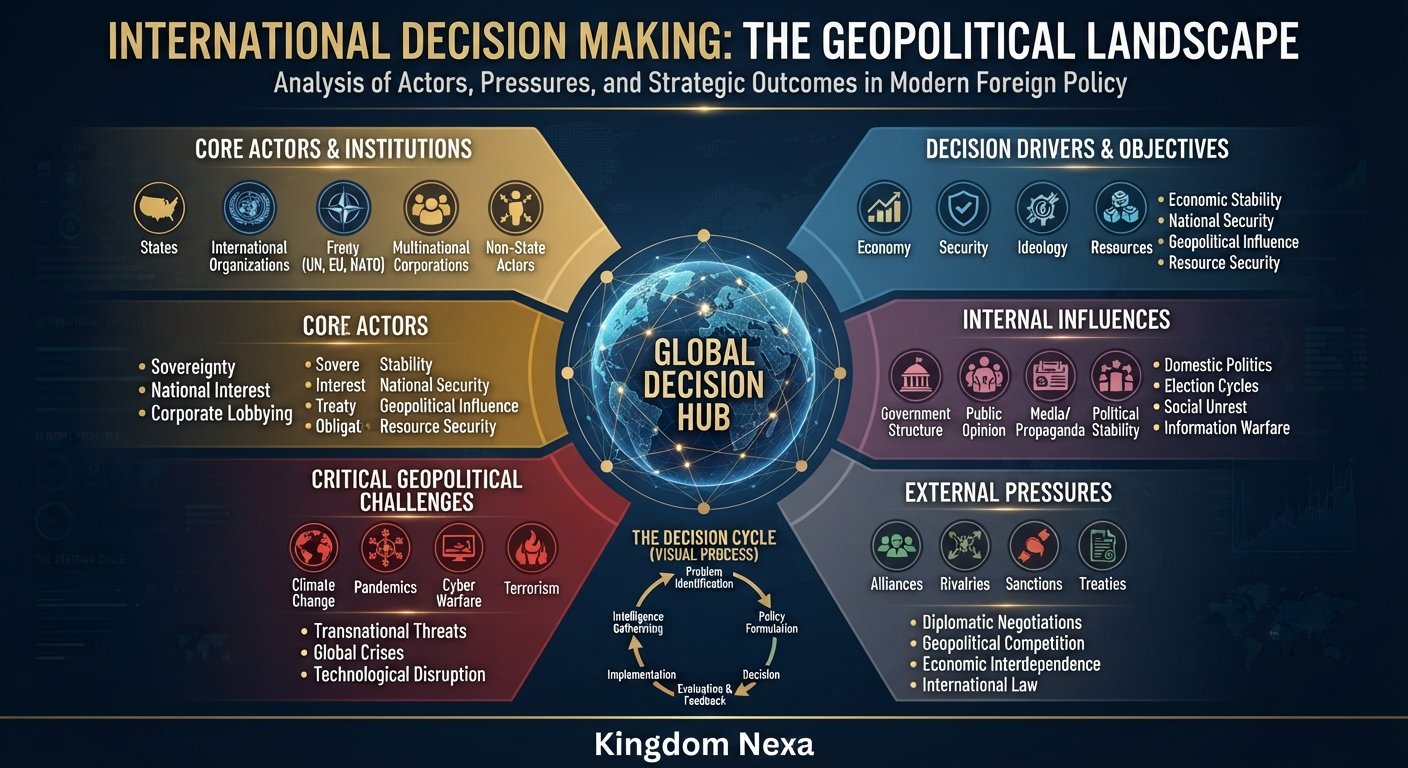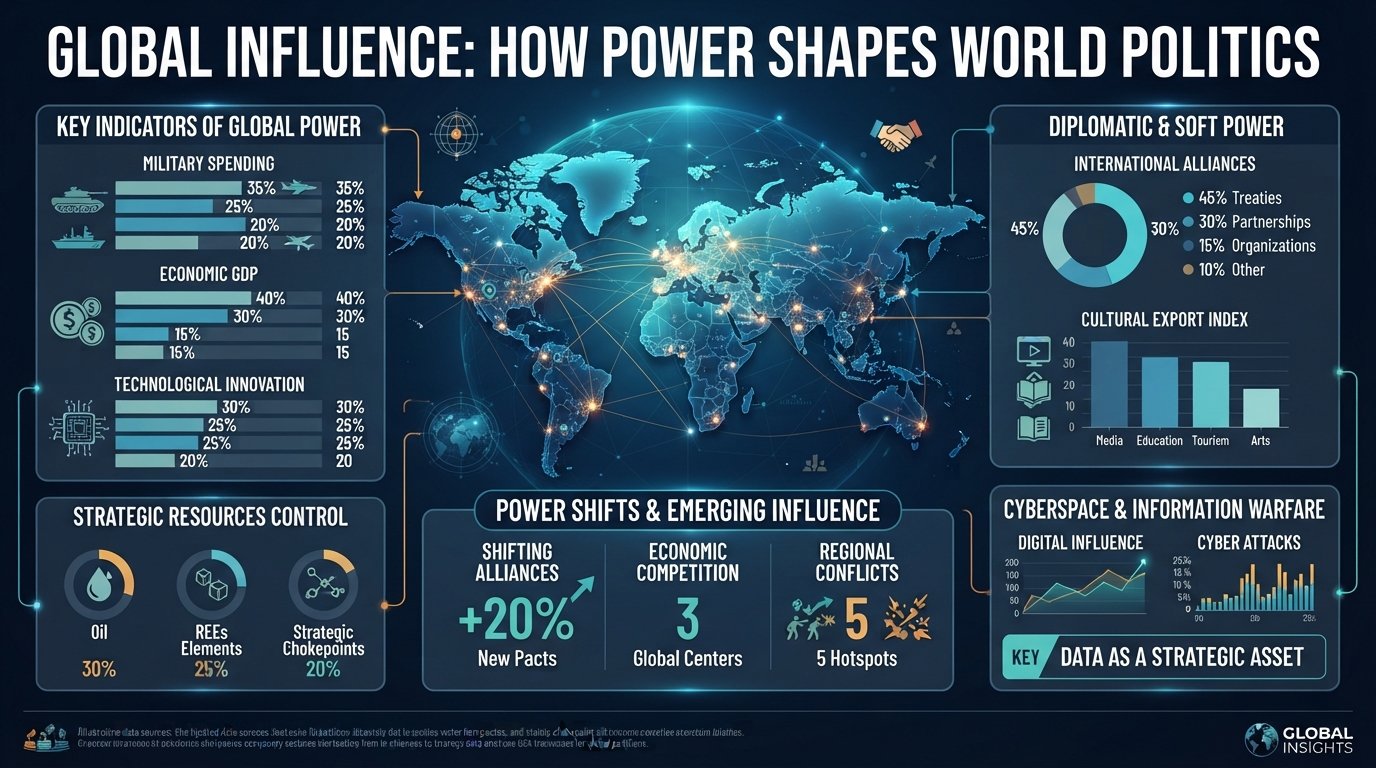
International peace depends on more than the military strength of individual states. It also depends on whether countries can agree that threats to peace are a shared concern and respond collectively when those threats emerge. This principle is known as collective security.
At its core, collective security is the idea that aggression against one state can become a concern for the wider international community, which should act together to preserve peace. The concept developed strongly after the First World War, shaped the League of Nations, and became more institutionalized through the United Nations Charter after 1945.
Yet collective security is not the same as a military alliance. A security alliance normally identifies members and potential threats, whereas collective security seeks a broader principle in which states cooperate against aggression regardless of where it originates.
In 2026, the concept remains central to international relations, but its effectiveness is constrained by geopolitical rivalry, the UN Security Council veto, disagreements among major powers, emerging technologies, regional conflicts, and changing forms of warfare. Understanding those strengths and limitations is essential for understanding the contemporary international system.


What Is Collective Security?
Collective security is an international security arrangement in which states agree to cooperate against threats to peace or acts of aggression, treating international security as a shared responsibility rather than solely a national concern.
The central assumption is that peace becomes more sustainable when states establish common rules and collectively respond to violations.
The concept therefore contains several interconnected ideas:
- States should avoid aggression and unlawful uses of force.
- International disputes should be addressed through peaceful means where possible.
- Threats to international peace should receive a collective response.
- States should cooperate through diplomatic, economic, legal, and, where authorized, military measures.
- International institutions should help coordinate collective action.
The concept is broader than simply creating a coalition against one particular country. Ideally, collective security rules apply to all participating states.
The United Nations Charter provides the most important modern institutional framework. Article 1 identifies maintaining international peace and security and taking effective collective measures against threats to peace and aggression among the UN’s purposes. (United Nations)
Collective Security vs. Collective Defence
These concepts are closely related but should not be confused.
Collective security is generally universal or broadly inclusive. Its objective is to preserve international peace by responding collectively to aggression or threats.
Collective defence, by contrast, normally operates within a defined group of states. NATO is the clearest example. Article 5 treats an armed attack against one NATO member as an attack against all, while allowing each Ally to determine what action it considers necessary. (NATO)
The distinction can be summarized simply:
| Collective Security | Collective Defence |
|---|---|
| Broad international principle | Alliance-based arrangement |
| Intended to address aggression generally | Focuses on protecting members |
| UN is the principal global example | NATO is a major example |
| Emphasizes common international security | Emphasizes mutual defence |
| Can involve sanctions, diplomacy, peace operations or force | Primarily designed around deterrence and defence |
This distinction matters because a country can participate in collective security institutions without belonging to a military alliance.
Historical Evolution of Collective Security
The modern idea of collective security emerged from repeated attempts to prevent wars through rules and institutions.
The League of Nations
The First World War demonstrated the destructive consequences of unrestricted great-power competition. After 1918, policymakers sought an international mechanism that could discourage future aggression.
The League of Nations, established after the First World War, represented one of the earliest major attempts to institutionalize collective security.
Article 10 of the League Covenant committed members to respect and preserve the territorial integrity and political independence of other members against external aggression. (Office of the Historian)
The experiment exposed a fundamental problem: collective security requires political willingness as well as formal commitments.
The League lacked an independent military force and depended heavily on member states to implement collective measures. The United States also never joined the organization after the U.S. Senate rejected ratification of the Treaty of Versailles. (Office of the Historian)
The inability of the League system to prevent major acts of aggression during the 1930s contributed to the search for a stronger post-1945 international framework.
The United Nations Era
The Second World War produced another institutional effort.
The United Nations Charter created a Security Council with primary responsibility for maintaining international peace and security. Today, the Council has 15 members: five permanent members and ten members elected for two-year terms. (United Nations)
The UN framework was designed to combine:
- international legal rules,
- diplomatic dispute settlement,
- collective decision-making,
- economic sanctions,
- peace operations,
- and, under specified circumstances, enforcement action.
This made collective security an integral component of the post-1945 international order.
How Does the UN Collective Security System Work?
The United Nations system operates through several stages rather than relying automatically on military force.
Prevention and Peaceful Settlement
The Charter places considerable emphasis on preventing disputes from becoming armed conflicts.
The Security Council can investigate disputes, encourage negotiations, appoint special envoys, dispatch missions, and support peaceful settlements. (United Nations)
This is important because collective security is not simply about responding after violence begins. Prevention can be considerably less costly than military intervention.
Determining a Threat to Peace
Under Article 39 of Chapter VII, the Security Council determines whether a situation constitutes a threat to the peace, breach of the peace, or act of aggression. It can then recommend or decide measures under Articles 41 and 42. (United Nations Legal Affairs)
This gives the Council a central gatekeeping role.
Economic and Diplomatic Measures
Article 41 permits measures that do not involve armed force.
These can include:
- economic restrictions,
- interruption of communications,
- diplomatic measures,
- sanctions,
- and other non-military actions. (United Nations Legal Affairs)
The purpose is to create pressure while avoiding the escalation associated with military action.
Military Enforcement
Article 42 allows the Security Council to authorize action by air, sea, or land forces when non-military measures are inadequate. (United Nations Legal Affairs)
The Charter also establishes provisions concerning member-state assistance and military arrangements. Articles 48 and 49 provide for implementation and mutual assistance in carrying out Security Council decisions. (United Nations)
In practice, however, the UN has never developed the standing global military force originally envisioned in the Charter. Military capabilities remain largely under national control.
Why Is the Security Council So Important?
The Security Council sits at the center of the UN collective security system.
Its permanent members are:
- China
- France
- Russia
- United Kingdom
- United States
The ten other members serve two-year terms. (United Nations)
The Veto Problem
The five permanent members possess veto power over substantive Council decisions.
A substantive decision requires at least nine affirmative votes, including the concurring votes of the permanent members. A negative vote by any permanent member prevents adoption. (United Nations)
This arrangement reflects the political realities of 1945: the UN’s founders considered cooperation among the major powers essential to maintaining international peace.
But the same mechanism creates one of the most persistent contradictions within collective security.
A permanent member can block collective action in a conflict involving its own interests or those of an important partner. Consequently, the legal machinery of collective security can exist while political agreement necessary to activate it remains absent.
The UN’s own historical materials identify disagreement among permanent members and political willingness to cooperate as important limitations on collective security. (Digital Library)
Collective Security and the Right of Self-Defence
Collective security does not eliminate a state’s right to defend itself.
Article 51 of the UN Charter recognizes the inherent right of individual or collective self-defence if an armed attack occurs against a UN member, pending action by the Security Council. (United Nations)
This provision is particularly important because it provides the legal foundation for collective defence arrangements.
NATO explicitly connects Article 5 of its founding treaty with Article 51 of the UN Charter. (NATO)
The distinction is therefore significant:
Collective security: the international community acts to maintain or restore international peace.
Collective self-defence: states assist one another in responding to an armed attack.
These mechanisms can overlap, but they are not legally identical.
Major Institutions Supporting Collective Security
The UN is the principal global institution, but contemporary collective security involves regional organizations as well.
NATO
NATO represents collective defence rather than universal collective security.
Article 5 establishes the principle that an armed attack against one Ally is treated as an attack against all, although each member decides what action it considers necessary. (NATO)
Article 5 has been invoked only once, following the September 11, 2001 terrorist attacks against the United States. (NATO)
NATO’s experience demonstrates how collective defence can generate deterrence through credible commitments, military planning, interoperability and political consultation.
African Union
The African Union has developed an important regional collective security architecture.
Its Peace and Security Council is described by the AU as a standing decision-making body for conflict prevention, management and resolution. It forms a key component of the African Peace and Security Architecture. (African Union)
Its responsibilities include early warning, peace support missions, conflict management, sanctions in cases of unconstitutional changes of government, and implementation of the AU’s common defence policy. (African Union)
This illustrates how collective security can operate at the regional level while remaining connected to the broader international system.
Regional Organizations and the UN
The modern security architecture is increasingly networked.
Regional organizations can provide:
- local knowledge,
- mediation capacity,
- peacekeeping personnel,
- early-warning systems,
- political legitimacy,
- and faster responses.
The 2024 UN Pact for the Future explicitly called for stronger cooperation between the UN and regional and subregional organizations, including the African Union, in peace operations. (United Nations)
Collective Security in the Current International System
As of September 2026, collective security operates in an international environment characterized by strategic rivalry, multiple armed conflicts, technological change, and growing pressure for institutional reform.
The central challenge is no longer simply whether states have created international rules. The more difficult question is whether major powers can cooperate when their strategic interests diverge.
The Security Council continues to possess important enforcement tools, including sanctions and authorization of collective military action. It also remains the principal global forum for dealing with threats to international peace and security. (United Nations)
At the same time, disagreements among major powers can limit the Council’s ability to act decisively.
The result is a system in which collective security can operate effectively in some situations but become politically constrained in others.
The Ukraine War and Great-Power Rivalry
The war involving Russia and Ukraine illustrates the broader structural difficulty.
The conflict has international consequences involving European security, military assistance, sanctions, energy, food security and relations among major powers. But the permanent-member structure of the Security Council also demonstrates how geopolitical disagreement can constrain collective decision-making.
This does not mean that the entire international system becomes irrelevant when the Council is divided. States can still use diplomacy, bilateral agreements, regional organizations, sanctions outside the UN framework, humanitarian institutions and other mechanisms.
However, those alternatives are not equivalent to universally supported Security Council action.
Conflicts in the Middle East
Conflicts in the Middle East similarly demonstrate the difficulty of applying common rules where major powers and regional actors hold sharply different interests.
The Security Council can debate ceasefires, humanitarian access, sanctions and other measures, but political divisions can affect what decisions are adopted and implemented.
This reinforces a fundamental lesson of collective security: institutions can create mechanisms for cooperation, but institutions cannot automatically eliminate geopolitical competition.
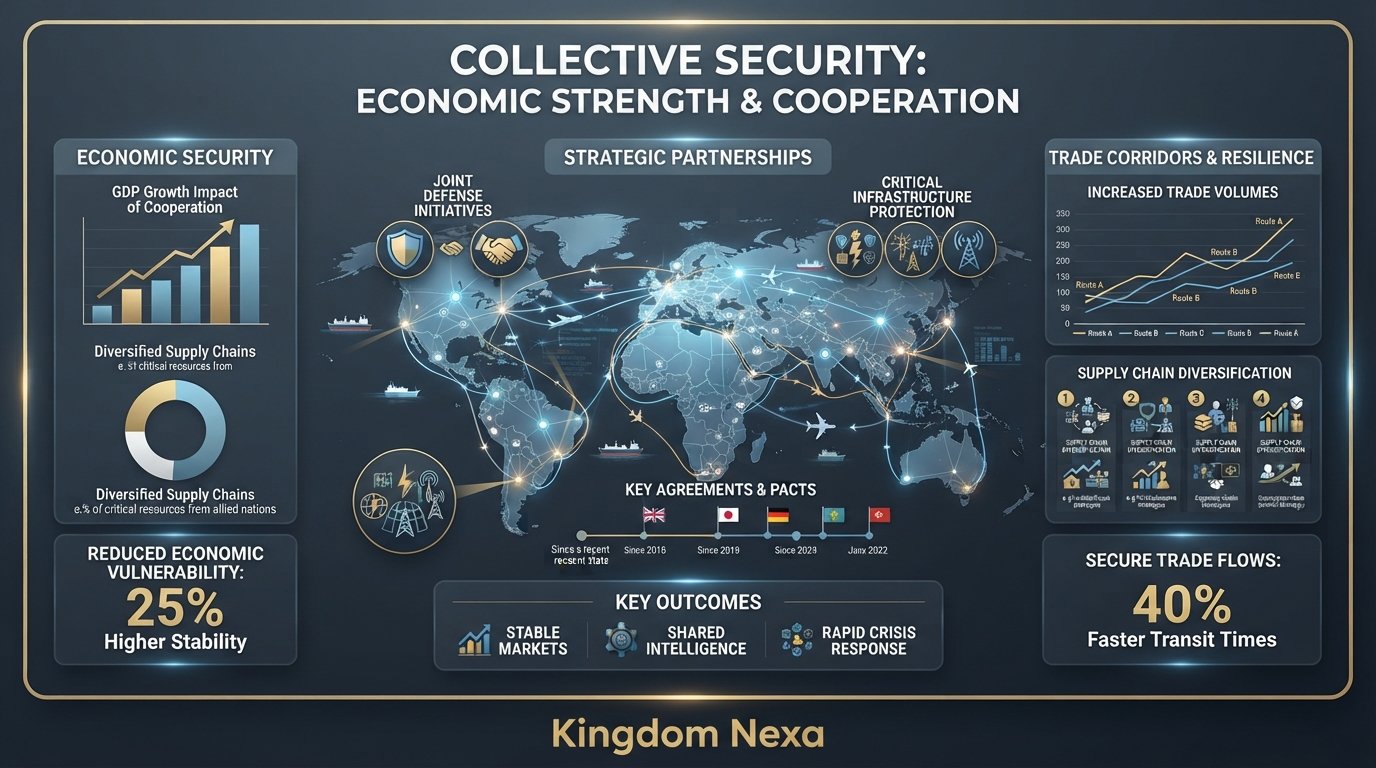
Economic Dimensions of Collective Security
Collective security is not exclusively military.
Modern security crises frequently involve economic measures such as:
- sanctions,
- asset freezes,
- trade restrictions,
- financial controls,
- export controls,
- energy restrictions,
- and restrictions on strategic technologies.
Economic interdependence has therefore become part of the security landscape.
However, sanctions can also create costs for states implementing them. Countries may face disrupted trade, higher energy prices, supply-chain problems or financial consequences.
Article 50 of the UN Charter recognizes that states affected by special economic problems resulting from Security Council preventive or enforcement measures may consult the Council. (United Nations)
This highlights an important reality: collective security requires not only political agreement but also mechanisms for managing the economic consequences of collective action.
Technology and the Future of Collective Security
Technology is transforming how collective security works.
Cybersecurity
Cyberattacks can affect governments, financial systems, telecommunications, energy networks and critical infrastructure without conventional military forces crossing borders.
Attribution can also be difficult.
This creates a major challenge for collective security because establishing responsibility is often more complicated in cyberspace than after a conventional armed attack.
Artificial Intelligence
Artificial intelligence can influence:
- intelligence analysis,
- military planning,
- autonomous systems,
- cyber operations,
- disinformation detection,
- early warning,
- and crisis decision-making.
The 2024 Pact for the Future recognized the need for stronger international governance of emerging technologies and reaffirmed that international law applies to emerging domains. (United Nations)
Drones and Autonomous Systems
Low-cost drones have expanded the ability of both state and non-state actors to conduct surveillance and attacks.
For collective security institutions, this creates a dual challenge: technological capabilities can strengthen monitoring and deterrence while simultaneously lowering barriers to armed violence.
Space Security
Satellites are increasingly essential to communications, navigation, intelligence and military operations.
Damage to space infrastructure could therefore have consequences far beyond traditional military competition.
The international community has consequently begun considering how existing international rules should apply to increasingly contested technological environments. The Pact for the Future includes commitments concerning outer space and the prevention of an arms race in space. (United Nations)
What Are the Main Weaknesses of Collective Security?
Collective security has several structural limitations.
Great-Power Rivalry
The system works most effectively when major powers agree that preserving international stability serves their interests.
When they see a crisis through fundamentally different strategic lenses, cooperation becomes difficult.
The Security Council Veto
The veto protects the permanent members’ central role but can also prevent Council action.
The UN maintains a public database of vetoes since 1946, demonstrating the long history of this mechanism in Council decision-making. (United Nations)
Unequal Capabilities
Not all countries have comparable military, financial or diplomatic resources.
A collective decision may therefore create very different burdens for different states.
Political Will
Treaties and institutions cannot substitute completely for political commitment.
States ultimately decide how much money, military capacity, diplomatic influence and political capital they are willing to devote to collective action.
Enforcement Gaps
Even when sanctions or other measures are adopted, implementation can be uneven.
Collective security therefore depends on national governments, international organizations and regional institutions working together.
Why Is UN Security Council Reform Important?
The structure of the Security Council remains one of the most significant questions facing collective security.
The UN has 193 member states, but only 15 sit on the Council at any one time, with five permanent members possessing veto power. (United Nations)
Many governments argue that the composition of the Council does not sufficiently reflect today’s international distribution of population, economic influence and regional representation.
The Pact for the Future, adopted in September 2024, committed states to Security Council reform and specifically identified the underrepresentation of Africa as a priority. It also called for continued negotiations concerning Council membership and the veto. (United Nations)
This reform process is not merely institutional housekeeping. It concerns the legitimacy and effectiveness of the collective security system itself.
As of 2026, UN member states continue intergovernmental negotiations on Council reform. The General Assembly’s current reform process includes discussions on representation, membership models, working methods and related questions. (United Nations)
What Role Does Peacekeeping Play?
Peacekeeping is one of the most visible expressions of international collective action.
UN peacekeeping missions can help:
- monitor ceasefires,
- protect civilians within mandates,
- support political processes,
- reduce violence,
- assist transitions,
- and create conditions for longer-term peace.
The UN states that more than two million peacekeepers from 125 countries have served under the UN flag since the first mission was established in 1948. (United Nations Peacekeeping)
Peacekeeping should nevertheless be distinguished from enforcement.
Traditional peacekeeping generally relies on consent, impartiality and limited use of force consistent with mission mandates. Enforcement operations can involve fundamentally different legal and military authorities.
The distinction is crucial when assessing what the international community can realistically accomplish in a conflict.
Future of Collective Security: Three Plausible Scenarios
The future of collective security cannot be predicted with certainty, but several broad scenarios are plausible.
Scenario 1: Institutional Adaptation
The UN and regional organizations could gradually adapt to a more multipolar international system.
This could involve:
- Security Council reform,
- stronger regional partnerships,
- improved early warning,
- more flexible peace operations,
- and greater cooperation on cyber and emerging technologies.
The 2024 Pact for the Future points toward this type of institutional adaptation. (United Nations)
Scenario 2: Fragmented Security
A second possibility is increasing reliance on regional organizations and security partnerships because global consensus remains difficult.
Under this model, NATO, the African Union and other regional mechanisms could become increasingly important alongside the UN.
Collective security would not disappear, but it could become more fragmented.
Scenario 3: Selective Multilateral Cooperation
A third possibility is selective cooperation.
Major powers may continue competing in some areas while cooperating in others, such as:
- nuclear risk reduction,
- terrorism,
- maritime security,
- pandemic preparedness,
- climate-related security risks,
- artificial intelligence,
- and crisis communication.
This would produce neither a fully unified security system nor complete institutional breakdown.
Instead, the international system would rely on overlapping mechanisms with varying levels of participation.
Frequently Asked Questions About Collective Security
What is collective security in simple terms?
Collective security means that states agree to work together to prevent or respond to aggression and threats to international peace. The underlying idea is that security is a shared responsibility.
What is an example of collective security?
The United Nations system is the principal global example. Its Security Council can adopt measures ranging from diplomatic and economic sanctions to authorization of military action under Chapter VII of the UN Charter. (United Nations)
Is NATO an example of collective security?
NATO is more precisely an example of collective defence. Article 5 creates a mutual defence commitment among NATO members rather than a universal obligation covering all states. (NATO)
What is the difference between collective security and collective defence?
Collective security is a broader international concept intended to address aggression generally. Collective defence involves a defined group of states agreeing to defend one another against armed attack.
Why did the League of Nations fail to maintain collective security?
The League faced several problems, including limited enforcement capacity, disagreements among members and inadequate political commitment. The absence of the United States also weakened the organization after the Senate rejected U.S. participation in the League. (Office of the Historian)
What is the role of the UN Security Council in collective security?
The Security Council has primary responsibility for maintaining international peace and security. It can investigate disputes, support peaceful settlements, impose sanctions and authorize enforcement measures under appropriate circumstances. (United Nations)
Why does the Security Council veto matter?
A permanent member’s negative vote can prevent adoption of a substantive Council decision. This gives China, France, Russia, the United Kingdom and the United States exceptional influence over collective security decisions. (United Nations)
Can collective security work without military force?
Yes. Collective security includes diplomacy, mediation, sanctions, peacekeeping, economic measures and other forms of cooperation. Military force is only one possible instrument and, under the UN framework, is subject to specific legal and institutional conditions.
How is technology changing collective security?
Cyberattacks, artificial intelligence, drones, satellites and other technologies create new security risks while also improving surveillance, early warning and crisis management. International institutions are increasingly considering how existing rules should apply to these technologies. (United Nations)
Is collective security still relevant in 2026?
Yes. The UN Security Council, regional security institutions and peace operations continue to provide mechanisms for addressing international conflicts. However, their effectiveness depends heavily on political cooperation among states, especially major powers. Current UN discussions on Security Council reform demonstrate that questions about the effectiveness and representation of collective security remain active. (United Nations)
Conclusion
Collective security remains one of the foundational ideas of modern international relations. Its central proposition is straightforward: international peace cannot depend entirely on each state protecting itself; states must also cooperate to deter aggression, resolve disputes and respond to threats that affect wider international stability.
The history of the League of Nations showed the consequences of weak enforcement and insufficient political commitment. The United Nations subsequently created a stronger legal and institutional framework, giving the Security Council authority to impose sanctions and, under specified circumstances, authorize enforcement action.
Yet collective security has never been an automatic mechanism. Great-power rivalry, veto politics, unequal national capabilities and disagreements over the use of force can constrain collective action. At the same time, regional organizations, peacekeeping operations, economic measures and emerging technological cooperation continue to expand the tools available to the international community.
The central issue for the coming years is therefore not whether collective security remains relevant. It is whether existing institutions can adapt sufficiently to a more complex and technologically advanced international system while retaining legitimacy, legal authority and meaningful cooperation among major and smaller powers.