Security is no longer measured only by the strength of borders, armed forces, or the ability of governments to deter external threats. A country can possess substantial military capabilities while many of its people remain exposed to hunger, displacement, disease, violence, economic shocks, environmental disasters, political repression, or digital threats. This gap between state security and the everyday security of people is the central concern of human security.
The concept emerged prominently in the 1994 Human Development Report of the United Nations Development Programme (UNDP), which shifted attention from territories and weapons toward people, livelihoods, dignity, and freedom. (Human Development Reports)
Three decades later, human security has become increasingly relevant as conflicts, climate pressures, food insecurity, forced displacement, health emergencies, inequality, and technological risks interact rather than occur separately. The United Nations’ 2024 report on human security and new UNDP work published in 2026 both emphasize the importance of integrated, preventive and people-centred responses. (United Nations)


What Is Human Security?
Human security is a people-centred approach to security that focuses on protecting the survival, livelihoods and dignity of individuals and communities from widespread and interconnected threats.
The UN General Assembly established a common understanding of the concept in Resolution 66/290, adopted on 10 September 2012. It describes human security as an approach for identifying and addressing widespread and cross-cutting challenges to people’s survival, livelihood and dignity. It calls for responses that are people-centred, comprehensive, context-specific and prevention-oriented, while strengthening protection and empowerment. (Digital Library)
The idea is broader than simply protecting individuals from physical violence. Human security also asks whether people can maintain livelihoods, obtain food and healthcare, live in a safe environment, participate in political life and preserve their community identity.
Human Security and the Three Core Freedoms
The intellectual foundations of the concept are often summarized through three closely related goals:
- Freedom from fear — protection from violence, war, crime, persecution and other serious threats.
- Freedom from want — protection from extreme poverty, hunger, disease and deprivation.
- Freedom to live in dignity — respect for human rights, inclusion, participation and personal agency.
The 1994 UNDP framework originally emphasized freedom from fear and freedom from want. Later UN discussions incorporated the broader concern with dignity and human rights. (Human Development Reports)
How Did the Human Security Concept Develop?
Human security emerged partly from the changing international environment after the Cold War.
The 1994 UNDP Human Development Report
The decisive milestone came in 1994 when UNDP published New Dimensions of Human Security. The report argued that security should be understood in relation to people rather than territory and development rather than arms. (Human Development Reports)
It also emphasized two broad types of insecurity:
- Chronic threats such as hunger, disease and repression.
- Sudden disruptions that damage people’s homes, employment, communities or daily lives.
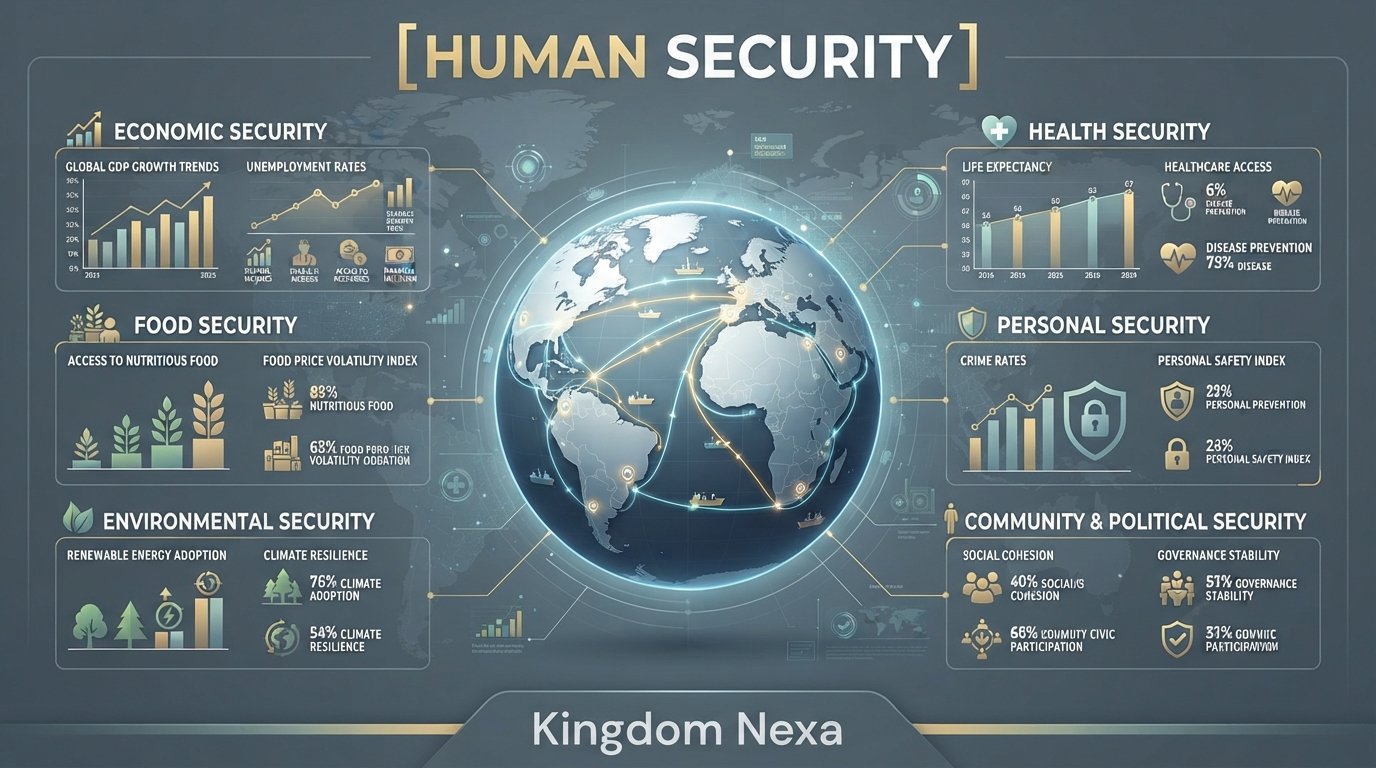
The report identified seven major dimensions of human security, creating a framework that remains widely used in teaching, research and policy analysis.
From a Concept to an International Policy Framework
The concept subsequently developed through academic debates, national policies, UN programmes and international cooperation.
The UN Trust Fund for Human Security was established in 1999 to support comprehensive and preventive responses to complex challenges. The UN Human Security Unit was established in 2004 to help integrate the approach into UN activities. (United Nations)
A major institutional milestone came in 2012 when the General Assembly adopted Resolution 66/290 by consensus, providing the UN system with a common understanding of human security. (United Nations Docs)
What Are the Seven Dimensions of Human Security?
The 1994 UNDP framework identified seven interconnected dimensions.
1. Economic Security
Economic security concerns people’s ability to maintain a basic and reasonably stable livelihood.
Threats can include:
- Extreme poverty
- Unemployment
- Income instability
- Economic crises
- Loss of livelihoods
- Lack of social protection
Economic insecurity can have political and security consequences. A household that loses employment may also experience food insecurity, reduced access to healthcare and education, indebtedness and displacement.
2. Food Security
Food security means that people can consistently access adequate, safe and nutritious food.
Conflict, climate shocks, inflation, disrupted agricultural production, trade interruptions and displacement can all undermine food security.
The scale remains significant. FAO’s latest 2026 global hunger estimates indicate that about 645 million people may have faced hunger in 2025, while around 2.1 billion people experienced moderate or severe food insecurity. (FAOHome)
Food insecurity therefore cannot be treated only as an agricultural issue. It can influence migration, social stability, health and political resilience.
3. Health Security
Health security concerns protection against disease and access to functioning healthcare systems.
The COVID-19 pandemic demonstrated how a health emergency can rapidly become an economic, social and political crisis. Health systems can be overwhelmed, supply chains disrupted and inequalities amplified.
The WHO reported that more than 300 million people required humanitarian assistance in 2025, amid overlapping conflict, climate-related disasters and disease emergencies. (World Health Organization)
Health security therefore involves not only hospitals and medicines but also surveillance, prevention, vaccination, sanitation, nutrition and emergency preparedness.
4. Environmental Security
Environmental security concerns threats arising from environmental degradation and natural or climate-related hazards.
Examples include:
- Extreme heat
- Flooding
- Drought
- Water stress
- Pollution
- Biodiversity loss
- Land degradation
- Climate-related disasters
Environmental risks frequently interact with economic and social vulnerabilities. A flood, for example, may destroy homes, interrupt education, damage agricultural production, spread disease and force displacement simultaneously.
UNDP’s 2022 Special Report on Human Security emphasized that climate change and other planetary pressures can reinforce existing inequalities and create new forms of insecurity. (HDR Hub)
5. Personal Security
Personal security focuses on protection from physical violence and serious threats to bodily safety.
These may include:
- Armed conflict
- Crime
- Domestic violence
- Human trafficking
- Terrorism
- Torture
- Sexual violence
- Other forms of physical abuse
The human security perspective is important because violence can occur during war but also within households and communities.
6. Community Security
Community security concerns the safety and resilience people derive from belonging to families, communities, cultural groups or social networks.
Threats can involve:
- Ethnic conflict
- Religious persecution
- Discrimination
- Social exclusion
- Forced displacement
- Destruction of cultural identity
Strong community networks can increase resilience, while systematic exclusion can intensify grievances and insecurity.
7. Political Security
Political security involves protection from political repression and respect for fundamental rights and freedoms.
It is closely associated with:
- Rule of law
- Political participation
- Civil liberties
- Accountability
- Freedom from arbitrary repression
- Access to justice
Political insecurity can weaken public trust and make other forms of insecurity more difficult to resolve.
Why Are the Seven Dimensions Interconnected?
One of the most important features of human security is that these dimensions should not be treated as isolated categories.
Consider a prolonged conflict.
Conflict can destroy agricultural production, creating food insecurity. Displacement can eliminate livelihoods, creating economic insecurity. Damaged hospitals produce health insecurity. Violence creates personal insecurity. Ethnic polarization can undermine community security, while political repression may deepen political insecurity.
The reverse can also occur. Persistent unemployment, inequality, exclusion and weak institutions can contribute to grievances that increase the risk of violence.
This interdependence is why the UN describes human security as a comprehensive approach rather than a collection of unrelated policy sectors. (United Nations)
Human Security vs Traditional National Security
Traditional security studies have historically focused heavily on the state.
A conventional national-security framework may ask:
Can the state defend its territory and sovereignty?
Human security adds another question:
Are the people living within that state actually safe and able to sustain their lives with dignity?
The two perspectives are not necessarily competing frameworks.
The 2012 UN General Assembly resolution explicitly states that human security does not replace state security. It also emphasizes that governments retain the primary responsibility for the survival, livelihood and dignity of their populations. (Digital Library)
This distinction matters. A functioning military can protect territorial sovereignty, but military power alone cannot provide reliable healthcare, food, employment, clean water or protection from domestic violence.
Conversely, effective institutions, social cohesion and resilient communities can strengthen a state’s broader security environment.
What Are the Major Human Security Challenges Today?
Human insecurity in 2026 increasingly results from compound risks rather than one isolated threat.
Armed Conflict and Forced Displacement
War remains one of the most direct threats to human security.
UNHCR’s latest Global Trends data show that at the end of 2025, 117.8 million people were forcibly displaced worldwide. This included 41.6 million refugees and approximately 68.7 million people internally displaced because of conflict or violence. (UNHCR)
The significance extends beyond immediate physical danger. Displacement can interrupt education, destroy livelihoods, separate families and place enormous pressure on host communities.
Climate Change and Environmental Stress
Climate change increasingly interacts with existing political and economic vulnerabilities.
A drought can reduce food production. Reduced agricultural income can increase poverty. Economic stress can accelerate migration. Large-scale displacement can place additional pressure on urban infrastructure and public services.
This does not mean climate change automatically causes conflict. The relationship is context-dependent and mediated by institutions, governance, resource management and social conditions.
The human security framework is useful precisely because it examines these connections rather than attributing insecurity to a single cause.
Food and Economic Insecurity
Economic shocks can move rapidly across borders through trade, finance, energy markets and supply chains.
Food and energy price increases may be particularly damaging to low-income households because a larger proportion of their income is devoted to essential goods.
For policymakers, economic security therefore involves more than GDP growth. It also concerns household resilience, employment, social protection and access to essential services.
Health Emergencies
Health threats remain transnational.
WHO’s current emergency architecture recognizes risks ranging from infectious disease outbreaks to climate-related hazards and other emergencies. Its 2026 reporting highlights the growing difficulty of maintaining health responses amid conflict, climate shocks and funding constraints. (World Health Organization)
Health insecurity can therefore become a geopolitical issue when outbreaks cross borders, medical supply chains are disrupted or humanitarian access is restricted.
Digital Technology and Artificial Intelligence
Technology creates both opportunities and vulnerabilities.
Digital systems can improve access to education, finance, healthcare and government services. However, cybersecurity attacks, surveillance, misinformation, exclusion from digital services and poorly governed AI systems can create new forms of insecurity.
UNDP’s 2022 human security analysis specifically identified digital technology as one of the emerging interconnected threats alongside violent conflict, inequality and healthcare challenges. (HDR Hub)
The policy challenge is not simply to regulate technology. It is to ensure that technological development expands human agency without creating disproportionate risks.
Human Security and Geopolitics
Human security has important implications for international relations because many threats do not stop at national borders.
Why Geography Still Matters
Although human security focuses on people, geography remains fundamental.
Rivers cross borders. Food and energy supplies depend on international trade routes. Disease spreads through transportation networks. Climate impacts affect interconnected regions. Refugees often move into neighboring countries.
Consequently, insecurity in one state can produce political, economic and humanitarian consequences elsewhere.
Human Security and Great-Power Competition
Great-power competition can affect human security through:
- Military confrontations
- Economic restrictions
- Technology competition
- Energy competition
- Cyber operations
- Supply-chain disruptions
- Competition over strategic infrastructure
However, human security analysis does not assume that geopolitical competition automatically produces insecurity. Its purpose is to examine how strategic decisions affect actual people and communities.
This can expose consequences that state-centred assessments overlook.
Human Security, International Law and Sovereignty
Human security is closely connected to human rights, international humanitarian law and international development, but it should not be confused with a separate comprehensive body of international law.
Resolution 66/290 makes several important distinctions. It states that human security:
- Does not replace state security.
- Does not entail the threat or use of force.
- Is distinct from the Responsibility to Protect.
- Must respect the UN Charter.
- Must respect sovereignty and territorial integrity.
- Does not create additional legal obligations for states. (Digital Library)
This is an important qualification because the broad nature of human security can otherwise create confusion about whether the concept itself authorizes international intervention.
It does not.
Instead, human security functions primarily as an analytical and policy framework connecting security, development and human rights.
How Can Governments Improve Human Security?
A human security strategy generally requires moving from isolated crisis management toward integrated prevention.
Protection
Governments and institutions can protect populations through:
- Effective laws
- Social protection
- Public healthcare
- Disaster preparedness
- Conflict prevention
- Security institutions
- Humanitarian response
Protection is particularly important when people face threats beyond their immediate ability to control.
Empowerment
Protection alone is insufficient.
People also need the ability to influence decisions affecting their lives. Empowerment can involve:
- Education
- Political participation
- Access to information
- Economic opportunity
- Community organizations
- Local decision-making
- Access to justice
The UN human security framework deliberately combines top-down protection with bottom-up empowerment. (United Nations)
Prevention
Prevention is central because many crises become substantially more expensive and difficult to manage after they escalate.
The UN Human Security Unit describes prevention as a core objective involving early action, attention to root causes and resilience-building. (United Nations)
This means identifying vulnerability before it becomes a crisis.
Local Ownership
Human security cannot be imposed through a universal checklist.
The same threat may require different responses in a fragile rural community, a major coastal city or a conflict-affected border region.
The UN framework therefore emphasizes context specificity and national ownership. (Digital Library)
The Role of International Organizations
Human security requires cooperation among national governments, international organizations, civil society, communities and the private sector.
The United Nations provides a major institutional platform through its Human Security Unit and UN Trust Fund for Human Security.
The UNDP contributes through development, governance, resilience and human security research.
The WHO addresses health emergencies and global health preparedness.
UNHCR works on refugee protection and forced displacement.
FAO contributes to food and agricultural resilience.
The World Bank addresses poverty, fragility and conflict-related development challenges. Its research continues to identify a strong relationship between fragility, conflict and persistent poverty. (World Bank)
No single institution can address the entire human security agenda because its underlying risks cross institutional boundaries.
Human Security in Practice: A Poly-Risk Approach
A major development in current thinking is the recognition of poly-risk environments.
A community may simultaneously experience:
- Climate-related flooding
- Food-price inflation
- Unemployment
- Poor healthcare access
- Digital exclusion
- Political distrust
- Displacement
Addressing only one problem may leave the underlying vulnerability intact.
In June 2026, UNDP’s Asia-Pacific Regional Bureau published a methodology specifically designed to mainstream human security in poly-risk contexts, emphasizing interconnected and evolving risks and placing people, vulnerability and resilience at the centre of development planning. (UNDP)
This represents an important shift from managing individual risks toward understanding how risks interact.
What Are the Main Criticisms of Human Security?
Human security is influential, but it is not without criticism.
The Concept Can Become Too Broad
If almost every social problem is classified as a security issue, the concept can lose analytical precision.
Poverty, disease, unemployment, climate change, crime, discrimination and political repression are all important, but policymakers still need methods for deciding which risks are most urgent.
Measurement Is Difficult
Military expenditure, troop numbers or territorial control can be measured relatively directly.
Human security is more complicated.
Researchers may need to combine indicators covering income, health, food, violence, displacement, environmental conditions, rights and people’s perceptions of insecurity.
Different Societies Face Different Risks
A universal list of threats cannot fully capture local conditions.
A drought may be the dominant threat in one region, while organized violence, unemployment or political repression may be more important elsewhere.
This is why context-specific analysis is central to the UN framework.
Security Securitization Can Create Risks
There is also a conceptual danger in treating every humanitarian or development issue primarily as a security problem.
Doing so can lead to excessive emergency framing or inappropriate security-sector responses.
Human security is most useful when it connects security with development and rights without allowing one policy domain to dominate all others.
What Is the Future of Human Security?
The future of human security will likely be shaped by several interacting trends.
First, compound risks will become increasingly important. Climate, conflict, food, health, migration and economic risks can reinforce each other.
Second, digital transformation and artificial intelligence will create both opportunities and new vulnerabilities. Governance will need to address cybersecurity, privacy, access, misinformation and algorithmic decision-making.
Third, prevention is likely to receive greater attention because responding after crises escalate is expensive in humanitarian, political and economic terms.
Fourth, local resilience and agency will remain important. Human security is not only about protecting populations; it is also about giving people greater capacity to shape their own futures.
Finally, international cooperation will remain essential. The UN’s recent human security work has continued to emphasize the interconnectedness of contemporary risks and the need for stronger multilateral cooperation. In September 2026, the UN Human Security Unit reported findings from Nordic Dialogues convened with SIPRI and regional institutions, highlighting human security’s continuing relevance amid compounding risks and pressure on multilateral cooperation. (United Nations)
Frequently Asked Questions About Human Security
What is human security in simple words?
Human security means protecting people from serious threats to their survival, livelihoods and dignity. It looks beyond military threats to include poverty, hunger, disease, violence, environmental hazards and political insecurity.
What are the seven dimensions of human security?
The seven dimensions identified in the 1994 UNDP framework are economic, food, health, environmental, personal, community and political security. (Human Development Reports)
Who introduced the concept of human security?
The concept became prominent internationally through the UNDP Human Development Report 1994, titled New Dimensions of Human Security. (Human Development Reports)
What is the difference between human security and national security?
National security traditionally emphasizes the protection of the state, its sovereignty and territory. Human security focuses on the survival, livelihood and dignity of people. The UN states that human security complements rather than replaces state security. (Digital Library)
Is human security part of international law?
Human security is primarily an analytical and policy framework rather than a standalone body of international law. UN General Assembly Resolution 66/290 specifically states that it does not create additional legal obligations for states. (Digital Library)
Why is human security important in geopolitics?
Many modern threats cross borders. Conflict, forced displacement, climate impacts, pandemics, food insecurity, cyber risks and supply-chain disruptions can affect multiple countries simultaneously. Human security helps policymakers examine these threats from the perspective of their effects on people.
How does climate change affect human security?
Climate change can affect food production, water availability, health, livelihoods, infrastructure and displacement. Its effects vary by geography and social vulnerability, so climate change should be analyzed alongside economic, institutional and social conditions.
How does AI affect human security?
AI can improve healthcare, disaster prediction, education and public services, but it can also create risks involving cybersecurity, privacy, misinformation, exclusion and poorly governed automated decision-making. UNDP identifies digital technology as part of the emerging generation of human security threats. (HDR Hub)
What is the role of the United Nations in human security?
The UN supports human security through policy frameworks, development programmes, humanitarian operations, peacebuilding, health initiatives and the UN Trust Fund for Human Security. Its approach emphasizes integrated, preventive and context-specific responses. (United Nations)
Conclusion
Human security represents a fundamental shift in how security can be understood. Instead of asking only whether states are protected from external threats, it asks whether people can survive, maintain livelihoods, exercise their rights and live with dignity.
Its seven traditional dimensions—economic, food, health, environmental, personal, community and political security—remain useful for understanding everyday vulnerabilities. But current conditions increasingly require attention to interconnected risks involving climate change, conflict, displacement, health emergencies, inequality and digital technology.
The central lesson is not that national security has become irrelevant. Rather, state security and human security are interconnected. Stable institutions, resilient communities, functioning economies and protected populations can reinforce wider national and international stability.
In an era of compound crises, human security provides a practical way to connect peace, development, human rights, resilience and prevention. Its continuing relevance lies in a simple but consequential principle: security ultimately has meaning when it improves the safety, opportunities and dignity of the people it is intended to protect.