Foreign policy decisions rarely emerge from a single cause. A government may respond to an external security threat, but its decision can also be shaped by domestic politics, economic interests, leadership beliefs, bureaucratic competition, public opinion, historical experience, and international institutions. Foreign Policy Analysis provides a systematic way to examine these interacting forces and understand why states behave as they do.
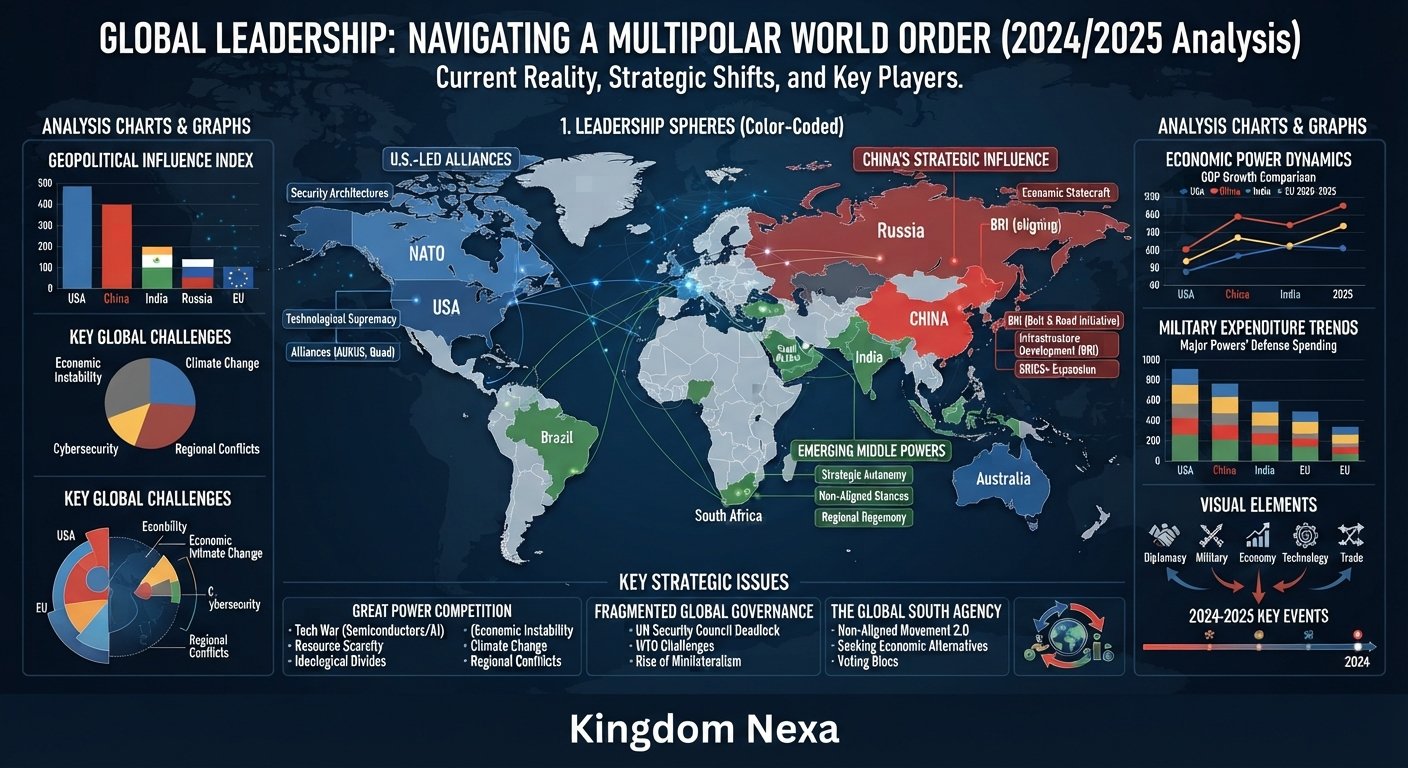
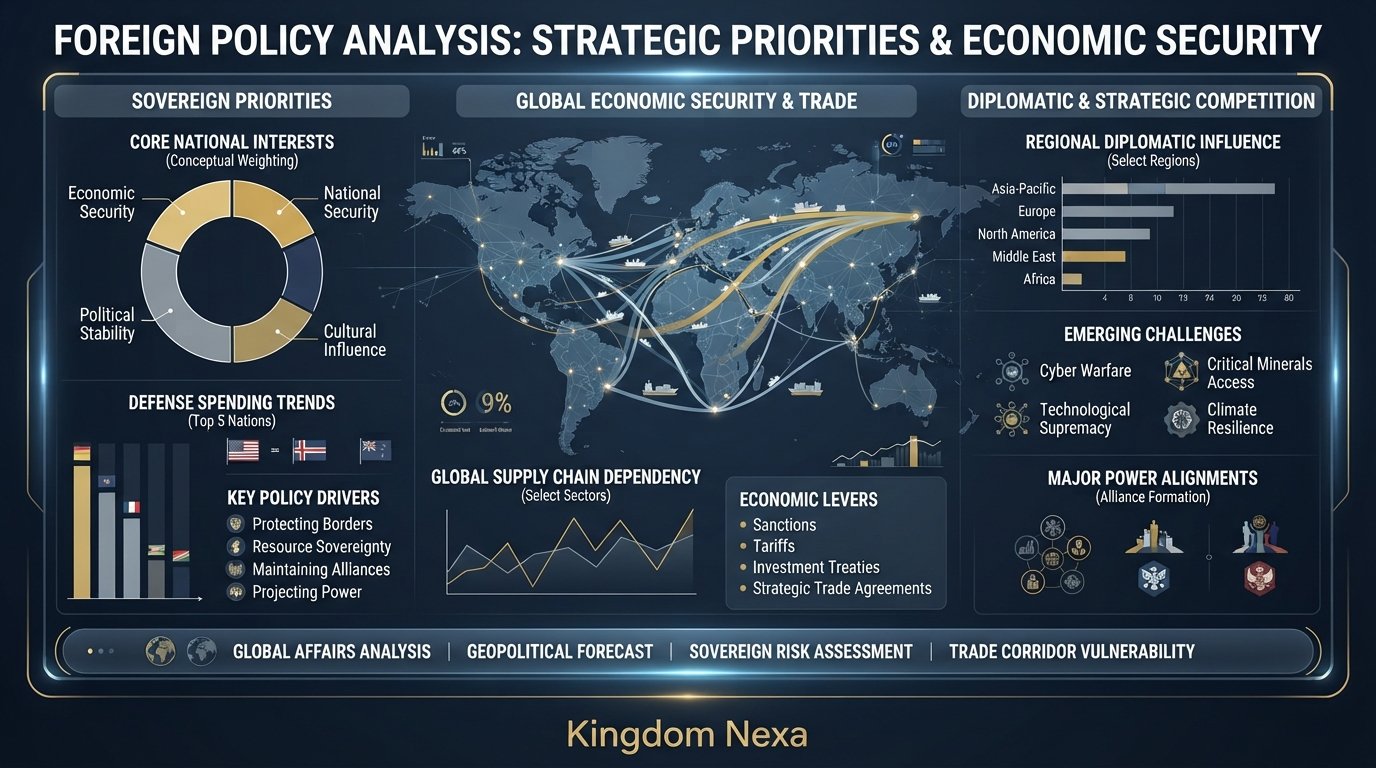
The field is especially important in the current international environment. Global trade reached more than $35 trillion in 2025, while geopolitical tensions continued to reshape supply chains and economic relationships. At the same time, global military expenditure reached approximately $2.9 trillion in 2025, the highest level recorded by SIPRI. These developments demonstrate why foreign policy can no longer be understood solely through military power or traditional diplomacy. Economic statecraft, technology, energy security, sanctions, cyber capabilities, alliances, and domestic political constraints increasingly influence international outcomes.
This guide explains what Foreign Policy Analysis means, how the field developed, its major theoretical approaches, the factors that shape foreign policy decisions, useful analytical methods, and how the discipline can be applied to contemporary international affairs.
What Is Foreign Policy Analysis?
Foreign Policy Analysis is the systematic study of how governments and other political actors formulate, implement, and change policies toward the external world.
It asks a fundamental question: Why did a particular foreign policy decision occur when other alternatives were available?
Foreign Policy Analysis differs somewhat from broader International Relations theory. International Relations often examines patterns in the international system, such as balance of power, alliances, institutions, or anarchy. Foreign Policy Analysis places greater emphasis on the actors and processes that convert international pressures into actual policy decisions.
A government is therefore not automatically treated as a perfectly unified actor. Analysts can examine leaders, advisers, ministries, legislatures, political parties, bureaucracies, interest groups, public opinion, organizational routines, and other domestic influences.
Academic work on foreign policy decision-making commonly considers individual, group, state, and international-system levels, while examining rational-choice, organizational, bureaucratic, psychological, and domestic-political explanations.
In practical terms, Foreign Policy Analysis connects three questions:
- What pressures does a country face?
- How do decision-makers interpret those pressures?
- Why do they select one policy option rather than another?
That connection makes FPA particularly useful for analyzing crises, alliances, wars, sanctions, diplomatic negotiations, trade disputes, peace agreements, and strategic partnerships.
Why Is Foreign Policy Analysis Important?
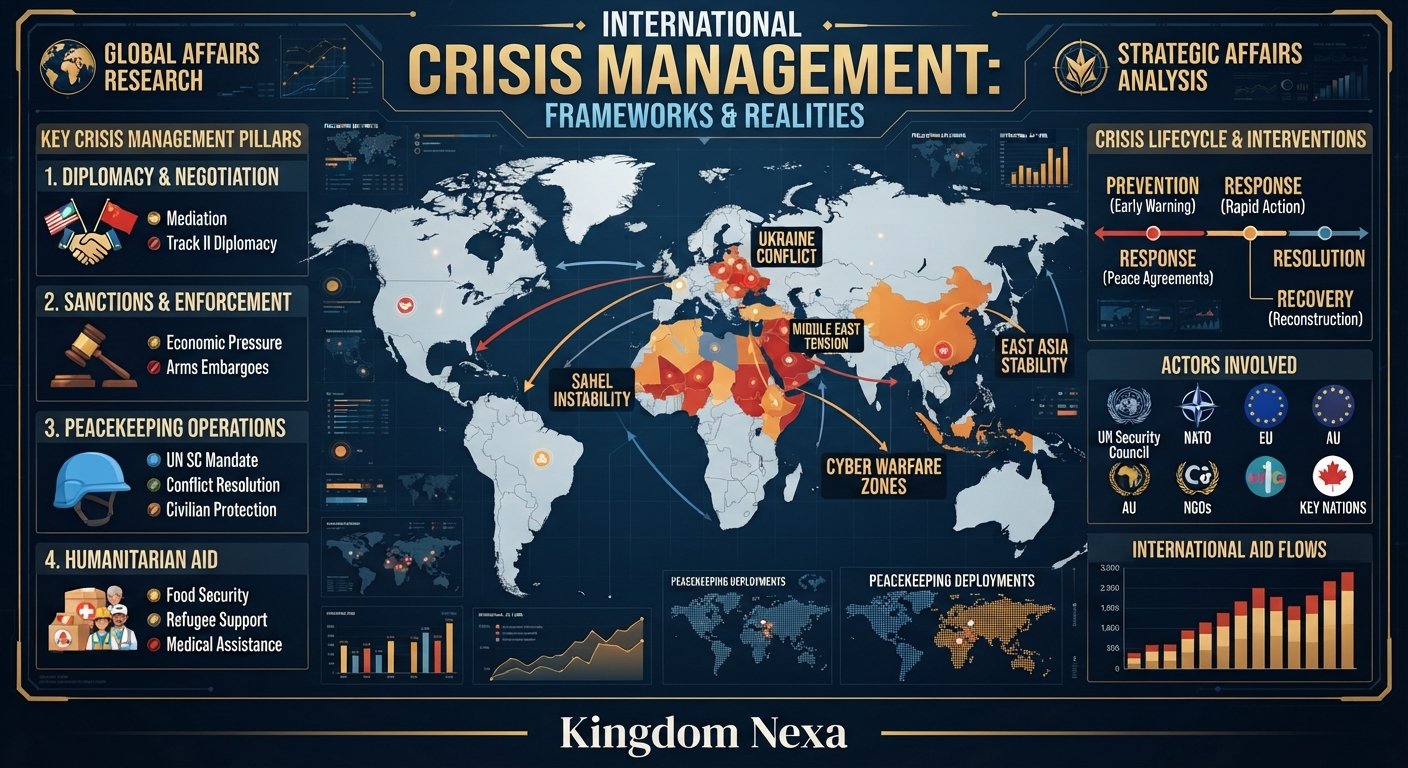
Foreign policy is the mechanism through which states interact with the international environment. The tools available to governments include diplomacy, economic measures, trade policy, sanctions, intelligence, military force, deterrence, and arms control.
Foreign Policy Analysis matters because identical external conditions can produce different decisions in different countries—or even different decisions under different leaders within the same country.
For example, two governments may face the same regional security threat but respond differently because they have different:
- threat perceptions;
- political institutions;
- economic capabilities;
- alliance commitments;
- leadership beliefs;
- historical experiences;
- domestic constituencies; and
- risk tolerances.
The field therefore helps explain why geopolitical outcomes are not determined by power alone.
It is also increasingly relevant to business and political-risk analysis. A government decision concerning tariffs, export controls, sanctions, energy infrastructure, maritime security, or technology restrictions can affect companies and markets far beyond the country making the decision.
How Foreign Policy Analysis Developed
Foreign Policy Analysis emerged partly from dissatisfaction with explanations that treated states as homogeneous units.
Earlier approaches to international politics often focused on systemic forces and national power. These perspectives remain important, but scholars increasingly asked what happens inside the state before a foreign policy decision reaches the international arena.
The intellectual development of FPA therefore incorporated several perspectives.
The Decision-Making Turn
A major development was the examination of decision-makers themselves.
Richard Snyder, H. W. Bruck, and Burton Sapin’s work in the 1950s helped establish the idea that foreign policy should be studied through the decision-making process rather than treating the state as an indivisible actor. Later scholarship expanded attention to perceptions, beliefs, organizations, bureaucracies, domestic politics, and strategic environments.
The Levels-of-Analysis Approach
Foreign policy can be examined at several levels:
- Individual level — leaders, advisers, beliefs, perceptions, and cognitive biases.
- Domestic or state level — institutions, political parties, bureaucracies, public opinion, economies, and political systems.
- International-system level — distribution of power, alliances, threats, institutions, and systemic constraints.
Modern approaches often combine these levels rather than treating them as mutually exclusive.
The Domestic Politics Turn
More recent scholarship has increasingly incorporated political institutions, public opinion, political culture, political parties, media, and other domestic actors into foreign policy research. This reflects the recognition that international strategy is often constrained by internal political realities.
Major Levels of Foreign Policy Analysis
A strong Foreign Policy Analysis usually moves across several levels rather than relying on a single explanation.
Individual-Level Analysis
Individual-level analysis examines how leaders and advisers perceive international events.
Two leaders can receive the same intelligence but interpret it differently. One may view an adversary’s military buildup as defensive; another may see it as preparation for aggression.
Relevant variables include:
- personal beliefs;
- historical experience;
- leadership style;
- ideology;
- risk tolerance;
- cognitive biases;
- perceptions of adversaries;
- analogies drawn from previous crises; and
- advice received from senior officials.
Research on foreign policy decision-making has found that advisers can influence policy through the information and recommendations they provide, meaning that decision-making cannot always be reduced to the preferences of the top leader alone.
State-Level Analysis
State-level analysis examines the institutions and political structures surrounding foreign policy.
Questions include:
- Who has constitutional authority over foreign affairs?
- How powerful is the legislature?
- How influential are military institutions?
- Which ministries participate in policymaking?
- What role do political parties play?
- How does public opinion constrain leaders?
- Are economic interests influencing policy?
This approach is particularly useful when foreign policy decisions appear inconsistent with a purely strategic explanation.
International-System Analysis
At the systemic level, analysts examine the external environment.
Key variables include:
- distribution of power;
- alliances;
- security dilemmas;
- strategic geography;
- rivalries;
- international institutions;
- global markets;
- military capabilities; and
- changes in the balance of power.
Systemic pressures can narrow the range of available choices, but they do not necessarily determine the exact policy selected.
Major Theories and Approaches in Foreign Policy Analysis
No single theory explains every foreign policy decision. Different approaches illuminate different parts of the policymaking process.
Rational Actor Model
The rational actor model assumes that policymakers identify objectives, consider alternatives, estimate consequences, and select the option expected to advance national interests.
It is useful because it provides a clear analytical baseline.
However, real-world decision-making rarely occurs with perfect information. Time pressure, uncertainty, incomplete intelligence, organizational limitations, and political disagreement can prevent policymakers from behaving like perfectly rational calculators.
Cognitive Approach
The cognitive approach examines how decision-makers perceive and interpret information.
A policymaker may rely on historical analogies, established beliefs, mental shortcuts, or assumptions about an adversary. Misperception can therefore become a major driver of foreign policy.
This approach is particularly valuable in crises because leaders frequently make decisions under uncertainty and time pressure.
Organizational Process Model
Organizations develop routines.
Foreign ministries, defense departments, intelligence agencies, militaries, and other institutions have established procedures for collecting information and responding to problems.
These routines can improve efficiency, but they can also constrain policymakers. A government may therefore produce a policy partly because an organization is structured to produce that type of response.
Bureaucratic Politics Model
The bureaucratic politics approach emphasizes competition among government agencies and officials.
Different institutions may define the national interest differently because their responsibilities differ.
A foreign ministry may prioritize diplomatic engagement, a defense establishment may emphasize deterrence, and an economic ministry may focus on trade and financial consequences.
The resulting policy can emerge from bargaining among these actors rather than from one unified national strategy.
Two-Level Games
Foreign policy negotiations often occur simultaneously at two levels:
- internationally, between governments; and
- domestically, among political actors inside each country.
A leader negotiating an international agreement must therefore consider whether the agreement can survive domestic political constraints.
This is particularly important for trade agreements, peace settlements, alliance commitments, and major international treaties.
What Factors Shape Foreign Policy?
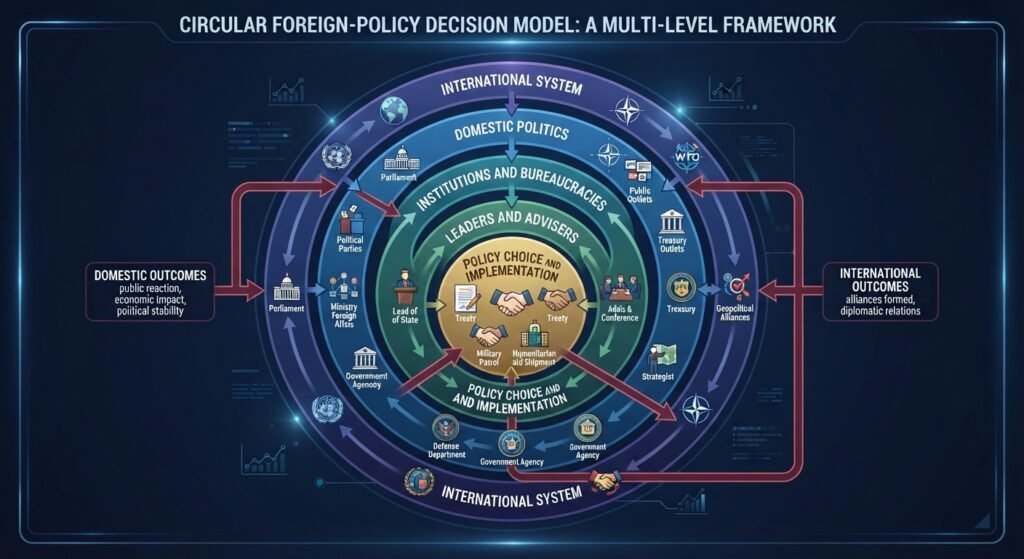
Foreign policy is usually produced by multiple interacting variables.
National Interests
Governments commonly define interests around security, economic prosperity, territorial integrity, political stability, international influence, and protection of citizens abroad.
The exact meaning of “national interest,” however, is politically contested. Different governments and domestic groups can define it differently.
Geography
Geography influences strategic choices through borders, coastlines, mountains, rivers, maritime routes, resources, and proximity to other powers.
A country’s geographic position can affect its alliance preferences, military planning, trade relationships, and perceptions of vulnerability.
Military Power
Military capabilities influence deterrence, bargaining power, alliance credibility, and crisis behavior.
The contemporary strategic environment demonstrates the continuing importance of military capabilities. SIPRI estimates that global military expenditure reached $2.887 trillion in 2025, representing 2.5 percent of global GDP and the eleventh consecutive annual increase.
Military power, however, is only one component of foreign policy.
Economic Interests
Trade, investment, energy, financial systems, sanctions, critical minerals, industrial capacity, and supply chains have become central components of foreign policy.
UN Trade and Development reported that global trade exceeded $35 trillion in 2025 while geopolitical tensions and changing trade policies continued to reshape global value chains.
This illustrates the growing importance of geoeconomics—the use of economic relationships and instruments to pursue strategic objectives.
Domestic Politics
Foreign policy can be affected by elections, political parties, public opinion, interest groups, economic conditions, media narratives, and institutional competition.
Domestic constraints can sometimes prevent leaders from adopting policies that appear strategically attractive from an external perspective.
History and Identity
Historical memories can influence threat perceptions, alliance preferences, territorial claims, and national narratives.
Historical experience does not automatically determine policy, but policymakers may interpret current events through established historical frameworks.
Technology
Technology has become an increasingly important foreign-policy variable.
Relevant areas include:
- artificial intelligence;
- semiconductors;
- cyber capabilities;
- satellite systems;
- drones;
- telecommunications;
- quantum technologies;
- surveillance systems; and
- digital infrastructure.
Technology can simultaneously function as an economic asset, security instrument, diplomatic bargaining tool, and source of strategic vulnerability.
Foreign Policy Tools and Instruments
Foreign Policy Analysis also examines how governments translate objectives into action.
Diplomacy
Diplomacy includes negotiations, official visits, diplomatic representation, communication, mediation, confidence-building measures, and international agreements.
The Vienna Convention on Diplomatic Relations, adopted in 1961 and entering into force in 1964, established an important legal framework for diplomatic relations and immunities.
Economic Statecraft
Governments can use:
- tariffs;
- sanctions;
- export controls;
- investment restrictions;
- development assistance;
- financial incentives;
- trade agreements; and
- economic partnerships.
Economic tools can exert pressure without direct military confrontation, although they can also generate unintended costs for the sender and third parties.
Military Power and Deterrence
Military capabilities can be used for defense, deterrence, reassurance of allies, coercion, or combat.
A Foreign Policy Analysis should distinguish between military capability and political willingness to use that capability.
Intelligence
Intelligence provides information about foreign governments, military capabilities, intentions, economic conditions, and emerging threats.
Its influence depends not only on the quality of information but also on how policymakers interpret it.
International Institutions
States pursue foreign-policy goals through organizations such as the United Nations, World Trade Organization, regional organizations, development institutions, and security alliances.
Institutions can reduce uncertainty, establish rules, facilitate negotiation, and create mechanisms for cooperation. They can also become arenas for geopolitical competition.
International Law and Foreign Policy Analysis
International law provides an important framework within which foreign policy operates.
The UN Charter establishes sovereign equality among members, requires disputes to be addressed through peaceful means, and states that members shall refrain from the threat or use of force against the territorial integrity or political independence of states, subject to the Charter’s framework and exceptions.
Foreign Policy Analysis should therefore distinguish between:
- what a government claims is legally justified;
- what international law actually provides;
- how other states interpret the legal issue; and
- how international institutions respond.
This distinction is essential because official legal claims are evidence of a government’s position, not automatically proof that the position is accepted internationally.
How to Analyze a Foreign Policy Decision
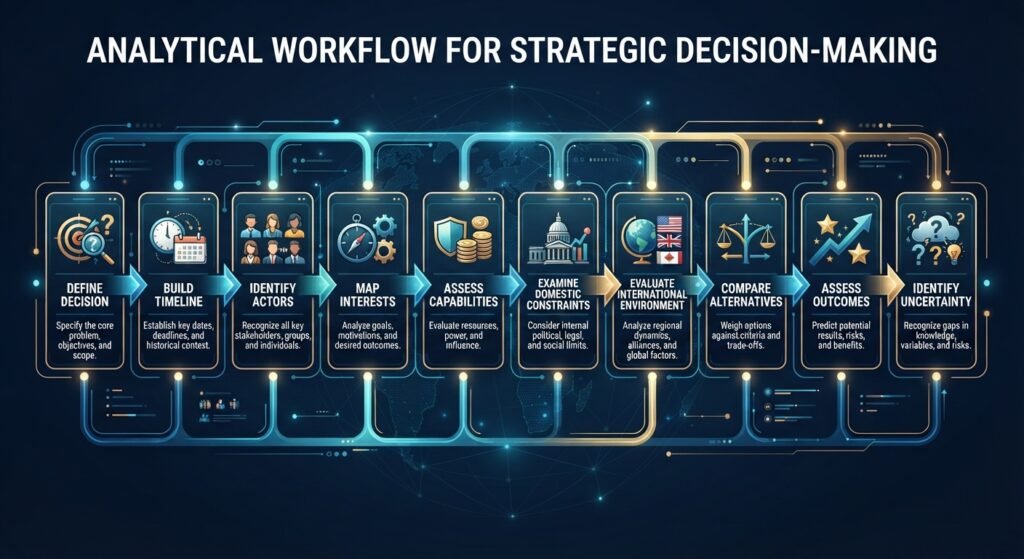
A practical Foreign Policy Analysis can follow a structured sequence.
Step 1: Identify the Decision
Clearly define what happened.
Avoid beginning with broad assumptions such as “Country X changed its foreign policy.” Identify the specific action: a treaty, military deployment, sanction, diplomatic recognition, trade measure, alliance decision, or policy announcement.
Step 2: Establish the Timeline
Determine:
- what happened before the decision;
- when the decision was made;
- what events immediately preceded it; and
- what happened afterward.
A timeline can reveal causal relationships that are difficult to see in a static description.
Step 3: Identify the Actors
Map the principal actors.
These may include:
- heads of government;
- foreign and defense ministries;
- legislatures;
- militaries;
- intelligence agencies;
- political parties;
- businesses;
- allied governments;
- international organizations;
- civil society groups; and
- non-state armed groups.
Step 4: Identify Interests and Constraints
Ask what each actor wants and what limits its choices.
An actor may have a strategic objective but lack sufficient military, economic, diplomatic, or political capacity to pursue it fully.
Step 5: Compare Alternative Explanations
A strong analysis should test multiple hypotheses.
For example:
- Was the decision primarily security-driven?
- Did domestic politics matter?
- Were economic interests decisive?
- Did leadership perceptions influence the outcome?
- Did bureaucratic competition affect the final policy?
- Did an international institution constrain available choices?
Step 6: Separate Evidence From Interpretation
Use a clear hierarchy:
Verified fact: What reliable evidence establishes.
Government position: What an official actor says.
Analytical interpretation: What available evidence may suggest.
Prediction: What could happen under particular conditions.
This distinction protects geopolitical analysis from turning speculation into fact.
Foreign Policy Analysis in the Current International Environment
As of September 2026, Foreign Policy Analysis is particularly relevant because international politics is being shaped by overlapping security, economic, technological, and diplomatic pressures.
Military expenditure provides one indicator. SIPRI estimates that world military spending reached $2.887 trillion in 2025, with particularly strong increases in Europe and Asia and Oceania.
Economic interdependence remains equally important. UNCTAD reported that global trade reached a record level in 2025 while geopolitical tensions, policy changes, and fragmentation continued to alter trade patterns.
Technology adds another layer. Governments increasingly treat advanced technologies, data, communications infrastructure, artificial intelligence, semiconductors, and cyber capabilities as matters of national security as well as economic development.
This creates a more complex analytical environment. A single policy decision can simultaneously have:
- military consequences;
- diplomatic consequences;
- economic effects;
- technological implications;
- domestic political consequences; and
- international legal implications.
For example, a government imposing technology export restrictions may describe the measure as a national-security policy. The affected country may interpret it as economic containment. Businesses may experience it as a supply-chain disruption. Allies may see it as either a collective security measure or a source of commercial friction.
Foreign Policy Analysis helps separate these different perspectives rather than collapsing them into one narrative.
Why Foreign Policy Decisions Often Produce Unintended Consequences
Policymakers rarely control all the consequences of their decisions.
A sanction may impose economic costs on a target but also redirect trade toward alternative suppliers. A military deployment may strengthen deterrence but increase the other side’s perception of threat. A diplomatic agreement may resolve one dispute while creating domestic opposition.
This is partly because international politics is interactive.
One government’s policy changes the environment in which other governments make their own decisions. Foreign policy therefore resembles a continuing strategic process rather than a series of isolated choices.
The security dilemma illustrates this problem. Measures adopted by one state to improve its security can be interpreted as threatening by another state, prompting a response that leaves both sides feeling less secure.
Common Mistakes in Foreign Policy Analysis
Several analytical errors can weaken otherwise well-researched work.
Treating States as Completely Unified Actors
Governments contain competing institutions and interests. Ignoring those differences can produce an incomplete explanation.
Assuming Stated Motives Are the Whole Explanation
Official statements are important evidence, but analysts should compare them with observable actions, institutional interests, historical context, and material constraints.
Ignoring Domestic Politics
International strategy can be constrained by domestic political realities. A theoretically attractive foreign policy may be politically impossible to implement.
Overemphasizing Military Power
Military capabilities matter, but diplomacy, economics, technology, geography, institutions, and legitimacy can also affect outcomes.
Confusing Correlation With Causation
Two events occurring close together does not prove that one caused the other.
Treating Predictions as Facts
Forecasts should be presented as scenarios or conditional possibilities, not established outcomes.
Future Directions for Foreign Policy Analysis
The field is likely to become increasingly interdisciplinary.
Artificial intelligence and data analytics can help researchers examine large collections of speeches, diplomatic statements, policy documents, voting records, trade data, and conflict information. Yet computational tools cannot eliminate the need for source criticism and contextual judgment.
Economic security will also receive greater attention as governments reconsider dependencies in energy, technology, critical minerals, finance, and strategic manufacturing.
Meanwhile, the continued interaction between domestic politics and international strategy means that Foreign Policy Analysis will remain closely connected to comparative politics, political psychology, economics, security studies, international law, and political communication.
The most useful future analyses will therefore be those capable of connecting leaders and institutions with broader structural forces without reducing one level to another.
Frequently Asked Questions About Foreign Policy Analysis
What is Foreign Policy Analysis in simple terms?
Foreign Policy Analysis is the study of how governments make decisions about their relationships with other countries and international actors. It examines leaders, institutions, domestic politics, international pressures, interests, perceptions, and available policy options.
What is the main purpose of Foreign Policy Analysis?
Its main purpose is to explain and understand foreign policy decisions. It asks why a particular policy was selected, what factors influenced it, what alternatives existed, and what consequences followed.
What are the main levels of Foreign Policy Analysis?
The major levels are generally the individual, domestic or state, and international-system levels. Analysts may examine leaders and advisers, domestic institutions and politics, and broader international pressures.
How is Foreign Policy Analysis different from International Relations?
International Relations often focuses on broader patterns and theories concerning the international system, while Foreign Policy Analysis places greater emphasis on how particular governments and decision-makers formulate and implement external policies. The two fields overlap substantially.
What theories are used in Foreign Policy Analysis?
Major approaches include the rational actor model, cognitive approaches, organizational process theory, bureaucratic politics, domestic-politics approaches, and two-level games. Different approaches explain different aspects of policymaking.
Why does domestic politics matter in foreign policy?
Leaders may need support from legislatures, political parties, voters, economic interests, bureaucracies, or other domestic constituencies. These pressures can influence both the selection and implementation of international policies.
What tools do governments use in foreign policy?
Common instruments include diplomacy, economic statecraft, trade policy, sanctions, intelligence, military capabilities, deterrence, development assistance, international institutions, and strategic communication.
Why is Foreign Policy Analysis important for businesses?
Foreign policy decisions can influence tariffs, sanctions, investment restrictions, supply chains, energy markets, technology controls, transportation routes, and political risk. Businesses can therefore use foreign policy analysis to understand how geopolitical developments may affect operating environments.
Can Foreign Policy Analysis predict future events?
It can identify drivers, constraints, scenarios, and possible consequences, but it cannot reliably predict every future outcome. International politics is interactive, uncertain, and affected by decisions made by multiple actors.
What makes Foreign Policy Analysis reliable?
Reliable analysis uses credible evidence, transparent methodology, multiple sources, clear timelines, competing explanations, careful attribution, and explicit distinctions between facts, interpretations, and predictions.
Conclusion
Foreign Policy Analysis provides a framework for understanding one of the most consequential processes in international politics: how governments turn perceptions, interests, capabilities, institutions, and external pressures into actual policy.
Its central insight is that foreign policy cannot always be explained by power or national interest alone. Leaders interpret information differently. Bureaucracies compete. Domestic politics impose constraints. Economic dependencies influence strategic choices. Geography shapes options. Technology changes capabilities. International law establishes important rules and institutions create opportunities for cooperation and competition.
The current international environment makes this multidimensional approach increasingly important. Rising military expenditure, changing trade patterns, economic statecraft, technological competition, and geopolitical tensions demonstrate that security and economics are becoming more closely interconnected.
For students and researchers, Foreign Policy Analysis provides a disciplined method for studying international decisions. Journalists and policymakers, it offers a way to distinguish evidence from official narratives and speculation. For businesses and political-risk professionals, it provides a framework for identifying how government decisions can affect markets and operating environments.
Ultimately, effective Foreign Policy Analysis asks not only what a government did, but why it did it, what constrained its choices, how other actors responded, and what consequences followed. That broader perspective is essential for understanding contemporary global affairs.