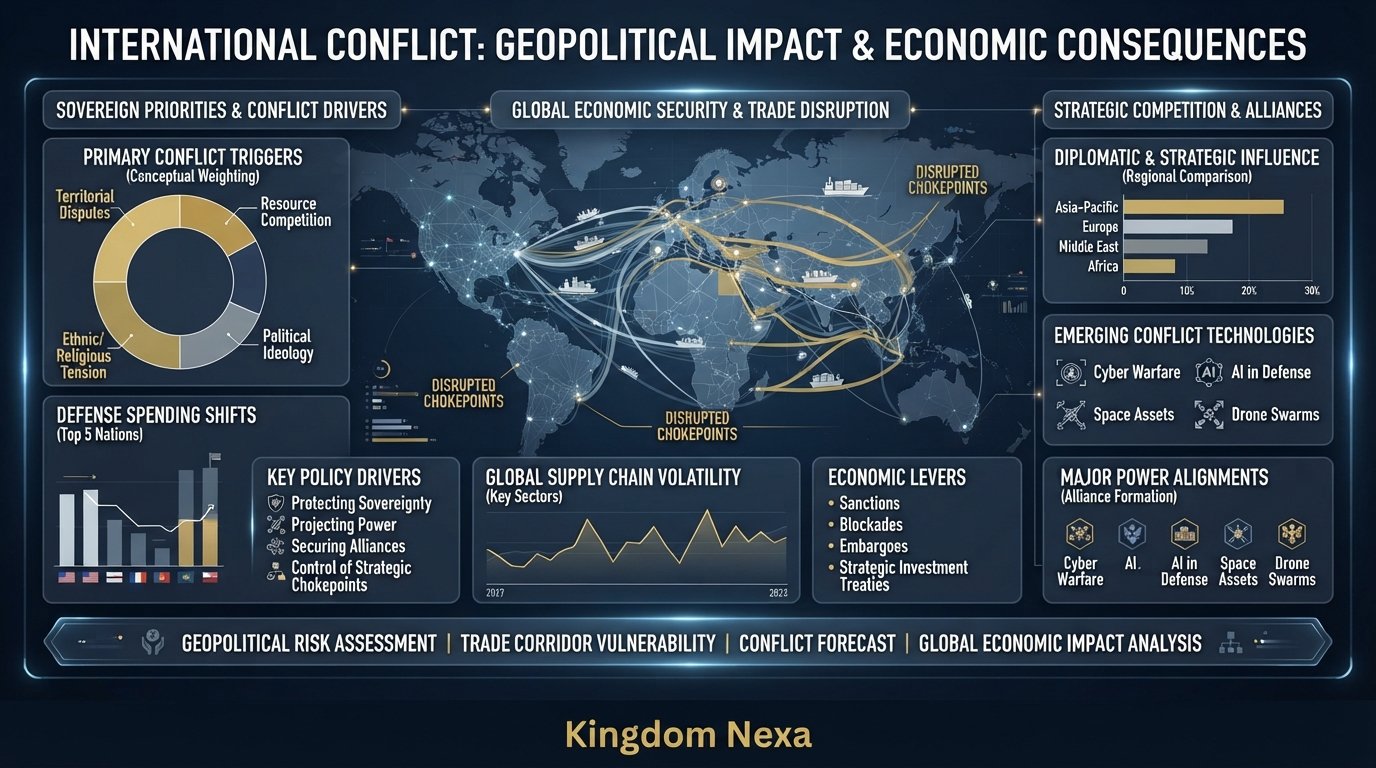
International conflict is one of the defining forces shaping the modern international system. It can involve direct warfare between states, conflicts involving governments and armed groups, proxy struggles, territorial disputes, competition over resources, or confrontations that remain below the threshold of open war. Its effects rarely remain confined to the battlefield. A conflict in one region can influence energy prices, trade routes, migration, military alliances, food security, investment decisions, cybersecurity, and diplomatic relations worldwide.
The contemporary conflict environment is particularly complex because traditional military power now operates alongside economic coercion, drones, cyber operations, information campaigns, sanctions, satellite technology, and diplomatic pressure. At the same time, conflicts such as those in Ukraine, Sudan, Gaza and Myanmar demonstrate how prolonged violence can generate humanitarian and economic consequences far beyond the immediate combat zone. UNHCR reported 117.8 million forcibly displaced people worldwide at the end of 2025, although that represented a decline from the record 123.2 million recorded at the end of 2024. [1]
Understanding international conflict therefore requires more than identifying who is fighting whom. It requires examining history, geography, political interests, security calculations, economics, international law, technology, regional dynamics and the institutions attempting to prevent escalation.
What Is International Conflict?
International conflict refers broadly to serious disputes or confrontations involving states or other internationally significant actors whose interests, objectives or actions come into sustained opposition.
The term can describe military confrontation, but armed force is not always necessary. States may compete through sanctions, diplomatic pressure, economic restrictions, cyber operations, intelligence activities, proxy forces or strategic competition while avoiding direct war.
In international humanitarian law, however, the terminology is more precise. The International Committee of the Red Cross defines an international armed conflict as a situation in which two or more states resort to armed force against one another. Even relatively limited clashes between state armed forces can trigger the application of international humanitarian law. [2]
This distinction matters because international conflict is a broad analytical concept, whereas international armed conflict is a specific legal classification.
International Conflict vs. International Armed Conflict
An international conflict may include:
- Territorial disputes
- Diplomatic crises
- Economic confrontation
- Proxy competition
- Cyber confrontation
- Political disputes
- Resource competition
- Military deterrence and coercion
- Direct interstate warfare
An international armed conflict is narrower and concerns armed force between states under international humanitarian law.
The distinction prevents analysts from treating every geopolitical rivalry as a war. A dispute between major powers can remain diplomatic or economic even when military forces are deployed nearby.
What Causes International Conflict?
International conflict rarely has one cause. Most major conflicts emerge from several interacting political, security, historical, economic and social pressures.
Security Dilemmas and Fear
A central mechanism is the security dilemma. One state may strengthen its military because it feels threatened. Other states can interpret that buildup as preparation for aggression and respond by increasing their own capabilities.
The result can be a cycle in which defensive measures are interpreted as offensive preparations.
This dynamic can become particularly dangerous when states have limited trust, unresolved territorial disputes or short warning times for military decisions.
Territorial Disputes
Control of territory remains one of the most persistent sources of international conflict.
Territory can provide:
- Strategic depth
- Access to ports
- Control of transport corridors
- Natural resources
- Military advantages
- Political legitimacy
- Influence over neighboring regions
Territorial disputes may also become intertwined with national identity, historical memory and domestic politics, making compromise more difficult.
Competition for Political Influence
International conflict can develop when states seek influence over strategically important regions.
Major powers may compete over:
- Alliances
- Military access
- Diplomatic partnerships
- Trade networks
- Critical infrastructure
- Political influence
- Technology standards
This does not automatically produce war. Diplomatic institutions, economic interdependence and deterrence can restrain competition. But when strategic interests become incompatible, the probability of confrontation can increase.
Economic and Resource Pressures
Natural resources can contribute to international conflict when their control has major strategic or economic value.
Oil, natural gas, minerals, freshwater, agricultural land and maritime resources can affect national security calculations. Resource competition becomes especially complicated when boundaries are disputed or when governments depend heavily on resource revenues.
Economic relationships can also become instruments of conflict. Sanctions, export controls, investment restrictions and financial pressure increasingly form part of modern geopolitical competition.
Historical Grievances and Nationalism
Historical disputes can remain politically relevant for generations.
Past wars, colonial boundaries, population movements, ethnic tensions and competing historical narratives can influence contemporary foreign policy.
Nationalism can intensify these disputes by transforming territorial or political questions into issues of national identity.
How Does International Conflict Escalate?
Conflict escalation is rarely a single event. It usually develops through a sequence of decisions and reactions.
A simplified escalation pathway may look like this:
Political dispute → diplomatic crisis → economic pressure → military signaling → limited confrontation → wider hostilities
Not every conflict follows this sequence. Some de-escalate at any stage.
Miscalculation and Signaling
States communicate strategic intentions through military exercises, troop deployments, public statements, diplomatic messages and weapons transfers.
The problem is that signals can be misunderstood.
A military exercise intended as deterrence may be interpreted as preparation for attack. Conversely, a state may underestimate another actor’s willingness to use force.
Alliances and External Support
Alliances can deter aggression by raising the potential cost of attacking a member state.
At the same time, external military, financial or intelligence support can internationalize a conflict without necessarily creating a direct war between supporting states.
This is one reason modern conflicts can involve multiple layers of participation.
Proxy Conflict
A proxy conflict occurs when external powers support local actors rather than directly fighting one another.
Support may include:
- Weapons
- Intelligence
- Financing
- Training
- Political backing
- Logistics
- Technology
Proxy relationships can make negotiations more complicated because the local parties and external supporters may have different objectives.
Major International Conflicts and Crisis Zones Today
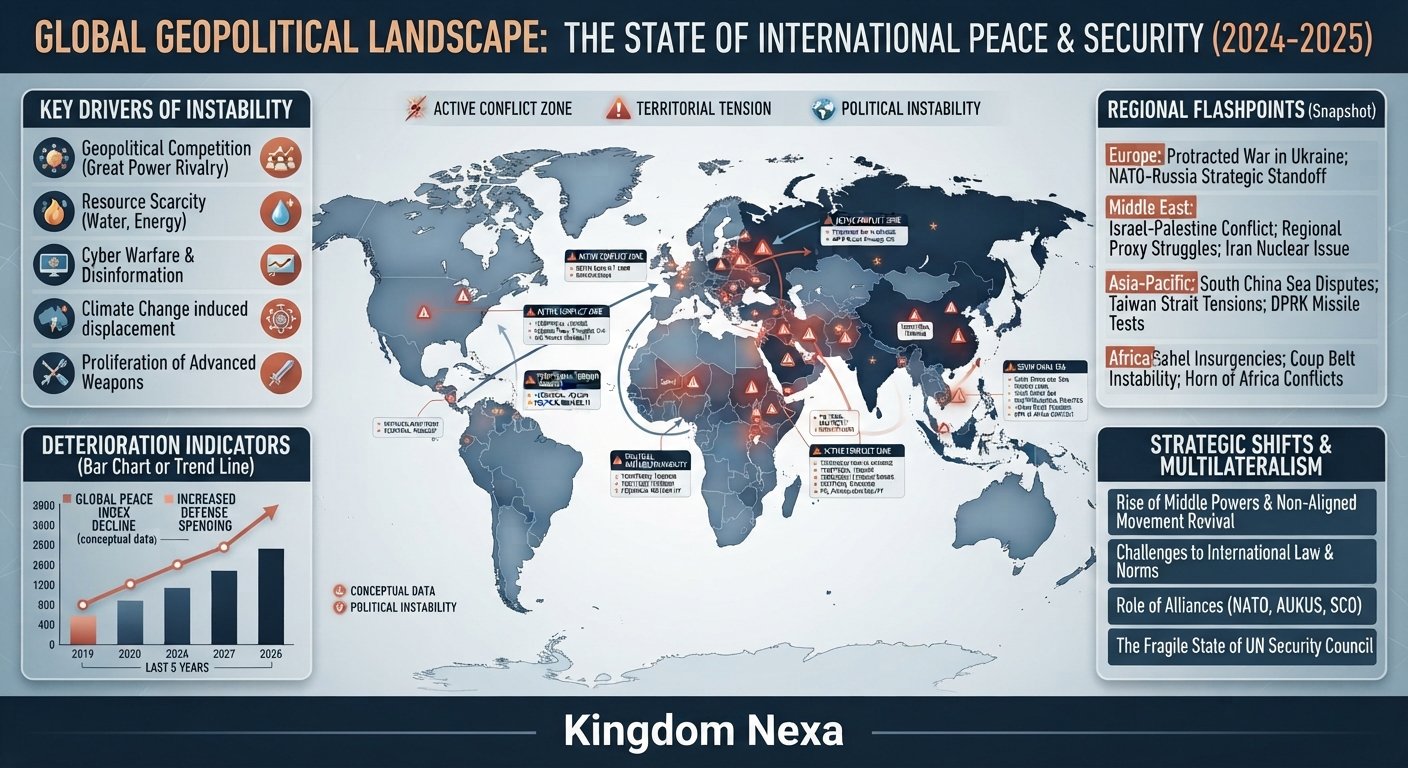
The global conflict environment in 2026 cannot be reduced to a single confrontation. Several conflicts continue to produce significant humanitarian, political and strategic consequences.
Current-status note: conditions can change rapidly. The following examples describe the situation based on UN and other authoritative reporting available through September 23, 2026.
Ukraine
Russia’s war against Ukraine remains a major interstate conflict with consequences for European security, military spending, energy infrastructure, food systems and international diplomacy.
UN reporting in September 2026 continued to raise concerns about the human impact of attacks on Ukraine’s critical energy infrastructure as winter approached. [3]
The conflict has also contributed to a broader European reassessment of defense capabilities. SIPRI reported that European military expenditure rose by 14 percent in 2025, while global military expenditure reached approximately $2.887 trillion. [4]
The strategic significance of the war therefore extends beyond the battlefield. It affects NATO’s security environment, European defense planning, sanctions policy, energy relationships and the wider relationship between Russia and Western states.
Sudan
Sudan remains one of the world’s most severe conflict and humanitarian crises.
The war that began in April 2023 between the Sudanese Armed Forces and the Rapid Support Forces has produced extensive displacement, destruction and humanitarian need. The UN reported that the conflict continued through 2025, with civilian deaths increasing significantly and violations of international humanitarian and human rights law continuing. [5]
The conflict also illustrates how international conflict and internal conflict can overlap with regional geopolitics. Neighboring states, humanitarian organizations and external powers can be affected by refugee movements, arms flows, border insecurity and economic disruption.
Gaza and the Israeli-Palestinian Conflict
The conflict involving Israel and Palestinian armed groups remains a major international security and humanitarian issue.
UN reporting in September 2026 stated that, despite a ceasefire announced in October 2025, hostilities and airstrikes continued in Gaza and most of the population remained displaced. Humanitarian agencies also reported major constraints on access and continuing damage to civilian infrastructure. [6]
The legal dimensions are particularly complex. International humanitarian law applies to armed conflicts regardless of which side initiated the fighting and requires parties to distinguish between civilians and military objectives, take feasible precautions and comply with proportionality rules. [7]
Claims concerning alleged violations of international law require careful distinction between documented findings, allegations and ongoing legal proceedings.
Myanmar
Myanmar demonstrates how prolonged internal conflict can acquire major international consequences.
The country’s conflict and political crisis have generated extensive displacement, humanitarian needs and regional diplomatic challenges. UNICEF reported that 16.2 million people required humanitarian assistance during the first half of 2026 and that nearly 3.8 million people were internally displaced as of June. [8]
The Independent Investigative Mechanism for Myanmar reported in September 2026 that serious international crimes were being committed with increasing frequency and intensity and highlighted continuing aerial attacks affecting civilians. [9]
Myanmar also demonstrates why international conflict analysis cannot focus exclusively on conventional interstate warfare. Civil wars can have cross-border consequences involving refugees, regional security, humanitarian operations and diplomatic intervention.
The Role of Geography in International Conflict
Geography influences both the causes and consequences of conflict.
A country’s location can determine its exposure to:
- Strategic chokepoints
- Mountain passes
- Maritime routes
- Border disputes
- Energy corridors
- Trade routes
- Neighboring military powers
- Resource competition
Strategic Chokepoints
Maritime chokepoints such as major canals, straits and narrow sea passages can have significance far beyond their geographic size.
Disruption in a strategically important shipping corridor can affect global transportation costs, insurance premiums, energy deliveries and supply chains.
Borderlands and Buffer Zones
Border regions can become strategically important because they separate competing security systems.
States may seek buffer zones to reduce vulnerability to military attack, while neighboring states may view the same behavior as territorial expansion or coercion.
This is why geography often interacts with the security dilemma.
Military Dimensions of International Conflict
Military power remains central to international conflict, but its character is changing.
Traditional capabilities such as aircraft, tanks, artillery, naval forces and missiles remain important. They now operate alongside drones, satellite systems, cyber capabilities, precision weapons and advanced surveillance.
Drones and Autonomous Systems
Drones have lowered the cost of surveillance and precision attacks while increasing the ability of smaller actors to challenge larger forces.
They can be used for:
- Intelligence, surveillance and reconnaissance
- Target acquisition
- Battlefield assessment
- Precision strikes
- Maritime surveillance
- Logistics
The growing importance of unmanned systems is changing military planning and raising new legal and ethical questions.
Cyber Operations
Cyber operations can target government networks, communications systems, financial institutions and critical infrastructure.
Their strategic value lies partly in their ability to disrupt an adversary without immediately crossing the threshold of conventional armed attack.
Attribution is one of the central difficulties. Establishing who conducted a cyber operation can be technically and politically difficult.
Space and Satellite Technology
Modern conflicts increasingly depend on satellites for communications, navigation, imagery and intelligence.
Damage to space-based infrastructure can therefore have consequences far beyond traditional military operations.
Economic Effects of International Conflict
International conflict creates economic costs both locally and globally.
Trade and Supply Chains
War can disrupt:
- Ports
- Roads
- Railways
- Industrial facilities
- Shipping routes
- Agricultural production
- Energy infrastructure
Companies may respond by changing suppliers, increasing inventories or relocating production.
Military Spending
Rising security concerns can produce sustained increases in military expenditure.
SIPRI estimated global military expenditure at $2.887 trillion in 2025, representing an 11th consecutive annual increase. Global military spending was equivalent to about 2.5 percent of world GDP. [4]
Military spending can strengthen deterrence and defense capacity, but it also creates opportunity costs when public resources are shifted away from other priorities.
Economic Development
Conflict can permanently damage economic potential.
The World Bank reports that high-intensity conflicts are typically followed by a cumulative decline of about 20 percent in GDP per capita after five years relative to pre-conflict projections. [10]
Conflict can destroy infrastructure, reduce investment, weaken institutions and push skilled workers to leave.
Humanitarian Consequences
The humanitarian dimension is often the most immediate consequence of international conflict.
People may experience:
- Death and injury
- Displacement
- Food insecurity
- Loss of housing
- Destruction of schools
- Collapse of healthcare services
- Family separation
- Psychological trauma
- Loss of livelihoods
UNHCR’s 2026 Global Trends data recorded 117.8 million forcibly displaced people worldwide at the end of 2025. The figure included refugees, asylum-seekers, internally displaced people and others requiring international protection. [11]
The decline from the previous year’s record level should not be interpreted as evidence that global displacement is no longer a major crisis. The absolute number remains exceptionally large.
Image/Infographic: Global map showing major conflict and crisis zones, categorized by interstate war, civil war, political violence and major humanitarian displacement.
Placement: Immediately after the H2 section “Humanitarian Consequences”
Purpose: Demonstrate geographically how conflict and displacement affect multiple regions simultaneously rather than presenting international conflict as a single-war phenomenon.
International Law and International Conflict
International law provides two related but distinct frameworks.
Jus ad Bellum
The UN Charter establishes restrictions on the use of force between states. The basic rule is contained in Article 2(4), while the Charter recognizes important legal exceptions including self-defense under Article 51 and force authorized by the Security Council.
The question of whether a state was legally entitled to use force is therefore different from the question of how its forces must behave once fighting begins.
International Humanitarian Law
International humanitarian law regulates conduct during armed conflict.
The ICRC explains that IHL is distinct from the legal rules governing whether force may lawfully be initiated. Its purpose is to limit suffering during conflict and protect people who are not, or are no longer, participating in hostilities. [7]
Core principles include:
- Distinction between civilians and combatants
- Distinction between civilian objects and military objectives
- Proportionality
- Precautions in attack
- Humane treatment of detainees
- Protection of medical personnel and facilities
These rules apply to parties regardless of whether their political cause is considered legitimate.
International Organizations and Conflict Management
International institutions attempt to prevent, contain and resolve conflicts.
United Nations
The UN can provide:
- Diplomatic mediation
- Peacekeeping
- Humanitarian coordination
- Sanctions mechanisms
- Investigative mechanisms
- Security Council action
- General Assembly diplomacy
The Security Council’s structure also creates constraints. Permanent members possess veto powers, which can make collective action difficult when major powers disagree.
Regional Organizations
Regional institutions can sometimes respond more quickly because they understand local political and security conditions.
Examples include the African Union, European Union, ASEAN, Arab League and Organization of American States.
Their effectiveness varies according to their mandates, resources, political cohesion and the willingness of member states to cooperate.
Domestic Politics and International Conflict
Foreign policy does not operate independently of domestic politics.
Governments must consider:
- Public opinion
- Elections
- Economic conditions
- National identity
- Military institutions
- Business interests
- Political opposition
- Media environments
Domestic pressures can encourage governments to take stronger positions abroad, but they can also create incentives for compromise when the costs of continued conflict become politically significant.
The relationship works in both directions: international conflict can reshape domestic politics just as domestic political changes can alter foreign policy.
Technology and the Changing Nature of Conflict
Technology is altering how states and non-state actors compete.
Artificial intelligence can improve intelligence analysis, targeting support, logistics and surveillance. Cyber tools can disrupt information systems. Commercial satellites can provide imagery that was once available primarily to governments.
Social media has also transformed information warfare. Governments, armed groups and political organizations can communicate directly with global audiences.
This creates a new strategic environment in which the battlefield extends into the digital and informational domains.
Image/Infographic: Layered diagram showing modern international conflict across five domains: land and sea, air, space, cyberspace and information.
Placement: Within the opening of the H2 section “Technology and the Changing Nature of Conflict”
Purpose: Explain visually why contemporary conflict is multidomain rather than limited to conventional battlefield operations.
Why International Conflict Matters to the Global Economy
A conflict can influence countries that are geographically distant from the battlefield.
The transmission mechanisms include:
Conflict → commodity disruption → higher prices → inflationary pressure → tighter economic policy
Another pathway is:
Conflict → displacement → pressure on neighboring states → increased humanitarian expenditure → political and economic strain
Global companies face additional risks involving sanctions, shipping insurance, infrastructure security, supply-chain reliability and investment uncertainty.
For developing economies, these shocks can be particularly difficult because fiscal space is often limited.
What Are the Major Risks of International Conflict?
The consequences of international conflict can be grouped into several interconnected risks.
Escalation Risk
A limited confrontation can expand if additional states become directly involved.
Humanitarian Risk
Long wars can overwhelm healthcare, food systems, shelter capacity and humanitarian funding.
Economic Risk
Prolonged instability can damage investment, trade and infrastructure while increasing military and emergency expenditures.
Nuclear Risk
When nuclear-armed states become involved in a crisis, deterrence can prevent direct confrontation but also creates severe consequences if signaling fails or escalation becomes uncontrolled.
Cyber and Infrastructure Risk
Attacks on energy, communications, financial or transportation systems can affect civilians even when they are far from the physical battlefield.
What Could Happen Next?
Future developments in international conflict are inherently uncertain. Rather than predicting a single outcome, analysts can consider several broad scenarios.
Scenario 1: Managed Competition
Major powers continue strategic rivalry but use diplomacy and deterrence to prevent direct war.
Scenario 2: Prolonged Fragmented Conflict
Several regional conflicts remain active simultaneously, producing repeated humanitarian crises and economic disruption.
Scenario 3: Negotiated De-escalation
Some conflicts move toward ceasefires, political negotiations or transitional arrangements, although implementation remains difficult.
Scenario 4: Wider Regional Escalation
A local conflict expands when external actors become directly involved or when attacks spread across borders.
The likelihood of any scenario depends on decisions by governments and non-state actors, military developments, economic conditions, diplomatic initiatives and unexpected events.
Frequently Asked Questions About International Conflict
What is international conflict?
International conflict is a broad term describing serious disputes or confrontations involving states or other internationally significant actors. It may involve military force, territorial disputes, economic pressure, diplomacy, proxy competition or other forms of strategic confrontation.
What is an international armed conflict?
Under international humanitarian law, an international armed conflict generally exists when two or more states resort to armed force against one another. The ICRC notes that even relatively limited clashes between state armed forces can qualify. [2]
What are the main causes of international conflict?
Common drivers include territorial disputes, security dilemmas, political competition, historical grievances, nationalism, resource competition, economic interests and disputes over regional influence. Most major conflicts involve several interacting causes.
What is the difference between international and civil conflict?
An international armed conflict involves states fighting one another. A non-international armed conflict generally involves government forces and organized non-state armed groups, or armed groups fighting each other. International humanitarian law contains rules applicable to both categories. [2]
How does international conflict affect the global economy?
Conflict can disrupt trade, energy supplies, shipping, investment, agriculture and supply chains. It can also increase military expenditure, inflationary pressure and reconstruction costs.
How does international conflict cause displacement?
Violence can destroy homes and livelihoods or make communities unsafe, forcing people to flee within their country or across international borders. Conflict is one of the major drivers of global forced displacement.
What role does the United Nations play in international conflict?
The UN can facilitate diplomacy, authorize certain Security Council measures, deploy peacekeeping operations, coordinate humanitarian assistance and support mediation and conflict-prevention efforts.
Does international law prohibit war?
International law places significant restrictions on the use of force between states. The UN Charter generally prohibits the use of force against the territorial integrity or political independence of states, while recognizing specific legal exceptions such as self-defense and Security Council authorization. [12]
Why are modern conflicts becoming more technologically complex?
Military forces increasingly combine conventional weapons with drones, cyber operations, satellites, precision systems, electronic warfare and information operations. Technology has therefore expanded the number of domains in which conflict can occur.
Conclusion
International conflict is not simply a contest between armies. It is a complex interaction of power, geography, history, economics, diplomacy, technology and domestic politics.
The conflicts of the mid-2020s demonstrate how quickly local violence can produce international consequences. Wars can reshape alliances, redirect military spending, disrupt trade, generate displacement and create pressure on international institutions. At the same time, economic and technological competition can intensify strategic rivalries without immediately producing conventional war.
The most useful way to understand International Conflict is therefore to examine both the immediate confrontation and the wider system surrounding it: who the actors are, what they want, why geography matters, how escalation occurs, which international rules apply, and how consequences spread beyond the battlefield.
The global conflict environment remains fluid as of September 2026. Some conflicts may move toward negotiated settlements, while others may remain prolonged or develop into wider regional crises. The central challenge for governments and international institutions is to manage competition without allowing disputes to cross thresholds from which peaceful resolution becomes increasingly difficult.