International conflict is one of the defining challenges of the modern international system. From wars between states to prolonged conflicts involving governments, armed groups, external powers, and transnational networks, contemporary conflict increasingly crosses political, economic, technological, and geographic boundaries. The consequences rarely remain confined to the battlefield. War can disrupt trade, energy supplies, food security, migration, investment, diplomacy, and global political stability.
The scale of the problem is significant. According to the Uppsala Conflict Data Program (UCDP), 65 conflicts involving states were recorded in 2025, the highest number since its records began in 1946. Thirteen reached the threshold used by UCDP to classify a conflict as a war. UCDP also recorded approximately 244,600 deaths from organized violence in 2025.
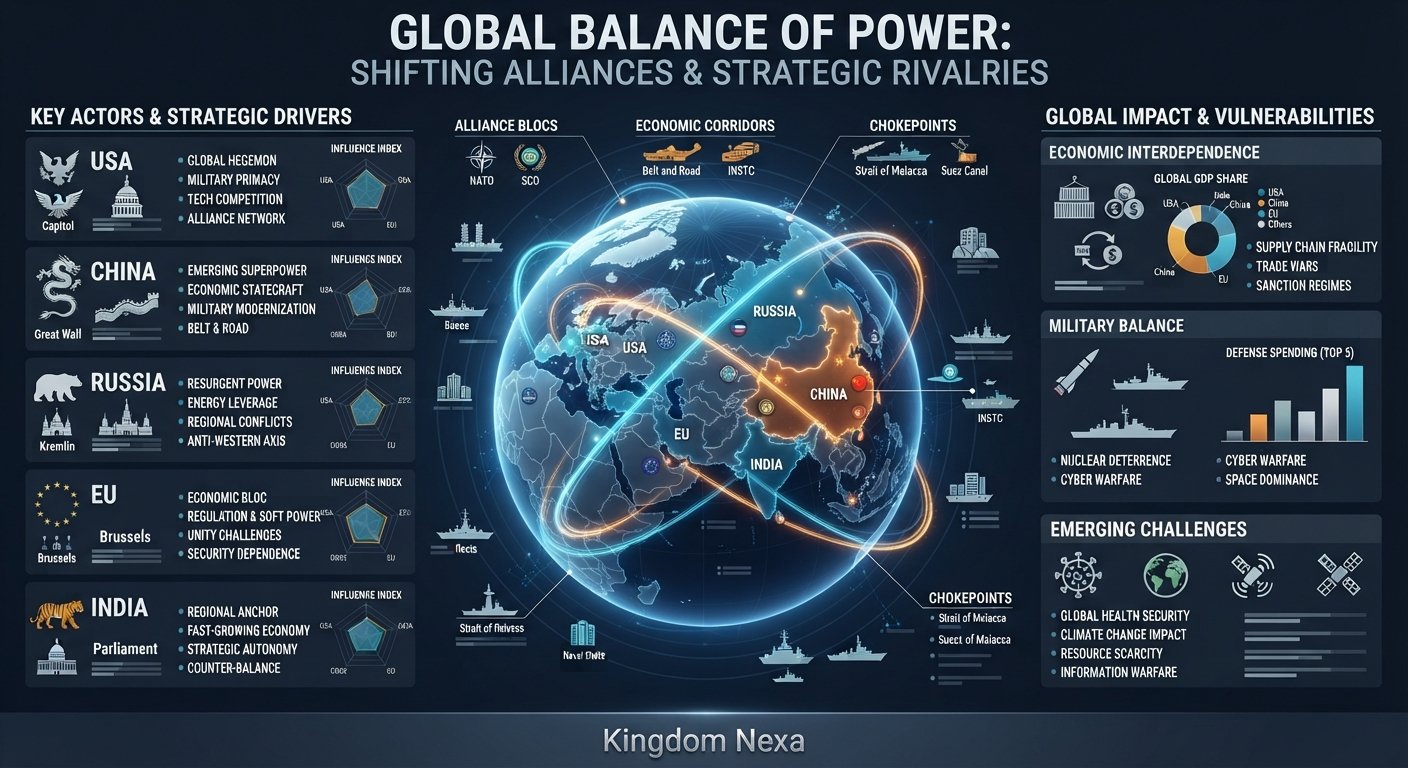
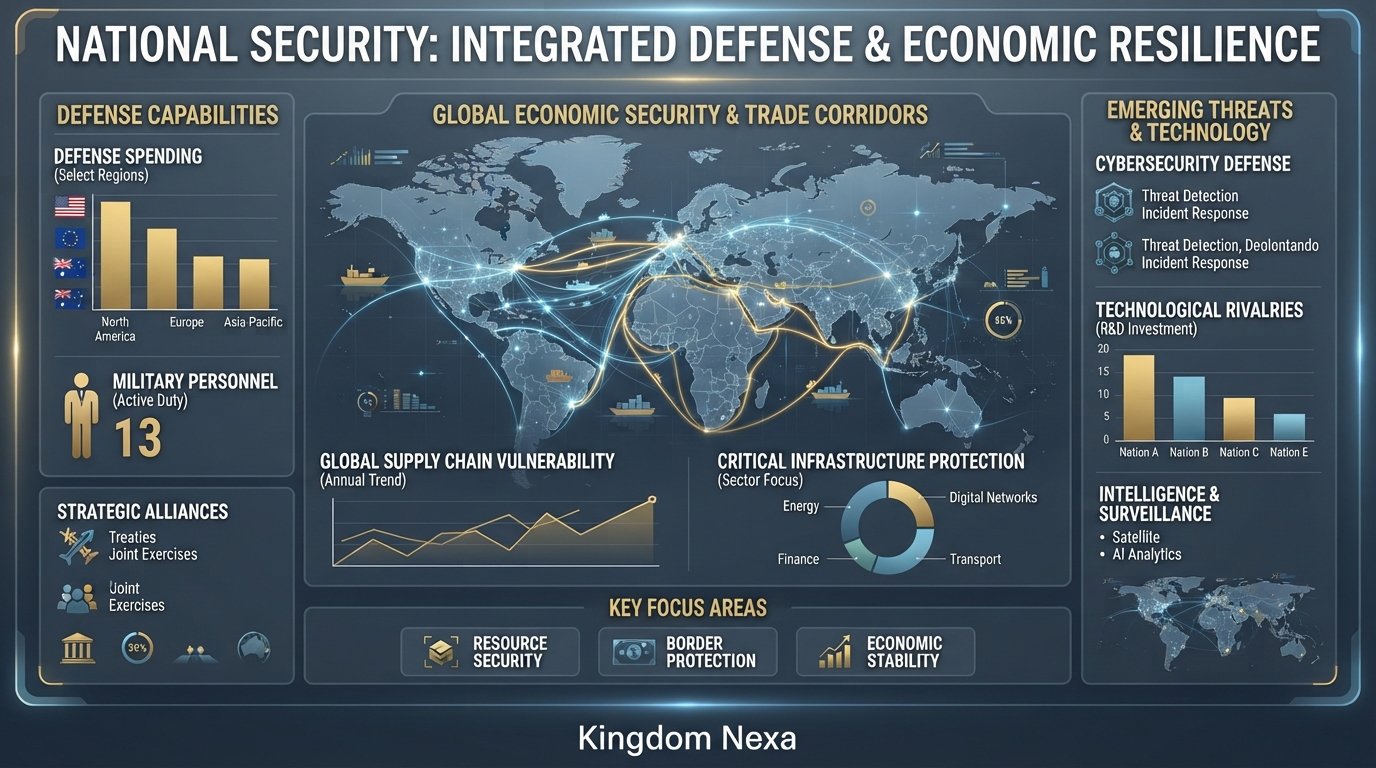
At the same time, international conflict is becoming more interconnected. Conventional warfare now operates alongside drones, cyber operations, economic sanctions, information campaigns, satellite systems, artificial intelligence, proxy relationships, and competition over strategic infrastructure.
This article explains what international conflict means, why conflicts emerge, how they are changing, what international law says, and why today’s conflicts matter far beyond their immediate geographic locations.
What Is International Conflict?
International conflict generally refers to serious disputes or confrontations involving states or other internationally significant actors in which competing political, territorial, security, economic, ideological, or strategic interests cannot be peacefully reconciled.
The term can describe several different situations. A direct war between two states is an obvious example, but international conflict can also involve civil wars with substantial external intervention, proxy conflicts, territorial disputes, military confrontations, or prolonged geopolitical rivalries.
From the perspective of international humanitarian law, the distinction between an international armed conflict and a non-international armed conflict is particularly important. The International Committee of the Red Cross explains that an international armed conflict involves two or more states resorting to armed force against one another, while non-international armed conflicts generally involve governments and organized non-state armed groups, or such groups fighting one another.
This legal classification is different from the broader geopolitical use of the term “international conflict.” A conflict can have international consequences without being legally classified as an international armed conflict.
International Conflict vs. International Armed Conflict
These concepts should not be treated as identical.
International conflict is a broad analytical concept. It can include diplomatic confrontation, strategic rivalry, sanctions disputes, territorial tensions, proxy warfare, and armed conflict.
International armed conflict, by contrast, is a specific legal classification under international humanitarian law. Once the relevant legal threshold is met, the rules governing the conduct of hostilities and protection of civilians apply regardless of whether the parties formally declare a war.
That distinction matters because political descriptions and legal classifications serve different purposes.
Why Does International Conflict Happen?
International conflict rarely has a single cause. Most major conflicts emerge from several interacting factors.
Territorial Disputes
Competition over territory remains one of the most persistent causes of conflict.
Borders may be disputed because of colonial-era boundaries, competing historical claims, strategic geography, ethnic divisions, access to resources, or disagreements over sovereignty.
Territory can also have military significance. A mountain pass, coastline, island, river valley, port, or strategic corridor may provide an important advantage. As a result, territorial disputes can become security problems even when the territory itself has limited economic value.
Competition for Political Power
Governments and political movements may compete over who controls the state, who determines national policy, or which political system will dominate.
Domestic political struggles can become internationalized when neighboring states, major powers, diaspora networks, or international organizations become involved.
This is particularly important in fragile states where institutions are weak and political competition is closely connected with control over armed forces, natural resources, taxation, or territory.
Security Dilemmas
A security dilemma occurs when one state’s attempt to improve its security makes another state feel less secure.
For example, State A may increase military spending because it fears State B. State B may interpret the buildup as preparation for aggression and respond by increasing its own military capabilities. The result can be an arms competition even when neither side originally intended to initiate a war.
Security dilemmas are especially dangerous when combined with mistrust, weak communication channels, disputed borders, or rapidly changing military technology.
Economic and Resource Competition
Natural resources can contribute to conflict when political institutions cannot distribute their benefits peacefully.
Oil, gas, minerals, water, agricultural land, and strategic trade routes can all become sources of competition. Economic grievances can also interact with political exclusion, corruption, inequality, and weak governance.
However, resources alone do not automatically produce war. Institutions, political incentives, external involvement, and the distribution of resource revenues often determine whether competition becomes violent.
Identity, Nationalism and Historical Grievances
National identity can strengthen social cohesion, but it can also intensify conflict when political leaders portray another group as an existential threat.
Historical memories of invasion, occupation, discrimination, displacement, or violence may remain politically influential for generations.
Such grievances can make compromise more difficult because territorial or political concessions may be interpreted domestically as surrender rather than negotiation.
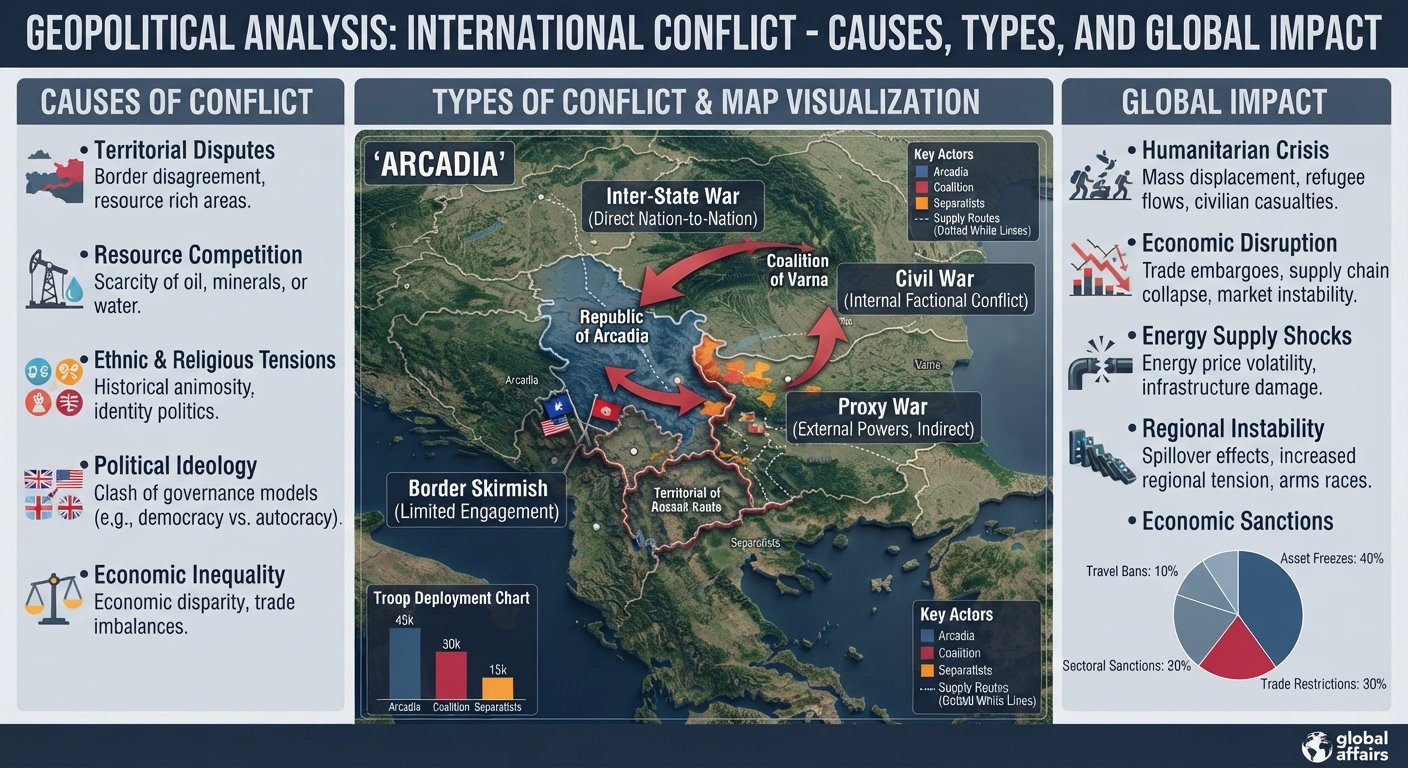
Major Types of International Conflict
International conflict takes several forms, and modern crises often combine multiple categories.
Interstate Conflict
Interstate conflict occurs when governments of different states become directly involved in armed hostilities.
These conflicts can range from limited border clashes to full-scale wars involving air, land, maritime, cyber, and missile operations.
UCDP reported that the number of conflicts between states rose sharply in 2025. It recorded eight interstate conflicts, the highest figure in its dataset since 1946.
Civil War With External Intervention
A conflict may begin primarily within one country but become internationalized when foreign governments provide weapons, funding, intelligence, troops, air support, diplomatic backing, or other forms of assistance.
External intervention can alter the balance between domestic actors and make negotiations more complicated.
Proxy Conflict
In a proxy conflict, external powers support local actors to pursue broader strategic interests without necessarily engaging in unrestricted direct war with one another.
Proxy relationships can reduce the political cost of intervention for powerful states, but they can also prolong conflicts by providing combatants with resources to continue fighting.
Territorial and Border Conflict
Border disputes can remain frozen for decades before becoming active again.
The risk increases when political relations deteriorate, military deployments change, or domestic leaders believe that confrontation will produce strategic or political benefits.
Hybrid and Gray-Zone Conflict
Modern competition increasingly occurs below the threshold of conventional war.
States may employ cyber operations, economic pressure, disinformation, covert operations, political influence, maritime coercion, sanctions, intelligence activities, or support for non-state actors.
These methods can create strategic effects while making attribution and escalation management more difficult.
Current International Conflict Landscape in 2026
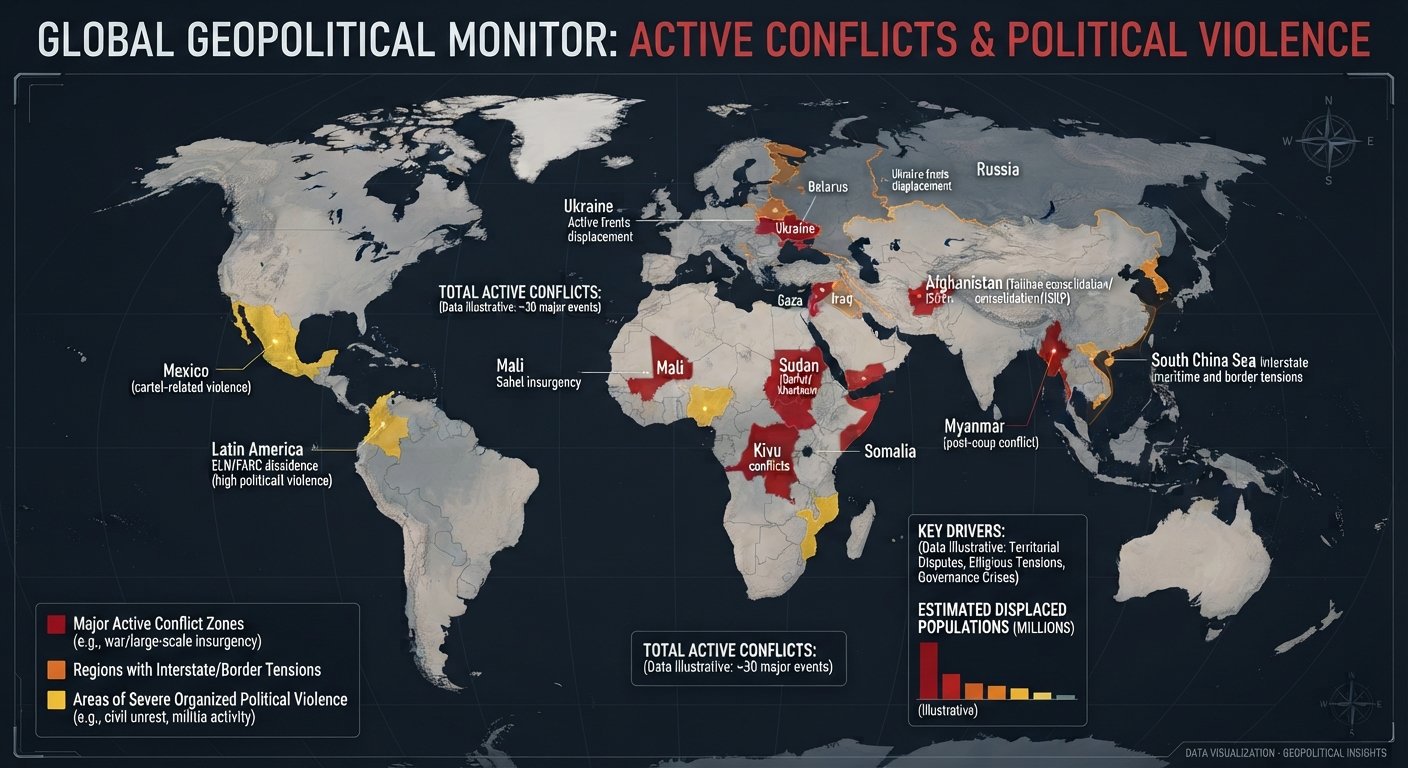
The international security environment in 2026 is characterized by a combination of active wars, interstate tensions, internal conflicts with external involvement, and increasingly complex geopolitical competition.
UCDP’s latest annual assessment provides an important baseline. It recorded 65 state-involved conflicts during 2025, the highest annual number in its historical dataset. Thirteen were classified as wars. The organization also estimated around 244,600 deaths from organized violence in 2025, making it one of the most violent years recorded in the modern period.
The Russia–Ukraine war remained the deadliest conflict in UCDP’s 2025 dataset, with at least 94,700 fatalities recorded by the program. The organization also identified the wars involving Israel and Hamas and the conflict in Sudan among the world’s deadliest conflicts that year.
Conflict is not evenly distributed. Severe violence continues across parts of Europe, the Middle East, Africa and Asia, while some long-running conflicts have simultaneously experienced de-escalation or peace processes.
ACLED’s Conflict Index illustrates another dimension of the problem. It recorded more than 204,000 conflict events between December 2024 and November 2025, resulting in more than 240,000 deaths according to its methodology. Ukraine and Palestine accounted for more than 40% of recorded conflict events during that period.
The methodologies of UCDP and ACLED differ, so their figures should not be treated as directly interchangeable. Nevertheless, both datasets demonstrate the scale and geographic breadth of contemporary political violence.
Europe: The Russia–Ukraine War
The Russia–Ukraine war remains central to European security and the broader international order.
Its significance extends beyond the battlefield. The war has affected European defense planning, energy policy, sanctions regimes, arms production, NATO strategy, food markets, and relations between Russia and Western states.
It has also contributed to increased military spending across Europe. SIPRI reported that European military expenditure rose by 14% in real terms in 2025 to approximately $864 billion, reflecting the continuing war and broader European rearmament.
Middle East
The Middle East remains one of the most strategically important conflict environments because political disputes intersect with energy security, maritime routes, regional alliances, missile capabilities, non-state armed groups, and external-power involvement.
The Israel-Palestinian conflict has broader regional consequences, while tensions involving Iran, Israel, Lebanon, Syria, and other regional actors have demonstrated how quickly local confrontations can acquire wider strategic implications.
The region also illustrates the difficulty of separating domestic, regional, and international conflict.
Africa
Africa contains several major conflict environments, including Sudan and parts of the Sahel and Great Lakes region.
Sudan has been particularly devastating. UCDP reported a sharp rise in one-sided violence against civilians during 2025, contributing significantly to the global increase in civilian deaths.
In the Democratic Republic of the Congo, conflict in the east has continued to produce severe humanitarian consequences. UNHCR reported that security and humanitarian conditions deteriorated in parts of North Kivu, South Kivu and Ituri during 2025 and that the conflict continued into 2026 despite diplomatic agreements.
Asia and the Indo-Pacific
Asia combines active conflicts with major strategic rivalries.
The region includes unresolved territorial disputes, tensions surrounding major maritime routes, military competition, nuclear deterrence relationships, and competition between major powers.
The Indo-Pacific is particularly important because economic interdependence and strategic competition coexist. A major military crisis in the region could therefore produce consequences far beyond the countries directly involved.
The Humanitarian Consequences of International Conflict
The human cost of international conflict extends far beyond battlefield casualties.
War can destroy homes, hospitals, schools, transport infrastructure, agricultural systems, electricity networks, and water supplies. It can also create long-term psychological and social consequences.
Forced Displacement
Conflict remains a major driver of forced displacement.
UNHCR reported that 117.8 million people were forcibly displaced worldwide at the end of 2025 because of persecution, conflict, violence, human-rights violations, or events seriously disturbing public order. This represented a decline from 2024, the first annual decline in a decade, but the total remained extraordinarily high.
The decrease should not be interpreted as evidence that the global conflict problem has been solved. Returns increased in several major displacement situations, but millions of people remained displaced.
At the end of 2025, UNHCR reported approximately 41.6 million refugees and 68.7 million people internally displaced by conflict or violence.
Economic and Social Damage
Conflict damages economies through several channels:
- Destruction of infrastructure
- Loss of productive capacity
- Reduced foreign investment
- Disruption of trade
- Higher defense spending
- Inflationary pressure
- Lower government revenues
- Human-capital losses
- Displacement of workers
- Disruption of education and healthcare
The effects can continue long after a ceasefire because damaged institutions and infrastructure may take years to rebuild.
Military Power and the Changing Character of Conflict
International conflict is also being transformed by technology.
Drones and Autonomous Systems
Drones have become increasingly important for surveillance, reconnaissance, targeting, logistics, and attack operations.
Their relatively low cost compared with some conventional weapons allows states and non-state groups to acquire capabilities that were previously more difficult to obtain.
The spread of drones also complicates air defense and raises questions about accountability when increasingly autonomous systems are used in combat.
Cyber Operations
Cyber operations can target government networks, military systems, financial institutions, telecommunications infrastructure, and critical services.
One of the major challenges is attribution. Determining who conducted a cyber operation can be technically and politically difficult, creating uncertainty over how a targeted state should respond.
Artificial Intelligence and Information Warfare
Artificial intelligence can assist intelligence analysis, image recognition, autonomous systems, cyber operations, logistics, and information campaigns.
At the same time, generative AI can make disinformation easier to produce and distribute. Synthetic media can complicate efforts to determine whether photographs, videos, audio recordings, or statements are authentic.
The result is a conflict environment in which controlling information can be almost as strategically important as controlling physical territory.
Space and Satellite Systems
Modern militaries increasingly depend on satellites for communications, navigation, intelligence, surveillance, and targeting.
This creates another strategic vulnerability. Disruption of satellite services could affect both military and civilian systems, including transportation, communications, financial services, and emergency response.
The Economic Dimension of International Conflict
War and geopolitical competition increasingly affect the global economy.
Trade and Supply Chains
A conflict near major ports, shipping corridors, rail networks, or energy routes can disrupt international trade.
Businesses may respond by changing suppliers, increasing inventories, moving production, or redesigning logistics networks.
This has contributed to growing interest in economic resilience and “de-risking” strategies.
Energy Security
Energy markets are especially sensitive to geopolitical instability.
Oil and gas disruptions can affect prices far beyond the conflict zone. Countries dependent on imported energy may accelerate diversification, while exporters may attempt to use energy relationships as instruments of strategic influence.
Sanctions and Economic Statecraft
Sanctions have become a major tool of international policy.
Governments can restrict trade, finance, technology transfers, investment, or access to specific markets in an attempt to change another state’s behavior.
However, sanctions can have unintended consequences. Their effectiveness depends on enforcement, international participation, the target state’s economic structure, and the availability of alternative markets.
International Organizations and Conflict Management
International organizations play several roles in conflict prevention and management.
United Nations
The United Nations provides a central diplomatic framework for international peace and security.
The Security Council can authorize certain collective measures, impose sanctions, establish peacekeeping operations, and address threats to international peace and security.
However, the veto power of the five permanent members can limit collective action when major powers disagree.
NATO and Regional Organizations
Regional organizations can provide security guarantees, military coordination, mediation, peacekeeping, or diplomatic mechanisms.
NATO remains central to Euro-Atlantic security, while organizations such as the African Union, European Union, ASEAN, Arab League, and other regional institutions address security challenges within their respective areas.
Their effectiveness varies according to political unity, institutional capacity, available resources, and the willingness of member states to cooperate.
International Law and International Conflict
International law provides an essential framework for understanding both the use of force and the conduct of warfare.
The UN Charter generally prohibits states from using force against the territorial integrity or political independence of another state, while recognizing important legal exceptions, including self-defense in response to an armed attack and force authorized by the UN Security Council.
This is distinct from international humanitarian law.
International humanitarian law does not generally determine whether starting a war was lawful. Instead, it regulates conduct once an armed conflict exists. It seeks to protect civilians and others who are not, or are no longer, participating in hostilities and limits permissible methods and means of warfare.
This distinction between jus ad bellum and jus in bello is fundamental to international conflict analysis.
Why Global Military Spending Matters
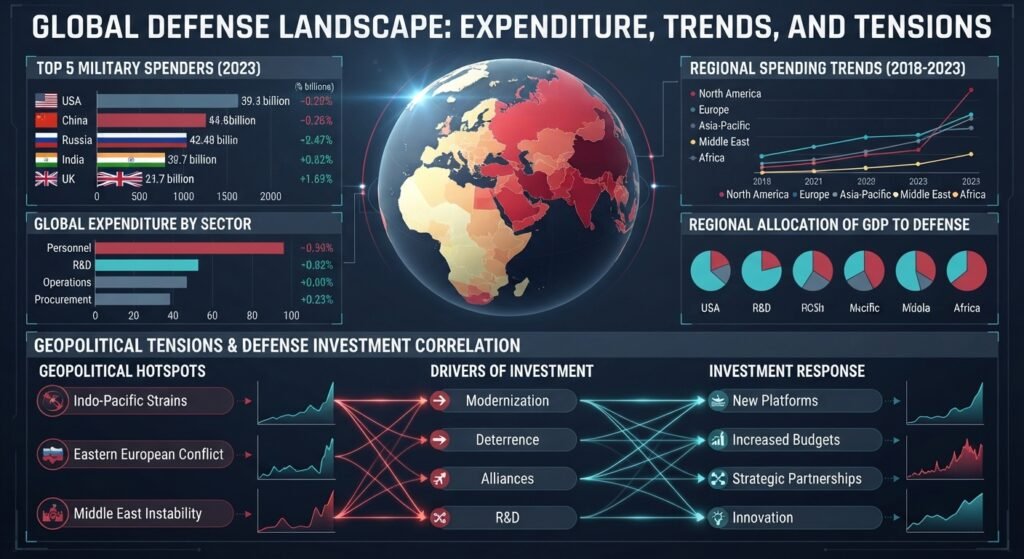
The growing intensity of geopolitical competition is reflected in military budgets.
SIPRI estimated that global military expenditure reached $2.887 trillion in 2025, a real-terms increase of 2.9% from 2024 and the eleventh consecutive annual increase. Global military spending represented approximately 2.5% of world GDP.
The increase is significant because military spending is both a response to insecurity and a potential contributor to security dilemmas.
One state’s military buildup can reassure its allies while simultaneously alarming rivals. If several states respond in the same way, military competition can become self-reinforcing.
What Makes Modern International Conflict Different?
Several characteristics distinguish contemporary conflicts from many earlier wars.
First, conflicts are increasingly interconnected. A regional war can affect energy markets, food prices, migration, cyber security, and diplomatic relations worldwide.
Second, the distinction between military and civilian domains is becoming less clear. Telecommunications, financial networks, satellites, ports, energy systems, and digital infrastructure can all become strategically important.
Third, conflicts increasingly involve combinations of state and non-state actors.
Fourth, information moves at extraordinary speed. Governments, militaries, journalists, activists, corporations, and ordinary citizens can distribute information globally within seconds.
Finally, nuclear weapons continue to impose a unique constraint on great-power conflict. Direct confrontation between nuclear-armed states carries escalation risks that can extend far beyond the original dispute.
How Can International Conflict Be Prevented?
Conflict prevention requires more than military deterrence.
Diplomacy and Communication
Direct communication can reduce miscalculation, particularly when military forces operate close to one another.
Hotlines, confidence-building measures, military-to-military communication, arms-control agreements, and diplomatic channels can help manage crises.
Strong Institutions
Effective institutions can provide peaceful mechanisms for resolving disputes.
Courts, arbitration bodies, legislatures, electoral institutions, regional organizations, and diplomatic mechanisms can all reduce the need to settle political disagreements through force.
Economic Cooperation
Economic interdependence does not guarantee peace, but mutually beneficial trade can increase the cost of conflict.
However, interdependence can also create vulnerabilities. Effective policy therefore requires a balance between openness and resilience.
Peace Agreements
Ceasefires can stop immediate violence, but durable peace usually requires addressing the political issues that generated the conflict.
Peace processes may need security guarantees, political reforms, power-sharing arrangements, disarmament, reintegration, transitional justice, or economic reconstruction.
Future Scenarios for International Conflict
Predicting international conflict with certainty is impossible. However, several broad scenarios are plausible.
Scenario 1: Managed Competition
Major powers may continue competing while maintaining mechanisms that prevent direct large-scale war.
This would involve military deterrence combined with diplomatic communication, selective cooperation, and crisis-management arrangements.
Scenario 2: Fragmented Regional Conflicts
Another possibility is a world characterized by multiple regional conflicts with limited coordination between major powers.
Such conflicts could remain geographically contained while producing global consequences through energy markets, migration, trade, and security competition.
Scenario 3: Escalation Between Major Powers
The most dangerous scenario would involve direct confrontation between major military powers.
Misinterpretation, accidental escalation, cyberattacks, attacks on critical infrastructure, or disputes over contested territory could create rapid escalation even when governments initially seek to avoid a wider war.
Scenario 4: Greater Emphasis on Conflict Prevention
A more optimistic possibility is renewed investment in diplomacy, mediation, peacekeeping, arms control, economic resilience, and international institutions.
This would not eliminate geopolitical rivalry. Instead, it could create stronger mechanisms for managing competition without allowing every strategic disagreement to become an armed conflict.
Frequently Asked Questions About International Conflict
What is international conflict?
International conflict is a serious confrontation involving states or other significant political actors over issues such as territory, security, political power, resources, ideology, or strategic interests. It may involve military force but can also include diplomatic, economic, cyber, and political competition.
What is the difference between international conflict and international armed conflict?
International conflict is a broad analytical term. International armed conflict is a specific legal category involving armed force between states under international humanitarian law. The ICRC distinguishes international armed conflicts from non-international armed conflicts involving governments and organized non-state armed groups.
What are the main causes of international conflict?
Major causes include territorial disputes, security dilemmas, competition for political power, resource competition, nationalism, historical grievances, ideological differences, weak institutions, and external intervention. Most serious conflicts result from several interacting causes rather than one factor.
How many armed conflicts are occurring in the world?
There is no single number because research organizations use different definitions and methodologies. UCDP recorded 65 conflicts involving states in 2025, including 13 classified as wars.
What is the world’s most important current international conflict?
There is no objective single answer. The Russia–Ukraine war has major implications for European security and the international order, while conflicts in the Middle East, Sudan, the Democratic Republic of the Congo and other regions have severe regional and humanitarian consequences. Their importance depends on whether the criterion is military intensity, geopolitical significance, humanitarian impact, economic consequences, or escalation risk.
How does international conflict affect the global economy?
Conflict can disrupt trade, energy supplies, investment, transportation, supply chains, tourism, food markets, and government finances. It can also increase military expenditure and create inflationary pressures.
What role does international law play in conflict?
International law regulates important aspects of interstate relations and the use of force. International humanitarian law regulates conduct during armed conflict and seeks to protect civilians and other people who are not participating, or are no longer participating, in hostilities.
Can international conflict be prevented?
Some conflicts can be prevented or contained through diplomacy, deterrence, mediation, economic cooperation, stronger institutions, confidence-building measures, and early-warning systems. Prevention becomes more difficult when leaders perceive the conflict as existential or believe that compromise threatens their political survival.
Is international conflict becoming more common?
Recent data indicate a concerning increase in organized conflicts involving states. UCDP recorded a record 65 state-involved conflicts in 2025, while the number of interstate conflicts reached eight, the highest level in its historical dataset.
Conclusion
International conflict is no longer simply a matter of armies crossing borders. Contemporary conflict operates across military, diplomatic, economic, technological, informational, and social domains. A war in one region can affect energy markets on another continent, redirect global investment, reshape military alliances, generate millions of displaced people, and influence international diplomacy.
The latest evidence demonstrates the scale of the challenge. UCDP recorded a historic number of state-involved conflicts in 2025, while global military expenditure reached approximately $2.9 trillion. At the same time, UNHCR reported that 117.8 million people remained forcibly displaced at the end of 2025.
Yet conflict trends should not be interpreted only through statistics. Every conflict is shaped by specific political institutions, historical experiences, geography, leadership decisions, economic pressures, and social conditions.
Understanding international conflict therefore requires more than identifying who is fighting whom. It requires asking why conflicts emerge, how they escalate, what interests shape the behavior of major actors, how international institutions respond, and what mechanisms can prevent disputes from becoming wider wars.
For policymakers, businesses, researchers, and citizens alike, that broader perspective is increasingly essential. In an interconnected world, international conflict rarely stays international in its consequences.