Great Power Competition describes the sustained contest among the world’s most capable states for influence, security, technological advantage, economic leverage, diplomatic weight, and the ability to shape the international order. It is not simply a military rivalry. Modern competition extends across trade, finance, critical minerals, artificial intelligence, semiconductors, cyberspace, space, energy, infrastructure, alliances, international institutions, and information.
The concept has become especially important as the relationship between the United States and China has become more strategically competitive, while Russia remains a major military and nuclear power and a central security challenge in Europe. The 2026 U.S. National Defense Strategy explicitly places China at the center of long-term U.S. defense planning while describing Russia as a persistent but more regionally concentrated threat. (U.S. Department of War)
Yet describing the world as a simple “new Cold War” can be misleading. Economic interdependence remains substantial, many states refuse to choose one side, and institutions such as the United Nations, WTO, NATO, G20, and BRICS continue to shape international behavior. Understanding Great Power Competition therefore requires looking beyond military strength toward the wider distribution of power.
What Is Great Power Competition?
In international relations, a great power is generally understood as a state possessing unusually large and diversified capabilities, the ability to project influence beyond its immediate neighborhood, and recognition by other states as a major actor. Scholars disagree about the precise threshold, but economic resources, military power, technology, diplomatic influence, geography, and political capacity are recurring criteria. (Cambridge University Press)
Great Power Competition is the persistent strategic contest among major states over relative power, security, influence, status, and the rules or institutions that govern international affairs.
Oxford’s Research Encyclopedia of International Studies describes it as a comprehensive contest that can span military, economic, technological, and other dimensions. It also emphasizes that competition varies in intensity and does not automatically mean war. (OUP Academic)
This distinction matters. Competition can involve:
- Military deterrence without direct combat
- Trade restrictions and investment controls
- Competition for technological leadership
- Diplomatic coalition-building
- Arms races
- Competing infrastructure projects
- Economic sanctions
- Cyber operations
- Space capabilities
- Influence in international organizations
- Competition for access to energy and critical minerals
- Development partnerships in emerging economies
The central question is not simply who has the largest military? It is who can convert economic, military, technological, diplomatic, demographic, geographic, and institutional resources into sustainable international influence?
Why Has Great Power Competition Returned?
Great-power rivalry is not new. European powers competed for territory, trade routes, colonies, alliances, and influence for centuries. The Congress of Vienna after the Napoleonic Wars institutionalized a form of great-power management, while the First and Second World Wars demonstrated how competition could escalate catastrophically.
After 1945, the international system became predominantly bipolar, centered on the United States and Soviet Union. Their rivalry combined nuclear deterrence, ideological competition, military alliances, economic systems, proxy conflicts, intelligence operations, and technological competition.
The Soviet collapse in 1991 produced a period of overwhelming U.S. predominance. That period did not eliminate power politics, however. China accumulated economic and technological capabilities, Russia rebuilt elements of its military power, and regional powers expanded their influence.
By the 2010s, strategic competition had become more prominent in official defense planning. The U.S. Department of Defense’s 2018 strategy described competition with China and Russia as a central feature of the security environment, while the 2022 U.S. National Defense Strategy identified China as the pacing challenge and Russia as an acute threat. (U.S. Department of War)
The current environment is therefore better understood as a return to intensified power politics, rather than a perfect repetition of the Cold War.
The Major Actors in Great Power Competition
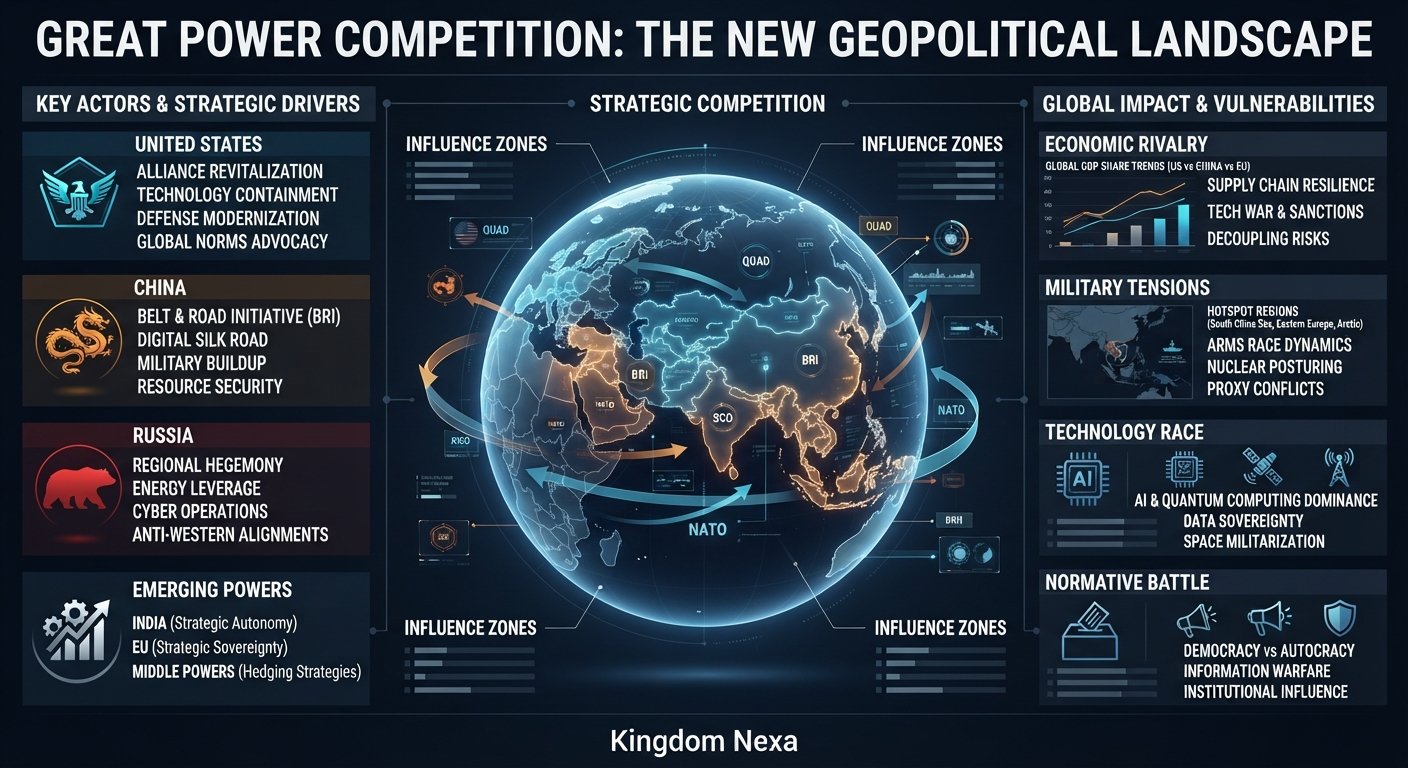
The United States, China, and Russia occupy the central position in much contemporary analysis, but the wider system is considerably more complicated.
United States
The United States retains exceptional advantages in military reach, financial power, technological innovation, alliances, global diplomatic networks, and power-projection capabilities.
Its competitive advantage is also institutional. The United States operates through extensive alliance and partnership networks rather than relying solely on national capabilities.
The 2026 U.S. National Defense Strategy places particular emphasis on preventing China from achieving regional military dominance in the Indo-Pacific while increasing burden-sharing among U.S. allies and partners. (U.S. Department of War)
China
China is the most consequential long-term competitor to the United States because it combines a huge economy, industrial capacity, technological capabilities, population, military modernization, diplomatic influence, and a growing ability to project power beyond its immediate borders.
Beijing’s strategic importance extends beyond the military sphere. China’s role in manufacturing, supply chains, infrastructure finance, critical minerals, telecommunications, electric vehicles, batteries, and other strategic industries gives it substantial economic leverage.
The United States increasingly treats economic security and technological security as national-security issues, while China’s military modernization is particularly important in the Western Pacific. (U.S. Department of War)
Russia
Russia presents a different model of great-power influence.
Its economy is substantially smaller than those of the United States and China, but it retains major strategic advantages, including nuclear weapons, energy resources, military-industrial capabilities, geographic depth, and a permanent seat on the UN Security Council.
Russia’s war against Ukraine has reinforced the importance of conventional military power in European security. NATO’s 2022 Strategic Concept identified Russia as the Alliance’s most significant and direct security threat. (NATO)
Russia should therefore not be assessed simply by GDP. Great-power status can derive from a combination of capabilities rather than economic size alone.
Other Major and Regional Powers
India, Japan, the European Union, France, the United Kingdom, Germany, Australia, South Korea, Türkiye, Saudi Arabia, Brazil, Indonesia, and others can influence how competition develops.
Their importance is often underestimated because they do not fit neatly into a two-bloc framework.
India, for example, maintains relationships with the United States, Russia, Europe, and countries of the Global South while pursuing its own strategic autonomy. The EU possesses enormous economic and regulatory power, while Japan and Australia play major roles in Indo-Pacific security.
This creates a system in which great powers compete, but other states retain agency.


Image/Infographic: A world map showing major centers of U.S., Chinese, Russian, European, and Indo-Pacific influence, with separate layers for military alliances, major trade routes, strategic chokepoints, and contested regions.
Placement: Immediately after this H2 section, “The Major Actors in Great Power Competition.”
Purpose: Demonstrate that contemporary competition is global but does not divide the world into two perfectly aligned blocs.
Where Is Great Power Competition Taking Place?
Great-power rivalry is global, but its intensity differs by region.
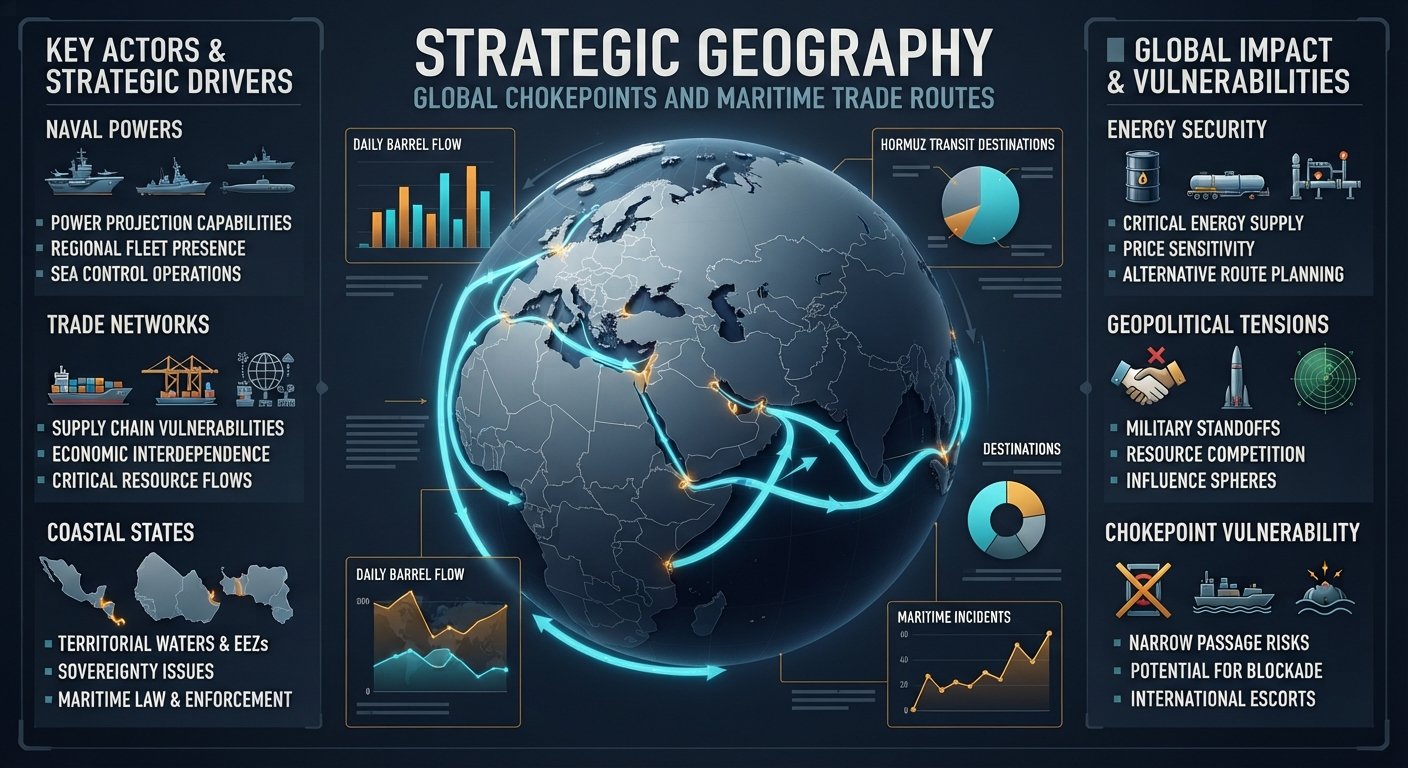
Indo-Pacific
The Indo-Pacific is arguably the most important long-term theater of strategic competition.
China’s rise intersects with U.S. alliances involving Japan, South Korea, Australia and the Philippines, as well as strategic partnerships with India and other regional states.
Taiwan is particularly sensitive because of its strategic location, the competing positions of Beijing and Washington, and the consequences that a conflict could have for regional security and global technology supply chains.
The South China Sea is another important arena involving maritime claims, freedom of navigation, military modernization, and competition over regional influence.
Europe
Europe remains central because of Russia’s war against Ukraine and the resulting transformation of European security.
NATO has strengthened deterrence and defense, while European states have increased military expenditure. NATO’s strategic planning now explicitly incorporates a security environment characterized by strategic competition and persistent instability. (NATO)
The European theater also illustrates how regional and global competition overlap. European countries must address Russia while simultaneously managing economic relations with China and maintaining their transatlantic relationship with the United States.
Middle East
The Middle East is another arena where major powers compete for diplomatic influence, energy relationships, arms partnerships, infrastructure projects, and strategic access.
The United States remains a major security actor, while China has expanded its economic and diplomatic presence. Russia has also sought influence through military, diplomatic, energy, and security relationships.
However, Middle Eastern states are not merely passive objects of competition. Saudi Arabia, Türkiye, Iran, the United Arab Emirates, Israel, Qatar, Egypt and others pursue their own interests and frequently maintain relationships with multiple major powers.
Africa
Africa has become increasingly important because of its natural resources, population growth, infrastructure requirements, strategic ports, energy potential, and diplomatic significance.
Competition involves investment, infrastructure, mining, military cooperation, arms sales, development finance, and diplomatic partnerships.
African governments generally seek to maximize their options rather than automatically align with one major power.
Latin America
Latin America remains strategically important because of its proximity to the United States, natural resources, agricultural production, energy assets, and growing economic relationships with China.
The region illustrates an important feature of contemporary Great Power Competition: economic relationships can change faster than military alliances.
How Do Great Powers Compete?
Great Power Competition is multidimensional.
Military Power and Deterrence
Military capability remains fundamental.
The world’s major powers are investing heavily in nuclear forces, missiles, aircraft, naval forces, drones, satellites, cyber capabilities, artificial intelligence, and long-range precision weapons.
SIPRI estimates that global military expenditure reached $2.887 trillion in 2025, up 2.9% in real terms from 2024. The United States, China, and Russia together accounted for approximately 51% of global military spending. (SIPRI)
The figures demonstrate the scale of contemporary strategic competition, although military expenditure alone does not measure military effectiveness.
Deterrence is also changing. States increasingly seek the ability to prevent adversaries from achieving objectives rather than simply maintaining larger conventional forces.
Economic Power
Economic power is one of the most important instruments of modern geopolitics.
States compete through:
- Tariffs
- Sanctions
- Export controls
- Investment restrictions
- Development finance
- Infrastructure projects
- Currency systems
- Energy markets
- Industrial policy
- Supply-chain diversification
The objective is increasingly to prevent strategic dependencies from becoming vulnerabilities.
This has produced the concept of geoeconomics: using economic tools to pursue geopolitical objectives.
The global economy has not, however, split completely into separate blocs. WTO data show that world trade in goods and commercial services increased by 8% in 2025 to about $34.89 trillion. (World Trade Organization)
The implication is important: geopolitical rivalry and globalization are currently coexisting.
Technology and Semiconductors
Technology may become the defining arena of twenty-first-century competition.
Artificial intelligence, advanced semiconductors, quantum technologies, telecommunications, robotics, cybersecurity, biotechnology, autonomous systems, and space systems have both civilian and military applications.
Semiconductors are particularly important because advanced computing affects military systems, AI, data centers, telecommunications, and industrial competitiveness.
The U.S. Commerce Department tightened controls on advanced computing semiconductors and related technologies in January 2025, explicitly linking the restrictions to national-security concerns involving China.
This illustrates a broader trend: technological leadership is increasingly treated as strategic power.
Alliances and Partnerships
Great powers rarely compete alone.
The United States benefits from a large network of formal allies and strategic partners. NATO’s strategic adaptation since 2014 demonstrates how alliance structures can respond to changing threats. (NATO)
China uses diplomatic, economic, institutional, and security partnerships to expand its international influence.
Russia relies on a mixture of bilateral security relationships, diplomatic ties, arms exports, energy connections, and strategic partnerships.
At the same time, countries such as India, Saudi Arabia, Brazil, Indonesia and Türkiye often pursue flexible strategies designed to avoid excessive dependence on any single major power.
The Economic Cost of Geoeconomic Fragmentation
Great Power Competition creates a difficult contradiction.
States want resilient supply chains, strategic autonomy and national security. But aggressive fragmentation can reduce efficiency and raise costs.
The World Bank has warned that geoeconomic fragmentation can restrict trade, technology diffusion, capital accumulation and access to lower-cost inputs. It can also complicate the global energy transition. (World Bank)
This creates a policy dilemma:
How much economic efficiency should governments sacrifice for greater strategic resilience?
The answer differs by sector.
Reducing dependence on a single supplier of critical military components may be relatively easy to justify. Completely separating two major economies, however, can be enormously costly.
The emerging model is therefore often closer to de-risking, diversification and selective decoupling than total economic separation.
The Role of BRICS and the Global South
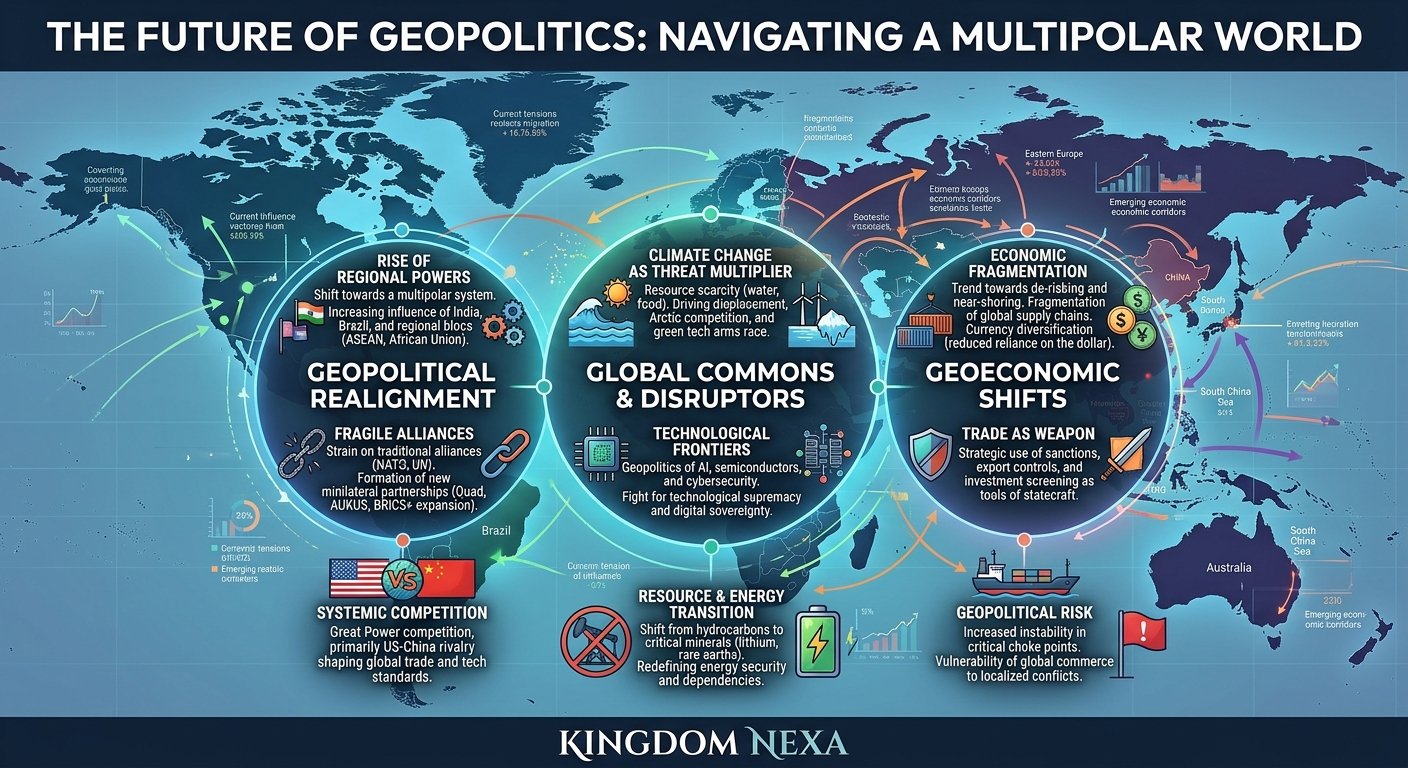
One of the most important developments is the growing importance of states that do not want the international system defined exclusively by U.S.-China rivalry.
BRICS expanded to 11 full members, including Brazil, Russia, India, China, South Africa, Egypt, Ethiopia, Indonesia, Iran, Saudi Arabia and the United Arab Emirates. (Brics)
The group presents itself as a coordination platform for the Global South and advocates reforms to international governance institutions.
However, BRICS should not automatically be treated as an equivalent of NATO or a unified anti-Western alliance. Its members have different political systems, economic interests, security relationships and foreign-policy priorities.
That diversity is itself significant.
It demonstrates that the emerging international system may be multipolar without being organized into rigid military blocs.
International Law and Great Power Competition
Great powers operate within an international legal framework, even when they dispute its interpretation or violate its rules.
The UN Charter establishes sovereign equality, peaceful dispute settlement and a general prohibition on the threat or use of force against the territorial integrity or political independence of states. (United Nations Office of Legal Affairs)
International law therefore matters in several ways:
- Rules governing the use of force
- State sovereignty
- Maritime law
- Treaties and arms control
- International humanitarian law
- Sanctions and countermeasures
- Diplomatic immunity
- International economic rules
- Cyber and emerging-technology governance
A central geopolitical problem is the gap between formal legal rules and the distribution of power needed to enforce them.
Great powers possess disproportionate influence over international institutions, but they are also constrained by alliances, economic interdependence, domestic politics, reputational costs and the possibility of reciprocal action.
Why Great Power Competition Does Not Mean a New Cold War
The Cold War comparison is useful, but only to a point.
Today’s environment differs in several fundamental ways.
First, the global economy is considerably more interconnected. China and the United States remain deeply connected through trade, investment and global production networks despite strategic rivalry.
Second, there are more influential actors. India, the EU, Japan, Türkiye, Saudi Arabia, Brazil, Indonesia and others have greater strategic relevance than a simple two-superpower model suggests.
Third, competition extends into commercial technology and private industry on an unprecedented scale.
Fourth, international institutions remain important.
Finally, the most important conflicts today do not necessarily divide the world into two opposing blocs.
The better description may therefore be competitive interdependence: states compete intensely while continuing to cooperate where their interests overlap.
What Are the Main Risks?
The greatest danger is not competition itself.
Competition becomes dangerous when leaders believe that confrontation is unavoidable or when defensive actions are interpreted as offensive preparations.
Several risks deserve particular attention.
Military Escalation
A confrontation in Taiwan, Eastern Europe, the South China Sea or another strategic theater could involve nuclear-armed states directly or indirectly.
Arms-Race Dynamics
Military modernization can produce security dilemmas. One state’s attempt to improve deterrence can appear threatening to another.
Economic Fragmentation
Excessive trade and investment restrictions could weaken growth and raise costs worldwide.
Technology Rivalry
AI, cyber capabilities and autonomous weapons could create new escalation pathways that traditional arms-control frameworks do not adequately cover.
Miscalculation
Perhaps the greatest danger is misunderstanding.
A military exercise, cyber operation, sanctions package or technological restriction intended as coercive signaling could be interpreted as preparation for a much larger confrontation.
What Does Great Power Competition Mean for Smaller and Middle Powers?
Smaller states are not simply spectators.
In fact, competition among major powers can increase their diplomatic bargaining power.
Countries can seek:
- Multiple investment sources
- Diversified export markets
- Security partnerships
- Infrastructure financing
- Technology partnerships
- Energy suppliers
- Defense relationships
The objective is often to avoid excessive dependence on any single power.
For developing economies, however, this balancing strategy has risks. Governments may face pressure to adopt positions on sanctions, security disputes, technology standards, voting behavior or infrastructure projects.
The World Bank notes that South Asian economies face both vulnerabilities and opportunities from shifting global supply chains and recommends diversification of trading partners and creditors. (Open Knowledge Repository)
The result could be a more fragmented but also more flexible international system.
What Happens Next?
The future of Great Power Competition is uncertain, but several broad scenarios are plausible.
Scenario 1: Managed Competition
The United States and China remain strategic competitors while establishing mechanisms to prevent military escalation.
Economic restrictions continue in sensitive sectors, but wider trade remains substantial.
This would produce rivalry without systemic rupture.
Scenario 2: Competitive Multipolarity
China, the United States, Russia, India, the EU, Japan and other powers maintain overlapping partnerships.
Countries increasingly avoid permanent alignment and instead form issue-specific coalitions.
This could create a complicated but relatively flexible international system.
Scenario 3: Intensifying Bloc Formation
Security crises could push states toward increasingly rigid alliances.
Technology ecosystems, financial systems, supply chains and military relationships could become more divided.
This would increase resilience in some strategic sectors but raise economic costs.
Scenario 4: Major-Power Crisis
A severe confrontation involving Taiwan, NATO territory, nuclear signaling or another major flashpoint could trigger rapid escalation.
This is the highest-risk scenario and precisely why deterrence, diplomacy, crisis communication and arms-control mechanisms remain important.
These are scenarios, not predictions. The trajectory will depend on domestic politics, economic performance, technological developments, military balances, leadership decisions and unexpected crises.
Frequently Asked Questions About Great Power Competition
What is Great Power Competition?
Great Power Competition is the sustained strategic rivalry among major states seeking influence, security, technological leadership, economic leverage and greater ability to shape the international system.
Which countries are involved in Great Power Competition?
The United States, China and Russia are central actors in contemporary great-power competition. However, India, the European powers, Japan and several regional powers significantly influence the wider strategic environment.
Is Great Power Competition the same as the Cold War?
No. The Cold War provides useful historical comparisons, but today’s system is more economically interconnected, technologically complex and multipolar.
Why is China central to Great Power Competition?
China combines a large economy, industrial capacity, technological capabilities, military modernization, global trade relationships and expanding diplomatic influence, making it the most significant long-term strategic competitor to the United States in many U.S. policy assessments. (U.S. Department of War)
What role does Russia play?
Russia remains a major military and nuclear power with significant influence in European security and other regions. Its economic weight is smaller than that of the United States or China, but its military and strategic capabilities give it disproportionate geopolitical influence.
Is Great Power Competition only about military power?
No. It includes economics, trade, technology, diplomacy, energy, finance, supply chains, cyber operations, space, alliances and international institutions.
How does Great Power Competition affect the global economy?
It can encourage investment diversification and supply-chain resilience but may also increase trade barriers, production costs and economic fragmentation. (World Bank)
Why are semiconductors important in Great Power Competition?
Advanced semiconductors support AI, telecommunications, data centers, advanced weapons and other strategic technologies. Control over their design, manufacturing and supply chains therefore has major economic and security implications.
Will Great Power Competition lead to another world war?
It is impossible to predict. Competition does increase the risk of confrontation, but nuclear deterrence, economic interdependence, diplomacy, alliances and the costs of major war can also constrain escalation.
Conclusion
Great Power Competition is one of the defining characteristics of the contemporary international system. It reflects a deeper struggle over military security, economic influence, technological leadership, diplomatic power and the future rules of international affairs.
The United States remains exceptionally powerful, China has emerged as the most consequential long-term challenger to U.S. primacy, and Russia retains major military and nuclear capabilities despite its smaller economic base. At the same time, India, the European Union, Japan, Gulf states, Brazil, Indonesia and other regional actors are increasingly important in determining how global power is distributed.
The central lesson is that today’s world cannot be understood through military power alone. Technology, trade, finance, supply chains, alliances, international law and diplomatic coalitions are now interconnected elements of national power.
Great Power Competition therefore does not necessarily mean inevitable war or a return to a rigid bipolar Cold War. Its most likely character is prolonged strategic rivalry combined with selective cooperation and intense competition for influence.
The decisive question for the coming decade will be whether major powers can manage this rivalry without allowing competition to become uncontrollable confrontation.