Introduction
Throughout history, the rise and decline of great powers have been closely connected to their ability to control, access, and protect resources essential to national survival and economic development. From ancient trade routes and colonial-era commodities to modern energy supplies, critical minerals, advanced technologies, and freshwater systems, strategic resources have consistently influenced the balance of international power.
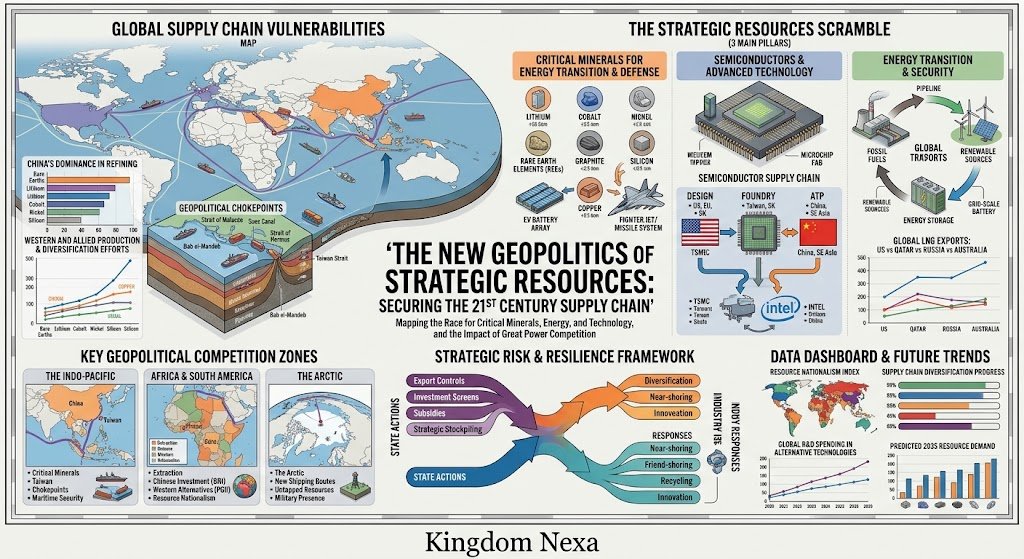
Today, their importance is becoming even more pronounced. The global transition toward renewable energy, intensifying competition between major powers, technological transformation, growing security concerns, and disruptions to international supply chains are reshaping how governments understand resource security. Oil and natural gas remain central to global energy politics, while lithium, cobalt, copper, rare earth elements, semiconductors, food supplies, and water resources are increasingly connected to national security and geopolitical influence.
Strategic resources are no longer simply economic assets; they are instruments of political leverage, technological leadership, diplomatic influence, and national resilience.
Understanding their geopolitical significance requires examining not only where resources are located, but also who controls their extraction, processing, transportation, financing, and technological applications.
This article explores the meaning of strategic resources, their historical evolution, the interests of major global actors, regional dynamics, economic and security implications, international law, and possible future scenarios. It also explains why resource competition will remain a defining feature of international relations in the coming decades.
What Are Strategic Resources?
Strategic resources are materials, assets, capabilities, or systems that are essential to a country’s national security, economic stability, technological development, or international influence.
Unlike ordinary commodities, strategic resources possess a particular importance because their disruption, scarcity, concentration, or restricted accessibility can create significant national or international consequences.
Their strategic value depends on several factors:
- Essentiality: Their importance to critical economic, military, or technological functions.
- Availability: Whether reliable supplies can be secured domestically or internationally.
- Concentration: Whether production or processing is controlled by a limited number of countries.
- Substitutability: Whether alternatives exist without significant economic or technological costs.
- Geopolitical exposure: Whether access can be disrupted through conflict, sanctions, export restrictions, or political instability.
- Strategic timing: Whether shortages would have immediate or long-term consequences.
A resource does not need to be physically scarce to become strategically important. A widely available material can become a strategic vulnerability if its processing capacity is concentrated in a single country or its transportation depends on a vulnerable maritime route.
Major Categories of Strategic Resources
| Category | Examples | Strategic importance |
|---|---|---|
| Energy resources | Oil, natural gas, uranium, coal | Energy security, military mobility, industrial production |
| Critical minerals | Lithium, cobalt, copper, graphite, rare earths | Batteries, electronics, defence, renewable energy |
| Food and agricultural resources | Wheat, rice, fertilizers, arable land | Food security, political stability, trade influence |
| Water resources | Rivers, aquifers, freshwater reserves | Agriculture, human survival, industrial development |
| Technological resources | Semiconductors, AI computing, advanced manufacturing | Innovation, military capabilities, economic competitiveness |
| Strategic infrastructure | Ports, pipelines, cables, electricity grids | Connectivity, logistics, trade, security |
| Human and intellectual resources | Skilled labour, scientific knowledge, industrial expertise | Productivity, innovation, national capabilities |
These categories increasingly overlap. For example, copper is simultaneously an industrial commodity, an energy-transition material, and a component of military and communications infrastructure.
Historical Evolution of Strategic Resource Competition
The relationship between resources and geopolitical power predates the modern state system. However, technological development and changing economic structures have continuously transformed which resources matter most.
Ancient and Medieval Resource Competition
Ancient empires sought control over fertile agricultural regions, freshwater sources, metal deposits, and trade routes. The Roman Empire relied on grain supplies from Egypt and North Africa, while control over Mediterranean trade supported its economic and military strength.
During the medieval period, spices, salt, precious metals, and maritime commerce became important sources of wealth and political influence. States and commercial networks competed to secure access to valuable commodities and transportation corridors.
Colonialism and Industrialization
From the fifteenth century onward, European expansion increasingly connected territorial control with access to overseas resources.
Colonial economies supplied sugar, cotton, rubber, minerals, and other commodities to industrializing powers. Resource extraction became deeply connected to imperial competition, maritime dominance, and unequal economic relationships.
The Industrial Revolution further increased the strategic importance of coal, iron, and later petroleum. Industrial production, railway networks, naval power, and military capabilities depended on reliable access to these resources.
The Twentieth Century: Oil and National Security
Oil became one of the defining strategic resources of the twentieth century.
During both World Wars, petroleum supplies were essential to naval operations, aircraft, mechanized forces, and industrial production. After 1945, access to energy resources became closely connected to the foreign policies of major powers.
The 1973 oil crisis demonstrated how resource-producing states could influence the global economy through coordinated supply restrictions. Oil prices, inflation, energy security, and diplomatic relations became increasingly interconnected.
The Twenty-First Century: A Broader Resource Landscape
Contemporary strategic competition extends beyond traditional energy commodities.
The growth of digital economies, renewable energy, electric vehicles, artificial intelligence, and advanced defence technologies has increased demand for minerals and technological inputs.
At the same time, climate change, pandemics, armed conflicts, and trade restrictions have highlighted the vulnerabilities of globally interconnected supply chains.
The result is a more complex geopolitical environment in which traditional resources remain important while new strategic dependencies emerge.
Strategic Resources in the Current Geopolitical Environment
Current assessment: 4 November 2026. Resource markets, export restrictions, government policies, and geopolitical relationships can change rapidly.
Strategic resources are increasingly central to national security and economic policymaking. Governments are seeking to reduce excessive dependencies, diversify supply chains, and protect access to materials essential for future industrial development.
The International Energy Agency’s Global Critical Minerals Outlook 2026, published on 16 July 2026, identifies supply concentration, export restrictions, investment uncertainty, and processing bottlenecks as major challenges to mineral security.
The report also highlights the importance of strategic minerals beyond clean energy, including materials used in aerospace, defence, advanced manufacturing, and digital technologies.
Critical Minerals and Supply Chain Competition
Critical minerals have become a major focus of geopolitical competition because their supply chains are geographically concentrated and difficult to diversify quickly.
China maintains a particularly influential position in mineral processing and refining, while countries such as Australia, Chile, the Democratic Republic of the Congo, Indonesia, and other resource-producing states play important roles in extraction.
According to the IEA’s 2026 assessment, the average share of the leading refining country across key minerals, excluding rare earths, increased to approximately 72% in 2025.
This concentration creates strategic vulnerabilities for countries dependent on imported materials.
Energy Security and Geopolitical Leverage
Oil and natural gas continue to influence international relations through production decisions, transportation routes, pricing, sanctions, and infrastructure dependencies.
The geopolitical importance of energy is particularly visible around the Persian Gulf, the Strait of Hormuz, the Caspian region, and major pipeline networks.
Energy-importing states seek stable supplies and diversified partnerships, while producing countries use energy revenues to support economic development and international influence.
Food, Water, and Climate Security
Food and water are increasingly recognized as strategic resources because shortages can affect political stability, migration, economic development, and regional security.
Countries dependent on imported grain or fertilizer may become vulnerable to export restrictions, conflict, or transportation disruptions.
Shared rivers and groundwater systems also create diplomatic challenges, particularly in regions experiencing water scarcity and growing agricultural demand.
Major Actors in Global Strategic Resource Competition
Resource competition involves both traditional great powers and emerging economies. Their strategies reflect different combinations of domestic requirements, industrial capabilities, security priorities, and diplomatic ambitions.
United States
The United States seeks to strengthen domestic production, diversify mineral supply chains, protect technological leadership, and reduce strategic dependencies.
Its approach combines industrial policy, investment incentives, strategic partnerships, research and development, and cooperation with resource-producing countries.
Energy resources also contribute to US economic and diplomatic influence.
China
China’s resource strategy combines domestic production, overseas investment, industrial development, infrastructure financing, and extensive processing capabilities.
Its position in critical mineral refining gives it considerable influence over several global supply chains.
Beijing also seeks secure access to imported energy, agricultural commodities, and industrial raw materials to support economic development.
European Union
The European Union faces a strategic challenge because many of its industries depend on imported energy and critical materials.
Its resource policies increasingly emphasize diversification, recycling, strategic partnerships, industrial competitiveness, and reducing excessive dependencies.
The EU also seeks to reconcile resource security with environmental standards and sustainable development.
Russia
Russia possesses substantial oil, natural gas, coal, uranium, and mineral resources.
These assets have historically supported its economic position and international influence. However, sanctions, changing export markets, infrastructure constraints, and geopolitical tensions have altered the strategic environment surrounding Russian resource exports.
Resource-Rich Developing Countries
Countries such as the Democratic Republic of the Congo, Chile, Indonesia, Australia, Brazil, and several African states possess important mineral or agricultural resources.
Their geopolitical importance is increasing as major powers compete to secure reliable supplies.
These countries can strengthen their bargaining position through investment partnerships, domestic processing, regional cooperation, and improved governance.
Regional Geopolitical Dynamics
<AsyncImageGroup query={[“global critical minerals mining and processing industrial facility”,”oil tanker maritime shipping strategic energy supply route”]} aspectRatio=”16:9″ layout=”bento”/>
Indo-Pacific
The Indo-Pacific is central to strategic resource competition because it combines major manufacturing economies, important maritime routes, mineral-producing states, and intense geopolitical rivalry.
China’s industrial capabilities, Australia’s mineral resources, Indonesia’s nickel production, and the region’s maritime infrastructure create significant strategic interdependencies.
The South China Sea and surrounding sea lanes are particularly important for international trade and energy transportation.
Middle East
The Middle East remains central to global energy security.
Oil and natural gas exports, maritime chokepoints, regional rivalries, and infrastructure security influence international diplomacy and military planning.
The region’s importance is also expanding through investment in renewable energy, hydrogen, mineral processing, and industrial diversification.
Africa
Africa possesses substantial reserves of cobalt, copper, lithium, manganese, platinum-group metals, and other strategically important resources.
The continent is increasingly important to global mineral supply chains, but resource wealth does not automatically produce broad economic development.
Infrastructure gaps, governance challenges, environmental concerns, financing constraints, and unequal value distribution can limit the benefits of extraction.
Latin America
Latin America is important for copper, lithium, agricultural commodities, and renewable energy potential.
Chile and Peru are major copper producers, while Argentina, Chile, and Bolivia are associated with significant lithium resources.
The region’s strategic choices involve balancing foreign investment, environmental protection, domestic industrial development, and economic sovereignty.
Arctic Region
The Arctic is becoming increasingly relevant because of its mineral resources, changing accessibility, maritime routes, and security implications.
However, resource development faces substantial environmental, technological, economic, and legal constraints.
Competition in the Arctic also involves territorial claims, scientific cooperation, indigenous communities, and military security.
Economic and Technological Implications
Strategic resources influence the global economy through trade, investment, industrial production, technological development, and financial markets.
Supply Chains and Economic Interdependence
Modern manufacturing depends on complex international supply chains.
A disruption in one critical component can affect multiple industries across different countries. For example, semiconductor shortages can influence automotive production, telecommunications, defence systems, and consumer electronics.
Resource security therefore requires more than securing raw materials. It also involves transportation, refining, manufacturing, logistics, and access to specialized technologies.
Artificial Intelligence and Advanced Technologies
Artificial intelligence is increasing demand for advanced computing infrastructure, electricity, semiconductor manufacturing, data centres, and specialized materials.
The strategic significance of AI extends beyond software. It depends on physical infrastructure, including advanced chips, power systems, cooling technologies, and secure supply chains.
Countries that combine technological innovation with reliable resource access may gain significant economic and geopolitical advantages.
Renewable Energy and the Energy Transition
The transition toward low-carbon energy systems is reshaping global resource demand.
Solar panels, wind turbines, batteries, electric vehicles, and electricity grids require substantial quantities of minerals and industrial materials.
The transition may reduce dependence on fossil fuels over time, but it can create new dependencies on mineral extraction, processing, manufacturing technologies, and specialized infrastructure.
This means energy security and mineral security are increasingly interconnected.
Military and National Security Dimensions
Strategic resources directly influence military readiness and defence-industrial capabilities.
Modern armed forces depend on reliable supplies of energy, metals, electronic components, specialized materials, and advanced manufacturing technologies.
Defence Production and Resource Access
Military aircraft, naval vessels, missiles, radar systems, satellites, and communications equipment require complex industrial supply chains.
Disruptions affecting specialized materials or components can delay production, increase costs, and reduce operational readiness.
Strategic Chokepoints
Maritime chokepoints are important because they connect resource-producing regions with global markets.
The Strait of Hormuz, Strait of Malacca, Suez Canal, and Bab el-Mandeb are examples of routes whose disruption could affect international energy and commodity flows.
Their strategic importance reflects geography, trade concentration, and the limited availability of immediate alternatives.
Strategic Stockpiles
Governments may maintain reserves of oil, minerals, food, or other essential materials to manage emergencies.
Stockpiles can provide temporary protection against disruptions, but they cannot permanently replace diversified production, functioning markets, and resilient infrastructure.
Diplomacy, International Organizations, and International Law
Strategic resource competition is not exclusively a zero-sum struggle. Diplomacy and international institutions can help manage dependencies, reduce tensions, and establish more predictable economic relationships.
Resource Diplomacy and Strategic Partnerships
Governments increasingly use bilateral agreements, investment partnerships, trade arrangements, and technology cooperation to secure access to essential resources.
Resource-producing countries may negotiate for infrastructure development, technology transfer, employment, local processing, and improved revenue-sharing arrangements.
These partnerships can create mutual benefits when they are transparent and economically sustainable.
Role of International Organizations
Several institutions contribute to resource governance and international cooperation:
- International Energy Agency (IEA): Energy security, critical minerals analysis, and emergency preparedness.
- United Nations: International cooperation, sustainable development, and relevant legal frameworks.
- World Trade Organization (WTO): Trade rules and mechanisms for addressing trade disputes.
- World Bank: Infrastructure investment, development financing, and resource governance.
- International Monetary Fund (IMF): Macroeconomic stability and support for countries facing external economic pressures.
- Regional organizations: Cooperation over shared resources, infrastructure, trade, and security.
International Law and Resource Sovereignty
States generally exercise permanent sovereignty over their natural resources within their territory, subject to applicable international obligations.
However, shared rivers, transboundary aquifers, maritime resources, and seabed activities create legal complexities.
International law also addresses environmental protection, maritime navigation, trade restrictions, and the peaceful settlement of disputes.
Resource competition can become particularly contentious when states disagree over territorial boundaries, access rights, or the interpretation of international agreements.
Domestic Politics and the Resource Security Agenda
Strategic resource policies are shaped not only by international competition but also by domestic political pressures.
Governments must balance national security, economic growth, environmental protection, employment, and public expectations.
Resource Nationalism
Resource nationalism occurs when governments seek greater national control over natural resources or a larger share of the economic benefits generated by their extraction.
Policies may include:
- Increasing royalties and taxation.
- Restricting foreign ownership.
- Requiring domestic processing.
- Introducing export restrictions.
- Renegotiating investment agreements.
- Establishing state-owned enterprises.
Such policies can strengthen national economic sovereignty, but poorly designed measures may discourage investment, reduce production, or create diplomatic tensions.
Public Opinion and Environmental Concerns
Mining, energy extraction, and infrastructure development can generate domestic opposition when communities experience displacement, environmental damage, or unequal distribution of benefits.
Governments must increasingly demonstrate that resource policies serve broader national interests rather than benefiting only political elites or foreign investors.
Risks and Challenges in Strategic Resource Competition
The growing importance of strategic resources creates several interconnected risks.
Supply Chain Concentration
Dependence on a limited number of suppliers can expose countries to export restrictions, conflict, natural disasters, political instability, or industrial disruptions.
Diversification is difficult because establishing new mines and processing facilities requires significant capital, specialized expertise, infrastructure, and time.
Economic Coercion and Trade Restrictions
States may use export controls, sanctions, tariffs, or licensing requirements to influence other countries.
Such measures can create uncertainty for businesses, increase production costs, and accelerate economic fragmentation.
However, export restrictions are not automatically evidence of geopolitical coercion. Governments may also introduce them for environmental, industrial, or domestic regulatory reasons.
Environmental and Social Risks
Resource extraction can contribute to water scarcity, pollution, biodiversity loss, land degradation, and community displacement.
These risks are particularly important where environmental regulation, monitoring, and institutional capacity are weak.
Resource Conflicts and Political Instability
Competition over valuable resources can intensify existing conflicts, particularly where governance is weak or revenues are distributed unequally.
Nevertheless, resource abundance alone does not cause conflict. Political institutions, historical grievances, economic inequality, external intervention, and conflict management mechanisms also matter.
The Resource Curse
The resource curse describes situations in which countries with substantial natural-resource wealth experience weaker economic diversification, institutional problems, or slower development than expected.
Possible contributing factors include excessive dependence on commodity exports, corruption, revenue volatility, and insufficient investment in human capital.
Strong institutions, transparent revenue management, economic diversification, and public accountability can reduce these risks.
Future Scenarios: How Strategic Resources May Shape Global Power
The future of resource competition is uncertain. However, several plausible scenarios can help policymakers and analysts understand the possible direction of international affairs.
Scenario 1: Intensified Strategic Competition
Major powers increasingly prioritize domestic production, national stockpiles, export controls, and exclusive resource partnerships.
This could strengthen national resilience in some sectors while increasing trade fragmentation and geopolitical mistrust.
Scenario 2: Diversified and Resilient Supply Chains
Governments and businesses invest in alternative suppliers, recycling, technological innovation, and geographically diversified processing facilities.
This scenario could reduce strategic vulnerabilities while preserving international economic interdependence.
Scenario 3: Resource Diplomacy and Cooperative Governance
Countries develop more effective partnerships involving technology transfer, infrastructure investment, environmental safeguards, and equitable economic benefits.
International institutions and regional organizations could help manage shared resources and reduce the likelihood of disputes.
Scenario 4: Technological Substitution and Circular Economies
Innovation reduces dependence on selected materials through alternative technologies, improved efficiency, recycling, and material substitution.
This could change the geopolitical value of certain resources, although new technological dependencies may emerge.
The most plausible future may combine elements of all four scenarios. Competition will likely remain significant, but its intensity and consequences will depend on domestic policies, technological developments, and international cooperation.
Frequently Asked Questions About Strategic Resources
1. What are strategic resources in geopolitics?
Strategic resources are materials, assets, or capabilities essential to national security, economic stability, technological development, or international influence. They include energy, critical minerals, food, water, semiconductors, and strategic infrastructure.
2. Why are strategic resources important in international relations?
They influence economic power, military capabilities, diplomatic leverage, trade relationships, and national security. Countries with reliable access to essential resources can strengthen their resilience and international influence.
3. What are examples of strategic resources?
Examples include oil, natural gas, uranium, lithium, cobalt, copper, rare earth elements, freshwater, agricultural commodities, semiconductors, and advanced computing infrastructure.
4. How do strategic resources affect national security?
They support military production, energy systems, transportation, communications, industrial capacity, and technological development. Supply disruptions can weaken defence readiness and economic stability.
5. Why are critical minerals becoming geopolitically important?
Critical minerals are essential for batteries, renewable energy, electric vehicles, electronics, aerospace, and defence technologies. Concentrated mining and refining supply chains create vulnerabilities for importing countries.
6. How does China influence global strategic resource competition?
China has significant influence through mineral processing, manufacturing capacity, domestic production, overseas investment, and international trade relationships. Its role is particularly important in several critical mineral supply chains.
7. What is resource nationalism?
Resource nationalism refers to government policies intended to increase national control over natural resources or capture a greater share of their economic benefits. Examples include higher royalties, export restrictions, domestic processing requirements, and limits on foreign ownership.
8. Can strategic resources cause international conflicts?
They can contribute to tensions or intensify existing conflicts, particularly when access is disputed or supply disruptions threaten national interests. However, resources are rarely the sole cause of conflict; political, historical, economic, and security factors also play important roles.
9. How can countries improve strategic resource security?
Countries can diversify suppliers, develop domestic capabilities, invest in recycling, maintain emergency reserves, strengthen infrastructure, improve resource governance, and establish reliable international partnerships.
10. Will strategic resources become more important in the future?
Their importance is likely to remain high as technological competition, energy transitions, climate pressures, and economic security concerns reshape international relations. The specific resources that matter most will evolve with technology and global demand.
Conclusion
Strategic resources remain fundamental to the distribution of power in international relations. Their significance extends beyond ownership of natural deposits to include processing capabilities, technological expertise, transportation infrastructure, financial resources, and the ability to maintain reliable access during crises.
The contemporary geopolitical environment demonstrates that resource security is increasingly connected to energy transitions, technological competition, military preparedness, economic resilience, and diplomatic influence. Critical minerals and advanced technologies are creating new strategic dependencies, while oil, food, water, and maritime infrastructure continue to shape traditional security concerns.
For governments, the challenge is to protect national interests without creating unnecessary economic fragmentation. For resource-producing countries, the opportunity lies in converting resource wealth into sustainable development, industrial capabilities, and stronger bargaining positions.
Ultimately, the future of strategic resources will depend on the balance between competition and cooperation. Countries that combine diversified supply chains, technological innovation, effective governance, and constructive diplomacy will be better positioned to navigate an increasingly complex international system.
Understanding strategic resources is therefore essential not only for geopolitical analysts and policymakers, but also for businesses, researchers, and citizens seeking to understand how global power is evolving.