Introduction
The international order is undergoing a profound transformation. Competition between major powers, technological breakthroughs, economic realignment, regional conflicts, and climate pressures are changing how countries protect their interests and exercise influence. These developments will shape international security, global trade, energy markets, technological innovation, and the opportunities available to developing economies.
The future of geopolitics will depend on more than military strength or economic size. Access to advanced technologies, control of critical resources, resilient supply chains, reliable alliances, and effective diplomacy will all influence the distribution of global power. Meanwhile, middle powers are seeking greater strategic independence, and international institutions face growing pressure to respond to challenges that cross national borders.
The World Economic Forum’s Global Risks Report 2026, published in January 2026, identified geoeconomic confrontation as the leading risk most likely to trigger a global crisis during the year. State-based armed conflict ranked second, highlighting the connection between economic pressure and traditional security threats. These rankings reflect surveyed expert perceptions, not certainty about future events.
World Economic Forum
+1
Understanding what comes next requires examining historical turning points, competing national interests, emerging technologies, economic dependencies, and plausible future scenarios. Rather than assuming that one country will inevitably dominate, this article explores the forces shaping the international system and the choices that could lead toward greater stability or deeper fragmentation.
What Is the Future of Geopolitics?
The future of geopolitics concerns how power, influence, competition, and cooperation among states and non-state actors are likely to evolve as international conditions change.
Traditional geopolitical analysis focused on geography, military strength, natural resources, strategic territories, and access to oceans. These factors remain important, but modern geopolitical power also depends on digital infrastructure, semiconductor production, financial networks, energy systems, and control over critical supply chains.
Three concepts are essential to understanding this transformation:
- Multipolarity: An international system in which several major powers exercise significant influence.
- Geoeconomics: The use of economic instruments, such as sanctions, tariffs, investment restrictions, and trade agreements, to achieve strategic objectives.
- Strategic autonomy: The ability of a country or regional bloc to make important decisions without excessive dependence on external powers.
These concepts help explain why economic size or military expenditure alone cannot measure a country’s influence. A technologically advanced state may remain vulnerable if it depends on imported energy or foreign semiconductor manufacturing. Another country may exercise influence through financial networks, diplomatic mediation, industrial expertise, or strategically important resources.
The central question is not simply which country will become the strongest. It is how different forms of power will interact and whether governments can manage competition without undermining international stability.
Historical Background: From the Cold War to a Contested World
The contemporary geopolitical environment reflects several major historical turning points.
The Cold War and bipolar competition
From the late 1940s until the Soviet Union dissolved in 1991, international politics was dominated by competition between the United States and the Soviet Union. Nuclear deterrence, military alliances, ideological rivalry, and proxy conflicts shaped global security.
Although direct war between the superpowers was avoided, regional conflicts and arms competition imposed substantial human and economic costs. The period also accelerated developments in computing, aerospace technology, intelligence, and missile systems.
The post-Cold War international order
After 1991, the United States enjoyed unmatched global military reach and considerable economic and institutional influence. Globalization expanded, trade networks deepened, and many countries became increasingly interconnected.
However, economic integration did not eliminate geopolitical rivalry. Conflicts, financial crises, terrorism, and disagreements over military intervention exposed the limitations of international cooperation.
The return of major-power competition
China’s economic expansion, India’s growing international role, Russia’s confrontation with the European security order, and the increasing independence of regional powers have complicated the post-Cold War system.
Russia’s full-scale invasion of Ukraine in February 2022, intensifying US–China competition, and disruptions to energy and supply chains reinforced the importance of strategic resilience.
By October 2026, the world is neither a simple reproduction of Cold War bipolarity nor a fully consolidated multipolar order. Instead, influence varies across military security, technology, finance, trade, energy, and diplomacy.
Eight Forces Shaping the Future of Geopolitics

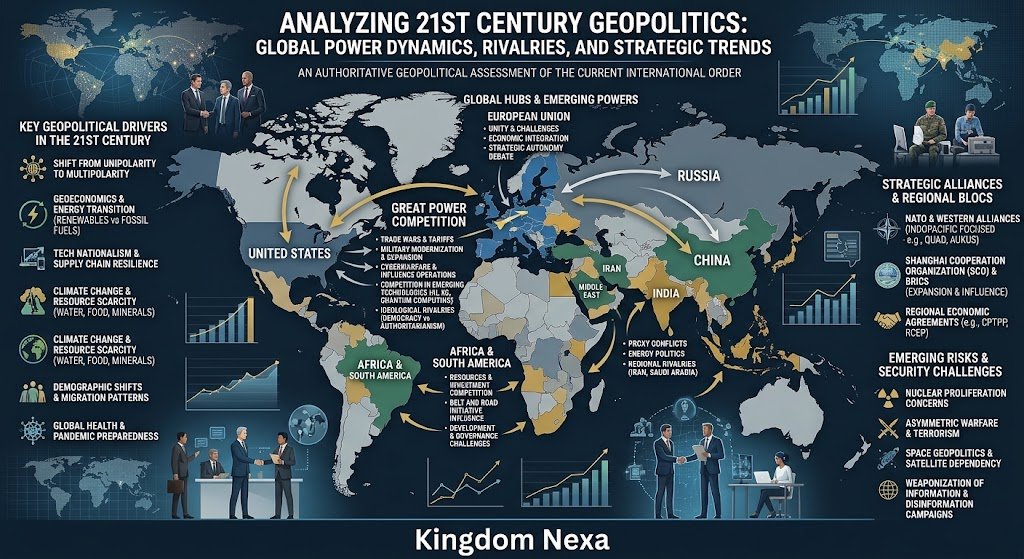
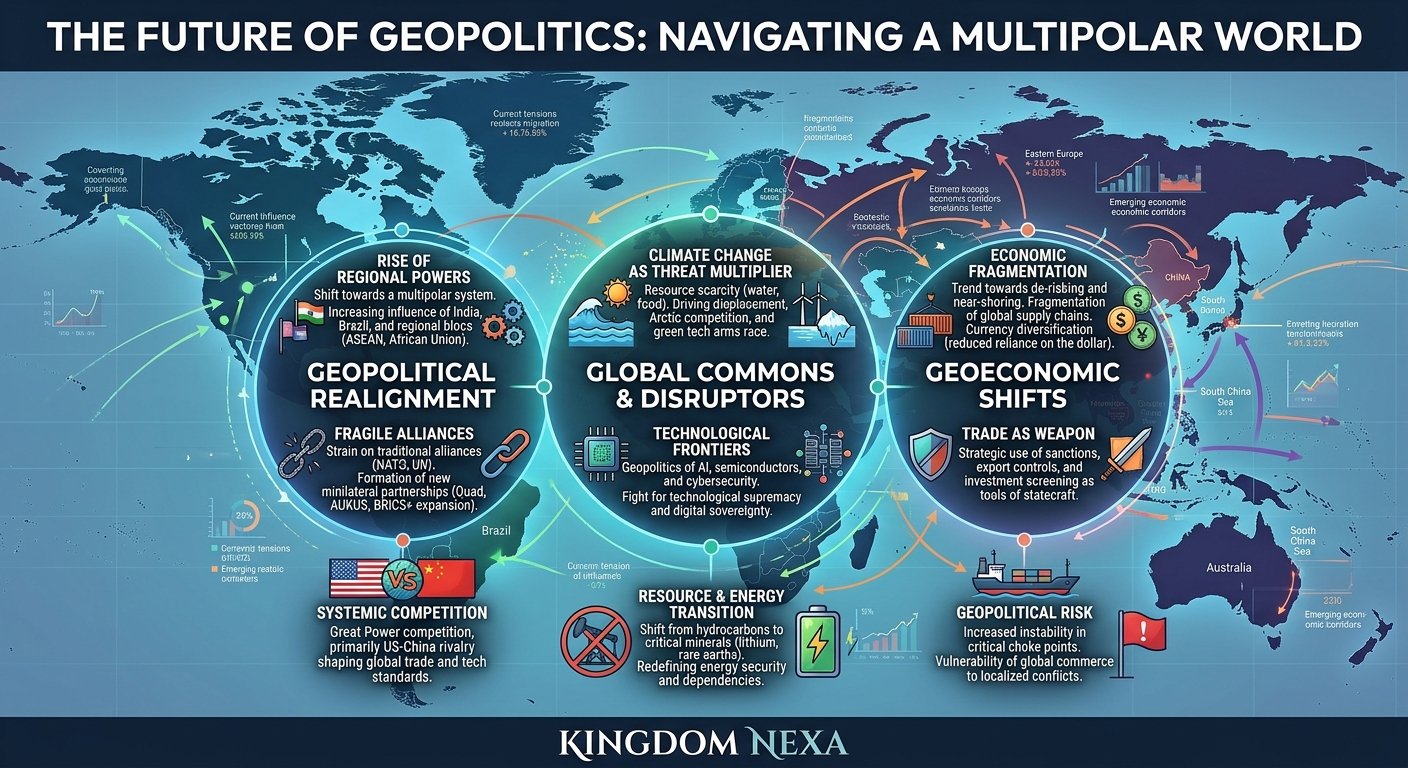
The infographic highlights the main forces influencing the distribution of global power, strategic competition, and international cooperation.
Major Trends Shaping Global Power
1. The emergence of a more multipolar world
The United States remains a leading military, financial, technological, and diplomatic power. China has become a major economic and military actor, while India, the European Union, Russia, and influential regional states shape outcomes in particular areas.
Multipolarity does not mean that all countries have equal capabilities. The United States retains extensive security partnerships and financial influence. China has substantial manufacturing capacity and a central position in many industrial supply chains. The European Union exercises considerable commercial and regulatory influence, while India’s economic development and diplomatic reach support its expanding international role.
Countries such as Brazil, Indonesia, Türkiye, Saudi Arabia, and South Africa are also seeking greater influence.
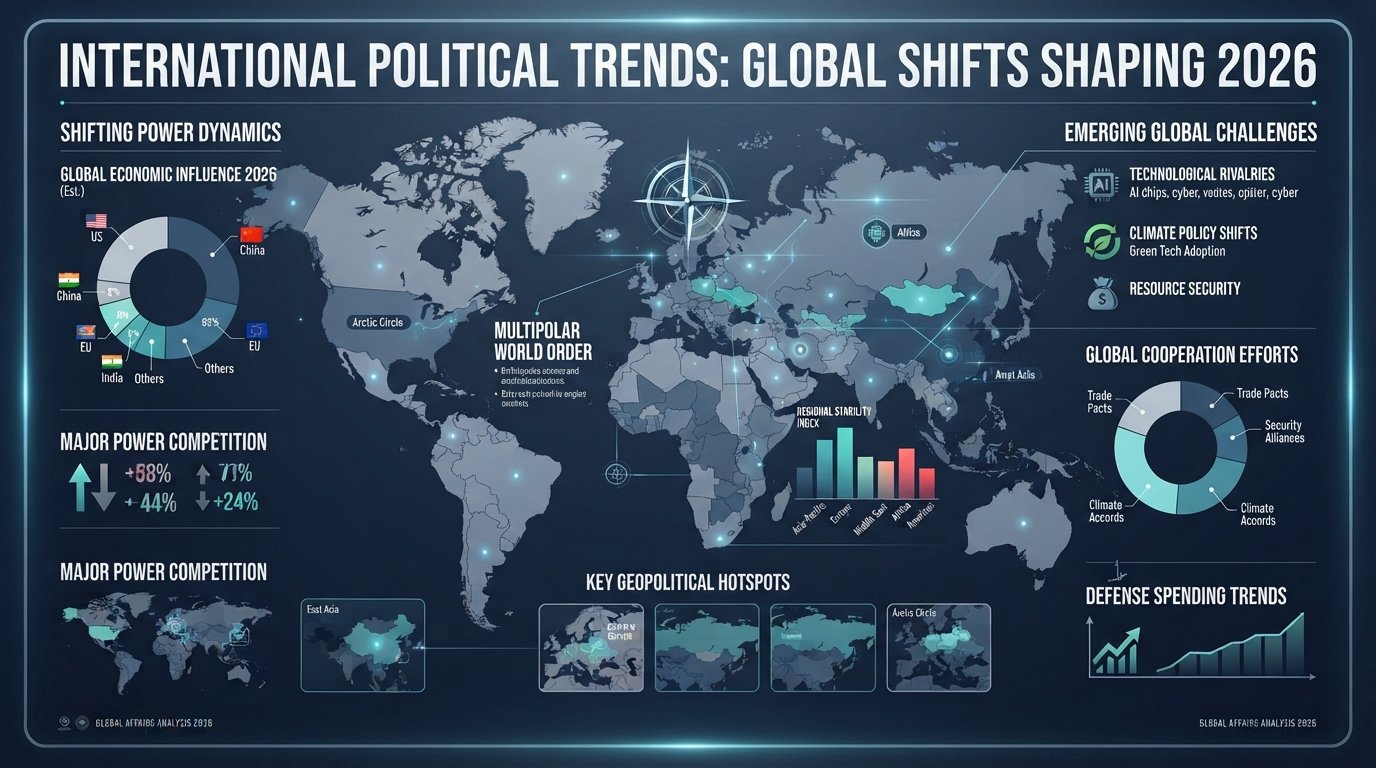
The emerging order is likely to feature overlapping partnerships and issue-specific coalitions rather than a single, uniform distribution of power. The World Economic Forum’s 2026 report found that 68% of surveyed respondents expected the global political environment to become more fragmented and multipolar over the next decade. This is an expert outlook, not a guaranteed outcome.
World Economic Forum
+1
2. Strategic competition between the United States and China
Competition between Washington and Beijing will remain one of the most consequential influences on global affairs. It spans advanced semiconductors, artificial intelligence, trade, military capabilities, maritime security, telecommunications, and international technology standards.
The United States seeks to maintain its security partnerships and technological advantages. China seeks continued economic development, stronger regional security, and greater international influence.
Taiwan and the South China Sea are particularly sensitive flashpoints. A major crisis could disrupt shipping, semiconductor supply chains, financial markets, and regional security well beyond East Asia.
However, competition does not make direct conflict inevitable. Crisis communication, credible deterrence, diplomacy, and practical agreements can help reduce the risk of miscalculation.
3. Economic fragmentation and geoeconomic pressure
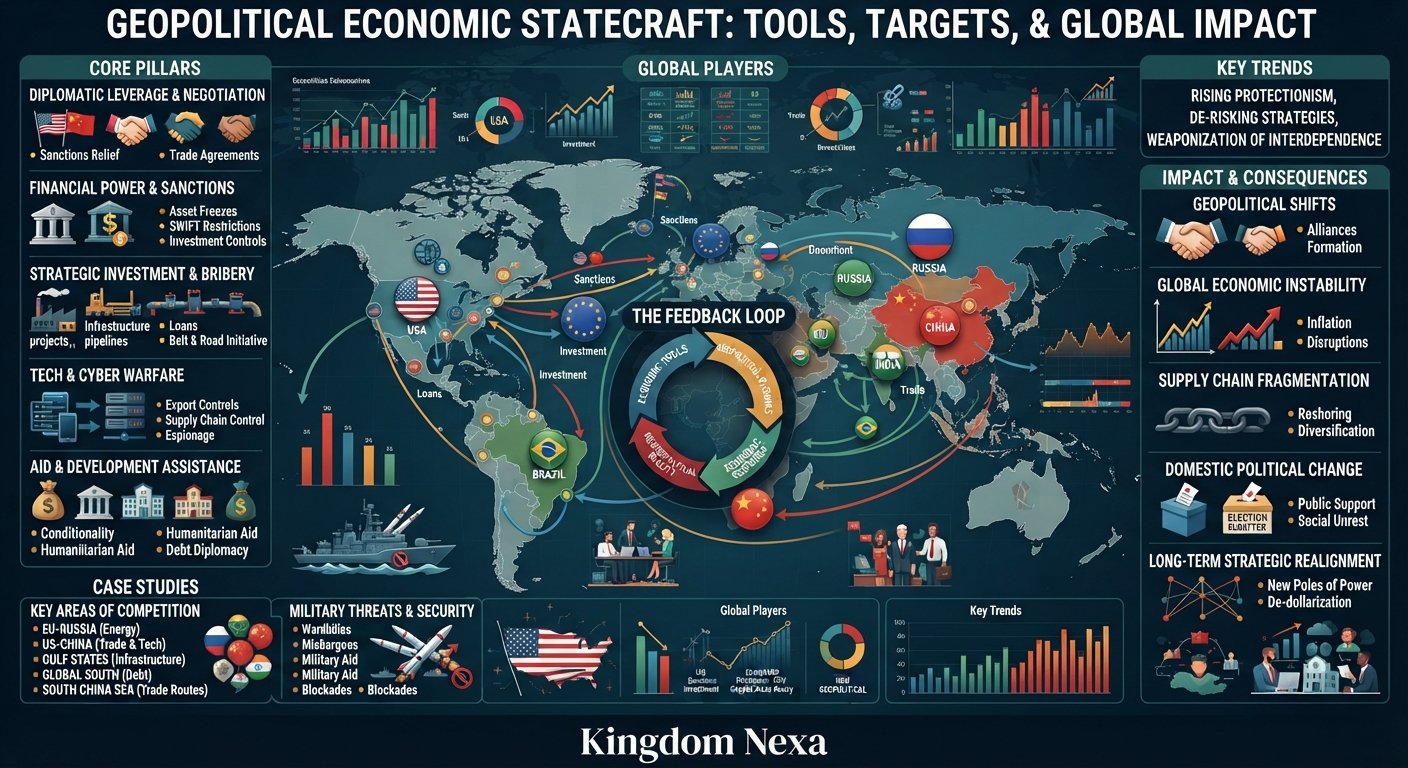
Governments increasingly treat trade and investment as national-security issues. Export controls, sanctions, tariffs, investment screening, and industrial subsidies are being used to protect strategic industries and influence other states’ decisions.
The World Economic Forum’s 2026 assessment identifies geoeconomic confrontation as the leading near-term global risk, reflecting concern about the use of economic tools for strategic advantage.
World Economic Forum
+1
Businesses are responding by diversifying suppliers, relocating some production closer to key markets, and reducing reliance on concentrated sources of essential components.
These changes can improve resilience, but they may also increase costs, reduce efficiency, and trigger retaliation. The challenge is to protect strategically important industries without unnecessarily undermining the benefits of international trade.
4. Technology as a source of geopolitical power
Artificial intelligence, advanced semiconductors, quantum computing, biotechnology, satellites, and autonomous systems are becoming central to international competition.
Technological leadership can strengthen military capabilities, improve productivity, support intelligence gathering, and shape international standards. Countries need more than research laboratories to succeed: reliable energy, skilled workers, computing infrastructure, investment, and effective regulation also matter.
Cybersecurity presents a related challenge. Attacks against power grids, financial institutions, government networks, and communications systems can cause serious disruption without conventional military operations.
AI introduces additional questions involving surveillance, misinformation, autonomous weapons, and the reliability of computer-assisted decisions. Governments that adopt new technologies without adequate safeguards may create vulnerabilities even as they gain new capabilities.
5. Energy security and critical minerals
The global energy transition is changing the strategic importance of natural resources. Lithium, copper, nickel, graphite, and rare earth elements support different parts of the electric vehicle, renewable energy, electronics, and defence industries.
Influence increasingly depends on the entire supply chain, from mining and refining to processing and manufacturing. Countries with substantial mineral reserves may gain bargaining power, but lasting economic benefits also require infrastructure, investment, technical expertise, and stable institutions.
Oil and natural gas will remain geopolitically important during the transition, although their significance will vary by region and over time. Pipelines, shipping routes, liquefied natural gas facilities, and electricity interconnections will continue to influence national security.
6. Regional powers and strategic autonomy
Many governments prefer to maintain multiple international relationships rather than depend on a single dominant partner.
India participates in the Quad while maintaining other diplomatic and economic relationships. Türkiye combines NATO membership with an independent regional agenda. Gulf states seek security partnerships while expanding economic ties with Asian markets.
Such approaches are often described as strategic autonomy or multi-alignment. They can increase diplomatic flexibility, although balancing competing interests can become difficult during a crisis.
For emerging economies, autonomy also requires stronger domestic institutions, diversified exports, sustainable public finances, and the capacity to withstand external shocks.
7. Military modernization and deterrence
Military capabilities will remain central to international politics. Drones, precision weapons, missile defence, cyber operations, electronic warfare, satellite surveillance, and AI-assisted systems are changing how states prepare for and conduct conflicts.
According to the Stockholm International Peace Research Institute (SIPRI), global military expenditure reached $2.887 trillion in 2025, an increase of 2.9% in real terms compared with 2024. It was the eleventh consecutive year of global growth.
SIPRI
+1
Higher spending reflects active conflicts, perceived threats, modernization, and changing alliance commitments. However, expenditure alone does not determine military effectiveness or strategic success.
Nuclear deterrence, arms control, conventional readiness, and crisis-management arrangements will remain important. Without effective communication and safeguards, military modernization can intensify threat perceptions and increase the risk of unintended escalation.
8. Climate change and human security
Climate change will increasingly interact with political and economic vulnerabilities. Extreme weather, droughts, floods, food insecurity, water stress, and infrastructure damage can increase pressure on governments and communities.
Environmental stress does not automatically cause conflict. Outcomes depend on governance, economic conditions, social inequalities, and the ability to manage scarce resources peacefully.
Cross-border rivers illustrate the challenge. Countries sharing water resources must negotiate allocation, irrigation, hydropower, and flood management while accounting for population growth and changing rainfall patterns.
Climate adaptation, resilient infrastructure, disaster preparedness, and regional cooperation can reduce the risk that environmental pressures develop into wider humanitarian or political crises.
Major Geopolitical Actors and Their Strategic Interests
The emerging international order is shaped by governments pursuing different priorities, sometimes cooperating in one area while competing in another.
| Actor | Principal strategic interests |
|---|---|
| United States | Alliance leadership, technological advantages, maritime security, and global influence |
| China | Economic development, regional security, technological advancement, and greater international influence |
| European Union | Economic competitiveness, continental security, and strategic autonomy |
| India | Economic growth, strategic independence, regional influence, and maritime security |
| Russia | Strategic depth, military influence, and regional leverage |
| Middle powers | Diversified partnerships, investment, regional stability, and diplomatic influence |
These priorities are broad analytical assessments rather than fixed predictions. Leadership changes, economic performance, domestic political pressures, and security crises can alter national strategies.
Why middle powers matter
Countries such as Brazil, Indonesia, Türkiye, Saudi Arabia, South Africa, and Pakistan can influence regional security, energy markets, trade routes, and diplomatic negotiations.
Their influence often derives from geographic position, access to resources, regional relationships, or the ability to connect competing partners. However, middle powers differ substantially in their capabilities and international reach.
For these countries, selective cooperation can be more effective than rigid alignment. Maintaining multiple partnerships may support economic development and diplomatic flexibility, provided governments carefully manage competing commitments.
Economic Implications of the Emerging World Order
Economic power increasingly depends on the ability to produce essential goods, finance development, attract investment, and withstand external pressure.
Trade, sanctions, and financial influence
Major markets and financial networks provide governments with important sources of leverage. Sanctions and export restrictions can impose substantial costs, but their effectiveness depends on coordination, enforcement, the target country’s economic exposure, and the availability of alternatives.
Attempts to reduce dependence on dominant financial or trading networks may encourage alternative payment arrangements and regional partnerships. These changes can expand governments’ options while making cross-border transactions more complicated.
Supply chains and industrial policy
Governments are investing in strategic industries to reduce reliance on concentrated suppliers. Such policies can strengthen resilience in semiconductors, pharmaceuticals, batteries, energy equipment, and defence production.
However, indiscriminate protectionism can raise prices and reduce competition. Countries that combine targeted industrial policies with transparent regulation, skilled workers, and diversified trade relationships may be better positioned to benefit.
Opportunities for developing economies
Supply-chain diversification, infrastructure investment, renewable energy, and demand for critical minerals could create opportunities for emerging markets.
Realizing these benefits requires reliable electricity, efficient transport, skilled labour, predictable regulation, and sustainable public finances. Without these foundations, countries risk remaining dependent on low-value commodity exports or expensive external borrowing.
Economic resilience will therefore become an increasingly important component of geopolitical influence.
International Institutions, Diplomacy, and International Law
International institutions remain important because many geopolitical challenges cannot be managed effectively by individual countries.
The United Nations provides a forum for diplomacy, peace and security discussions, humanitarian coordination, and the development of international norms. NATO remains a collective-defence alliance, while the European Union combines economic integration with regulatory and diplomatic influence.
The World Trade Organization provides a framework for international trade rules. The IMF and World Bank support financial cooperation, economic stabilization, and development financing.
On September 22, 2024, UN member states adopted the Pact for the Future, alongside the Global Digital Compact and the Declaration on Future Generations. The agreements address international peace and security, sustainable development, digital cooperation, and global governance reform. Their long-term significance will depend on implementation and sustained political support.
United Nations
+1
International law will remain central to disputes involving territorial sovereignty, maritime boundaries, the use of force, and armed conflict. The UN Charter establishes fundamental rules governing the use of force, while international humanitarian law regulates conduct during armed conflict.
The principal challenge is often enforcement rather than the absence of legal principles. Powerful states may disagree over interpretation, resist external pressure, or use institutional vetoes to block collective action.
A more stable international system will require credible diplomatic processes, consistent application of legal standards, and mechanisms for resolving disputes before they escalate.
Four Possible Scenarios for the Future of Geopolitics
No forecast can determine the exact international order of the next two decades. These scenarios illustrate plausible directions rather than predicting a single outcome.
Scenario 1: Fragmented multipolarity
Major powers build competing economic and security networks, while international institutions lose some capacity to coordinate collective action. Trade continues, but strategic industries become increasingly divided.
This could increase production costs, weaken arms-control efforts, and make international crises harder to manage. Smaller states might gain bargaining opportunities, but they could also face greater pressure to align with competing blocs.
Scenario 2: Competitive coexistence
Strategic rivalry remains intense, but governments establish practical limits on confrontation. They maintain deterrence while negotiating on trade, nuclear risks, maritime incidents, and selected global challenges.
Distrust would persist, yet communication channels and limited agreements could make competition more predictable.
Scenario 3: Renewed international cooperation
Major powers recognize that certain challenges cannot be managed independently. They strengthen international institutions and cooperate on climate adaptation, public health, nuclear safety, and technology governance.
Achieving this outcome would require sustained political commitment, adequate resources, and compromises that accommodate different national interests.
Scenario 4: Escalating instability
Regional conflicts, economic shocks, technological disruptions, and declining diplomatic trust occur together. Governments focus increasingly on immediate security, while humanitarian and economic crises spread.
This would be particularly damaging for countries dependent on imported food, energy, or external financing. It is not inevitable: diplomacy, economic resilience, and effective crisis management can reduce these risks.
In practice, the international system may combine elements of several scenarios. Cooperation could improve in one area even as rivalry intensifies elsewhere.
Frequently Asked Questions About the Future of Geopolitics
1. What is the future of geopolitics?
It is the evolving distribution of international power, influence, alliances, and competition. Major drivers include strategic rivalry, technological innovation, economic security, climate change, and shifting regional relationships.
2. Will the world become multipolar?
A more multipolar system is plausible, with several major powers and regional actors influencing international outcomes. However, their capabilities will remain unequal, and the United States and China are likely to retain particularly important roles.
3. Which countries will shape future geopolitics?
The United States, China, India, Russia, and major European powers will remain influential. Regional actors such as Türkiye, Saudi Arabia, Brazil, Indonesia, and South Africa will also shape specific international issues.
4. How will artificial intelligence affect geopolitics?
AI will influence military planning, intelligence, cybersecurity, economic productivity, surveillance, and information systems. Countries with strong computing infrastructure, skilled workforces, and research capabilities may gain strategic advantages.
5. Will US–China competition lead to war?
War is not inevitable. However, disputes involving Taiwan, maritime security, technology restrictions, and military activity create escalation risks. Deterrence, crisis communication, and diplomacy can help manage these tensions.
6. How will climate change affect global politics?
Climate change can increase food and water insecurity, damage infrastructure, influence migration, and intensify existing political vulnerabilities. Adaptation measures and regional cooperation can help reduce these risks.
7. What role will international organizations play?
The UN, NATO, EU, WTO, IMF, and World Bank will continue to provide frameworks for security, diplomacy, trade, and development. Their effectiveness will depend on institutional capacity and cooperation among member states.
8. How can developing countries benefit from geopolitical changes?
Developing countries can attract diversified investment, strengthen regional trade, develop strategic industries, and negotiate more balanced partnerships. Success depends on reliable infrastructure, sound economic management, skilled workers, and stable institutions.
9. What are the biggest risks to the future international order?
Major risks include great-power conflict, economic fragmentation, nuclear escalation, cyberattacks, climate-related instability, misinformation, and weakened international cooperation. Their effects may compound across regions and economic sectors.
Conclusion: Navigating an Uncertain International Order
The future of geopolitics will be shaped by the interaction of military capabilities, economic resilience, technological innovation, strategic geography, domestic politics, and international cooperation. The emerging international system is becoming more contested, but the precise distribution of power remains uncertain.
The United States and China will remain central to strategic competition, while India, the European Union, and other influential states will help determine regional and global outcomes. Artificial intelligence, critical minerals, energy security, cyber capabilities, and supply-chain resilience will increasingly influence national strategies.
Yet competition is not the only possible path. Climate change, nuclear risks, economic instability, and technological threats require cooperation across borders. International institutions and diplomacy will remain important, even as their ability to manage disagreements faces growing pressure.
For governments, businesses, researchers, and developing economies, the practical priority is to prepare for uncertainty rather than rely on a single prediction. Diversified partnerships, credible institutions, economic resilience, technological capability, and effective diplomacy can help countries navigate geopolitical risks.
Ultimately, the international order will depend not only on who possesses the greatest power, but also on how states exercise it, manage competition, and address shared challenges.